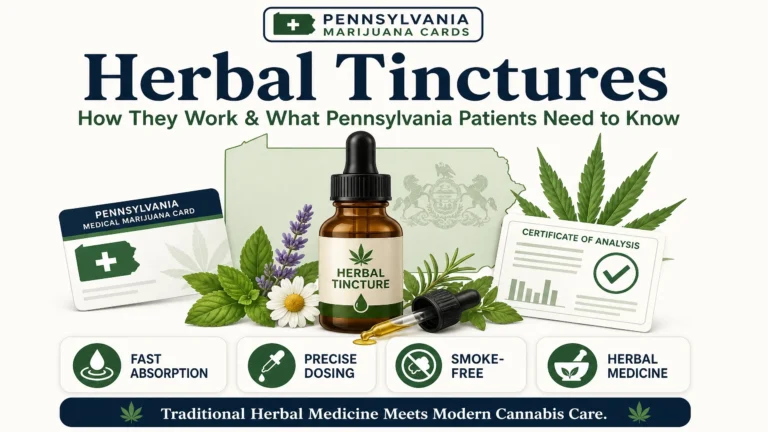

Herbal tinctures are concentrated liquid extracts made by soaking plant material in a solvent, most commonly alcohol to pull out the plant’s active compounds into a form your body absorbs quickly and predictably.
They are one of the oldest delivery formats in plant medicine, used for centuries before capsules and tablets existed.
Need a PA Medical Marijuana Card?
Get certified online in 15 minutes. 100% Money-Back Guarantee.
Get Certified Now →And in 2026, they are making a significant comeback, both in the general herbal wellness market and specifically as a preferred format for Pennsylvania medical marijuana patients looking for fast, smokeless, discreet relief.
This guide covers what herbal tinctures are, how they work, the different types, and everything Pennsylvania MMJ patients need to know about cannabis tinctures at licensed dispensaries.
Key Takeaways
- Herbal tinctures are concentrated liquid plant extracts typically made with alcohol, glycerin, or vinegar as the solvent — taken in small doses under the tongue or mixed into liquid
- Cannabis tinctures are one of the fully legal delivery formats for Pennsylvania medical marijuana patients and are available at all 186+ licensed PA dispensaries
- Sublingual absorption produces effects in 15 to 45 minutes, significantly faster than capsules or edibles (45 to 90 minutes) because active compounds bypass the digestive tract
- Alcohol-based tinctures have the highest bioavailability (40 to 50%) due to better extraction of both water-soluble and fat-soluble compounds; glycerin-based options are available for alcohol-sensitive patients
- PA dispensary cannabis tinctures are dosed in milligrams of THC and CBD, with 100mg THC counting as one Pennsylvania medical marijuana unit toward your 90-day supply
- Cannabis tinctures will show up on a drug test — the same THC-COOH metabolite is produced regardless of whether cannabis is inhaled, eaten, or taken as a tincture
What Is a Herbal Tincture?
A tincture is a concentrated liquid extract of herbs.
The herbs are soaked in a solvent, most commonly alcohol, which pulls out a wide range of plant compounds including alkaloids, glycosides, flavonoids, resins, and essential oils that would otherwise remain locked in the plant material.

Do You Qualify for a PA MMJ Card?
Connect with a licensed Pennsylvania state physician online from home.
The result is a shelf-stable, highly concentrated liquid that delivers the active properties of an herb in a form your body absorbs faster and more efficiently than a whole dried herb capsule or a cup of tea.
Herbal tinctures are making a comeback after being overshadowed by capsules in the last decade. Growing awareness about their benefits and ease of use, along with consumer “pill fatigue,” has created renewed interest.
Herbalists and large-scale supplement companies still utilize this gentle processing method to create high-quality, concentrated herbal formulas.
The word “tincture” technically refers only to alcohol-based extracts. Products made with glycerin or vinegar are more precisely called glycerites or acetums, though the term “tincture” is now commonly applied to all three in everyday use.
How Are Herbal Tinctures Made?
The basic process looks like this: fresh or dried plant material is placed in a jar. Alcohol or another solvent is poured over the plant. The mixture is sealed and left to extract for weeks.
Then the liquid is strained away from the spent plant material and bottled.

The key variables are:
Which part of the plant is used. Roots, bark, leaves, berries, flowers, and seeds all contain different concentrations of active compounds. Quality tincture makers select the specific plant part with the highest concentration of the compounds they want to extract.
Which solvent is used. Alcohol acts as an excellent solvent for a wide variety of phytochemicals, especially those that have limited solubility in water. It is also an excellent preservative, so that tinctures typically last several years.
The alcohol percentage is calibrated to each herb, higher percentages extract resins and essential oils, while lower percentages extract water-soluble polysaccharides and alkaloids better.
⚡ Fast & 100% Online PA Medical Cards
Board-Certified Doctors • 100% Money-Back Guarantee
Book Evaluation Now →How long the extraction runs. Short extractions (hours to days) capture lighter volatile compounds. Extended extractions (weeks to months) pull out a broader, richer phytochemical profile.
The herb-to-solvent ratio. A 1:5 ratio means one gram of herb per five milliliters of solvent, a standard medicinal strength. A 1:1 ratio produces a much more concentrated extract.
The Three Types of Herbal Tinctures

| Type | Solvent | Bioavailability | Best For |
|---|---|---|---|
| Alcohol-based | Ethanol (20 to 95%) | Highest — 40 to 50% sublingual | Most herbs, fastest absorption, longest shelf life |
| Glycerin-based (glycerite) | Vegetable glycerin | Moderate | Alcohol-sensitive users, children, alcohol recovery |
| Vinegar-based (acetum) | Apple cider or white vinegar | Lower | Culinary herbs, mineral-rich plants |
Alcohol-Based Tinctures
For those looking to maximize effectiveness, alcohol-based tinctures are the top choice due to their fast absorption and high potency.
Alcohol can dissolve both water-soluble and fat-soluble compounds, allowing for a higher percentage of cannabinoids or plant actives to be absorbed sublingually. Effects typically begin within 15 to 30 minutes.
The alcohol content in a finished tincture is typically low. A standard dose of 1 mL of a 60% alcohol tincture contains roughly the same alcohol as a small bite of ripe banana. For most adults, this is not a meaningful concern.
Glycerin-Based Tinctures (Glycerites)
Glycerin is slower to absorb than alcohol but faster than oil. It can carry water-soluble components reasonably well but is less effective at extracting fat-soluble compounds.
Glycerin tinctures have a naturally sweet taste, making them palatable for people who find alcohol-based tinctures harsh.
This is the format recommended for people in alcohol recovery, those with alcohol sensitivity, and children requiring herbal support.
Shelf life is shorter than alcohol-based tinctures, typically one to three years compared to five or more for alcohol-based versions.
Vinegar-Based Tinctures (Acetums)
Vinegar extractions are the weakest of the three in terms of compound extraction efficiency. They work best for mineral-rich herbs like nettles, herbs with high alkaloid content, and culinary applications.
They are rarely the preferred format for medicinal use where rapid absorption and consistent dosing matter.
How Do Tinctures Work in the Body?
Renewing Your PA MMJ Card?
Quick annual recertification online. No paperwork hassle.
Renew Card Online →The key advantage of a tincture over a capsule or tea is what happens when it touches the tissue under your tongue.
When you hold a tincture under your tongue for 30 to 60 seconds, it comes into contact with the sublingual mucosa, a thin membrane richly supplied with capillaries sitting directly beneath the tongue.

The delicate tissues there absorb cannabinoids or herbal actives directly into the bloodstream.
This bypass around your digestive system means effects can start within 15 to 45 minutes, and you get better bioavailability, meaning more of what you take actually makes it into your system.
Compare this to a capsule or edible, which has to travel through the stomach, small intestine, and liver before reaching the bloodstream.
That journey takes 45 to 90 minutes and subjects the active compounds to first-pass hepatic metabolism, where the liver breaks down a significant portion of the dose before it ever reaches circulation.
Tinctures show 25 to 40% better bioavailability per dose due to sublingual absorption bypassing the liver. For acute use like managing an anxiety spike or breakthrough pain, tinctures act 2 to 4 times faster than capsules.
One important nuance: if you swallow a tincture immediately rather than holding it sublingually, you lose most of this advantage. The liquid then travels through your digestive tract just like any other oral product.
Tinctures vs. Capsules vs. Tea: Key Differences

| Feature | Herbal Tincture | Capsule | Herbal Tea |
|---|---|---|---|
| Onset time | 15 to 45 minutes | 45 to 90 minutes | 20 to 60 minutes |
| Bioavailability | 40 to 50% (sublingual) | 20 to 30% | Lower, variable |
| Dosing precision | High — measured by dropper | High — fixed per capsule | Low — depends on steeping |
| Taste | Present — can be strong | None | Present |
| Portability | High — small bottle | High | Low |
| Alcohol content | Trace amounts | None | None |
| Shelf life | 5+ years (alcohol) | 2 to 3 years | Use immediately |
For chronic conditions requiring daily maintenance dosing, capsules offer simplicity and no taste. For conditions where speed of onset matters acute anxiety, breakthrough pain, nausea, a sublingual tincture’s faster absorption is a meaningful practical advantage.
Common Herbal Tinctures and What They Are Used For
The general herbal supplement market offers tinctures for a wide range of purposes. Some of the most widely used include:

Valerian root: Commonly used for sleep support and anxiety. Contains valerenic acid and isovaleric acid, which interact with GABA receptors in the brain similarly to how benzodiazepines work, though at much lower potency.
Get Approved by a Licensed PA Doctor
Schedule your appointment in minutes. You only pay if approved.
Start Online Application →Echinacea: The most popular immune-support herb in North America. Research is mixed on its effectiveness for cold prevention, though some evidence supports modest reduction in cold duration.
Ashwagandha: An adaptogenic herb used for stress response and cortisol regulation. Multiple clinical trials support its effect on self-reported stress and anxiety at doses of 300 to 600mg.
Milk thistle (silymarin): Primarily used for liver support. Silymarin has good evidence for liver-protective effects in people with liver disease from alcohol or medications.
Elderberry: Used for immune support, particularly during cold and flu season. Some clinical evidence supports reduced duration of influenza symptoms.
Passionflower: Used for anxiety and sleep. A small randomized controlled trial published in Phytotherapy Research found it comparable to oxazepam (a prescription benzodiazepine) for generalized anxiety disorder in a short-term study.
Important note for all herbal tinctures: The FDA does not regulate the creation or use of herbal tinctures. A person should speak to their doctor before using a tincture, especially if they take medications.
Herb-drug interactions are real and range from mild to clinically significant. St. John’s Wort, for example, is a potent inducer of cytochrome P450 enzymes and can reduce the effectiveness of medications including antidepressants, birth control, and antiretrovirals.
Cannabis Tinctures: What Pennsylvania Patients Need to Know
For Pennsylvania medical marijuana patients, tinctures occupy a particularly important place in the product landscape.
Cannabis tinctures are a fully legal delivery method under Pennsylvania’s Medical Marijuana Act.

They are available at all 186+ licensed PA dispensaries and represent one of the fastest-acting formats patients can use legally without inhalation. Unlike vaporized flower, which requires a device, a tincture needs only a dropper.
Ready to Get Your Official PA MMJ Card?
State-certified doctor consultations online. No risk—100% refund if not approved.
Claim Your MMJ Card Online →Cannabis tinctures are made via a solvent-based extraction process that relies on alcohol to separate the terpenes and cannabinoids (THC, CBD, and others) from the rest of the plant material.
Tinctures can be flavored to make consumption more enjoyable. Each tincture is made with specific concentrations of THC and CBD to deliver a particular set of expected effects.
For Pennsylvania patients specifically, cannabis tinctures serve as the closest legal equivalent to THC drinks, a format many patients have used from smoke shops.
With most hemp-derived THC drinks facing a federal ban under H.R. 5371 effective November 12, 2026, dispensary tinctures offer a tested, labeled, legal alternative with comparable onset speed when used sublingually.
What Makes Cannabis Tinctures Different From General Herbal Tinctures
The same sublingual mechanism applies. But the active compounds, delta-9 THC, CBD, CBN, CBG, and terpenes, interact with the endocannabinoid system rather than traditional plant receptor sites.

The result is a cannabis experience that:
- Begins within 15 to 45 minutes when held sublingually
- Lasts 3 to 6 hours, shorter than edibles but longer than inhaled products
- Produces a predictable, controlled effect with accurate mg-per-dose labeling
- Bypasses the 11-hydroxy-THC conversion that makes traditional edibles feel more intense for many users
Pharmacokinetics of the sublingual formulations of THC show a faster onset of action (15 to 60 minutes), shorter time to reach peak effects (45 minutes), and a shorter duration of action (4 to 6 hours) compared to oral ingestion.
Cannabis Tinctures and Pennsylvania’s 90-Day Supply Limit
Pennsylvania tracks purchases in medical marijuana units (MMUs). For tinctures and liquid products, 100mg of THC equals one medical marijuana unit.
A typical 30mL cannabis tincture containing 300mg THC counts as 3 MMUs toward your 90-day supply of 192 units. Understanding this helps patients plan their purchases efficiently across different product formats.
How to Use a Cannabis Tincture at a PA Dispensary?
Using a cannabis tincture correctly makes a meaningful difference in how quickly and reliably it works.

The sublingual method (recommended for fastest onset):
- Shake the bottle gently before each use — cannabis compounds can settle
- Use the dropper to place the dose under your tongue, not on top of it
- Hold it there for 30 to 60 seconds without swallowing
- After 60 seconds, swallow whatever remains
- Expect first effects in 15 to 45 minutes
The oral method (slower but longer-lasting):
Mix your dose into a small amount of water, juice, or a smoothie and drink it. This routes the tincture through your digestive system, producing a slower onset (45 to 90 minutes) but a longer-lasting effect (4 to 8 hours).

This approach may be preferable for overnight sleep support or all-day pain management.
Adding to food: PA patients may legally mix cannabis oil or tinctures into food at home.
This is the legal workaround for patients who want an edible experience, PA dispensaries cannot sell pre-made cannabis gummies or brownies, but patients can add tincture to homemade recipes.
Dosing Guidance: How to Start and Adjust
Starting low and adjusting gradually is the standard guidance from cannabis physicians for tinctures and it applies regardless of your experience with other cannabis formats.

For new patients:
- Start with 2.5mg THC per dose, once daily in the evening
- Use this dose for 3 to 5 days before assessing
- If effects are insufficient with no adverse reactions, increase to 5mg
- Continue this pattern until you reach your therapeutic target
For patients switching from other formats:
- Your effective dose in one format does not translate directly to a tincture
- A 5mg vaporized dose and a 5mg sublingual tincture dose produce different experiences due to different bioavailability and onset profiles
- Treat a tincture as a new format and restart at a low dose even if you are an experienced cannabis patient
Practical dropper math:
Most PA dispensary tinctures come in 30mL bottles with a 1mL dropper. If your tincture contains 300mg THC in 30mL, each 1mL dropper contains 10mg THC.
A 2.5mg starting dose equals approximately a quarter dropper. Count the drops or mark the dropper level for consistency.
What to Look for on a PA Dispensary Cannabis Tincture Label
Every cannabis tincture at a licensed Pennsylvania dispensary includes mandatory labeling verified by third-party testing. Here is what to look for.

Total THC and CBD in milligrams: This is the most important number. A 300mg THC tincture in 30mL delivers approximately 10mg per 1mL dose. A 600mg tincture delivers 20mg per dose. Know your target dose before selecting a product.
THC:CBD ratio: A 1:1 ratio (equal THC and CBD) is commonly recommended for anxiety patients because CBD moderates THC’s anxiogenic potential at higher doses.

A high-THC, low-CBD ratio produces stronger psychoactive effects. A CBD-dominant ratio (10:1 or higher) produces minimal intoxication with primarily calming effects.
Base solvent: Alcohol-based tinctures have higher bioavailability but a more pronounced taste. MCT oil-based tinctures (medium-chain triglycerides from coconut oil) are alcohol-free and have a neutral taste with good fat-soluble cannabinoid absorption.
Check the label if alcohol content is a concern.
Full spectrum vs. broad spectrum vs. isolate: Full spectrum tinctures contain all cannabinoids and terpenes from the plant, producing what researchers call the entourage effect.
Broad spectrum removes THC while retaining other cannabinoids. Isolate contains only one purified cannabinoid. For most PA patients with qualifying conditions, full spectrum is generally recommended by dispensary pharmacists.
Terpene profile: Higher-quality PA dispensary tinctures list the dominant terpenes. For anxiety patients, limonene and linalool are the terpenes with the strongest clinical evidence for anxiolytic effects.
For pain patients, beta-caryophyllene’s CB2 receptor activation supports anti-inflammatory relief.
Ask the dispensary pharmacist for the COA, the Certificate of Analysis for the specific batch you are purchasing, to confirm the product matches its label claims.
If you have a qualifying condition and want access to cannabis tinctures and other PA dispensary products, the certification process is done entirely online through telehealth at Pennsylvania Marijuana Cards.
View Pennsylvania’s 24 qualifying conditions here.
| Physician Fee | PA State Fee | Total | |
|---|---|---|---|
| New Patient | $159 | $50 | $209 |
| Renewal | $149 | $50 | $199 |
| MMAP Qualifying Patients | $159 / $149 | $0 waived | Physician fee only |
Frequently Asked Questions
Q: What are herbal tinctures and how do they work?
A: Herbal tinctures are liquid herbal extracts made by soaking herbs in alcohol, glycerin, or vinegar. The herbs are steeped for days to weeks, then strained to create a concentrated liquid taken in small doses by mouth. They work by delivering the plant’s active compounds through sublingual absorption, when held under the tongue, the liquid absorbs directly into the bloodstream through thin mucosal tissue, bypassing the digestive system. This produces faster onset (15 to 45 minutes) and higher bioavailability than capsules or teas, which must travel through the digestive tract before entering circulation.
Q: What is the difference between a tincture and a capsule?
A: The primary differences are onset speed and bioavailability. Tinctures show 25 to 40% better bioavailability per dose due to sublingual absorption bypassing the liver, and act 2 to 4 times faster for acute conditions like an anxiety spike or breakthrough pain. Capsules take 45 to 90 minutes to produce effects because they travel through the digestive tract and undergo liver metabolism before reaching the bloodstream. Capsules have no taste and are simpler for daily maintenance dosing. Tinctures are preferable when speed of onset matters or when precise dose adjustment is needed drop by drop.
Q: Are cannabis tinctures legal in Pennsylvania?
A: Yes. Cannabis tinctures are a fully authorized delivery format under Pennsylvania’s Medical Marijuana Act for registered patients. The types of medical marijuana that are legal for sale in Pennsylvania include pills, extracts, liquids, gels, tinctures, creams, ointments, and flowers. They are available at all 186+ licensed PA dispensaries. To purchase, you need a valid Pennsylvania MMJ card issued after a physician certification confirming a qualifying condition. The certification process is completed entirely online through telehealth.
Q: How long do tinctures take to kick in?
A: It depends on whether you use the sublingual method or swallow the tincture. When you hold a tincture under your tongue for 30 to 60 seconds, the tissue absorbs active compounds directly into the bloodstream, with effects starting within 15 to 45 minutes. If you swallow the tincture immediately or mix it into food, it routes through your digestive system, producing onset similar to a capsule or edible: 45 to 90 minutes. The sublingual method is consistently recommended for faster, more predictable relief.
Q: Do cannabis tinctures show up on a drug test?
A: Yes. Whether you inhale cannabis, eat an edible, or use a sublingual cannabis tincture, your liver processes delta-9 THC into the same metabolite, THC-COOH, which is what standard urine drug tests detect. The delivery method does not change the metabolite. Detection windows in urine range from 3 to 7 days for occasional use to 30 or more days for daily heavy use. If your job involves drug testing, cannabis tinctures from a PA dispensary carry the same detection risk as any other cannabis product.
Q: What is the difference between alcohol-based and glycerin-based tinctures?
A: Alcohol-based tinctures have higher bioavailability because alcohol dissolves both water-soluble and fat-soluble compounds, allowing more active ingredients to be absorbed sublingually. Effects typically begin within 15 to 30 minutes. Glycerin-based tinctures are slower to absorb but are suitable for people avoiding alcohol entirely, those in recovery, alcohol-sensitive individuals, or children needing herbal support. Glycerin tinctures have a naturally sweet taste, shorter shelf life (1 to 3 years vs. 5 or more for alcohol-based), and somewhat lower potency per dose. At PA dispensaries, cannabis tinctures are most commonly made with MCT oil (coconut-derived medium-chain triglyceride oil) as an alcohol-free alternative with good fat-soluble cannabinoid absorption.
Q: How do I dose a herbal or cannabis tincture for the first time?
A: Start with the lowest available dose and hold it for 3 to 5 days before assessing. For cannabis tinctures at PA dispensaries, most physicians recommend 2.5mg THC as a starting dose, approximately a quarter of a 1mL dropper on a standard 10mg-per-mL tincture. Increase in 2.5mg increments every 3 to 5 days until you reach your therapeutic target. For general herbal tinctures, follow the product’s label dosing instructions and start at the lower end of the range. Unlike cannabis, herbal tinctures rarely produce intoxication, but individual sensitivity to specific plant compounds varies. If you take prescription medications, consult a physician before starting any herbal tincture to check for interactions.
This blog post is intended for general educational and informational purposes only and does not constitute medical advice. Herbal tinctures and cannabis products affect individuals differently. Always consult a licensed healthcare provider before using herbal tinctures, particularly if you take prescription medications. Herbal supplements are not regulated by the FDA for safety or efficacy the same way prescription drugs are. Cannabis tinctures in Pennsylvania are available only to registered medical marijuana patients with qualifying conditions. Do not drive after consuming any cannabis product. Medically reviewed by Dr. Johnathon Chance Miller, MD (License #MD474783).
Sources
- Gaia Herbs. “What Is an Herbal Tincture?” July 2026.
- Herb Pharm. “What Is an Herbal Tincture? Ask an Herbalist.“
- Elixart. “Herbal Tinctures Explained: Benefits, Uses and How They’re Made.” February 2026.
- Foggy River Farm. “Herbal Tinctures Explained: How They Work and How to Use Them.” January 2026.
- Medical News Today. “Herbal Tinctures: 5 Types and Recipes.“
- Culinary Solvent. “How Do Sublingual Tinctures Work?” January 2026.
- Remedys Nutrition. “Tinctures vs. Capsules: Which Delivers More Benefits?” May 2026.
- A Therapeutic Alternative. “Tinctures vs. Edibles: Key Differences Explained.” February 2026.
- The Permanente Journal. “Clinical Evaluation of the Cannabis-Using Patient: Sublingual Bioavailability Data.“
- Fior Delivery. “Cannabis Tincture Effects: Understanding Onset, Duration, and More.” May 2026.
- FLUENT Dispensaries Pennsylvania. “Types of Edibles and Tinctures at Dispensaries in PA.“
- Veriheal. “Why Cannabis Absorption Rates Vary by Consumption Method.” May 2026.
- Pennsylvania Marijuana Cards. “Pennsylvania Medical Marijuana Laws.“
- Pennsylvania Department of Health. “Medical Marijuana Program.“