


✅ Quick Answer: Is Marijuana Legal in Pennsylvania?
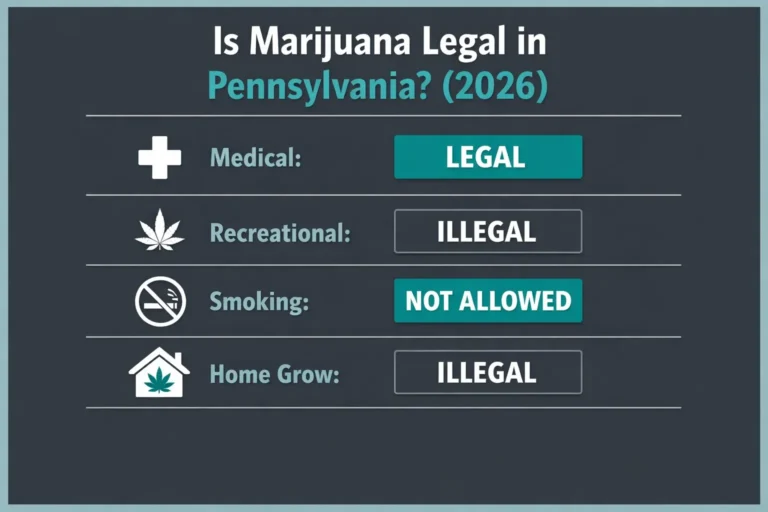
- Medical marijuana: YES — legal since April 17, 2016 under the Pennsylvania Medical Marijuana Act (Act 16)
- Recreational marijuana: NO — still illegal in Pennsylvania as of 2026
- Growing your own: NO — illegal even for medical patients; all cannabis must be purchased at a licensed dispensary
- Smoking: NO — smoking cannabis is prohibited even with a medical card; vaporization is allowed
- Who can use it: Pennsylvania residents with one of 24 qualifying medical conditions and a valid PA MMJ card
The Basics: What Pennsylvania’s Medical Marijuana Law Actually Says

Pennsylvania became the 24th state to legalize medical marijuana when Governor Tom Wolf signed Senate Bill 3 — known as the Medical Marijuana Act (Act 16) — on April 17, 2016. The law came into effect on May 17, 2016, and the first dispensaries opened their doors to patients in February 2018.
The law is run by the Pennsylvania Department of Health (PA DOH), which oversees everything from approving physicians to licensing dispensaries. Since 2016, the program has grown significantly: today Pennsylvania has more than 439,000 registered patients, over 185 licensed dispensaries across the state, and 24 qualifying medical conditions. It is one of the largest medical-only cannabis programs in the country.
Here is the most important thing to understand: being a registered medical marijuana patient in Pennsylvania gives you specific legal protections — but it does NOT put you above all laws. There are clear rules about how much you can have, where you can use it, how you can travel with it, and what restrictions still apply even with a valid card. This page explains all of them in plain language.
Sources:
- Pennsylvania DOH – Medical Marijuana Program
- Marijuana Policy Project – Summary of Pennsylvania’s Medical Marijuana Act
- NORML – Pennsylvania Medical Marijuana Law
Who Qualifies? The 24 Medical Conditions
To legally use medical marijuana in Pennsylvania, you need two things:
(1) A diagnosis of one of the 24 approved qualifying conditions, and
(2) A certification from a PA DOH-registered physician.
If you have one of these conditions and a Pennsylvania doctor certifies you, you qualify for a medical marijuana card.
Here are all 24 qualifying conditions:
* Opioid Use Disorder qualifies only when conventional treatments are contraindicated, ineffective, or when cannabis is used as adjunctive therapy alongside primary treatment.
Don’t see your condition on the list?
Some conditions not explicitly named may still qualify under a broader category. For example, fibromyalgia can qualify under ‘severe chronic pain,’ and many anxiety-related conditions fall under ‘anxiety disorders.’ If you’re unsure whether your diagnosis qualifies, a certified PA MMJ physician can review your records and advise you.
Sources:
- Pennsylvania DOH – Full List of 24 Qualifying Conditions
- PA Code Appendix A – Serious Medical Conditions
How to Get a Pennsylvania Medical Marijuana Card

Getting a PA medical marijuana card is simpler than most people expect. The whole process can be done from home in under a week. Here’s exactly how it works:
| Step | What You Do |
|---|---|
| Step 1: Register Online | Create a free account on the PA Medical Marijuana Program Patient Registry at https://padohmmp.custhelp.com/app/login. You’ll need your PA driver’s license or state-issued ID. |
| Step 2: Get a Physician Certification | Book a telehealth appointment with a PA DOH-registered medical marijuana physician. Most appointments take 10–15 minutes via video call from your home. The doctor will review your medical history and certify you if you qualify. |
| Step 3: Pay the Card Fee | After the doctor submits your certification to the state registry, complete your registration and pay the $50 annual card fee online. Fee waivers are available if you receive Medicaid, PACE/PACENET, CHIP, SNAP, or WIC. |
| Step 4: Get Your Card | Your digital card is usually available within a few business days. Your physical card arrives by mail within 7–14 days. You can use your digital card at dispensaries immediately. |
| Step 5: Visit a Dispensary | With your card, you can visit any licensed PA dispensary. A pharmacist is always on-site to help you choose products and answer questions. |
Who can be a caregiver? If you are unable to visit a dispensary yourself — due to age, disability, or medical condition — you can designate a registered caregiver to purchase cannabis on your behalf. Caregivers must pass a criminal background check. A single caregiver can serve up to five patients. Learn more about the PA medical marijuana caregiver process.
Minors: Patients under 18 can participate in the program, but a parent or legal guardian must register as their caregiver and obtain cannabis for them.
Sources:
PA Medical Marijuana Card Rules: What You CAN and CANNOT Do

This is the section most patients need most. Having a medical marijuana card gives you specific rights — but there are also clear limits. Here’s the complete breakdown.
✅ What You CAN Do with a PA Medical Marijuana Card
- Purchase medical cannabis from any licensed Pennsylvania dispensary
- Possess up to a 90-day supply of medical marijuana as determined by your dispensary pharmacist
- Use medical marijuana at home or in a private residence
- Vaporize dry leaf or flower cannabis (added as an approved form in 2018)
- Use oils, tinctures, capsules, topical creams/gels, and edible-infused food products prepared at home
- Have your certification verified and renewed annually via telehealth
- Purchase cannabis in any licensed dispensary across Pennsylvania — you are not limited to one dispensary
- Designate up to two caregivers to purchase cannabis on your behalf
- Receive legal protection from arrest or prosecution for possessing your lawful supply
❌ What You CANNOT Do Even with a PA Medical Marijuana Card
- SMOKE cannabis. Smoking is prohibited under PA law. Vaporization is legal; combustion (smoking) is not.
- Use cannabis in a public place, school, vehicle, or workplace.
- Grow your own cannabis at home. All cannabis must be purchased from a state-licensed dispensary. Even one plant is a felony.
- Purchase cannabis without your valid PA MMJ card. Your card must be presented at the dispensary.
- Use an out-of-state medical marijuana card at PA dispensaries. Pennsylvania does not recognize other states’ cards.
- Drive after using cannabis. DUI laws apply fully to medical marijuana patients (see DUI section below).
- Purchase or possess a firearm while being a medical marijuana patient (see Firearms section below).
- Have your employer required to accommodate on-site cannabis use. Employers may still enforce drug-free workplace policies.
- Carry cannabis across state lines. Cannabis remains federally illegal; transporting it across state lines is a federal crime.
- Purchase from unlicensed sources. All cannabis must come from a licensed PA dispensary.
What Forms of Medical Marijuana Are Available in Pennsylvania?

Pennsylvania dispensaries carry a wide range of product types. Unlike some states that restrict medical cannabis to specific formats, Pennsylvania allows several options to suit different needs and preferences:
| Product Type | What It Is & Who It’s For |
|---|---|
| Dry Leaf / Flower (for vaporization) | The plant in its natural form. Must be vaporized — not smoked. Fastest onset (within minutes). Good for acute symptom relief. Added to the PA program in 2018. |
| Oils / Tinctures | Liquid cannabis extract dropped under the tongue or added to food. Medium onset (15–45 minutes). Easy to dose precisely. Good for pain, anxiety, and sleep. |
| Capsules / Pills | Pre-dosed cannabis in capsule or tablet form. Slowest onset (1–2 hours) but longest lasting (4–8 hours). Good for chronic conditions needing sustained relief. |
| Topicals (creams, gels, patches) | Applied directly to skin. Does NOT enter the bloodstream or produce a ‘high.’ Good for localized pain, inflammation, muscle soreness, and skin conditions. |
| Concentrates (wax, shatter, rosin) | Highly concentrated cannabis extracts. Vaporized using a device. Potent — best for experienced patients or those needing strong symptom control. |
| Vape Cartridges | Pre-filled oil cartridges used with a vape pen. Convenient and discreet. Medium-fast onset. Available in various cannabinoid ratios. |
| Infused Products (RSO, etc.) | Highly concentrated full-plant extracts. Often used by cancer patients or those with severe conditions. Can be added to food or taken directly. |
Note on edibles: PA dispensaries cannot sell pre-made edible food products (like gummies or brownies). However, patients may purchase cannabis oil or tinctures and mix them into food or drinks at home. Some dispensaries sell cannabis-infused lozenges or sublingual strips, which are permitted.
Not sure which form is right for you? The licensed pharmacist at your PA dispensary is required to consult with you on product selection. Take advantage of this — it’s a free, private consultation included with your card.
Pennsylvania Medical Marijuana Possession Limits

Pennsylvania law allows registered patients to possess up to a 90-day supply of medical marijuana at any given time. What counts as a 90-day supply is determined by the dispensary pharmacist based on your needs — there is no fixed weight or gram limit written into the law itself.
How the 90-Day Supply Rule Actually Works
You can purchase up to a 30-day supply in a single dispensary visit. Beginning 7 days before the end of any 30-day period, you may purchase a 90-day supply for the next period — effectively allowing you to stockpile up to 90 days’ worth before a refill is needed. Always carry your PA MMJ card when you have cannabis in your possession.
⚠ Important: What Happens If You’re Found with More Than Your Legal Supply?
If you are found in possession of more cannabis than your dispensary pharmacist recommended as your 90-day supply, you could face criminal penalties under Pennsylvania law. Always keep your dispensary receipt and your PA MMJ card with you as documentation. Without those, even legal cannabis can look like illegal possession to law enforcement.
Driving and DUI Laws: The #1 Risk PA Patients Don’t Know About

This section covers one of the most misunderstood — and most consequential — areas of Pennsylvania’s medical marijuana laws. Please read it carefully.
- ⚠ Critical: Pennsylvania Has a Zero-Tolerance DUI Law for Cannabis
Pennsylvania law (75 Pa. C.S. § 3802) makes it illegal to drive with any detectable amount of THC or its metabolites in your blood. This applies to EVERYONE — including registered medical marijuana patients. - Having a PA medical marijuana card does NOT protect you from a cannabis DUI charge.
- THC metabolites can stay in your blood for days or weeks after use — long after you are no longer impaired.
- You can fail a blood test and be charged with DUI even if you used cannabis days ago and feel completely fine.
- A cannabis DUI in Pennsylvania carries the same penalties as a 0.16% BAC alcohol DUI — the most severe tier.
- First offense: up to 6 months in jail, $1,500 fine, 12-month license suspension.
In plain terms: if you use medical marijuana and then drive, even after waiting what seems like a reasonable amount of time, you face real legal risk in Pennsylvania. Advocacy groups are pushing for reform to this zero-tolerance standard, but as of 2026, it remains the law.
Practical advice: Do not drive for several hours after using cannabis. If you use cannabis daily, be aware that THC metabolites can be detectable in blood tests for up to 30 days in heavy users. If you are stopped and blood-tested, your medical card will not help you avoid the charge. Consult a Pennsylvania DUI attorney if you are ever in this situation.
Read More:
Firearms and Medical Marijuana: A Serious Federal Conflict

This is one of the most serious and least-discussed legal issues facing Pennsylvania medical marijuana patients. It affects hunters, homeowners with guns for protection, concealed carry permit holders, law enforcement, veterans, and anyone who owns a firearm.
- ⚠ Federal Law: You Cannot Have Both a PA MMJ Card and a Firearm
Under federal law (18 U.S.C. § 922(g)(3)), any person who ‘unlawfully uses or is addicted to a controlled substance’ is prohibited from possessing firearms or ammunition. Because marijuana is still a federally illegal Schedule I controlled substance, this applies to medical marijuana patients — even in states where medical cannabis is legal. - It is illegal under federal law to purchase, possess, or renew a License to Carry Firearm (LTC) while holding a PA medical marijuana card.
- When buying a gun, ATF Form 4473 (Question 21e) specifically asks if you are an unlawful user of a controlled substance. Cannabis is listed explicitly. Lying on this form is a federal felony.
- Pennsylvania Consolidated Statutes § 6109(e)(1)(xiv) also bars individuals prohibited under federal firearms law from holding a PA LTC.
- The PA State Police background check (PICS system) does NOT automatically check the medical marijuana patient registry — but the ATF Form requires self-disclosure.
This conflict is real, it is strictly enforced, and it affects Pennsylvanians in practical ways. A Warren County District Attorney who obtained a PA MMJ card in 2024 was required by law to surrender his firearm carry license. Senator Dan Laughlin has introduced legislation to protect gun rights for medical marijuana patients, but as of 2026, no such reform has passed.
Your choice: Under current law, Pennsylvania residents must choose between holding a PA medical marijuana card and legally owning or purchasing firearms. There is no middle ground under federal law. If this affects you, consult a Pennsylvania attorney before making a decision about your medical care or your firearm ownership.
Read More:
Sources:
- PennsylvaniaStateCannabis.org – Can You Own a Gun with a Medical Card in Pennsylvania?
- The Center Square – Bill Protects Medical Marijuana Patients’ Gun Ownership Rights
Employment Protections: What Your PA MMJ Card Does and Doesn’t Cover
Many patients wonder whether having a PA medical marijuana card protects their job. The answer is nuanced — there are some protections, but they have real limits.
What the Law DOES Protect
- Pennsylvania’s Medical Marijuana Act prohibits employers from discriminating against employees or job applicants solely because they are registered medical marijuana patients.
- An employer cannot fire, refuse to hire, or otherwise discipline you just because you have a PA MMJ card.
- Registered patients cannot be denied child custody or visitation rights solely based on their medical marijuana patient status.
- Medical marijuana patient status information is confidential and not shared with employers.
What the Law Does NOT Protect
- Employers CAN require employees to be drug-free as a condition of employment and CAN test for drugs.
- If you test positive for THC at work — even with a medical card — your employer can take action if they have a documented drug-free workplace policy.
- Employers are NOT required to accommodate cannabis use on the job site or during work hours.
- Federal contractors, transportation workers, safety-sensitive industries (aviation, trucking, railroads), and anyone subject to federal drug testing requirements have essentially no protection. Federal law overrides state protections.
- Pennsylvania’s workers’ compensation system does not guarantee coverage for medical marijuana as a treatment expense.
Practical Advice for Working Patients
Before you get a PA MMJ card, review your employer’s drug policy. If your job involves federal contract work, transportation, heavy machinery, firearms, or regulated safety-sensitive duties — be aware that your PA card provides little to no protection. Consider consulting an employment attorney if you’re unsure about your specific situation.
Where You CAN and CANNOT Use Medical Marijuana in Pennsylvania

Having a PA medical marijuana card means you can legally use cannabis — but there are strict rules about WHERE.
| Location | Legal? |
|---|---|
| Your own home or private residence | ✅ Yes — your primary location for legal use |
| A friend’s or family member’s private residence | ✅ Yes, if the homeowner permits it |
| Public parks, streets, sidewalks, plazas | ❌ No — public use is prohibited |
| Vehicles (even parked) | ❌ No — using cannabis in a vehicle is illegal |
| Workplaces | ❌ No — employers are not required to allow on-site use |
| Schools and school grounds | ❌ No — strictly prohibited |
| Restaurants, bars, stores | ❌ No — private businesses may prohibit use on their premises |
| Hotels / Airbnb | ❓ Depends on the property’s rules — always confirm beforehand |
| Outdoors in nature (hiking trails, parks) | ❌ No — public land is not permitted |
| Near dispensaries | ❌ No — dispensaries are purchase-only locations; consumption is not permitted on premises |
Bottom line: use medical marijuana at home, privately. Keep it stored safely and out of sight when not in use.
Traveling with Medical Marijuana in Pennsylvania

Traveling with your medical cannabis requires some common sense and awareness of the rules:
- Within Pennsylvania: You can transport your medical cannabis in your vehicle as long as you are not using it while driving. Keep it in its original dispensary packaging with your receipt accessible. Carry your PA MMJ card at all times.
- To another state: Do NOT cross state lines with cannabis — even to a neighboring state where marijuana is legal (like New Jersey, Maryland, or New York). Transporting cannabis across state lines is a federal crime, regardless of both states’ local laws.
- Flying: Do NOT bring cannabis through airport security or onto a plane. Even domestic flights are subject to federal law, and TSA agents are required to report drug discoveries to law enforcement.
- Out-of-state cards: Pennsylvania does not have medical marijuana reciprocity with any other state. If you are a registered patient in another state, you cannot purchase cannabis at PA dispensaries.
Card Renewal and Costs
Here is what it costs to get and maintain your PA medical marijuana card:
| Cost | Amount |
|---|---|
| Physician certification (telehealth) | $159 for new certification and $149 for renewal |
| PA DOH card registration fee | $50 per year |
| Fee waiver | $0 if you qualify for Medicaid, PACE/PACENET, CHIP, SNAP, or WIC |
| Card validity | 1 year from date of issuance |
| Renewal timing | Begin renewal process 30 days before expiration to avoid any gap in coverage |
Insurance does not cover medical marijuana costs in Pennsylvania. The card fee, physician certification, and cannabis purchases are all out-of-pocket expenses. If you are on a government assistance program, apply for the fee waiver — it is available at no cost to eligible patients.
Recreational Marijuana in Pennsylvania: Still Illegal in 2026
As of April 2026, recreational marijuana remains illegal in Pennsylvania. Possession of cannabis without a valid PA MMJ card is still a criminal offense under state law:
- Possession of 30 grams (about 1 ounce) or less: misdemeanor, up to 30 days in jail and a $500 fine
- Possession of more than 30 grams: misdemeanor, up to 1 year in jail and a $5,000 fine
- Intent to distribute: felony with significantly higher penalties
- Growing even one plant: felony, 2.5–5 years in prison and up to $15,000 fine
Some cities have decriminalized small amounts at the local level. Philadelphia imposes a $25 civil fine for possession of 30 grams or less. Pittsburgh has also decriminalized small amounts. However, local decriminalization does NOT override state law — you can still be charged under Pennsylvania statute even in these cities.
What about legalization?
Governor Josh Shapiro has included cannabis legalization in his last three state budget proposals, and the PA House of Representatives passed a legalization bill (HB 1200) for the first time in May 2025, but it was killed in the Senate. As of early 2026, no legalization bill has been scheduled for a hearing. The medical card remains the only legal way to purchase cannabis in Pennsylvania.
Sources:
Frequently Asked Questions About Pennsylvania Medical Marijuana Laws
Is medical marijuana legal in Pennsylvania?
Can I smoke weed in Pennsylvania with a medical card?
How much marijuana can I possess in Pennsylvania?
Can I get a DUI in Pennsylvania with a medical marijuana card?
Can I own a gun and have a PA medical marijuana card?
Can my employer fire me for using medical marijuana in Pennsylvania?
Can I use my out-of-state medical marijuana card in Pennsylvania?
Can I grow my own cannabis as a medical marijuana patient?
How do I renew my PA medical marijuana card?
Does insurance cover medical marijuana in Pennsylvania?
Ready to Get Your PA Medical Marijuana Card?
- Get certified from home in 10–15 minutes
If you have one of Pennsylvania’s 24 qualifying conditions, getting your PA medical marijuana card is fast, private, and completely online. A telehealth appointment with a PA DOH-registered physician takes about 15 minutes. Your physician certification goes directly to the state registry, and your digital card is available within days. - No need to leave your house
- Board-certified PA physicians
- Available statewide via secure video call
- $50 state card fee (fee waivers for eligible patients)
➡ [BOOK YOUR TELEHEALTH CERTIFICATION APPOINTMENT]