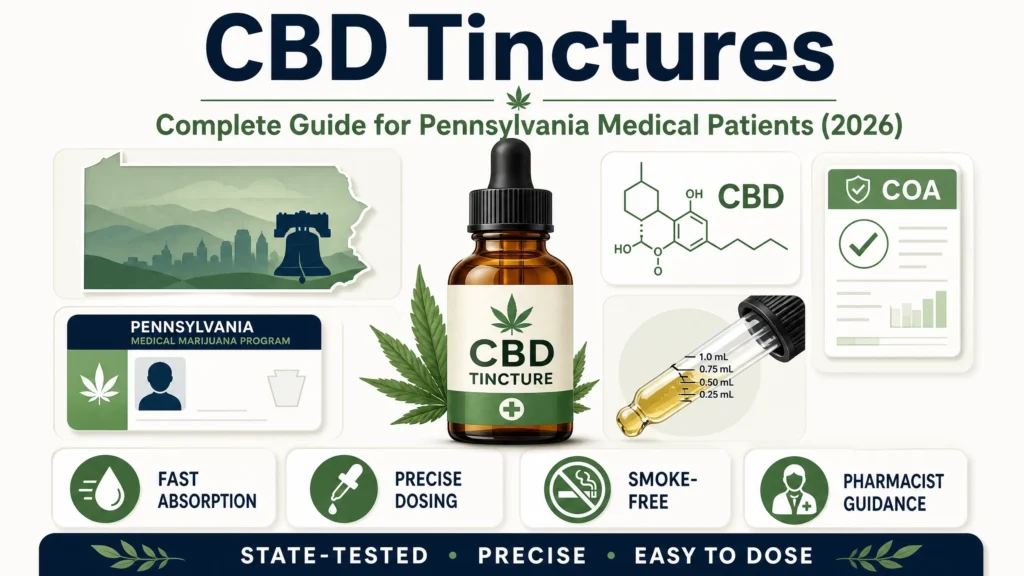
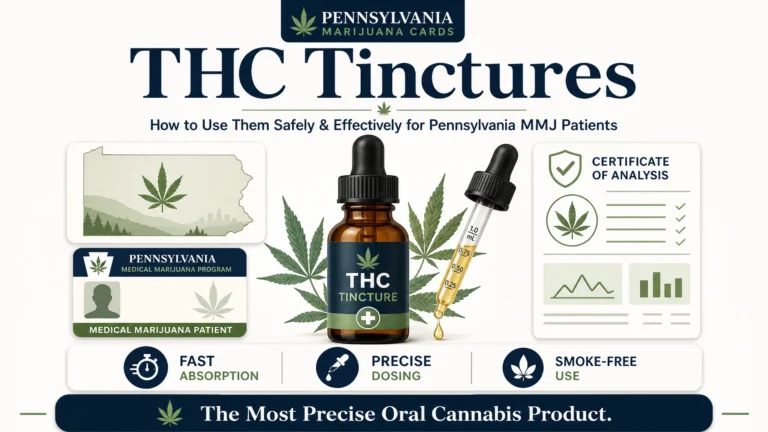

THC tinctures are one of the most versatile products at any licensed Pennsylvania dispensary, and one of the most underused by new patients.
A THC tincture is a liquid cannabis extract, typically suspended in MCT oil or alcohol, that you take with a calibrated dropper. Place it under your tongue, hold for 60 to 90 seconds, then swallow. Effects begin in 15 to 45 minutes. The whole process takes less than two minutes.
Need a PA Medical Marijuana Card?
Get certified online in 15 minutes. 100% Money-Back Guarantee.
Get Certified Now →For Pennsylvania MMJ patients who want a smoke-free option with faster onset than capsules, more dosing precision than flower, and a longer duration than a vape cartridge, tinctures occupy a genuinely useful middle ground that very few product formats can match.
Key Takeaways
- THC tinctures are liquid cannabis extracts taken sublingually (under the tongue) for faster onset than capsules, or swallowed for longer duration.
- Onset is 15 to 45 minutes sublingually and 45 to 90 minutes when swallowed. Duration ranges from 3 to 5 hours sublingual, and 4 to 8 hours swallowed.
- Dosing math is simple: check mg per mL on the PA dispensary label, then use the dropper markings to measure your dose. A 500mg/30mL tincture delivers approximately 16.7mg per full 1mL dropper.
- PA dispensaries are required by law to carry a Certificate of Analysis (COA) for every tincture, confirming verified THC content, carrier type, terpene profile, and contaminants.
- Tinctures are the closest PA dispensary alternative to gummies. Pennsylvania dispensaries cannot sell traditional edibles under Act 16. Tinctures provide the same oral cannabis experience in a medically precise format.
- Start at 2.5mg and adjust upward in small increments every 3 to 7 days until you find your effective dose. The dropper makes this easier than any other product format.
What Are THC Tinctures?
THC tinctures are concentrated liquid cannabis extracts packaged in small glass bottles (typically 15mL or 30mL) with a calibrated dropper.
The cannabinoids, primarily THC and often CBD, are dissolved in a carrier liquid: either food-grade alcohol or an oil (most commonly MCT oil derived from coconut or palm kernel).

Cannabis tinctures have a longer medical history than most people realize. They were listed in the U.S. Pharmacopeia from 1850 until 1942, widely prescribed by physicians for pain, nausea, and anxiety before federal prohibition.
Do You Qualify for a PA MMJ Card?
Connect with a licensed Pennsylvania state physician online from home.
Today they’ve been rediscovered as a preferred format among medical cannabis patients who want smoke-free, precisely dosed, longer-lasting effects without the unpredictability of traditional edibles.
In Pennsylvania, tinctures are one of the approved product formats under Act 16 of 2016 and are available at all 186+ licensed PA dispensaries.
Unlike hemp tinctures sold at smoke shops, PA dispensary tinctures come with state-mandated third-party lab testing and verified potency on every bottle.
How THC Tinctures Work: The Two Routes
This is the most important thing to understand before using a tincture for the first time.
The same product, taken two different ways, produces two meaningfully different experiences.

Route 1: Sublingual (under the tongue)
When you hold tincture under your tongue for 60 to 90 seconds, cannabinoids absorb directly through the mucous membranes lining the floor of your mouth and enter your bloodstream without going through your digestive system first.
This bypasses most of the liver’s first-pass metabolism.
The result: faster onset (15 to 45 minutes), more predictable effects, and a shorter duration (3 to 5 hours). Because less THC is converted to 11-hydroxy-THC through this route, the experience tends to feel cleaner and more controllable than a swallowed product.
Route 2: Swallowed (or mixed into food or drink)
When you swallow a tincture, or mix it into food or a beverage, it travels through your digestive system and liver before reaching your bloodstream.
Your liver converts delta-9 THC into 11-hydroxy-THC, a significantly more potent metabolite.

⚡ Fast & 100% Online PA Medical Cards
Board-Certified Doctors • 100% Money-Back Guarantee
Book Evaluation Now →The result: slower onset (45 to 90 minutes), longer duration (4 to 8 hours), and often stronger-feeling effects per milligram. This route behaves similarly to an edible, which is why it matters that you do not underestimate a tincture because it comes in a small dropper bottle.
Most experienced patients use the sublingual route by default and switch to the swallowed route only when they specifically want the longer-lasting profile, such as for overnight symptom management or all-day chronic pain coverage.
Sublingual vs Swallowed: Which Should You Choose?
| Factor | Sublingual | Swallowed |
|---|---|---|
| Onset | 15 to 45 minutes | 45 to 90 minutes |
| Duration | 3 to 5 hours | 4 to 8 hours |
| Potency per mg | Moderate | Higher (11-OH-THC conversion) |
| Predictability | High | Moderate (metabolism variability) |
| Best for | Daytime management, acute symptoms, titrating dose | Overnight coverage, chronic pain, all-day relief |
| Risk of overconsumption | Lower | Higher (slower onset, easy to redose too early) |
Choose sublingual if: you are new to tinctures, want more control over the experience, or need something that fits into a daytime routine without lasting too long.
Choose swallowed if: you need sustained overnight relief, are managing a chronic condition that requires all-day coverage, or are a more experienced patient comfortable with the edible-type experience.
How to Use a THC Tincture: Step by Step

For sublingual use:
- Shake the bottle gently before each use. Cannabinoids can settle over time.
- Fill the dropper to your measured dose. Use the mL markings on the dropper, not a rough squeeze.
- Place the drops under your tongue, toward the sides where the tissue is thinnest and the blood supply richest.
- Hold without swallowing for 60 to 90 seconds. This is the step most people rush. The longer you hold, the more absorbs sublingually rather than going through your digestive system.
- Swallow the remainder after holding.
- Wait at least 45 minutes before assessing effects. Do not redose early. The sublingual route is faster than edibles but slower than inhalation.
- Keep a simple note: the product name, the dose in mg, the time, and how you felt at 30 minutes, 1 hour, and 2 hours. Three sessions of data will tell you more than any general guide can.
For swallowed/food use:
If you prefer to mix tincture into food or a non-alcoholic beverage, plan for the longer onset. Add the measured dose to something at room temperature (heat can degrade cannabinoids), and plan to wait 60 to 90 minutes before evaluating the effect. Do not add alcohol-based tinctures to hot beverages.
How to Read a PA Dispensary Tincture Label
Every PA dispensary tincture is required to carry a Certificate of Analysis (COA) and label showing verified cannabinoid content. Here is what the numbers actually mean:

Potency expressed as mg/mL: If a 30mL bottle shows 500mg THC, that is 500 / 30 = 16.7mg per milliliter. A full 1mL dropper delivers 16.7mg.
Dropper math for your target dose:
| Tincture Strength (30mL bottle) | mg per full 1mL dropper | Dose for 5mg | Dose for 2.5mg |
|---|---|---|---|
| 150mg total | 5mg | 1.0mL (full dropper) | 0.5mL |
| 300mg total | 10mg | 0.5mL | 0.25mL |
| 500mg total | 16.7mg | 0.3mL | 0.15mL |
| 1000mg total | 33.3mg | 0.15mL | 0.075mL |
Most dispensary tincture droppers have markings at 0.25mL, 0.5mL, 0.75mL, and 1.0mL.

Renewing Your PA MMJ Card?
Quick annual recertification online. No paperwork hassle.
Renew Card Online →For starting doses of 2.5 to 5mg, lower-strength bottles (150 to 300mg) make accurate measuring significantly easier. Ask the dispensary pharmacist which strength bottle is easiest to use at your target starting dose.
What else to check on the label:
- THC:CBD ratio. A 1:1 or 1:2 ratio significantly reduces anxiety risk at the same THC dose.
- Carrier type. MCT oil or alcohol. This affects taste and may matter for patients with dietary restrictions.
- Full-spectrum vs isolate. Full-spectrum includes terpenes and minor cannabinoids. Isolate-based products contain THC only.
THC Tincture Dosing: Where to Start
Most cannabis physicians and dispensary pharmacists recommend starting at 2.5mg of THC for first-time tincture users, regardless of prior cannabis experience.

Tinctures are particularly easy to titrate, meaning adjust upward gradually, which is why starting conservatively costs you nothing.
The titration protocol most PA dispensary pharmacists use:
- Week 1: 2.5mg twice daily (morning and evening)
- Weeks 2 to 3: If insufficient relief, increase to 5mg twice daily
- Week 4 onward: Increase by 2.5mg increments every 7 days until reaching the effective dose
The goal of titration is finding your minimum effective dose, the lowest amount that provides the therapeutic benefit you need without side effects you don’t want.
More is not better with THC. The sweet spot for most medical patients is far lower than recreational users assume.
A note on tolerance: regular daily use builds CB1 receptor tolerance over time, meaning you may need more to achieve the same effect.
Taking one or two cannabis-free days per week slows tolerance development significantly.
Types of THC Tinctures at PA Dispensaries
PA dispensaries carry several distinct tincture formulations. Here is what each offers:
THC-dominant tinctures: Highest ratio of THC with minimal CBD. Strongest psychoactive effect.
Get Approved by a Licensed PA Doctor
Schedule your appointment in minutes. You only pay if approved.
Start Online Application →Best suited for patients with established tolerance, chronic pain requiring stronger relief, and those specifically seeking THC’s therapeutic properties.

Balanced THC:CBD (1:1 or 1:2)
Equal or near-equal ratios of THC and CBD. CBD modulates THC’s psychoactivity at the CB1 receptor, reducing anxiety risk and cognitive impairment.
Often the best starting point for anxiety disorder patients and beginners. Both cannabinoids produce complementary therapeutic effects through what researchers call the entourage effect.
CBD-dominant (low THC)
Very low THC (1 to 3mg per dropper) with high CBD. Minimal to no psychoactivity. Useful for patients who want the anti-inflammatory or anxiolytic properties of CBD with minimal intoxication.
CBN formulations
Some PA dispensaries carry tinctures with elevated CBN content. CBN is a mildly sedating cannabinoid particularly popular for sleep support.
THC:CBN tinctures taken before bed are a common sleep management option for patients with PTSD-related insomnia and chronic pain.
Full-spectrum vs isolate
Full-spectrum tinctures preserve the plant’s natural terpene and minor cannabinoid profile. Many patients report fuller, more nuanced effects. Isolate-based products contain a specific cannabinoid only.
For patients using tinctures to manage a specific condition, full-spectrum options with a relevant terpene profile, such as linalool for anxiety or myrcene for pain, may offer more targeted support.
Alcohol-Based vs MCT Oil-Based Tinctures
Both carrier types are available at PA dispensaries. The practical differences matter for some patients.

Alcohol-based tinctures:
- Slightly faster sublingual absorption due to alcohol’s permeability through mucous membranes
- Stronger, more pronounced taste
- Not appropriate for patients avoiding alcohol for religious, medical, or recovery reasons
- Longer shelf life (alcohol is a preservative)
Ready to Get Your Official PA MMJ Card?
State-certified doctor consultations online. No risk—100% refund if not approved.
Claim Your MMJ Card Online →MCT oil-based tinctures:
- Milder taste, often preferred for longer-term daily use
- Slightly slower sublingual absorption than alcohol-based, but the difference is modest
- Better for patients with alcohol sensitivities or preferences
- Still very effective sublingually and when swallowed
Ask the dispensary pharmacist which carrier type is available in your target potency range if this distinction matters for your situation.
How Long Do THC Tinctures Last?
Duration depends on which route you use and your individual metabolism:

Sublingual: 3 to 5 hours for most patients. Effects begin at 15 to 45 minutes and peak around 1 to 2 hours.
Swallowed/mixed: 4 to 8 hours. Onset at 45 to 90 minutes, peaking at 2 to 3 hours after ingestion.
These ranges reflect average adult metabolism at moderate doses (5 to 10mg THC). Higher doses extend duration. Patients with higher body fat percentages may experience longer duration because THC is fat-soluble.
People who metabolize THC quickly through CYP2C9 and CYP3A4 liver enzymes may find effects clear faster, particularly with the swallowed route.
One practical implication: a tincture taken sublingually at 9pm for sleep will likely clear before 2am. If overnight coverage is the goal, the swallowed route or a capsule may be more appropriate.
If the goal is winding down in the evening without residual grogginess in the morning, the sublingual route’s 3 to 5 hour window fits better.
Do THC Tinctures Show Up on a Drug Test?
Yes. THC from a tincture produces the same metabolite (THC-COOH) as THC from any other cannabis product. Standard urine drug tests detect THC-COOH regardless of product type or carrier.

There is no “cleaner” cannabis product from a drug test perspective.
Detection windows for THC from tinctures:
| Test Type | Occasional Use | Regular Use |
|---|---|---|
| Urine | 3 to 7 days | Up to 30+ days |
| Blood | Up to 48 hours | Up to 72 hours |
| Saliva | Up to 24 to 72 hours | Up to 72 hours |
Pennsylvania’s per se DUI law (75 Pa. C.S. §3802(d)) sets a 1ng/mL threshold for THC or its metabolites in blood, making it possible to face a DUI charge even after the subjective effects of a tincture have faded. Do not drive after using any THC product, including tinctures.
If you are a registered PA MMJ patient, Senate Bill 363 added actual-impairment protections for MMJ DUI cases, but these protections do not eliminate the legal risk of driving with detectable THC in your blood.
Why PA Patients Choose Tinctures Over Other Formats
Pennsylvania’s Medical Marijuana Act prohibits dispensaries from selling gummies and traditional food-form edibles.
This makes tinctures the most practical oral cannabis option for patients who cannot or prefer not to inhale.

Compared to capsules, tinctures offer:
- Faster onset via sublingual route (15 to 45 minutes vs 45 to 90 minutes for capsules)
- More flexible dosing: you can adjust by fractions of a milliliter rather than buying a different capsule strength
- The option to switch between sublingual and swallowed routes depending on your needs
Compared to flower and vape:
- No inhalation required, which matters for patients with respiratory conditions
- Longer duration per dose
- More discreet and portable
Compared to hemp tinctures from smoke shops:
- State-mandated COA testing verifying potency, purity, terpene profile, pesticides, and heavy metals
- Pharmacist guidance available at every visit
- Full legal protection under Act 16
- Not subject to the H.R. 5371 November 2026 federal deadline that threatens most hemp products
The PA Dispensary Pharmacist and Tincture Guidance
Every licensed Pennsylvania dispensary is required by state law to have a pharmacist on staff during business hours.
Tincture dosing is one of the most common questions they handle, and it is exactly what this consultation is designed for.

Before leaving the dispensary with a new tincture, ask:
- What is the mg per mL on this specific product?
- Given my qualifying condition and current medications, is there a ratio (THC:CBD) you would recommend?
- Should I start sublingual or swallowed for my condition?
- Are there any drug interactions with my current prescriptions I should watch for? (THC interacts with some blood thinners, antidepressants, and anti-epileptics through CYP liver enzymes)
These are clinical questions with clinical answers. No appointment needed. Just ask.
If you have a qualifying condition and want access to tinctures and other oral cannabis products at licensed PA dispensaries with pharmacist guidance, a PA MMJ card is the path.
Certification is completed same-day via telehealth with Dr. Johnathon Chance Miller, MD.

| Physician Fee | PA State Fee | Total | |
|---|---|---|---|
| New Patient | $159 | $50 | $209 |
| Renewal | $149 | $50 | $199 |
| MMAP Qualifying Patients (Medicaid, SNAP, WIC, CHIP, PACE, PACENET) | $0 (waived) | Physician fee only |
Start your same-day certification here.
Frequently Asked Questions
Q: What are THC tinctures?
A: THC tinctures are concentrated liquid cannabis extracts packaged in small glass bottles with a calibrated dropper. The THC is dissolved in a carrier liquid, either food-grade alcohol or MCT oil. They are taken by placing drops under the tongue (sublingually) and holding for 60 to 90 seconds for faster absorption, or swallowed for a slower, longer-lasting edible-type effect. Tinctures have been used medicinally for over 150 years and are available at all licensed Pennsylvania dispensaries as one of the approved formats under Act 16 of 2016.
Q: How do you use a THC tincture?
A: Fill the calibrated dropper to your measured dose, place the drops under your tongue, hold without swallowing for 60 to 90 seconds, then swallow the remainder. For sublingual use, expect effects in 15 to 45 minutes lasting 3 to 5 hours. If you swallow the tincture or mix it into food, expect 45 to 90 minute onset and 4 to 8 hour duration, similar to a traditional edible. The most common beginner mistake is redosing before the first dose has peaked. Wait at least 45 minutes before assessing whether more is needed.
Q: How do you dose a THC tincture from a PA dispensary?
A: Check the label for mg per mL, then use the dropper markings to measure your target dose. For a 500mg/30mL tincture, one full 1mL dropper delivers 16.7mg THC. For a 5mg starting dose, you need approximately 0.3mL. Most PA dispensary pharmacists recommend starting at 2.5 to 5mg and increasing by 2.5mg every 7 days until reaching your effective dose. Tinctures allow finer dosing precision than any other dispensary product format. Every PA dispensary product carries a state-mandated COA confirming verified potency, making label math reliable.
Q: How long does a THC tincture last?
A: Sublingual THC tinctures typically last 3 to 5 hours, with effects beginning in 15 to 45 minutes. When swallowed or mixed into food, onset extends to 45 to 90 minutes and duration extends to 4 to 8 hours. The swallowed route produces more potent effects per milligram because the liver converts more delta-9 THC to 11-hydroxy-THC. Individual metabolism, body composition, and tolerance all affect actual duration. Higher doses extend duration for both routes.
Q: Do THC tinctures show up on a drug test?
A: Yes. THC from a tincture produces the same urinary metabolite (THC-COOH) as THC from any other cannabis product. Standard drug tests cannot distinguish between tincture, flower, edibles, or vapes. Detection windows in urine are 3 to 7 days for occasional use and up to 30+ days for regular daily use. Pennsylvania’s per se DUI law also applies, meaning detectable THC metabolites in blood can result in a DUI charge even after the subjective effects of a tincture have passed.
Q: What is the difference between sublingual and swallowed THC tinctures?
A: Sublingual means holding drops under the tongue for 60 to 90 seconds before swallowing. This allows direct absorption through mucous membranes, bypassing most of the liver’s first-pass metabolism. The result is faster onset (15 to 45 minutes), shorter duration (3 to 5 hours), and more predictable effects. Swallowing sends the tincture through digestion and the liver, converting more THC to 11-hydroxy-THC, which is more potent and longer-lasting. Swallowed tinctures behave similarly to edibles: 45 to 90 minute onset, 4 to 8 hour duration, stronger effects per milligram.
Q: Can Pennsylvania MMJ patients buy tinctures at dispensaries?
A: Yes. Tinctures are one of the approved product formats under Pennsylvania’s Medical Marijuana Act (Act 16 of 2016) and are available at all 186+ licensed PA dispensaries. Pennsylvania dispensaries cannot sell gummies or traditional food-form edibles, making tinctures the most versatile oral option for PA patients who prefer not to inhale. Every dispensary tincture carries a state-mandated Certificate of Analysis verifying potency, carrier type, terpene profile, and contaminant testing. A valid PA MMJ card is required to purchase.
Medical Disclaimer
This blog post is intended for general educational and informational purposes only and does not constitute medical advice. THC tincture dosing recommendations in this article represent general starting points. Individual responses to THC vary significantly based on body chemistry, tolerance, delivery method, and other factors. Always consult the licensed pharmacist on duty at your Pennsylvania dispensary before starting a new cannabis product. Do not drive or operate machinery after using any THC product. Patients taking prescription medications should discuss potential cannabis drug interactions with a pharmacist or physician before starting tincture use. Medically reviewed by Dr. Johnathon Chance Miller, MD.
Sources
- Green Rush News — The Complete Guide to Cannabis Tinctures: Dosing, Making, and Using Sublingual Drops (March 2026)
- Budpedia — Cannabis Tinctures and Sublingual Products: The Complete 2026 Guide (April 2026)
- EO Care — How to Use Cannabis Tinctures: A Beginner’s Guide (March 2026)
- Mission Dispensaries — How to Use Weed Tinctures: Dosing, Tips and More (April 2026)
- Cannabis for Seniors — Sublingual Tinctures: The Senior Default (April 2026)
- Kind Goods Cannabis Dispensary — Cannabis Tinctures Guide (April 2026)
- PMC — The Entourage Effect: Terpenes Coupled with Cannabinoids (Borrelli et al., 2025)
- Pennsylvania Medical Marijuana Act, Act 16 of 2016 (approved product formats)
- Pennsylvania Marijuana Cards — Flower vs Oil vs Tincture vs Capsules: PA Dispensary Guide
- Pennsylvania Marijuana Cards — Qualifying Conditions