
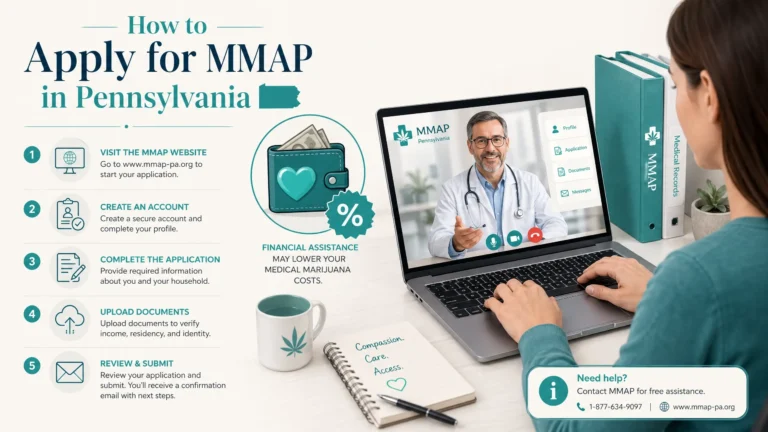

If you’re researching how to apply for MMAP in PA online free, you’re in exactly the right place.
Pennsylvania’s Medical Marijuana Assistance Program (MMAP) is a state-run financial assistance program that helps low-income patients access medical marijuana by eliminating the $50 annual card registration fee and in some cases, providing an additional $50 per month toward cannabis purchases at licensed dispensaries.
The good news: if you’re already enrolled in one of Pennsylvania’s qualifying financial hardship programs, the MMAP application process is significantly simpler than most guides make it sound.
There is no separate complicated application. Your eligibility is verified automatically through your existing program enrollment when you register for your PA MMJ card online.
This guide explains exactly who qualifies, what MMAP covers, what it doesn’t cover, and the precise step-by-step process to apply, updated for April 2026.
What Is MMAP and Why Does It Exist?
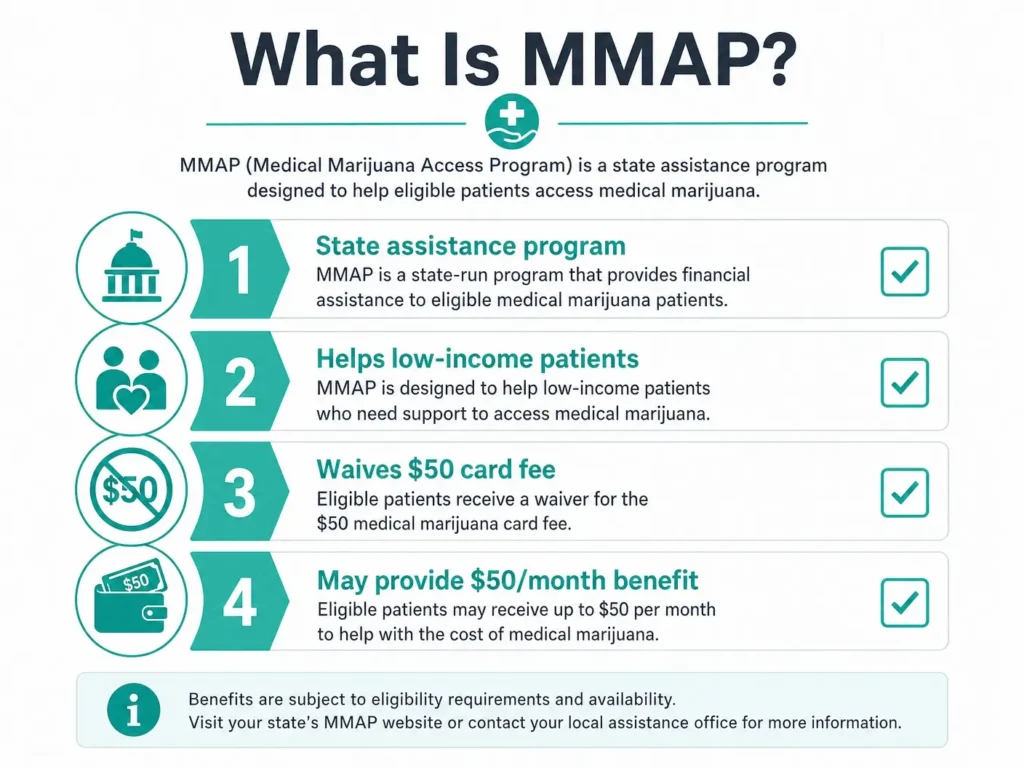
The Medical Marijuana Assistance Program (MMAP) was created to address a genuine access problem in Pennsylvania’s medical marijuana program: for patients living in poverty or on fixed incomes, the combined cost of a physician certification and the state card registration fee can be a real barrier to legal cannabis access.
MMAP has its legal roots in Act 16 of 2016, the original Medical Marijuana Act, which created the Medical Marijuana Program Fund specifically to assist patients and caregivers with program costs.
The program was substantially expanded through Act 44 of 2021, which gave the Pennsylvania Bureau of Medical Marijuana (now the Office of Medical Marijuana) the authority and funding structure to implement MMAP in phases.
According to the Pennsylvania Department of Health’s official MMAP page, the Bureau has been providing some form of patient assistance since December 2017. Full MMAP implementation began rolling out in phases starting March 2022.
As of April 2026, Pennsylvania’s medical marijuana program serves over 440,000 registered patients across 186 dispensary locations statewide, according to program enrollment data. MMAP exists to ensure that financial circumstances don’t prevent qualifying patients from participating in this program.
Who Qualifies for MMAP in Pennsylvania?
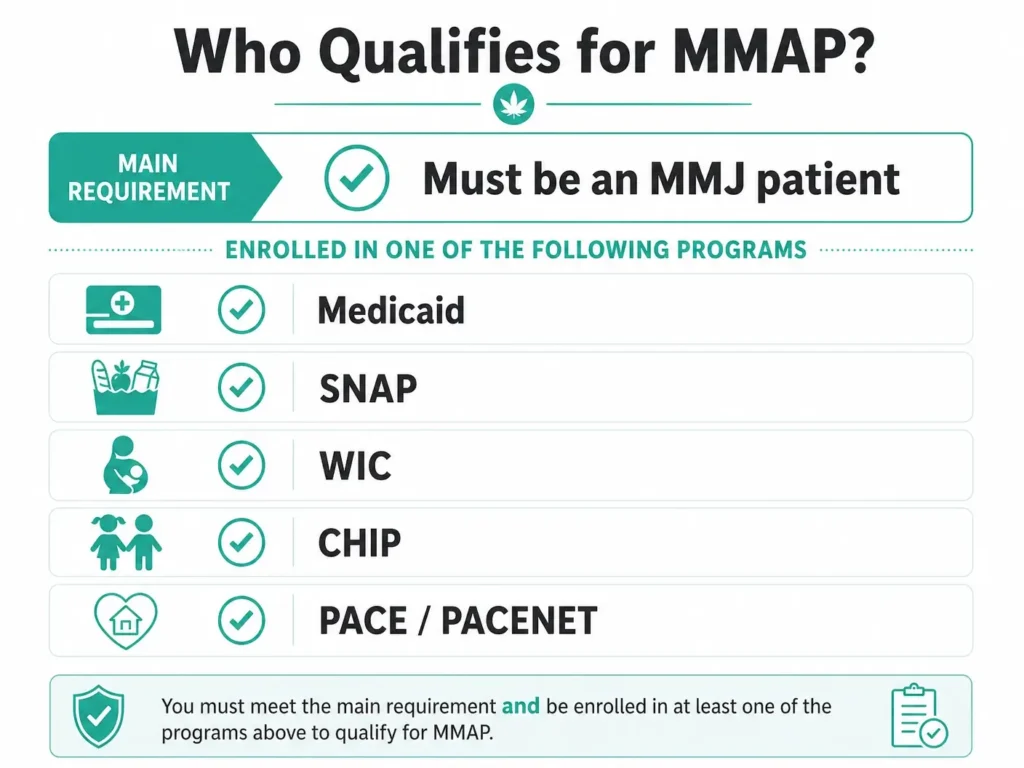
To qualify for MMAP, you must meet two requirements simultaneously:
Requirement 1 — Be a registered Pennsylvania MMJ patient or caregiver You must be registered (or in the process of registering) with the Pennsylvania Medical Marijuana Registry. You must have a qualifying medical condition certified by a PA-licensed physician and be enrolled in the state program.
MMAP is not available to people who have not yet entered the MMJ registration process.
Requirement 2 — Be currently enrolled in a qualifying Commonwealth financial hardship program
According to the official PA Department of Health MMAP page, the qualifying programs are:
| Program | Full Name | Administered By |
|---|---|---|
| Medicaid | Medical Assistance (MA) | PA Department of Human Services |
| CHIP | Children’s Health Insurance Program | PA Department of Human Services |
| PACE | Pharmaceutical Assistance Contract for the Elderly | PA Department of Aging |
| PACENET | PACE Needs Enhancement Tier | PA Department of Aging |
| SNAP | Supplemental Nutrition Assistance Program | PA Department of Human Services |
| WIC | Women, Infants, and Children | PA Department of Health |
You must be actively enrolled in one of these programs, not just eligible. Eligibility alone does not qualify you. The state verifies your enrollment status when you complete your MMJ registry profile.
If you are unsure which program you may be enrolled in, check any benefit cards or correspondence you have received from the state. Your enrollment status can also be verified by contacting the PA Department of Human Services at 1-866-550-4355 or visiting COMPASS.state.pa.us.
What Does MMAP Actually Cover? The Three Phases Explained
MMAP was implemented in three distinct phases, each targeting a different cost barrier. Understanding which phases apply to you is essential.
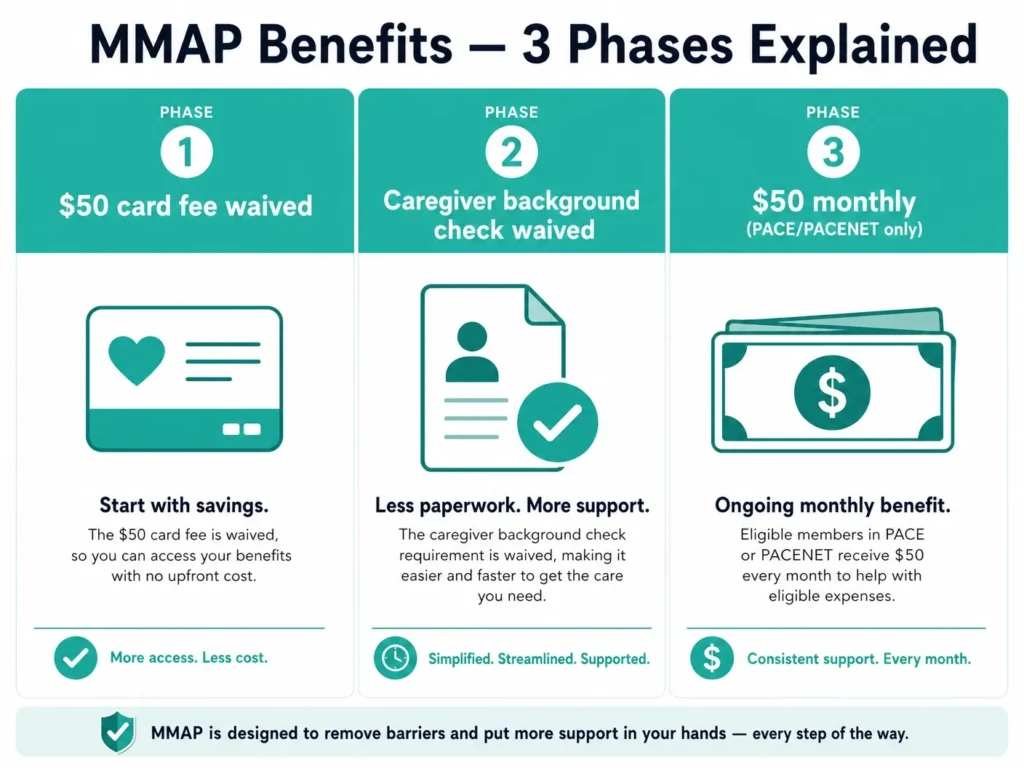
Phase 1 — Annual Card Fee Waiver ✅ Active Since March 2022
What it covers: The $50 annual Pennsylvania MMJ patient registration fee, completely waived for eligible patients.
Who it applies to: Any patient enrolled in one of the six qualifying financial hardship programs listed above.
How it works: When you register in the PA Medical Marijuana Registry and your enrollment in a qualifying program is verified, the $50 state card fee is automatically eliminated. You do not pay it. This benefit renews annually as long as your qualifying program enrollment is maintained.
This is the most widely available MMAP benefit and the one that applies to the broadest group of qualifying patients.
Phase 2 — Caregiver Background Check Fee Waiver ✅ Active Since March 2022
What it covers: The federal background check fee required for caregiver registration, completely eliminated for eligible caregivers.
Who it applies to: Registered caregivers who are enrolled in a qualifying Commonwealth financial hardship program.
How it works: Caregivers must complete a background check as part of the PA MMJ program registration process. Under Phase 2, the fee associated with that background check is waived automatically upon verification of qualifying program enrollment.
Note: The caregiver themselves must be enrolled in a qualifying program, not just the patient they are caring for. More details on caregiver applications are covered in Section 8.
Phase 3 — Monthly $50 Dispensary Benefit ⚠️ Pilot Program — PACE/PACENET Only
What it covers: A $50 benefit per month per eligible patient toward the purchase of medical cannabis products at licensed Pennsylvania dispensaries.
Who it applies to: Currently, Phase 3 is a pilot program limited to patients enrolled specifically in PACE or PACENET, the pharmaceutical assistance programs for elderly Pennsylvanians. This phase is NOT currently available to patients enrolled only in Medicaid, CHIP, SNAP, or WIC.
Pilot scope: According to Pennsylvania State Cannabis, the pilot is limited in scope to approximately 1,000–3,000 patients. The $50 monthly benefit is applied at the register at participating dispensaries, patients do not receive cash.
Expansion status: The PA Department of Health MMAP page states explicitly: “Expansion of Phase 3 is dependent on the funding that will be allocated to the program in the future.” As of April 2026, broader Phase 3 expansion has not been announced.
What the $50 benefit covers: It can be applied to any medical marijuana product sold at licensed PA dispensaries, flower, tinctures, vapes, capsules, topicals, troches. According to The Greener Institute, the benefit cannot be used for non-cannabis products such as devices (vaporizers, pipes) or accessories.
What MMAP Does NOT Cover — Important Clarifications
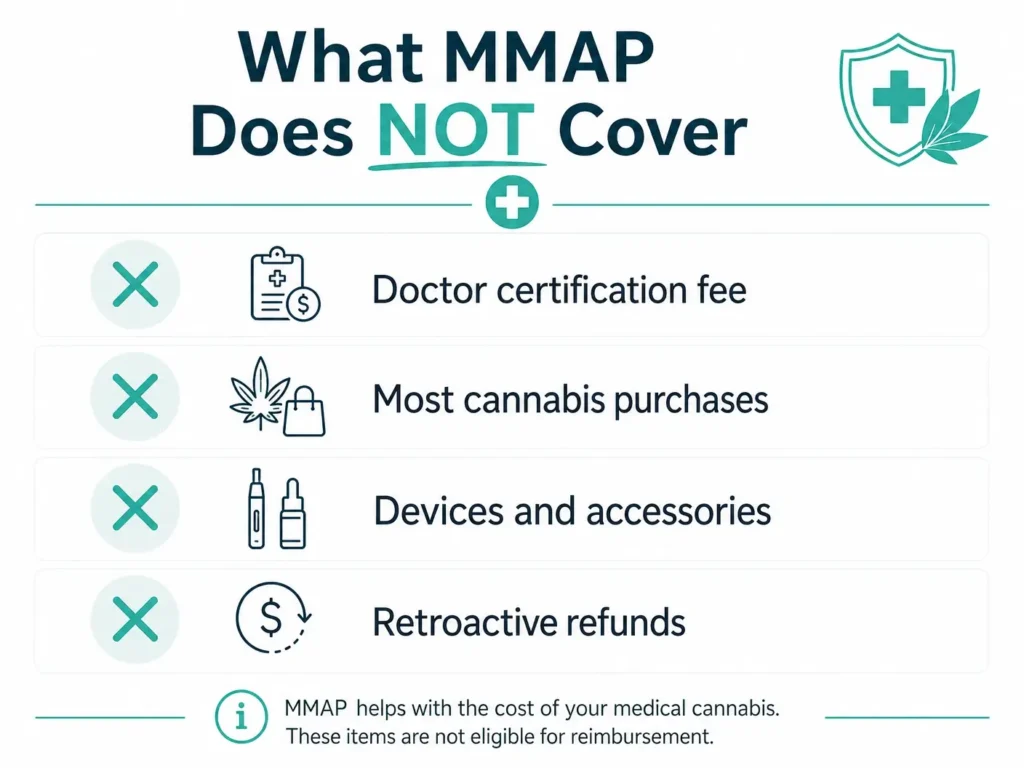
This is where many patients get confused and disappointed. Being clear about MMAP’s limitations upfront prevents frustration:
MMAP does NOT cover the physician certification fee. The $50 state registration fee is waived for qualifying patients. The physician’s consultation and certification fee, which is set by the individual provider and typically ranges from $75 to $200, is a separate cost that MMAP does not offset. This fee is charged by the certifying physician, not the state, and MMAP has no authority over it.
MMAP does NOT make your MMJ card completely free. Even with MMAP Phase 1, you will still need to pay for your physician certification. The total out-of-pocket minimum for a qualifying patient is roughly the physician certification fee alone, typically $75–$150 depending on the provider you choose. Budget accordingly.
MMAP does NOT cover cannabis purchases for most patients. Only Phase 3 provides a dispensary purchasing benefit and as of April 2026, Phase 3 is limited to PACE/PACENET pilot participants. Patients enrolled only in Medicaid, SNAP, WIC, or CHIP receive card fee waivers but not monthly dispensary benefits.
MMAP does NOT cover vaporizers, devices, or accessories. The Phase 3 $50 monthly benefit is restricted to cannabis products only. Equipment for consuming cannabis cannot be purchased with MMAP funds.
MMAP does NOT apply retroactively. If you already paid your $50 state card fee before verifying your MMAP eligibility, you cannot receive a refund. Establish your MMAP eligibility before paying the state registration fee.
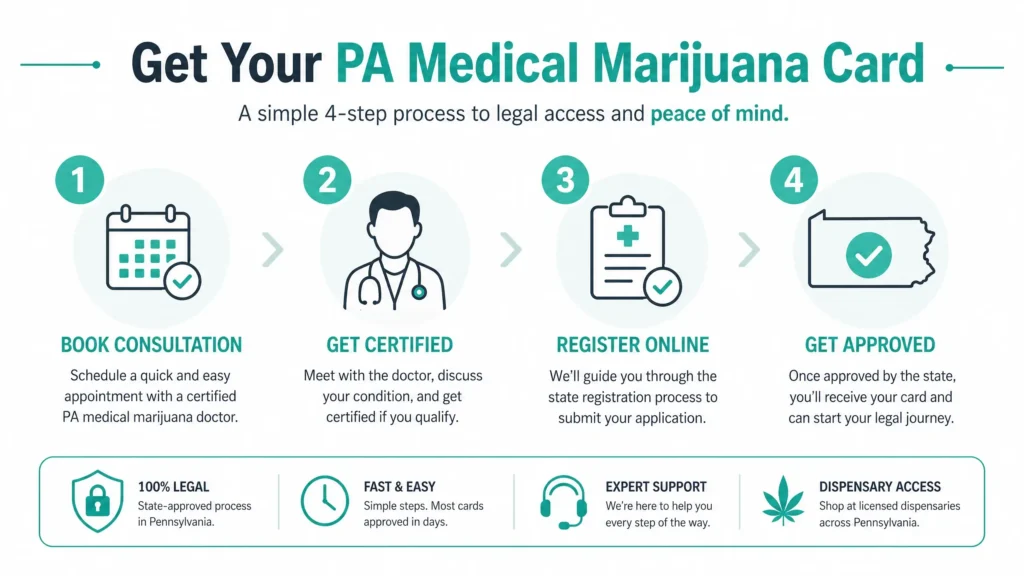
How to Apply for MMAP in PA Online — Step-by-Step
Here is the important thing most guides fail to explain clearly: MMAP does not have a separate, standalone application. You don’t fill out a separate MMAP form. Instead, your MMAP eligibility is verified automatically through the Pennsylvania Medical Marijuana Registry during your standard patient registration process.
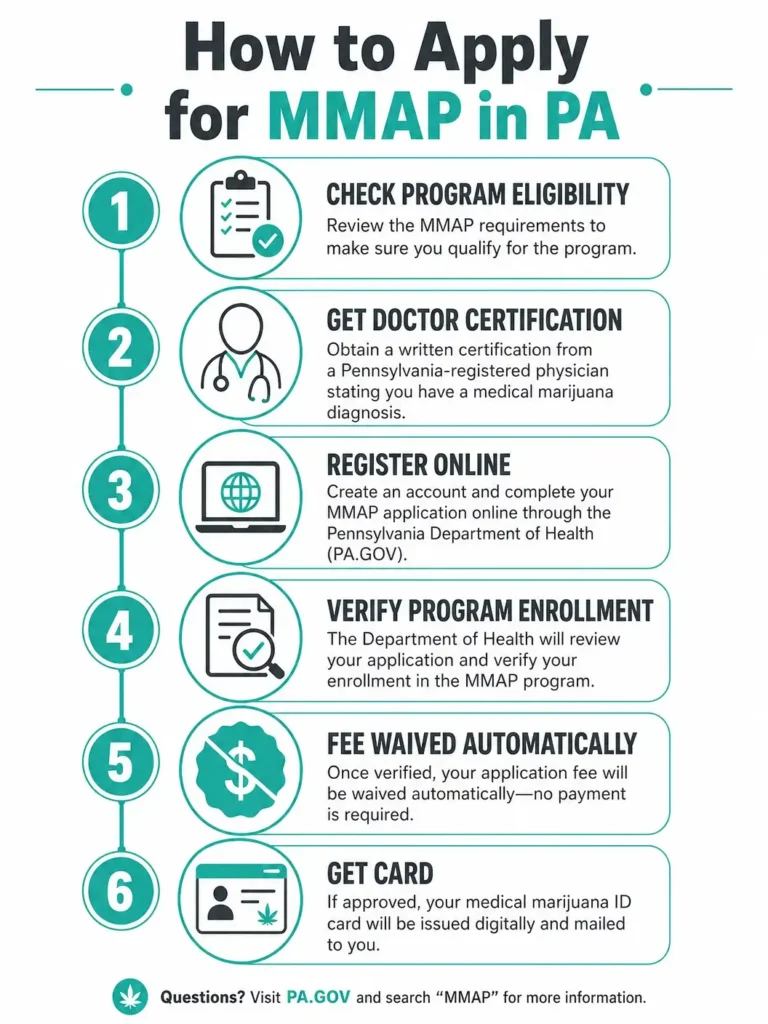
Here is exactly how the full process works, step by step, as of April 2026:
Step 1 — Check Your Qualifying Program Enrollment
Before anything else, confirm that you are actively enrolled in one of the six qualifying programs: Medicaid, CHIP, PACE, PACENET, SNAP, or WIC.
- Medicaid/CHIP/SNAP/WIC: Check your active benefit card or correspondence from PA Department of Human Services. Verify current enrollment at COMPASS.state.pa.us or call 1-866-550-4355
- PACE/PACENET: Contact the PA Department of Aging at 1-800-225-7223 or visit aging.pa.gov
If you are not currently enrolled in any qualifying program but think you may be eligible, apply for the relevant program first. Medicaid, SNAP, and WIC applications can all be completed at COMPASS.state.pa.us. You must have active enrollment verified before your MMAP benefit applies.
Step 2 — Get Certified by a PA-Licensed MMJ Physician
Before registering with the state, you need a physician certification from a Pennsylvania Department of Health-approved physician.
This is available entirely online through telehealth:
- Schedule an appointment with a PA-licensed MMJ physician
- Attend your video or phone consultation (typically 15–20 minutes)
- Discuss your qualifying medical condition and medical history
- If certified, your physician submits your certification electronically to the PA Medical Marijuana Registry
You do not need to physically visit a doctor’s office. The entire certification process is completed remotely.
Pennsylvania recognizes 24 qualifying medical conditions, including anxiety disorders, chronic pain, PTSD, cancer, epilepsy, Crohn’s disease, autism, multiple sclerosis, and more. The full list of qualifying conditions is available at pennsylvaniamarijuanacards.com/pennsylvania-medical-marijuana-qualifying-conditions.
Important: The physician fee is paid directly to the certifying physician, not the state. This cost is not waived by MMAP. Budget for this separately.
Step 3 — Create Your Account in the PA Medical Marijuana Registry
Go to the official Pennsylvania Medical Marijuana Registry portal at padohmmp.custhelp.com.
Click “Register” and create your patient profile. You will need:
- Your Pennsylvania driver’s license or state-issued ID — the name, address, and ID number must match exactly what is on your PennDOT-issued ID
- Your date of birth
- A valid email address (you will receive communications from the Department of Health here)
- Your phone number
Critical tip from April 2026 data: The most common reason for application delays is a mismatch between the information entered in the registry and what is on your PennDOT ID.
As CannabisMD TeleMed advises: “Pull out your PennDOT driver’s license or state ID and copy your full legal name, address, and apartment/unit exactly as printed — same abbreviations, punctuation, and capitalization.”
If you have moved recently and your ID still shows your old address, update your PennDOT record before registering in the MMJ registry.
After creating your account, your physician’s certification will appear in your profile once it has been submitted electronically by your certifying physician.
Step 4 — Verify Your MMAP Eligibility in the Registry
This is the key step for MMAP. Once your certification appears in your registry profile, you will be prompted to complete your registration and pay the $50 state card fee.
Before clicking pay — look for the MMAP eligibility section.
During the registration completion process, the registry will ask you to confirm or enter your enrollment in a qualifying Commonwealth financial hardship program. You will need to provide:
- The name of the qualifying program you are enrolled in (Medicaid, SNAP, WIC, CHIP, PACE, or PACENET)
- Your member/case ID number or relevant enrollment documentation for that program
The state then verifies your enrollment in the qualifying program. If verified successfully, the $50 fee is automatically waived, you will not be charged.
If you are unsure what documentation to have ready, contact the PA MMJ Program helpdesk at 888-733-5595 (7AM–9PM ET, seven days a week, excluding state holidays) before completing this step.
They can advise on exactly what documentation your specific qualifying program requires for verification.
Step 5 — Receive Your Digital Card and Physical Card
Once your registration is complete and fee status is resolved:
- Your digital patient ID card is available immediately through your registry account — you can access it from your phone and many dispensaries accept digital cards
- Your physical card arrives by mail within approximately 7–14 business days at the address on your PennDOT ID
Your card is valid for one year from the date of issuance. You will receive a renewal reminder approximately 60 days before expiration via email.
The renewal process follows the same steps, a new physician certification and updated registry registration with MMAP benefits applying again automatically at renewal if your qualifying program enrollment is maintained.
Step 6 — Visit a Licensed Pennsylvania Dispensary
With your card, you can legally purchase medical marijuana products from any of Pennsylvania’s licensed dispensaries. According to MMJ.com’s 2026 program guide, Pennsylvania currently has 186 dispensary locations statewide.
If you are a PACE/PACENET patient enrolled in the Phase 3 pilot, your $50 monthly benefit will be applied at the register at participating dispensaries. Inform the dispensary staff of your PACE/PACENET enrollment when checking in, they will confirm your Phase 3 benefit status.
Understanding Each Qualifying Program
Many patients are unsure which qualifying program they are enrolled in, or whether they might be eligible for one they haven’t yet applied for. Here is a plain-language summary of each:
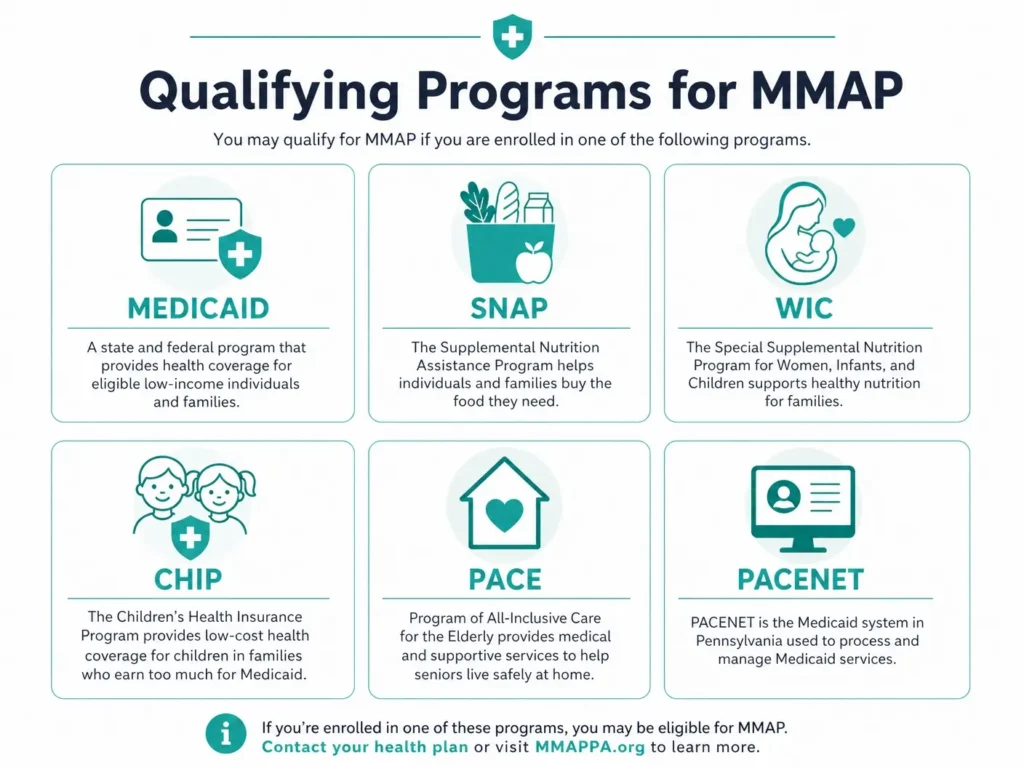
Medicaid (Medical Assistance — MA)
Pennsylvania’s Medicaid program, called Medical Assistance, covers adults with income up to 138% of the Federal Poverty Level (FPL), approximately $20,783 per year for a single individual in 2026, according to Health Insurance.org.
Pennsylvania expanded Medicaid under the ACA and currently serves over 3.5 million residents. Apply at COMPASS.state.pa.us or call 1-866-550-4355.
CHIP (Children’s Health Insurance Program)
Covers children in households with income up to 314% of FPL, approximately $98,296 annually for a family of four in 2026.
If your child is a minor registered as a PA MMJ patient through a caregiver, and your household is enrolled in CHIP, you may qualify for MMAP fee assistance. Apply through COMPASS.state.pa.us.
PACE and PACENET
Pennsylvania’s pharmaceutical assistance programs for residents aged 65 and older with limited income. PACE has lower income limits; PACENET covers slightly higher incomes. Both are funded through the Pennsylvania Lottery and administered by the PA Department of Aging.
PACE/PACENET participants are also the only group currently eligible for the Phase 3 $50 monthly dispensary benefit. Contact PACE directly at 1-800-225-7223 or visit aging.pa.gov. There is no cost to enroll in PACE.
SNAP (Supplemental Nutrition Assistance Program)
Formerly called food stamps, SNAP provides food purchasing assistance to low-income households of any age. Pennsylvania administers SNAP through county assistance offices.
If you receive SNAP benefits, you qualify for MMAP Phase 1 card fee waiver. Apply at COMPASS.state.pa.us.
WIC (Women, Infants, and Children)
A federal nutrition program for pregnant women, new mothers, infants, and children up to age 5 who meet income guidelines. If you or your child is a PA MMJ patient and you are enrolled in WIC, you qualify for MMAP Phase 1. Contact your local WIC office or visit pawic.com.
The Phase 3 Monthly $50 Benefit — What You Need to Know
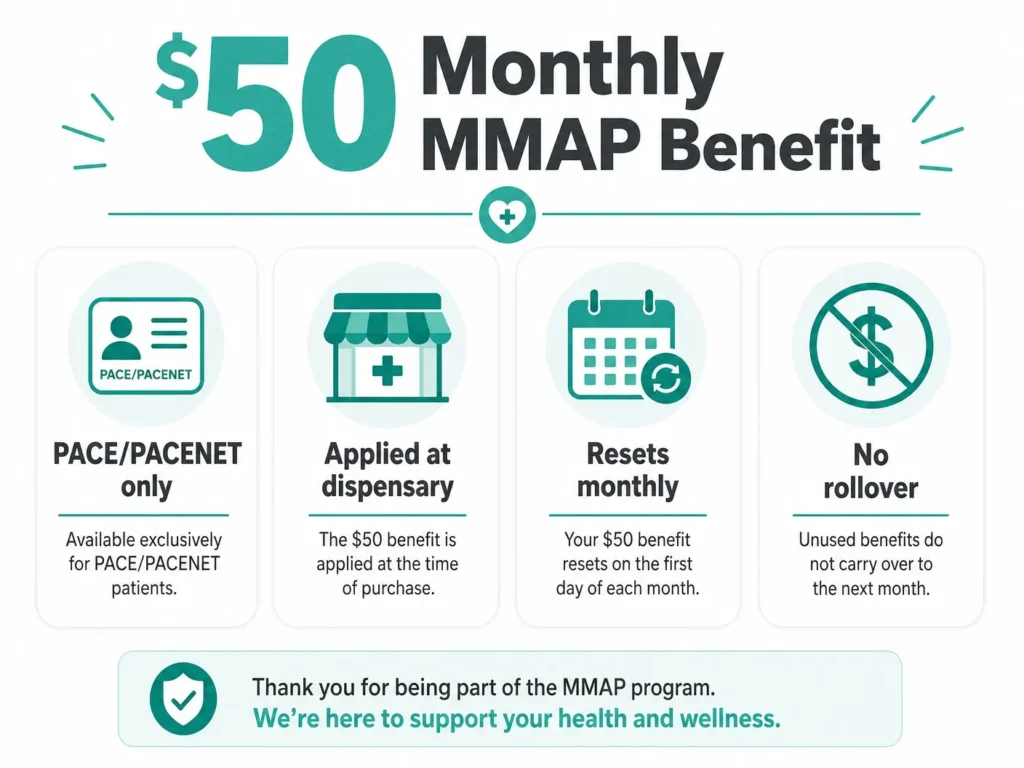
For PACE and PACENET patients who qualify for the Phase 3 pilot, the $50 monthly dispensary benefit is the most financially significant MMAP advantage. Here is everything you need to know about how it works in practice:
How the benefit is applied: The $50 credit is applied directly at the dispensary register when you make a purchase. You do not receive a check, a card, or cash. You present your PA MMJ patient card, the dispensary confirms your Phase 3 enrollment, and the $50 is applied to your purchase total.
Monthly reset: The benefit is $50 per calendar month, it resets on the first of each month. Unused balance does not roll over to the following month.
What it can buy: Any medical cannabis product sold at a licensed PA dispensary, flower, tinctures, vapes, capsules, topicals, troches, concentrates.
As of April 2026, the most affordable product options at PA dispensaries include dry leaf flower averaging approximately $7.59 per gram, down significantly from $14.90/gram in 2021, according to MMJ.com’s market data. At current prices, $50 buys approximately 6–7 grams of flower monthly.
What it cannot buy: Vaporizers, grinders, carrying cases, batteries, or any non-cannabis product.
Pilot scope limitation: Phase 3 is currently limited to approximately 1,000–3,000 PACE/PACENET patients. Expansion beyond the pilot is subject to future state budget allocation.
If you are a PACE/PACENET patient and believe you should be enrolled in Phase 3 but haven’t been notified, contact the PA MMJ helpdesk at 888-733-5595 for clarification on current pilot status.
MMAP for Caregivers — What’s Different
If you are registering as a caregiver for a PA MMJ patient rather than as a patient yourself, MMAP applies differently:
Phase 1 (Card fee waiver): The annual caregiver card fee is waived if the caregiver is enrolled in a qualifying Commonwealth financial hardship program. The patient’s program enrollment does not qualify the caregiver, the caregiver must have their own independent enrollment.
Phase 2 (Background check fee waiver): Caregivers are required to complete a federal background check as part of the PA MMJ registration process. Under Phase 2, this background check fee is completely eliminated for caregivers enrolled in a qualifying program. This benefit has been active since March 2022.
Caregiver registration additional requirements:
- Caregivers must be 18 years or older
- Caregivers cannot have a drug-related conviction within the past 5 years
- Each patient can designate a maximum of two caregivers
- Caregivers must present both the patient’s card and their own caregiver card at dispensary visits
For parents or guardians of minor patients: if your household is enrolled in CHIP, Medicaid, WIC, or SNAP, your caregiver application may qualify for MMAP Phase 1 and 2 fee waivers.
Complete the registration process the same way as described in Section 5, providing your qualifying program enrollment information when prompted.
Common Mistakes That Delay Your Application
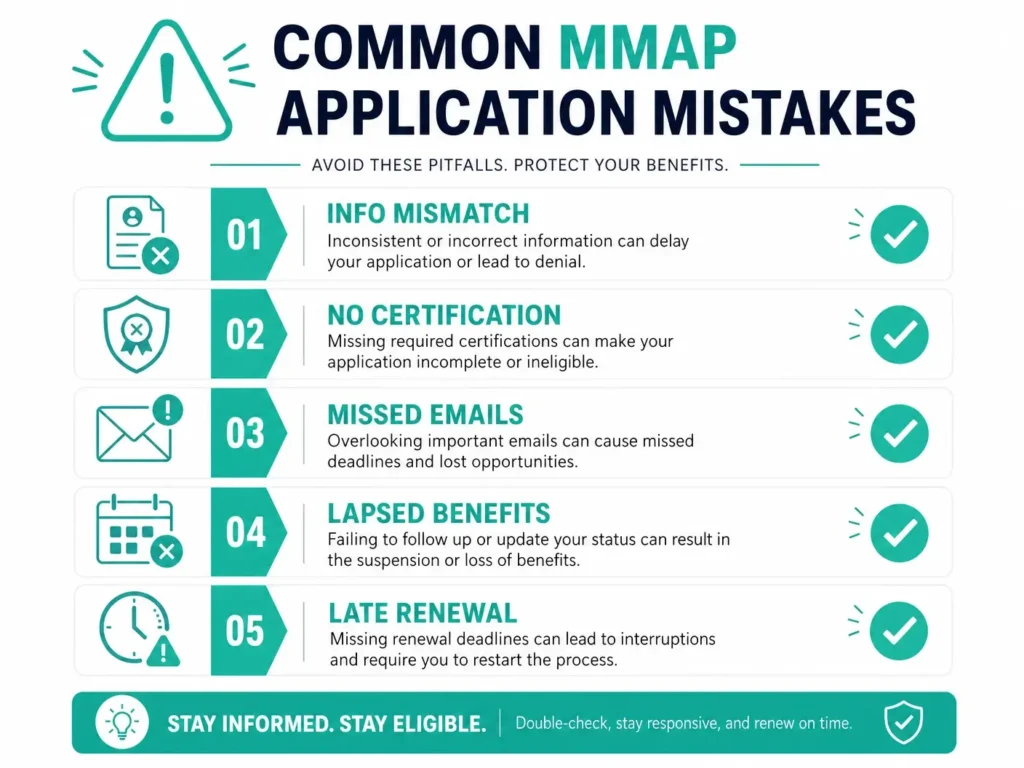
Based on current PA MMJ program data and patient experience as of April 2026, here are the most common mistakes that slow down or complicate the MMAP application process:
Mistake 1 — Entering mismatched information in the registry: Your registry name, address, and ID number must match your current PennDOT-issued ID exactly. Middle names, abbreviations, unit numbers, all must match. A mismatch causes the system to flag your application for manual review, adding days to weeks of delay. If you have moved, update PennDOT first.
Mistake 2 — Trying to apply for MMAP before completing physician certification: MMAP eligibility is verified during the patient registration completion step, after your physician certification has been submitted to your registry profile. Do not try to claim MMAP benefits before your certification is in the system.
Mistake 3 — Assuming everything is free: MMAP waives the state card fee. It does not waive the physician certification fee. Budget for the physician consultation separately.
Mistake 4 — Not checking your spam folder: Critical communications from the PA Department of Health, including your registration confirmation and card issuance notices, can end up in spam folders. Add the DOH email domain to your allowed senders list after creating your account.
Mistake 5 — Letting your qualifying program lapse: If your Medicaid, SNAP, WIC, CHIP, PACE, or PACENET enrollment lapses or is terminated — due to income changes, missed renewal, or other reasons, your MMAP eligibility also ends. Keep your qualifying program enrollment current to maintain your card fee waiver at renewal.
Mistake 6 — Waiting until your card expires to renew: Renewal should begin as soon as you receive your 60-day renewal reminder. Waiting until the last week risks a gap in your card validity, during which your legal protection from possession charges is temporarily removed.
What If You Don’t Qualify for MMAP? Alternative Savings Options
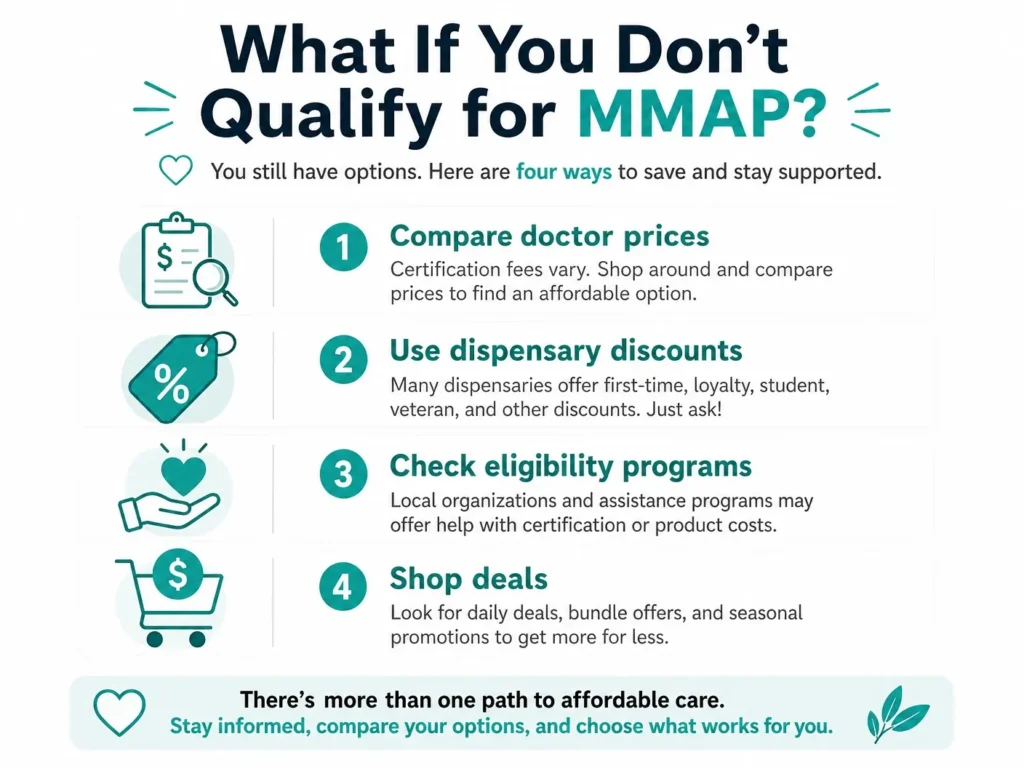
If you are not enrolled in a qualifying Commonwealth financial hardship program, MMAP benefits are not available to you but you still have options to reduce the cost of your PA MMJ card and cannabis purchases:
Shop for lower physician certification fees Physician certification fees vary significantly by provider. Some PA-licensed MMJ physicians charge as little as $75 for an initial certification, while others charge $200 or more. Compare providers before booking.
At Pennsylvania Marijuana Cards, we offer competitive certification pricing with fully online telehealth appointments.
Dispensary loyalty programs and patient discounts Nearly all licensed PA dispensaries offer their own patient discount programs, loyalty points, and regular sales. Many offer:
- First-time patient discounts (often 10–20% off)
- Veterans discounts
- Senior discounts
- Medical patient appreciation days with storewide discounts
Ask your dispensary about available programs when you visit for the first time.
Price comparison across dispensaries Pennsylvania’s dispensary market has become increasingly competitive. Dry leaf flower prices dropped from $14.90/gram in 2021 to approximately $7.59/gram in 2025, according to MMJ.com market data.
Shopping multiple dispensaries and watching for weekly sales can meaningfully reduce your ongoing cannabis costs.
Check if you might qualify for a program you haven’t applied for Many Pennsylvanians who qualify for Medicaid, SNAP, or WIC have not yet applied. If your household income is relatively modest, it is worth checking your eligibility at COMPASS.state.pa.us before concluding that MMAP is unavailable to you.
Getting Your PA MMJ Card After MMAP Approval
With MMAP verified and your card fee waived, the only remaining cost is your physician certification fee. Once that is paid and your certification is in the system, your PA medical marijuana card gives you:
- Legal protection from state criminal possession charges for dispensary-purchased cannabis
- Access to any of Pennsylvania’s 186+ licensed dispensaries statewide
- The ability to possess up to a 90-day supply of medical cannabis as determined by your dispensary pharmacist
- Employment anti-discrimination protections under the Medical Marijuana Act
Pennsylvania recognizes 24 qualifying conditions. Some of the most commonly certified include:
- Amyotrophic Lateral Sclerosis (ALS)
- Autism
- Cancer, including remission therapy
- Crohn’s Disease
- Damage to the nervous tissue of the central nervous system (brain-spinal cord) with objective neurological indication of intractable spasticity, and other associated neuropathies
- Epilepsy
- Glaucoma
- Positive status for Human Immunodeficiency Virus or Acquired Immune Deficiency Syndrome (HIV/AIDS)
- Huntington’s Disease
- Inflammatory Bowel Disease (IBD)
- Intractable Seizures
- Tourettes
- Multiple Sclerosis
- Neuropathies
- Parkinson’s Disease
- Post-traumatic Stress Disorder (PTSD)
- Severe chronic or intractable pain of neuropathic origin or severe chronic or intractable pain
- Sickle Cell Anemia
- Neurodegenerative diseases (i.e., Alzheimer’s Disease)
- Terminal illness
- Dyskinetic and spastic movement disorders
- Opioid use disorder for which conventional therapeutic interventions are contraindicated or ineffective, or for which adjunctive therapy is indicated in combination with primary therapeutic interventions
- Anxiety Disorder – — the #1 qualifying condition, cited in approximately 60% of all certifications
- Chronic Hepatitis C
View the complete list of all qualifying conditions at pennsylvaniamarijuanacards.com/pennsylvania-medical-marijuana-qualifying-conditions.
If you have a qualifying condition and are enrolled in Medicaid, SNAP, WIC, CHIP, PACE, or PACENET, your $50 state card fee is waived. Get started with your certification today and keep your physician certification cost as the only expense between you and legal cannabis access in Pennsylvania.
Frequently Asked Questions
Q: What is MMAP in Pennsylvania?
A: MMAP stands for Medical Marijuana Assistance Program. It is a Pennsylvania state program created under the Medical Marijuana Act that provides financial assistance to registered MMJ patients and caregivers who are enrolled in qualifying Commonwealth financial hardship programs. MMAP waives the $50 annual state card fee for eligible patients (Phase 1), eliminates caregiver background check fees (Phase 2), and provides a $50 monthly dispensary benefit for PACE/PACENET patients in the pilot (Phase 3).
Q: How do I apply for MMAP in PA online?
A: There is no separate MMAP application. Eligibility is verified automatically during your PA Medical Marijuana Registry registration. When completing your patient profile at padohmmp.custhelp.com, you provide your qualifying program enrollment information (Medicaid, SNAP, WIC, CHIP, PACE, or PACENET). The state verifies your enrollment and waives the $50 card fee automatically if you qualify.
Q: Is the PA medical marijuana card completely free with MMAP?
A: No. MMAP waives the $50 annual state registration fee. However, the physician certification fee, charged separately by the certifying physician, is not covered by MMAP. The certification typically costs $75–$200 depending on the provider. With MMAP, your total cost is reduced to the physician fee only.
Q: Which programs qualify for MMAP in Pennsylvania?
A: The qualifying Commonwealth financial hardship programs are: Medicaid (Medical Assistance), CHIP (Children’s Health Insurance Program), PACE (Pharmaceutical Assistance Contract for the Elderly), PACENET (PACE Needs Enhancement Tier), SNAP (Supplemental Nutrition Assistance Program), and WIC (Women, Infants, and Children).
Q: What is the Phase 3 $50 monthly benefit and who qualifies?
A: Phase 3 distributes a $50 monthly benefit per eligible patient toward cannabis purchases at licensed PA dispensaries. As of April 2026, Phase 3 is a pilot program limited to patients enrolled in PACE or PACENET only, not all MMAP qualifying programs. The $50 is applied at the register and cannot be used for devices or accessories. Expansion depends on future state funding.
Q: Does MMAP apply to renewals as well as first-time applications?
A: Yes. MMAP benefits apply annually at renewal, as long as your qualifying program enrollment (Medicaid, SNAP, WIC, CHIP, PACE, or PACENET) remains active. Your $50 fee is waived each year automatically upon verified enrollment. If your qualifying program enrollment lapses, you will need to pay the full $50 state fee at renewal.
Q: Can caregivers get MMAP benefits?
A: Yes. Caregivers enrolled in a qualifying Commonwealth financial hardship program qualify for Phase 1 (annual card fee waiver) and Phase 2 (background check fee waiver). The caregiver’s own program enrollment determines eligibility, not the patient’s enrollment.
Q: What is the PA MMJ helpdesk number?
A: The Pennsylvania Medical Marijuana Program helpdesk number is 888-733-5595. Hours are 7AM–9PM ET, seven days a week, excluding Pennsylvania state holidays. Call for questions about MMAP eligibility verification, registry issues, or card delivery status.
Q: What happens if I paid the $50 fee before applying for MMAP?
A: MMAP does not apply retroactively. If you paid the $50 state registration fee before verifying your MMAP eligibility, a refund is generally not available. Establish your MMAP eligibility during the registration process, before completing fee payment, to avoid this situation.
Q: Can I use MMAP benefits at any Pennsylvania dispensary?
A: Phase 1 (fee waiver) applies statewide, it is a registry-level benefit. Phase 3 ($50 monthly benefit for PACE/PACENET patients) is applied at participating dispensaries. Confirm with your dispensary whether they participate in Phase 3 benefit redemption when you visit.
The Bottom Line
Applying for MMAP in Pennsylvania online is straightforward once you understand the process and the most important thing to know is that it’s built into your standard MMJ registry registration, not a separate application.
If you are enrolled in Medicaid, SNAP, WIC, CHIP, PACE, or PACENET, your $50 annual state card fee is waived automatically through MMAP. If you are a PACE or PACENET patient in the Phase 3 pilot, you also receive $50 monthly toward cannabis purchases at licensed dispensaries.
The only cost you cannot avoid is the physician certification fee and at Pennsylvania Marijuana Cards, we offer fully online telehealth certifications at competitive rates, so cost is never a reason to delay the medical care you need.
If you have a qualifying condition and want to get started today, begin your certification here. Questions about whether your condition qualifies? Review the full list of PA qualifying conditions or learn more about anxiety disorder and medical marijuana in Pennsylvania.
Medically reviewed by Dr. Johnathon Chance Miller, MD. This article is for informational purposes only and reflects Pennsylvania Medical Marijuana Program information as of April 2026. Program details, eligibility requirements, and benefit amounts are subject to change. Always verify current information at pa.gov/agencies/health/programs/medical-marijuana/mmap or by calling the PA MMJ helpdesk at 888-733-5595.
Sources:
- PA Department of Health — Official MMAP Page
- PA Department of Health — Medical Marijuana Program
- Pennsylvania Medical Marijuana Registry Portal
- Pennsylvania State Cannabis — MMAP Overview
- MMJ.com — Pennsylvania Cannabis 2026 Complete Guide
- Quick Med Cards — PA Medical Marijuana Program 2026 Guide
- CannabisMD TeleMed — How to Get a Medical Marijuana Card in Pennsylvania 2026
- AR Cannabis Clinic — PA Medical Marijuana Fee Waiver
- Restore Dispensaries — Compassionate Use Programs PA
- Get Your ID Card — MMAP Guide
- The Greener Institute — MMAP
- PA COMPASS — Benefits Application Portal
- PA Department of Aging — PACE/PACENET
- Health Insurance.org — Pennsylvania Medicaid Eligibility