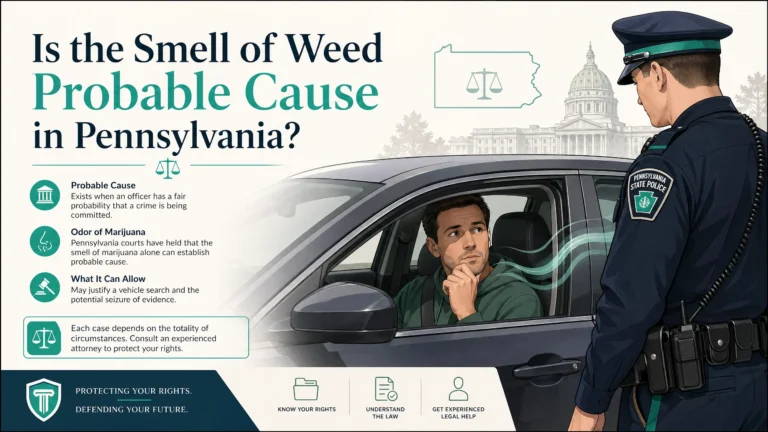

Is the smell of weed probable cause in PA? This is one of the most practically important legal questions for Pennsylvania residents who use cannabis and the answer changed dramatically in December 2021 when the Pennsylvania Supreme Court issued its landmark ruling in Commonwealth v. Barr.
The short answer: No, the smell of marijuana alone is no longer probable cause for a warrantless search in Pennsylvania. But the full answer is considerably more nuanced than that.
Need a PA Medical Marijuana Card?
Get certified online in 15 minutes. 100% Money-Back Guarantee.
Get Certified Now →The smell of weed is still a legal factor that police can consider. What it cannot be is the only factor. And in certain circumstances, particularly involving homes, illegal grow operations, or cannabis found without dispensary packaging, the calculus shifts significantly.
If you’re a Pennsylvania resident, medical marijuana patient or not, understanding exactly where this legal line sits protects you. This guide breaks it all down clearly.
What Is Probable Cause and Why Does It Matter?

Before diving into the marijuana-specific law, a quick grounding in what probable cause actually means because this is the standard everything else turns on.
Under the Fourth Amendment to the U.S. Constitution and Article I, Section 8 of the Pennsylvania Constitution, which provides even broader protections, people have the right to be free from unreasonable searches and seizures. Police generally need either:
- A warrant issued by a judge based on probable cause, or
- An exception to the warrant requirement — and one of the most commonly invoked exceptions for vehicles is that police can search without a warrant if they have probable cause to believe the vehicle contains contraband or evidence of a crime
Do You Qualify for a PA MMJ Card?
Connect with a licensed Pennsylvania state physician online from home.
Probable cause means a reasonable belief, based on specific and articulable facts, that a crime has been or is being committed. It is a higher standard than reasonable suspicion (which justifies briefly stopping someone) and lower than proof beyond a reasonable doubt (which is required for conviction).
Why does this matter for weed? Because before 2021, the smell of marijuana automatically satisfied the probable cause standard in Pennsylvania, giving police a green light to search any vehicle where they detected the odor, no questions asked. That is no longer the law.
What Was the “Plain Smell Doctrine” in Pennsylvania?

For decades before Pennsylvania legalized medical marijuana in 2016, the legal framework was simple: if police smelled marijuana, they had probable cause to search. This was known as the “plain smell doctrine”, an extension of the plain view doctrine applied to olfactory detection.
The logic was equally simple: because marijuana was completely illegal for everyone under Pennsylvania law, detecting its odor was inherently indicative of criminal activity. The smell of marijuana meant marijuana was present. Marijuana was a crime. Therefore: probable cause.
As Shrager Defense Attorneys explain: “Prior to the effective date (May 2016) of the Medical Marijuana Act (MMA), it was illegal for any person in Pennsylvania to possess even small amounts of marijuana. Therefore, the unique scent of it alone was indicative that a crime had been or was being committed.”
This doctrine made it extraordinarily easy for police to justify vehicle searches in drug enforcement contexts. Claiming to smell marijuana, whether accurate or not, functioned as an automatic warrant substitute for vehicle searches. The MMA changed that foundation entirely.
Commonwealth v. Barr — The Ruling That Changed Everything

The case that upended the plain smell doctrine in Pennsylvania began with a routine traffic stop in Allentown in November 2018.
Pennsylvania State Police troopers pulled over a vehicle after it failed to properly stop at a stop sign. As the troopers approached, they smelled burnt marijuana through the window.
The driver — Teri Barr and her passenger, Timothy Barr, both immediately presented valid Pennsylvania medical marijuana cards to the troopers.
Despite this, the troopers conducted a warrantless search of the vehicle, stating that the marijuana odor alone justified the search. They also claimed to believe — incorrectly, that medical marijuana could only be consumed through a vape pen that would not produce a smell, and therefore the odor indicated illegal marijuana.
⚡ Fast & 100% Online PA Medical Cards
Board-Certified Doctors • 100% Money-Back Guarantee
Book Evaluation Now →The search produced:
- A Ziploc bag containing less than 1 gram of marijuana with no dispensary packaging or barcode
- Unused Ziploc baggies commonly associated with drug distribution
- A loaded firearm found under the driver’s seat
Barr was charged with firearm and drug-related offenses. He filed a motion to suppress the evidence, arguing the search violated his constitutional rights.
The case traveled through the Pennsylvania court system over three years:
- Trial Court (2019): Granted the suppression motion. The smell of marijuana no longer establishes probable cause given the MMA.
- Pennsylvania Superior Court (September 2020): Commonwealth v. Barr, 240 A.3d 1263. Agreed smell alone isn’t enough, but said the trial court should have considered additional factors including the troopers’ experience, the defendants’ demeanor, and the “high crime area” location.
- Pennsylvania Supreme Court (December 29, 2021): Commonwealth v. Barr, 252 A.3d 1086. Reversed the Superior Court’s remand. The evidence must be suppressed. The odor of marijuana alone does not constitute probable cause for a warrantless vehicle search.
What the Ruling Actually Says — The Exact Legal Standard
Chief Justice Max Baer wrote the majority opinion for the Pennsylvania Supreme Court. The key holdings, in the Court’s exact words:
“The odor of marijuana alone does not amount to probable cause to conduct a warrantless search of the vehicle but, rather, may be considered as a factor in examining the totality of the circumstances.”
The Court’s reasoning was grounded directly in the Medical Marijuana Act:
“We conclude that the MMA makes abundantly clear that marijuana no longer is per se illegal in this Commonwealth. Accordingly, the enactment of the MMA eliminated this main pillar supporting the ‘plain smell’ doctrine as applied to the possession or use of marijuana.”
And most critically:
“So long as a patient complies with the dictates of the MMA, that person can legally possess and consume various forms of medical marijuana, including the plant itself. Accordingly, the smell of marijuana alone cannot create probable cause to justify a search under the state and federal constitutions.”
The Court’s underlying logic mirrors an earlier ruling, Commonwealth v. Hicks (2019), where the Pennsylvania Supreme Court ruled police could not infer criminal activity merely from a person carrying a concealed firearm because firearms can be lawfully carried. The same principle applies: because marijuana can be lawfully possessed by medical patients, its odor alone cannot signal criminal activity.
What Factors Can Police Use Alongside Smell?

The Barr ruling didn’t eliminate marijuana odor from probable cause analysis, it just prevented it from being the only factor. Courts evaluate probable cause under the “totality of the circumstances” standard, meaning police can combine multiple observations to build the necessary level of suspicion.
Renewing Your PA MMJ Card?
Quick annual recertification online. No paperwork hassle.
Renew Card Online →Here are the additional factors that Pennsylvania courts have recognized as relevant alongside marijuana odor in the probable cause analysis:
Packaging and appearance Cannabis found outside its original dispensary packaging, no barcode, no label, no sealed container from a licensed PA dispensary, is a significant factor.
As Justice Dougherty noted in his concurrence in Barr: “Where an officer who smells marijuana also observes its packaging (or lack thereof) and there is no barcode or other identifying information that typically appears on the original packaging from a dispensary, that could be enough to establish probable cause.”
Quantity suggesting distribution Large quantities of cannabis inconsistent with personal medical use, combined with the presence of distribution paraphernalia (baggies, scales, large amounts of cash), can contribute to probable cause.
Visible marijuana or paraphernalia If cannabis or drug paraphernalia is visible inside the vehicle alongside the smell, this adds a separate evidentiary basis.
Suspicious behavior Furtive movements reaching under seats, attempting to conceal items, or attempting to flee, can contribute to the totality analysis.
Location context Courts have considered whether a stop occurred in a high-crime area or an area known for drug trafficking, though this factor alone is insufficient and the courts have treated it cautiously.
Officer training and experience Courts give weight to an officer’s ability to distinguish different odors and recognize drug-related indicators based on their specific training and experience.
Information from informants A tip from a credible informant about drug activity, combined with marijuana odor, can contribute to the totality analysis.
What is NOT sufficient in addition to smell: The Superior Court in Barr initially sent the case back for consideration of the “high crime area” and officer experience factors. The Supreme Court reversed this, finding that those factors alone, combined only with smell, did not salvage the probable cause determination. The Court was clear: the additional factors must be genuinely meaningful, not pretextual.
The Packaging Exception — A Critical Detail Most People Miss

One of the most practically important points in the Barr litigation is the dispensary packaging observation and it has direct implications for how PA medical marijuana patients should transport their cannabis.
Get Approved by a Licensed PA Doctor
Schedule your appointment in minutes. You only pay if approved.
Start Online Application →Justice Dougherty’s concurrence specifically identified the absence of dispensary packaging as potentially constitutive of probable cause when combined with smell. In the Barr case itself, the marijuana found was in a plain Ziploc bag with no dispensary identification, not in original licensed dispensary packaging.
What this means for you practically:
Every product purchased from a licensed Pennsylvania dispensary comes in sealed, labeled packaging with:
- The dispensary’s name
- A barcode and product identification
- Patient-specific labeling
- Compliance with PA Department of Health packaging requirements
If your cannabis is in its original, intact dispensary packaging when police encounter it alongside an odor, this significantly weakens any argument that the odor indicates illegal activity. The packaging itself is evidence that the marijuana was legally purchased.
Conversely: If your cannabis is out of its original packaging, in a plain bag, loose in a pocket, or transferred to another container, this increases the likelihood that an officer can build probable cause by combining the smell with the packaging observation.
The practical rule for every PA patient: Keep your dispensary-purchased cannabis in its original packaging at all times during transport. This is already required under Pennsylvania law but it also provides meaningful Fourth Amendment protection.
Vehicles vs. Homes — The Rules Are Different

A critical limitation of Commonwealth v. Barr that most guides fail to adequately address: the ruling specifically addressed vehicle searches. Homes and other premises operate under a different and generally stronger, constitutional framework.
Why vehicles are treated differently: The vehicle exception to the warrant requirement has long been recognized by both federal and Pennsylvania courts. Because vehicles are mobile, the threat of evidence being driven away before a warrant can be obtained justifies a lower threshold for warrantless searches. Barr applies this exception but changes how marijuana odor functions within it.
Homes have stronger protections: The Fourth Amendment and Pennsylvania Constitution provide the highest level of protection for private residences. Police generally need a warrant to search a home, even if they smell marijuana from outside. The automobile exception does not apply to homes. An officer smelling marijuana from outside your front door does not automatically create an exception to the warrant requirement for homes in the way it once did for vehicles.
However — as the 2025 Commonwealth v. Batista case demonstrates, the smell of marijuana can contribute to probable cause for obtaining a warrant to search a home when combined with other circumstances. The key difference is the warrant requirement itself.
Commonwealth v. Batista — The 2025 Home/Garage Ruling
Ready to Get Your Official PA MMJ Card?
State-certified doctor consultations online. No risk—100% refund if not approved.
Claim Your MMJ Card Online →A 2025 Pennsylvania Superior Court ruling, Commonwealth v. Batista, addressed the smell of marijuana in the context of a home search and illustrates how the analysis differs from vehicles.
As My State College Lawyer reports, in Batista, police received an anonymous tip about a suspected marijuana grow operation in a private garage in Philadelphia. The tipster reported:
- Strong odors of fresh marijuana coming from the property
- The presence of surveillance cameras — indicators commonly associated with illegal operations
Police used this information, combined with the marijuana odor, to obtain a search warrant (not to conduct a warrantless search). The warrant was issued and the search was executed.
The Superior Court upheld the warrant, noting two critical factors that distinguish this from Barr:
The grow operation context: The court emphasized that only a small number of growers are legally permitted under Pennsylvania’s Medical Marijuana Act, making it reasonable for police to suspect illegal activity when marijuana odors are detected.
Unlike personal possession, where hundreds of thousands of PA patients legally possess marijuana, licensed commercial growers are extremely limited in number. Detecting cultivation odors dramatically increases the probability of illegal activity.
A warrant was obtained: Unlike Barr, where troopers conducted a warrantless search, the Batista officers appropriately sought a judicial warrant. Even if the smell of marijuana alone cannot justify a warrantless home search, it can contribute to probable cause for a warrant application alongside other factors.
The practical takeaway from Batista:
- Home cultivation is illegal in Pennsylvania for everyone, including medical patients
- Odors from growing operations are a much stronger probable cause indicator than odors from personal use
- The warrant requirement for home searches remains a meaningful protection — but obtaining a warrant based partly on marijuana smell is permissible when additional factors are present
What About Drug-Sniffing Dogs?

A question many Pennsylvania residents have: can police use drug-sniffing dogs to detect marijuana at a traffic stop, and does a dog alert constitute probable cause after Barr?
This is a genuinely unsettled area of law in Pennsylvania and the answer is complicated.
The science problem: Drug detection dogs are trained to identify cannabis through the plant’s terpene profile, particularly myrcene and other aromatic compounds that give cannabis its characteristic smell.
Critically, as Salt Baked City News explains, terpenes are found in essentially all cannabis, medical or recreational, legal or illegal. A drug dog cannot distinguish between legally possessed medical marijuana and illegally possessed recreational marijuana. The dog will alert to both.
The legal problem this creates: If a dog’s alert to marijuana is used as probable cause for a vehicle search, and the dog cannot distinguish between legal and illegal marijuana, then the dog alert functionally provides no more information than human smell detection, which Barr says is insufficient alone.
Several states have grappled with this question. In Michigan, for example, courts have addressed whether post-legalization dog alerts to cannabis satisfy probable cause. Pennsylvania courts have not yet issued definitive guidance specifically on dog alerts post-Barr, making this an active area of evolving law.
The practical reality: Law enforcement may still deploy drug detection dogs, and officers may still conduct searches following dog alerts. If a search occurs following a dog alert to marijuana, whether that alert satisfies probable cause is a question for the courts and a strong argument for a suppression motion if no other factors were present.
What To Do If Police Say They Smell Weed?

This section is the most practically important for Pennsylvania residents. If you are stopped by police who claim to smell marijuana, here is what to know:
Know your rights — calmly: You have the right to remain silent. You are not required to answer questions beyond identifying yourself. You can and generally should, clearly but calmly assert your rights without being hostile.
Do not consent to a search: Consenting to a search eliminates your Fourth Amendment protections entirely. If police ask “Can I search your car?”, the answer that preserves your rights is: “I do not consent to a search.” Say this clearly and calmly. You are not required to explain why.
Asserting your rights does not equal guilt: A refusal to consent to a search cannot legally be used as evidence of guilt or treated as probable cause. If police have probable cause, they will search regardless of your consent. Refusing simply ensures that if they search without proper legal basis, the evidence may be suppressed.
Show your medical marijuana card if you have one: If you are a registered PA MMJ patient, present your card. As the Barr case itself illustrates, the Barrs presented their medical cards and this became part of the legal record that ultimately led to suppression of the evidence. Having a valid card doesn’t make you immune from a search, but it changes the legal landscape and weakens any subsequent probable cause argument.
Keep your product in original dispensary packaging: As covered in Section 6, original dispensary packaging with visible labeling and barcodes significantly weakens an officer’s ability to argue that the smell indicates illegal marijuana.
Do not physically resist: Even if a search is unlawful, physically resisting a police officer creates serious criminal liability. The remedy for an unlawful search is suppression in court, not resistance at the scene.
Document what happens: After any encounter, write down or record everything you can remember: the time, location, officers’ names and badge numbers, what was said, what was searched, and what was found. This documentation is invaluable for your attorney.
Ask if you are free to go: If you have not been arrested, you can ask: “Am I free to go?” If yes, leave calmly. If no, you are being detained, in which case, ask clearly: “Am I under arrest?” If not under arrest, continue to assert your right to remain silent.
If You Have a PA Medical Marijuana Card — How It Changes Things

For registered Pennsylvania medical marijuana patients, the post-Barr legal landscape has meaningful practical implications.
Your card doesn’t make you immune but it matters: Presenting a valid PA MMJ card during a traffic stop where marijuana odor is present does several things legally:
- It establishes on the record that you have a legal basis to possess cannabis
- It removes the automatic inference that the odor indicates criminal activity
- It places the burden on the officer to identify additional factors beyond the smell to justify a search
- If a search occurs anyway and evidence is found, your card status becomes part of the suppression motion analysis
In Barr itself, the Barrs’ medical cards were a central fact in the suppression motion that ultimately succeeded.
Your card and the packaging rule together: A medical card + original dispensary packaging = the two strongest protections a patient can have during a traffic encounter. The combination means: (1) you are documented as a legal possessor, and (2) the cannabis is visibly consistent with legal possession.
What your card does NOT do: Your card does not prohibit police from using marijuana smell as one factor in a totality analysis. It does not prevent a search if additional factors are present. And as the Batista case shows, in the context of illegal growing activity, even card status is irrelevant.
Annual card renewal matters here too: An expired or lapsed card doesn’t provide the same protections as an active one. Keep your card current. Pennsylvania’s card renewal process is the same online process as the initial application, completed annually. You’ll receive a reminder 60 days before expiration.
If you don’t yet have a PA medical marijuana card and have a qualifying condition, getting one provides not just legal purchasing rights but also meaningful Fourth Amendment protection during encounters with law enforcement. Learn more about qualifying conditions or get started today.
How Other States Compare — PA Is Not Alone
Pennsylvania’s Barr ruling is part of a national legal trend driven by state-level marijuana legalization. According to State Court Report’s analysis, state courts in Colorado, Illinois, Minnesota, Michigan, Delaware, Maryland, and Virginia have all reached similar conclusions, limiting the ability of police to search solely on the basis of marijuana odor.
The common thread: once marijuana becomes legal for at least some portion of the population, detecting its odor no longer automatically signals illegal activity. The inference that smell equals crime collapses when smell can equally indicate lawful conduct.
Michigan (2025): The Michigan Supreme Court in People v. Armstrong held that marijuana smell alone does not establish probable cause for a warrantless vehicle search, mirroring Pennsylvania’s Barr ruling with a similar rationale tied to that state’s recreational legalization.
Colorado and Illinois: Both states, with full recreational legalization, have adopted similar approaches in case law, marijuana odor alone is legally insufficient for a warrantless search.
States that still allow smell as probable cause: States where marijuana remains fully illegal with no medical program, still apply the traditional plain smell doctrine. In those jurisdictions, detecting marijuana odor retains its pre-MMA function as automatic probable cause.
The legal trend is clear: as more states legalize or decriminalize marijuana, the plain smell doctrine continues to erode. If Pennsylvania eventually legalizes recreational cannabis, which pending bills like SB 120 propose, the protections against smell-based searches would likely expand even further.
If You Were Searched Based on Smell Alone — What to Do
If police searched your vehicle or home based solely or primarily on the smell of marijuana and you believe this search was unlawful under Barr, you have legal recourse.
Motion to Suppress: In Pennsylvania criminal proceedings, a defendant can file a motion to suppress evidence arguing that the search was conducted without proper legal basis. If the court agrees the search was unlawful, any evidence obtained during that search, marijuana, firearms, paraphernalia, anything, can be suppressed, meaning it cannot be used against you at trial.
As Matthew Zatko’s legal analysis explains: “The Supreme Court affirmed, stating that ‘the odor of marijuana may be a factor, but not a standalone one, in evaluating the totality of the circumstances for purposes of determining whether police had probable cause to conduct a warrantless search.'”
A successful suppression motion often results in charges being dropped entirely because if the evidence cannot be used, the prosecution has no case.
What you need for a suppression motion:
- A detailed account of exactly what happened before, during, and after the search
- Any documentation of what was said by officers
- Evidence that the search was based only on smell, without additional factors
- Confirmation that you did not consent to the search
Who to contact: A Pennsylvania criminal defense attorney familiar with post-Barr case law is essential. This area of law is evolving rapidly and requires counsel who understands the current state of the “totality of circumstances” analysis.
If you are a registered medical marijuana patient, your card status becomes a key element of the suppression motion, as it did in Barr itself.
Frequently Asked Questions
Q: Is the smell of weed probable cause in PA?
A: No — not on its own. Since the Pennsylvania Supreme Court’s ruling in Commonwealth v. Barr (December 29, 2021), the smell of marijuana alone is no longer sufficient probable cause for a warrantless vehicle search in Pennsylvania. The odor may be considered as one factor in the “totality of the circumstances” analysis, but police must have additional factors beyond smell alone to establish probable cause.
Q: What was Commonwealth v. Barr?
A: Commonwealth v. Barr, 252 A.3d 1086 (Pa. 2021), is the landmark Pennsylvania Supreme Court ruling that ended the “plain smell doctrine” for marijuana. The Court held that because the Medical Marijuana Act made marijuana legal for registered patients, its odor no longer automatically indicates criminal activity. The ruling required suppression of evidence found during a warrantless vehicle search based solely on marijuana smell.
Q: Can police still search my car if they smell weed in PA?
A: Potentially yes — but only if they have additional factors beyond smell alone. The smell of marijuana is still a legally relevant factor. Combined with other circumstances, lack of dispensary packaging, suspicious behavior, visible contraband, large quantities, or distribution paraphernalia, police may establish the totality of circumstances needed for probable cause. Smell alone, however, is legally insufficient.
Q: Does my PA medical marijuana card protect me from vehicle searches?
A: Your card significantly changes the legal analysis by establishing a lawful basis for possessing marijuana. Officers cannot use smell alone to infer illegal activity when a valid medical card is presented. However, your card does not make you completely immune from searches if other probable cause factors are present. Always present your card during any encounter where cannabis is relevant, and keep your product in original dispensary packaging.
Q: Is the smell of weed probable cause to search my home in PA?
A: For homes, the analysis is different, homes have stronger constitutional protections and generally require a warrant. Police cannot conduct a warrantless search of your home based on smelling marijuana outside. However, the smell can contribute to probable cause for obtaining a search warrant when combined with other factors, as the 2025 Commonwealth v. Batista ruling confirmed in the context of a suspected illegal grow operation.
Q: What should I do if police want to search my car because they smell weed?
A: Calmly and clearly state: “I do not consent to a search.” Present your medical marijuana card if you have one. Keep your cannabis in original dispensary packaging. Do not physically resist. If police search anyway, document everything and contact a criminal defense attorney immediately to explore whether a motion to suppress is appropriate.
Q: What happens if evidence was found during an illegal smell-based search?
A: You can file a motion to suppress the evidence in court. If the court finds the search violated your Fourth Amendment or Pennsylvania constitutional rights because it was based on smell alone without additional probable cause factors, the evidence must be excluded. Without that evidence, charges are often dropped entirely.
Q: Does a drug dog alert to marijuana still establish probable cause after Barr?
A: This remains unsettled in Pennsylvania. Drug dogs cannot distinguish between legally possessed medical marijuana and illegal marijuana. Whether a dog alert to cannabis constitutes probable cause post-Barr is an active area of legal development. If you are searched following a drug dog alert to cannabis alone, this may be a viable basis for a suppression motion, consult a criminal defense attorney.
The Bottom Line

Is the smell of weed probable cause in PA? Since December 29, 2021, the answer is no, not on its own. The Pennsylvania Supreme Court’s ruling in Commonwealth v. Barr fundamentally changed the legal landscape by recognizing that the legalization of medical marijuana eliminated the foundation of the plain smell doctrine.
The smell of marijuana can still be one factor in a totality of circumstances analysis. But combined only with factors like officer experience or a “high crime area,” it is not enough. Additional, meaningful evidence of illegal activity is required.
For Pennsylvania residents and especially for registered medical marijuana patients, the practical takeaway is clear: carry your card, keep your cannabis in original dispensary packaging, know how to calmly invoke your rights, and contact a defense attorney immediately if you believe a search was conducted unlawfully.
Getting a PA medical marijuana card doesn’t just give you legal access to cannabis, it gives you meaningful legal protection in exactly the kind of situation Barr addressed. If you have a qualifying condition and want to understand more about how the program works, explore all 24 qualifying conditions or get started with your certification today.
This article is for informational and educational purposes only and does not constitute legal advice. Pennsylvania search and seizure law is actively evolving. If you have been arrested or charged following a vehicle or home search, consult a licensed Pennsylvania criminal defense attorney immediately.
Sources
- Commonwealth v. Barr, 252 A.3d 1086 (Pa. 2021) — Goldstein Mehta LLC
- NORML — Pennsylvania Supreme Court: Marijuana Odor Insufficient for Warrantless Search
- CBS Pittsburgh — PA Supreme Court Rules Smell of Marijuana Alone Not Enough
- Shrager Defense Attorneys — Marijuana Smell Alone Insufficient for Warrantless Search
- Clark Hill PLC — Shifting Cannabis Standards in Pennsylvania
- Ketchel Law — Pennsylvania Smell Marijuana Warrantless Search
- Matthew Zatko Law — Pot Smell Alone Doesn’t Give Police Probable Cause
- My State College Lawyer — Marijuana Odor Is a Factor in Probable Cause (2025)
- My State College Lawyer — PA Court Holds Odor of Marijuana Alone Not Probable Cause
- Criminal Legal News — PA Supreme Court: Smell of Marijuana Not Standalone Probable Cause
- Salt Baked City News — The Odor of Probable Cause: Drug Dogs and Terpenes
- State Court Report — State Legalization Changing Search and Seizure Law
- PA Department of Health — Medical Marijuana Program