
Hash rosin vs live rosin — If you have been browsing a Pennsylvania dispensary menu and found yourself staring at these two product names wondering what actually separates them, you are not alone. Both are solventless concentrates. Both are premium products. Both sit at the top of most dispensary menus in terms of quality and price. And yet the experience they deliver — the flavor, the effect, the texture — can be meaningfully different depending on which one you choose.
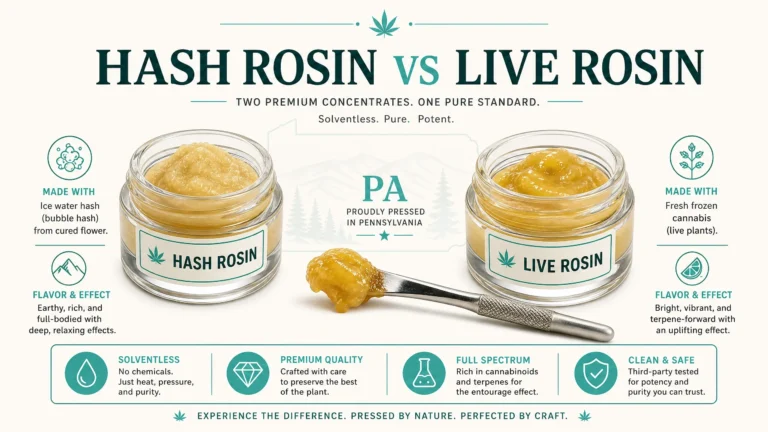
The single most important thing to understand: The difference between hash rosin and live rosin comes down to one variable — the starting material. Everything else — the flavor difference, the price difference, the potency difference, the texture difference — flows directly from that single distinction.
This guide explains exactly what that means in plain language, walks through every meaningful difference between the two, introduces the premium fourth tier most guides ignore entirely, and helps you decide which one belongs in your next dispensary visit.
The Rosin Family — Where Hash Rosin and Live Rosin Fit
Before comparing hash rosin and live rosin directly, it helps to understand where both sit within the broader rosin family — because most people come to this comparison without that context, which makes everything more confusing.
Rosin is a category of cannabis concentrate defined by one shared characteristic: it is made without chemical solvents. No butane, no propane, no CO2. Just heat, pressure, and sometimes ice water. This solventless production is what makes all rosin products premium — the absence of chemical extraction means no risk of residual solvents in the final product, and typically a cleaner, more complete expression of the plant’s natural compounds.
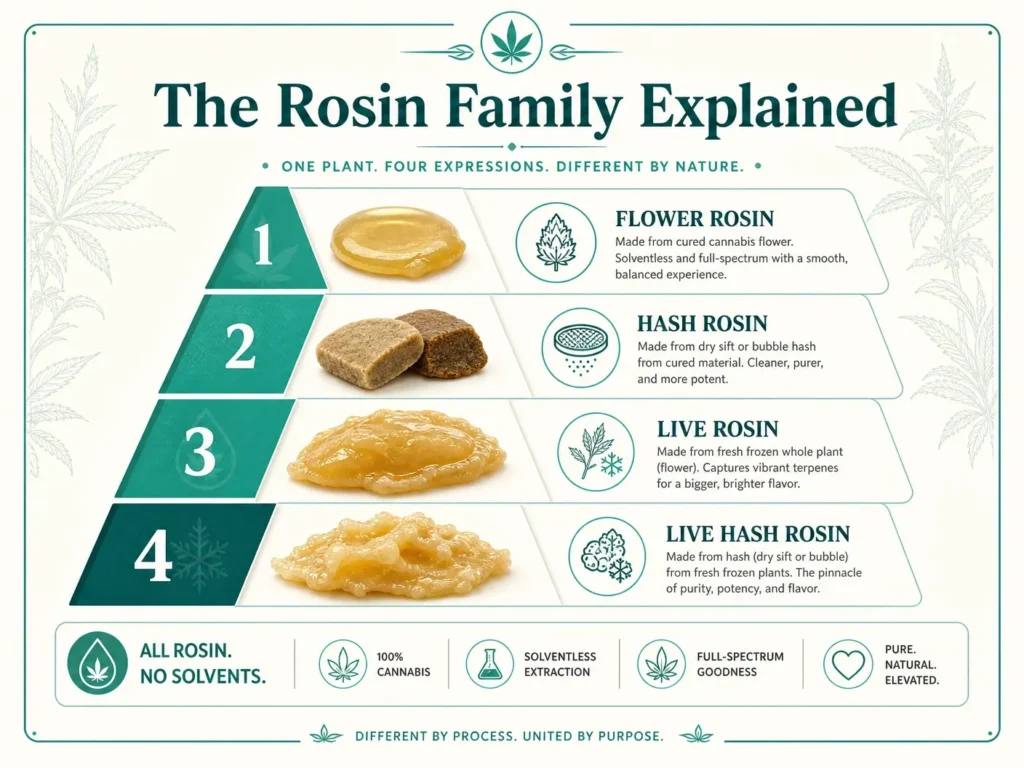
Within the rosin family, there are four tiers:
Tier 1 — Flower Rosin Made by pressing whole dried cannabis flower directly between heated plates. The simplest and most accessible form of rosin — lowest price, lower yield, more plant material in the final product. Least refined option.
Tier 2 — Hash Rosin Made from dried and cured cannabis that is first processed into bubble hash using ice water extraction, then pressed. The intermediate step of making bubble hash before pressing significantly increases purity and potency compared to flower rosin.
Tier 3 — Live Rosin Made from fresh-frozen cannabis — plant material that was frozen immediately after harvest without going through drying or curing — processed into bubble hash, then pressed. The “live” starting material preserves terpenes that would otherwise degrade during drying, producing the freshest, most terpene-rich result.
Tier 4 — Live Hash Rosin The most refined category — using only the finest isolated trichome heads from fresh-frozen material (typically 73–90 micron bubble hash) rather than whole plant material. This is the pinnacle of solventless extraction. Covered in detail in Section 10.
Hash rosin and live rosin are Tiers 2 and 3. They share the same extraction method — ice water washing into bubble hash followed by pressing — but diverge at the very first step: what goes into the wash.
What Is Hash Rosin? The Complete Explanation
Hash rosin begins with dried and cured cannabis flower — the same starting material as the flower you would vaporize in a dry herb vaporizer, but put through a significantly more refined extraction process.
The hash rosin production process:
Step 1 — Cure the flower Cannabis is harvested and then dried and cured — a process that removes moisture and develops the plant’s flavor profile over days to weeks. During curing, some terpenes naturally volatilize and degrade. This is an important detail that directly affects the end product’s flavor.
Step 2 — Ice water extraction (bubble hash) The cured flower is placed into ice water and agitated — either by hand or mechanically. The cold water causes the trichome heads (the resin glands containing cannabinoids and terpenes) to become brittle and break off from the plant material. The resulting slurry is filtered through a series of mesh bags of varying sizes called micron bags. Different micron sizes collect different grades of trichome material.
The most common micron ranges used:
- 25–45 micron: Finest grade — small trichome heads, often the most potent
- 73–90 micron: Premium “full melt” grade — the sweet spot for quality and yield
- 120–160 micron: Broader collection — higher yield but less refined
The resulting material — dried trichome heads separated from plant matter — is the bubble hash. The quality grade of bubble hash is often rated on a star system (1–6 stars), with 4–6 star “full melt” hash being pressing-grade material.
Step 3 — Pressing The pressing-grade bubble hash is placed in a micron filter bag and pressed between heated plates at precisely controlled temperature (typically 150–220°F) and pressure. The heat and pressure cause the resin to flow out of the bag as a viscous oil — this is the rosin.
Step 4 — Post-processing The fresh-pressed rosin is collected and processed into its final texture — cold-cured, whipped into badder, pressed into a jam consistency, or left as a sauce. This post-processing step significantly affects the final product’s texture and usability.
The result: A premium solventless concentrate with strong potency, excellent flavor, and a terpene profile influenced by the curing process — typically deeper, earthier, and more mellow than live rosin.
What Is Live Rosin? The Complete Explanation
Live rosin begins with fresh-frozen cannabis — plant material that is harvested and immediately frozen, bypassing the drying and curing process entirely. The word “live” refers to this fresh state — the plant is processed while its biochemistry is essentially still alive.
Why freeze immediately? Terpenes — the aromatic compounds responsible for cannabis flavor and a significant portion of its therapeutic effect — are volatile. They begin to degrade within hours of harvest. Research on cannabis terpene degradation has shown that conventional drying and curing can result in the loss of 30–60% of a plant’s volatile terpene content depending on conditions and duration.
By freezing immediately after harvest, live rosin production locks in the full terpene profile at its peak — capturing compounds that would otherwise evaporate or transform during the curing process.
The live rosin production process:
Step 1 — Fresh freeze immediately after harvest Plants are harvested at peak ripeness and immediately placed in a freezer — typically within hours of cutting. Temperature is maintained at approximately -10°F to -20°F to halt all biochemical activity and preserve volatile compounds.
Step 2 — Ice water extraction at cold temperatures The fresh-frozen material is processed through ice water extraction in the same way as hash rosin — but with more precise temperature control throughout to prevent terpene loss. The extremely cold conditions during washing help the trichomes separate cleanly while preserving their integrity.
Step 3 — Freeze drying Unlike hash rosin, where the bubble hash can air-dry, live rosin bubble hash is typically freeze-dried — a process that removes water while keeping the hash at low temperatures, preserving volatile terpenes that would otherwise escape during traditional drying.
Step 4 — Pressing at carefully controlled temperatures Live rosin requires more precise temperature control during pressing than hash rosin — typically lower temperatures (140–190°F) to protect the additional volatile terpenes. Higher moisture content in the fresh-frozen starting material also requires careful management during pressing.
Step 5 — Post-processing Same options as hash rosin — cold cure, badder, jam, sauce — but live rosin’s higher terpene and moisture content often results in a softer, more malleable texture at room temperature.
The result: A premium solventless concentrate with a brighter, more intense, fresher terpene profile that more closely represents the living plant — often described as fruity, floral, or citrus-forward rather than the earthy, deep profile of hash rosin.
The One Variable That Changes Everything — Starting Material
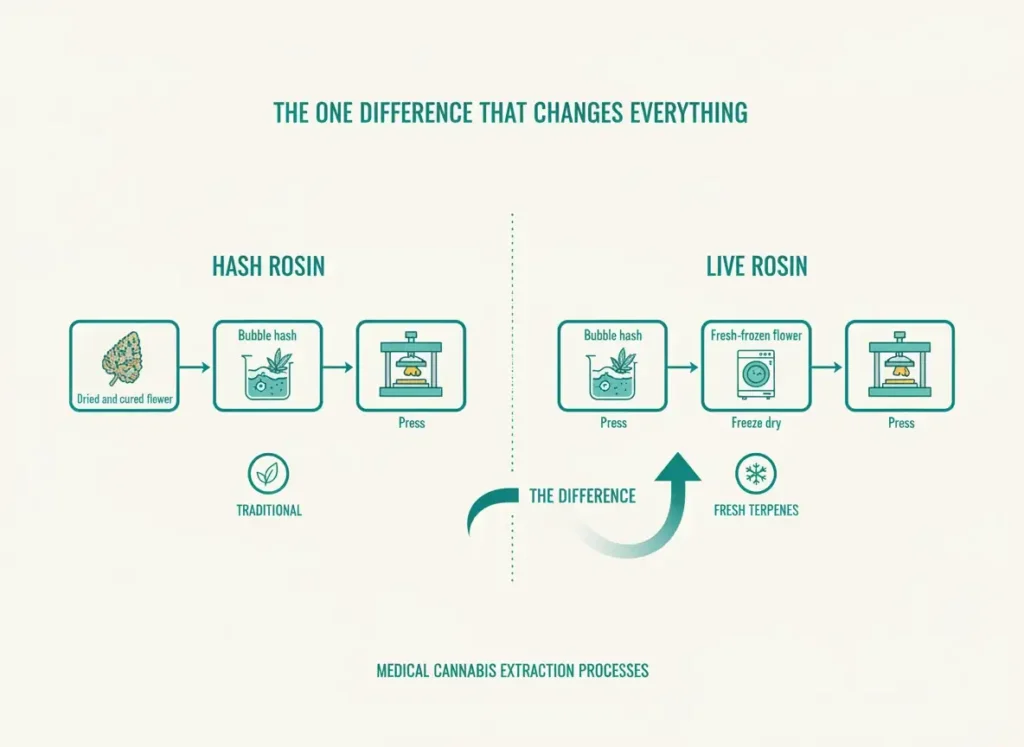
Now that both processes are clear, the single foundational difference can be stated simply:
| Hash Rosin | Live Rosin | |
|---|---|---|
| Starting material | Dried and cured flower | Fresh-frozen flower |
| Terpenes at start | Reduced by drying/curing | Fully preserved |
| Process | Ice water wash → press | Fresh-freeze → ice water wash → freeze dry → press |
| End result flavor | Deep, earthy, classic | Bright, fresh, fruity/floral |
Everything else in this comparison — flavor, potency experience, texture, price, storage requirements — flows directly from this single distinction.
Hash Rosin vs Live Rosin — Side-by-Side Comparison
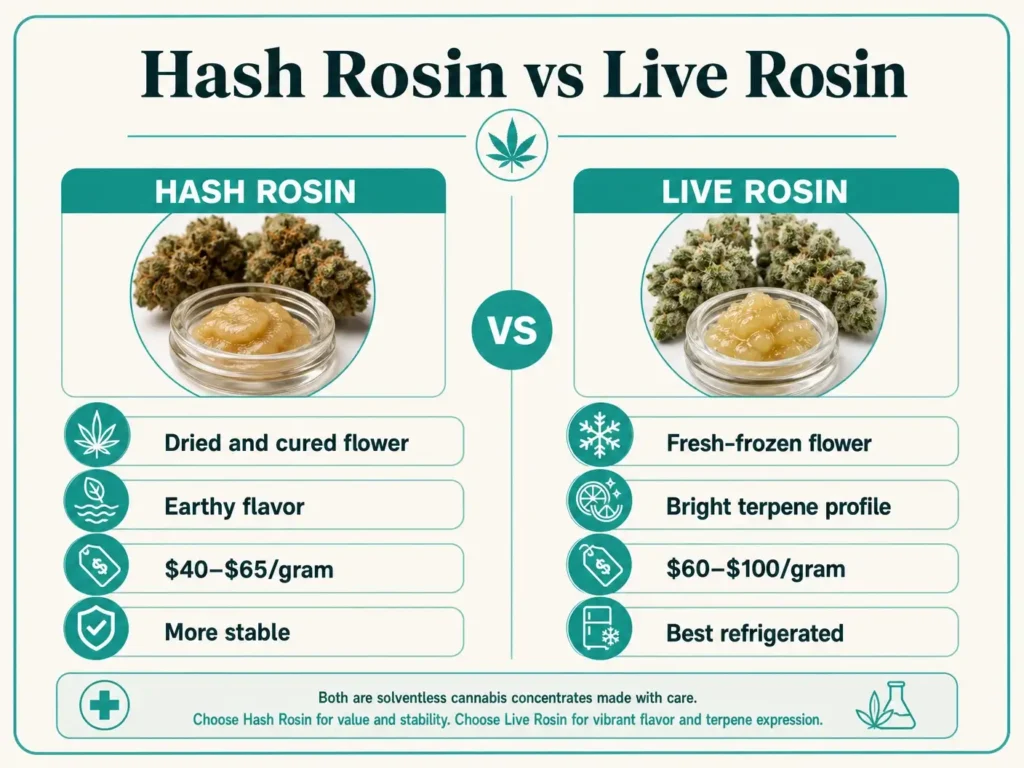
| Category | Hash Rosin | Live Rosin |
|---|---|---|
| Starting material | Dried and cured cannabis | Fresh-frozen cannabis |
| Solvent-free? | ✅ Yes | ✅ Yes |
| Terpene content | Moderate — reduced by curing | High — fully preserved |
| Flavor profile | Earthy, deep, classic, woody | Bright, fruity, floral, citrus |
| Potency (THC%) | 60–80% typically | 65–85% typically |
| Effect character | Smooth, grounded, traditional | Vibrant, complex, full-spectrum |
| Texture | Thicker, waxier, more stable | Softer, more malleable |
| Price at PA dispensaries | $40–$65 per gram | $60–$100 per gram |
| Storage | Shelf stable at room temp | Best refrigerated |
| Perishability | More stable | More perishable |
| Best for | Pain, sleep, classic experience | Flavor chasers, anxiety, complex effects |
| Beginner-friendly? | More forgiving | Requires more care |
Flavor — Which Tastes Better?
Flavor is where the difference between hash rosin and live rosin is most immediately noticeable — and where patient preference is most personal.
Hash rosin flavor profile: Because the starting material went through drying and curing, some of the most volatile terpenes have already degraded or transformed by the time extraction begins. The resulting flavor tends to be:
- Earthy and grounded
- Woody, spicy, or herbal
- Deeper and more mellow
- Reminiscent of classic hash and traditional cannabis
This is not inferior — it is simply different. Many experienced patients strongly prefer the depth and warmth of cured-material flavor. The flavor profile of hash rosin has more in common with classic cannabis concentrates that patients who have used cannabis for years may find deeply familiar and satisfying.
Live rosin flavor profile: Because fresh-frozen material preserves the full volatile terpene spectrum, live rosin delivers:
- Bright and fresh citrus, fruit, or floral notes
- More intense aroma — often noticeably pungent when the jar is opened
- Flavor that more closely represents the living plant
- A “cleaner” taste due to the absence of curing-related terpene transformation
According to Gold Canna’s solventless concentrate guide: “Live rosin delivers a more intense, terpene-rich experience due to minimal degradation during processing. Because the terpenes haven’t degraded through drying or curing, the final product captures the essence of the living plant.”
The honest verdict on flavor: Neither is universally better. Patients who prefer bright, complex, aromatic experiences tend to favor live rosin. Patients who prefer smooth, traditional, grounded flavor tend to prefer hash rosin. The best approach is to try both with the same strain when possible — the difference is immediately apparent.
Potency — Which Is Stronger?
Both hash rosin and live rosin are significantly more potent than cannabis flower. On raw THC percentage:
- Hash rosin: Typically 60–80% total cannabinoids
- Live rosin: Typically 65–85% total cannabinoids
The overlap is substantial — a well-made hash rosin can test higher than a mediocre live rosin batch. Raw THC percentage is not the reliable differentiator patients often assume it is.
Where the more meaningful potency difference lies is in the experiential quality of effects — covered in the next section.
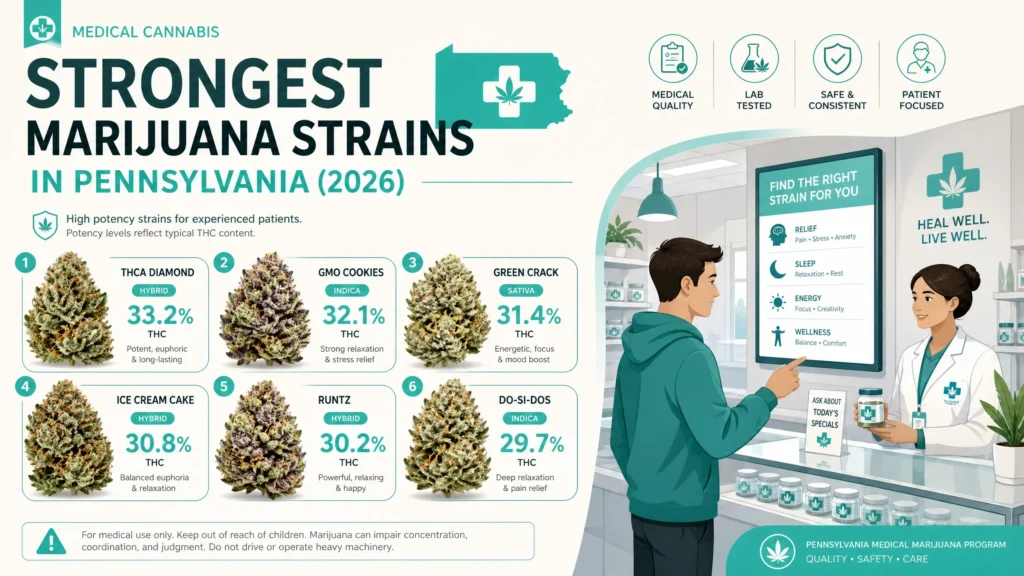
Important for PA patients: As noted in our strongest strains at PA dispensaries guide, both hash rosin and live rosin deliver dramatically more potency than even the strongest flower available at Pennsylvania dispensaries. Flower peaks at approximately 30–35% THC; rosin of either type delivers roughly double to triple that potency per equivalent amount consumed.
For new concentrate users: Start with a rice-grain-sized amount regardless of which type you choose. The difference between a comfortable experience and an overwhelming one at these potency levels is a very small quantity.
The Entourage Effect — Why Terpenes Matter More Than THC%
This is one of the most important concepts for understanding why live rosin commands a premium — and why the flavor difference is not just cosmetic.
The entourage effect refers to the synergistic interaction between cannabinoids (THC, CBD, CBN, CBG) and terpenes — the same mechanism we covered in our strongest strains guide. Research strongly suggests that these compounds work together to produce effects that differ qualitatively from isolated THC alone.
Terpenes influence effect in measurable ways:
- Myrcene — enhances sedation and body relaxation, may facilitate THC crossing the blood-brain barrier
- Caryophyllene — binds directly to CB2 receptors, produces anti-inflammatory effects and natural anxiolytic properties
- Limonene — mood-elevating, potentially counteracts THC-induced anxiety at higher doses
- Terpinolene — associated with uplifting, energizing effects
Because live rosin preserves significantly more of these terpenes than hash rosin — including many volatile compounds that completely evaporate during curing — its effect profile is often described as more complete, more nuanced, and more therapeutically complex.
As Root Sciences’ extraction analysis confirms: “The full-spectrum profile is particularly useful for therapeutic applications as it may enhance the medicinal properties of rosin.” Live rosin’s robust terpene preservation is the primary reason medical patients managing complex symptom profiles — particularly anxiety alongside other conditions — often find it more effective than hash rosin even at similar THC percentages.
Texture Types — Cold Cure, Badder, Jam, and Sauce Explained
Both hash rosin and live rosin undergo post-processing that determines their final texture. Understanding these texture types helps you know what to expect when you open the jar — and which texture suits your consumption method.
Cold Cure The fresh-pressed rosin is immediately sealed and stored at cold temperatures (typically 35–45°F) for 24–72 hours. This gentle process stabilizes the extract into a smooth, creamy, almost butter-like consistency. Cold cure is widely considered the gold standard for preserving terpene quality post-pressing. Texture: smooth, scoopable, uniform.
Badder / Batter Rosin that is whipped and agitated during the post-processing stage, incorporating air into the extract. The result is a lighter, fluffier consistency similar to cake batter. Badder is easy to work with — scoops cleanly onto a dab tool and melts evenly. Good for beginners to concentrates.
Jam A semi-liquid, glossy consistency with more terpene separation visible — often showing a slightly oily surface. Jam consistency indicates high terpene content and typically delivers an especially flavorful experience.
Sauce The most liquid of the rosin textures — a viscous, pourable consistency high in terpenes. Sauce is typically the most terpene-forward texture but can be more difficult to handle precisely for dosing.
Which texture to choose: For beginners: cold cure or badder — easier to handle and dose consistently. For experienced users prioritizing flavor: jam or sauce — more terpene-forward but requires more careful handling. Both hash rosin and live rosin are available in all texture types at PA dispensaries — the texture is determined post-pressing, not by whether the material is fresh-frozen or cured.
The Fourth Tier — Live Hash Rosin Explained
This is the category that causes the most confusion at Pennsylvania dispensaries — and the one most competing guides either ignore or explain poorly.
Live hash rosin (sometimes written as “live hash rosin” or “LHR”) combines both the “live” and “hash” elements into the most refined solventless concentrate available:
- “Live” — the starting material is fresh-frozen cannabis, preserving maximum terpene content
- “Hash” — specifically the finest grade bubble hash from that fresh-frozen material — typically the 73–90 micron fraction of highest-quality “full melt” trichome heads — is isolated before pressing
The distinction from standard live rosin: instead of pressing the full range of washed material, live hash rosin presses only the finest, most refined trichome heads from the fresh-frozen wash. This removes more plant material and lower-quality trichomes from the equation entirely.
The result: Ultra-clean flavor, maximum terpene density, the clearest and most refined expression of the plant possible. This is the product that commands the highest prices at PA dispensaries — often $80–$120 per gram for top-tier live hash rosin from quality producers.
Should you buy live hash rosin? If you are a high-tolerance patient who has already explored both hash rosin and live rosin and wants the absolute pinnacle of solventless concentrate quality — yes. If you are new to concentrates — no. Start with hash rosin, graduate to live rosin, then explore live hash rosin once you understand your preferences.
Price — What to Expect at PA Dispensaries in 2026
Here is the realistic price picture for rosin at licensed Pennsylvania dispensaries in April 2026:
| Product Type | Typical Price Per Gram (PA Dispensary) |
|---|---|
| Flower rosin | $25–$40 |
| Hash rosin | $40–$65 |
| Live rosin | $60–$100 |
| Live hash rosin | $80–$120 |
Why the price difference exists:
Hash rosin costs more than flower rosin because the intermediate step of making bubble hash requires additional equipment, labor, and time — while producing a significantly more refined product. The yield of rosin from bubble hash is also lower than from flower, increasing per-gram cost.
Live rosin costs more than hash rosin because fresh-frozen material requires:
- Freezing immediately at harvest — logistical complexity
- Freeze-drying equipment rather than simple air-drying
- More precise temperature control throughout pressing
- Higher overall labor intensity
- Lower tolerance for inconsistency at every stage
Live hash rosin costs the most because the additional step of isolating only the finest micron fractions reduces yield further while maximizing quality.
Is the price difference worth it? For patients with high tolerance who need maximum therapeutic effect — often yes. For patients new to concentrates or with lower tolerance — hash rosin provides an excellent quality entry point at a more accessible price. The jump from hash rosin to live rosin is meaningful; the jump from live rosin to live hash rosin is more subtle and more personal.
Storage — A Critical Practical Difference
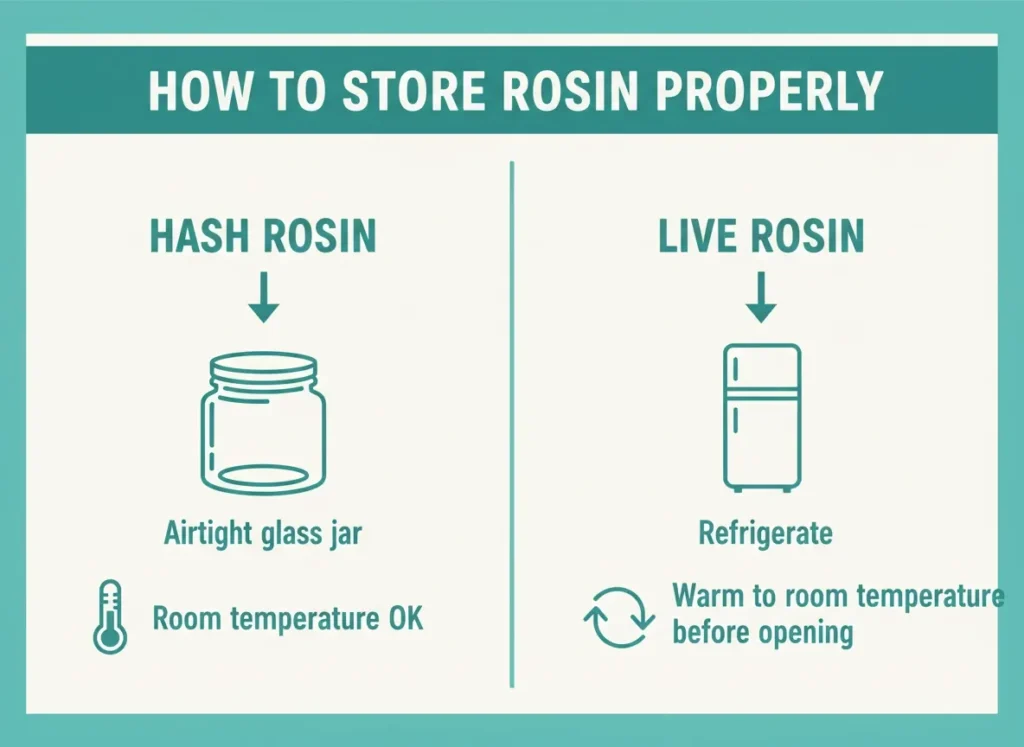
This is the practical difference most guides handle too vaguely — and it matters for how you actually use and maintain your purchase.
Hash rosin storage: Hash rosin, made from cured starting material with lower residual moisture content, is relatively shelf-stable at room temperature for weeks to months when properly sealed. Store in an airtight glass jar in a cool, dark place away from heat and direct light. A cool cabinet or drawer works well for short to medium-term storage.
Live rosin storage: Live rosin’s higher terpene content and residual moisture make it significantly more perishable than hash rosin. As Gold Canna’s rosin guide confirms: “Live rosin is more perishable due to its higher terpene and moisture content, which can degrade over time if not stored properly. It’s best kept in a cool, dark environment — ideally refrigerated — to preserve its flavor and potency.”
Practical storage rules for live rosin:
- Store in an airtight glass jar (silicone containers are acceptable short-term but glass is better long-term)
- Keep refrigerated for storage beyond a few days
- When removing from refrigeration, allow the jar to reach room temperature before opening — this prevents condensation from getting into the product
- Never leave open on a hot surface or in direct sunlight — heat and UV exposure are the fastest ways to degrade terpene quality
- Consume within 3–6 months for best flavor and effect; refrigerated storage extends this window
Live hash rosin storage: Same as live rosin — refrigerate for longer-term storage and handle carefully to preserve the exceptional terpene profile.
How to Consume Rosin — Dab Rig, E-Rig, and Vape Options
Pennsylvania law prohibits smoking cannabis — but vaporization of concentrates is fully legal for registered patients. Here are the primary consumption options for rosin at PA dispensaries:
Dab rig (traditional) A glass water pipe designed for concentrates with a heated “banger” (nail) made from quartz, ceramic, or titanium. The rosin is placed on the heated banger surface and vaporizes. Delivers the fullest flavor expression — but requires a torch, precise temperature control (typically 400–550°F for rosin), and regular cleaning. Best for experienced users who prioritize flavor.
Electronic dab rig (e-rig) Battery-powered devices (like the Puffco Peak, Dr. Dabber Switch, or Carta Focus V) that heat a ceramic or quartz cup electronically to precise temperatures. More consistent temperature control than a torch, more portable, easier for beginners. Well-suited for rosin consumption — preserves terpene expression better than high-heat methods.
Rosin vape cartridges Some PA dispensaries carry pre-filled vape cartridges containing rosin — a more convenient, discrete consumption format. Slightly less terpene-forward than fresh dabs but significantly more convenient. Ask your dispensary pharmacist specifically for rosin-based cartridges vs. distillate cartridges.
Cold start (reverse) dab A technique where rosin is placed in a cold banger first, then heat is applied slowly until vaporization begins. Lower-temperature method that preserves more volatile terpenes — recommended specifically for live rosin to maximize flavor. The technique takes practice but delivers noticeably better flavor than traditional high-heat dabbing.
Which Is Right for You? A Decision Framework for PA Patients
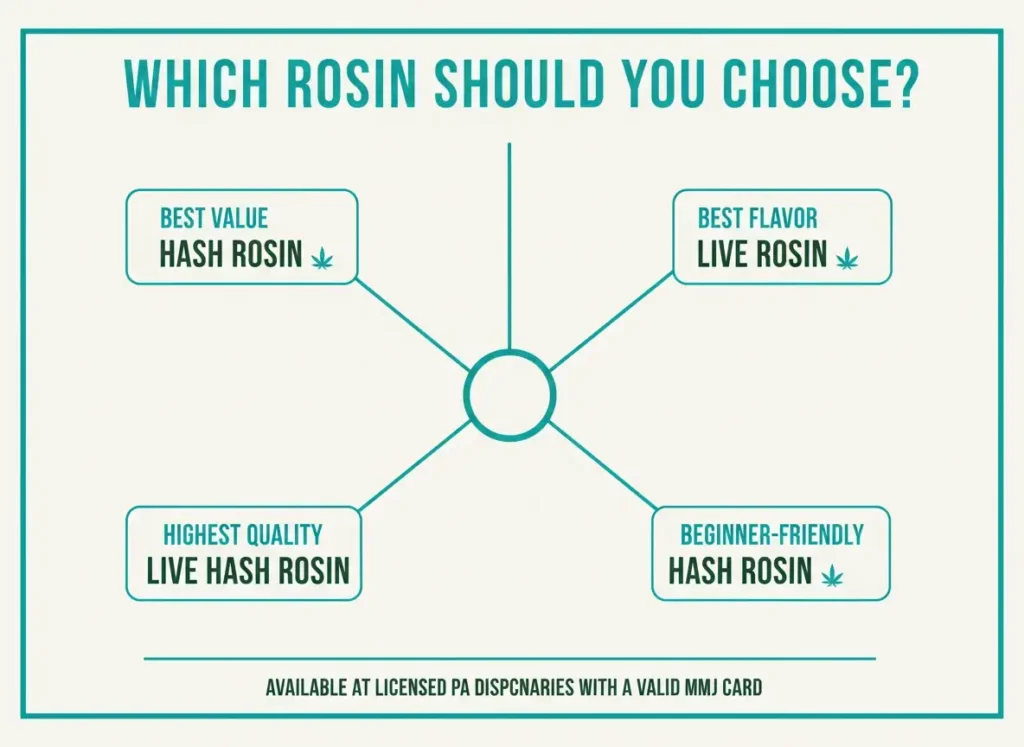
Choose hash rosin if:
- You are new to concentrates and want a premium solventless product at a more accessible price
- You prefer deeper, earthier, more traditional cannabis flavor profiles
- You want a product that is easier to store at room temperature
- You are managing chronic pain and want strong potency with a smooth, grounded body effect
- You are a high-tolerance patient who finds even strong flower insufficient
Choose live rosin if:
- You prioritize the freshest, most terpene-rich flavor experience available
- You are managing anxiety and want complex terpene profiles including caryophyllene and limonene (natural anxiolytic and mood-elevating properties)
- You want the closest possible experience to the living plant
- You are comfortable with refrigerated storage
- Budget is secondary to quality
Choose live hash rosin if:
- You are an experienced rosin user who has worked through hash rosin and live rosin
- You want the absolute pinnacle of solventless concentrate quality
- You are specifically seeking maximum terpene expression for complex symptom management
- Budget is not the primary consideration
Choose flower rosin if:
- You want a solventless experience at the most accessible price point
- You are exploring concentrates for the first time before committing to premium options
For Pennsylvania medical marijuana patients managing anxiety specifically: live rosin or live hash rosin from strains high in caryophyllene and limonene tends to produce better anxiety outcomes than maximum-sedation hash rosins from heavy indica strains. The terpene nuance matters significantly for anxiety management. For more detailed guidance, see our Anxiety Disorder & Medical Marijuana in Pennsylvania guide.
How to Read a Rosin Label at a PA Dispensary
All rosin products at licensed Pennsylvania dispensaries must be tested and labeled with specific information. Here is what to look for:
Product type designation: Look for specific language — “hash rosin,” “live rosin,” or “live hash rosin.” Vague terms like “solventless blend” or “premium extract” without clear designation should prompt you to ask dispensary staff for clarification.
Starting material: Premium producers specify strain name, harvest date, and whether material was fresh-frozen. “Single source” or “single strain” designations indicate no blending across different harvests or genetics.
Total THC %: Calculated from THCA (× 0.877) + Delta-9 THC. Numbers in the 65–85% range are typical for quality rosin. Numbers at the extreme high end (85%+) can reflect lab variability as much as true potency.
Total terpene %: This is your quality indicator. For live rosin especially, total terpene percentage above 3% is excellent; above 5% is exceptional. Hash rosin typically shows 1–3% total terpenes. A live rosin showing under 1% total terpenes warrants skepticism.
Texture designation: Cold cure, badder, jam, or sauce — tells you what to expect when you open the container and how to handle it on your dab tool.
COA (Certificate of Analysis): All licensed PA dispensary products should have a COA available — either printed on request or accessible via QR code on the packaging. The COA shows the complete test results including cannabinoid panel, terpene panel, heavy metals, pesticides, and residual solvents. For solventless products like rosin, the residual solvents panel should show zero or undetectable levels — that is the defining feature of the category.
Do You Need a PA MMJ Card to Buy Rosin?
Yes — absolutely. All rosin products, including hash rosin, live rosin, and live hash rosin, are sold exclusively at licensed Pennsylvania medical marijuana dispensaries. A valid Pennsylvania medical marijuana patient ID card is required for entry and purchase.
Without a PA MMJ card, none of these products are legally accessible to you. Recreational cannabis — including concentrate purchases — remains illegal in Pennsylvania as of April 2026.
Getting your PA MMJ card is entirely online:
- Book a telehealth appointment with a PA-licensed MMJ physician at Pennsylvania Marijuana Cards
- Complete your certification by phone or video (15–20 minutes)
- Register in the PA Medical Marijuana Registry at padohmmp.custhelp.com and pay the $50 state fee (waived for Medicaid, SNAP, WIC, CHIP, PACE, PACENET patients through MMAP)
- Access your digital card immediately — visit any licensed PA dispensary
Pennsylvania recognizes 24 qualifying conditions including anxiety disorders, chronic pain, PTSD, cancer, epilepsy, and many more. View the full qualifying conditions list here.
Frequently Asked Questions
Q: What is the difference between hash rosin and live rosin?
A: The core difference is the starting material. Hash rosin is made from dried and cured cannabis flower processed into bubble hash and then pressed. Live rosin is made from fresh-frozen cannabis — harvested and immediately frozen — processed into bubble hash and then pressed. The fresh-frozen starting material preserves significantly more terpenes, giving live rosin a brighter, more complex flavor profile. Hash rosin has a deeper, earthier, more traditional flavor. Both are solventless concentrates made without chemical solvents.
Q: Is live rosin stronger than hash rosin?
A: In raw THC percentage, live rosin is typically slightly higher (65–85%) than hash rosin (60–80%), but the overlap is substantial and a well-made hash rosin can test higher than a mediocre live rosin. The more meaningful difference is in effect quality — live rosin’s higher terpene content produces more complex, nuanced effects through the entourage effect. Raw THC percentage alone does not determine which product delivers a stronger therapeutic experience.
Q: Why is live rosin more expensive than hash rosin?
A: Live rosin requires more complex logistics (immediate freezing at harvest), specialized freeze-drying equipment, more precise temperature control throughout the entire process, and a lower tolerance for any quality deviation. The fresh-frozen starting material also yields slightly less rosin per pound than cured material. At Pennsylvania dispensaries in 2026, hash rosin typically costs $40–$65 per gram while live rosin ranges from $60–$100 per gram.
Q: What is live hash rosin?
A: Live hash rosin (LHR) is a fourth category that combines both “live” fresh-frozen starting material AND the additional refinement step of isolating only the finest micron-grade bubble hash before pressing. It is the most refined and premium solventless concentrate available — pressing only the purest trichome heads from fresh-frozen material. At PA dispensaries, live hash rosin typically commands $80–$120 per gram.
Q: How should I store live rosin vs hash rosin?
A: Hash rosin is shelf-stable at room temperature for weeks to months when stored in an airtight glass jar in a cool, dark place. Live rosin is more perishable due to higher terpene and moisture content — it should be refrigerated for storage beyond a few days, then allowed to reach room temperature before opening to prevent condensation. Both should be kept away from heat and direct light.
Q: Can I smoke rosin in Pennsylvania?
A: No — Pennsylvania law prohibits smoking cannabis including concentrates. Rosin must be vaporized using a dab rig, electronic dab rig (e-rig), or compatible vaporizer. Vaporization of concentrates is fully legal for registered PA MMJ patients.
Q: Which is better for anxiety — hash rosin or live rosin?
A: For Pennsylvania patients managing anxiety disorders, live rosin from strains high in caryophyllene and limonene terpenes generally produces better outcomes than high-THC hash rosins from heavy indica strains. Live rosin’s broader terpene preservation means more caryophyllene (naturally anxiolytic) and limonene (mood-elevating) in the final product. Very high THC concentrates of any type can worsen anxiety in susceptible patients — start with a very small amount and assess carefully.
Q: Do I need a PA MMJ card to buy rosin at a Pennsylvania dispensary?
A: Yes. All rosin products — hash rosin, live rosin, and live hash rosin — are available exclusively at licensed Pennsylvania dispensaries, which require a valid PA medical marijuana patient ID card. Recreational cannabis remains illegal in Pennsylvania as of April 2026.
The Bottom Line
Hash rosin vs live rosin comes down to one decision: do you want depth and value, or brightness and complexity?
Hash rosin delivers premium solventless concentrate quality at a more accessible price — earthy, smooth, and potent, with a traditional character that experienced cannabis patients often find deeply satisfying.
Live rosin delivers the freshest possible terpene expression — brighter, more aromatic, more vibrant, and often more therapeutically nuanced through the entourage effect — at a premium price that reflects the additional complexity of its production.
Both are among the finest products available at licensed Pennsylvania dispensaries. Both require a valid PA medical marijuana card to purchase. And both deliver an experience that far surpasses what cannabis flower alone can achieve.
If you have a qualifying condition and want access to the full range of Pennsylvania’s licensed dispensary products — including premium concentrates like rosin — get started with your PA MMJ certification today.
Medically reviewed by Dr. Johnathon Chance Miller, MD. This article is for educational purposes only and does not constitute medical advice. Cannabis concentrate potency percentages and prices reflect Pennsylvania dispensary market conditions as of April 2026 and vary by product and location. Always consult your dispensary pharmacist before trying new concentrate products, especially if you are new to cannabis concentrates.
Sources:
- Cheef Botanicals — Live Rosin vs Hash Rosin
- This That CBD — Hash Rosin vs Live Rosin Complete Guide 2026
- This That CBD — Live Hash Rosin vs Live Rosin
- Gold Canna — Hash Rosin vs Live Rosin
- Root Sciences — Live Rosin vs Live Resin
- Root Sciences — Hash Rosin vs Live Resin
- Couch Lock’d — Flower Rosin vs Hash Rosin vs Live Rosin Guide
- NuggMD — Live Resin vs Rosin
- Floyd’s Cannabis — Hash Rosin vs Live Resin
- MMJ.com — Pennsylvania Cannabis 2026 Complete Guide
- PA Department of Health — Medical Marijuana Program