
Getting caught with weed for the first time in Pennsylvania is a stressful experience and the uncertainty about what happens next can feel overwhelming.
If you’re facing a 1st time offense of possession of weed in PA, here is what you need to know: the exact penalties you’re facing, how the amount in your possession changes everything, what your realistic options are for protecting your record, and what you can do differently going forward to stay on the right side of Pennsylvania law.
Need a PA Medical Marijuana Card?
Get certified online in 15 minutes. 100% Money-Back Guarantee.
Get Certified Now →This guide is written for people who want clear, accurate information not legal jargon, not scare tactics, and not vague advice to “just hire a lawyer” without explaining why or what to expect.
Note: This article is for informational purposes only and does not constitute legal advice. If you are facing charges, consult a licensed Pennsylvania criminal defense attorney.
Is Weed Still Illegal in Pennsylvania in 2026?

Yes, recreational marijuana remains illegal in Pennsylvania in 2026. Despite neighboring states like New Jersey, New York, Delaware, and Maryland legalizing recreational cannabis, Pennsylvania has not passed adult-use legalization at the state level as of this writing.
Medical marijuana is legal in Pennsylvania. The Pennsylvania Medical Marijuana Act has been in effect since 2016, and registered patients with valid MMJ cards can legally purchase and possess cannabis from licensed dispensaries. But without that card, any possession of marijuana, even a small amount is a criminal offense under Pennsylvania state law.
Do You Qualify for a PA MMJ Card?
Connect with a licensed Pennsylvania state physician online from home.
Certain Pennsylvania cities have passed local ordinances decriminalizing small amounts, we cover those specifically in Section 6. But those local rules only go so far, and understanding the difference between local decriminalization and state law is critical if you’ve been charged.
The Crucial Factor — How Much Weed You Had

The single most important factor in determining what you’re facing is the amount of marijuana in your possession. Pennsylvania law draws a clear legal line at 30 grams (approximately 1.06 ounces).
This threshold determines:
- Whether you’re charged with a minor misdemeanor or a more serious one
- Whether prosecutors might pursue a Possession with Intent to Deliver (PWID) charge
- Which diversion programs you may be eligible for
- How the court views your offense overall
Here is what the law says about each amount bracket, under 35 P.S. § 780-113 of the Pennsylvania Controlled Substance, Drug, Device and Cosmetic Act:
30 grams or less (personal use amount): This is the most favorable category for a first-time offender. Pennsylvania law defines this as a “small amount” for personal use. The charge is a misdemeanor and the statutory maximum penalties are relatively limited.
More than 30 grams: Crossing this threshold increases your exposure significantly. The charge is still a misdemeanor for personal possession, but the maximum jail time increases to one year and the fine jumps to $5,000.
Amounts that suggest intent to distribute: Larger quantities, particularly anything that suggests you intended to sell or distribute, can result in a Possession with Intent to Deliver (PWID) charge, which is a felony. Pennsylvania courts use quantity as a primary indicator of intent, though packaging, scales, large amounts of cash, and communications can also be factors.
Pennsylvania Weed Possession Penalties at a Glance

Here is a complete breakdown of possession penalties under current Pennsylvania law, sourced from NORML’s Pennsylvania penalties guide and Shrager Defense Attorneys’ legal reference:
| Offense | Classification | Max Jail Time | Max Fine |
|---|---|---|---|
| Possession — 30g or less (personal use) | Misdemeanor | 30 days | $500 |
| Possession — more than 30g | Misdemeanor | 1 year | $5,000 |
| Possession with Intent to Deliver — most cases | Felony | 5 years | $15,000 |
| Delivery within 1,000 ft of a school | Enhanced Felony | 2–4 years added | Additional |
| Distribution to a minor (by someone 21+) | Felony | Doubled penalties | Doubled |
| Growing marijuana (any amount) | Felony | 2.5–5 years | $15,000 |
| Possession of hashish — 8g or less | Misdemeanor | 30 days | $500 |
| Possession of hashish — more than 8g | Misdemeanor | 6–12 months | $5,000 |
First conviction benefit: According to NORML, a first possession conviction is eligible for conditional release, meaning the court can place you on probation for up to one year instead of imposing jail time. A second or subsequent conviction can lead to doubled penalties.
Second or subsequent convictions: Subsequent convictions carry a maximum of 18–36 months imprisonment and a fine up to $25,000, according to Pennsylvania State Cannabis.
The Paraphernalia Trap — The Charge Nobody Warns You About

⚡ Fast & 100% Online PA Medical Cards
Board-Certified Doctors • 100% Money-Back Guarantee
Book Evaluation Now →This is one of the most important and least discussed, realities of marijuana possession arrests in Pennsylvania. If you had any paraphernalia when you were arrested, you are almost certainly facing a second, separate charge.
Under 35 P.S. § 780-113(a)(32), possession of drug paraphernalia is a separate misdemeanor carrying:
- Up to 1 year in jail
- Up to $2,500 in fines
Paraphernalia is defined extremely broadly in Pennsylvania. It includes:
- Pipes, bongs, and bowls of any kind
- Rolling papers
- Grinders
- Vape pens or cartridges
- Even the bag or container the marijuana was stored in
That last point catches people off guard constantly. The plastic bag your weed was in can be charged as paraphernalia. A grinder found in your pocket is paraphernalia. A vape cartridge, even empty, qualifies.
If you were charged with both marijuana possession and paraphernalia, you are now facing two separate misdemeanor charges, each with its own potential jail time and fines. Address both with your attorney, because diversion programs can cover both charges simultaneously in many cases.
The Driving License Consequence Nobody Expects

Here is something that blindsides many first-time offenders: a marijuana possession conviction in Pennsylvania will automatically suspend your driver’s license.
Under Pennsylvania law, PennDOT is required to suspend driving privileges upon conviction of any drug offense, including simple marijuana possession. The standard suspension period for a first offense is 6 months.
This suspension applies regardless of whether a car was involved in your arrest. You could have been arrested while walking, at a party, or at home and PennDOT will still suspend your license upon conviction.
For first offenders using the ARD diversion program (covered in the next section), the license suspension is typically shorter or may be avoided entirely depending on your county. This is one of the significant practical incentives for pursuing diversion rather than a conviction.
If your license is suspended, you may be eligible for an Occupational Limited License (OLL) that allows driving for work purposes but this varies by circumstance and requires a separate application through PennDOT.
Decriminalized Cities in PA — What That Actually Means

Several Pennsylvania cities have passed local ordinances that decriminalize small amounts of marijuana, meaning possession is treated as a civil infraction rather than a criminal offense within city limits:
- Philadelphia
- Pittsburgh
- Erie
- Harrisburg
- Lancaster
- Bethlehem
- State College
- Steelton
Renewing Your PA MMJ Card?
Quick annual recertification online. No paperwork hassle.
Renew Card Online →According to Pennsylvania State Cannabis, in these cities, possession of 30 grams or less may result in a civil fine only (typically $25–$100 in Pittsburgh) rather than a criminal misdemeanor but only if the responding officer chooses to issue a civil citation rather than a criminal charge.
The critical limitation: Decriminalization is at the officer’s discretion. A Pittsburgh police officer can still charge you criminally under state law even within Pittsburgh’s city limits. State law enforcement agencies, state police, federal agents are bound by state law regardless of local ordinances.
In practice, decriminalized cities have significantly lower criminal prosecution rates for small possession. But it is not a guarantee of avoiding criminal charges and if a state trooper makes the arrest rather than a city officer, city decriminalization offers no protection at all.
Your Three Diversion Program Options as a First Offender

This section is where a first-time offender’s path forward becomes clearest and where most competing guides fall short by only mentioning one option.
Pennsylvania actually offers three distinct diversion pathways for first-time marijuana possession defendants, each with different eligibility requirements and strategic implications.
Option 1 — ARD (Accelerated Rehabilitative Disposition)
The ARD program is Pennsylvania’s primary pre-trial diversion program for non-violent first-time offenders.
According to Shrager Defense Attorneys, ARD is available in all 67 Pennsylvania counties for offenders charged with marijuana possession, drug paraphernalia, and other minor non-violent offenses.
How it works:
- The District Attorney must approve your acceptance — there is no automatic right to ARD
- You complete a probationary period of typically 1–2 years with conditions
- Conditions may include drug education classes, community service, random drug testing, and program fees
- Upon successful completion, charges are dismissed
- You can then petition for expungement — removing the arrest from your criminal record entirely
What ARD costs: Program fees typically range from $2,500 to $3,000 according to LegalClarity’s ARD guide, excluding attorney fees. This is a real financial commitment, but it buys you a clean record.
2025 update — Commonwealth v. Shifflett: A landmark 2025 Pennsylvania Supreme Court ruling confirmed that acceptance into ARD no longer counts as a “prior offense” for sentencing enhancement purposes. This was a significant change, previously, prior ARD participation could be used against you in future cases. Under Commonwealth v. Shifflett (2025), that’s no longer the case.
ARD disqualifiers (general):
- Prior felony or misdemeanor convictions
- Active warrants or pending charges
- Prior PWID or delivery convictions within 10 years
- Being on parole or probation at the time of the offense
Option 2 — Section 17 (Probation Without Verdict)
Get Approved by a Licensed PA Doctor
Schedule your appointment in minutes. You only pay if approved.
Start Online Application →Section 17, formally called “Probation Without Verdict” is a less commonly known but valuable alternative, particularly for first offenders who don’t qualify for ARD or want to preserve their ARD eligibility for the future.
According to McAndrews Legal, Section 17 is designed for individuals who can demonstrate drug dependency, not just someone who was caught with weed, but someone who has a genuine substance use issue.
Key requirements:
- You must enter a guilty plea or no contest plea (unlike ARD, which is pre-adjudication)
- You must provide proof of drug dependency from a licensed physician or psychologist
- You must have no prior drug convictions — felony or misdemeanor
Strategic advantage of Section 17 over ARD: Most prosecutors will allow ARD even if you’ve previously used Section 17 but they typically won’t offer Section 17 to someone who has already used ARD.
This means using Section 17 for a first offense preserves your ARD eligibility for a potential future offense. For a first-time offender, this sequencing can be strategically valuable.
Option 3 — District Court Drug Diversion Program (DCDP)
Available specifically in Bucks County, the District Court Drug Diversion Program is a pre-trial diversion option offered at the Magisterial District Court level, meaning it can be initiated earlier in the process than ARD, sometimes at or before the preliminary hearing.
Eligible offenses include:
- Marijuana possession
- Drug paraphernalia possession
- Possession of a controlled substance
According to McAndrews Legal, individuals can request admission at the preliminary hearing itself. If accepted and completed successfully, charges are dismissed and eligible for expungement. If you live in Bucks County, ask your attorney specifically about DCDP before the ARD process.
What Happens If You Don’t Use a Diversion Program
If you proceed to conviction without a diversion program, either because you don’t qualify, the DA doesn’t offer one, or you choose not to pursue one, here is what you’re looking at as a first-time offender for a small amount (30g or less):
At sentencing, the judge has discretion. For a true first offense with a small amount, incarceration is uncommon but it is legally possible. More typical outcomes include:
- A fine (up to $500 for under 30g)
- Probation (up to 1 year under the conditional release provision for first convictions)
- Drug education or treatment programs as a condition of probation
- Court costs and fees (which often exceed the fine itself)
Ready to Get Your Official PA MMJ Card?
State-certified doctor consultations online. No risk—100% refund if not approved.
Claim Your MMJ Card Online →What follows a conviction:
- A permanent misdemeanor conviction on your criminal record
- Automatic 6-month driver’s license suspension by PennDOT
- Potential loss of federal student financial aid eligibility (FAFSA — covered in Section 10)
- Background check visibility affecting employment and housing
The conviction, even for a small amount is permanent unless you later qualify for expungement. Pennsylvania’s expungement rules for convictions are significantly more restrictive than for ARD completions.
Generally, a misdemeanor conviction is not expungeable in Pennsylvania unless you are 70 years old or have been free of arrest for 10 years after completing your sentence.
This is why diversion matters so much: it keeps your record clean in a way that a conviction, even for a minor amount, cannot.
Legal Defenses That Can Get Charges Reduced or Dismissed
Even if you don’t qualify for a diversion program, a criminal defense attorney may be able to challenge the charges themselves. Common defenses in Pennsylvania marijuana possession cases include:
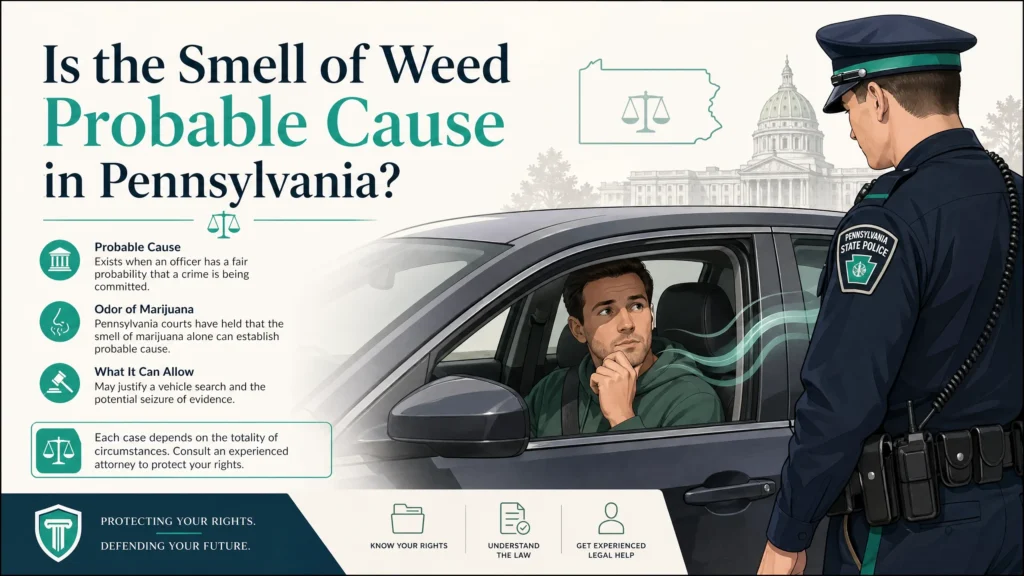
Unlawful search and seizure Under the Fourth Amendment, police cannot search you without probable cause or a valid warrant (with exceptions). If the marijuana was discovered during an unlawful stop, search, or seizure, the evidence may be suppressible, meaning it cannot be used against you at trial. A suppressed search often leads to a dismissed case.
Lack of knowing possession You must have known the marijuana was in your possession. If someone else’s marijuana was in a shared space (a car, a backpack, a room), and you genuinely didn’t know it was there, lack of knowing possession is a viable defense. According to Buzgon Davis Law, demonstrating that you were unaware of the drugs in your possession may negate criminal liability.
Misidentification of substance If the substance hasn’t been properly lab-tested, or if there’s any question about the accuracy of testing, misidentification of substance is a potential defense. Law enforcement field tests are not always reliable and have been challenged in court.
Constructive possession challenges If you were near marijuana but it wasn’t on your person, in a car with multiple occupants, at a party, in a shared residence, the prosecution must prove you had “constructive possession” (knowledge of and control over the substance). This can be challenged effectively in many circumstances.
Long-Term Consequences of a Weed Conviction in PA

A first-time weed conviction in Pennsylvania carries consequences that extend well beyond fines and probation. Understanding these before deciding how to proceed makes the case for diversion even clearer:
Employment: Any employer conducting a background check will see a misdemeanor drug conviction. Many employers in healthcare, education, finance, government, and law have automatic disqualifying policies for drug convictions. According to Ketchel Law, a drug conviction on your permanent record can make it very difficult to obtain employment in many fields.
Federal student financial aid (FAFSA): A drug conviction can affect your eligibility for federal student loans and grants under the Higher Education Act. First-time simple possession convictions result in a 1-year suspension of federal aid eligibility. Second offenses result in a 2-year suspension. A conviction for distribution results in an indefinite suspension.
Professional licenses: Nurses, teachers, attorneys, medical professionals, real estate agents, and many other licensed professionals in Pennsylvania can face disciplinary action, including license revocation, for drug convictions. If you hold or are pursuing a professional license, this is a critical reason to pursue diversion aggressively.
Housing: Private landlords and federally-assisted housing programs can deny housing to applicants with drug convictions. This is a particular concern for anyone seeking Section 8 housing assistance.
Child custody and family court: A drug conviction can be raised in custody disputes and may affect family court proceedings.
Firearm rights: While a single marijuana misdemeanor does not automatically strip firearm rights under Pennsylvania law, it can be a factor in gun permit applications and is visible in background checks.
Immigration Consequences — If This Applies to You
This section is brief but critical for anyone who is not a U.S. citizen.
Drug convictions — including simple marijuana possession, can have severe immigration consequences under federal law, which classifies marijuana as a Schedule I controlled substance regardless of state law. For non-citizens, a drug conviction can trigger:
- Deportation or removal proceedings
- Inadmissibility — being barred from re-entering the United States
- Denial of naturalization
- Loss of legal permanent resident status in serious cases
Even a conviction that results in no jail time, probation only, or a small fine, can qualify as a “drug abuse offense” under the Immigration and Nationality Act and trigger these consequences.
If you are not a U.S. citizen and are facing marijuana possession charges in Pennsylvania, this is a genuine legal emergency.
Consult both a criminal defense attorney and an immigration attorney before taking any plea, entering any program, or making any statements. Do not plead guilty without understanding the immigration consequences.
The Legal Path Forward: PA Medical Marijuana Card
Here is something worth considering if you were caught with marijuana for a legitimate medical reason, managing anxiety, chronic pain, insomnia, PTSD, or another health condition:
Pennsylvania has a legal, state-sanctioned way to possess and use marijuana, a medical marijuana card.
Pennsylvania’s Medical Marijuana Act allows registered patients with qualifying medical conditions to legally purchase and possess cannabis from licensed state dispensaries. With a valid MMJ card, you are protected under Pennsylvania law.
Pennsylvania recognizes 24 qualifying conditions, including:
- Amyotrophic Lateral Sclerosis (ALS)
- Autism
- Cancer, including remission therapy
- Crohn’s Disease
- Damage to the nervous tissue of the central nervous system (brain-spinal cord) with objective neurological indication of intractable spasticity, and other associated neuropathies
- Epilepsy
- Glaucoma
- Positive status for Human Immunodeficiency Virus or Acquired Immune Deficiency Syndrome (HIV/AIDS)
- Huntington’s Disease
- Inflammatory Bowel Disease (IBD)
- Intractable Seizures
- Tourettes
- Multiple Sclerosis
- Neuropathies
- Parkinson’s Disease
- Post-traumatic Stress Disorder (PTSD)
- Severe chronic or intractable pain of neuropathic origin or severe chronic or intractable pain
- Sickle Cell Anemia
- Neurodegenerative diseases (i.e., Alzheimer’s Disease)
- Terminal illness
- Dyskinetic and spastic movement disorders
- Opioid use disorder for which conventional therapeutic interventions are contraindicated or ineffective, or for which adjunctive therapy is indicated in combination with primary therapeutic interventions
- Anxiety Disorder
- Chronic Hepatitis C
If you’re using marijuana to manage a condition that qualifies under Pennsylvania’s program and you didn’t know you could get a card, this is the most important thing you can take away from this article.
Getting a medical marijuana card is the difference between facing criminal charges in the future and being a fully legal, protected patient.
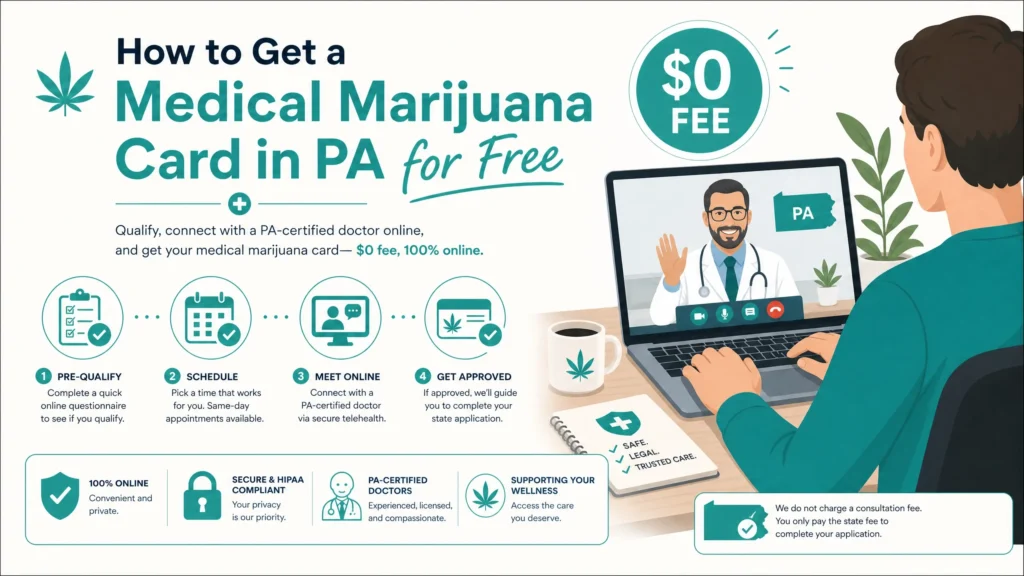
The process is entirely online at most providers:

- Consult with a PA-licensed MMJ physician (telehealth available)
- Register with the PA Department of Health MMJ Registry
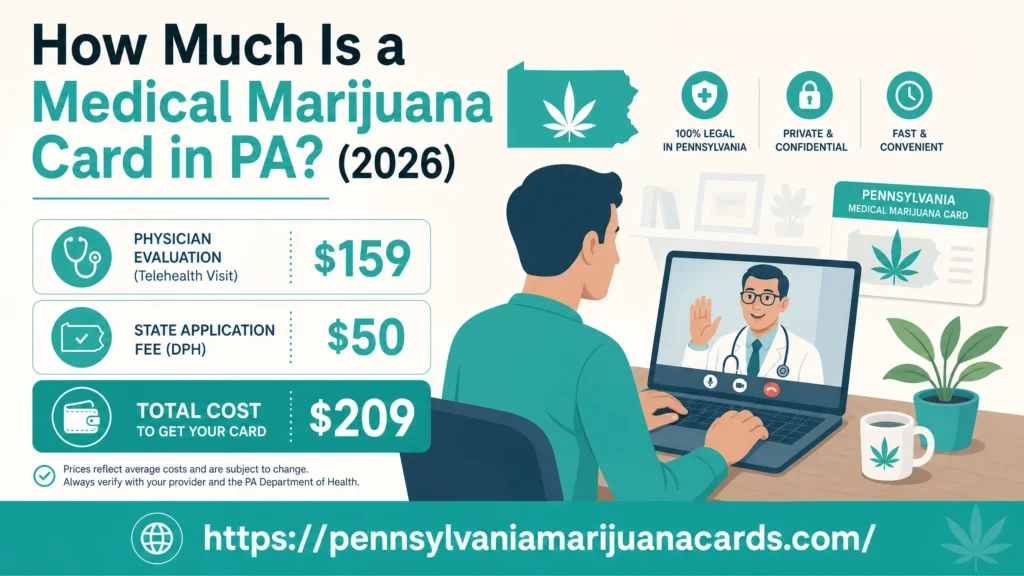
- Pay the $50 state registration fee
- Receive your card and purchase from any licensed PA dispensary
According to Spotlight PA’s analysis of over 1.1 million certification records, anxiety disorders alone appear in 60% of all Pennsylvania MMJ certifications, making it the #1 qualifying condition in the state. That’s hundreds of thousands of Pennsylvanians who now possess marijuana legally, with full protection under state law.
If you have a qualifying condition and want to explore whether a PA medical marijuana card is the right path forward, learn more on our Qualifying Conditions page or get started here.
Frequently Asked Questions
Q: What is the penalty for a first time weed possession offense in PA?
A: For possession of 30 grams or less, the maximum penalty is 30 days in jail and a $500 fine. For more than 30 grams, the maximum is 1 year in jail and a $5,000 fine. First-time offenders are eligible for conditional release, probation instead of jail and may qualify for diversion programs that avoid a conviction entirely.
Q: Will I go to jail for a first time marijuana possession charge in PA?
A: For a small amount (30 grams or less), incarceration is uncommon for true first offenders, particularly those who pursue a diversion program like ARD. However, jail time is legally possible at the judge’s discretion. A criminal defense attorney can help minimize this risk significantly.
Q: What is the ARD program and how does it help?
A: The Accelerated Rehabilitative Disposition (ARD) program is Pennsylvania’s pre-trial diversion option for first-time non-violent offenders. If accepted by the District Attorney and successfully completed, ARD results in dismissed charges and eligibility for full expungement, leaving you with a clean record. ARD costs approximately $2,500–$3,000 in fees, excluding attorney costs.
Q: Will a weed possession charge affect my driver’s license in PA?
A: Yes. PennDOT automatically suspends your driving privileges for 6 months upon conviction of any drug offense in Pennsylvania, including simple marijuana possession, regardless of whether a vehicle was involved in the arrest. Participants in the ARD diversion program may face a shorter suspension or avoid it altogether depending on county.
Q: Can I get my record expunged after a weed possession charge in PA?
A: If you complete the ARD program, you can petition for expungement, removing the arrest from your record entirely. For an actual conviction (misdemeanor), expungement is much harder to obtain in Pennsylvania and generally requires either turning 70 years old or remaining arrest-free for 10 years after completing your sentence. This is a major reason why diversion is strongly preferable to conviction for first-time offenders.
Q: Is marijuana decriminalized in Philadelphia and Pittsburgh?
A: Both cities have passed local ordinances treating possession of 30 grams or less as a civil infraction rather than a criminal offense, typically resulting in a fine of $25–$100. However, this is at the responding officer’s discretion, and state law enforcement officers are not bound by city ordinances. Criminal charges are still possible within decriminalized cities.
Q: Can I get a PA medical marijuana card to legally possess cannabis?
A: Yes. Pennsylvania’s medical marijuana program allows registered patients with qualifying conditions to legally possess cannabis purchased from licensed dispensaries. If you have a qualifying condition, such as anxiety, chronic pain, PTSD, or another recognized condition, getting a PA MMJ card protects you under state law and eliminates the risk of future possession charges for legally purchased cannabis.
Q: What happens to non-citizens caught with marijuana in PA?
A: Non-U.S. citizens face potential immigration consequences from drug convictions, including deportation, inadmissibility, and denial of naturalization, under federal law. Even a minor possession conviction with no jail time can trigger these consequences. Non-citizens facing marijuana charges should consult both a criminal defense attorney and an immigration attorney immediately before making any plea or statement.
The Bottom Line
A first-time offense for marijuana possession in Pennsylvania is serious but it is far from the end of the road. The penalties, while real, are manageable for most first offenders who understand their options and act quickly.
The most important steps you can take right now:
- Understand what you’re actually charged with — amount matters enormously, and paraphernalia charges are separate
- Consult a criminal defense attorney — preferably before your preliminary hearing
- Ask specifically about ARD, Section 17, and your county’s diversion options — these programs exist precisely for situations like yours
- Protect your license — understand the PennDOT suspension and whether diversion reduces it
- If you have a qualifying medical condition — explore getting a PA medical marijuana card so this never happens again
Pennsylvania’s medical marijuana program exists to give patients a legal, protected path to the cannabis they’re using. If you’re managing a health condition with marijuana and didn’t know you could do it legally, we can help with that.
This article is for informational and educational purposes only and does not constitute legal advice. If you are facing marijuana possession charges in Pennsylvania, consult a licensed criminal defense attorney in your county. For immigration-related questions, consult both a criminal defense attorney and a licensed immigration attorney.
Sources
- 35 P.S. § 780-113 — Pennsylvania Controlled Substance Act
- NORML — Pennsylvania Marijuana Penalties
- Pennsylvania State Cannabis — Possession Laws
- MPL Law — Pennsylvania Drug Possession Laws
- Shrager Defense Attorneys — First Offense Marijuana PA
- Ketchel Law — First Time Drug Offense Pennsylvania
- McAndrews Legal — PA Marijuana Possession Defense
- LegalClarity — ARD Program in Pennsylvania
- Shrager Defense — ARD Program Allegheny County
- York County DA — ARD Program Details
- Buzgon Davis Law — Pennsylvania Drug Laws
- PA Department of Health — Medical Marijuana Program
- Spotlight PA — PA MMJ Certifications Analysis