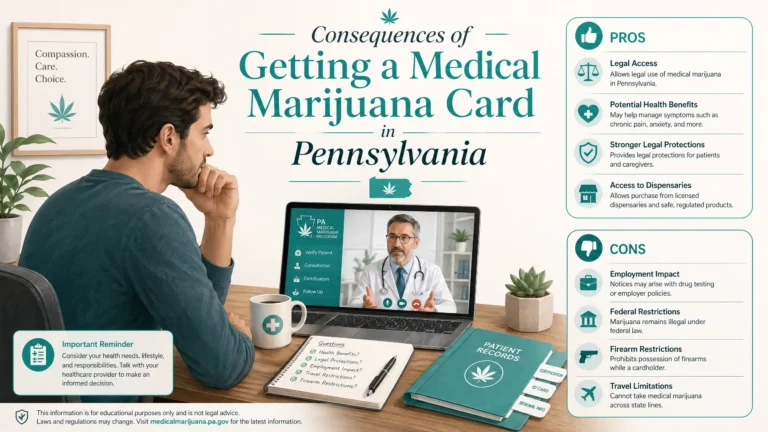

If you’re researching the consequences of getting a medical card in Pennsylvania, you’ve landed on exactly the right article and you’re asking exactly the right question before making this decision.
Most guides either paint an unrealistically rosy picture (“there are basically no consequences!”) or focus only on the negatives without explaining the significant legal protections that come with the card. The truth is more nuanced than either extreme.
Need a PA Medical Marijuana Card?
Get certified online in 15 minutes. 100% Money-Back Guarantee.
Get Certified Now →Getting a PA medical marijuana card comes with real legal protections, meaningful benefits, and genuine limitations and you deserve to understand all of them before you decide.
This guide covers every material consequence, positive and negative in plain language, backed by verified Pennsylvania law and recent court decisions.
First — What the Card Actually Does

Before covering consequences, it helps to understand exactly what a Pennsylvania medical marijuana card is and what it authorizes.
Under the Pennsylvania Medical Marijuana Act (Act 16 of 2016), registered patients with qualifying medical conditions receive a state-issued patient identification card that:
- Allows legal purchase of cannabis products from licensed Pennsylvania dispensaries
- Provides protection from state criminal prosecution for possession of dispensary-purchased marijuana
- Establishes patient status that triggers specific anti-discrimination protections under state law
- Authorizes purchase of up to a 30-day supply at any given time
Do You Qualify for a PA MMJ Card?
Connect with a licensed Pennsylvania state physician online from home.
What it does not do is create a bubble of protection across all areas of life. Because marijuana remains federally illegal under the Controlled Substances Act, your state card carries no weight in federal jurisdictions, which creates a series of real-world conflicts covered throughout this guide.
As of early 2025, Pennsylvania has over 700,000 registered medical marijuana patients, according to ACLU Pennsylvania. That’s a significant portion of the state’s population navigating the consequences this article addresses.
Consequence #1 — Legal Protection From Criminal Possession Charges

This is the primary positive consequence and the reason most people get the card.
With a valid PA medical marijuana card, you are protected from state criminal prosecution for possessing marijuana purchased from a licensed Pennsylvania dispensary, as long as:
- You are a currently registered patient with an active card
- Your marijuana was purchased from a licensed PA dispensary (not another state or an individual)
- Your marijuana is kept in its original packaging
- You do not possess more than a 30-day supply as determined by your certifying physician
This protection is significant. Without a card, possession of even a small amount of marijuana in Pennsylvania is a misdemeanor carrying up to 30 days in jail and a $500 fine. With a valid card, you are fully protected from those state criminal consequences for legally purchased cannabis.
One critical limitation: Protection only applies to marijuana purchased at a licensed Pennsylvania dispensary. Marijuana purchased from another state, even a legal recreational state like New Jersey or New York or from a private individual is not protected under Pennsylvania law.
The PA Department of Health FAQ makes this explicit: a patient in possession of medical marijuana from another state is subject to prosecution under Pennsylvania’s Controlled Substances Act.
Consequence #2 — Employment Protections (With Important Exceptions)

Employment protection: Pennsylvania’s Medical Marijuana Act contains explicit anti-discrimination provisions for registered patients. Under the Act, employers are prohibited from discharging, threatening, refusing to hire, or otherwise discriminating against an employee based solely on their status as a medical marijuana cardholder.
As employment attorney Steven Auerbach explained to the Philadelphia Inquirer: “As long as they are a Pennsylvania resident, they have that card, they use it off work hours, and are eligible for their medicine, they cannot be fired just because they are medical marijuana patients.”
In a landmark 2021 ruling, Palmiter v. Commonwealth Health Systems (2021 Pa. Super 159), the Pennsylvania Superior Court confirmed that the Medical Marijuana Act creates an implied private right of action, meaning employees can sue employers who take adverse job actions based solely on marijuana patient status. This is real legal teeth, not just a policy statement.
⚡ Fast & 100% Online PA Medical Cards
Board-Certified Doctors • 100% Money-Back Guarantee
Book Evaluation Now →What the protections cover:
- Pre-employment drug testing for marijuana — an employer generally cannot refuse to hire you solely because you tested positive for marijuana
- Random drug testing — in most cases, testing positive does not justify termination solely on that basis
- Compensation, terms, conditions, and privileges of employment
Philadelphia goes even further: Since January 1, 2022, a Philadelphia City Council ordinance prohibits employers in Philadelphia from conducting pre-employment drug tests for marijuana at all with specific exceptions.
The critical exceptions, your card does NOT protect you when:
You use at work or are impaired during work hours. The Medical Marijuana Act explicitly states that employers are not required to permit use during work hours, and employees can be prohibited from performing duties where impairment would pose a safety risk.
You work in a safety-sensitive position. Section 510 of the Medical Marijuana Act defines safety-sensitive jobs as including those who handle chemicals, work with high voltage electricity, work at heights (linemen, tree cutters), miners, and truckers or bus drivers. For these positions, employers can take adverse action even against registered patients.
Your employer has federal contracts or is federally regulated. Federal contractors operating under federal grant requirements may maintain zero-tolerance drug policies that override state law protections.
The bottom line on employment: Your card provides meaningful protection for most office, service, hospitality, and non-safety-sensitive jobs when you use marijuana off-hours. It does not protect you in safety-sensitive roles or from being impaired at work.
Consequence #3 — The Gun Rights Conflict You Need to Understand

This is the most significant negative consequence for gun owners and the one that surprises people most.
Under federal law, specifically 18 U.S.C. § 922(g)(3) any person who is an “unlawful user of or addicted to any controlled substance” is prohibited from possessing, purchasing, or transporting firearms or ammunition. Because marijuana remains a federally controlled Schedule I substance, medical marijuana patients, regardless of state law authorization are classified as prohibited persons under federal law.
The ATF stated this explicitly in an open letter to all gun dealers in 2011: “Any person who uses or is addicted to marijuana, regardless of whether his or her State has passed legislation authorizing marijuana use for medicinal purposes, is an unlawful user of or addicted to a controlled substance, and is prohibited by Federal law from possessing firearms or ammunition.”
ATF Form 4473 — the impossible question:
Renewing Your PA MMJ Card?
Quick annual recertification online. No paperwork hassle.
Renew Card Online →Every firearm purchase from a licensed dealer requires completing ATF Form 4473, which directly asks whether the buyer is an unlawful user of marijuana. If you answer yes, the dealer must deny the sale.
If you answer no while being a registered medical marijuana patient, you may be committing a federal felony, perjury punishable by up to 10 years in prison. According to Pennsylvania State Cannabis, medical marijuana patients are legally required to answer yes to this question.
Concealed carry permits are also affected:
Under Pennsylvania Consolidated Statutes Chapter 18 § 6109(e)(1)(xiv), a person prohibited from owning or purchasing a firearm under U.S. law may not apply for, possess, or renew a Pennsylvania License to Carry Firearm (LTC). If you currently hold a concealed carry permit, you cannot legally renew it while you are a registered medical marijuana patient.
If you already own firearms:
Firearms you owned before obtaining your card are not automatically confiscated. However, using medical marijuana while owning those firearms creates a technical federal violation, since active medical marijuana use qualifies you as a “prohibited person” under federal law.
Enforcement is inconsistent, the Pennsylvania Department of Health decided in January 2018 not to disclose patient identities to law enforcement but the legal risk exists.
A changing landscape:
In December 2025, President Trump signed an executive order directing the Department of Justice to complete the rescheduling of marijuana from Schedule I to Schedule III, as reported by LegalClarity.
As of April 2025, that rescheduling process is not yet complete but if and when it takes effect, the federal firearm prohibition for marijuana users would likely be significantly affected. This is a developing area of law worth monitoring.
The practical reality: If owning or purchasing firearms is important to you, getting a PA medical marijuana card creates a genuine federal legal conflict you need to weigh carefully.
Consequence #4 — The Driving and DUI Trap Most Patients Don’t Know About

Get Approved by a Licensed PA Doctor
Schedule your appointment in minutes. You only pay if approved.
Start Online Application →This is the consequence that blindsides more Pennsylvania MMJ patients than any other.
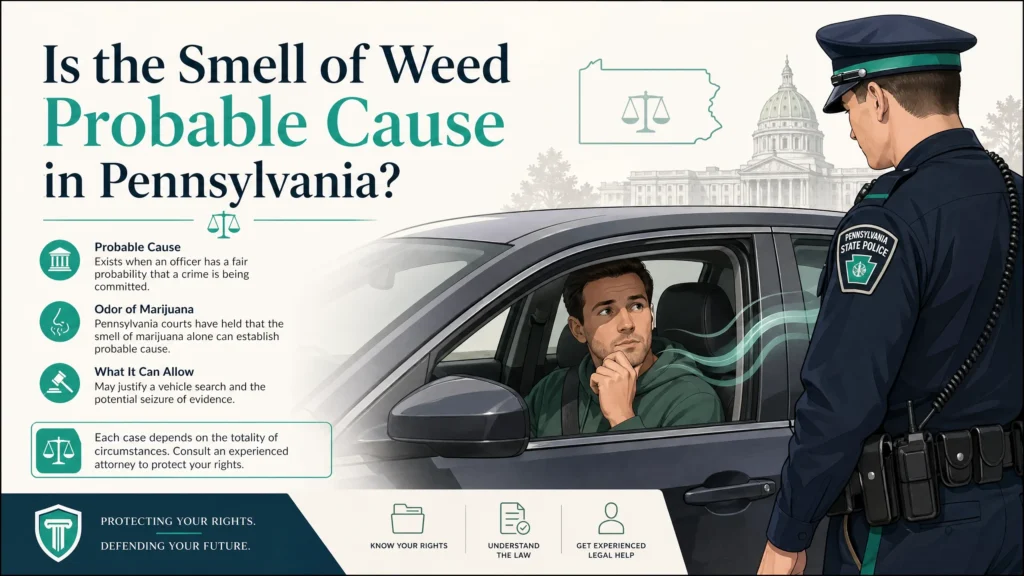
Pennsylvania has a per se DUI law that makes it illegal to drive with any detectable amount of a Schedule I controlled substance or its metabolites, in your blood. Under 75 Pa.C.S. § 3802(d)(1), this applies to marijuana regardless of whether you are actually impaired.
Here is the problem: THC metabolites remain detectable in blood for days to weeks after use, long after any actual impairment has passed. This means a medical marijuana patient who used cannabis three days ago, is completely sober, and drives without any impairment whatsoever can technically be charged with a DUI if stopped and tested.
The ACLU of Pennsylvania has stated this plainly: “There are more than 700,000 people who have medical marijuana cards in Pennsylvania, not a single one of them can lawfully drive” under a strict reading of the current law.
A valid medical marijuana card is not a defense to DUI charges. As Gambone Law explains, the law treats medical marijuana the same as illegal marijuana for driving purposes, the card does not create an exception to the strict liability provision.
Practical guidance:
In practice, law enforcement typically targets DUI enforcement at drivers who appear impaired, swerving, failing field sobriety tests, showing visible signs of impairment. A sober-driving MMJ patient who follows traffic laws is unlikely to be randomly blood-tested. However, the legal risk exists, and patients should understand:
- Never admit to recent marijuana use during a traffic stop — this can trigger testing
- The actual impairment DUI standard (75 § 3802(d)(2)) still applies regardless of your card status
- Pennsylvania has proposed legislation (HB 983) to address this gap for medical patients — but as of early 2025, it has not passed
Consequence #5 — Privacy — What Shows Up on Background Checks

The good news: Your medical marijuana card status does not appear on standard employment background checks.
Under HIPAA and the Pennsylvania Medical Marijuana Act’s strict confidentiality provisions, patient registry information is protected health information. Standard background screening services used by employers cannot access the state’s patient registry.
According to The Sanctuary Wellness Institute: “Possession of a medical marijuana card does not appear on standard background checks in Pennsylvania. The registration of an MMJ card is considered protected health information under HIPAA.”
Ready to Get Your Official PA MMJ Card?
State-certified doctor consultations online. No risk—100% refund if not approved.
Claim Your MMJ Card Online →In January 2018, the Pennsylvania Department of Health made a significant policy decision not to include patient names in law enforcement databases, a deliberate privacy protection for registered patients.
The exception — federal security clearance investigations:
Standard background checks follow HIPAA protections. Security clearance investigations conducted by federal agencies operate under different rules and have broader investigative authority.
As Veriheal notes, “Federal positions requiring security clearances may access state registries during investigation processes.” If you are pursuing or maintaining a federal security clearance, your MMJ card status may be discoverable, covered further in Section 8.
Consequence #6 — Federal Housing and HUD Programs

This is a consequence that receives almost no attention in competing guides and it matters significantly for lower-income Pennsylvanians.
Because marijuana remains federally illegal, federally-assisted housing programs, including HUD public housing and Housing Choice Voucher (Section 8) programs, maintain policies that can result in denial of housing or eviction for marijuana use, regardless of your state medical card status.
The federal prohibition on marijuana use in HUD-assisted housing has not been overridden by state medical marijuana laws. Public housing authorities retain the ability to enforce drug-free lease provisions against marijuana use, including medical use.
What this means practically:
- If you live in public housing or receive Section 8 assistance, using medical marijuana may violate your lease terms
- Landlords in federally-assisted properties are not required to accommodate medical marijuana use as a reasonable accommodation
- Private landlords in Pennsylvania have more flexibility and cannot discriminate solely based on MMJ status in most cases — but this is less settled law
If you are a PA MMJ patient living in or applying for federally-assisted housing, consult a legal aid attorney familiar with both housing law and medical marijuana law before proceeding.
Consequence #7 — Federal Jobs and Security Clearances
Federal employment:
Federal agencies follow federal law — not Pennsylvania state law. Marijuana use remains grounds for disqualification from federal employment regardless of your PA medical card status. This applies to positions with the federal government, federal contractors in certain roles, and positions requiring federal background investigations.
Security clearances:
For active or pending security clearances, marijuana use is a significant adjudicative issue. The Intelligence Community and Department of Defense evaluate marijuana use under their respective adjudicative guidelines, and regular use, even legally under state law, can be disqualifying for clearance purposes.
The key practical guidance from Veriheal: while standard employer background checks follow HIPAA protections, security clearance investigations have broader access and may reveal your MMJ card status. Self-disclosure on security questionnaires (SF-86) is also required and dishonest answers carry serious consequences.
If you hold or are pursuing a security clearance, consult a national security attorney before obtaining a PA medical marijuana card.
Consequence #8 — CDL Drivers and DOT-Regulated Positions
If you hold a Commercial Driver’s License (CDL) or work in any position regulated by the U.S. Department of Transportation, your medical marijuana card provides zero protection.
Under Federal DOT Guidelines (49 CFR Part 40), marijuana use by CDL drivers, medical or otherwise is explicitly prohibited. The federal cutoff for a positive urine test is 50 nanograms of THC per milliliter. DOT guidelines do not distinguish between recreational and medical users.
Pennsylvania’s own CDL Drug & Alcohol Testing Requirements reinforce this: marijuana use by CDL drivers is prohibited regardless of medical marijuana card status.
DOT-regulated positions include:
- Commercial truck drivers (CDL)
- Bus drivers
- Airline pilots and aviation workers
- Railroad workers
- Pipeline safety workers
- Maritime workers operating under USCG regulations
If your livelihood depends on a CDL or any DOT-regulated position, getting a PA medical marijuana card and using cannabis will put your license and job at serious risk. This is a bright-line limitation with no state-law workaround.
Consequence #9 — Traveling With Medical Marijuana
Within Pennsylvania: You can legally travel with your dispensary-purchased medical marijuana as long as you carry your card and keep the product in original packaging.
Across state lines: Transporting marijuana across state lines, even to another state where marijuana is legal, is a federal crime. Your PA medical card has no legal standing in federal jurisdictions or other states unless that state has reciprocity provisions.
At airports (TSA): TSA checkpoints operate under federal jurisdiction. As LegalClarity notes, marijuana remains illegal at federal checkpoints “regardless of your state card.” TSA’s stated policy is to report discovered marijuana to law enforcement, who then apply local laws but this creates risk, and TSA screeners are not required to defer to your PA medical card.
Practical guidance: Do not travel by air with medical marijuana. Do not transport it across state lines. Travel within Pennsylvania with your card and original packaging.
Consequence #10 — What Your Card Does NOT Protect You From
Beyond the specific areas above, here is a clear summary of what a PA medical marijuana card does not protect you from:

- Using marijuana at work or while impaired during work hours — no protection
- Buying from unlicensed sources — no protection; only dispensary-purchased marijuana is protected
- Growing your own — home cultivation remains illegal in Pennsylvania even for registered patients
- Driving after recent use — no protection under the per se DUI law
- Federal criminal prosecution — federal law does not recognize state medical marijuana programs
- Bringing marijuana from other states — no protection; treated as illegal possession
- Failing drug tests in safety-sensitive or DOT-regulated jobs — no protection
- Carrying a concealed firearm — no protection; license to carry is not renewable during active card status
The Positive Consequences Most People Overlook
Most of this guide necessarily covers limitations because that’s what people searching “consequences” want to understand. But the card’s positive consequences are real and substantial:
State criminal protection is the foundation, avoiding a misdemeanor record and possible jail time for cannabis you were going to use anyway is a significant tangible benefit.
Employment discrimination protection gives you legal standing to challenge employers who fire or refuse to hire you solely because you use medical cannabis off-hours. This is a real right backed by case law (Palmiter 2021) and real financial remedies.
Access to regulated, tested products: Licensed Pennsylvania dispensaries sell products with verified cannabinoid content, accurate labeling, and quality testing. This is a meaningful health and safety benefit compared to unregulated sources.
Medical guidance: The certification process requires interaction with a licensed PA physician who can advise on appropriate products, dosing, and potential interactions with existing medications.
Cost savings for qualifying patients: If you participate in Medicaid, PACE/PACENET, CHIP, SNAP, or WIC programs, the Pennsylvania Department of Health offers the state registration at no cost, the $50 state fee is waived entirely. This is a significant benefit that most guides never mention.
Peace of mind and legitimacy: For patients managing real medical conditions, the card provides legal clarity about an aspect of their healthcare that was previously carried with risk and uncertainty.
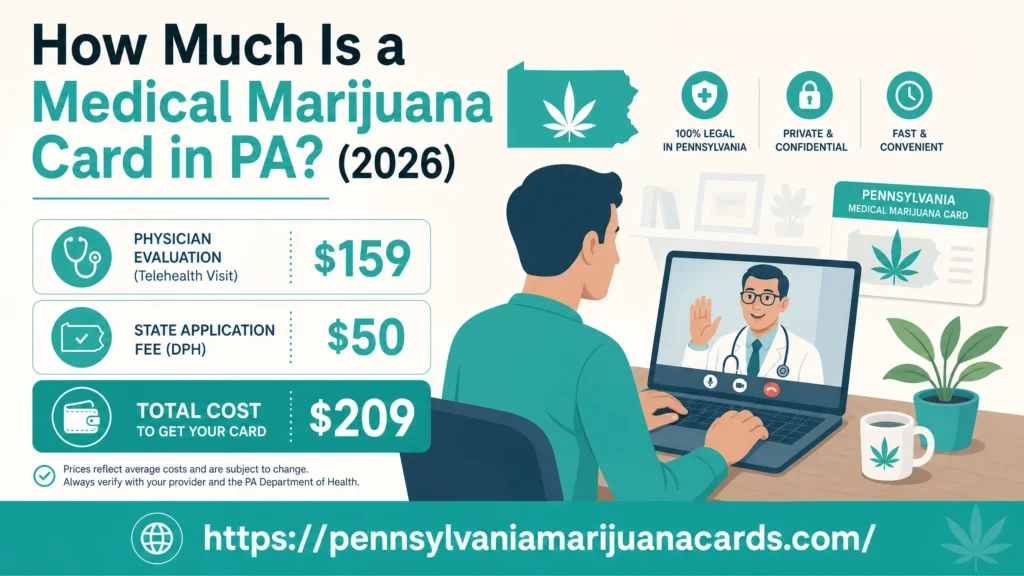
How Much Does a PA Medical Marijuana Card Cost?
Understanding the full cost picture is part of making an informed decision:

| Cost Component | Amount |
|---|---|
| Physician certification (varies by provider) | $75–$200 typical |
| PA state registration fee | $50 |
| Total typical cost | $125–$250 |
| State fee for qualifying low-income patients (Medicaid, SNAP, WIC, CHIP, PACE/PACENET) | $0 |
| Card validity period | 1 year |
| Annual renewal (physician + state fee) | Similar to initial cost |
The entire certification process is available via telehealth, no in-person visit required. Appointments typically take 15–20 minutes.
If you have a qualifying medical condition and want to explore whether a PA medical marijuana card is right for your situation, you can review all 24 qualifying conditions here or get started with your certification today.
Read More: How Much Is a Medical Marijuana Card in PA?
Frequently Asked Questions
Q: Will getting a PA medical marijuana card affect my gun rights?
A: Yes, significantly. Under federal law (18 U.S.C. § 922(g)(3)), registered marijuana users are classified as prohibited persons who cannot legally purchase or possess firearms. Your PA medical card does not create an exception. You also cannot legally apply for or renew a Pennsylvania License to Carry Firearm (concealed carry permit) while your card is active. Firearms you already owned before getting your card are not automatically confiscated, but federal possession law creates ongoing risk.
Q: Can my employer fire me for having a PA medical marijuana card?
A: In most cases, no — not solely for having the card. Pennsylvania’s Medical Marijuana Act prohibits employers from discriminating based solely on your patient status. The 2021 Palmiter v. Commonwealth Health Systems ruling confirmed patients can sue employers for such discrimination. However, safety-sensitive positions, CDL roles, and federally regulated jobs are exceptions where your card provides no protection.
Q: Does a PA medical marijuana card show up on a background check?
A: No — not on standard employment background checks. Your card status is protected health information under HIPAA and the Medical Marijuana Act’s confidentiality provisions. The PA Department of Health does not share patient information with law enforcement. However, federal security clearance investigations operate under broader rules and may access state registries.
Q: Can I get a DUI in Pennsylvania even with a medical marijuana card?
A: Yes. Pennsylvania’s per se DUI law prohibits driving with any detectable amount of THC metabolites in your blood, regardless of your card status or actual impairment. THC metabolites remain detectable for days to weeks after use. Your medical card is not a defense to a DUI charge. Legislation to address this gap (HB 983) has been proposed but not yet passed as of early 2025.
Q: Does a PA medical marijuana card protect me from federal prosecution?
A: No. Your state medical card has no legal effect under federal law. Federal agencies, federal contractors, and anyone subject to federal jurisdiction operates under the federal Controlled Substances Act, which still classifies marijuana as Schedule I. Federal prosecution of individual patients is rare but legally possible.
Q: Can I get a PA medical marijuana card if I live in public housing?
A: Getting the card itself is not prohibited but using marijuana may violate the terms of your federally-assisted housing lease, which is governed by federal law. This creates a practical conflict between your state rights as a patient and your obligations under federal housing programs. Consult a housing attorney before using medical marijuana if you receive HUD assistance.
Q: Is the PA medical marijuana card really worth it given these consequences?
A: For most patients with qualifying conditions who don’t own firearms, hold CDL licenses, or work in safety-sensitive or federal jobs — yes. The criminal protection, employment discrimination protections, access to tested products, and peace of mind are meaningful benefits. The consequences are most significant for gun owners, CDL holders, federal employees, and security clearance holders, who face genuine conflicts that require careful consideration.
Q: How do I get a PA medical marijuana card?
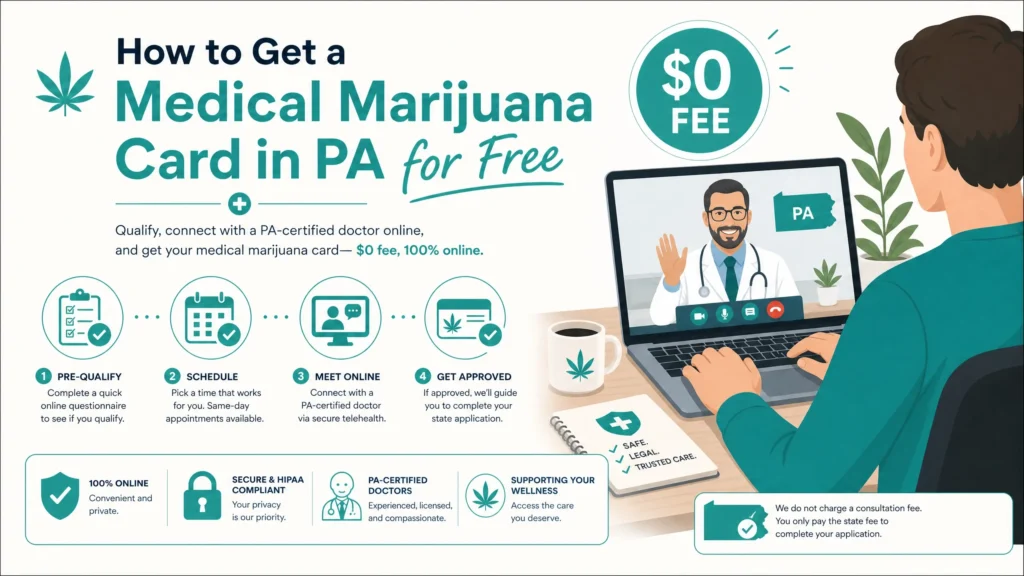
A: The process involves three steps: (1) Get certified by a PA-licensed medical marijuana physician (available via telehealth, 15–20 minutes); (2) Register with the PA Department of Health Medical Marijuana Registry and pay the $50 state fee (waived for qualifying low-income patients); (3) Receive your digital card and purchase from any licensed PA dispensary.
The Bottom Line
The consequences of getting a medical marijuana card in Pennsylvania are real, both the protections it gives you and the limitations that come with it.
You should strongly consider the consequences before getting a card if:

- You own firearms or plan to purchase them
- You hold or are pursuing a security clearance
- You work in a CDL or DOT-regulated position
- You live in federally-assisted housing
- You are a federal employee
For most other Pennsylvanians with a qualifying condition: The card provides meaningful criminal protection, employment discrimination safeguards backed by court decisions, access to quality-tested products, and the legitimacy of managing your health through a state-sanctioned program, rather than carrying ongoing legal risk.
The decision is yours. If you have a qualifying condition and want to understand whether a PA medical marijuana card is the right choice for your specific situation, our team can help you explore your options.
Medically reviewed by Dr. Johnathon Chance Miller, MD. This article is for informational and educational purposes only and does not constitute legal advice. Laws in this area change frequently. Consult a licensed Pennsylvania attorney for advice specific to your situation.
Sources
- Pennsylvania Medical Marijuana Act — PA Department of Health
- 18 U.S.C. § 922(g)(3) — Federal Firearms Prohibition
- Pennsylvania State Cannabis — Gun Ownership and MMJ
- Kaufman Workers’ Comp Law — Legal Rights of PA MMJ Patients
- Philadelphia Inquirer — Medical Marijuana Employment Rights PA
- Palmiter v. Commonwealth Health Systems, 2021 Pa. Super 159
- Pennsylvania State Cannabis — Drug Testing Laws 2025
- LegalClarity — Pennsylvania Medical Marijuana Act Key Rules
- Gambone Law — Medical Marijuana DUI and PA Driver’s License
- ACLU of Pennsylvania — HB 983 Medical Cannabis DUI
- Sanctuary Wellness Institute — Are Medical Marijuana Cards Public Record?
- Veriheal — Does a Medical Cannabis Card Show Up on Background Checks?
- Pennsylvania State Cannabis — Qualifying Conditions
- PA Medical Marijuana Program — PA.gov