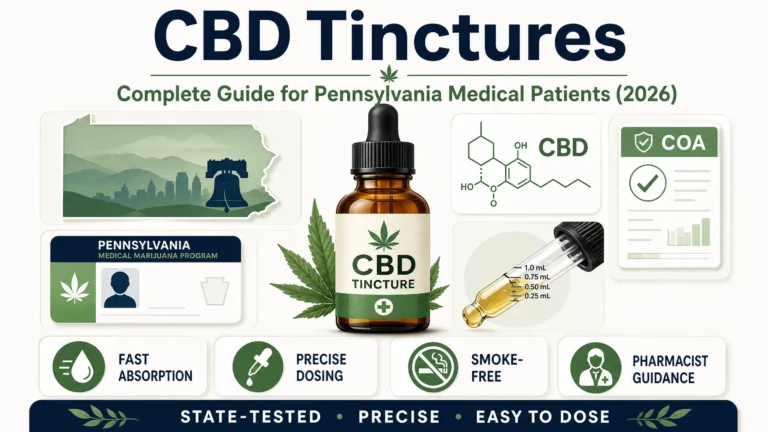

CBD tinctures are one of the most used and most misunderstood products in the cannabis market.
They are liquid CBD extracts taken sublingually (under the tongue), designed to absorb through the mucous membranes in your mouth faster than a capsule or edible.
Need a PA Medical Marijuana Card?
Get certified online in 15 minutes. 100% Money-Back Guarantee.
Get Certified Now →For Pennsylvania medical marijuana patients, they are also one of the original approved product forms under the Medical Marijuana Act (Act 16 of 2016) and are available at licensed PA dispensaries with a valid MMJ card.
But here is what most CBD tincture guides never explain: not all CBD tinctures are the same, and in Pennsylvania, where you buy your tincture changes everything.
Hemp-derived CBD tinctures are available without a card at pharmacies, wellness stores, and online retailers.
Dispensary CBD tinctures require a PA MMJ card, are tested by two independent state-approved laboratories, and come with employment protections and pharmacist guidance that hemp products never can.
This guide covers how CBD tinctures work, the bioavailability science, dosing guidance, and the specific Pennsylvania market context that matters for registered PA patients.
Key Takeaways
- CBD tinctures are liquid CBD extracts designed for sublingual absorption under the tongue, with a typical onset of 15 to 45 minutes and duration of 2 to 4 hours for sublingual use.
- Sublingual bioavailability for CBD is approximately 12% to 35%, significantly higher than swallowing CBD in a capsule or edible (6% to 13%). Hold the dose under your tongue for 60 to 90 seconds for best absorption.
- Pennsylvania dispensaries carry CBD tinctures including pure CBD formulations and ratio tinctures (1:1, 1:3, 1:10 THC to CBD). These require a valid PA MMJ card and are tested by two independent PA DOH-approved laboratories.
- Hemp CBD tinctures (no card required) and dispensary CBD tinctures (card required) are different products with different quality standards, different legal protections, and different therapeutic options.
- CBD inhibits liver enzymes (CYP2C9 and CYP3A4) that process many common medications, including blood thinners and anti-seizure drugs. PA patients on other medications should consult their physician before using CBD tinctures regularly.
- For PA anxiety patients, CBD tinctures are one of the most appropriate starting products because they offer therapeutic effects without significant psychoactivity, with precise dosing control.
What Are CBD Tinctures? The Basics
A CBD tincture is a concentrated liquid CBD extract held in a carrier substance, dispensed with a dropper, and typically taken sublingually (under the tongue).
The word “tincture” has traditional roots in herbal medicine, where herbs were steeped in high-proof alcohol to extract their active compounds.

Today, most commercial CBD tinctures use oil-based carriers rather than alcohol, though both exist.
The format is simple: a small glass or plastic bottle with a calibrated dropper cap. You draw CBD liquid into the dropper, place the drops under your tongue, hold for 60 to 90 seconds, and swallow. The concentration of CBD per milliliter of liquid is labeled on the bottle, allowing precise dosing down to fractions of a milliliter.
This precision is one reason tinctures have become a preferred format for medical cannabis patients who need consistent, controlled dosing.
As Green Rush News’ 2026 cannabis tincture guide notes: “Tinctures represent approximately 6% of dispensary sales nationally and are among the fastest-growing subcategories in the medical market.”
For Pennsylvania MMJ patients, tinctures hold a specific legal status worth understanding.
They were listed as an approved product form under Act 16 of 2016 from the beginning of Pennsylvania’s program, making them one of the most established and legally recognized cannabis formats in the state.
CBD Tinctures vs CBD Oil: Is There a Difference?
This is one of the most common sources of confusion in the CBD market, and the answer has shifted as product terminology has evolved.

⚡ Fast & 100% Online PA Medical Cards
Board-Certified Doctors • 100% Money-Back Guarantee
Book Evaluation Now →Traditionally, the distinction was:
- CBD tincture: Alcohol-based extraction, CBD compounds dissolved in ethanol
- CBD oil: Oil-based extraction, CBD compounds in a carrier oil such as MCT (medium-chain triglycerides), hemp seed oil, or olive oil
In practice, as Sunmed CBD’s tincture guide explains: “Many brands use CBD tincture and CBD oil interchangeably, which can cause confusion. While the traditional definitions still apply, both terms often refer to a dropper bottle of CBD extract designed for sublingual use.”
In the current market, the dropper-bottle liquid format intended for sublingual use is broadly labeled as either CBD oil or CBD tincture regardless of whether the carrier is alcohol or oil.
What matters more than the terminology is the carrier type and the concentration, both of which affect absorption speed, taste, and compatibility with different users.
For Pennsylvania dispensary products: Most PA dispensary tinctures use oil-based carriers (MCT oil or coconut oil derivatives) because Pennsylvania’s regulatory framework for medical products generally limits alcohol content in consumer products.
When shopping at a licensed PA dispensary, the label will specify the carrier and the cannabinoid concentrations clearly on the COA-backed product packaging.
How CBD Tinctures Work: Sublingual Absorption Explained
The mechanism that makes CBD tinctures effective is sublingual absorption, and understanding it helps you get the most out of the format.
The tissue under your tongue is thin and heavily vascularized, meaning it is close to many small blood vessels.

When CBD liquid contacts this tissue and is held in place, cannabinoids can pass directly through the mucosal membrane into your bloodstream without traveling through your digestive system first.
This matters because of what the digestive system does to CBD: it metabolizes a significant portion of the CBD before it reaches circulation.
This metabolic process, called first-pass metabolism, primarily occurs in the liver. Sublingual absorption bypasses this route to a meaningful degree, delivering more CBD per dose into your bloodstream faster.
Renewing Your PA MMJ Card?
Quick annual recertification online. No paperwork hassle.
Renew Card Online →As ScienceInsights’ April 2026 CBD tincture analysis describes the process: “The thin tissue under your tongue is rich in tiny blood vessels, and CBD can pass directly through that membrane into your bloodstream.
This route bypasses your digestive system and liver, where a significant portion of the CBD would otherwise be broken down before it ever reaches circulation.”
Onset and duration from sublingual use:
- First effects: 15 to 45 minutes
- Full effects: 30 to 60 minutes
- Duration: 2 to 4 hours
If you swallow the CBD immediately rather than holding it sublingually, it enters your digestive system and behaves more like a capsule or edible, with slower onset (1 to 2 hours) and potentially longer duration (4 to 6 hours), but lower bioavailability.
Bioavailability: What 12% to 35% Actually Means for Your Dose
Bioavailability is the percentage of a consumed substance that actually enters your bloodstream in active form.

For CBD tinctures used sublingually, the bioavailability range is approximately 12% to 35%, depending on individual factors and product formulation.
As ScienceInsights notes: “Sublingual CBD reaches a bioavailability of roughly 12% to 35%, meaning that percentage of the CBD you take actually makes it into your bloodstream.
Swallowing CBD (in a capsule or edible, for example) drops that figure to about 9% to 13%.”
What this means in practical dosing terms:
| PA Dispensary Tincture Bottle | Concentration | Per Full Dropper | At 25% Bioavailability |
|---|---|---|---|
| 30ml bottle, 300mg CBD total | 10mg per ml | 10mg CBD | ~2.5mg absorbed |
| 30ml bottle, 500mg CBD total | 16.7mg per ml | 16.7mg CBD | ~4.2mg absorbed |
| 30ml bottle, 1,000mg CBD total | 33.3mg per ml | 33.3mg CBD | ~8.3mg absorbed |
This table illustrates why CBD tincture labels can feel misleading. A “500mg CBD tincture” does not deliver 500mg to your body. It contains 500mg total in the bottle.
Each full dropper contains approximately 16.7mg, and sublingual absorption brings that to roughly 4 to 6mg actually absorbed.
Get Approved by a Licensed PA Doctor
Schedule your appointment in minutes. You only pay if approved.
Start Online Application →This is still meaningful, but understanding the math helps set realistic expectations and prevents over-purchasing concentrated products.
How to improve bioavailability:
Hold the CBD under your tongue for 60 to 90 seconds before swallowing.
Newer research, including guidance from Mary’s Nutritionals’ April 2026 sublingual study summary, suggests the updated best practice is 60 to 90 seconds rather than the older recommendation of 30 to 60 seconds.
Do not eat or drink for 10 to 15 minutes before taking a sublingual tincture, as residual food in the mouth reduces direct mucosal contact.
Full-Spectrum, Broad-Spectrum, and Isolate CBD Tinctures
Every CBD tincture is built around one of three formulations, and the differences in effect are meaningful for medical cannabis patients.

Full-spectrum CBD tinctures
Contain CBD plus the full range of other cannabinoids naturally present in the cannabis plant, including trace to measurable amounts of THC, CBG, CBN, and CBC, plus terpenes.
The interaction of these compounds produces what is known as the entourage effect: synergistic effects from multiple cannabinoids working together rather than CBD in isolation.
At PA dispensaries, full-spectrum tinctures may contain significant CBD alongside THC at various ratios. At hemp shops, full-spectrum products contain CBD with THC at 0.3% or less by dry weight.
Broad-spectrum CBD tinctures
Contain multiple cannabinoids and terpenes but with THC removed or reduced to non-detectable levels.
Ready to Get Your Official PA MMJ Card?
State-certified doctor consultations online. No risk—100% refund if not approved.
Claim Your MMJ Card Online →Designed for patients who want the potential benefits of multiple cannabinoids without psychoactive effects or drug test risk. Most hemp store CBD tinctures fall into this category.
CBD isolate tinctures
Contain only purified CBD in a carrier oil, with all other cannabinoids and terpenes removed. The highest-purity format, with the most predictable and isolated CBD effect.
No THC of any amount. No drug test risk from the product itself. Lowest entourage effect potential.
The PA dispensary difference on spectrum
Licensed PA dispensaries carry all three formulations and can also carry ratio tinctures not available in the hemp market.
A 1:1 THC:CBD dispensary tincture provides both cannabinoids at equal concentrations, which research and patient reports consistently describe as producing a balanced, mellower effect than either cannabinoid alone.
These ratio products are only available at PA dispensaries with a valid MMJ card.
The Two CBD Tincture Markets in Pennsylvania
This is the section that most CBD tincture guides skip entirely, and it is the most important one for Pennsylvania residents to understand.
In Pennsylvania in 2026, CBD tinctures are available through two completely different markets with different regulations, different quality standards, and different legal implications.

Market 1: Hemp CBD Tinctures (No Card Required)
Available at pharmacies, health food stores, online retailers, and wellness shops throughout Pennsylvania. Made from hemp-derived CBD under the 2018 Farm Bill framework.
The finished product must contain 0.3% or less delta-9 THC by dry weight to be legally classified as hemp. No PA MMJ card is required to purchase.
Quality standards vary dramatically. Some manufacturers voluntarily test products with third-party labs and publish COAs. Others do not.
Pennsylvania has no mandatory testing requirement for hemp CBD products sold outside the licensed dispensary system.
Market 2: PA Dispensary CBD Tinctures (PA MMJ Card Required)
Available only at Pennsylvania’s 186+ licensed medical marijuana dispensaries. Require a valid PA MMJ patient ID card for purchase. Products may contain significant CBD, significant THC, or both at various ratios.
Pricing, lab testing, and labeling follow PA DOH requirements.
The critical comparison:
| Feature | Hemp CBD Tincture | PA Dispensary CBD Tincture |
|---|---|---|
| Card required | No | Yes |
| Mandatory PA DOH testing | No | Yes (dual independent labs) |
| THC options | 0.3% or less delta-9 | Any approved ratio, including 1:1, 1:3, 1:10 |
| Employment protection | None | Act 16 protections for MMJ patients |
| Pharmacist guidance | Not available | Available at every dispensary visit |
| Contaminant testing (pesticides, heavy metals) | Voluntary only | Mandatory under 28 Pa. Code Chapter 1171a |
| COA availability | Varies, often voluntary | Required, on QR code or by request |
For PA patients with qualifying conditions who are already registered, dispensary CBD tinctures offer product quality assurance, pharmacist consultation, and legal protections that the hemp market cannot match.
Why PA Dispensary CBD Tinctures Are Different
Pennsylvania’s mandatory dual-lab testing system makes licensed dispensary products a different category from hemp market products, not just a more expensive version of the same thing.

As covered in our How to Read a Pennsylvania Dispensary COA guide, every PA dispensary product including CBD tinctures must be tested by two separate, independent, ISO 17025-accredited laboratories before reaching the dispensary shelf.
These labs are prohibited from having common ownership with the growers/processors or dispensaries whose products they test.
What that means for CBD tinctures specifically:
Accurate CBD concentration: The CBD content on the label is verified by independent laboratory analysis. Research on hemp market CBD products has consistently found significant label inaccuracy.
A 2020 study published in JAMA found that only 26% of CBD products purchased online were accurately labeled within 10% of their claimed concentration. PA dispensary products are required to match their lab-verified concentrations.
Contaminant-free certification: Every PA dispensary CBD tincture passes testing for heavy metals (arsenic, cadmium, lead, mercury), mycotoxins, microbial contaminants, pesticides, and residual solvents. In the hemp market, contaminant testing is voluntary and inconsistently performed.
Pharmacist consultation available: All licensed PA dispensaries are required to have a licensed pharmacist on-site.
For patients who take other medications alongside CBD (which is a real consideration given the drug interaction risks covered in Section 9), this professional resource is available at every dispensary visit.
CBD Tincture Dosing Guide for PA Patients
Dosing CBD tinctures is more individual than many products because CBD’s therapeutic window is wide and people’s responses vary considerably.
The starting principle is consistent across all cannabis guidance: start low, go slow, and assess before escalating.

Starting dosing framework:
| Patient Profile | Starting Dose | Escalation Step | Assessment Window |
|---|---|---|---|
| CBD beginner, new to cannabis | 5 to 10mg | Add 5mg every 5 to 7 days | 7 days at each dose |
| Occasional CBD user | 10 to 25mg | Add 5 to 10mg as needed | 3 to 5 days at each dose |
| Experienced CBD user | 25 to 50mg | Adjust based on response | 2 to 3 days |
| High-CBD therapeutic use (PA dispensary) | 25 to 75mg | Physician-guided | Per physician |
These ranges align with guidance from Green Rush News’ 2026 tincture dosing section: “CBD tinctures follow different dosing conventions.
Effective doses for anxiety and inflammation typically range from 25 to 75mg CBD per serving, significantly higher than THC doses because CBD is non-intoxicating and has a wider therapeutic window.”
A practical note on label math:

Before dosing, calculate what your tincture bottle actually delivers per dropper:
Total CBD in bottle divided by bottle volume in ml equals CBD per ml.
For example, a 500mg CBD tincture in a 30ml bottle equals 16.7mg per ml (one full dropper). If your target starting dose is 10mg, take approximately 0.6ml rather than a full dropper.
Most droppers on tincture bottles hold exactly 1ml when full. Some have measurement markings on the dropper; others do not. If yours does not, a half-dropper is approximately 0.5ml.
CBD Tinctures and Drug Interactions: What PA Patients Need to Know
This is the section most CBD guides handle inadequately, and it is particularly important for Pennsylvania MMJ patients because many are managing serious medical conditions with multiple medications.
CBD inhibits a family of liver enzymes called cytochrome P450, specifically CYP2C9 and CYP3A4. These enzymes are responsible for metabolizing a wide range of common medications.

When CBD slows their activity, affected medications can build up to higher-than-intended blood levels, potentially increasing their effects or side effects.
As ScienceInsights’ April 2026 analysis warns: “CBD inhibits certain liver enzymes that your body uses to process drugs. One enzyme family in particular is affected at concentrations you’d realistically encounter from normal CBD use. Medications that rely on these same enzymes to be metabolized can build up to higher-than-intended levels in your body, potentially causing stronger effects or side effects.”
Medication categories with known or potential interactions with CBD:
- Blood thinners (warfarin, apixaban): CBD can increase warfarin blood levels significantly, raising bleeding risk
- Anti-seizure medications (clobazam, valproate): CBD is FDA-approved for specific seizure syndromes (Epidiolex) but interacts with several other anti-seizure drugs
- Immunosuppressants (tacrolimus, cyclosporine): used by transplant patients, can accumulate to toxic levels with CBD inhibition
- Certain antidepressants and antianxiety medications: CYP3A4 metabolized drugs in this class may be affected
- Some statins (lovastatin, simvastatin): elevated levels possible with CBD co-administration
- Certain opioids: metabolic interactions possible
This is not a complete list, and interaction severity varies by dose.
The practical guidance for any PA MMJ patient who takes prescription medications: bring your full medication list to your dispensary pharmacist before starting CBD tinctures, and discuss the plan with your prescribing physician.
This is especially important for patients on anticoagulants, anti-seizure medications, or immunosuppressants.
CBD Tinctures for Anxiety: The PA Patient Perspective
Anxiety disorders are the most common qualifying condition for Pennsylvania’s medical marijuana program, cited in approximately 60% of all PA MMJ certifications.
For anxiety patients, CBD tinctures occupy a particularly useful therapeutic position.

Research on CBD and anxiety, including a 2019 study published in The Permanente Journal on CBD for anxiety and sleep (n=103), found that CBD was associated with anxiety score improvements in approximately 79% of patients during the first month of use.
While this study has limitations, it reflects a consistent pattern across anxiety and CBD research.
Why CBD tinctures suit anxiety patients specifically?
Precise dosing control matters more for anxiety than almost any other condition. THC-induced anxiety is a real risk at higher doses, particularly in anxiety-predisposed individuals.
CBD-dominant or CBD-only tinctures allow anxiety patients to access therapeutic cannabinoid effects without the psychoactivity of THC that can worsen anxiety at high doses.
Sublingual onset (15 to 45 minutes) is faster than capsules or edibles, which is meaningful for situational anxiety where prompt relief is more useful than delayed-onset products.
CBD’s interaction with serotonin receptors (specifically 5-HT1A) is one proposed mechanism for its anxiolytic effects, and this pathway is distinct from the CB1 receptor activation pathway that drives THC’s psychoactive effects.
PA dispensary CBD:THC ratio tinctures for anxiety
For anxiety patients who have found pure CBD provides partial but not complete relief, ratio tinctures available at PA dispensaries offer a step up.
A 1:10 THC:CBD ratio tincture provides a small amount of THC alongside high CBD, with the CBD moderating any psychoactive THC effects. Many anxiety patients report this ratio provides better symptom management than either cannabinoid alone.
For detailed condition-specific guidance on cannabis and anxiety management in Pennsylvania, see our Anxiety Disorder and Medical Marijuana in Pennsylvania guide.
How to Use a CBD Tincture Correctly?
The technique most people use for CBD tinctures is close to correct but often missing one or two details that meaningfully affect results.

Step-by-step sublingual technique:
First, shake the bottle gently before drawing the dropper. CBD compounds can settle in oil-based carriers. A few seconds of shaking ensures even distribution before dosing.
Second, draw the liquid into the dropper to your target dose. Know your bottle’s mg per ml so you can measure the volume you need rather than always taking a full dropper.
Third, place the dropper tip toward the back of the area under your tongue, not at the very tip. The tissue is thinner and more vascularized further back, improving absorption contact.
Fourth, hold for 60 to 90 seconds. This is the step most people rush. Research updates in 2025 and 2026 consistently show better bioavailability with 60 to 90 seconds versus the older 30-second guidance. Set a timer if needed.
Fifth, swallow. The CBD that absorbed sublingually is already in your bloodstream. What you swallow will go through digestion and provide a secondary, slower-onset absorption.
Sixth, avoid eating or drinking for 10 to 15 minutes afterward for maximum effect from the swallowed portion.
When to take your CBD tincture?
Timing depends on your goal. For sleep support, 1 to 2 hours before bed allows sublingual onset to build.

For anxiety management, 30 to 45 minutes before an anticipated stressful situation allows effects to establish. For general wellness, the same time daily builds consistent blood levels, as CBD accumulates with regular use.
If you have a PA MMJ card and are purchasing your CBD tincture from a licensed dispensary, ask your dispensary pharmacist to review your dosing plan at your first visit.

This consultation is free, takes a few minutes, and can save weeks of trial-and-error dosing.
If you do not yet have a PA MMJ card and want access to dispensary-quality CBD tinctures, pharmacist guidance, and the ratio products not available in the hemp market, check your qualifying condition here or get certified at Pennsylvania Marijuana Cards.
Frequently Asked Questions
Q: What are CBD tinctures?
A: CBD tinctures are concentrated liquid CBD extracts dispensed with a dropper, designed primarily for sublingual (under the tongue) administration. They typically contain CBD in a carrier oil such as MCT oil or coconut oil, though some use alcohol as the carrier. Sublingual absorption allows CBD to enter the bloodstream faster than swallowing a capsule or edible, with onset in 15 to 45 minutes and duration of 2 to 4 hours. They are available both as hemp-derived products (no PA card required) and as licensed PA dispensary products (PA MMJ card required).
Q: What is the difference between CBD tinctures and CBD oil?
A: The terms are often used interchangeably in the current market, and many manufacturers label oil-based CBD dropper products as either “tincture” or “oil.” Traditionally, tinctures were alcohol-based and oils were oil-based. In practice both terms now refer to the dropper-bottle liquid format designed for sublingual use. What matters more than the label is the carrier (MCT oil vs alcohol vs hemp seed oil), the spectrum (full, broad, isolate), and the concentration (mg of CBD per ml of liquid).
Q: How much CBD tincture should I take?
A: For beginners, 5 to 10mg is a reasonable starting dose. Add 5mg increments every 5 to 7 days based on your response. For anxiety, research suggests effective doses typically range from 25 to 75mg per serving, though individual responses vary significantly. PA dispensary pharmacists can provide personalized dosing guidance based on your qualifying condition, medication list, and experience with cannabis. Always calculate what your specific bottle delivers per dropper (total CBD divided by volume in ml) before dosing.
Q: Can CBD tinctures interact with my medications?
A: Yes, meaningfully so for some medications. CBD inhibits CYP2C9 and CYP3A4 liver enzymes that process many common drugs, including blood thinners (warfarin), some anti-seizure medications, immunosuppressants, certain statins, and some antidepressants. These interactions can cause affected medications to reach higher-than-intended blood levels. If you take prescription medications, review your full medication list with your prescribing physician and your PA dispensary pharmacist before starting regular CBD tincture use.
Q: Are hemp CBD tinctures and PA dispensary CBD tinctures the same?
A: No. Hemp CBD tinctures are available without a PA MMJ card and use CBD derived from hemp under the 2018 Farm Bill (0.3% or less delta-9 THC). Quality and labeling accuracy vary widely with no mandatory Pennsylvania testing requirement. PA dispensary CBD tinctures require a valid PA MMJ card, are tested by two independent PA DOH-approved laboratories for cannabinoid content and contaminants, may include THC at various ratios not available in the hemp market, and come with licensed pharmacist consultation and Act 16 employment protections.
Q: How long should I hold CBD tincture under my tongue?
A: 60 to 90 seconds, according to updated 2025 and 2026 guidance. The older recommendation of 30 to 60 seconds is still commonly cited but newer research supports the longer hold time for improved bioavailability. The sublingual tissue is most effective at absorbing CBD when given adequate contact time. Swallowing immediately treats the tincture like an edible with lower bioavailability and slower onset.
Q: Do CBD tinctures show up on a drug test?
A: It depends on the product. Pure CBD isolate tinctures with no THC should not produce a positive drug test for THC-COOH. Broad-spectrum and full-spectrum CBD tinctures contain trace amounts of THC that can accumulate with regular use and potentially trigger a positive drug test. PA dispensary CBD tinctures may contain significant THC depending on the ratio. If you face drug testing, confirm your tincture’s complete cannabinoid profile on the COA and consult with a pharmacist about your specific risk.
Q: Can I get CBD tinctures at a Pennsylvania dispensary?
A: Yes. CBD tinctures are one of the original approved product forms under Pennsylvania’s Medical Marijuana Act (Act 16 of 2016) and are available at licensed PA dispensaries with a valid PA MMJ patient card. PA dispensaries carry multiple formulations including CBD-dominant, balanced ratio (1:1 THC:CBD), and high-CBD ratio tinctures. All products are state-tested with COAs available.
The Bottom Line
CBD tinctures are one of the most versatile, precise, and patient-friendly formats in the cannabis product landscape.
Sublingual absorption, adjustable dosing, fast onset, and manageable duration make them suitable for a wide range of conditions and patient profiles, including PA anxiety patients who want therapeutic benefits without significant psychoactivity.

For Pennsylvania residents, the key distinction to carry from this guide is the difference between hemp CBD tinctures (widely available, no card) and PA dispensary CBD tinctures (card required, state-tested, pharmacist-guided, legally protected).
Both have their place, but they are not interchangeable products.
If you have a qualifying medical condition and want access to dispensary-quality CBD tinctures with accurate labeling, mandatory contaminant testing, ratio product options, and professional pharmacist guidance, the PA medical marijuana certification process is the path to that level of product quality and legal protection.
This blog post is intended for general educational and informational purposes only and does not constitute medical advice. CBD tinctures can interact with prescription medications, and individual responses to CBD vary. Consult your physician before starting CBD tinctures, especially if you take anticoagulants, anti-seizure medications, immunosuppressants, or any other prescription medication. Medically reviewed by Dr. Johnathon Chance Miller, MD.
Sources
- ScienceInsights: What Is a CBD Tincture? Benefits, Types, and Uses (April 2026)
- Green Rush News: Cannabis Tinctures Complete Guide 2026 (March 2026)
- HempLucid: What Is a CBD Tincture? (May 2026)
- Sunmed CBD: What Is a CBD Tincture? Benefits, Dosage, and How to Choose
- Mary’s Nutritionals: Sublingual CBD Explained: Holding Time for Best Results (April 2026)
- Future Compounds: Sublingual CBD Delivery: The Ultimate Guide to Increasing Bioavailability
- Kind Goods Cannabis: Cannabis Tinctures Guide (April 2026)
- Budpedia: Cannabis Tinctures and Sublingual Products Complete 2026 Guide (April 2026)
- Kinebuds Dispensary: Weed Tinctures Complete Guide (May 2026)
- Breaking AC: Why CBD Tinctures Are Becoming the Go-To Wellness Solution in 2026 (February 2026)
- JAMA: Labeling Accuracy of Cannabidiol Extracts Sold Online
- PMC: CBD for Anxiety and Sleep: A Large Case Series (The Permanente Journal, 2019)
- 28 Pa. Code Chapter 1171a: Laboratory Testing Requirements
- PA Department of Health: Medical Marijuana Program
- Pennsylvania Marijuana Cards: Qualifying Conditions