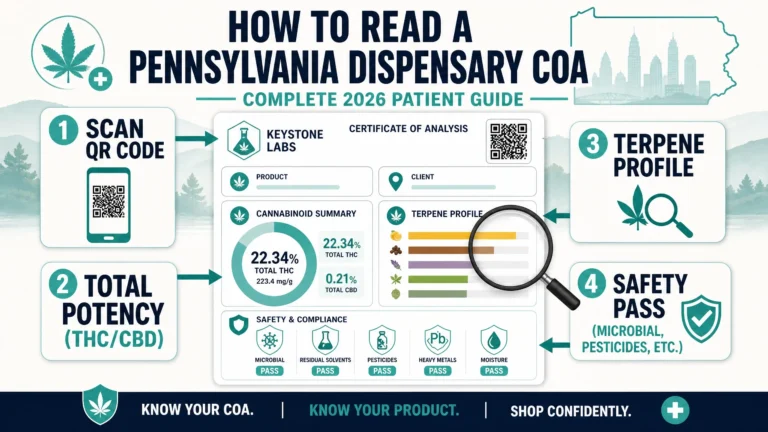

Every single product sold at a licensed Pennsylvania medical marijuana dispensary comes with a Certificate of Analysis (COA), a lab report that tells you exactly what is in the product you are about to use. And yet most patients never look at it. Many don’t know it exists. Almost none know how to read it.
This is one of the biggest information gaps in the entire PA medical marijuana experience. The COA is the single most useful document available to you as a patient. It tells you the real potency of your product (which often differs from the label percentage you’d expect), the complete terpene profile that determines how it will actually feel, and whether it passed Pennsylvania’s required safety screening for pesticides, heavy metals, mold, and other contaminants.
This guide walks through every section of a Pennsylvania dispensary COA, explains exactly what the numbers mean, and shows you how to use this information to make better decisions every time you shop.
Key Takeaways
| What to Check | What It Tells You | What You Want to See |
|---|---|---|
| Batch number | Whether this COA matches your actual product | An exact match with your packaging |
| Total THC | Realistic potency after heating, not raw THCA | A number consistent with the label and your tolerance needs |
| Total Terpenes | How complex and pronounced the effects will likely feel | Generally 1% or higher for flower; 2% or higher for concentrates |
| Contaminant panels | Whether the product passed PA’s required safety screening | “ND” (Not Detected) or “Pass” across pesticides, heavy metals, mycotoxins, and microbials |
| Test date and lab name | Freshness and legitimacy of the testing | A recent date and a PA DOH-approved laboratory |
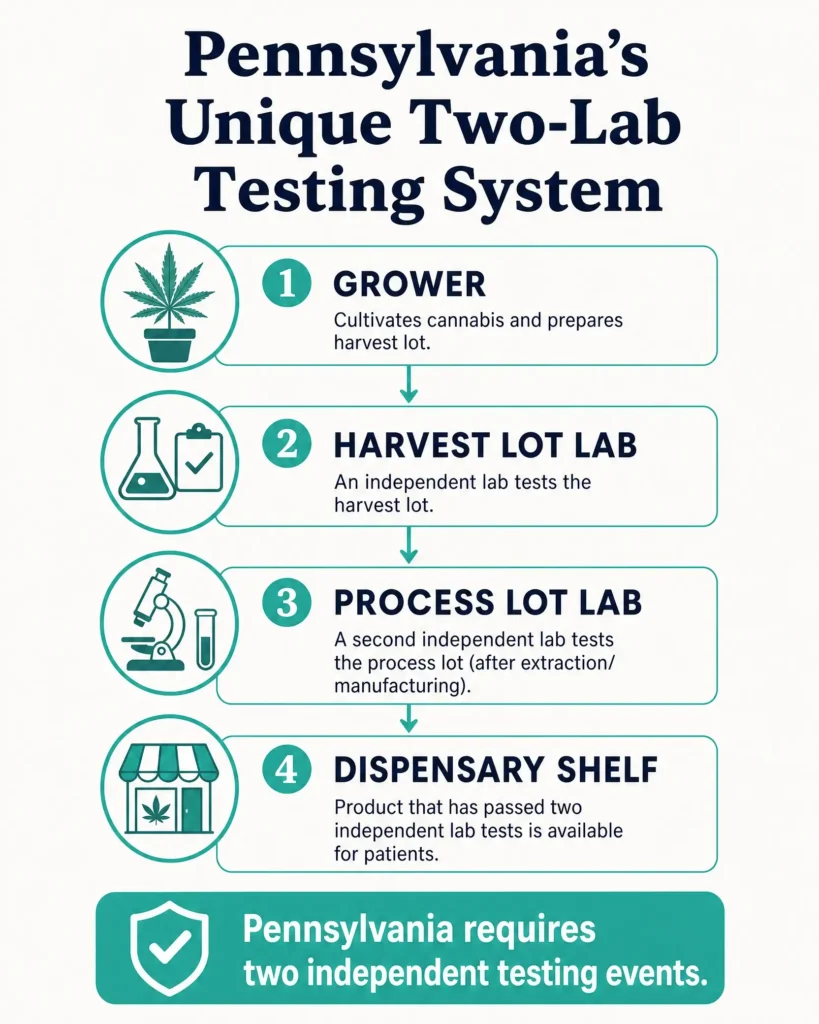
Pennsylvania requires two separate, independent labs to test every product before it reaches a dispensary shelf: one for the harvest lot and a different one for the process lot. Total THC is calculated as (THCA × 0.877) + Delta-9 THC, and is almost always lower than the raw THCA percentage on its own. COAs are available through a QR code on the packaging or by asking your budtender, and every licensed PA dispensary is required to provide one on request.
What Is a COA and Why Pennsylvania Requires It?
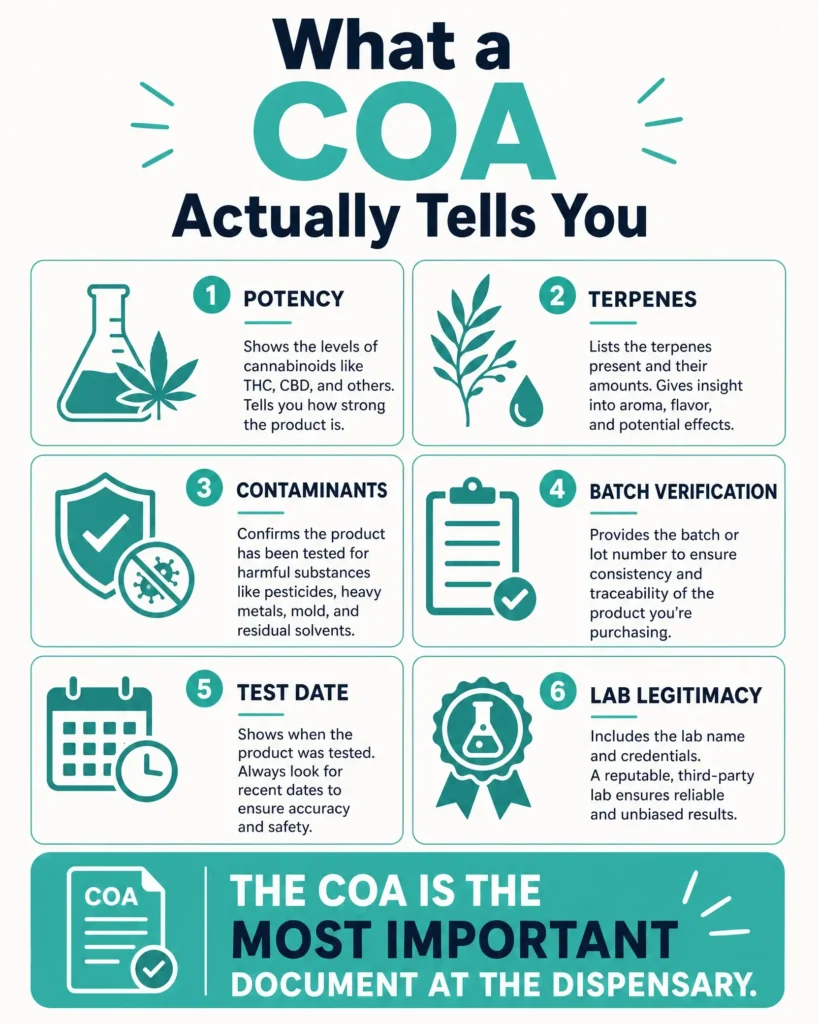
A Certificate of Analysis (COA) is a document issued by an independent, accredited laboratory after testing a sample of a cannabis product. Think of it as a combination nutrition label and safety inspection report. It tells you exactly how potent the product is, what its terpene profile looks like (which shapes the experience), and whether it is free of contaminants that could pose a health risk.
In Pennsylvania, every medical marijuana product is legally required to undergo this testing before it can be sold. According to 28 Pa. Code Chapter 1171a, the Pennsylvania Department of Health mandates that approved laboratories test every harvest batch and every process lot for the following:
| Category | What Is Tested |
|---|---|
| Cannabinoids | THC and CBD concentration |
| Terpenes | Full terpene profile |
| Pesticides | Defined list of pesticide analytes |
| Solvents | Residual solvent levels |
| Microbiological | Bacteria, mold, yeast, and pathogens |
| Heavy metals | Arsenic, cadmium, lead, mercury |
| Mycotoxins | Aflatoxins and ochratoxin |
| Moisture | Water activity and moisture content |
Every cannabis product sold in Pennsylvania must be accompanied by a COA issued by a DOH-certified cannabis testing laboratory, confirming delta-9 THC potency, terpene profile, residual solvent levels, microbial contaminants, heavy metals, and pesticide residues before product release.
This is not optional, and it is not a marketing add-on. It is a legal requirement built into Pennsylvania’s medical marijuana regulatory framework, and as a patient, you have every right to see it.
Pennsylvania’s Unique Two-Lab Testing System
This is something genuinely distinctive about Pennsylvania’s program that almost no general COA guide explains, because it doesn’t apply in most other states.
Under Pennsylvania’s regulations, a single product must pass through two separate, independent laboratories before it reaches a dispensary shelf:
First lab, harvest lot testing: Before a harvest batch can be used to produce any medical marijuana product, an approved laboratory must test samples from that harvest batch.
Second lab, process lot testing: A different approved laboratory, not the one that tested the harvest batch, must test samples from each process lot before the medical marijuana is sold or offered for sale.
This means the flower, oil, or concentrate in your hand has been independently verified twice, by two labs that have no business relationship with each other or with the grower/processor. According to industry coverage, this dual-lab requirement is unique enough that it has prompted discussion within Pennsylvania’s cannabis industry about implementation, but for patients, it represents one of the more rigorous testing frameworks in the country.
Why this matters to you: when you see a COA on a PA product, you may actually be looking at results from one of two separate testing events, harvest-stage and process-stage. Some dispensaries make both available; others provide the final process lot COA, which is the one most directly relevant to the product you’re purchasing, since it reflects the finished form.
Pennsylvania labs must also maintain ISO/IEC 17025 accreditation, the international standard for testing laboratory competence, and are prohibited from having common ownership with the grower/processors or dispensaries whose products they test. This independence requirement exists specifically to prevent conflicts of interest in testing results.
How to Access a COA at a PA Dispensary?
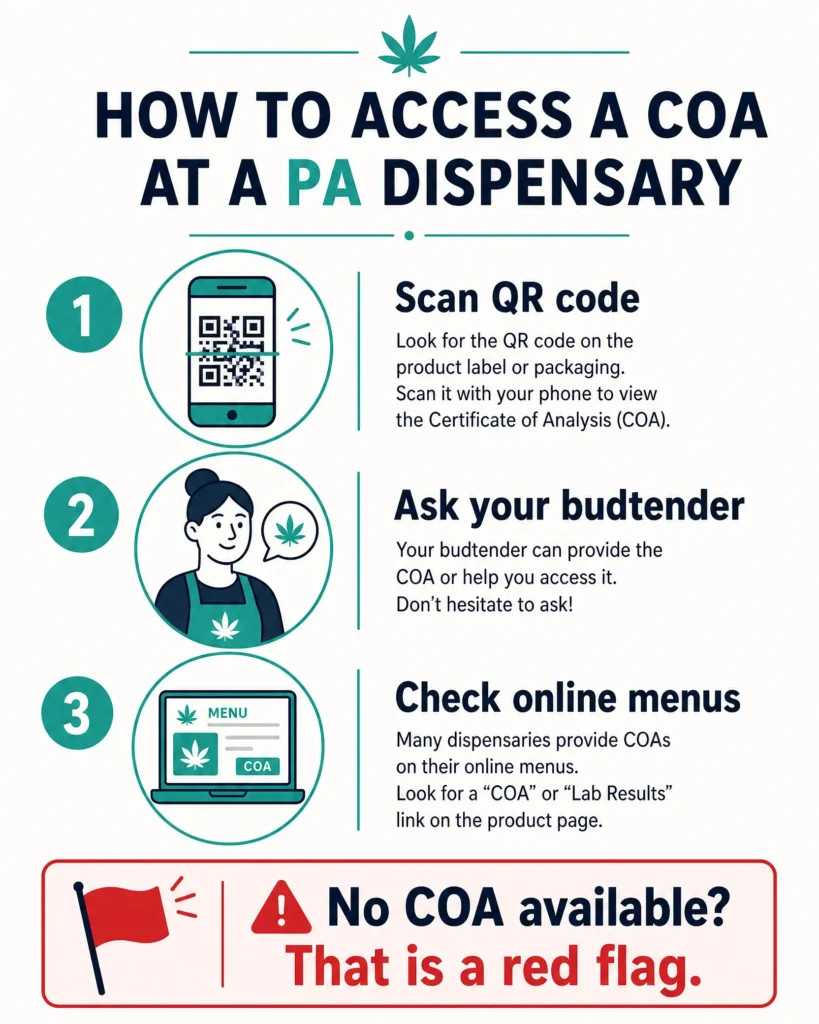
Getting your hands on a COA is easier than most patients realize. You just need to know where to look.
QR codes on packaging: Many PA dispensary products include a QR code directly on the packaging that links to the product’s COA. Scan it with your phone camera to pull up the lab results immediately.
Ask your budtender: Every licensed PA dispensary has access to COAs for the products on their shelves. If a QR code isn’t present or isn’t working, ask the dispensary staff directly. They can pull it up for you, often on a tablet or printed copy.
Dispensary websites: Many Pennsylvania dispensary chains maintain online menus where COAs are linked directly to each product listing, useful for researching before you even visit.
A red flag worth noting: if a dispensary cannot produce a COA for a product when asked, or seems unable to locate one, that is worth questioning. In a properly functioning PA dispensary, COA access should be quick and routine. Staff handle these requests regularly.
Section 1: Product Identification and Batch Matching
At the top of every COA, you’ll find identifying information that connects the lab report to the specific product in your hand:
- Product name and type (for example, “Flower, Strain Name” or “Live Rosin, Strain Name”)
- Batch number or lot number
- Date of testing
- Name of the testing laboratory
- Name of the grower/processor
The single most important check you can make: does the batch number on the COA match the batch number printed on your product’s packaging?
This matters because cannabis is an agricultural product. Potency, terpene content, and even contaminant results can vary meaningfully from one batch to the next, even for the exact same strain from the exact same grower. A COA from a different batch tells you about a different harvest of that product, not necessarily the one you’re holding.
If the date on the COA is old, or the batch number doesn’t match, ask the dispensary for the correct, current COA before relying on the numbers.
Section 2: Cannabinoid Potency: Reading Total THC Correctly
This is the section most patients look at first, and the one most commonly misread.
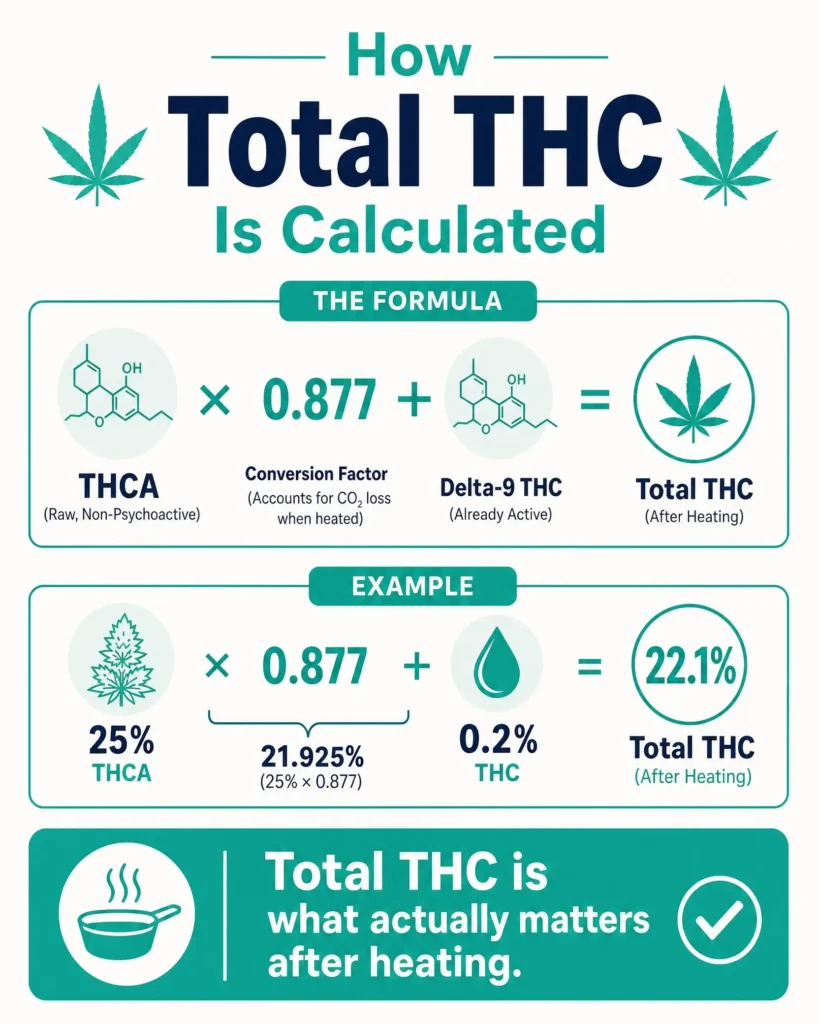
The most important number on the entire COA is Total THC, and it is calculated using a specific formula:
Total THC = (THCA × 0.877) + Delta-9 THC
Here’s why this formula exists: raw cannabis flower contains THC primarily in the form of THCA (tetrahydrocannabinolic acid), a non-psychoactive precursor. When you heat cannabis (through vaporization, since smoking is prohibited for PA patients), THCA converts to active Delta-9 THC through a process called decarboxylation. During that conversion, a small amount of mass is lost, which is why the formula multiplies THCA by 0.877 rather than 1.0.
A worked example:
| Value | Amount |
|---|---|
| THCA (raw) | 25% |
| Delta-9 THC (raw) | 0.2% |
| Calculation | (25 × 0.877) + 0.2 |
| Total THC | 22.1% |
This is the number that tells you the realistic maximum potency of the product once it’s been heated and consumed, and it’s almost always lower than the raw THCA percentage alone. If you’ve ever wondered why a product labeled “28% THCA” delivers a Total THC closer to 24-25%, this formula is the answer.
Other cannabinoids you may see on a PA COA:
| Cannabinoid | What It Is |
|---|---|
| CBD / CBDA | Non-intoxicating, often relevant for patients seeking balanced products |
| CBG, CBN, CBC | Minor cannabinoids present in smaller amounts that contribute to the overall effect profile |
| Delta-9 THC (raw) | The small amount of THC already in active form before any heating |
Why this matters for dosing: if you’ve read our guide on is 100mg of THC a lot, you know that the relationship between a product’s label potency and your actual experienced dose depends heavily on accurate Total THC figures. A flower product showing 30% Total THC on its COA is delivering meaningfully more THC per gram than one showing 18%, even if both are labeled with similar THCA numbers before conversion is accounted for.
Section 3: The Terpene Profile
This section is where COA literacy genuinely transforms your dispensary experience, because terpenes, not just THC percentage, are a major driver of how a product actually feels.
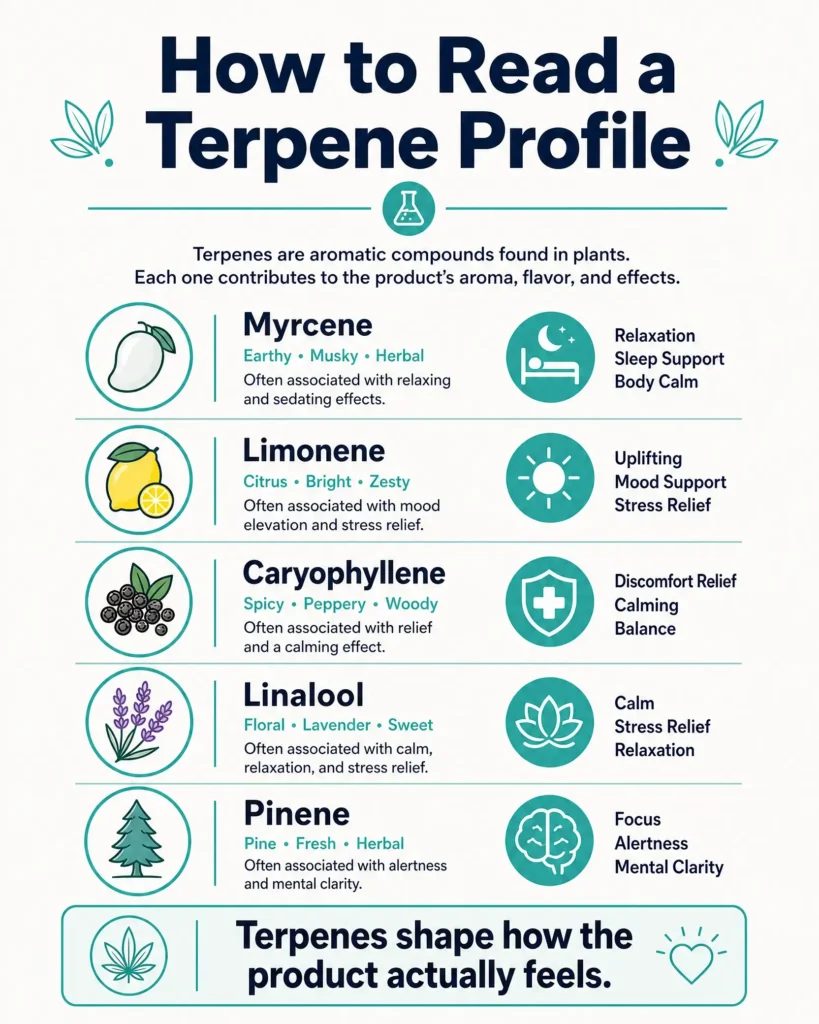
A PA COA will list individual terpenes by name and percentage:
| Terpene | Commonly Associated With |
|---|---|
| Myrcene | Relaxing, sedating effects |
| Limonene | Uplifting, citrusy character |
| Caryophyllene | Anti-inflammatory properties |
| Linalool | Calming effects |
| Pinene | Alertness and a pine aroma |
At the bottom of this section, look for Total Terpenes, the sum of all individual terpenes detected.
Why Total Terpenes matters as much as Total THC: two products with nearly identical Total THC percentages can produce noticeably different experiences depending on their terpene profiles. A product with 24% Total THC and 2.5% Total Terpenes will likely feel more pronounced, flavorful, and complex than a product with 28% Total THC and 0.8% Total Terpenes.
This is especially relevant if you’ve read our hash rosin vs live rosin guide. The terpene preservation differences between extraction methods show up directly in this section of the COA. A live rosin COA showing high Total Terpenes is the lab-verified evidence of that fresher, more complete profile.
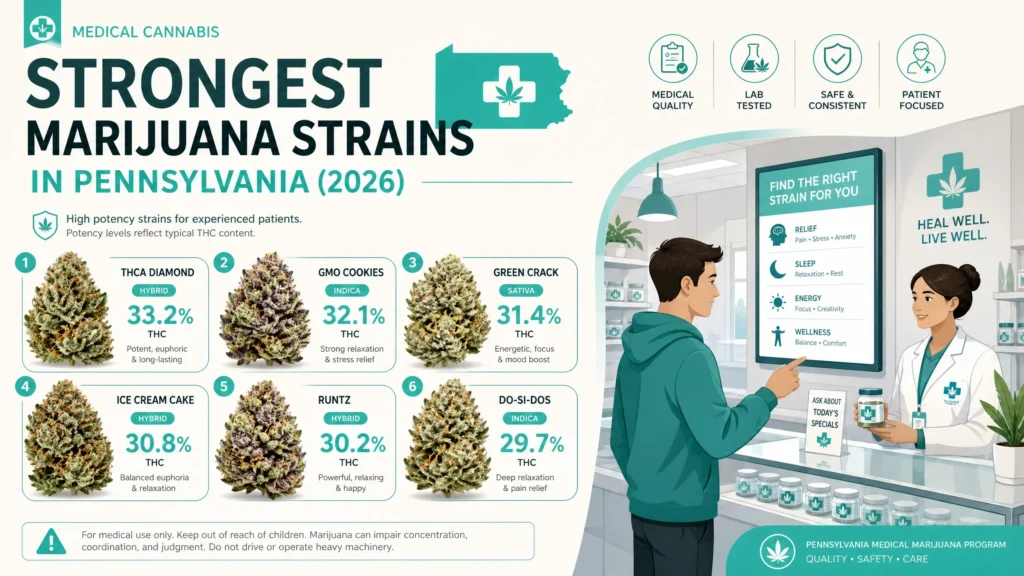
For patients exploring strain selection, our strongest strain guide for PA dispensaries and the practical terpene knowledge from this section work together: a COA lets you verify, batch by batch, whether the product in front of you actually matches the terpene profile a strain is known for.
Section 4: Contaminant Testing: What PA Requires
This is the safety backbone of the COA, and the section most patients never look at, despite it being arguably the most important for health.
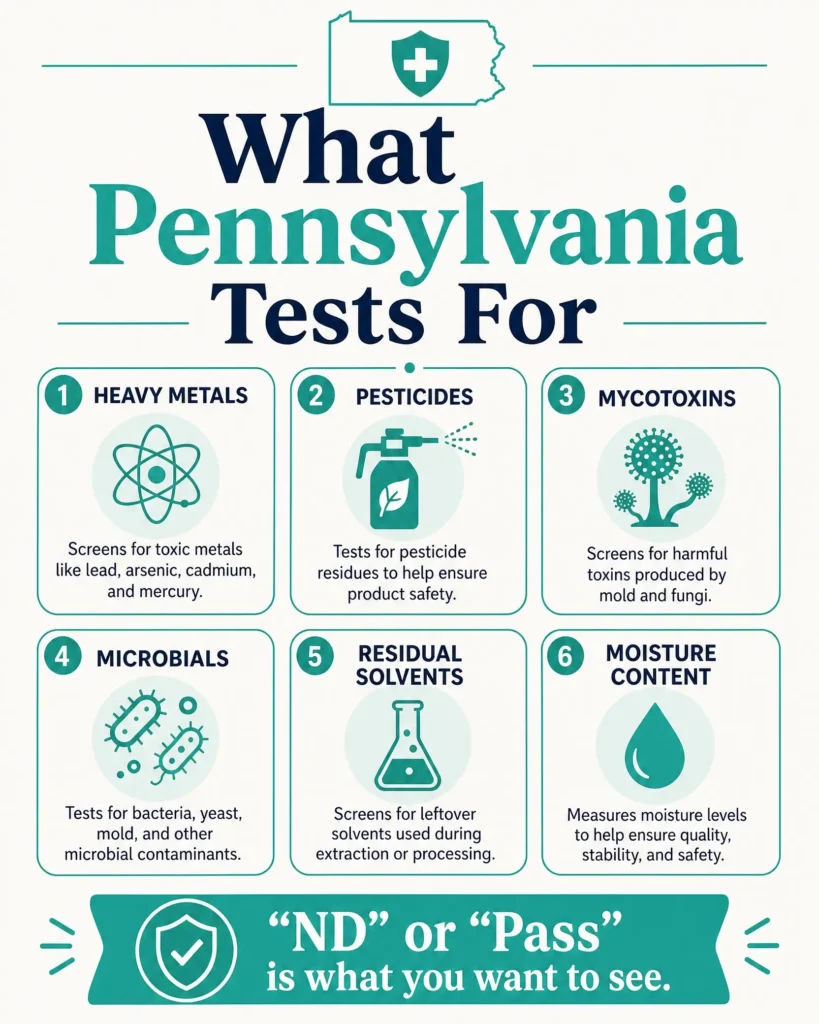
Pennsylvania’s required contaminant panel, per 28 Pa. Code § 1171a.29 and DOH guidance, covers the following:
| Category | Specific Compounds Tested |
|---|---|
| Heavy Metals | Arsenic, cadmium, lead, mercury |
| Mycotoxins | Aflatoxin B1, B2, G1, G2, and Ochratoxin A |
| Microbiological Contaminants | Total aerobic bacteria, total yeast and mold, E. coli, Salmonella, Aspergillus species |
| Pesticides | Defined list of analytes, tested to a limit of quantification of 0.1 μg/g or lower |
| Residual Solvents | Applies to extraction-based products (concentrates, vapes, solvent-extracted edibles) |
| Moisture / Water Activity | Primarily relevant for flower products |
If a lab detects a pesticide exceeding acceptable limits, or detects a prohibited pesticide at all, it must notify the Department of Health immediately.
Understanding ND, LOQ, and Pass/Fail Results
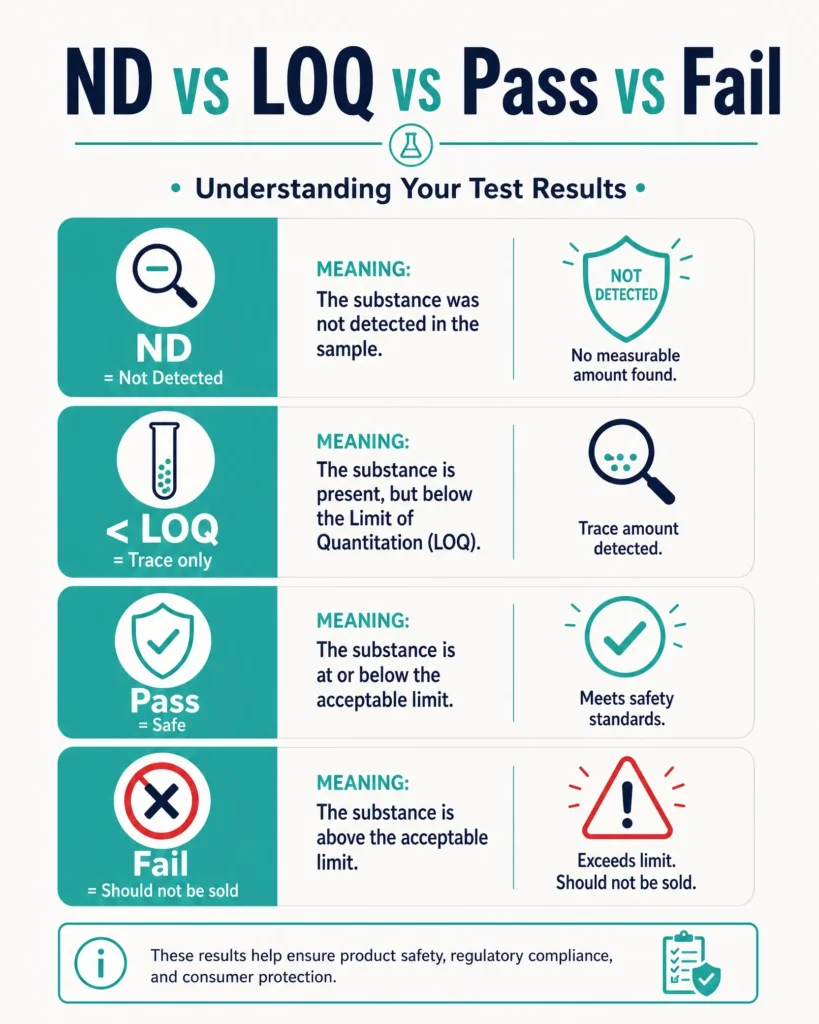
Once you reach the contaminant section, you’ll see results expressed in a specific shorthand. Here’s what it means:
| Result | What It Means | Is It Good? |
|---|---|---|
| ND (Not Detected) | The substance was tested for and not found at or above the lab’s detection limit | Yes, this is the ideal result for contaminants |
| < LOQ (Less Than Limit of Quantitation) | The substance was detected, but at a level too low to precisely measure | Generally yes, indicates trace amounts |
| Pass | The category met Pennsylvania’s regulatory thresholds | Yes |
| Fail | The category did not meet regulatory thresholds | No, this product should not have reached a shelf |
The bottom line: for every contaminant category (pesticides, heavy metals, mycotoxins, microbials, residual solvents), ND or “Pass” is the result you’re looking for. If you ever see a numeric result for a heavy metal or pesticide that is reported as exceeding the lab’s threshold, or a category marked “Fail,” that product should not have reached a dispensary shelf under PA regulations, and is worth raising with dispensary staff immediately.
A Real Walkthrough: Reading a Sample PA Flower COA
Let’s put it all together with a realistic example of what you might see on a Pennsylvania dispensary flower COA.
Header section:
| Field | Value |
|---|---|
| Product | Flower, “Example Strain” |
| Batch # | PA-2026-04-1187 |
| Test Date | 04/18/2026 |
| Lab | PA DOH-Approved Laboratory |
| Batch number matches packaging? | Yes |
Cannabinoid Potency:
| Cannabinoid | Result |
|---|---|
| THCA | 26.4% |
| Delta-9 THC | 0.3% |
| Total THC | (26.4 × 0.877) + 0.3 = 23.5% |
| CBDA | 0.1% |
| Total CBD | < LOQ |
Terpene Profile:
| Terpene | Result |
|---|---|
| Myrcene | 0.68% |
| Limonene | 0.42% |
| Caryophyllene | 0.31% |
| Linalool | 0.15% |
| Pinene | 0.09% |
| Total Terpenes | 1.65% |
Contaminant Testing:
| Category | Result |
|---|---|
| Heavy Metals (As, Cd, Pb, Hg) | ND, Pass |
| Mycotoxins (Aflatoxins B1/B2/G1/G2, Ochratoxin A) | ND, Pass |
| Microbials (E. coli, Salmonella, Aspergillus, yeast/mold) | ND, Pass |
| Pesticides | ND, Pass |
| Moisture Content | 11.2%, within acceptable range |
What this COA tells you:
This is a 23.5% Total THC flower product with a moderate terpene profile (1.65% Total Terpenes, myrcene-dominant, suggesting more relaxing characteristics). It passed every required PA contaminant screen with clean results across heavy metals, mycotoxins, microbials, and pesticides. The batch number matches your packaging, confirming this COA actually corresponds to the product you’re holding.
If you compared this to a different batch of the same strain showing 28% Total THC but only 0.9% Total Terpenes, you’d now understand why the higher-THC batch might actually feel flatter or less complex, exactly the dynamic discussed in our strongest strain guide.
What Happens When a Batch Fails in Pennsylvania?
Understanding what happens behind the scenes when a product fails testing helps build confidence in what reaches dispensary shelves.
Under Pennsylvania’s regulations, if an approved laboratory detects a pesticide exceeding acceptable limits, or any contaminant exceeding regulatory thresholds, the laboratory must notify the Department of Health immediately. Failed batches must be quarantined and may only be remediated through DOH-approved processes, or destroyed.
Pennsylvania also allows retesting of samples that failed initial testing, but this must follow a formal notification process. The grower/processor must notify both the PA DOH and the testing laboratory of its intention to retest.
What this means for you: the COA you’re looking at represents a product that has already cleared this entire regulatory gauntlet, harvest-lot testing by one independent lab, process-lot testing by a second independent lab, and full compliance with Pennsylvania’s contaminant thresholds. Products that fail are not simply relabeled and sold. They’re quarantined, and any path back to the shelf requires DOH-approved remediation and retesting.
Red Flags: When a COA Should Concern You
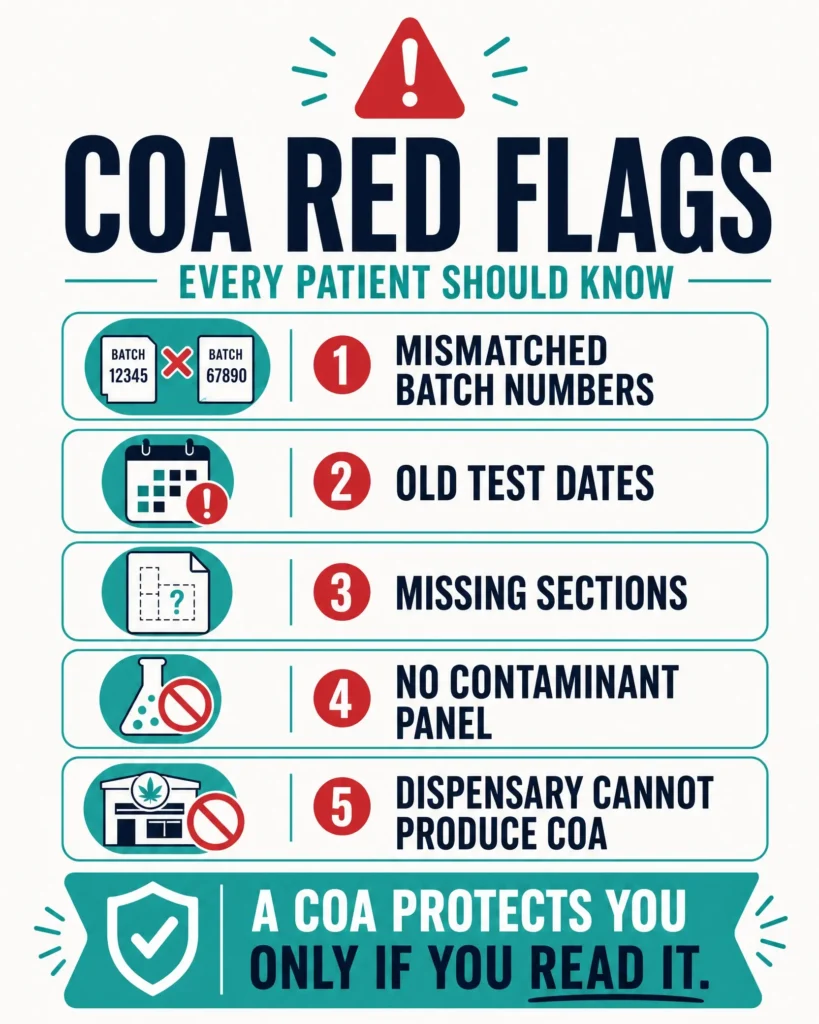
While the vast majority of PA dispensary products will show clean, compliant COAs, here’s what would actually warrant a second look:
| Red Flag | Why It Matters |
|---|---|
| Mismatched batch numbers | You may be looking at results for a different harvest |
| Old test dates | Particularly relevant for products with shorter shelf life, like live rosin |
| Missing sections entirely | A complete PA COA covers potency, terpenes, and contaminants |
| Inability to produce a COA on request | This should be a routine, quick request at any licensed PA dispensary |
| Lab not listed among PA DOH-approved laboratories | Unusual for a licensed PA dispensary product |
To be clear, encountering any of these is rare in the PA market given the regulatory framework described throughout this guide. But knowing what to look for transforms you from a passive consumer into an informed patient who understands exactly what you’re putting into your body.
How COA Literacy Changes Your Dispensary Visits?
Once you understand how to read a COA, your relationship with every dispensary visit changes in practical ways.
Comparing products becomes meaningful. Instead of choosing based on strain name or THC percentage alone, you can compare Total THC and Total Terpenes across products, giving you a much fuller picture of what each will actually deliver.
You can verify dosing more precisely. If you’re working within a specific dosing framework, as discussed in our 100mg THC guide, knowing the actual Total THC percentage of your product (not just the THCA number) helps you calculate doses more accurately.
You gain confidence in product safety. Seeing “ND” across the full contaminant panel, heavy metals, mycotoxins, microbials, pesticides, for the specific batch you’re purchasing is direct, lab-verified confirmation of safety, not just a general assumption about regulated markets.
You can make informed choices about emerging cannabinoids. If you’re researching products containing newer cannabinoids, as in our delta 11 vs delta 9 comparison, the COA is where you’ll find the actual cannabinoid breakdown for any product claiming to contain these compounds.
Bottom line: the COA is not a document for cannabis scientists. It’s a document for you, built into Pennsylvania’s regulatory framework specifically so that patients can verify what they’re consuming. Most patients simply don’t know it’s there, or don’t know what the numbers mean. Now you do.
Frequently Asked Questions
Q: What is a Certificate of Analysis (COA) for cannabis?
A: A COA is a lab report from an independent, accredited laboratory that verifies what’s actually in a cannabis product, including cannabinoid potency (THC, CBD, and others), terpene profile, and safety testing for contaminants like pesticides, heavy metals, mycotoxins, and microbial impurities. In Pennsylvania, every medical marijuana product is legally required to have one.
Q: How do I get the COA for a product at a PA dispensary?
A: Look for a QR code on the product packaging, which often links directly to the COA. If there’s no QR code or it doesn’t work, ask your budtender. Licensed PA dispensaries are required to make COAs available to patients upon request.
Q: What does “Total THC” mean on a COA, and why is it different from THCA?
A: Total THC represents the realistic maximum potency of a product after heating (decarboxylation) converts THCA into active Delta-9 THC. It’s calculated as (THCA × 0.877) + Delta-9 THC. The 0.877 factor accounts for a small loss of molecular weight during conversion. Total THC is almost always lower than the raw THCA percentage. For example, 26.4% THCA converts to roughly 23.5% Total THC.
Q: What does ND mean on a cannabis lab report?
A: ND stands for “Not Detected.” The laboratory tested for that substance and did not find it at or above their detection limit. For contaminants like pesticides, heavy metals, and mycotoxins, ND is the result you want to see, indicating the product is free of that contaminant.
Q: Why does Pennsylvania require testing by two different labs?
A: Under 28 Pa. Code § 1171a.29, Pennsylvania requires that harvest batches be tested by one approved laboratory before being used to produce products, and that each subsequent process lot be tested by a different approved laboratory before sale. This dual-lab structure is part of what makes Pennsylvania’s testing framework particularly rigorous compared to many other state programs.
Q: What contaminants does a PA dispensary COA test for?
A: Pennsylvania-required contaminant testing covers heavy metals (arsenic, cadmium, lead, mercury), mycotoxins (Aflatoxins B1/B2/G1/G2 and Ochratoxin A), microbiological contaminants (E. coli, Salmonella, Aspergillus, total yeast and mold, total aerobic bacteria), pesticides (tested to a limit of quantification of 0.1 μg/g or lower), and for extraction-based products, residual solvents.
Q: Does Total Terpenes matter as much as Total THC?
A: For the actual experience of a product, often yes. Total Terpenes reflects the aromatic compounds that significantly shape effects, flavor, and the entourage effect alongside THC. Two products with similar Total THC can feel quite different depending on whether their Total Terpenes percentage is high (more complex, pronounced effects) or low (more one-dimensional).
Q: What happens if a cannabis batch fails testing in Pennsylvania?
A: Failed batches must be quarantined and can only be remediated through Department of Health-approved processes, or destroyed. Growers/processors may request retesting, but must formally notify both the PA DOH and the testing laboratory of that intention. Products that fail are not simply re-sold without addressing the issue.
The Bottom Line
The Certificate of Analysis is the most underused resource available to every Pennsylvania medical marijuana patient. It’s already there, on a QR code on your packaging, or one ask away from your budtender, and it tells you, in lab-verified terms, exactly what you’re about to use: its real potency, its terpene character, and confirmation that it passed Pennsylvania’s required safety screening.
Pennsylvania’s dual-lab testing requirement, ISO 17025 accreditation standards, and independence rules between labs and producers represent one of the more rigorous testing frameworks among state medical marijuana programs. As a patient, that rigor exists for your benefit, but only if you know how to read what it produces.
Next time you’re at a PA dispensary, ask to see the COA. Check the batch number. Look at Total THC. Look at Total Terpenes. Confirm the contaminant panel reads “ND” across the board. It takes thirty seconds, and it transforms you from a passive buyer into an informed patient.
If you’re not yet a registered Pennsylvania medical marijuana patient and want access to this level of regulated, lab-verified product information, explore whether your condition qualifies or get started with your certification today.
Medically reviewed by Dr. Johnathon Chance Miller, MD. This article is for educational and informational purposes only and does not constitute medical or legal advice. Pennsylvania medical marijuana testing regulations are subject to change. Verify current requirements with the Pennsylvania Department of Health.
Sources: