
How long does delta 9 stay in your system? The direct answer: between 1 day and 90 days — depending on how frequently you use it, which type of drug test is used, and your individual biology. But that range is so wide it is almost useless without understanding what drives it.
More importantly for Pennsylvania residents: how long delta 9 THC stays detectable in your body has serious implications for driving, employment, and your rights as a registered PA medical marijuana patient — and the rules here are more specific, and more consequential, than most guides explain.
Need a PA Medical Marijuana Card?
Get certified online in 15 minutes. 100% Money-Back Guarantee.
Get Certified Now →This guide gives you the complete picture — verified detection windows by test type, the individual factors that move those windows dramatically in either direction, and the Pennsylvania-specific legal thresholds that every PA MMJ patient needs to understand before getting behind the wheel or walking into a job drug test.
The Most Important Distinction — Effects Window vs. Detection Window

Before any detection numbers — this is the single most important concept to understand, and most guides either skip it or treat it as a footnote.
Feeling high and having detectable THC in your system are two completely different things on two completely different timelines.
The effects of delta 9 THC — the euphoria, relaxation, altered perception — typically last:
- Inhalation (vaporization): 2–4 hours
- Edibles/oral products: 4–8 hours, sometimes longer
- Sublingual tinctures: 3–6 hours
Do You Qualify for a PA MMJ Card?
Connect with a licensed Pennsylvania state physician online from home.
After those windows, you feel completely normal. You are not impaired. Your cognition and motor function have returned to baseline.
But THC metabolites — the compounds your liver produces when it breaks down delta 9 — remain detectable in your system for days to weeks after the effects have completely worn off. The effect window and the detection window are two entirely different timelines. While effects from delta-9 THC can be gone in a few hours, THC metabolites linger for much longer — and it’s what most drug tests are screening for.
This gap between feeling sober and testing positive is the source of most confusion — and most legal problems — for cannabis users and medical marijuana patients. A Pennsylvania patient who vaporized cannabis three days ago, feels completely normal, and has zero impairment can still test positive on a urine drug test. Understanding why this happens requires understanding how the body processes delta 9.
What Is Delta 9 THC and Why Does It Stay So Long?

Delta-9-tetrahydrocannabinol (delta 9 THC) is the primary psychoactive compound in cannabis — the molecule responsible for the effects patients seek when using medical marijuana for pain, anxiety, sleep, or other qualifying conditions.
When you consume delta 9 — through vaporization, a tincture, a troche, or a capsule — it enters your bloodstream and binds to CB1 receptors in your brain and body, producing its therapeutic and psychoactive effects.
The reason delta 9 stays in your system so much longer than its effects last comes down to one chemical property: THC is fat-soluble.
Unlike water-soluble compounds that are rapidly processed and excreted through urine, delta 9 THC dissolves in fat tissue. This means it is stored throughout the body — in fat cells, organs, and tissues — rather than being quickly filtered out through the kidneys.
As your body slowly metabolizes the stored THC, it releases metabolites — primarily THC-COOH (11-nor-9-carboxy-THC) — back into your bloodstream, where they are gradually excreted through urine and feces. The liver metabolizes THC into various compounds, with THC-COOH being the primary metabolite that drug tests detect. Approximately 80–90% of THC is eliminated from the body within five days, but the remaining metabolites stored in fat cells can be released slowly over weeks.
This is the core of the detection window problem. The active psychoactive effect ends within hours. The fat-stored metabolites continue releasing and testing positive for days to weeks — and in heavy chronic users, for months.
How the Body Metabolizes Delta 9 — The Fat Storage Problem
Here is the complete metabolic pathway that determines how long delta 9 stays in your system:
⚡ Fast & 100% Online PA Medical Cards
Board-Certified Doctors • 100% Money-Back Guarantee
Book Evaluation Now →Step 1 — Absorption Delta 9 enters the bloodstream — rapidly through the lungs when vaporized, or more slowly through the digestive system when taken orally. Peak blood THC concentrations occur within minutes of inhalation or 1–2 hours after oral consumption.
Step 2 — Distribution THC distributes rapidly throughout the body — crossing the blood-brain barrier to produce effects, and simultaneously being absorbed into fat tissue throughout the body. The fat storage process begins within minutes of consumption.
Step 3 — Liver metabolism The liver converts delta 9 THC into metabolites — primarily 11-hydroxy-THC (which is psychoactive) and then THC-COOH (which is not psychoactive but is what urine drug tests detect). This metabolic conversion is why edibles produce such intense effects — the 11-hydroxy-THC step is more pronounced when THC passes through the liver first.
Step 4 — Excretion THC is excreted primarily through urine (65%) and feces (20%), with smaller amounts through sweat and other bodily fluids. The process is slow precisely because metabolites are being continuously released from fat storage rather than processed all at once.
Step 5 — Gradual release from fat stores This is the step that extends detection windows so dramatically in regular users. THC stored in fat tissue is not released all at once — it seeps back into the bloodstream gradually over days and weeks, especially during exercise, fasting, or periods of fat metabolism. This means a heavy user who has stopped consuming cannabis entirely may still test positive weeks later as stored metabolites slowly release.
Detection Windows by Test Type — Complete 2026 Reference

Detection windows vary dramatically depending on which test is used. Here is the complete 2026 reference:
Urine Testing — Most Common for Employment
Urine tests detect THC-COOH metabolites — not active THC. This is both the most common test type and the one with the longest detection window, which is why it is the standard for employment screening.
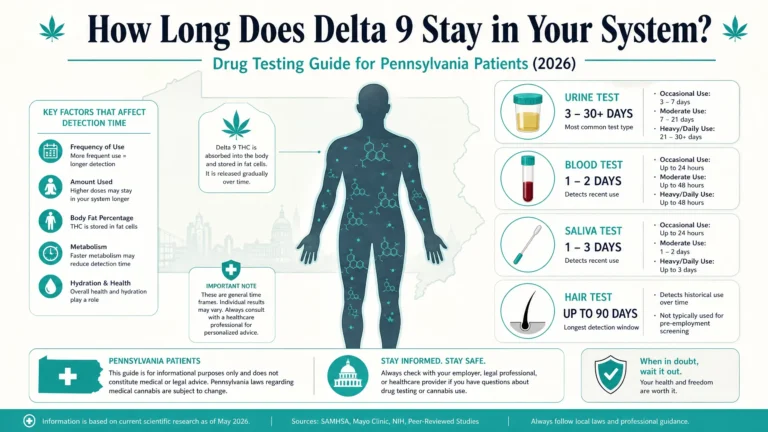
Urine tests can detect THC-COOH for varying periods depending on usage patterns: occasional use (1–3 times per week): 3–7 days; moderate use (4 times per week): 7–14 days; frequent use (daily): 14–30 days; heavy use (multiple times daily): up to 30–90 days.
Standard urine test cutoffs:
- SAMHSA initial screening: 50 ng/mL — the threshold used for the first pass immunoassay test
- SAMHSA confirmatory testing: 15 ng/mL — a lower threshold used on GC-MS confirmatory tests when the initial screen is positive
A positive initial screen at 50 ng/mL does not automatically mean a confirmed positive — it triggers confirmatory testing at the stricter 15 ng/mL threshold. Some patients who test positive on initial screening test negative on confirmatory testing.
Blood Testing — Used for DUIs and Workplace Accidents
Blood tests detect active delta 9 THC — not just metabolites — making them a more precise indicator of recent impairment. However, they have a significantly shorter detection window than urine.
Renewing Your PA MMJ Card?
Quick annual recertification online. No paperwork hassle.
Renew Card Online →Delta 9 THC is usually detectable in blood for 1–2 days. However, for chronic users, it can be detected for up to a month.
Active THC in blood peaks rapidly after inhalation — often above 100 ng/mL in the first few minutes — then drops quickly. THC declines quickly to single-digit levels within an hour. THC can remain at low but detectable levels of 1–2 ng/mL for 8 hours or more without any measurable signs of impairment in one-time users. In chronic users, residual THC can persist for 24–48 hours or longer.
Blood testing is primarily used in DUI investigations and serious workplace accidents — not routine employment screening.
This is where Pennsylvania law creates a critical issue for MMJ patients — covered in detail in Section 8.
Saliva Testing — Increasing Use for Roadside Checks
Delta 9 THC can be detected in saliva for up to 72 hours after use. Saliva tests detect recent oral THC exposure and are increasingly used in roadside law enforcement checks and some workplace situations.
Detection window: typically 24–72 hours depending on frequency of use. Saliva testing has a shorter window than urine, making it a more reasonable indicator of recent use — though it still does not measure impairment directly.
Hair Follicle Testing — Longest Detection Window
A hair test can detect THC for up to 90 days after consumption, but it is less commonly used than other drug tests.
Hair tests work by detecting THC metabolites that become trapped in the hair shaft as it grows. Because hair grows approximately 0.5 inches per month, a standard 1.5-inch hair sample represents approximately 90 days of history.
Hair testing is less common for employment screening — more expensive and slower — but is used in some federal employment, high-security clearance, and legal proceedings contexts.
Important limitation: Hair tests may not detect single-use or very occasional use as reliably as chronic use, and external contamination (smoke exposure) can occasionally affect results.
Complete Detection Window Reference Table
| Test Type | Occasional User | Moderate User | Daily User | Heavy/Chronic User |
|---|---|---|---|---|
| Urine | 3–7 days | 7–14 days | 14–30 days | 30–90 days |
| Blood | 1–2 days | 2–3 days | 3–7 days | Up to 30 days |
| Saliva | 24–48 hours | 48–72 hours | Up to 72 hours | Up to 72 hours |
| Hair | Up to 90 days | Up to 90 days | Up to 90 days | Up to 90 days |
How Frequency of Use Changes Everything

Frequency of use is the single most important variable in determining your personal detection window — more than body weight, metabolism, or any other factor.
Get Approved by a Licensed PA Doctor
Schedule your appointment in minutes. You only pay if approved.
Start Online Application →The reason: THC accumulates in fat tissue with regular use. Each subsequent use before the previous dose has cleared adds to the accumulated reservoir of stored metabolites. Over time, a daily or multiple-daily user builds up a significant fat-stored THC burden that continues releasing metabolites long after they stop.
The practical breakdown:
Single-use or occasional (once per week or less): Most users clear urine tests within 3–7 days. Fat accumulation is minimal because sufficient time passes between uses for stored THC to release and excrete before the next dose.
Moderate use (several times per week): Detection extends to 7–14 days. Some fat accumulation occurs but clearance still happens relatively efficiently.
Daily use: 14–30 days is the typical urine detection window. Meaningful fat accumulation occurs and sustained release of metabolites continues well after cessation.
Multiple daily use (heavy chronic use): This is the category where the 30–90 day detection windows become real. Heavy chronic users have substantial fat-stored THC that releases slowly over weeks. For maximum caution, regular users should consider abstaining for at least 30 days before a known drug test. Occasional users should allow at least 7–10 days to ensure metabolites have cleared.
The Individual Factors That Shift Your Personal Timeline
Beyond frequency of use, these individual variables meaningfully affect your specific detection window:
Body fat percentage: Higher body fat means more storage capacity for fat-soluble THC metabolites — and potentially longer release times. Leaner individuals with lower body fat percentages tend to clear THC more quickly because there is less storage tissue available.
Metabolism rate: Faster metabolic rates process and excrete THC metabolites more quickly. Metabolism is influenced by age, fitness level, thyroid function, and genetics. There is no reliable way to “boost” metabolism quickly enough to meaningfully shorten a detection window.
Hydration: Well-hydrated individuals produce more dilute urine — which can push THC-COOH concentrations below the 50 ng/mL cutoff even when metabolites are still present. Over-hydration before a test (drinking excessive water) is detectable through creatinine and specific gravity measurements in confirmatory testing — and submitting dilute specimens can itself be flagged.
Ready to Get Your Official PA MMJ Card?
State-certified doctor consultations online. No risk—100% refund if not approved.
Claim Your MMJ Card Online →Exercise: Physical exercise burns fat — which releases stored THC metabolites back into the bloodstream before excretion. This means vigorous exercise in the days immediately before a drug test can temporarily increase urinary THC-COOH concentrations. Ironically, exercising the day before a drug test may raise your levels, not lower them.
Method of consumption: Inhalation produces faster but shorter absorption spikes. Oral consumption through capsules or troches (legal in PA) produces slower absorption but may extend the fat accumulation period due to 11-hydroxy-THC’s longer half-life. Detection windows are generally similar across consumption methods, but onset and peak differ.
Kidney and liver function: Both organs are central to THC metabolism and excretion. Patients with reduced kidney or liver function may clear THC metabolites more slowly than individuals with healthy organ function.
Pennsylvania-Specific Thresholds Every Patient Must Know
This section is where this guide diverges most significantly from generic delta 9 detection articles — and where it matters most for Pennsylvania residents.
Pennsylvania has specific legal THC thresholds that apply in three distinct contexts, each with different consequences:
1. Standard employment urine testing (SAMHSA standards): 50 ng/mL initial screen / 15 ng/mL confirmatory. These are federal SAMHSA standards used by most Pennsylvania private employers for employment drug testing. Your PA MMJ card provides limited protection here — covered in Section 9.
2. PA DUI blood testing (75 Pa.C.S. § 3802): 1 ng/mL of active THC in blood. Pennsylvania’s most restrictive and consequential threshold — covered in full in Section 8.
3. Safety-sensitive employment under PA Act 16 (35 Pa.C.S.A. § 10231.510): Act 16 states that people performing safety-sensitive job functions cannot exceed a limit of 10 nanograms of tetrahydrocannabinol (THC) in their bloodstream during work hours. This rule applies even if the THC is from off-the-clock cannabis consumption.
These three different thresholds apply in three different legal contexts — and confusing them is a common and consequential mistake for PA patients.
The PA DUI Blood Threshold — 1 ng/mL and What It Means for Patients

This is the most important Pennsylvania-specific fact in this entire guide — and it is the one most PA patients do not fully understand.
Pennsylvania’s threshold for DUI is 1 ng/mL of THC in your blood. If you are pulled over and fail drug testing, you can be charged with a DUI — it does not matter if the marijuana was bought legally in a medical dispensary or on the street.
What makes this particularly significant:
Pennsylvania’s DUI law prohibits operating a motor vehicle with any detectable amount of THC metabolites in the blood — including inactive metabolites that produce no impairment whatsoever.
Pennsylvania DUI law prohibits operating a motor vehicle with any active or inactive THC metabolites in the blood. Active THC metabolites spike in the blood shortly after ingestion and begin to dissipate within an hour, converting to inactive THC metabolites which can stay in the blood for weeks and months depending on rate of usage and physical characteristics of the user.
This means a Pennsylvania patient who consumed cannabis three days ago, feels completely sober, and has zero actual impairment can still be charged with a DUI if blood testing detects inactive THC metabolites above 1 ng/mL.
Your PA MMJ card is not a defense to DUI charges. The card demonstrates legal possession — it does not authorize driving with detectable THC in your blood.
This is the same legal reality that prompted the ACLU of Pennsylvania to note that hundreds of thousands of registered PA patients technically cannot drive lawfully under a strict reading of current law — and why proposed legislation like HB 983 to create a patient-specific standard has been introduced but not yet passed as of May 2026.
Practical guidance for PA patients:
- Blood THC levels drop quickly — active delta 9 falls to single-digit ng/mL within 1–2 hours of consumption in most users
- For experienced daily users, residual blood THC can persist for 24–48 hours at low levels
- The safest approach: do not drive for at least 8 hours after consumption — and considerably longer if you are a heavy daily user
- If stopped by police, do not volunteer information about recent cannabis use
Employment Drug Testing in Pennsylvania — Your Rights as an MMJ Patient

Pennsylvania’s employment drug testing landscape is more nuanced than most states — and your PA MMJ card changes your legal position significantly when you test positive.
What the PA Medical Marijuana Act protects:
Pennsylvania’s Medical Marijuana Act extends specific anti-discrimination protections to employees with valid medical marijuana cards. Employers are prohibited from discharging, refusing to hire, or discriminating against patients concerning their compensation or privileges solely based on their status as a medical marijuana cardholder. As long as an employee is a Pennsylvania resident, possesses a valid medical marijuana card, and only uses medical marijuana outside of work hours, termination solely on the grounds of being a medical marijuana patient is prohibited.
The 2021 Palmiter v. Commonwealth Health Systems ruling confirmed that patients have an implied right to sue employers who take adverse employment actions solely based on MMJ patient status — giving real legal teeth to these protections.
What the Act does NOT protect:
- Being impaired at work — no protection if you are actually under the influence during work hours
- Safety-sensitive positions — employers can enforce the 10 ng/mL blood threshold for defined dangerous jobs even for registered patients
- Federal contractors — federal employment and contractors operating under federal regulations follow federal law, not Pennsylvania state law
- CDL/DOT-regulated positions — covered in the next section
The critical practical question — does testing positive alone justify termination?
For most non-safety-sensitive jobs: a positive drug test alone, combined with a valid PA MMJ card and off-hours use, does not legally justify termination or refusal to hire. The employer must demonstrate actual impairment or safety risk, not just a positive test result.
However — this area of law is still developing. Working with a Pennsylvania employment attorney familiar with medical marijuana law is advisable if you face adverse employment action based on a positive drug test.
The Philadelphia Pre-Employment Drug Test Ban
This is a significant fact that affects hundreds of thousands of Pennsylvania workers — and that virtually no competing guide mentions.
Since January 1, 2022, a Philadelphia City Council ordinance prohibits employers in Philadelphia from requiring applicants to submit to pre-employment drug tests that include marijuana screening — with specific exceptions.
Pennsylvania State Cannabis confirms this ordinance applies to Philadelphia employers and limits pre-employment marijuana testing.
Exceptions to Philadelphia’s ban:
- Police officers and law enforcement
- CDL operators and positions requiring federal drug testing
- Positions requiring supervision or care of children, medical patients, or people with disabilities
- Positions where impairment would constitute a safety risk
What this means for Philadelphia workers: If you live or work in Philadelphia and are applying for a non-excepted position, your prospective employer generally cannot require a pre-employment marijuana drug test. This does not affect random testing once employed or testing after a workplace incident.
CDL and DOT-Regulated Jobs — Different Rules Apply
If you hold a Commercial Driver’s License (CDL) or work in any Department of Transportation-regulated position, Pennsylvania’s MMJ patient protections do not apply. Federal rules govern entirely.
CDL drivers are subject to Federal DOT Guidelines (49 CFR Part 40). The cutoff for a positive urine or body fluid test is 50 nanograms of THC per milliliter. Federal DOT guidelines do not distinguish between recreational and medical users of marijuana.
DOT-regulated positions include commercial truck drivers, bus drivers, airline pilots, railroad workers, pipeline safety workers, and maritime workers.
For these workers: a positive drug test at the 50 ng/mL urine threshold results in immediate removal from safety-sensitive duties regardless of your PA MMJ card status. There is no card-based exemption. The consequences include mandatory substance abuse evaluation, return-to-duty testing, and follow-up testing — a long and professionally costly process.
If your livelihood depends on a CDL or DOT-regulated position, this is the most significant consequence of regular cannabis use regardless of its legal medical status in Pennsylvania.
Do Detox Products Work? The Honest Answer
Many products claim to accelerate THC clearance — “detox drinks,” “cleansing supplements,” THC detox kits. The honest answer from current evidence:
According to research from the National Institute on Drug Abuse, the only reliable way to test negative is allowing sufficient time for natural metabolism and elimination. Despite numerous products claiming to “detox” or “flush” THC from your system, scientific evidence doesn’t support their effectiveness.
Why detox products generally fail:
THC is stored in fat tissue — not in the bloodstream or urine in a way that can be rapidly “flushed.” No drink, supplement, or short-term intervention can meaningfully accelerate the release and excretion of fat-stored metabolites in a clinically significant way.
What some products do achieve: Some “detox drinks” work primarily through dilution — significantly increasing urine output temporarily. This can push THC-COOH concentrations below the 50 ng/mL cutoff if levels are close to the threshold. However: confirmatory drug tests check for creatinine and specific gravity to identify dilute specimens. An unnaturally dilute sample may be flagged and rejected — requiring a retest or being treated as a failed test.
The only evidence-based strategies:
- Time — the only reliable approach
- Abstinence — stopping consumption as early as possible before a known test date
- Moderate exercise in the weeks before testing (but avoid vigorous exercise the day before — it can temporarily raise levels)
- Normal hydration — not excessive, not dehydrated
How a PA MMJ Card Changes Your Legal Standing on a Positive Drug Test

Summarizing the complete picture of what your PA medical marijuana card does and does not protect you from when delta 9 shows up on a drug test:
Your card HELPS you when:
- A private employer in a non-safety-sensitive role fails you on a drug test and takes adverse action solely because of your patient status — Palmiter gives you the right to sue
- A Philadelphia employer requires pre-employment marijuana testing in a non-excepted role — you can invoke the city ordinance
- You receive unemployment benefits after termination — Pennsylvania courts have ruled MMJ patients are still eligible even after failing a drug test (Jack Lehr Electric v. UCBR)
Your card does NOT protect you when:
- You are driving with detectable THC in your blood above 1 ng/mL — DUI law applies regardless of your card
- You work in a safety-sensitive role and exceed 10 ng/mL during work hours
- You work in a CDL or DOT-regulated position — federal rules govern
- You work for a federal contractor or federal employer — federal law governs
- You are actually impaired at work — no protection for on-the-job impairment
The bottom line: your PA MMJ card is meaningful legal protection in employment contexts for most non-safety-sensitive workers. It is not protection from DUI charges based on blood THC detection. It is not protection in federal or DOT-regulated employment contexts.
If you do not yet have a PA medical marijuana card and use cannabis regularly — getting registered is the single most important step you can take to protect your employment rights when delta 9 shows up on a drug test.
View the full list of PA qualifying conditions or get certified today.
Frequently Asked Questions
Q: How long does delta 9 stay in your system?
A: Between 1 day and 90 days depending on frequency of use and the type of test. Urine tests: 3–7 days for occasional users, 14–30 days for daily users, up to 90 days for heavy chronic users. Blood tests: 1–2 days for most users, potentially longer for chronic heavy users. Saliva: up to 72 hours. Hair: up to 90 days regardless of frequency.
Q: How long does delta 9 stay in urine?
A: Occasional users (once per week or less): 3–7 days. Moderate users: 7–14 days. Daily users: 14–30 days. Heavy chronic users: 30–90 days. The standard urine test threshold is 50 ng/mL on initial screening and 15 ng/mL on confirmatory GC-MS testing.
Q: Does delta 9 show up on a standard drug test?
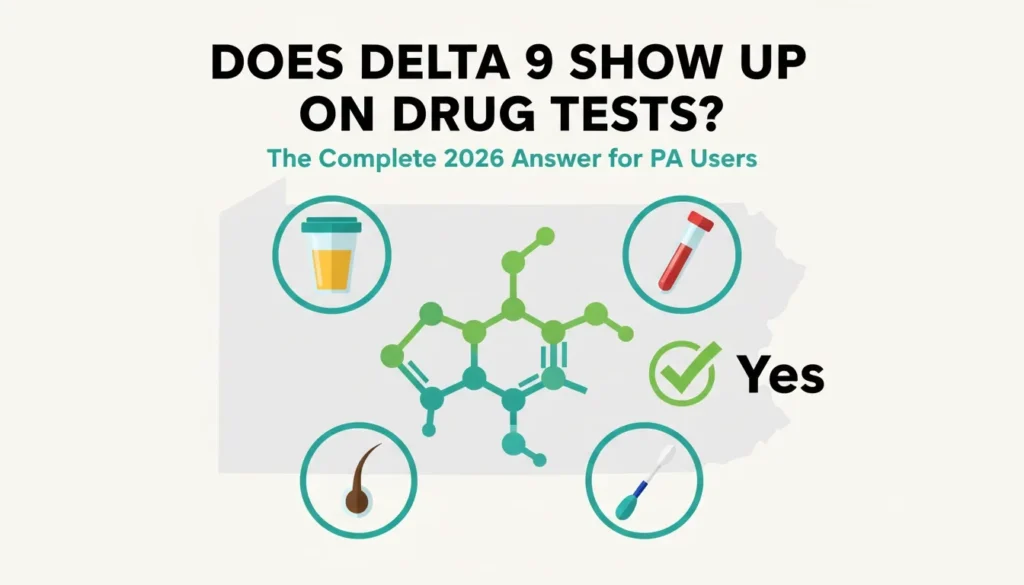
A: Yes — all standard drug tests screen for THC metabolites (primarily THC-COOH), regardless of whether the delta 9 came from medical marijuana, recreational cannabis, or hemp-derived delta 9 products. The test cannot distinguish between legal and illegal sources.
Q: How long after stopping does delta 9 become undetectable?
A: For occasional users, urine tests typically become negative within 3–7 days of stopping. For daily users, 2–4 weeks. For heavy chronic users, potentially 4–12 weeks. Blood tests typically become negative within 1–7 days of stopping for most users.
Q: Can I drive in Pennsylvania if I have a PA MMJ card?
A: Having a card does not authorize driving with detectable THC in your blood. Pennsylvania’s DUI law prohibits any detectable amount of THC metabolites in the blood — the threshold is 1 ng/mL of active THC. Your card is not a defense to DUI charges. Active THC in blood drops to low levels within 1–2 hours of inhalation for most users but inactive metabolites can persist longer in chronic users.
Q: Does a PA MMJ card protect me from a positive drug test at work?
A: For most non-safety-sensitive private sector jobs: yes — Pennsylvania’s Medical Marijuana Act prohibits employers from taking adverse action solely based on your patient status when you use off-hours. The 2021 Palmiter ruling confirmed patients can sue for discrimination. However, safety-sensitive roles, CDL/DOT positions, and federal employers are not covered by this protection.
Q: How long does delta 9 stay in your blood for a DUI test?
A: Active delta 9 THC peaks in blood within minutes of inhalation and drops quickly — typically to single-digit ng/mL within 1 hour. For one-time users, blood THC may be undetectable within 1–2 days. For chronic heavy users, residual levels can persist 24–48 hours or longer. Pennsylvania’s DUI threshold is 1 ng/mL — a very low standard that includes both active and inactive metabolites.
Q: Do detox drinks clear delta 9 from your system faster?
A: No — there is no scientific evidence that detox products meaningfully accelerate THC clearance. THC is stored in fat tissue and releases slowly over time regardless of any supplement or drink. Some products can temporarily dilute urine, but confirmatory tests check for dilution. Time and abstinence are the only reliable approaches.
The Bottom Line
How long does delta 9 stay in your system? The honest answer: long enough to matter for drug testing purposes — days to weeks depending on how often you use it, and potentially months for heavy chronic users on urine tests.
For Pennsylvania medical marijuana patients specifically, the most important facts are:
Your PA MMJ card protects your employment rights in most non-safety-sensitive jobs when you test positive — but only when you have that card registered and active. Without a card, a positive test has no legal protection behind it.
Your card does not protect you from DUI charges. Pennsylvania’s 1 ng/mL blood threshold applies to everyone — patients included. Avoid driving for at least 8 hours after consumption, and longer if you are a regular daily user.
If you have a qualifying condition and are not yet registered as a PA medical marijuana patient — your first and most important step toward protecting yourself legally when delta 9 shows up in a drug test is getting your card. Get certified today at Pennsylvania Marijuana Cards.
Medically reviewed by Dr. Johnathon Chance Miller, MD. This article is for informational and educational purposes only and does not constitute legal or medical advice. Pennsylvania drug testing law and medical marijuana regulations are actively evolving. Consult a licensed Pennsylvania employment attorney for advice specific to your situation. Updated May 2026.
Sources:
- Pennsylvania State Cannabis — Drug Testing Law 2026
- Kaufman Workers’ Comp Law — Legal Rights of PA MMJ Patients
- Weisberg Cummings — Medical Marijuana Employment Laws in PA
- ACBA — PA Medical Marijuana FAQ
- MPP — Act 16 Employment Provisions
- Talcada — Pennsylvania Drug Testing Laws 2026
- Crescent Canna — How Long Delta 9 Stays in System (January 2026)
- Cornbread Hemp — How Long Does Delta 9 Stay in Your System (March 2026)
- Refine Recovery — How Long Does Delta 9 Stay in Your System (March 2026)
- FAB CBD — How Long Delta 9 Stays in Your System
- SAMHSA — Mandatory Guidelines for Federal Workplace Drug Testing
- NIDA — Cannabis Research