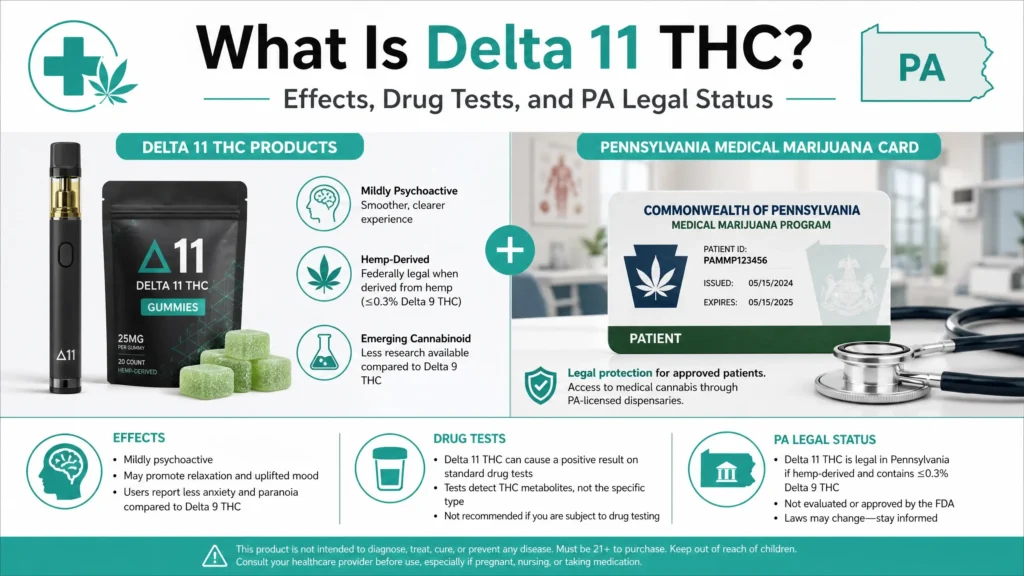


Does delta 9 show up on drug tests? Yes — completely, consistently, and regardless of whether your delta 9 came from a licensed Pennsylvania dispensary, a hemp gummy you bought at a gas station, or a CBD tincture you picked up online. Standard drug tests do not know or care whether your THC was legal. They detect one thing: a metabolite your liver produces when it processes delta 9 THC, called THC-COOH — and that metabolite is chemically identical regardless of the source.
This is the answer many people searching this question do not expect — particularly those who consumed a legal hemp-derived delta 9 product and assumed that “federally legal” means “won’t show on a drug test.” Those two things have nothing to do with each other.
Need a PA Medical Marijuana Card?
Get certified online in 15 minutes. 100% Money-Back Guarantee.
Get Certified Now →This guide explains exactly why delta 9 shows up on every standard drug test, what each test type actually detects, the important differences between hemp and dispensary delta 9 when it comes to your legal rights in Pennsylvania, and what you can do to protect yourself.
The Direct Answer — Does Delta 9 Show Up on Drug Tests?
Yes. Delta 9 THC shows up on drug tests — every standard drug test type used in employment, probation, athletics, and medical screening. This applies to:
- Delta 9 THC purchased at a licensed Pennsylvania medical marijuana dispensary
- Hemp-derived delta 9 gummies, drinks, and edibles sold legally online or in stores
- Full-spectrum CBD products that contain trace amounts of delta 9 THC
- Delta 9 THC consumed through any method — vaporization, oral products, sublingual tinctures
There is no form of delta 9 THC consumption that standard drug tests cannot detect, given sufficient recent use and sensitivity of the test.
The follow-up questions that matter more than the yes/no are: how long does it remain detectable, what legal protections do you have when it shows up, and does the source of your delta 9 — hemp vs. dispensary — change your rights when you test positive in Pennsylvania? The answer to that last question is yes — and it is the most practically important distinction this guide makes.
Do You Qualify for a PA MMJ Card?
Connect with a licensed Pennsylvania state physician online from home.
For a complete breakdown of detection windows by test type and frequency of use, see our companion guide: How Long Does Delta 9 Stay in Your System?
Why “Legal Hemp” Doesn’t Mean “Invisible on Drug Tests”

This is the misconception that brings most people to this search query — and it deserves a thorough, honest answer.
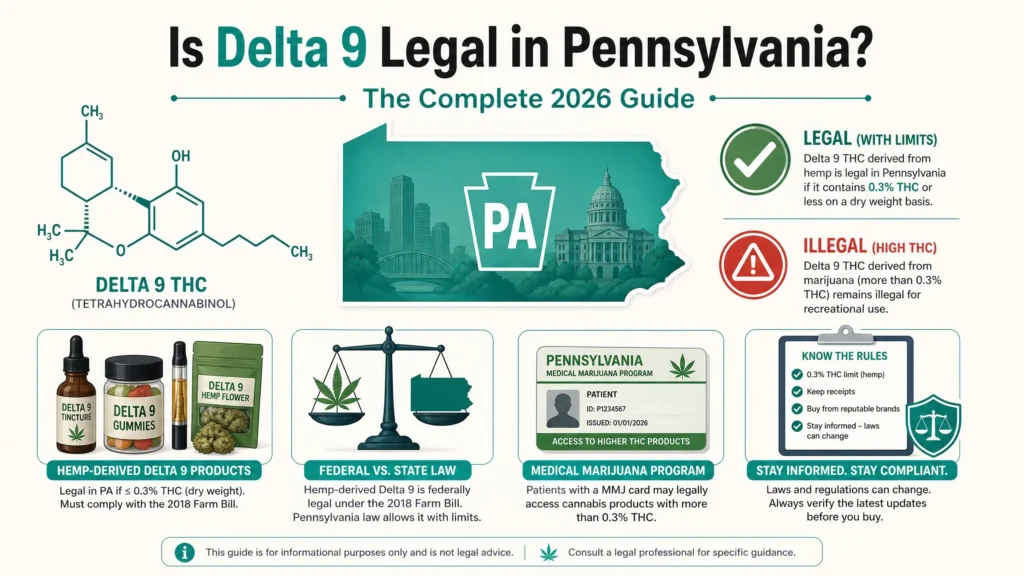
Since the 2018 Farm Bill, hemp-derived delta 9 THC products containing less than 0.3% THC by dry weight are federally legal. You can buy hemp-derived delta 9 gummies, beverages, capsules, and tinctures in Pennsylvania without a prescription, without a medical card, and without visiting a dispensary. They are sold in gas stations, health food stores, and widely online.
The logical assumption many people make: if it’s legal, it won’t get me in trouble on a drug test.
This assumption is completely wrong — and here is exactly why.
Drug tests are designed by chemists to detect metabolites in your body. They are not designed to detect legality. The test does not know the legal status of the product you consumed. It does not know whether you bought it from a licensed Pennsylvania dispensary with a medical card, from a gas station with a credit card, or from a friend. It simply detects whether a specific compound — THC-COOH — is present above the cutoff threshold.
Standard drug tests are not designed to differentiate between delta 9 THC from hemp or marijuana. They detect the presence of THC metabolites, specifically THC-COOH, which are structurally identical regardless of the source. A positive result will simply indicate THC use — not its origin.
As Cornbread Hemp states plainly in their April 2026 lab testing guide: “Drug tests don’t account for legal versus illegal sources. They just check for THC or its metabolites.”
The legal landscape has evolved dramatically faster than drug testing protocols. In 2026, you can legally buy hemp delta 9 products virtually everywhere — and lose your job for doing so if your employer maintains a zero-tolerance THC policy.
The 0.3% Dry Weight Rule — What It Actually Means for Your Test
Understanding this rule clarifies a common confusion about how much delta 9 is actually in legal hemp products.
⚡ Fast & 100% Online PA Medical Cards
Board-Certified Doctors • 100% Money-Back Guarantee
Book Evaluation Now →The 2018 Farm Bill established that hemp products are legal if they contain 0.3% or less delta 9 THC by dry weight of the total product. This is not a limit on milligrams of THC — it is a concentration limit applied to the total product weight.
This is how manufacturers legally sell gummies containing 5mg, 10mg, 20mg, or even 50mg of delta 9 THC per piece. The math works like this:
A 10mg delta 9 gummy that weighs 5 grams (5,000mg total) contains 10mg/5,000mg = 0.2% THC by dry weight — below the legal 0.3% threshold. Legal.
The product may contain far more THC than most people realize from the “legal hemp” framing. The 0.3% is a regulatory classification rule — not a safety threshold, not a potency limit, and certainly not a drug test detection limit.
The practical implication: Legal hemp delta 9 products can and do contain meaningful doses of active THC — often the same doses you would receive from a dispensary product. These doses produce the same metabolites as marijuana and are detected by drug tests at the same sensitivity levels. The “it’s legal hemp” framing tells you nothing about whether it will show on a test.
What Drug Tests Actually Detect — THC-COOH Explained

To understand why delta 9 shows up on drug tests regardless of source, you need to understand what the test is actually measuring.
When you consume delta 9 THC — through any method, from any source — your liver metabolizes it into a cascade of compounds. The primary metabolite produced is THC-COOH (11-nor-9-carboxy-THC).
THC-COOH has several important characteristics:
It is not psychoactive. THC-COOH produces no high. It is a waste metabolite — the product of your body processing and clearing delta 9 THC.
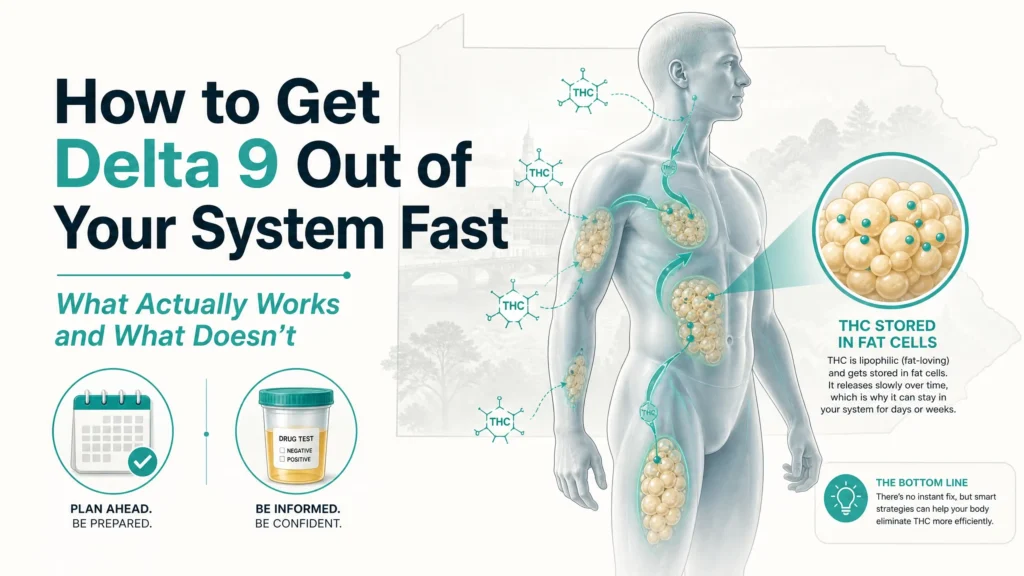
It is fat-soluble and long-lasting. Like delta 9 THC itself, THC-COOH is fat-soluble and stores in body tissue, releasing slowly over days to weeks after consumption.
It is chemically identical regardless of THC source. Your liver does not produce a different metabolite from hemp-derived delta 9 than it does from marijuana-derived delta 9. The molecule is the same; the metabolic pathway is the same; the metabolite is the same.
Renewing Your PA MMJ Card?
Quick annual recertification online. No paperwork hassle.
Renew Card Online →It is what immunoassay drug tests detect. Standard urine drug tests use antibodies that bind specifically to THC-COOH. When concentration exceeds the cutoff threshold — typically 50 ng/mL — the test returns a positive result.
Drug tests detect metabolites in your body, not the legal status of the product you consumed. The body produces that same metabolite regardless of the THC source. Legal status doesn’t change body chemistry.
Does Delta 9 Show Up on Every Type of Drug Test?
Yes — but with different detection windows and different practical implications:

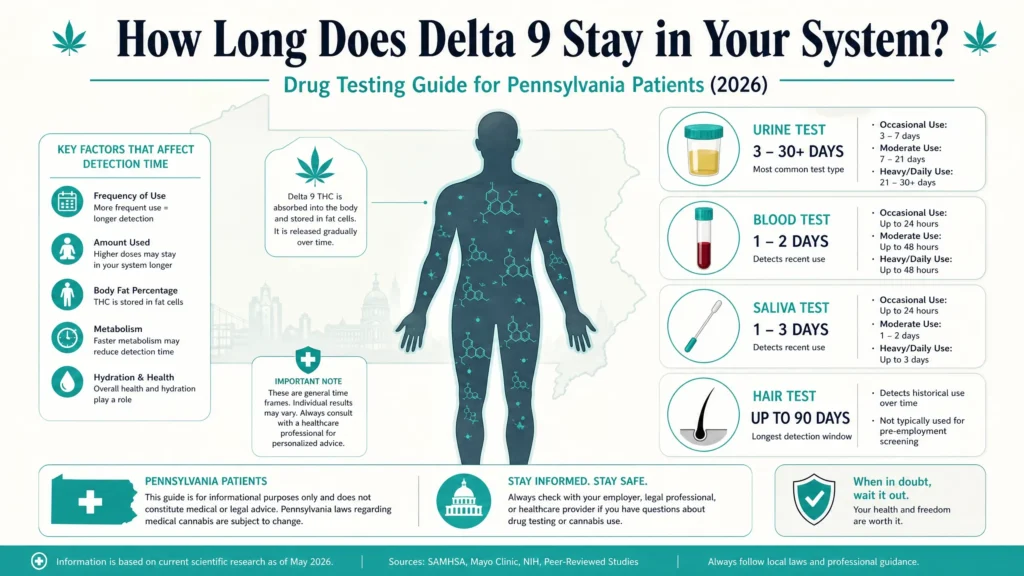
Urine Testing — Most Common for Employment
Does delta 9 show up? Yes — urine tests are specifically designed to detect THC-COOH and are the primary employment screening method.
Detection window:
- Occasional use (once per week or less): 3–7 days
- Moderate use: 7–14 days
- Daily use: 14–30 days
- Heavy chronic use: 30–90 days
Standard cutoffs:
- Initial immunoassay screening: 50 ng/mL
- Confirmatory GC-MS testing: 15 ng/mL
A positive at 50 ng/mL triggers confirmatory testing at the stricter 15 ng/mL threshold. Some patients who screen positive initially test negative at confirmation.
Blood Testing — Used for DUI Investigations
Does delta 9 show up? Yes — blood tests detect active delta 9 THC (not just metabolites), making them more indicative of recent use and actual impairment.
Detection window:
- Most users: 1–2 days after use
- Chronic heavy users: up to 7 days for active THC, longer for metabolites
Blood tests are primarily used in DUI investigations, serious workplace accidents, and high-security employment contexts — not routine employment screening.
Critical Pennsylvania note: Pennsylvania’s DUI threshold is 1 ng/mL of active THC in blood — one of the lowest standards in any state. This threshold applies to all drivers including registered PA medical marijuana patients. Your PA MMJ card is not a defense to DUI charges.
Saliva Testing — Roadside and Workplace
Get Approved by a Licensed PA Doctor
Schedule your appointment in minutes. You only pay if approved.
Start Online Application →Does delta 9 show up? Yes — saliva tests detect recent THC exposure through oral fluid.
Detection window: Typically 24–72 hours after use. Saliva tests are increasingly used for roadside law enforcement checks in Pennsylvania and some workplace settings.
Practical note: Saliva testing has a shorter detection window than urine, making it a more reasonable indicator of recent consumption — but it still does not directly measure impairment.
Hair Follicle Testing — Longest Detection Window
Does delta 9 show up? Yes — hair tests detect THC metabolites trapped in the hair shaft for up to 90 days after use.
Detection window: Up to 90 days from last consumption for most users. A standard 1.5-inch hair sample captures approximately 90 days of history.
Important limitation: Hair tests may not reliably detect single-use or infrequent use. They are more effective at identifying patterns of regular use and are less common for standard employment screening due to cost.
Complete Detection Reference
| Test Type | Occasional | Daily | Chronic | PA-Specific Note |
|---|---|---|---|---|
| Urine | 3–7 days | 14–30 days | 30–90 days | 50 ng/mL cutoff |
| Blood | 1–2 days | 3–7 days | Up to 30 days | 1 ng/mL PA DUI threshold |
| Saliva | 24–48 hrs | 48–72 hrs | 72 hrs | Roadside use increasing |
| Hair | Up to 90 days | Up to 90 days | Up to 90 days | Rare in employment |
What Is Actually on a Standard Drug Test Panel?

Many people do not know what a “standard drug test” actually screens for — and assume it tests for everything. In reality, most workplace drug tests use standardized panels that test for a specific list of substances.
5-Panel Drug Test (most common for standard employment): Tests for: THC, cocaine, opiates, amphetamines, phencyclidine (PCP)
10-Panel Drug Test (government and safety-sensitive jobs): Adds to the 5-panel: benzodiazepines, barbiturates, methadone, propoxyphene, methaqualone
12-Panel Drug Test (expanded screening): Further adds: MDMA/ecstasy, oxycodone/oxymorphone, and sometimes buprenorphine
Ready to Get Your Official PA MMJ Card?
State-certified doctor consultations online. No risk—100% refund if not approved.
Claim Your MMJ Card Online →Key point: THC is on every standard panel — from the most basic 5-panel test to the most comprehensive 12-panel. There is no standard employment drug test that does not screen for THC. This applies to all sources of delta 9 — hemp-derived, dispensary-purchased, or any other.
DOT (Department of Transportation) panels: Federal DOT drug testing uses a specific 5-panel urine test with the SAMHSA 50 ng/mL cutoff. This applies to all CDL holders and DOT-regulated positions in Pennsylvania — and PA MMJ card protections do not apply to DOT-regulated employment.
Can CBD Make You Fail a Drug Test?
This is a closely related question that many PA patients — and hemp product consumers — ask alongside the delta 9 question.
Pure CBD isolate: Will not cause a positive drug test. CBD itself is not detected by standard immunoassay panels targeting THC-COOH.
Broad-spectrum CBD (THC-free): Generally will not cause a positive. These products are formulated to remove detectable THC while retaining other cannabinoids and terpenes.
Full-spectrum CBD: Can cause a positive with regular use. Full-spectrum CBD products contain up to 0.3% delta 9 THC by dry weight — the legal hemp limit. With daily use of high-dose full-spectrum products, THC-COOH can accumulate to detectable levels over time.
The risk from full-spectrum CBD is dose and frequency dependent. A person using a small amount of a low-potency full-spectrum tincture occasionally is unlikely to accumulate enough THC-COOH to trigger a positive at 50 ng/mL. A person using high-dose full-spectrum products daily is at meaningful risk.
If you are subject to drug testing and use CBD: Choose broad-spectrum or CBD isolate products and verify the absence of THC through the product’s third-party Certificate of Analysis (COA). Do not rely solely on label claims — verify the COA directly.
At-Home Drug Test Kits — How Reliable Are They?
At-home drug test kits are widely available in Pennsylvania pharmacies and online and can provide a useful preview of what an employment or probation test might show. But understanding their limitations is important before relying on them.
How they work: At-home urine test strips use the same immunoassay technology as initial screening at most labs — detecting THC-COOH above a threshold (typically 50 ng/mL, the same SAMHSA standard).
What they do reliably:
- Confirm you are clearly above the threshold — a strong positive on a home test is a genuine signal
- Confirm you are clearly below the threshold after sufficient abstinence
What they do unreliably:
- Results near the threshold are inconsistent — a negative home test does not guarantee a negative lab test
- Home tests do not perform confirmatory GC-MS analysis, which labs use at the stricter 15 ng/mL threshold
- Hydration level significantly affects home test results — dilute urine on a home test may show negative when a controlled lab sample would be positive
The dilution problem: Some people drink large amounts of water before testing at home to dilute below the threshold. This same strategy at a lab can backfire — labs check creatinine and specific gravity to identify dilute specimens. An abnormally dilute sample may be rejected and retested, or flagged as an attempt to tamper with results.
The safest approach: Use at-home tests as directional guidance only. A clear negative on a home test after appropriate abstinence time is reassuring. A positive on a home test means you are definitely not ready for an employment or probation test.
Probation and Court-Ordered Testing — Stricter Rules Apply
Pennsylvania patients on probation or subject to court-ordered drug testing face a significantly stricter testing environment than standard employment screening — and this distinction matters enormously for delta 9 users.
Lower cutoff thresholds: Many probation testing programs use cutoffs of 20 ng/mL rather than the employment standard of 50 ng/mL — meaning THC-COOH is detected at lower concentrations and for longer periods.
More frequent testing: Probation tests may occur weekly or multiple times per month — leaving no safe window for delta 9 consumption if you are a regular user.
No PA MMJ card protection in probation contexts: Your Pennsylvania medical marijuana patient status does not exempt you from probation drug testing requirements. Probation terms are set by the court — and if your probation prohibits THC use, your medical card does not override that court order.
Hemp delta 9 — no protection whatsoever: Legal hemp-derived delta 9 products provide zero defense if you test positive while on probation. The metabolite is the same regardless of source, and probation officers and courts are not required to accept legal hemp use as an explanation.
If you are on probation and use any delta 9 THC products — medical or hemp — consult a Pennsylvania criminal defense attorney before your next test. The consequences of a positive probation drug test are significantly more severe than an employment positive.
Athletic Drug Testing — Different Thresholds
Pennsylvania patients who participate in competitive athletics subject to anti-doping testing face their own specific set of rules.
WADA (World Anti-Doping Agency) threshold: 150 ng/mL of THC-COOH in urine — significantly higher than the SAMHSA employment standard of 50 ng/mL. WADA raised its threshold in 2013 specifically to focus on in-competition impairment rather than out-of-competition recreational use.
NCAA threshold: 35 ng/mL — significantly stricter than WADA, making it one of the more challenging standards for cannabis users.
Professional sports leagues vary: NFL, MLB, NBA, NHL, and other professional leagues each have their own testing programs and thresholds — some have reduced or eliminated marijuana testing entirely in recent labor negotiations.
At the WADA 150 ng/mL threshold: Most occasional cannabis users clear within 1–3 days. Regular users may still test positive for 1–2 weeks. Heavy daily users for longer. The higher threshold does not make cannabis use risk-free for competitive athletes — it simply changes the calculation.
The Critical PA Legal Difference — Hemp Delta 9 vs. Dispensary Delta 9

This is the most important Pennsylvania-specific distinction in this entire guide — and the one that most directly affects the real-world consequences of a positive drug test for PA residents.
Hemp-derived delta 9 products (gas station, online, non-dispensary):
- Are federally legal under the 2018 Farm Bill
- Produce identical THC-COOH metabolites as dispensary cannabis
- Are NOT covered by Pennsylvania’s Medical Marijuana Act protections
- Provide zero employment discrimination protection under Palmiter v. Commonwealth Health Systems
- Are not recognized by your PA MMJ card status
- Cannot be defended in a drug testing context by showing your medical card
Pennsylvania dispensary-purchased medical marijuana:
- Requires a valid PA MMJ card to purchase
- Also produces identical THC-COOH metabolites
- IS covered by Pennsylvania Medical Marijuana Act employment protections
- May be defended in non-safety-sensitive employment contexts using your card
- Gives you the right to sue employers who take adverse action solely based on your patient status
The real-world consequence of this difference:
A Pennsylvania patient who uses dispensary cannabis with a valid PA MMJ card and fails a workplace drug test has legal protection against termination for most non-safety-sensitive jobs — backed by a 2021 Superior Court ruling and Act 16 of the Medical Marijuana Act.
A Pennsylvania resident who consumes hemp delta 9 gummies from a convenience store and fails the same drug test has no legal protection whatsoever — even though the product they consumed was federally legal. The employment discrimination protections of the Medical Marijuana Act apply only to registered patients using dispensary-purchased cannabis.
This distinction is not academic. It is the difference between a recoverable situation and a lost job with no legal recourse.
What Your PA MMJ Card Protects — And What It Doesn’t

For registered Pennsylvania medical marijuana patients, here is the complete picture of how your card status interacts with a positive delta 9 drug test:
Your card DOES protect you from:
- Termination solely based on your registered patient status in most non-safety-sensitive private sector jobs
- Pre-employment marijuana drug testing discrimination in Philadelphia (city ordinance since January 2022)
- Loss of unemployment benefits after termination for a positive test (Jack Lehr Electric v. UCBR, 2021)
- Adverse employment actions taken by employers who cannot demonstrate actual impairment or safety risk
Your card does NOT protect you from:
- A DUI charge if blood THC exceeds 1 ng/mL — card is not a driving defense
- Employment consequences in safety-sensitive roles exceeding 10 ng/mL during work hours
- DOT/CDL drug testing — federal rules govern regardless of state card status
- Federal employment drug testing
- Probation or court-ordered testing restrictions
- Testing positive from hemp-derived delta 9 products — the card only covers dispensary-purchased cannabis
The practical message: If you use cannabis and want both legal product access AND employment protection, registering as a Pennsylvania medical marijuana patient and purchasing exclusively from licensed PA dispensaries gives you the strongest legal position available in the state.
For details on qualifying conditions and how to get your card, see our full qualifying conditions guide or get certified today.
The November 2026 Federal Hemp Deadline — What’s Coming
This is the most current May 2026 development affecting everyone who uses hemp-derived delta 9 products in Pennsylvania — and it is completely absent from most competing guides.
Under the current federal regulatory timeline, hemp-derived THC products face a potential legal status change on November 12, 2026, when certain provisions related to hemp cannabinoid regulation were set to take effect — potentially eliminating or severely restricting the hemp-derived delta 9 market that has grown dramatically since 2018.
As HealthDataConsortium.org’s April 2026 analysis notes: “Drug tests detect metabolites in your body, not the legal status of the product you consumed. Whether hemp-derived delta 9 products become illegal under the new regulations doesn’t change the fact that THC-COOH shows up on a test the same way regardless.”
What this means practically for Pennsylvania users:
Regardless of what happens to hemp delta 9’s legal status at the federal level in late 2026, the drug testing implications remain identical. THC-COOH is THC-COOH — the regulatory status of the product does not change the metabolite’s behavior in your body or its detectability on a drug test.
If you are a Pennsylvania resident managing a qualifying medical condition and currently using hemp-derived delta 9 products, this regulatory uncertainty is an additional reason to consider transitioning to Pennsylvania’s licensed dispensary system with a registered PA MMJ card — which provides legal certainty, tested and labeled products, and employment protections that hemp products cannot offer.
Practical Guidance — What to Do If You Face a Drug Test

If you use delta 9 THC in any form and have a drug test approaching, here is clear, evidence-based guidance:
The only reliable strategy is abstinence — how far in advance depends on your use pattern:
- Occasional user (once per week or less): abstain at least 7–10 days before a urine test
- Regular user (several times per week): abstain at least 14–21 days
- Daily user: abstain at least 30 days; consider 45 days for safety
- Heavy chronic user: abstain 45–90 days before any urine test
Use an at-home test kit as directional guidance: Purchase a SAMHSA-standard 50 ng/mL urine test strip from a pharmacy. Test yourself 2–3 days before your scheduled test. A clear negative is encouraging but not a guarantee — use it as directional data, not certainty.
Do not attempt to cheat the test: Diluting with excessive water, substituting synthetic urine, or adding adulterants to your sample are detectable through lab confirmatory testing and constitute fraud — with significantly worse consequences than a positive test. Labs check creatinine, specific gravity, and pH to identify sample manipulation.
Know your rights before you test: If you are a registered PA MMJ patient and use dispensary cannabis, know your rights under Act 16 and the Palmiter ruling before your results come back. If you work in a non-safety-sensitive role and your employer takes adverse action based solely on a positive test and your card status, consult a Pennsylvania employment attorney.
If you use hemp delta 9, understand you have no legal protection on a positive: Hemp-derived delta 9 is not covered by PA’s Medical Marijuana Act protections. If you want both legal product access AND employment protection in Pennsylvania, get a PA MMJ card and use licensed dispensary products.
Frequently Asked Questions
Q: Does delta 9 show up on drug tests?
A: Yes — completely and consistently. Standard drug tests detect THC-COOH, a metabolite produced when your liver processes delta 9 THC. This metabolite is identical regardless of whether the THC came from a licensed Pennsylvania dispensary, a legal hemp gummy, or any other source. Drug tests cannot distinguish between legal and illegal THC. The legal status of the product you consumed has no effect on whether you test positive.
Q: Does legal hemp delta 9 show up on a drug test?
A: Yes. Hemp-derived delta 9 products that are federally legal under the 2018 Farm Bill produce the same THC-COOH metabolites as marijuana. Standard drug tests detect the metabolite — not the source or legal status of the product. Consuming a legal hemp delta 9 gummy will trigger a positive drug test if consumed recently enough and in sufficient quantity.
Q: What drug tests detect delta 9?
A: All standard drug test types detect delta 9 THC: urine tests (most common, detects THC-COOH for days to weeks), blood tests (detects active THC for 1–7 days depending on use frequency), saliva tests (detects recent use up to 72 hours), and hair follicle tests (detects metabolites up to 90 days). THC is included on every standard drug test panel from 5-panel to 12-panel.
Q: Does a PA medical marijuana card protect you if delta 9 shows up on a drug test?
A: For most non-safety-sensitive private sector jobs in Pennsylvania: yes — your card protects you from adverse employment action taken solely because of your patient status, as long as you use dispensary-purchased cannabis off-hours. However, your card does not protect you from DUI charges, DOT/CDL testing, federal employment testing, safety-sensitive roles, or probation testing. And critically: your card provides NO protection if the positive test came from hemp-derived delta 9 products rather than dispensary cannabis.
Q: Can you fail a drug test from a legal hemp delta 9 gummy?
A: Yes — absolutely. Legal hemp delta 9 gummies contain real delta 9 THC that produces real THC-COOH metabolites when metabolized. A single 10mg hemp delta 9 gummy is detectable in urine for several days in an occasional user. Regular consumption of hemp delta 9 products produces the same detection windows as regular marijuana use.
Q: What is the cutoff for delta 9 on a urine drug test?
A: Most employment urine tests use a 50 ng/mL cutoff for initial immunoassay screening. Positive initial screens are confirmed at a stricter 15 ng/mL cutoff using GC-MS laboratory testing. Probation testing may use a stricter 20 ng/mL initial threshold. DOT/federal testing uses the SAMHSA 50 ng/mL standard.
Q: How long does delta 9 stay detectable after a single use?
A: After a single use, delta 9 THC is typically detectable in urine for 3–7 days at the 50 ng/mL threshold. In blood: 1–2 days for active THC. In saliva: up to 72 hours. In hair: potentially up to 90 days (though single-use detection in hair is less reliable than chronic use detection).
Q: Does delta 8 also show up on drug tests?
A: Yes — delta 8 THC produces similar metabolites to delta 9 THC and is detected by standard immunoassay panels. Most standard drug tests cannot distinguish between delta 8 and delta 9 metabolites. Consuming delta 8 products carries the same drug test implications as delta 9.
The Bottom Line
Does delta 9 show up on drug tests? Yes — unambiguously, consistently, and regardless of whether your source was a licensed PA dispensary, a hemp gummy from a convenience store, or a CBD tincture. The test detects a metabolite your body produces when processing THC. That metabolite is identical from all sources.
The most important takeaway for Pennsylvania residents in May 2026 is not just that delta 9 shows up — it is what happens afterward depending on your legal status:
Registered PA MMJ patients using dispensary-purchased cannabis have meaningful employment protections under Act 16 and the Palmiter ruling for most non-safety-sensitive jobs. They have a legal framework to challenge adverse employment actions.
Hemp delta 9 users have no such framework. Legal hemp products provide no protection when you test positive at work, on probation, or in any other formal drug testing context. The product’s legality has no bearing on the employment or legal consequences of a positive test.
If you use cannabis regularly for a qualifying medical condition and want the strongest possible legal protection in Pennsylvania — your PA MMJ card combined with dispensary purchases is the only path that provides it. Get started with your certification today.
Medically reviewed by Dr. Johnathon Chance Miller, MD. This article is for informational and educational purposes only and does not constitute legal or medical advice. Pennsylvania drug testing law and federal hemp regulations are actively evolving as of May 2026. Consult a licensed Pennsylvania employment attorney for advice specific to your situation.
Sources:
- Cornbread Hemp — Does Delta 9 Show Up on Drug Tests (March 2026)
- SEABEDEE — Does Delta 9 Show Up on Drug Tests (March 2026)
- Ovus Medical — Does Delta 9 Show Up on Drug Tests
- HealthDataConsortium — Delta 9 Drug Test Detection Guide (April 2026)
- Crescent Canna — How Long Delta 9 Stays in System (January 2026)
- Triangle Hemp Wellness — Is Delta 9 THC Legal 2026 Guide
- Pennsylvania State Cannabis — Drug Testing Law 2026
- Kaufman Workers’ Comp — Legal Rights of PA MMJ Patients
- MPP — PA Act 16 Employment Provisions
- SAMHSA — Mandatory Guidelines Federal Workplace Drug Testing
- PA Department of Health — Medical Marijuana Program