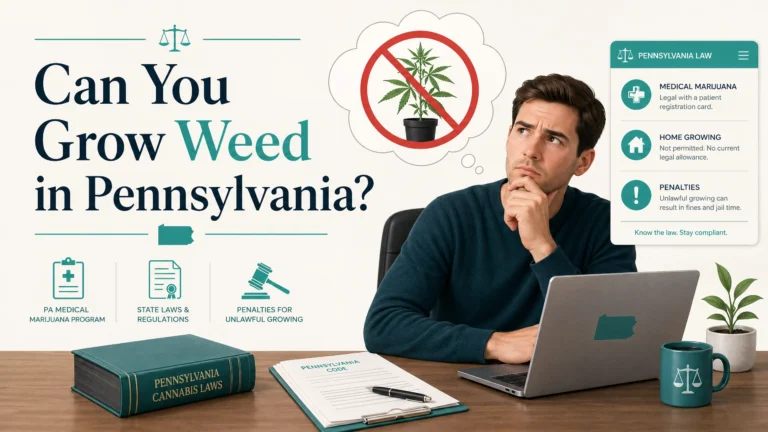

Can you grow weed in PA? If you’re asking in 2026, the answer is straightforward: no — growing marijuana at home is illegal in Pennsylvania for everyone. That includes recreational users, medical marijuana patients, and even registered caregivers. Not a single plant. Not in your basement. Not in your backyard. Not behind a locked door.
But the fuller answer is more interesting than just a flat no. Pennsylvania came remarkably close to changing this in 2025. The legislative battle over home cultivation reached its most dramatic point in the state’s history — and the story of where things stand now, what penalties you’re actually risking, and where the law is likely headed matters enormously if you’re a Pennsylvanian who uses or is considering cannabis.
Need a PA Medical Marijuana Card?
Get certified online in 15 minutes. 100% Money-Back Guarantee.
Get Certified Now →More specifically, many people are asking: is it legal to grow weed in PA at all under any circumstances? This guide answers that completely — including the one narrow pathway that does exist for licensed commercial growers, and what the future may hold for home cultivators.
The Direct Answer — Can You Grow Weed in PA Right Now?

No. As of April 2026, growing marijuana at home is completely illegal in Pennsylvania under state law.
This applies to:
- Adults who want to grow for personal recreational use
- Registered medical marijuana patients
- Registered caregivers
- Anyone without a state-issued commercial grower/processor permit
The legal basis is clear. Under Section 304(b)(3) of the Pennsylvania Medical Marijuana Act, growing marijuana without a grower/processor permit is unlawful. The Act makes no provision whatsoever for personal home cultivation — even by registered patients. All legal cannabis in Pennsylvania must be purchased from licensed state dispensaries.
Do You Qualify for a PA MMJ Card?
Connect with a licensed Pennsylvania state physician online from home.
Pennsylvania is one of a shrinking number of states that prohibits home cultivation even under its medical program. Among the 38 states with medical marijuana programs, most now allow some form of patient home cultivation — making Pennsylvania increasingly the exception, not the rule.
Is It Legal to Grow Weed in PA for Medical Patients?

No — and this surprises many people who assume a medical marijuana card creates broader rights than it actually does.
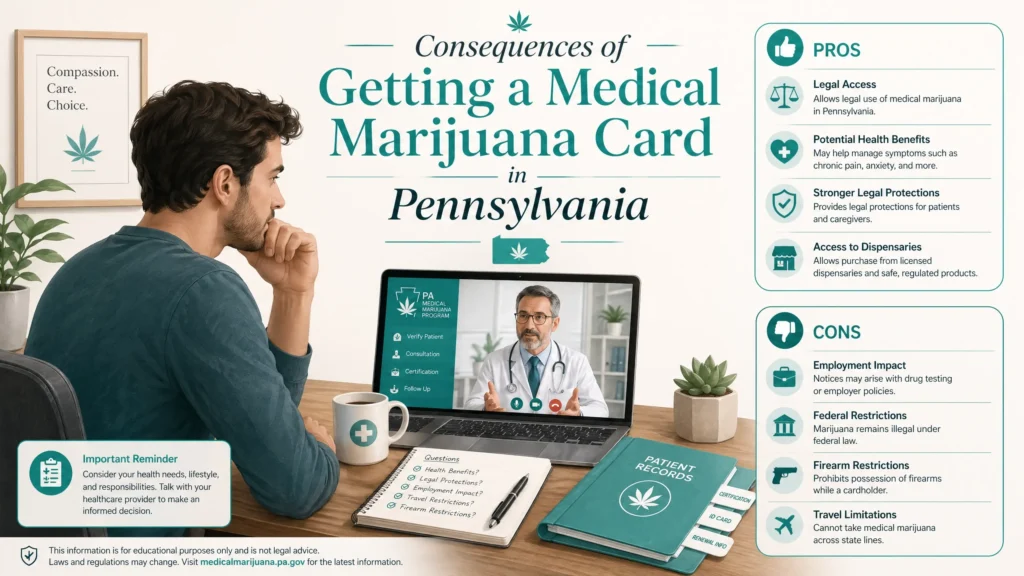
Is it legal to grow weed in PA if you’re a registered medical patient? Definitively no. The Pennsylvania Medical Marijuana Act does not include any home cultivation provision for patients. Your medical marijuana card authorizes you to:
- Purchase cannabis from licensed Pennsylvania dispensaries
- Possess up to a 30-day supply of dispensary-purchased cannabis
- Use that cannabis for your qualifying medical condition
It does not authorize you to:
- Grow your own plants — even one
- Possess cannabis purchased from another state
- Possess cannabis from an unlicensed source
The Pennsylvania Senate specifically voted down a medical patient home cultivation amendment in June 2021, making it explicit that the legislature did not intend to extend cultivation rights to patients under the existing medical program. That position has not legally changed as of this writing.
In June 2021, the Pennsylvania Senate blocked a medical marijuana home cultivation amendment specifically — making clear that patient status does not confer growing rights under current law.
The frustration this creates for patients is real. Many Pennsylvanians managing chronic conditions find the cost of dispensary cannabis significant, and home cultivation would offer a more affordable path. This is precisely why SB 76 — a bill specifically targeting medical patient home cultivation rights — has been proposed separately from broader legalization efforts. More on pending legislation in Sections 5 and 6.
What Are the Penalties for Growing Weed in PA?

Growing marijuana in Pennsylvania is treated as a felony — not a misdemeanor — under most circumstances. The severity of the charge and the penalties escalate sharply based on the number of plants or the weight of the cannabis involved.
Here is the complete penalty breakdown, sourced from NORML’s Pennsylvania penalties guide and Pittsburgh Criminal Attorney:
By Plant Count
| Number of Plants | Classification | Minimum Sentence | Maximum Fine |
|---|---|---|---|
| Fewer than 10 plants (PWID intent) | Felony | 1 year | $5,000 |
| 10 to 21 plants | Felony | 1 year (1st offense) | $5,000 |
| 21 to 51 plants | Felony | 3 years (1st offense) | $15,000 |
| 51 plants or more | Felony | 5 years | $15,000+ |
For Second and Subsequent Offenses
Penalties essentially double. A second offense for growing 21–51 plants carries a minimum of 4 years in prison and a $30,000 fine. Prior drug convictions of any kind escalate the mandatory minimums further.
The Smallest Possible Amount
⚡ Fast & 100% Online PA Medical Cards
Board-Certified Doctors • 100% Money-Back Guarantee
Book Evaluation Now →Even growing a single plant for personal use is illegal. Depending on how prosecutors characterize it — possession of a small amount vs. cultivation — you may face charges ranging from a misdemeanor (if treated as personal use possession) to a felony (if treated as cultivation).
According to Pennsylvania State Cannabis, cultivation without a license is “punishable by 2.5 to 5 years imprisonment and a $15,000 fine” at the felony level — one of the harshest cultivation penalty structures among states with active medical marijuana programs.
The “Whole Plant Weight” Trap Most People Don’t Know About

This is one of the most important — and least-discussed — aspects of marijuana cultivation charges in Pennsylvania that can dramatically affect the severity of your case.
When prosecutors charge you with marijuana cultivation, they have the option to calculate the weight of the cannabis involved using the entire plant — including stems, roots, and all plant matter not normally consumed. As Alva & Moscow’s Philadelphia marijuana defense attorneys explain:
“If determined by weight, prosecutors will use the whole plant — even the roots and other sections of the plant not normally ingested, smoked, or otherwise used.”
This matters enormously in practice. A cannabis plant that produces only a few ounces of usable flower may weigh several pounds when the entire root ball, stalk, and fan leaves are included. This can push a small personal grow into a much higher penalty bracket than the actual usable cannabis would suggest.
What this means if you’re charged:
- The number of plants AND the total plant weight can both be used to determine your penalty bracket
- Prosecutors will typically choose whichever calculation produces the higher charge
- Even a small home grow of 3–5 plants can result in weight calculations that elevate the charge significantly
This is a critical reason why anyone facing cultivation charges needs experienced legal representation immediately — the difference between how prosecutors frame the weight calculation can be the difference between a lighter sentence and years in prison.
Pennsylvania’s Historic 2025 Legislative Battle Over Home Cultivation

2025 was the most significant year in Pennsylvania cannabis legislative history — and the story is one of dramatic near-success followed by a frustrating setback that has left home cultivation still illegal but potentially closer than ever to changing.
May 7, 2025 — Pennsylvania Makes History
On May 7, 2025, the Pennsylvania House of Representatives passed House Bill 1200 — the Cannabis Health and Safety Act — by a razor-thin vote of 102–101. This was the first time in Pennsylvania history that either legislative chamber had passed a comprehensive recreational cannabis legalization bill.
HB 1200 would have:
- Legalized adult-use cannabis for residents 21 and older
- Created state-run cannabis stores overseen by the Pennsylvania Liquor Control Board
- Allowed adults to apply for home cultivation permits to grow up to 2 mature plants and 2 immature plants at home, enclosed and secure, for a $100 annual permit fee
- Capped cannabis flower THC content at 25%
- Authorized automatic expungement of cannabis convictions
Renewing Your PA MMJ Card?
Quick annual recertification online. No paperwork hassle.
Renew Card Online →Governor Josh Shapiro voiced his support after the bill passed the House, stating: “Nearly all of our neighbors have legalized adult-use cannabis — and while we sit on the sidelines, we’re losing out on millions in revenue and millions more in economic activity.”
May 13, 2025 — The Senate Kills It
Six days later, the Pennsylvania Senate Law and Justice Committee voted 7–3 to table HB 1200, according to official Pennsylvania General Assembly records. The bill was dead.
The primary objection was not cannabis legalization itself — several committee members supported legalization in principle — but the state-run stores model, which critics including Committee Chair Sen. Dan Laughlin argued would limit consumer choice and drive buyers to neighboring states. As Laughlin stated: “The state acting as a buyer will limit consumer choice and drive consumers out of state to legal markets like Maryland, New York, New Jersey, and Ohio.”
July 2025 — A New Bipartisan Path
In July 2025, Senators Dan Laughlin (R-Erie) and Sharif Street (D-Philadelphia) introduced Senate Bill 120 — a bipartisan legalization bill addressing the concerns that killed HB 1200. In the same month, Reps. Emily Kinkead and Abby Major introduced companion House Bill 20.
October 2025 — SB 120 Advances Further Than Any Bill Before
In a significant development, the Senate Law and Justice Committee — the same committee that killed HB 1200 — approved SB 120 and sent it to the full Senate for consideration. According to MMJ.com’s analysis, this marked the furthest any recreational marijuana bill had ever advanced in Pennsylvania’s legislative process.
As of April 2026: SB 120 remains in the Senate awaiting a floor vote. Home cultivation is still illegal. But the legislative trajectory is the most promising it has ever been.
What SB 120 and HB 20 Propose for Home Growers

If either of Pennsylvania’s pending bipartisan legalization bills becomes law, here is specifically what they would mean for home cultivation:
Senate Bill 120 — Medical Patient Cultivation Rights
SB 120 includes a specific and significant provision for medical marijuana patients. Under SB 120, registered medical patients would be permitted to cultivate up to 5 cannabis plants at home for personal medical use — something not currently permitted under Pennsylvania’s medical program, according to MMJ.com’s legislative analysis.
HB 1200’s Home Cultivation Framework (for reference)
Though HB 1200 failed, its home cultivation provisions give insight into what a future framework might look like:
- Adults 21+ could apply for a home cultivation permit
- Up to 2 mature plants and 2 immature plants per household
- Annual permit fee of $100
- Plants must be at the adult’s residence in an enclosed, secure space
- Home cultivation permits would only become available after legal sales began
SB 76 — Medical-Specific Home Cultivation Bill
Separately, SB 76 would specifically allow medical cannabis home cultivation for patients — addressing cost and accessibility concerns without requiring full adult-use legalization. This bill has been proposed as an important option for patients who cannot afford dispensary pricing.
The bottom line on pending legislation: Multiple active bills would legalize home cultivation in Pennsylvania — but none have passed into law as of April 2025. Until one does, growing even a single plant remains a felony.
The Only Legal Way to Grow Weed in PA Right Now

Get Approved by a Licensed PA Doctor
Schedule your appointment in minutes. You only pay if approved.
Start Online Application →While home cultivation is prohibited for everyone, there is one narrow legal pathway to grow marijuana in Pennsylvania: obtaining a state-issued commercial grower/processor permit from the Pennsylvania Department of Health.
This is not a realistic option for personal use — it is a commercial license designed for businesses. Key requirements include:
- A non-refundable application fee of $10,000
- Demonstration of adequate security systems and physical controls over the cultivation facility
- Compliance with municipality zoning requirements
- Growing must occur in an indoor facility only — outdoor cultivation is not permitted even for licensed growers
- Demonstrable ability to prevent diversion of harvested cannabis
According to Pennsylvania State Cannabis, the Department of Health also combines the grower and processor license — meaning a licensed grower can also process medical marijuana. But all cannabis produced must supply the state’s medical dispensary network — it cannot be consumed by the grower personally.
The grower/processor permit is the only legal cannabis cultivation pathway in Pennsylvania. There is no “small grower,” “microcultivator,” or “personal use” permit tier available to individuals.
Why Pennsylvania Is Falling Behind — The Neighbor State Problem
The context around why Pennsylvania’s home cultivation debate matters so urgently comes down to geography. Pennsylvania is surrounded by states that have moved decisively on cannabis:

| Neighboring State | Recreational Legal? | Home Cultivation |
|---|---|---|
| New York | ✅ Yes | Up to 6 plants |
| New Jersey | ✅ Yes | Bill pending |
| Delaware | ✅ Yes | Up to 3 plants |
| Maryland | ✅ Yes | Up to 2 plants |
| Ohio | ✅ Yes | Up to 6 plants |
| West Virginia | ❌ No (medical only) | No |
Five of Pennsylvania’s six bordering states have legalized adult-use cannabis. According to Montgomery McCracken’s legislative analysis, border-state retailers report that up to 60% of their customers are from Pennsylvania — meaning Pennsylvanians are already crossing state lines in large numbers to purchase cannabis legally elsewhere.
Governor Shapiro’s budget office projects that a legal Pennsylvania cannabis market would generate $250 million in annual tax revenue once mature, and $1.3 billion over five years. That’s revenue currently flowing to neighboring states.
According to Marijuana Policy Project data, Pennsylvania saw more than 10,000 arrests for cannabis possession in 2025 alone — resources spent enforcing a prohibition that five of its six neighbors have already abandoned.
What Counts as Cultivation in Pennsylvania?

If you’re unsure whether your specific situation constitutes “cultivation” under Pennsylvania law, here is what courts and prosecutors typically look at:
Clearly counts as cultivation:
- Any living cannabis plant at any stage of growth
- Seeds that have been germinated and are growing
- Clones or cuttings that have taken root
- Hydroponic setups with cannabis plants
- Cannabis plants growing in soil, indoors or outdoors
Ready to Get Your Official PA MMJ Card?
State-certified doctor consultations online. No risk—100% refund if not approved.
Claim Your MMJ Card Online →May or may not be charged as cultivation:
- Ungerminated seeds — these are typically charged as possession rather than cultivation, though they are still illegal to possess
- A single dying or very small plant — could be charged as simple possession of a small amount depending on prosecutorial discretion and quantity
Aggravating factors that elevate charges:
- Growing lights, nutrients, or specialized growing equipment (can also result in paraphernalia charges)
- Large quantities suggesting commercial operation
- Proximity to a school (within 1,000 feet) or playground (within 250 feet) — mandatory minimum sentences increase substantially
- Presence of firearms during cultivation — mandatory 5-year minimum under firearm enhancement
As Pittsburgh Criminal Attorney confirms: “You can be arrested for growing even one marijuana plant.”
If You’re Growing or Thinking About It — What to Know
If you are currently growing marijuana at home in Pennsylvania or are seriously considering it, here is honest, direct information you need:
The legal risk is real and serious. Unlike simple possession of a small amount — which carries up to 30 days and $500 — cultivation is a felony at nearly every meaningful scale. A felony conviction follows you: it affects employment, housing, professional licenses, federal financial aid, immigration status, and firearm rights.
Law enforcement methods: Police typically require a warrant to search your home. Cultivation operations are often detected through:
- Utility usage patterns that suggest grow lights (unusually high electricity consumption)
- Odor complaints from neighbors
- Information from informants
- Traffic stop discoveries that lead to home searches
If you are arrested: Do not speak to police without an attorney present. The weight calculation method prosecutors use can significantly affect your charge level, and experienced legal representation is essential from the moment of arrest.
The legislative landscape is changing: Pennsylvania has come closer than ever to legalizing home cultivation. If you are a patient managing a medical condition and cost is a barrier, holding on through this legislative period — while accessing the legal dispensary system with a medical card — may be the most practical path forward.
The Legal Alternative Available to PA Residents Right Now
Since you cannot legally grow weed in Pennsylvania — even as a medical patient — the only legal path to cannabis access is through the Pennsylvania medical marijuana program.
With a valid PA medical marijuana card, registered patients can:

- Purchase cannabis legally from any of Pennsylvania’s licensed dispensaries statewide
- Access quality-tested, accurately labeled products with known cannabinoid content
- Possess up to a 30-day supply of dispensary-purchased cannabis
- Be protected from state criminal prosecution for legal possession
- Access a wide range of product forms — flower, tinctures, vapes, capsules, topicals, and more
For patients who are growing — or considering growing — primarily because of cost concerns, it’s worth knowing that:
- Pennsylvania’s $50 state registration fee is waived entirely for patients enrolled in Medicaid, SNAP, WIC, CHIP, or PACE/PACENET
- Dispensaries regularly offer patient discounts, loyalty programs, and medical-specific pricing
- Competition among Pennsylvania’s expanding dispensary network has driven prices down significantly since the program launched
Pennsylvania recognizes 24 qualifying conditions for the medical marijuana program, including anxiety disorders, chronic pain, PTSD, cancer, epilepsy, Crohn’s disease, and many more. If you have a qualifying condition and are not yet registered, the certification process is entirely online and typically takes 15–20 minutes.
You can review all 24 qualifying conditions here or get started with your certification today. If anxiety is your qualifying condition, our detailed Anxiety Disorder & Medical Marijuana in Pennsylvania guide covers everything you need to know.
Frequently Asked Questions
Q: Can you grow weed in PA in 2026?
A: No. Growing marijuana at home is illegal in Pennsylvania for all residents as of 2026 — including recreational users, medical marijuana patients, and caregivers. The only legal cultivation pathway is a state-issued commercial grower/processor permit, which requires a $10,000 non-refundable application fee and is designed for commercial operations, not personal use.
Q: Is it legal to grow weed in PA if you have a medical marijuana card?
A: No. Pennsylvania’s Medical Marijuana Act does not include any home cultivation provision for registered patients. All medical marijuana must be purchased from licensed Pennsylvania dispensaries. The Pennsylvania Senate specifically blocked a medical patient home cultivation amendment in June 2021. Pending bills like SB 76 and SB 120 would change this, but neither has passed into law.
Q: What are the penalties for growing weed in PA?
A: Growing marijuana in Pennsylvania is a felony in most cases. Penalties escalate by plant count: 10–21 plants carries a minimum of 1 year in prison and $5,000 fine for a first offense; 21–51 plants carries 3 years and $15,000; over 51 plants carries 5 years and $15,000+. Second offenses roughly double the mandatory minimums. Even a single plant can result in criminal charges.
Q: Did Pennsylvania legalize home cultivation in 2025?
A: Not yet. HB 1200 — which would have allowed home cultivation of up to 2 mature plants with a $100 permit — passed the Pennsylvania House on May 7, 2025 by a vote of 102–101, a historic first. However, the Senate Law and Justice Committee killed it 7–3 on May 13, 2025. Senate Bill 120, a bipartisan alternative that includes home cultivation rights for medical patients, was approved by the Senate committee in October 2025 and awaits a full Senate vote as of April 2026.
Q: Which neighboring states allow home growing?
A: New York allows up to 6 plants, Ohio allows up to 6 plants, Delaware allows up to 3 plants, and Maryland allows up to 2 plants — all of which have legalized adult-use cannabis. New Jersey has pending home cultivation legislation. West Virginia, Pennsylvania’s only neighboring state without recreational legalization, also prohibits home cultivation.
Q: Can I grow hemp in Pennsylvania legally?
A: Yes — with a permit from the Pennsylvania Department of Agriculture. Hemp cultivation is legal under Pennsylvania’s Hemp Program for licensed growers, but hemp must contain no more than 0.3% THC. Hemp permits are separate from the Medical Marijuana Act’s grower/processor permits and are regulated by PDA rather than the Department of Health. Growing hemp without a permit is still illegal.
Q: What is the only legal way to access cannabis in Pennsylvania right now?
A: The Pennsylvania medical marijuana program is the only legal path to cannabis in Pennsylvania. Registered patients with qualifying conditions can purchase cannabis from licensed dispensaries using their state-issued patient ID card. The certification process is available online, costs approximately $125–$200 total including the $50 state fee, and is valid for one year.
Q: How many plants can I grow if SB 120 passes?
A: Under SB 120’s current provisions, registered medical marijuana patients would be permitted to grow up to 5 cannabis plants at home for personal medical use. For adult-use (non-patient) cultivation, the specific provisions differ — consult the bill text for current proposed limits, as legislation can change before passage.
The Bottom Line
Can you grow weed in PA? As of April 2025 — no, not legally, not even one plant, not even as a registered medical patient.
Pennsylvania remains one of the most restrictive states for home cannabis cultivation, even as five of its six neighbors have fully legalized adult use and home growing. The penalties for cultivation are serious: felony charges, mandatory minimums, and whole-plant weight calculations that can elevate charges dramatically.
What is changing — faster than at any point in the state’s history — is the legislative landscape. In 2025, Pennsylvania came closer to home cultivation legalization than it ever has, passing a House bill for the first time and advancing a bipartisan Senate alternative further than any previous legislation.
Until that changes legally, the only way to access cannabis in Pennsylvania without criminal risk is through the state’s medical marijuana program. If you have a qualifying condition — from anxiety to chronic pain to PTSD and 21 others — get started with your PA MMJ certification today.
Medically reviewed by Dr. Johnathon Chance Miller, MD. This article is for informational and educational purposes only and does not constitute legal advice. Pennsylvania cannabis law is actively evolving — verify current legislation status before making any decisions. Consult a licensed Pennsylvania criminal defense attorney for advice specific to your situation.
Sources:
- Pennsylvania Medical Marijuana Act — Section 304(b)(3)
- Pennsylvania General Assembly — HB 1200 Vote Record
- Pennsylvania General Assembly — SB 120
- Pittsburgh Criminal Attorney — Marijuana Cultivation Charges
- Pennsylvania State Cannabis — Marijuana Laws
- Pennsylvania State Cannabis — Cultivation License
- Marijuana Policy Project — Pennsylvania
- MMJ.com — Is SB 120 the Bill That Finally Legalizes Weed?
- MMJ.com — Pennsylvania Cannabis 2026 Complete Guide
- Montgomery McCracken — PA Recreational Marijuana Legislative Analysis
- City & State PA — Cannabis Legalization Bill Advances
- FOX43 — Senate Committee Rejects HB 1200
- NORML — Pennsylvania Penalties
- Alva & Moscow — Philadelphia Marijuana Cultivation Defense
- MPP — Key Marijuana Policy Reform Bills 2026
- PA Department of Health — Medical Marijuana Program