
This is one of the most serious legal questions any Pennsylvania MMJ patient can ask and as of June 2026, it is also one of the most actively changing areas of federal law.
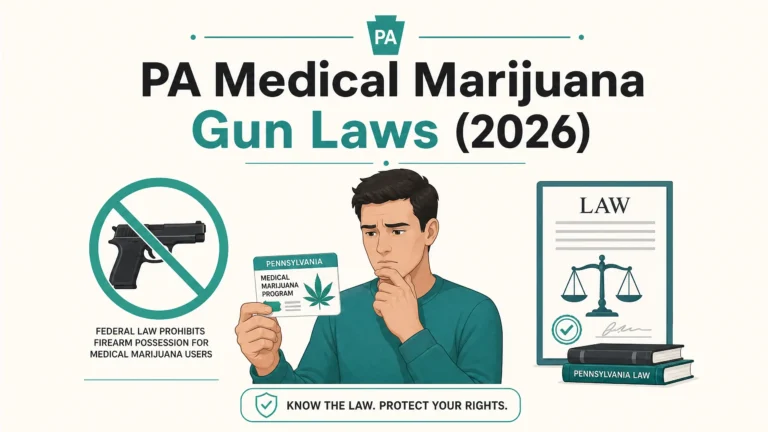
The short answer under current law: holding a Pennsylvania medical marijuana card makes you a legally prohibited person for the purpose of purchasing and possessing firearms. Pennsylvania state law adds a second layer by barring MMJ cardholders from obtaining or renewing a License to Carry Firearm (LTC).
Need a PA Medical Marijuana Card?
Get certified online in 15 minutes. 100% Money-Back Guarantee.
Get Certified Now →But the longer answer is changing fast. The ATF proposed a major revision to the gun purchase form on May 8, 2026. A landmark Supreme Court ruling in United States v. Hemani is expected any day. Federal rescheduling took effect April 28, 2026. And a Pennsylvania reform bill is still pending.
None of these changes have fully resolved the conflict yet. But every PA MMJ patient needs to understand exactly where the law stands today, what the real enforcement picture looks like, and what is coming.
Key Takeaways
- The old Form 4473 is still legally active — the proposed revision removing the medical marijuana warning is in public comment through August 6, 2026 and has not taken effect
- Lying on Form 4473 remains a federal felony carrying up to 10 years in prison regardless of any pending legal changes
- Federal rescheduling to Schedule III (April 28, 2026) does not by itself restore firearm rights — 922(g)(3) still applies to Schedule III controlled substances
- The Hemani Supreme Court ruling could narrow or strike down the prohibition as applied to regular marijuana users — decision expected any day as of June 2026
- PA MMJ patient registry is HIPAA protected and is not shared with JNET or NICS background check systems
- PA Senate Bill 1146 would fix the state-level LTC restriction but cannot override federal law
The Core Conflict: State Law vs. Federal Law

Pennsylvania legalized medical marijuana under Act 16 of 2016. The state considers registered patients fully lawful users of a controlled medical substance. The PA Department of Health explicitly protects patient data under state confidentiality law.
The federal government sees it differently. Under federal law, marijuana remains a controlled substance. Even with state authorization, the federal government classifies you as an “unlawful user of a controlled substance.” That label carries serious consequences for your firearm rights.
Do You Qualify for a PA MMJ Card?
Connect with a licensed Pennsylvania state physician online from home.
This was the ATF’s explicit written position until May 8, 2026:
“Any person who uses or is addicted to marijuana, regardless of whether his or her State has passed legislation authorizing marijuana use for medical purposes, is prohibited by Federal law from possessing firearms or ammunition.”
Pennsylvania state law does not strip MMJ patients of firearms they already own. But it does bar them from obtaining or renewing a concealed carry permit. The federal prohibition goes further, covering new firearm purchases and technically all ongoing possession.
Federal Law: The Gun Control Act and 18 U.S.C. § 922(g)(3)

The governing federal statute is 18 U.S.C. 922(g)(3), part of the federal Gun Control Act of 1968. It makes it unlawful for any person who is “an unlawful user of or addicted to any controlled substance” to possess, purchase, or receive any firearm or ammunition.
Since marijuana is a federally controlled substance regardless of state law, any PA MMJ cardholder who is actively using marijuana is technically an unlawful user under this statute. Federal regulators have taken the position that the mere possession of a medical marijuana card creates a rebuttable inference of ongoing use.
Violating 922(g)(3) is a federal felony carrying up to 15 years in federal prison.
No one has been prosecuted federally simply for holding a PA MMJ card and owning a firearm as an otherwise law-abiding citizen. Prosecutions have historically involved other significant criminal conduct. But “rarely prosecuted” is not the same as “legal” — and the statute remains fully in force as of June 2026.
Critical note for June 2026: The April 28, 2026 rescheduling order moved state-licensed medical marijuana to Schedule III. This is significant — but Schedule III substances are still federally controlled substances. The 922(g)(3) prohibition applies to users of any controlled substance, not just Schedule I. Rescheduling alone does not restore firearm rights. The Trump administration’s own Solicitor General confirmed in an April 2026 Supreme Court filing that rescheduling does not resolve the Hemani firearms case.
ATF Form 4473: The Form That Creates the Problem

Every firearm purchase through a federally licensed dealer (FFL) requires the buyer to complete ATF Form 4473, the Firearms Transaction Record.
The current legally active form contains Question 21(e), which asks whether the buyer is “an unlawful user of, or addicted to, marijuana or any depressant, stimulant, narcotic drug, or any other controlled substance.” It follows this with a bold warning that marijuana remains unlawful under federal law regardless of state legalization.
This puts every PA MMJ patient in a direct bind at the point of purchase:
- If you answer truthfully (yes): The FFL dealer is legally prohibited from completing the sale and you will be denied
- If you answer untruthfully (no): You have made a false statement on a federal form — a federal felony punishable by up to 10 years in prison and fines up to $250,000, regardless of whether you would otherwise have been a lawful gun owner
This is not hypothetical. Hunter Biden was convicted in 2024 on federal gun charges partly related to false statements on Form 4473. Federal dealers have been required to keep Form 4473 records indefinitely since August 2022. The ATF can access these records during any criminal investigation — even one unrelated to the original gun purchase.
⚡ Fast & 100% Online PA Medical Cards
Board-Certified Doctors • 100% Money-Back Guarantee
Book Evaluation Now →Lying on Form 4473 is never a safe strategy. It never has been.
The May 2026 ATF Form Revision: What Changed and What Did Not
This is the most significant development to occur after this blog was originally published — and every PA patient needs to understand it precisely.
What the ATF Proposed on May 8, 2026
On May 8, 2026, the ATF published a proposed revision to Form 4473 in the Federal Register (Document 2026-09182). The proposed revision makes several changes, including one that directly affects PA MMJ patients:
The old warning language (currently legally active): “The use or possession of marijuana remains unlawful under Federal law regardless of whether it has been legalized or decriminalized for medicinal or recreational purposes in the state where you reside.”
The proposed new warning language: “Federal law does not permit the use or possession of marijuana for recreational purposes.”
The word “medicinal” is gone from the warning. The revised form focuses the prohibition explicitly on recreational marijuana. This is a direct downstream consequence of the April 28, 2026 rescheduling order that moved state-licensed medical marijuana to Schedule III.
As Jones Walker LLP attorneys Dan Russell and Will Hall wrote in Marijuana Moment: this revision represents a formal, federal acknowledgment that medical marijuana is no longer in the same legal category it once occupied.
What This Does NOT Mean Right Now
This is where precision matters enormously.
The proposed form is not yet finalized. The public comment period runs through August 6, 2026. The ATF can change, withdraw, or finalize the form in a different version. No finalized version has been published as of June 2026.
The old Form 4473 is still the law at every gun counter today. As CentralLaw.com’s firearms attorney analysis states directly: “Until the ATF officially publishes the final version and updates the physical and electronic forms at gun shops, the old form remains the law of the land. Signing the current form and answering ‘No’ while holding an active medical card still exposes you to severe federal prosecution.”
Section 922(g)(3) has not been repealed. The form revision reflects a changed interpretation of who is an “unlawful user” — but only Congress can repeal the underlying statute, and only the courts can declare it unconstitutional.
The Comment Deadline — PA Patients Can Participate
Renewing Your PA MMJ Card?
Quick annual recertification online. No paperwork hassle.
Renew Card Online →The ATF is accepting public comments on the proposed Form 4473 revision through August 6, 2026. Patients, physicians, attorneys, and advocacy organizations can submit written comments to [email protected]. This gives the PA MMJ community a direct opportunity to put real experiences into the federal record before the form is finalized.
Pennsylvania State Law: The LTC Prohibition

On top of the federal prohibition, Pennsylvania state law independently blocks MMJ patients from concealed carry.
Under Pennsylvania Consolidated Statutes 18 Pa.C.S. 6109(e)(1)(xiv), any person prohibited from owning or purchasing a firearm under federal law is ineligible to receive, hold, or renew a Pennsylvania License to Carry Firearm (LTC). Since MMJ patients are federally prohibited persons, they cannot:
- Apply for a new LTC
- Renew an existing LTC
- Hold an LTC while actively registered as an MMJ patient
The Pennsylvania State Police Firearms Division strictly enforces this. If your LTC comes up for renewal while you hold an active MMJ card, it will be denied.
One nuance worth understanding: Pennsylvania allows open carry without a permit (except in Philadelphia). However, the federal possession prohibition applies regardless of carry method. Open carrying while an active marijuana user remains a potential federal violation independent of LTC status.
What About Guns You Already Own?
Pennsylvania state law does not require you to surrender, sell, or transfer firearms you already own when you get an MMJ card. There is no mandatory state-level forfeiture or transfer requirement upon card issuance.
What is true: the federal prohibition under 922(g)(3) applies to possession, not just purchase. From the moment you become an active marijuana user, federal law technically prohibits you from possessing any firearm — including one you owned before you ever used cannabis.
In practical terms, this exposure becomes real primarily in scenarios where law enforcement encounters you with both firearms and evidence of marijuana use. For most law-abiding patients with no other legal issues, this is a theoretical risk rather than an immediate practical one. But it is genuine legal exposure that a qualified Pennsylvania attorney can help you evaluate specific to your circumstances.
Private Party Gun Sales in Pennsylvania
Pennsylvania requires background checks for most firearm transfers, including private party sales. Under 18 Pa.C.S. § 6111, private transfers of firearms must generally go through a licensed dealer who conducts a PICS (Pennsylvania Instant Check System) check.
When such a sale goes through an FFL, Form 4473 is completed and the same 21(e) question applies. If somehow a transfer were to occur without going through an FFL — which would itself be a violation of PA law in most circumstances — no Form 4473 would be completed. But this does not change your federal status as a prohibited person. The 922(g)(3) prohibition on possession applies regardless of how the firearm was acquired.
Will the MMJ Registry Show Up in a Background Check?
The answer requires a careful distinction.
Get Approved by a Licensed PA Doctor
Schedule your appointment in minutes. You only pay if approved.
Start Online Application →The PA DOH does not share the MMJ patient registry with JNET — the state law enforcement intelligence database — or with federal background check systems like NICS. In January 2018, the PA DOH explicitly reversed a prior policy that would have added MMJ patient names to JNET, citing the potential impact on patient firearm rights.
As a result, MMJ cardholder status does not currently appear in PICS checks run at the point of a gun purchase.
However, this privacy protection does not change your legal status under federal law. It does not make firearm possession lawful. It does not protect you from federal prosecution if your MMJ use becomes known through other means — an investigation, a traffic stop, a search warrant, or a criminal proceeding.
The Pennsylvania State Police Firearms Division states plainly on its official website: “The possession of a Medical Marijuana Card and use of medical marijuana can result in a federal firearms prohibition.”
Real-World Enforcement: How Often Does This Actually Come Up?

Honest answer: federal prosecution for 922(g)(3) violations against otherwise law-abiding MMJ patients is extremely rare.
Federal prosecutors have historically used this statute in cases involving other significant criminal conduct — not to target people whose only issue is a medical marijuana card. A 2017 Washington Post review of over 112,000 federal gun purchase denials found only 12 led to prosecution.
Specific scenarios that meaningfully elevate risk:
- A self-defense shooting triggers a thorough investigation of every aspect of the incident, including MMJ status and any Form 4473 signed
- A federal criminal investigation of any kind may lead investigators to firearm records, at which point 922(g)(3) becomes an independently available charge
- An LTC renewal denial through PSP confirms a paper trail connecting your identity to both MMJ registration and gun ownership history
- A prior false answer on Form 4473 combined with any future law enforcement encounter creates federal perjury exposure independent of the original firearms issue
The honest assessment: for most law-abiding PA MMJ patients, the practical day-to-day risk of federal prosecution is low. But the legal exposure is real, and its consequences — if triggered — are severe and life-altering.
What Is Actively Changing in 2026
This section covers four developments that have occurred since this blog was originally published in May 2026 and that every PA MMJ patient must understand.

1. Federal Rescheduling to Schedule III (April 28, 2026)
On April 23, 2026, Acting Attorney General Todd Blanche issued a final order reclassifying state-licensed medical marijuana products to Schedule III of the Controlled Substances Act. The order took effect April 28, 2026 upon publication in the Federal Register at 91 Fed. Reg. 22714.
Ready to Get Your Official PA MMJ Card?
State-certified doctor consultations online. No risk—100% refund if not approved.
Claim Your MMJ Card Online →What this does for gun rights: reduces federal legal risk in some contexts and is the foundation for the ATF Form 4473 revision described above.
What this does NOT do: repeal 922(g)(3). Schedule III controlled substances are still controlled substances. The firearms prohibition applies to users of any controlled substance — not just Schedule I. As confirmed by the Trump administration’s own Supreme Court brief, rescheduling does not resolve the firearm prohibition question.
What comes next: A DEA administrative hearing on broader rescheduling of all cannabis (including recreational) began June 29, 2026. This could have further implications for how 922(g)(3) is interpreted — but any outcome is months or years away.
2. Proposed ATF Form 4473 Revision (May 8, 2026)
Covered in full above. Key summary:
| Status | Detail |
|---|---|
| Proposed on | May 8, 2026 |
| Public comment deadline | August 6, 2026 |
| Current legal status | Proposed only — NOT yet in effect |
| Old form still active? | Yes — at every gun dealer in the US today |
| What changes when finalized | Medical marijuana warning removed; recreational-only prohibition language |
| What does NOT change | Section 922(g)(3) remains on the books until Congress acts or courts rule |
3. United States v. Hemani — The Supreme Court Ruling Is Imminent
This is the case that could change everything for PA patients — and a decision is expected any day in June 2026.
Background: The case centers on Ali Danial Hemani, charged under 922(g)(3) after FBI agents found a firearm and marijuana at his Texas home. The Fifth Circuit Court of Appeals struck down the indictment as unconstitutional under the Second Amendment’s Bruen standard, which requires modern gun regulations to be grounded in the nation’s historical tradition of firearm regulation at the founding era.
What happened at oral arguments (March 2, 2026): Multiple justices across ideological lines expressed deep skepticism of the government’s position. As SCOTUSblog reported, Justice Neil Gorsuch questioned whether someone who uses marijuana a few times per week approaches the historical threshold of a “habitual drunkard.” Justice Ketanji Brown Jackson challenged the entire framework. Legal observers across the spectrum described the justices as more skeptical of the government than expected.
The two possible outcomes:
| Outcome | What It Means for PA Patients |
|---|---|
| Court affirms Fifth Circuit | Section 922(g)(3) struck down or severely narrowed as applied to regular marijuana users. Largest expansion of gun rights for PA MMJ patients in program history. |
| Court reverses Fifth Circuit | Existing prohibition stands in full. No change. |
What to do now: Do not make any firearm purchasing decisions in anticipation of a ruling. Wait for the actual decision. Then consult a licensed Pennsylvania attorney before taking any action.
4. Pennsylvania Senate Bill 1146 — The State-Level Fix
Pennsylvania State Senator Dan Laughlin (R-49) introduced Senate Bill 1146 seeking to amend Pennsylvania’s Uniform Firearms Act. The bill would ensure valid medical marijuana cardholders are no longer classified as unlawful marijuana users under state law, specifically removing the LTC denial that currently flows from MMJ card status.
As of June 2026, SB 1146 has not been enacted.
Critical limitation: Even if SB 1146 passes, it would only address the state-law LTC prohibition. It cannot override 18 U.S.C. 922(g)(3) — that is federal law beyond the reach of any state legislature. A patient benefiting from SB 1146 could theoretically hold a valid PA LTC under state law while still technically prohibited under federal law — an uncomfortable legal position requiring careful attorney guidance.
Do not make any firearm-related decisions in anticipation of SB 1146’s passage.
The Bottom Line for PA Patients
Here is where things stand clearly, as of May 2026:
| Issue | Current Status |
|---|---|
| Purchasing a new firearm through an FFL | Prohibited under federal law |
| Lying on ATF Form 4473 (Question 21e) | Federal felony — up to 10 years |
| Possessing firearms you already own | Federally prohibited while an active marijuana user |
| Obtaining or renewing a PA LTC (concealed carry) | Prohibited under PA state law (Section 6109(e)(1)(xiv)) |
| MMJ registry appearing in PICS background check | No — PA DOH does not share with JNET |
| Federal prosecution risk for typical law-abiding patients | Low historically, but not zero |
| ATF Form 4473 proposed revision | Not yet in effect — public comment through August 6, 2026 |
| Federal rescheduling changing gun rights directly | No — not by itself |
| Hemani Supreme Court decision | Pending — expected any day in June 2026 |
| PA Senate Bill 1146 | Not yet enacted |
If you are facing a genuine choice between managing a qualifying medical condition and maintaining firearm rights, that is a real and difficult dilemma that deserves a direct conversation with a licensed Pennsylvania attorney — not a generic answer from any website.
What is never wise, under any circumstances, is providing false information on ATF Form 4473. No subsequent change in law can undo the consequences of that decision.
Frequently Asked Questions
Q: Can you own a gun if you have a medical marijuana card in Pennsylvania?
A: Under current federal law, no. Active users of marijuana — including Pennsylvania medical marijuana cardholders — are classified as prohibited persons under 18 U.S.C. 922(g)(3) and cannot legally purchase or possess firearms. Pennsylvania state law additionally bars MMJ cardholders from obtaining or renewing a License to Carry Firearm. However, the U.S. Supreme Court heard oral arguments in United States v. Hemani on March 2, 2026. A ruling expected by late June 2026 could significantly narrow or strike down this federal prohibition. Until that ruling is issued and you have reviewed it with a qualified attorney, the current prohibition remains in effect.
Q: Did the ATF change the Form 4473 gun purchase form for medical marijuana patients?
A: The ATF proposed a revision on May 8, 2026 — but it is not yet in effect. The proposed draft removes the explicit warning that medical marijuana use is federally prohibited and replaces it with language focused on recreational marijuana only. This is a direct downstream consequence of the April 28, 2026 rescheduling of state-licensed medical cannabis to Schedule III. However, the public comment period runs through August 6, 2026, and the old form remains legally active at every licensed gun dealer in the United States today. Signing the current form and answering “No” while holding an active PA MMJ card still creates federal felony exposure until the revised form is officially finalized and deployed.
Q: Does federal rescheduling restore gun rights for PA MMJ patients?
A: Not by itself. The April 28, 2026 final order moving state-licensed medical marijuana to Schedule III was a historic shift — but it does not repeal 18 U.S.C. 922(g)(3). That statute prohibits firearm possession by users of any controlled substance, not just Schedule I. Schedule III substances are still federally controlled substances. The Trump administration’s own Solicitor General confirmed in a Supreme Court filing that rescheduling does not resolve the firearms prohibition. What rescheduling does do is provide the legal foundation for the ATF Form 4473 revision and may influence how courts interpret “unlawful user” going forward.
Q: Does getting a PA medical marijuana card show up on a gun background check?
A: No. The Pennsylvania Department of Health does not share the MMJ patient registry with JNET or federal background check systems like NICS. MMJ cardholder status does not appear in PICS checks at the point of a firearm purchase. However, this privacy protection does not change your legal status under federal law. Active marijuana users remain federally prohibited from purchasing or possessing firearms regardless of whether the registry is checked. Privacy protection and legal protection are two separate things.
Q: What is the penalty for lying on ATF Form 4473 about marijuana use?
A: It is a federal felony. Providing false information on Form 4473 — including answering “No” to the controlled substance question while actively using marijuana — is punishable by up to 10 years in federal prison and fines up to $250,000. FFL dealers are required to keep Form 4473 records indefinitely. The ATF can access them during any criminal investigation — even one unrelated to the original gun purchase. No pending legal change eliminates this risk while the current form remains in effect.
Q: What is United States v. Hemani and why does it matter for PA MMJ patients?
A: It is the most consequential Second Amendment case for marijuana users in American legal history. The U.S. Supreme Court heard oral arguments on March 2, 2026 and is expected to rule by late June 2026. The case directly challenges the constitutionality of 18 U.S.C. 922(g)(3) — the federal statute that prohibits marijuana users from possessing firearms. Multiple justices across ideological lines expressed skepticism about the government’s position during oral arguments. If the Court affirms the Fifth Circuit’s ruling, the categorical gun ban for marijuana users could be struck down or narrowed for users not shown to be intoxicated at the time of possession. A ruling in favor of Hemani would be the largest expansion of Second Amendment rights for PA MMJ patients since the program launched in 2016.
Q: What does Pennsylvania Senate Bill 1146 do?
A: SB 1146 would fix the state-level LTC restriction — but not the federal prohibition. Introduced by Sen. Dan Laughlin (R-49), the bill would amend Pennsylvania’s Uniform Firearms Act so valid MMJ cardholders are no longer classified as unlawful marijuana users under state law and can no longer be denied a License to Carry Firearm solely based on MMJ registration. As of June 2026, the bill has not been enacted. Even if it passes, it cannot override 18 U.S.C. 922(g)(3) — federal law that only Congress or the federal courts can change. Patients should not make any firearm-related decisions in anticipation of SB 1146’s passage.
This blog presents legal information, not legal advice. Federal and Pennsylvania state laws regarding medical marijuana and firearms are complex, actively changing, and highly fact-specific. Always consult a licensed Pennsylvania attorney regarding your individual circumstances before making any decisions related to firearms and medical marijuana. Medically reviewed by Dr. Johnathon Chance Miller, MD (License #MD474783).
Sources
- 18 U.S.C. § 922(g)(3) — Federal Gun Control Act, Prohibited Persons
- ATF Form 4473 — Firearms Transaction Record (Current Version, August 2023 Revision)
- ATF — Updated Form 4473, August 2023 Revisions
- Pennsylvania State Police — Firearms Information (MMJ Federal Prohibition Notice)
- Pennsylvania Consolidated Statutes 18 Pa.C.S. § 6109(e)(1)(xiv) — LTC Eligibility
- U.S. Department of Justice — DEA Final Order Rescheduling Certain Marijuana Products to Schedule III (April 23, 2026)
- Congressional Research Service — Legal Consequences of Rescheduling Marijuana (LSB11105)
- SCOTUSblog — Supreme Court Skeptical of Law Banning Drug Users from Possessing Firearms (March 2026)
- NPR — Supreme Court Ponders Law Making It a Crime for Marijuana Users to Own Guns (March 2026)
- ACLU — Supreme Court Weighs Felony Conviction for Gun Owner Who Uses Marijuana
- Marijuana Moment — Federal Rescheduling Does Not Affect Hemani Gun Rights Case, Trump DOJ Says
- The Trace — Supreme Court Questions Federal Gun Ban for Drug Users (March 2026)
- PA Senate Republicans — Laughlin Introduces PA Uniform Firearms Act Update for Medical Marijuana (SB 1146)
- Cipriani & Werner — Medical Marijuana Card is a Firearm Prohibitor Regardless of State Law