
If you have never tried a cannabis edible before, 10 mg of THC might sound modest — it is a single capsule, one measured dose, a number printed neatly on a label. But for many first-time users, 10 mg is genuinely a lot. For experienced patients, it may barely register. And for Pennsylvania medical marijuana patients specifically, the question carries an extra layer of context: the state regulates which oral cannabis products are legally available at licensed dispensaries, and traditional gummies are not among them.
This guide answers the question directly and completely — explaining the science behind why edibles hit differently than inhaled cannabis, breaking down what each dose tier actually feels like, and giving Pennsylvania patients the practical information they need to dose safely and legally.
Need a PA Medical Marijuana Card?
Get certified online in 15 minutes. 100% Money-Back Guarantee.
Get Certified Now →The Short Answer: Is 10 mg a Lot?
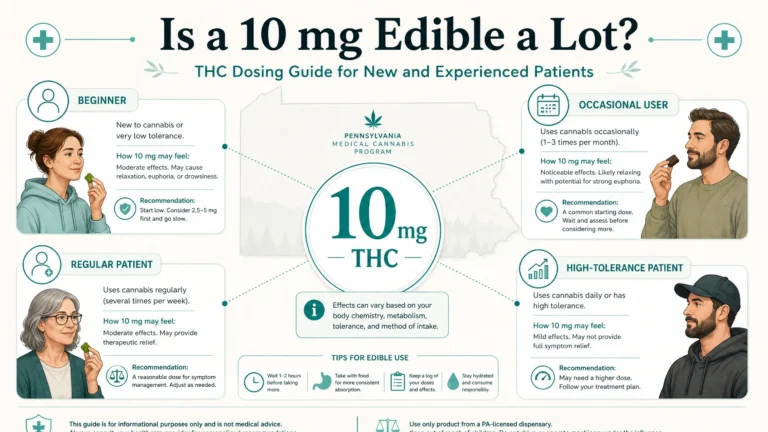
For a first-time user: yes — 10 mg is a significant dose.
For an experienced patient with established tolerance: no — 10 mg is a moderate, often comfortable therapeutic dose.

Most cannabis clinicians and harm reduction experts recommend beginners start at 2.5 mg to 5 mg, not 10 mg. According to GoodRx Health’s THC dosage guide, it is best to start slowly with a low dose under 2.5 mg to better understand how THC affects you — and a 10 mg oral dose will typically feel considerably stronger than the same amount consumed through inhalation.
The reason the answer varies so widely comes down to one biological fact: your body processes oral THC through a completely different pathway than inhaled THC. That difference makes 10 mg in an edible, capsule, or tincture functionally more potent and significantly longer-lasting than 10 mg vaporized — even though the milligram number on the label is identical.
Why Edibles Feel Stronger Than Inhaled Cannabis

Do You Qualify for a PA MMJ Card?
Connect with a licensed Pennsylvania state physician online from home.
When you vaporize cannabis, THC travels from your lungs directly into your bloodstream and reaches your brain within minutes. The effects are fast, predictable, and fade within 2 to 3 hours.
Oral cannabis — whether a capsule, tincture, oil, or troche — works through an entirely different route. Once swallowed, THC passes through your digestive system and is processed by your liver. During that process, the liver converts delta-9 THC into a compound called 11-hydroxy-THC — a metabolite that crosses the blood-brain barrier more efficiently and produces effects that are stronger and significantly longer-lasting than the original compound.
As Northwell Health’s palliative care physician Dr. Diana Martins-Welch explains, your body metabolizes oral THC in a way that makes it more potent and longer-lasting than inhaled cannabis — which is why even experienced users are occasionally caught off guard by capsules or tinctures.
The general timeline for oral cannabis products looks like this:
| Stage | Timing |
|---|---|
| Onset of effects | 30 to 90 minutes after consumption |
| Peak effects | 2 to 4 hours after consumption |
| Total duration | 4 to 8 hours (sometimes up to 12) |
| Full clearance | 24 hours or more |
That delayed onset is where the most common and most dangerous dosing errors happen — covered in detail below.
THC Dosing Chart: What Each Level Actually Feels Like

Clinical guidance from Northwell Health, GoodRx Health, and cannabis-experienced physicians broadly align on the following dosing tiers for oral cannabis consumption (capsules, tinctures, troches, oils):
| Dose | Who It Is For | What to Expect |
|---|---|---|
| 1 – 2.5 mg | First-timers, anxiety-prone, older adults | Subtle relaxation, mild stress relief, little to no psychoactive effect. Described by clinicians as “almost imperceptible.” The safest entry point for new patients. |
| 2.5 – 5 mg | Beginners with some prior exposure | Light mood lift, gentle body relaxation, mild euphoria. The range most physicians use when starting cannabis-naïve patients on oral products. |
| 5 – 10 mg | Moderate experience, some tolerance | Noticeable euphoria and body relaxation. Cognitive effects begin. Can feel strong for those without prior tolerance. This is the “standard serving size” printed on products in many legal cannabis markets — but that reflects convention, not clinical recommendation. |
| 10 – 20 mg | Experienced users with established tolerance | Strong psychoactive effects, significant sedation or euphoria. Risk of anxiety or paranoia increases without tolerance. Not recommended for patients with anxiety disorders unless they have experience at lower doses first. |
| 20 mg+ | High-tolerance medical patients only | Very strong effects. Cognitive and motor impairment likely. Appropriate only for patients who have titrated up slowly over time under physician guidance. |
The key takeaway: 10 mg sits at the upper end of the moderate range and the beginning of the strong range depending entirely on who is consuming it.
Factors That Change How 10 mg Affects You
No two people process THC the same way. The following variables all influence how a 10 mg dose feels in practice:
Body composition: THC is fat-soluble and stored in fatty tissue. People with higher body fat percentages may experience longer detection windows, as THC accumulates with regular use.
Metabolism: A faster metabolism generally means a quicker onset and shorter duration. A slower metabolism means effects build more gradually but may persist longer.
⚡ Fast & 100% Online PA Medical Cards
Board-Certified Doctors • 100% Money-Back Guarantee
Book Evaluation Now →Recent food intake: Taking an oral cannabis product on a full stomach significantly slows absorption. An empty stomach accelerates it — sometimes dramatically. The same 10 mg dose can feel entirely different depending on whether you have eaten.
Prior cannabis experience: The endocannabinoid system adapts to regular THC exposure. A person who has never consumed cannabis has zero tolerance; a daily medical patient may need 20 mg or more to achieve the same therapeutic effect a new patient gets from 5 mg.
Cannabinoid profile: A 10 mg THC capsule with no CBD will feel different from a 10 mg product formulated with an equal ratio of CBD. Research published in Neuropsychopharmacology consistently shows that CBD moderates the psychoactive intensity of THC and reduces anxiety-provoking side effects — making balanced-ratio products particularly valuable for anxiety patients.
Your anxiety baseline: Patients who already experience anxiety disorders are more sensitive to THC’s psychoactive edge. Given that anxiety disorders are the number one qualifying condition in Pennsylvania’s MMJ program, this is a critical factor for the majority of PA patients. For this group, starting well below 10 mg is especially important.
What Pennsylvania Medical Patients Actually Have Access To

This section covers information that no general edibles dosing guide provides — and that every Pennsylvania patient needs to understand.
Traditional food-based edibles — gummies, chocolates, baked goods — are not sold at Pennsylvania licensed dispensaries. The Pennsylvania Medical Marijuana Act (Act 16 of 2016) does not include food-based cannabis products as an approved form. As confirmed by the Allegheny County Bar Association’s PA MMJ FAQ, processing medical marijuana into an edible food form is prohibited. The PA Department of Health cites child safety and dosing accuracy as the regulatory basis for this restriction.
As Terrapin Care Station — a licensed Pennsylvania dispensary operator — states directly: products like infused gummies, chocolates, baked goods, or any food items containing THC are not approved for sale or use under current Pennsylvania medical cannabis laws.
So what oral options do PA patients have? As of April 2026, Pennsylvania dispensaries carry the following oral cannabis formats:
| Product Type | How It Works | Onset | Duration |
|---|---|---|---|
| Capsules / Pills | Swallowed, processed through liver — identical to a traditional edible | 30–90 min | 4–8 hours |
| Tinctures | Absorbed under the tongue (sublingual) for faster onset than capsules | 15–45 min | 3–6 hours |
| RSO / Oils | Full-spectrum concentrated oil — oral or sublingual | 30–90 min | 4–8 hours |
| Troches / Lozenges | Dissolve in the mouth, absorbed sublingually — functionally closest to a gummy in experience | 15–30 min | 3–6 hours |
| Concentrates | Very high potency — typically vaporized, but some used orally in tiny amounts | Varies | Varies |
The important thing to understand: all dosing science that applies to a 10 mg gummy applies equally to a 10 mg PA dispensary capsule or troche. The 11-hydroxy-THC conversion, the delayed onset, the extended duration — all of it is the same because the oral route is the same. As noted by The Holistic Center PA, troches and lozenges have expanded rapidly at Pennsylvania dispensaries since late 2024 and offer a faster-acting and more titrateable experience than traditional capsules for many patients.
When visiting a PA dispensary, always ask the dispensary pharmacist to see the product’s full cannabinoid and terpene breakdown before purchasing. This is more useful than THC percentage alone.
Dosing by Medical Goal: Anxiety, Sleep, and Pain
For Pennsylvania patients using oral cannabis therapeutically, the right starting dose often depends on which condition you are treating.
For Anxiety
Renewing Your PA MMJ Card?
Quick annual recertification online. No paperwork hassle.
Renew Card Online →Start at the lowest possible dose — 1 to 2.5 mg THC. Research published in Neuropsychopharmacology confirms that CBD has significant anti-anxiety effects and can meaningfully offset THC’s potential to worsen anxiety in sensitive individuals. For anxiety disorder patients in Pennsylvania — the program’s largest qualifying group — a balanced THC:CBD ratio capsule or tincture is generally preferable to a high-THC product. Never start anxiety management at 10 mg.
For Sleep and PTSD
5 to 10 mg is a frequently used therapeutic range for sleep support and nightmare reduction. Because oral cannabis lasts 4 to 8 hours, it is particularly well-suited for patients who wake frequently in the night rather than simply struggling to fall asleep. A study published in the Journal of Psychoactive Drugs found that cannabis reduced PTSD symptom severity including nightmare frequency. Pennsylvania explicitly recognizes PTSD as a qualifying condition for the MMJ program. Take your oral cannabis product 30 to 60 minutes before your intended sleep time to allow for full onset.
For Chronic Pain
Patients managing severe chronic or intractable pain — a qualifying condition in Pennsylvania — often require higher doses as tolerance develops over time. Starting at 5 mg and titrating upward in 2.5 mg increments across separate sessions gives patients the ability to find the lowest effective dose without unnecessary side effects. A 2015 JAMA systematic review found moderate-quality evidence supporting cannabinoids for chronic pain relief, with the research base continuing to grow.
The Most Common Dosing Mistake — and How to Avoid It

Every cannabis clinician agrees on this: the single most common oral cannabis dosing error is taking a second dose before the first has peaked.
Here is how it plays out: You take a 10 mg capsule. Thirty minutes pass — nothing. An hour passes — still nothing. You conclude it did not work. You take another dose. Then, 90 minutes after the first capsule, both doses hit simultaneously. The result is several hours of anxiety, disorientation, or extreme sedation — not medically dangerous, but deeply unpleasant and enough to put many patients off cannabis entirely.
Northwell Health’s clinical team is unambiguous: wait a full two hours before considering any additional dose. With tinctures and troches that absorb sublingually, 90 minutes is an appropriate wait time. With capsules and oils — two hours minimum, every time.
The practical framework for new PA patients:
- Start at 2.5 to 5 mg for your first oral cannabis session
- Wait two full hours before assessing whether it is working
- Do not redose in the same session — if the dose was insufficient, note it and try 5 to 7.5 mg in your next session
- Increase in 2.5 mg increments across separate sessions only
- Keep a simple dosing log — product name, mg amount, time taken, onset time, effects felt, duration — this data becomes invaluable for finding your therapeutic sweet spot
What to Do If You Take Too Much?

First and most importantly: you cannot fatally overdose on cannabis. According to the National Institute on Drug Abuse, while cannabis use disorder is real and dependency is a genuine risk for a subset of users (estimated at approximately 9% of those who use cannabis), lethal toxicity from THC alone is not a documented clinical reality.
However, taking too much oral THC can produce several hours of intensely uncomfortable effects — racing heart, paranoia, acute anxiety, nausea, or disorientation. If this happens:
Stay calm and remind yourself it is temporary. The effects will pass. Actively telling yourself this can meaningfully reduce panic during the experience.
Change your environment. Move to a quieter, more familiar, more comfortable space. Bright lights and loud noise intensify an overconsumption experience.
Get Approved by a Licensed PA Doctor
Schedule your appointment in minutes. You only pay if approved.
Start Online Application →Stay hydrated. Drink water steadily. Avoid alcohol entirely — combining THC and alcohol significantly intensifies psychoactive effects for most people.
Try black pepper. This sounds unusual but has legitimate scientific grounding. Beta-caryophyllene, the terpene present in black pepper, has been studied for its interaction with CB2 receptors and may soften THC’s psychoactive intensity — as covered in research published on PubMed. Sniffing or lightly chewing a few peppercorns is a widely used harm-reduction technique in cannabis communities.
Lie down if needed. If you feel dizzy or nauseous, a dark, quiet room is the safest place to ride out the experience.
Do not drive. Under any circumstances, for any reason.
PA-Specific Warning: Oral Cannabis and Pennsylvania’s DUI Law

This section is essential reading for every Pennsylvania medical marijuana patient — particularly those who use any oral cannabis product.
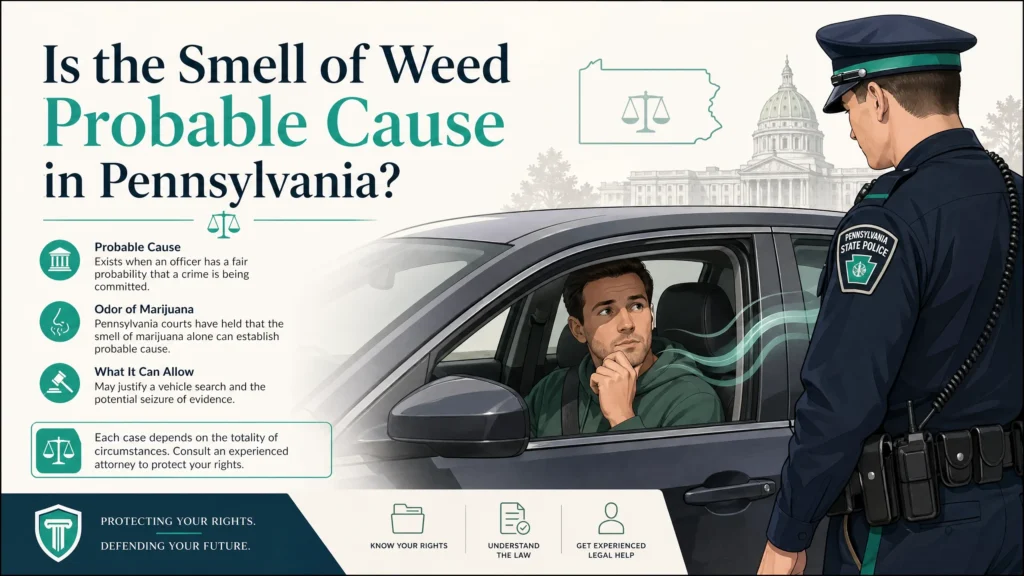
Pennsylvania operates under a per se DUI law for THC. This means that any detectable level of THC metabolites in your blood — regardless of actual impairment — can result in a DUI charge. There is no legal threshold. There is no “I was clearly not impaired” defense under Pennsylvania law.
This is especially significant for oral cannabis patients because oral THC remains in the system far longer than inhaled THC. Full acute clearance from a single oral dose can take 24 hours or more. Frequent users accumulate THC metabolites in fatty tissue that can remain detectable in blood for days or weeks.
As the Allegheny County Bar Association’s PA MMJ FAQ explicitly confirms, Act 16 does not protect registered medical patients from DUI prosecution under Pennsylvania’s controlled substances DUI statute.
Practical guidance for PA oral cannabis patients:
- Do not drive after any oral cannabis dose until you are certain the acute effects have fully resolved — give yourself a minimum of several hours
- Understand that regular use of capsules, tinctures, or troches may result in metabolite levels detectable in blood for significantly longer than occasional inhalation use
- Consult with your physician about how your specific oral dosing regimen interacts with Pennsylvania’s DUI law if driving is a daily necessity
- The ACLU of Pennsylvania has been active in advocacy for DUI reform for MMJ patients, but as of April 2026 the zero-tolerance per se policy remains in force
How to Get Legal Access to Oral Cannabis in Pennsylvania?
To legally purchase any cannabis product at a Pennsylvania dispensary — including capsules, tinctures, troches, RSO, or concentrates — you need a valid PA medical marijuana card. Recreational cannabis remains illegal in Pennsylvania as of April 2026, as confirmed by NORML’s Pennsylvania law summary.
Ready to Get Your Official PA MMJ Card?
State-certified doctor consultations online. No risk—100% refund if not approved.
Claim Your MMJ Card Online →The process is straightforward and can be completed entirely online:
Step 1 — Physician certification. A physician registered with the PA Department of Health confirms you have at least one qualifying condition and submits your certification directly to the state via the secure registry portal.
Step 2 — State registration. You complete patient registration at the PA DOH patient portal and pay the $50 annual state fee. This fee is waived for qualifying patients through Pennsylvania’s MMAP program — those receiving Medicaid, SNAP, WIC, CHIP, PACE, or PACENET.
Step 3 — Card issuance and dispensary access. Cards are typically received within 2 to 5 days as of April 2026. Once issued, you can visit any of Pennsylvania’s 186+ licensed dispensaries statewide and speak directly with a dispensary pharmacist about which oral product format and dosage best suits your condition.
At Pennsylvania Marijuana Cards, Dr. Johnathon Chance Miller, MD provides telehealth certifications entirely online — no waiting room, no office visit, no travel required.
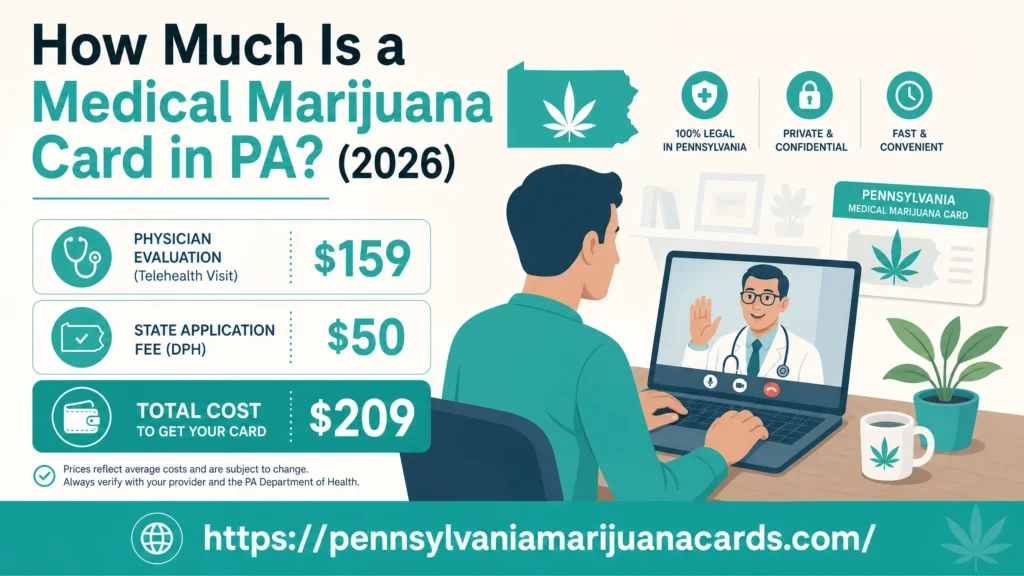
Certification Pricing
| Fee | New Patient | Renewal |
|---|---|---|
| Physician Certification Fee | $159 | $149 |
| PA State Registration Fee | $50 | $50 |
| Total | $209 | $199 |
MMAP-qualifying patients have the $50 state fee waived, reducing the total to the physician certification fee only. Renewal pricing ($199 total) is always lower than new patient pricing ($209 total).
Frequently Asked Questions
Q: Is a 10 mg edible a lot for a beginner?
A: Yes, for most beginners 10 mg is too high a starting dose. Clinical guidance from cannabis physicians — including Northwell Health’s Dr. Diana Martins-Welch — consistently recommends that first-time users begin at 2.5 to 5 mg. Because edibles and oral cannabis products are converted into 11-hydroxy-THC by the liver — a more potent compound than delta-9 THC — their effects are stronger and last longer than the same dose inhaled. Starting low gives you control over your experience and dramatically reduces the risk of an unpleasant first encounter.
Q: How long does a 10 mg edible or capsule take to kick in?
A: Expect 30 to 90 minutes for effects to begin, with peak effects arriving around 2 to 4 hours after consumption. The timeline depends on your metabolism, whether you have eaten recently, and the specific product format. Tinctures and troches absorbed under the tongue work faster — sometimes within 15 to 30 minutes. Capsules and oils that must pass through full digestion take the longest. The GoodRx Health THC dosage guide notes that edibles can take up to 4 hours to reach full effect — which is why patience and waiting before redosing is so critical.
Q: How long does a 10 mg oral cannabis dose last?
A: For most people, the effects of a 10 mg oral cannabis product last between 4 and 8 hours, with some sensitive individuals reporting residual effects for up to 12 hours. This is significantly longer than inhaled cannabis, which typically peaks and fades within 2 to 3 hours. This extended duration is one of the therapeutic advantages of oral cannabis for conditions like chronic pain, sleep disorders, and PTSD — but it also requires careful planning around activities that require full cognitive function, particularly driving in Pennsylvania where any detectable THC is a DUI offense.
Q: Can I buy gummies or food-based edibles at a Pennsylvania dispensary?
A: No. Traditional food-based edibles — gummies, chocolates, baked goods — are not approved for sale at Pennsylvania licensed dispensaries under the Medical Marijuana Act. As confirmed by the Allegheny County Bar Association, processing medical cannabis into food-based edible form is prohibited. Pennsylvania dispensaries offer oral cannabis in the form of capsules, tinctures, oils, RSO, and troches/lozenges — all of which follow the same dosing principles as a traditional edible because the oral absorption mechanism is the same.
Q: Will a 10 mg oral cannabis dose leave me too impaired to function?
A: It depends on your tolerance level. For someone with no prior cannabis experience, 10 mg via oral consumption will likely produce significant psychoactive effects — noticeable euphoria, cognitive slowing, and sedation — that most people would find impairing for several hours. For a patient with established tolerance, 10 mg may feel mild to moderate. If your goal is functional therapeutic relief without heavy intoxication, start at 2.5 to 5 mg and titrate upward slowly. Many PA patients find their optimal therapeutic dose for anxiety or mild pain management is actually at or below 5 mg.
Q: Is 10 mg enough THC for chronic pain relief?
A: For patients new to cannabis, 10 mg of oral THC can provide meaningful pain relief and is toward the upper end of what most clinicians recommend as a starting point. A 2015 JAMA systematic review found moderate evidence supporting cannabinoids for chronic pain. Many patients managing severe chronic pain — a qualifying condition in Pennsylvania — require higher doses as tolerance develops over time, but always starting at 5 to 10 mg and assessing response across several sessions is the appropriate clinical approach.
Q: Can I get a DUI in Pennsylvania after taking an oral cannabis product?
A: Yes. Pennsylvania’s per se DUI law makes it illegal to drive with any detectable level of THC metabolites in your blood — regardless of actual impairment — and this applies to all registered medical marijuana patients. Oral cannabis (capsules, tinctures, troches) stays in the system longer than inhaled cannabis, meaning the risk window after dosing is extended. As the ACBA’s PA MMJ FAQ confirms, your medical card does not protect you from DUI prosecution under this statute. Do not drive for several hours after any oral cannabis dose.
Q: Do I need a PA medical marijuana card to buy oral cannabis products legally?
A: Yes. All cannabis products in Pennsylvania — including capsules, tinctures, troches, and concentrates — are legal only for patients registered in the state’s medical marijuana program. Recreational cannabis remains illegal in Pennsylvania as of April 2026. To obtain your card, you need a qualifying condition, a physician certification from a PA DOH-registered physician, and state registration. The full process can be completed online via telehealth at Pennsylvania Marijuana Cards, with new patient certifications starting at $159 (physician fee) plus the $50 state fee.
Medically reviewed by Dr. Johnathon Chance Miller, MD. This content is for informational and educational purposes only and does not constitute medical advice. Cannabis affects individuals differently. Always consult a licensed physician before beginning any cannabis regimen, particularly if you take other medications or have a pre-existing condition. Pennsylvania patients should be aware of the state’s per se THC DUI law before using any cannabis product.
Sources
- GoodRx Health — How Much THC Dosage
- Northwell Health / The Well — Edibles Overdose Risk and Doctor Dose Guide
- National Institute on Drug Abuse — Is There a Cannabis Use Disorder
- Bergamaschi et al. (2011) — CBD and Anxiety, Neuropsychopharmacology (PMC)
- Whiting et al. (2015) — Cannabinoids for Medical Use, JAMA
- Journal of Psychoactive Drugs — Cannabis and PTSD Symptom Reduction
- NCBI/PubMed — Cannabis Terpenes Pharmacology (2024)
- Pennsylvania Department of Health — Medical Marijuana Program (April 2026)
- Allegheny County Bar Association — PA Medical Marijuana Patient FAQ
- Terrapin Care Station — Pennsylvania Cannabis Law Guide
- NORML — Pennsylvania Medical Marijuana Law Summary
- The Holistic Center PA — PA Medical Marijuana Law Updates 2025-2026
- ACLU of Pennsylvania