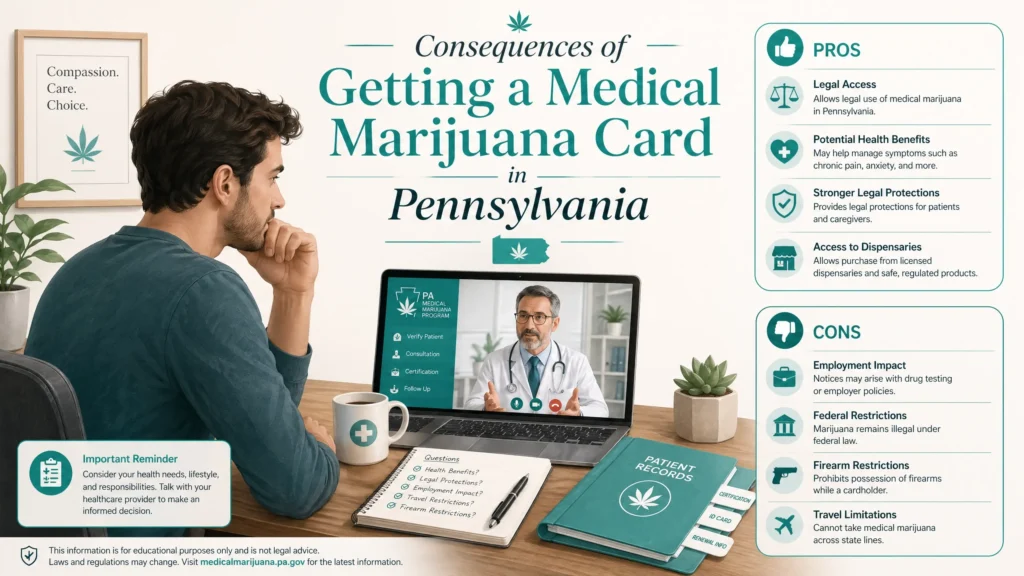

Employment fear is the number one reason Pennsylvania residents with qualifying conditions delay getting a medical marijuana card. They worry about drug tests, job loss, background checks, and their boss finding out.
Some of those fears are valid. Some are significantly overstated. And several important legal protections exist that most PA workers do not know they have.
Need a PA Medical Marijuana Card?
Get certified online in 15 minutes. 100% Money-Back Guarantee.
Get Certified Now →This guide covers the complete picture, what the law actually says, what employers can and cannot legally do, how your city affects your rights, what happens with federal jobs, and exactly what to do if your employer crosses the line.
Quick Answer
Pennsylvania law protects MMJ cardholders from being fired or refused a job SOLELY because of their patient status but employers retain broad rights to enforce drug-free policies and terminate for impairment.
- Cannot do: Fire or refuse to hire you solely because you hold a PA MMJ card
- Can do: Test you for drugs, prohibit impairment at work, and in many cases terminate you if you test positive
- Palmiter ruling (2021): Pennsylvania patients can sue employers for wrongful termination under the MMA
- Philadelphia and Pittsburgh: Have additional pre-employment testing protections beyond state law
- Federal jobs and DOT positions: State law does not apply — zero tolerance remains in full effect
- The word “solely” is the most important word in your employment protection and the biggest loophole
This is legal information, not legal advice. If you believe your rights were violated, consult a licensed Pennsylvania employment attorney.

Key Takeaways
- Section 2103(b)(1) of the PA Medical Marijuana Act prohibits employers from discriminating against you SOLELY because you are a certified MMJ patient
- The word “solely” is critical — employers regularly find other reasons to justify termination, which removes your protection
- You CAN be drug tested — and you CAN be fired for a positive test in most private sector jobs outside Philadelphia and Pittsburgh
- Palmiter v. Commonwealth Health Systems (2021) established that PA MMJ patients can sue employers for wrongful termination, back pay, front pay, and punitive damages are available
- Philadelphia bans pre-employment marijuana testing for most jobs (effective January 1, 2022); Pittsburgh extends stronger protections during employment too
- Federal employees, contractors, and DOT workers have virtually no protection under state MMJ law
What Pennsylvania Law Actually Says: Section 2103(b)(1)
The core legal protection for Pennsylvania MMJ patients in the workplace comes from Section 2103(b)(1) of the Pennsylvania Medical Marijuana Act (35 P.S. 10231.2103):
“No employer may discharge, threaten, refuse to hire or otherwise discriminate or retaliate against an employee regarding an employee’s compensation, terms, conditions, location or privileges solely on the basis of such employee’s status as an individual who is certified to use medical marijuana.”
Three things this covers:
- Firing an existing employee
- Refusing to hire a job applicant
- Any other discrimination in pay, terms, or conditions of employment
This is meaningful protection. Pennsylvania is an at-will employment state, which ordinarily means employers can fire employees for almost any reason or no reason at all. The MMA carves out a clear exception.
But that exception has important limits and one word determines almost everything.
The Most Important Word in Your Employment Protection

Do You Qualify for a PA MMJ Card?
Connect with a licensed Pennsylvania state physician online from home.
The word “solely” in Section 2103(b)(1) is where your protection can be strengthened or erased depending on how your employer handles the situation.
The law prohibits discrimination based solely on your status as a certified patient. Not “primarily.” Not “in part.” Solely.
What this means in practice:
If your employer fires you and can point to any other reason alongside your MMJ status, a positive drug test, impairment at work, a workplace policy violation, performance issues, the “solely” standard may not be met. Your termination may no longer qualify as discrimination under the MMA.
This is the loophole employers use. A positive drug test gives most employers a separate, independent basis for termination that is distinct from your status as a certified patient. Even if your employer knew about your MMJ card and was motivated by it, the positive test result provides cover.
This is why the Palmiter case, discussed in full below, matters so much. It clarified that courts will look carefully at whether a positive test was used as a pretext to accomplish what the employer actually wanted: to fire someone for being an MMJ patient.
The honest bottom line: your protection is real but it is not absolute. It works best when:
- You are fired and there is no other documented reason
- You are denied a job solely because you disclosed MMJ patient status
- You can prove impairment was not the actual issue
What Employers CAN Legally Do?

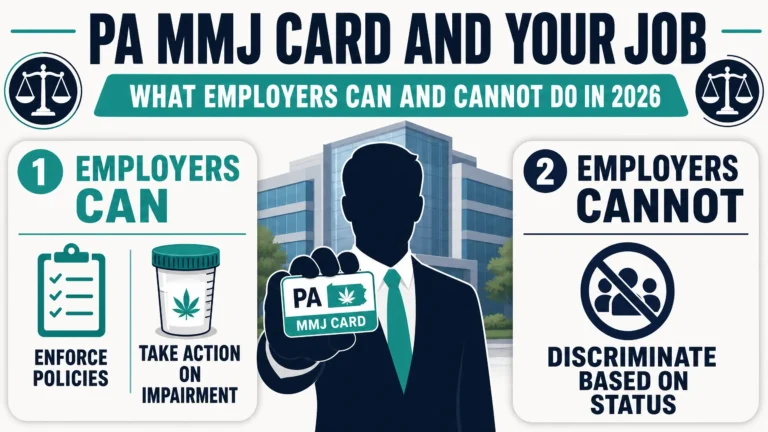
Pennsylvania law is clear that employers retain significant authority over their workplaces even after the MMA. Under Section 2103(b)(2) and Section 510 of the MMA, employers CAN:
Drug test employees and applicants. Pre-employment, random, post-accident, and reasonable suspicion drug tests are all permitted under Pennsylvania law, even for certified MMJ patients. As Nolo’s Pennsylvania workplace drug testing guide confirms, employers are not required to exempt MMJ patients from their drug testing programs.
Prohibit marijuana use on work premises. The MMA explicitly states that employers are not required to accommodate marijuana use on their property or premises. You have no right to use cannabis at work, during work hours, or on company property.
Discipline employees for working while impaired. If your conduct at work falls below the standard of care normally accepted for your position due to marijuana use, your employer can discipline or terminate you. Impairment at work is not protected.
⚡ Fast & 100% Online PA Medical Cards
Board-Certified Doctors • 100% Money-Back Guarantee
Book Evaluation Now →Prohibit certain safety-sensitive tasks while under the influence. Section 510 of the MMA gives employers specific authority to prohibit any task they deem life-threatening when an employee may be under the influence of marijuana.
Terminate employment when a positive test gives independent grounds. If your termination is based on a positive drug test result and not solely on your status as a certified patient, many courts will allow it to stand, though this is increasingly contested after Palmiter.
Maintain a drug-free workplace policy. Employers can still maintain, communicate, and enforce drug-free workplace policies. The MMA does not require them to abandon such policies.
What Employers CANNOT Legally Do?
Under the Pennsylvania Medical Marijuana Act, employers CANNOT:

Ask you if you have a PA MMJ card during hiring. As NACE’s employment law analysis states clearly, employers should never ask an applicant about MMJ card status. This information cannot lawfully be used in the pre-employment hiring process.
Refuse to hire you based solely on your MMJ card status. Denying someone a job offer simply because they disclosed or were found to have a PA MMJ card with no other reason, violates Section 2103(b)(1).
Fire you solely because you are a certified patient. Terminating an existing employee because of their MMJ status, without any workplace conduct issue, impairment evidence, or other independent reason, is a violation of the MMA.
Reduce your pay, change your conditions, or demote you based solely on your MMJ status.
Penalize you for disclosing your MMJ status when responding to questions about lawfully prescribed medications.
Use your MMJ card as the sole basis for denying unemployment benefits. Pennsylvania courts have ruled that employees who fail drug tests for marijuana while holding valid MMJ cards remain eligible for unemployment compensation. This is an important protection many patients do not know about.
The Palmiter Case: Why It Changed Everything

Before 2021, it was unclear whether PA MMJ patients even had the right to sue their employers for discrimination under the MMA. Employers argued the law created no private right of action, meaning patients could not go to court.
Renewing Your PA MMJ Card?
Quick annual recertification online. No paperwork hassle.
Renew Card Online →Palmiter v. Commonwealth Health Systems, Inc., No. 398 MDA 2020 (Pa. Super. Ct. Aug. 5, 2021) settled that question permanently.
The facts: Pamela Palmiter worked as a medical assistant and was certified to use medical marijuana for chronic pain, PTSD, and migraines. She disclosed her certification to her employer. When her employer was acquired by Commonwealth Health Systems, she failed a mandatory drug test and was terminated despite providing documentation of her lawful use.
The ruling: The Pennsylvania Superior Court held that:
- The MMA’s Section 2103 creates an implied private right of action — meaning patients can sue
- Palmiter could pursue a wrongful termination claim in violation of public policy
- Medical marijuana should be treated as more akin to a prescription drug than recreational drug use
- Available damages include back pay, front pay, and potentially punitive damages
What this means for you: If your employer fires you or refuses to hire you solely because of your MMJ patient status, you have a legal path to court in Pennsylvania. The Palmiter decision is binding on all lower courts in the Commonwealth.
The limitation: Palmiter addresses the right to sue, not an automatic win. You still need to prove the termination was based solely on your MMJ status. If your employer can point to a positive drug test or impairment as the reason, the case becomes significantly harder.
Drug Testing: Your Rights by Situation
Pennsylvania law does not prevent employers from drug testing. But your rights vary significantly based on what kind of job you hold and where you work.
Pre-Employment Drug Testing (Statewide, Outside Philadelphia and Pittsburgh)
Pennsylvania has no state law banning pre-employment marijuana testing. Employers statewide can require a pre-employment drug test and can refuse to hire applicants who test positive, even if those applicants hold a valid PA MMJ card.
The practical tension: This appears to conflict with the MMA’s prohibition on refusing to hire someone “solely” because of their MMJ status. Courts have not fully resolved this tension. Some argue a positive pre-employment drug test is a separate, independent basis for denial that satisfies the “solely” standard.
Random and Reasonable Suspicion Testing
Employers can conduct random drug testing and reasonable suspicion testing in most workplaces. For MMJ patients, a positive result gives the employer potential grounds for disciplinary action. Your best protection in this scenario is ensuring your employer cannot document impairment at work alongside the positive test.
Post-Accident Testing
Post-accident drug testing is permitted across Pennsylvania. A positive marijuana test after a workplace accident is one of the highest-risk scenarios for MMJ patients because it combines a positive test with a safety event, providing employers with strong independent grounds for termination.
The Impairment Problem
Standard urine drug tests detect THC-COOH, a metabolite that remains in your system for days to weeks after use, long after any psychoactive effects have resolved. A positive test does not prove current impairment. But Pennsylvania law does not currently require employers to prove current impairment before acting on a positive result.
This remains one of the most legally contested areas for PA MMJ patients and is likely to evolve as the legal landscape changes.
Philadelphia Workers: Stronger Protections

Get Approved by a Licensed PA Doctor
Schedule your appointment in minutes. You only pay if approved.
Start Online Application →If you work in Philadelphia, your employer faces additional restrictions under Philadelphia Code Chapter 9-4700, which took effect January 1, 2022.
What the Philadelphia ordinance prohibits:
Most Philadelphia employers cannot require pre-employment marijuana drug testing as a condition of employment. This applies to employers, labor organizations, employment agencies, and their agents.
Exceptions – pre-employment testing is still permitted for:
- Police officers and law enforcement positions
- Positions requiring a commercial driver’s license (CDL)
- Positions requiring the supervision or care of children, medical patients, or vulnerable populations
- Jobs where drug testing is required by federal or state statute or regulation
- Jobs covered by certain collective bargaining agreements
What the ordinance does NOT cover:
The Philadelphia ordinance applies only to pre-employment testing. Your current employer can still drug test you during employment. Being under the influence at work is still grounds for discipline regardless of your MMJ status.
The practical benefit: If you are job hunting in Philadelphia and hold a PA MMJ card, most employers cannot screen you out before you are hired based on marijuana alone. This is meaningful protection that does not exist in the rest of Pennsylvania.
Pittsburgh Workers: Even Stronger Protections
Pittsburgh’s protections go further than Philadelphia’s. Under Pittsburgh’s Medical Marijuana Employment Ordinance, employers with five or more employees cannot:
- Require pre-employment marijuana drug testing of applicants who hold valid PA MMJ cards
- Require ongoing employment marijuana drug tests of current employees who hold PA MMJ cards, except when there is reasonable suspicion of impairment
Why this matters: Pittsburgh’s ordinance limits marijuana testing during the employment relationship itself, not just at hiring. Outside of a reasonable suspicion standard, your Pittsburgh employer generally cannot randomly test you for marijuana if you hold a PA MMJ card.
Exceptions in Pittsburgh’s ordinance:
- DOT-regulated positions
- Positions requiring the person to carry a firearm
- Certain collective bargaining agreement positions
- Safety-sensitive roles
Federal Employees and DOT Workers: A Different World

Ready to Get Your Official PA MMJ Card?
State-certified doctor consultations online. No risk—100% refund if not approved.
Claim Your MMJ Card Online →If you work for a federal agency or in a federally regulated DOT position, Pennsylvania’s Medical Marijuana Act provides virtually no protection. Federal law governs, and under federal law, marijuana remains a controlled substance, regardless of Schedule III rescheduling.
Federal government employees are subject to Executive Order 12564, which established a drug-free federal workplace. Federal agencies test employees in sensitive positions and zero tolerance applies. Having a PA MMJ card does not provide any exception, accommodation, or defense in federal employment.
Security clearances: Using marijuana, including medically authorized state-legal marijuana is grounds for denial or revocation of a federal security clearance. The Defense Counterintelligence and Security Agency (DCSA) considers marijuana use a disqualifying factor under Guideline H of the Adjudicative Guidelines. A PA MMJ card does not change this analysis under current federal policy.
DOT-regulated employees, including commercial truck drivers, airline pilots, railroad workers, transit employees, pipeline workers, and maritime workers are subject to 49 CFR Part 40, which requires drug testing using federal procedures. Marijuana remains a prohibited substance for these workers.
As Verified First’s 2026 pre-employment testing analysis confirms: the DOT has issued clear guidance for 2026 that until the rescheduling process is fully finalized and specific agency rules are rewritten, marijuana use remains prohibited for safety-sensitive employees. Even in states where marijuana is legal for medical use, federally regulated workers must abstain.
If you hold a CDL or work in transportation: Do not obtain a PA MMJ card with the expectation that it will protect your employment. It will not. Pennsylvania’s MMA has an explicit exception allowing employers to prohibit marijuana use in DOT-regulated positions.
Federal Contractors: The In-Between Zone
Federal contractors occupy a complicated middle ground that many PA patients do not fully understand.
The basic rule: Companies that receive federal contracts worth $100,000 or more must maintain a drug-free workplace under the Drug-Free Workplace Act of 1988. This requires prohibiting controlled substance use, including marijuana and taking action against employees who violate that prohibition.
What this means: If your employer is a federal contractor in a role covered by the contract, they may legally prohibit marijuana use even for certified PA MMJ patients, regardless of the state MMA protections that would otherwise apply.
As the Glassdoor search results from federally contracted Pennsylvania employers confirm, companies like UGI and AmeriGas explicitly state in job listings: “As a federal contractor that engages in safety-sensitive work, we cannot permit employees in certain positions to use medical marijuana, even if prescribed by an authorized physician.”
The nuance: The federal contractor exception applies to contract-covered positions, not necessarily every employee at a company that has one federal contract. Whether your specific role falls under contract coverage is a fact-specific question a Pennsylvania employment attorney can help you evaluate.
Safety-Sensitive Positions: Where the Rules Change
The Pennsylvania Medical Marijuana Act includes specific provisions for what it calls safety-sensitive tasks. Under Section 510 of the MMA, employers can prohibit MMJ patients from performing tasks the employer deems life-threatening while under the influence.
Specific restrictions the MMA itself identifies:
Patients with more than 10 nanograms per milliliter of active THC in blood serum may not:
- Operate or be in physical control of chemicals requiring federal or state permits
- Operate or control high-voltage electricity or other public utilities
- Perform employment duties at heights or in confined spaces, including mining
- Operate or be in physical control of a vehicle, aircraft, train, or any other transport vehicle while carrying passengers for a commercial purpose
Important legal nuance: The MMA’s safety-sensitive provisions apply to being “under the influence” not to merely having THC metabolites in your system. However, employers often use positive drug tests as evidence of impairment, and courts have not fully clarified the distinction in the employment context.
Jobs typically classified as safety-sensitive in Pennsylvania:
- Commercial truck drivers
- Construction workers at heights
- Healthcare workers in patient care
- Manufacturing workers operating heavy machinery
- Mining workers
- School bus drivers
- Law enforcement officers
The April 2026 Rescheduling: What Changed for Workers
The April 28, 2026 federal rescheduling of state-licensed medical marijuana to Schedule III has created new complications for Pennsylvania employers and new opportunities for patient advocates.
What changed in a meaningful way:
The argument that marijuana is “illegal under federal law” as justification for blanket workplace bans is now significantly weaker. As Barley Snyder’s May 2026 employer alert states: policy language stating marijuana is “illegal under federal law” is no longer fully accurate for medical use dispensed through a qualifying state program.
The ADA accommodation angle: Now that state-licensed medical marijuana is a Schedule III substance in the same regulatory category as prescribed opioids and benzodiazepines, employers may face increased difficulty arguing that they cannot accommodate medical marijuana patients under the ADA. If an employer accommodates employees who use prescribed opioids or benzodiazepines, refusing to accommodate medical marijuana patients may become harder to defend legally.
What did NOT change:
- Employers are not required to drop drug testing
- Employers are not required to permit marijuana use at work
- DOT and federal contractor rules remain unchanged
- The MMA’s existing patient protections are unchanged
If You Are Fired or Denied a Job: What to Do
If you believe your employer violated the Pennsylvania Medical Marijuana Act, here is the practical step-by-step path forward.

Step 1: Document everything immediately.
Write down every detail while your memory is fresh, dates, conversations, emails, the reason given for termination or denial, whether your MMJ status was mentioned, who was present. If you received anything in writing, preserve it. Do not delete work emails or messages.
Step 2: Do not sign anything immediately.
Employers sometimes present separation agreements or severance offers at termination. You are not required to sign immediately. These documents often include releases of legal claims. Once signed, your right to sue may be gone. Consult an attorney before signing.
Step 3: Apply for unemployment compensation.
Pennsylvania courts have confirmed that MMJ patients who fail drug tests and are certified users remain eligible for unemployment. File your claim through the Pennsylvania Office of Unemployment Compensation. Your employer may contest it, but the law is on your side if termination was solely MMJ-related.
Step 4: Consult a Pennsylvania employment attorney.
The MMA creates a private right of action under Palmiter. An employment attorney can evaluate whether your situation meets the “solely” standard, what damages you may be entitled to, and whether filing a lawsuit or administrative complaint is appropriate.
Step 5: Know your filing options.
Depending on the specifics of your situation, you may have claims before:
- Pennsylvania Human Relations Commission (PHRC) — for discrimination claims
- Equal Employment Opportunity Commission (EEOC) — if disability discrimination is involved
- Pennsylvania Court of Common Pleas — for wrongful termination under Palmiter
- Philadelphia Commission on Human Relations — if you are a Philadelphia worker
Time limits matter. Pennsylvania wrongful termination claims generally have a two-year statute of limitations. Do not wait.
Should You Tell Your Employer You Have an MMJ Card?
This is the question most patients actually want answered and it deserves an honest answer rather than a legal hedge.
You are generally not required to volunteer this information. Pennsylvania law does not require you to disclose your MMJ patient status to your employer as a condition of employment.
However, consider these scenarios:
If your employer has a drug-free workplace policy and you know you may be tested, silence does not protect you from a positive result. It simply means the positive test comes as a surprise rather than a conversation.
If your employer asks whether you are taking any medications that might affect your work or that might appear in a drug test, disclosing your MMJ certification in response to that question may protect you from being fired “solely” for a positive test, because your employer had notice.
If you work in Philadelphia or Pittsburgh and hold an MMJ card, your city’s ordinance may protect you from pre-employment testing regardless, meaning disclosure during hiring is less risky there.
The practical guidance most employment attorneys offer:
Do not volunteer your MMJ status unprompted. But if you are asked directly about prescription medications or drug test results, be truthful, because the alternative creates its own legal exposure and because the Palmiter case shows that truthful disclosure combined with documented wrongful termination is a viable legal path.
If you are seriously concerned about your specific situation, a 30-minute consultation with a Pennsylvania employment attorney before you either disclose or start a new job is the most valuable thing you can do. The legal landscape is genuinely complex and fact-specific.
Frequently Asked Questions
Q: Can my Pennsylvania employer fire me for having a medical marijuana card?
A: No – not solely because of your card status. Section 2103(b)(1) of the Pennsylvania Medical Marijuana Act prohibits employers from firing, threatening, refusing to hire, or otherwise discriminating against you solely because you are a certified MMJ patient. The Pennsylvania Superior Court confirmed in Palmiter v. Commonwealth Health Systems (2021) that patients can sue employers who violate this provision, with available damages including back pay, front pay, and punitive damages. However, the word “solely” is critical, if your employer can point to a positive drug test, workplace impairment, or any other documented reason alongside your card status, the protection becomes significantly harder to enforce. Consult a Pennsylvania employment attorney if you believe you were wrongfully terminated.
Q: Can my employer drug test me even though I have a PA MMJ card?
A: Yes. Pennsylvania law permits employers to conduct pre-employment, random, post-accident, and reasonable suspicion drug testing of employees, including employees who hold valid PA MMJ cards. The MMA does not exempt certified patients from their employer’s drug testing program. A positive result can give your employer independent grounds for termination separate from your card status, which is the most significant practical challenge PA MMJ patients face in the workplace. Philadelphia and Pittsburgh have enacted additional protections limiting pre-employment testing, see those sections above for details specific to your city.
Q: What did the Palmiter case decide and why does it matter?
A: Palmiter established that PA MMJ patients have the right to sue employers for discrimination. Before the Pennsylvania Superior Court’s 2021 ruling in Palmiter v. Commonwealth Health Systems, Inc., it was unclear whether the MMA created any enforceable right for patients to take legal action. The court held that Section 2103 creates an implied private right of action, that medical marijuana should be treated similarly to a prescription drug, and that wrongful termination claims based on the MMA can proceed. This means that if you are fired solely because of your certified patient status, you have a legal path to court in Pennsylvania with potential damages including back pay, front pay, and punitive damages.
Q: Does having a PA MMJ card affect federal government jobs?
A: Yes – significantly. If you work for a federal agency, hold or seek a federal security clearance, or work in a DOT-regulated position (commercial truck driver, airline pilot, railroad worker, etc.), Pennsylvania’s Medical Marijuana Act provides virtually no protection. Federal law governs these employment relationships, and under federal law, marijuana remains a controlled substance. Executive Order 12564 mandates a drug-free federal workplace. DOT regulations require zero tolerance for marijuana in safety-sensitive transportation positions. A PA MMJ card does not create any exception, accommodation, or defense in federal employment contexts.
Q: Does Philadelphia have extra protections for MMJ patients at work?
A: Yes. Philadelphia’s Prohibition on Testing for Marijuana as a Condition for Employment (Philadelphia Code Chapter 9-4700), effective January 1, 2022, bars most employers from requiring pre-employment marijuana drug tests. This means Philadelphia job applicants with PA MMJ cards cannot be screened out before hiring based on marijuana alone. The ordinance has exceptions for law enforcement, CDL positions, jobs caring for vulnerable populations, and federally mandated testing. Pittsburgh goes even further, protecting current employees from most ongoing marijuana testing absent reasonable suspicion of impairment.
Q: What should I do if I was fired because of my PA MMJ card?
A: Document everything, do not sign anything immediately, and consult a Pennsylvania employment attorney. Write down all details of your termination immediately, dates, conversations, reasons given, who was present. Do not sign a severance or separation agreement before an attorney reviews it, as these typically include releases of legal claims. Apply for Pennsylvania unemployment compensation, courts have confirmed MMJ patients who fail drug tests are still eligible. Then consult an employment attorney to evaluate whether your termination meets the “solely” standard under the MMA and whether you have viable claims before the Pennsylvania courts, PHRC, or EEOC. Time limits apply, Pennsylvania wrongful termination claims generally have a two-year statute of limitations.
Q: What changed for PA workers after the April 2026 federal rescheduling?
A: The legal landscape shifted but your immediate workplace protections did not change overnight. On April 28, 2026, state-licensed medical marijuana was rescheduled to Schedule III of the federal Controlled Substances Act, the same category as prescribed opioids and benzodiazepines. This makes blanket employer arguments that marijuana is “illegal under federal law” significantly harder to sustain. It may strengthen ADA accommodation arguments if employers accommodate other Schedule III drugs but not medical marijuana. However, employers are not required to change their drug testing policies as a direct result of rescheduling. DOT rules and federal contractor requirements remain unchanged. Pennsylvania’s existing patient protections under the MMA still apply and may be strengthened by rescheduling in legal disputes going forward.
This blog presents legal information for educational purposes only and does not constitute legal advice. Federal and Pennsylvania state laws regarding medical marijuana and employment are complex, actively changing, and highly fact-specific. Individual situations vary significantly. Always consult a licensed Pennsylvania employment attorney regarding your specific circumstances before making decisions related to medical marijuana and your employment. Medically reviewed by Dr. Johnathon Chance Miller, MD (License #MD474783).
Sources
- Pennsylvania Medical Marijuana Act, Section 2103(b)(1). “35 P.S. 10231.2103 — Employment Protections.“
- Pennsylvania Medical Marijuana Act, Section 510. “35 P.S. 10231.510 — Safety-Sensitive Positions.“
- Wood Smith Henning and Berman. “Employees Have a Private Cause of Action Under Pennsylvania’s Medical Marijuana Act — Palmiter v. Commonwealth Health Systems, Inc.” September 2021.
- Ogletree Deakins. “Pennsylvania Court Holds Medical Marijuana Act Allows Employees to Sue for Discrimination.“
- Cozen O’Connor. “Court Finds Implied Wrongful Discharge Cause of Action Under PA Medical Marijuana Act.” January 2020.
- Littler. “Pennsylvania Appeals Court Determines State’s Medical Marijuana Act Includes a Private Right of Action for Employees.” August 2021.
- Nolo. “Workplace Drug Testing Rules in Pennsylvania.” November 2025.
- PennsylvaniaStateCannabis.org. “Pennsylvania Drug Testing Laws 2026.“
- NACE. “Preemployment Drug Testing and the Legalization of Medical and Recreational Marijuana.“
- Barley Snyder. “Federal Reclassification of Medical Marijuana: What Pennsylvania Employers Should Do Now.” May 2026.
- Klehr Harrison Harvey Branzburg. “Philadelphia Ordinance Prohibits Pre-Employment Testing for Marijuana Use.“
- Littler. “Pittsburgh Ordinance Bans Tests for Many Prospective and Current Employees Who Use Medical Marijuana.“
- SHRM. “Pittsburgh Bans Tests for Many Prospective and Current Employees Who Use Medical Marijuana.“
- Kaufman Workers Compensation Law. “A Primer on the Legal Rights of Medical Marijuana Patients in Pennsylvania.” February 2026.
- Kaufman Workers Compensation Law. “Can Employers in PA Discriminate Against Medical Marijuana Patients?” August 2025.
- Dilworth Paxson LLP. “The Pennsylvania Medical Marijuana Act: Protections, Prohibitions and Pitfalls.“
- Verified First. “Pre-Employment THC Drug Testing Laws: State-by-State Guide.” March 2026.
- Talcada. “Pennsylvania Drug Testing Laws and Employer Compliance 2026.“
- Department of Transportation. “49 CFR Part 40 — Procedures for Transportation Workplace Drug and Alcohol Testing Programs.“
- Pennsylvania Office of Unemployment Compensation. “UC Benefits Information.“
- Pennsylvania Human Relations Commission. “Filing a Complaint.“
- Compassionate Certification Centers. “PA Medical Marijuana Rescheduling Update 2026.” June 2026.