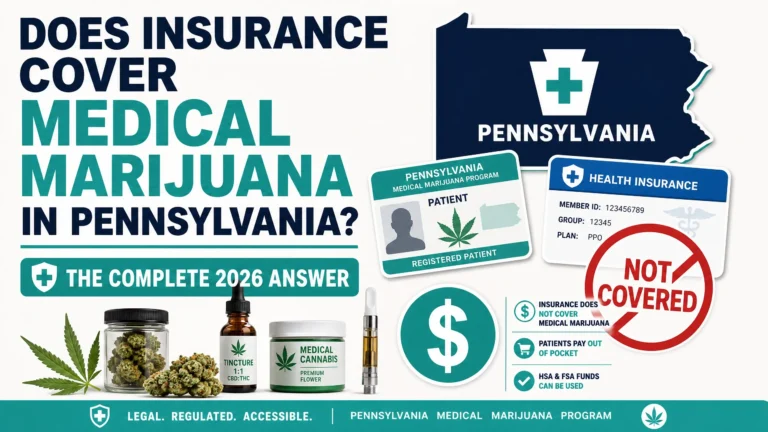
The short answer is NO.
Standard health insurance does not cover medical marijuana products in Pennsylvania. But the full answer is more nuanced than that, and for some patients, there are real pathways to reduce what medical marijuana actually costs you that most guides completely miss.
This blog covers everything: Why standard insurance will not pay, the two exceptions that actually exist, the workers compensation landmark cases that changed PA law in 2023. What you can and cannot do with an HSA or FSA, the state sales tax exemption that saves PA patients real money on every dispensary visit, and every legitimate cost-reduction strategy available in 2026.
If you are looking for a full breakdown of card fees and dispensary product prices specifically, our complete PA MMJ cost guide covers those numbers in detail.
Key Takeaways
- No standard health insurance covers medical marijuana products in Pennsylvania. Private plans, Medicare, Medicaid, and TRICARE all exclude cannabis because it lacks FDA approval and remains a federal controlled substance.
- Workers compensation is the major exception. Pennsylvania law now requires workers comp carriers to reimburse injured workers for reasonable and necessary medical marijuana treatment, following landmark rulings in Fegley v. Firestone Tire and Rubber and Appel v. GWC Warranty Corp. (2023).
- HSA and FSA funds cannot be used at a PA dispensary, but many patients successfully use them for the physician certification fee, which is a separate transaction from a licensed medical doctor.
- PA patients save 6% on every dispensary purchase through the state sales tax exemption under 72 P.S. 7204(28), plus 2% in Philadelphia and 1% in Allegheny County on local surtaxes.
- MMAP qualifying patients (Medicaid, SNAP, WIC, CHIP, PACE, PACENET) have the $50 annual state card fee waived entirely, reducing the total new patient cost to $159.
- The April 2026 federal rescheduling to Schedule III has not yet changed insurance coverage or HSA eligibility, but it reduces barriers to future FDA approval of cannabis-derived medications.
Why Health Insurance Does Not Cover Medical Marijuana?
The reason is federal law, not individual insurer preference.
Health insurance companies in the United States base coverage decisions on two standards: FDA drug approval and federal drug classification. Cannabis fails both.
The FDA approval problem
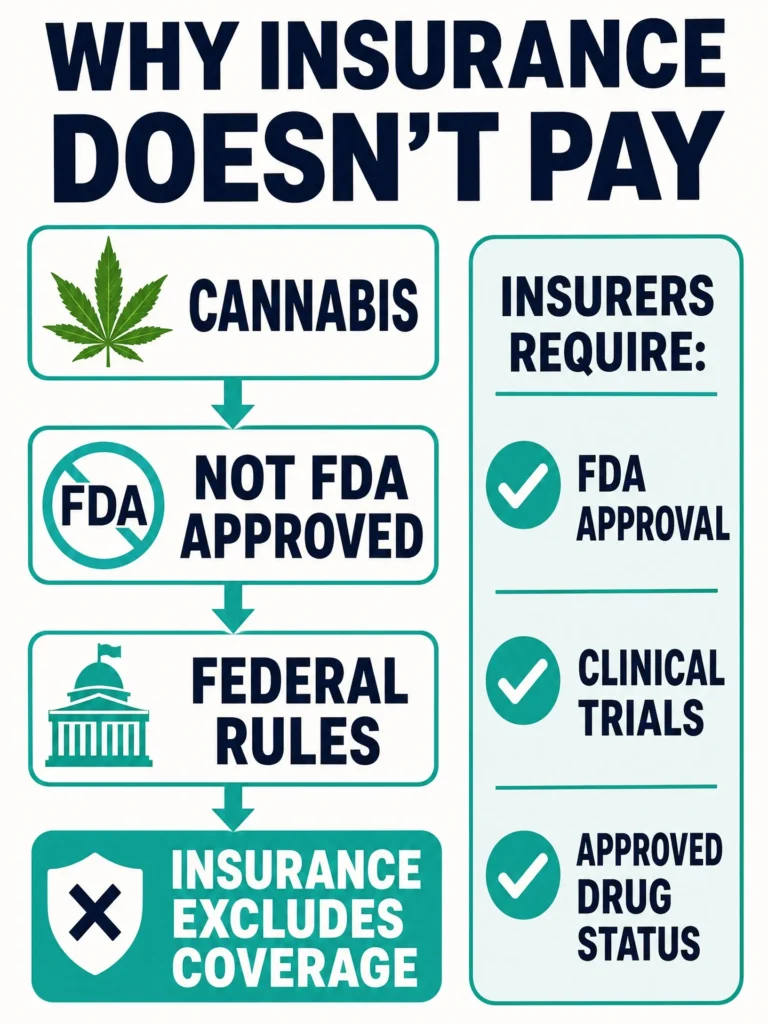
Health insurers generally only cover drugs that have completed the FDA’s rigorous approval process, which includes large-scale clinical trials demonstrating safety and efficacy for specific conditions. Because cannabis is federally classified as a controlled substance, conducting FDA-standard trials has been legally complicated. Without FDA approval, every insurer categorizes medical marijuana as “experimental” or “investigational” — language that gives them grounds for automatic exclusion.
The federal classification problem
Under the Controlled Substances Act, marijuana remains a Schedule I substance for most purposes as of July 2026. Even though the April 2026 rescheduling order moved state-licensed medical marijuana to Schedule III for some regulatory purposes, the core coverage barrier at the insurer level has not changed. An insurer paying for cannabis products would technically be facilitating transactions in a federally controlled substance.
What this means in practice?
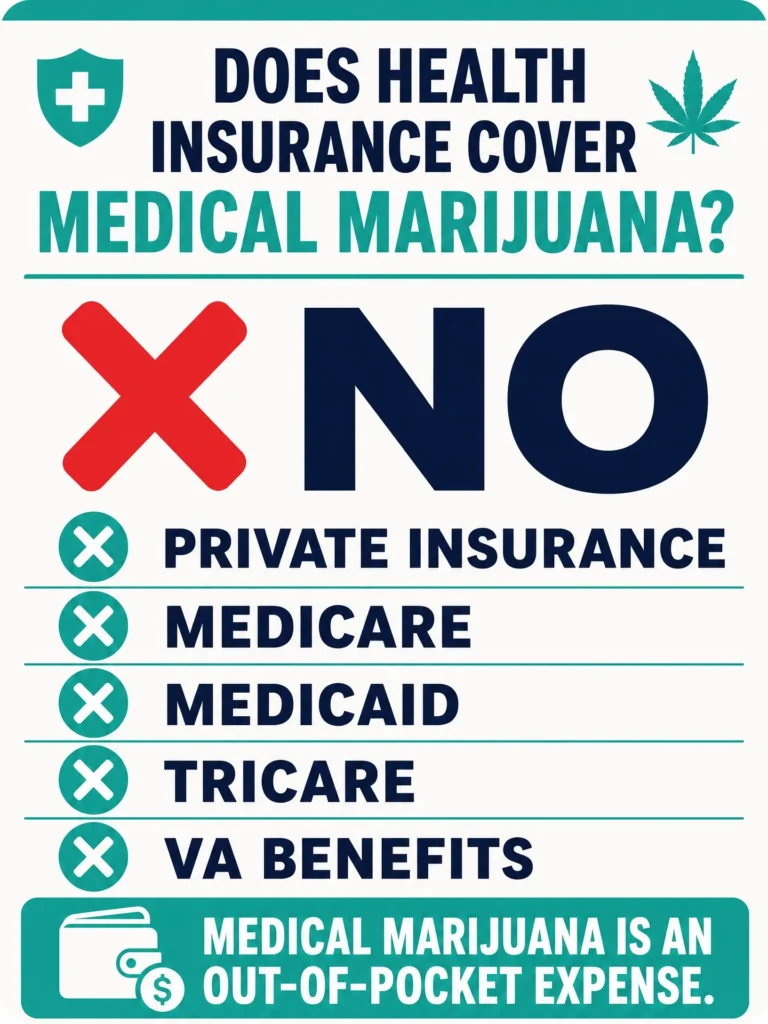
If you walk into a Pennsylvania dispensary with your Blue Cross Blue Shield, Aetna, UnitedHealthcare, UPMC, or Cigna card, you will be turned away. There is no billing mechanism. There is no claim code. Insurance payment at a dispensary is not possible under the current framework.
This applies to:
- All private health insurance plans
- Employer-sponsored group health plans
- Medicare (all parts: A, B, C, D)
- Pennsylvania Medicaid (Medical Assistance)
- CHIP
- TRICARE (military)
- VA health benefits
The One FDA-Approved Exception: Epidiolex
There is exactly one cannabis-derived drug that health insurance covers: Epidiolex.
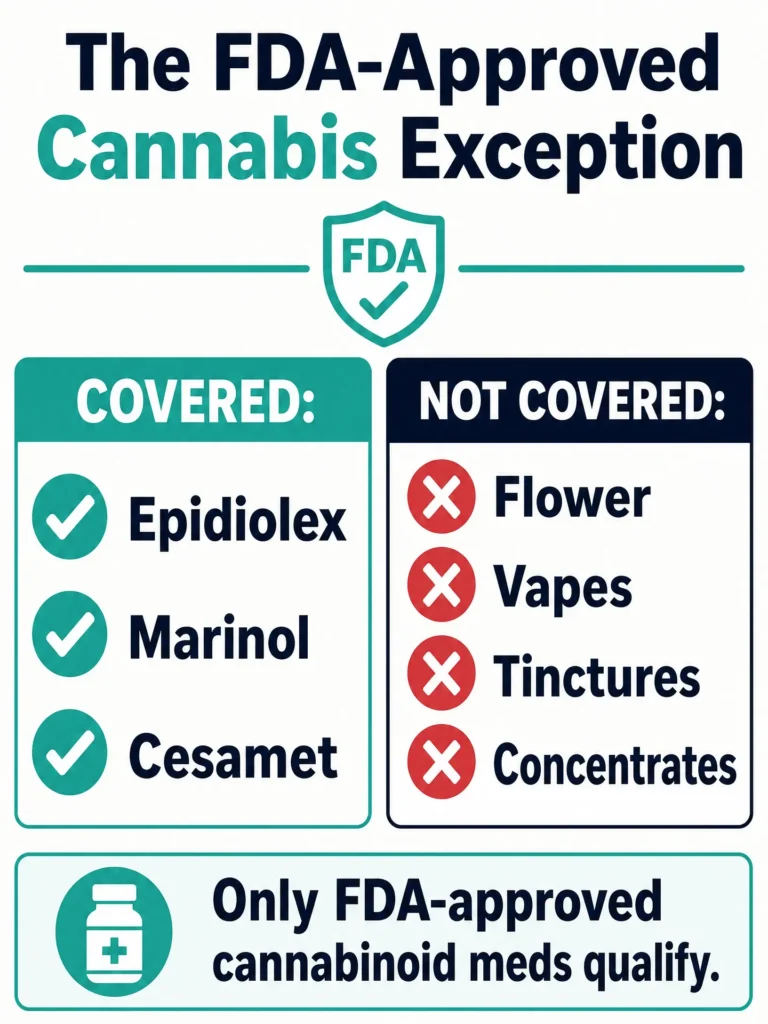
Epidiolex is a purified CBD-based medication approved by the FDA in 2018 for two rare and severe forms of epilepsy: Dravet syndrome and Lennox-Gastaut syndrome. It was later approved for tuberous sclerosis complex.
Because Epidiolex went through full FDA approval, health insurance companies treat it like any other prescription drug. Coverage depends on your specific plan’s formulary, but major insurers including Blue Cross, Aetna, and UnitedHealthcare have covered it.
Epidiolex is not available at Pennsylvania dispensaries. It is prescribed by a physician and dispensed through a licensed pharmacy. It does not provide the broad symptom management that most PA MMJ patients seek.
Two other synthetic cannabinoid medications, dronabinol (Marinol) and nabilone (Cesamet), are FDA-approved for chemotherapy-related nausea and AIDS-related weight loss and are also coverable through insurance as Schedule III or II prescription drugs. These are synthetic THC analogs, not plant-derived cannabis products.
For the vast majority of Pennsylvania patients using flower, tinctures, oils, vape cartridges, or concentrates at licensed dispensaries, none of these exceptions apply.
Workers Compensation: The Major Pennsylvania Exception
This is the section of this guide that most PA patients have never read anywhere else, and for injured workers, it may be the most financially significant information here.
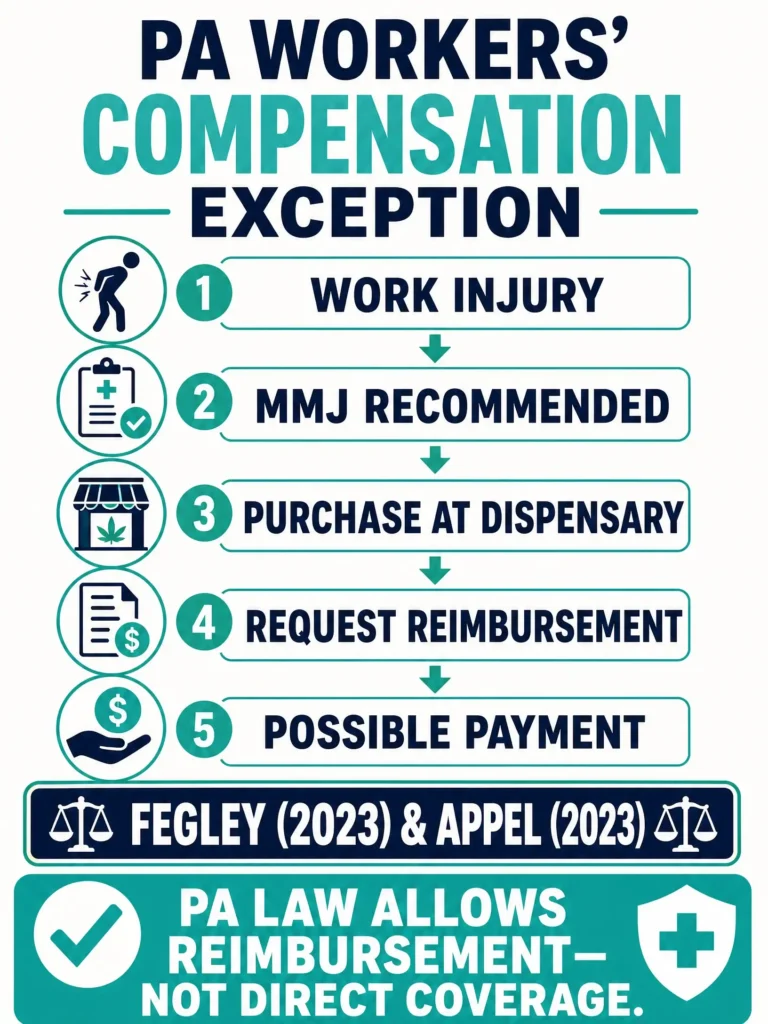
Pennsylvania law now requires workers compensation carriers to reimburse injured workers for medical marijuana costs when cannabis is reasonable and necessary treatment for a work injury.
This is not speculation. It is established Pennsylvania case law following two landmark decisions from the Pennsylvania Commonwealth Court issued on March 17, 2023.
Fegley v. Firestone Tire and Rubber (2023)
The claimant, Paul Sheetz, sustained a work-related back injury in 1977. After decades of treatment including two back surgeries and escalating opioid prescriptions culminating in 30mg daily OxyContin, his physician prescribed medical marijuana in 2019. Within a year, Sheetz was able to completely wean off OxyContin and Valium using medical marijuana.
When he sought reimbursement from the workers comp carrier, they refused — arguing that reimbursing a federally illegal substance violated federal law and that the Medical Marijuana Act specifically excluded coverage by insurers.
The Pennsylvania Commonwealth Court disagreed. Writing for the court, Judge Anne Covey held that:
- Reimbursement is legally distinct from coverage
- Paying a worker back for lawfully purchased medical marijuana does not cause the employer or carrier to “manufacture, distribute, or dispense” a controlled substance under federal law
- The Medical Marijuana Act’s exclusion of “coverage” does not eliminate the Workers’ Compensation Act’s mandate to reimburse for reasonable and necessary medical treatment
- Denying reimbursement to a worker lawfully using medical marijuana under the MMA is a violation of the Workers’ Compensation Act, subject to penalties of up to 50%
Appel v. GWC Warranty Corp. (2023)
Issued the same day as Fegley, Appel reinforced the same framework in a different factual context. The claimant sustained a work injury in 2006. After conventional treatments failed, his physician certified him for medical marijuana to treat chronic pain from the injury. The carrier denied reimbursement, again citing federal law.
The court rejected the federal preemption argument a second time, holding that a carrier reimbursing a lawfully registered PA patient for medically necessary treatment is not violating the Controlled Substances Act.
What This Means for PA Injured Workers
If you sustained a work injury in Pennsylvania and your physician has recommended medical marijuana as reasonable and necessary treatment for that injury, you have a legal right to seek reimbursement from your workers compensation carrier. This right exists even though your carrier will likely deny the initial request.
Important note: Workers compensation carriers continue to deny these claims despite the Fegley and Appel rulings, hoping injured workers will give up. If you are denied, you have legal recourse.
How to Pursue Workers Comp Reimbursement in PA?
If you are an injured Pennsylvania worker using medical marijuana for a work-related injury, follow these steps.
Step 1: Keep all your receipts.
Every dispensary receipt must be saved. Include dates, amounts, product types, and dispensary name. Pennsylvania law requires reasonable and necessary documentation to support a reimbursement claim.
Step 2: Get physician documentation.
Your certifying physician should document that medical marijuana is reasonable and necessary treatment for your specific work injury. This is the same standard applied to any other medical treatment under workers comp.
Step 3: Submit a formal written reimbursement request.
Send your request with all documentation by certified mail to your workers compensation carrier. Include your physician certification, dispensary receipts, and medical records connecting the marijuana use to your work injury.
Step 4: File a Claim Petition if denied.
Pennsylvania’s Workers’ Compensation system allows you to appeal a carrier denial through a Claim Petition heard by a workers compensation judge. This is where having legal representation significantly improves your outcome.
Step 5: Consider a Penalty Petition for bad faith denials.
When a carrier denies your claim using arguments the courts already rejected in Fegley and Appel, a Penalty Petition can recover interest on delayed payments and attorney fees. Carriers who knew about these rulings and denied anyway face up to 50% penalty.
Pennsylvania workers compensation attorneys often handle these cases on contingency. A free initial consultation with a workers comp attorney is the most practical first step if your carrier has denied your reimbursement request.
HSA and FSA: What You Can and Cannot Do
This is one of the most commonly asked questions, and the answer has two distinct parts that most sources fail to separate clearly.
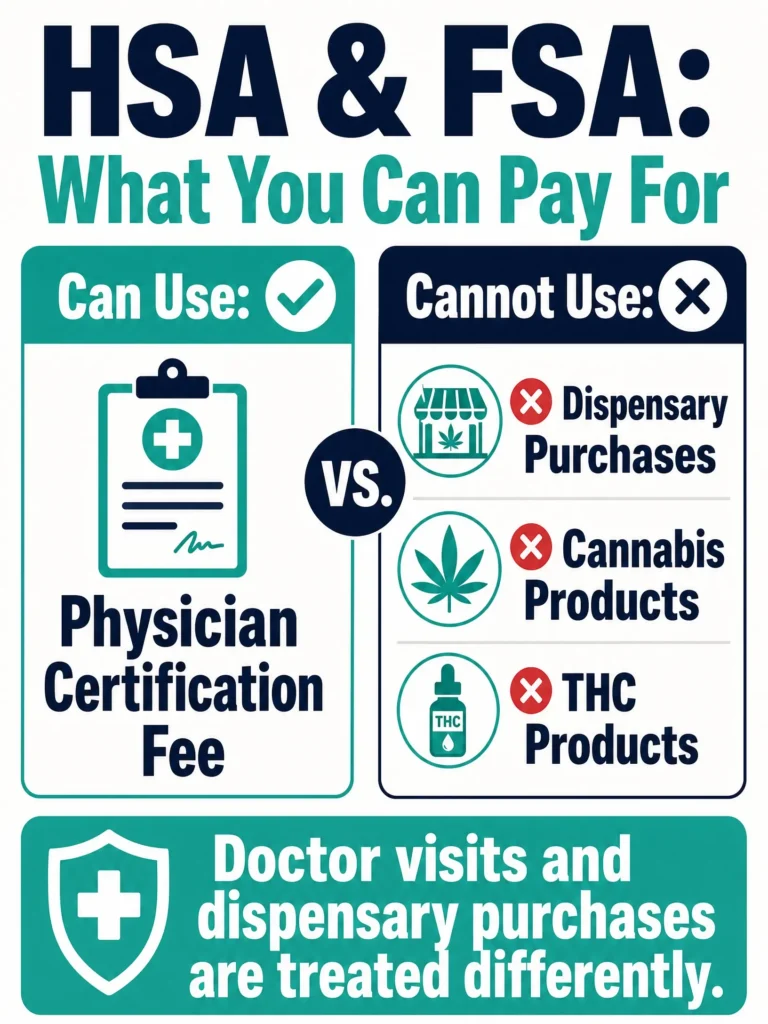
For the Cannabis Products at a PA Dispensary: No
You cannot use an HSA or FSA debit card at a Pennsylvania dispensary. There are two reasons.
First, IRS Publication 502 explicitly states: “You can’t include in medical expenses amounts you pay for controlled substances (such as marijuana, laetrile, etc.) that aren’t legal under federal law, even if such substances are legalized by state law.” This language has not been updated to reflect the April 2026 rescheduling.
Second, dispensaries are federally classified as cannabis businesses. Most banking networks will decline HSA/FSA transactions at dispensaries at the point of sale regardless of the IRS question.
Using HSA funds for cannabis products at a dispensary is a non-qualified expense. It would trigger income tax on the withdrawal and a 20% IRS penalty for anyone under age 65.
For the Physician Certification Fee: Possibly Yes
This is where many patients find an unexpected cost-saving opportunity.
The physician certification visit for a PA MMJ card is a separate transaction from the dispensary purchase. It involves a licensed medical doctor evaluating your diagnosed medical condition and issuing a clinical certification. This looks like a standard physician consultation for a medical condition, because that is what it is.
Many PA MMJ patients successfully use HSA or FSA cards to pay the physician certification fee. The logic is that the visit is a legitimate medical service from a licensed physician for a qualifying medical condition, exactly the type of expense HSA and FSA funds are designed to cover.
However, this is not guaranteed. Individual HSA and FSA plan administrators apply their own standards. Some approve these transactions. Some do not. The IRS has not issued explicit guidance on whether a physician’s medical marijuana certification fee qualifies.
The practical approach: Attempt to pay your physician certification fee with your HSA or FSA card. If your plan administrator approves it, you have used pre-tax dollars for part of your card cost. If they decline, pay with another method. Do not attempt to use HSA/FSA funds for any dispensary purchase.
Can You Deduct Medical Marijuana on Your Federal Tax Return?
No. The same federal controlled substance prohibition that blocks HSA eligibility for cannabis products also prevents you from claiming dispensary purchases as a medical expense deduction on your federal income tax return under IRC Section 213.
This position has not changed as a result of the April 2026 rescheduling. Until the IRS updates its guidance, federal tax deductibility of cannabis products remains unavailable to PA patients.
Medicare, Medicaid, and VA Benefits
Medicare
Medicare does not cover medical marijuana products under any part of its program. Part D (prescription drug coverage) only covers FDA-approved medications. Medical marijuana is not FDA-approved. Epidiolex, dronabinol, and nabilone may be covered under Part D if prescribed and included in your plan’s formulary, but plant-derived cannabis products from a PA dispensary are not.
Pennsylvania Medicaid (Medical Assistance)
Pennsylvania Medicaid does not cover medical marijuana products. However, Medicaid enrollment qualifies Pennsylvania patients for the MMAP fee waiver, which eliminates the $50 annual state card registration fee. Medicaid patients pay only the physician certification fee for their card.
VA Benefits
The VA does not pay for or provide medical marijuana to veterans. VA physicians cannot prescribe or recommend marijuana, and VA pharmacies do not dispense it. However, in 2017 VA policy guidance, the VA stated that veterans’ use of state-legal medical marijuana will not jeopardize their VA benefits or affect their ability to receive VA pain management services.
PA veteran MMJ patients are in a unique position. Their VA benefits remain intact. The 20% veteran discount available at multiple PA dispensaries including Trulieve, AYR, Rise, and Zen Leaf provides meaningful cost reduction. And the PA MMJ card gives them legal protection the VA acknowledges even if it will not fund treatment.
The PA Sales Tax Exemption: Real Money Back on Every Visit
This is the most overlooked financial benefit of the Pennsylvania MMJ card and it compounds over time.
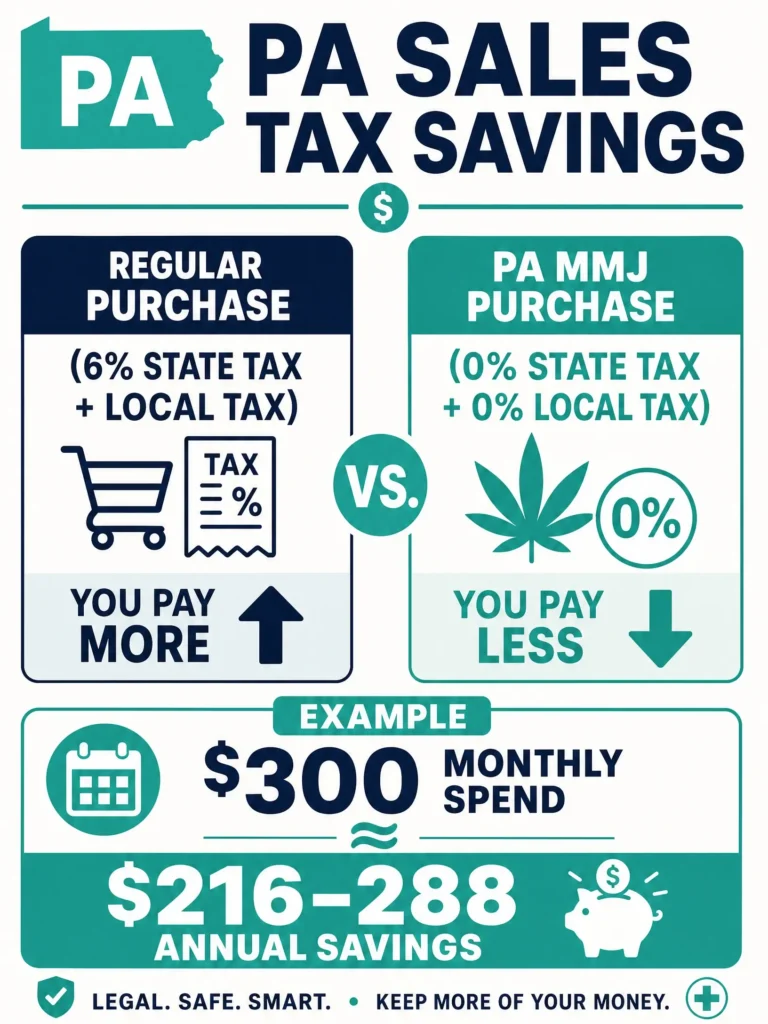
Under 72 P.S. 7204(28), medical marijuana products purchased by a registered Pennsylvania MMJ cardholder at a licensed dispensary are completely exempt from Pennsylvania’s 6% state sales tax.
The exemption goes further than most patients realize. Per MMJ.com’s 2026 renewal guide, the exemption also preempts local sales tax surtaxes, including:
- Philadelphia’s 2% local sales tax surtax
- Allegheny County’s 1% local sales tax surtax
This means Philadelphia patients save 8% on every dispensary purchase. Allegheny County patients save 7%. All other PA patients save 6%.
At $300 per month in dispensary spending, a reasonable estimate for a regular patient, a Philadelphia patient saves $24 per month or $288 per year through the sales tax exemption alone. That covers more than the entire physician certification fee for a renewal year.
This exemption does not apply to recreational cannabis if Pennsylvania eventually legalizes it. Governor Shapiro’s 2026 legalization framework proposes a 20% wholesale tax plus the standard 6% state sales tax on recreational purchases. Medical card holders would retain their tax-exempt status.
MMAP: Pennsylvania’s Fee Waiver Program
Pennsylvania’s Medical Marijuana Assistance Program (MMAP) functions as the state’s closest equivalent to financial assistance for MMJ patients. It does not cover product costs, but it does eliminate the annual state registration fee entirely for qualifying patients.
The $50 annual state card fee is waived for patients enrolled in any of these programs:
- Medicaid (Pennsylvania ACCESS card)
- SNAP (Supplemental Nutrition Assistance Program)
- WIC (Women, Infants, and Children)
- CHIP (Children’s Health Insurance Program)
- PACE (Pharmaceutical Assistance Contract for the Elderly)
- PACENET
To apply the MMAP waiver, provide documentation of program enrollment during your PA DOH registry registration. For most programs, verification is electronic. Contact the PA DOH helpdesk at 888-733-5595 (available 7 days a week, 7am to 9pm ET) if you encounter issues applying the waiver.
What the April 2026 Rescheduling Means for Insurance Coverage
On April 28, 2026, the federal government reclassified state-licensed medical marijuana from Schedule I to Schedule III of the Controlled Substances Act. Many patients have asked whether this changes the insurance coverage picture.
The honest answer: Not yet but it plants the seeds for future change.
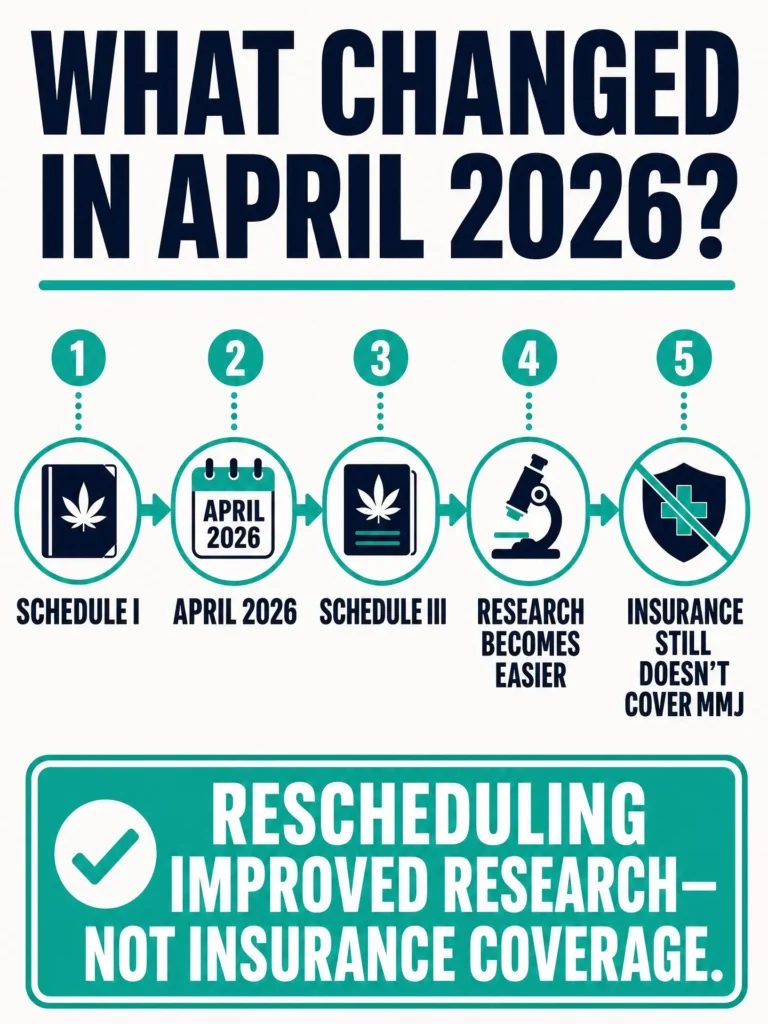
What changed that matters for insurance?
Schedule III substances are in the same regulatory category as prescription opioids and benzodiazepines. Insurers routinely cover Schedule III medications. The argument that cannabis is “in a different category than real medicine” is now significantly weaker. Employers and insurers who cover Schedule III drugs like hydrocodone while refusing to cover medical marijuana may face harder questions from patients and advocacy groups going forward.
What did not change?
The IRS has not updated Publication 502 to reflect rescheduling. HSA and FSA eligibility for cannabis products has not changed as of July 2026. The FDA has not approved plant-derived cannabis products for general use. Health insurers have not announced coverage changes.
What may change in the future?
If the FDA eventually approves cannabis-based medications through its standard approval process, now a more plausible pathway since rescheduling reduces research barriers, those specific approved products could become coverable. The IRS may eventually update its controlled substance guidance. The ADA accommodation argument for medical marijuana employees may also strengthen, as discussed in our PA MMJ card and employment rights guide.
For now, Pennsylvania patients should plan their budgets around the current reality: products are out of pocket, the physician fee may be HSA-eligible, the sales tax exemption applies at the dispensary, and workers comp reimbursement is available for work-related injuries.
Every Legitimate Way to Reduce Your PA MMJ Costs in 2026
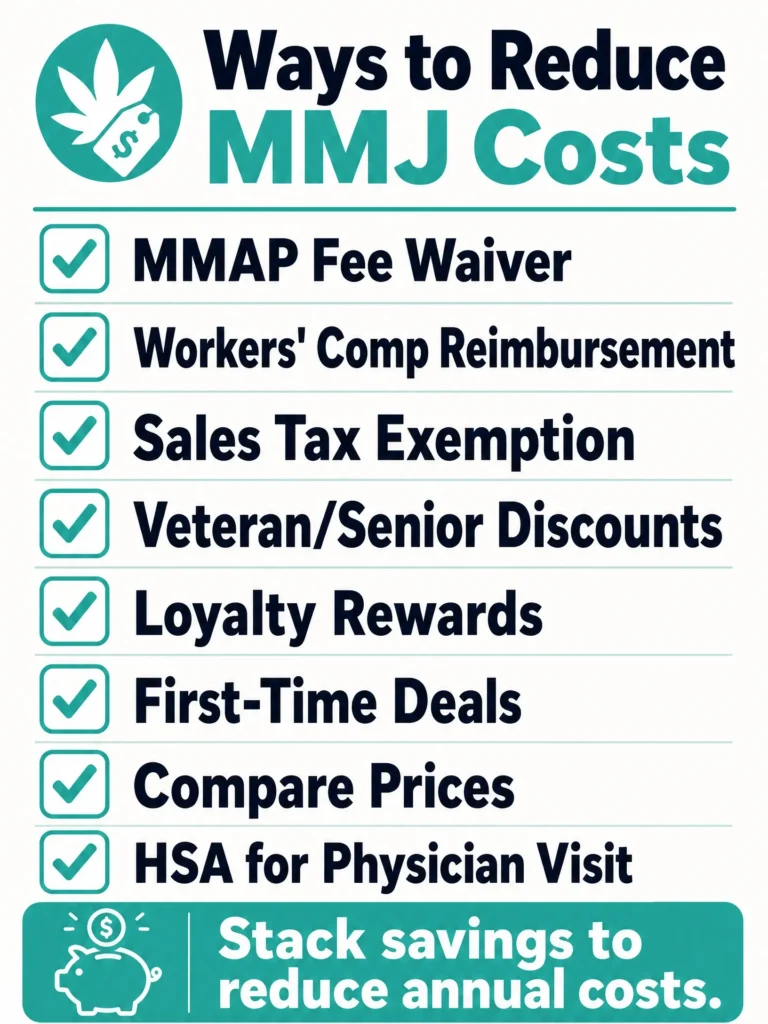
Here is a complete summary of every cost-reduction strategy available to Pennsylvania patients right now.
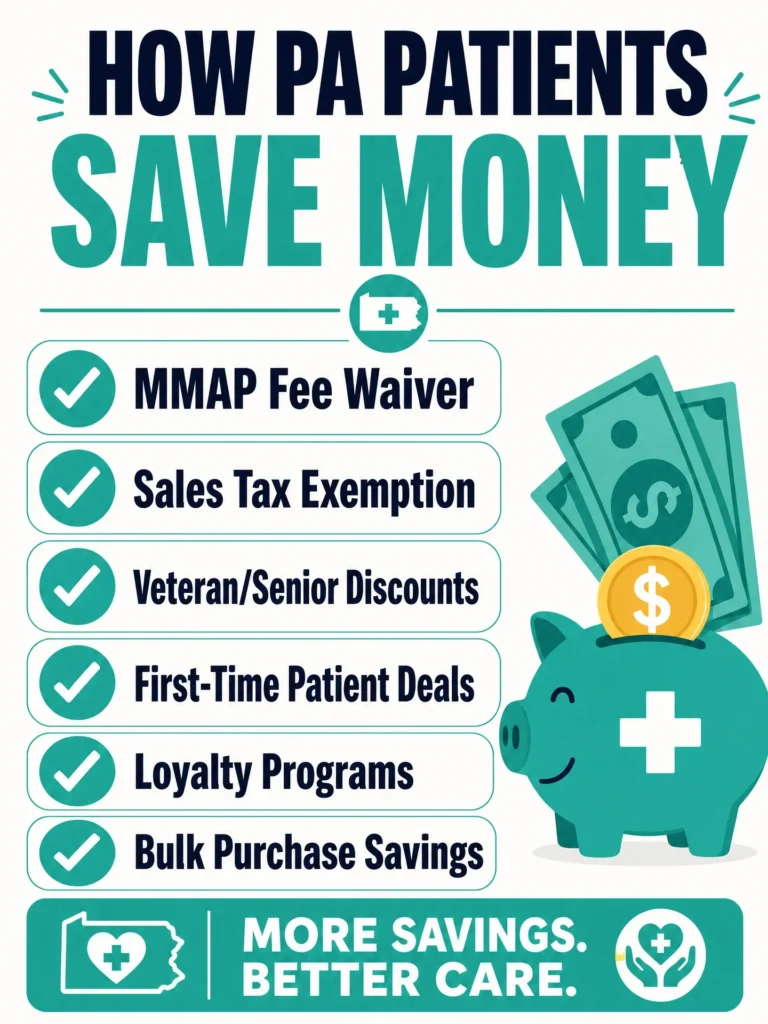
The PA sales tax exemption (automatic at checkout)
All dispensary products are exempt from the 6% PA sales tax, plus local surtaxes in Philadelphia (2%) and Allegheny County (1%). Estimated annual savings at $300/month spend: $216 to $288.
MMAP fee waiver (for qualifying patients)
Medicaid, SNAP, WIC, CHIP, PACE, and PACENET recipients have the $50 annual state card fee waived. Bring documentation to your DOH registry registration.
First-time patient discounts
Most PA dispensaries offer 15% to 50% off your first purchase. Trulieve offers 50% off. For a $150 first purchase, that is $75 off, nearly covering the difference between new patient and renewal physician fees.
Veteran discounts
Trulieve, AYR, Rise, and Zen Leaf all offer 20% off for veterans on every purchase. At average dispensary prices of $10/g, this brings effective cost to $8/g, often below street market pricing for comparable product.
Senior discounts
Most major PA dispensary chains offer 10% to 15% off daily for patients 55 and older. Combined with loyalty points, effective per-gram cost drops meaningfully.
Loyalty programs
Most PA dispensaries offer points redeemable for discounts. Accumulated over time, these return 3% to 5% of spending.
Bulk purchase discounts
Rise Cannabis offers 10% off orders over $150, 15% off over $300, and 20% off over $450. Planning monthly supply purchases in a single transaction maximizes these discounts.
HSA/FSA for the physician visit
Attempt to pay the certification fee with HSA or FSA funds. Many plan administrators approve this as a physician visit for a medical condition.
Workers comp reimbursement (for injured workers)
If you are using PA medical marijuana for a work-related injury, you have a legal right to seek reimbursement from your workers comp carrier under Fegley and Appel. Consult a Pennsylvania workers comp attorney if your carrier denies your initial request.
Comparing dispensary prices
PA dispensary prices vary. Budget flower runs $6/g at some dispensaries. Using dispensary menu comparison tools before purchasing helps identify the best value for your specific product needs.
If you have a qualifying condition and want to start the process, Pennsylvania Marijuana Cards offers same-day telehealth certifications with Dr. Johnathon Chance Miller, MD.
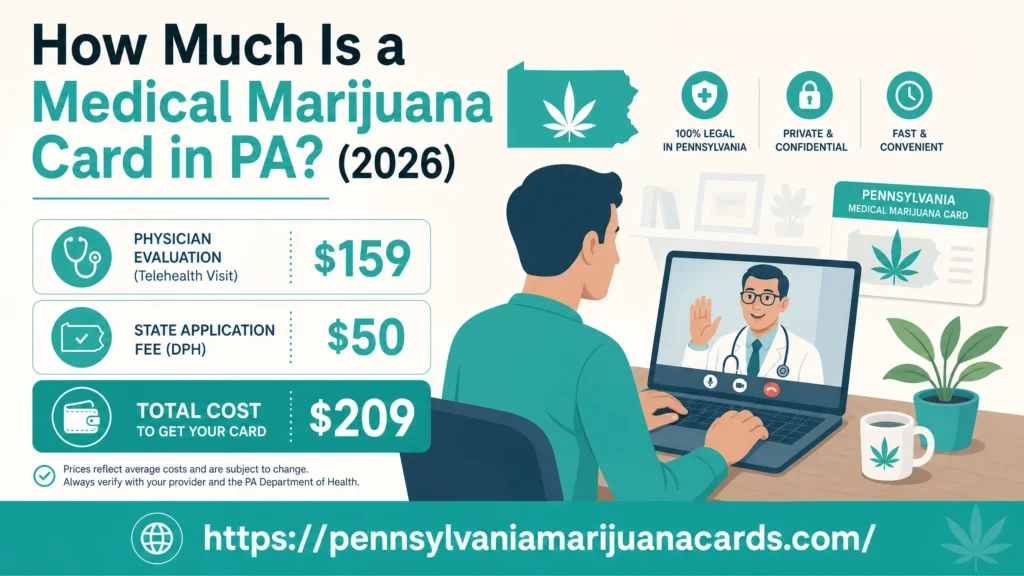
| Physician Fee | PA State Fee | Total | |
|---|---|---|---|
| New Patient | $159 | $50 | $209 |
| Renewal | $149 | $50 | $199 |
| MMAP Qualifying Patients | $159 / $149 | $0 waived | Physician fee only |
Frequently Asked Questions
Q: Does insurance cover medical marijuana in Pennsylvania?
A: No. Standard health insurance does not cover medical marijuana products in Pennsylvania or anywhere in the United States. This applies to private insurers, Medicare, Medicaid, TRICARE, and VA benefits. The reason is federal law: cannabis is not FDA-approved for general use, and IRS and federal controlled substance rules prevent insurers from covering it. There are two meaningful exceptions. First, workers compensation carriers in Pennsylvania are required by state law to reimburse injured workers for reasonable and necessary medical marijuana treatment (Fegley and Appel, 2023). Second, the physician certification fee for your PA MMJ card may be payable with HSA or FSA funds as a physician medical service, though individual plan administrators vary.
Q: Can I use my HSA or FSA to pay for medical marijuana at a PA dispensary?
A: No. IRS Publication 502 explicitly excludes controlled substances, including marijuana, from qualified medical expenses regardless of state law. Using HSA or FSA funds at a dispensary would trigger income tax on the withdrawal plus a 20% IRS penalty for anyone under age 65. However, the physician certification fee for your PA MMJ card is a separate transaction from a licensed medical doctor for a medical condition. Many Pennsylvania patients successfully use HSA or FSA cards for this fee. Results vary by plan administrator. The dispensary purchase itself remains categorically excluded from HSA and FSA eligibility as of July 2026.
Q: Does workers comp cover medical marijuana in Pennsylvania?
A: Yes, under specific conditions. Following two landmark rulings from the Pennsylvania Commonwealth Court on March 17, 2023 (Fegley v. Firestone Tire and Rubber and Appel v. GWC Warranty Corp.), Pennsylvania workers compensation carriers are required to reimburse injured workers for reasonable and necessary medical marijuana costs related to work injuries. The court held that reimbursement is legally distinct from coverage, and that denying reimbursement to a lawfully registered PA patient for medically necessary treatment violates the Workers’ Compensation Act. Despite these rulings, carriers continue to deny claims, consulting a Pennsylvania workers comp attorney is the most effective response to a denial.
Q: Does the PA sales tax exemption really save money on medical marijuana?
A: Yes, meaningfully. Pennsylvania medical marijuana purchases are exempt from the state’s 6% sales tax under 72 P.S. 7204(28). The exemption also preempts Philadelphia’s 2% local surtax and Allegheny County’s 1% local surtax. A Philadelphia patient spending $300 per month on dispensary products saves $24 per month through the exemption, or $288 annually, more than enough to offset the annual physician renewal fee. This exemption is automatic at any licensed PA dispensary and applies to every cardholder. It does not apply to recreational cannabis purchases if Pennsylvania legalizes adult use in the future.
Q: Does Medicare cover medical marijuana in Pennsylvania?
A: No. Medicare Part D covers FDA-approved prescription drugs only. Medical marijuana products from Pennsylvania dispensaries are not FDA-approved. Medicare will not cover flower, vape cartridges, tinctures, oils, concentrates, or topicals purchased at any PA dispensary under any coverage scenario. Epidiolex (a CBD-based drug for specific epilepsy types) and dronabinol (synthetic THC for chemotherapy nausea) are FDA-approved and may be covered under Part D if included in your plan’s formulary, but these are not dispensary products and are not what most Pennsylvania MMJ patients use.
Q: Does getting a PA MMJ card affect my eligibility for public benefits like SNAP or Medicaid?
A: No. Your PA MMJ card status is protected health information under HIPAA and is not shared with any other government agencies. The Pennsylvania Department of Health does not share the MMJ patient registry with DHS, SSA, SNAP, or Medicaid administering agencies. Getting a PA MMJ card does not affect your eligibility for SNAP, Medicaid, CHIP, SSI, SSDI, housing assistance, or any other public benefit. In fact, enrollment in SNAP, Medicaid, WIC, CHIP, PACE, or PACENET makes you eligible for the MMAP fee waiver, which eliminates your $50 annual state card fee.
Q: Did the April 2026 federal rescheduling change insurance coverage for PA MMJ patients?
A: Not yet. On April 28, 2026, state-licensed medical marijuana was rescheduled from Schedule I to Schedule III of the federal Controlled Substances Act. This is a historically significant shift, but it has not changed insurance coverage as of July 2026. Health insurers have not announced coverage changes. The IRS has not updated Publication 502 to reflect rescheduling. HSA and FSA eligibility for cannabis products has not changed. The most significant near-term implication is that rescheduling reduces legal barriers to FDA clinical trials for cannabis-derived medications, which may eventually produce FDA-approved products that insurers are required to cover. For now, Pennsylvania patients should continue to plan around out-of-pocket costs.
This blog post is intended for general educational and informational purposes only and does not constitute medical, legal, or financial advice. Insurance coverage rules, tax laws, and Pennsylvania regulations are subject to change. Always verify current requirements with your insurance provider, tax professional, or a licensed Pennsylvania attorney before making financial decisions related to medical marijuana. Workers compensation situations are highly fact-specific, consult a licensed Pennsylvania workers compensation attorney for guidance on your individual case. Medically reviewed by Dr. Johnathon Chance Miller, MD (License #MD474783).
Sources
- Pennsylvania Department of Revenue. “Medical Marijuana Tax.” PA Revenue, 2026.
- 72 P.S. 7204(28). “Pennsylvania Tax Reform Code of 1971 — Sales Tax Exemption for Medical Marijuana.“
- Fegley v. Firestone Tire and Rubber (WCAB), 291 A.3d 940 (Pa. Cmwlth. 2023). Summarized via Post and Schell PC and Insurance Journal.
- Appel v. GWC Warranty Corp. (WCAB), 291 A.3d 927 (Pa. Cmwlth. 2023). Analysis via Goldberg Segalla.
- White and Williams LLP. “For PA Employers: Defense Against Medical Marijuana Goes Up in Smoke.” March 2023.
- NORML. “Pennsylvania Appellate Court Rules That Medical Cannabis Costs Should Be Reimbursed by Workers Compensation Insurance Plans.” March 2023.
- American Bar Association. “Medical Marijuana Reimbursement in Workers Compensation Claims: An Exercise in States Rights.” 2024.
- IRS. “Publication 502 — Medical and Dental Expenses.” 2026 edition.
- HSAList.org. “Is Medical Marijuana HSA Eligible?“
- FSAStore.com. “Is Medical Marijuana FSA and HSA Eligible?“
- The Holistic Center. “Is Medical Marijuana Covered by Insurance in PA? (2026 Guide).” January 2026.
- FDA. “FDA Approves First Drug Comprised of an Active Ingredient Derived from Marijuana to Treat Rare, Severe Forms of Epilepsy.” June 2018.
- Federal Register. “Schedules of Controlled Substances: Rescheduling of FDA-Approved Products Containing Marijuana — effective April 28, 2026.“
- Pennsylvania Department of Health. “Medical Marijuana Program — Patient Registry and MMAP.“
- VA. “Veterans and Medical Marijuana — VHA Directive 1315.“