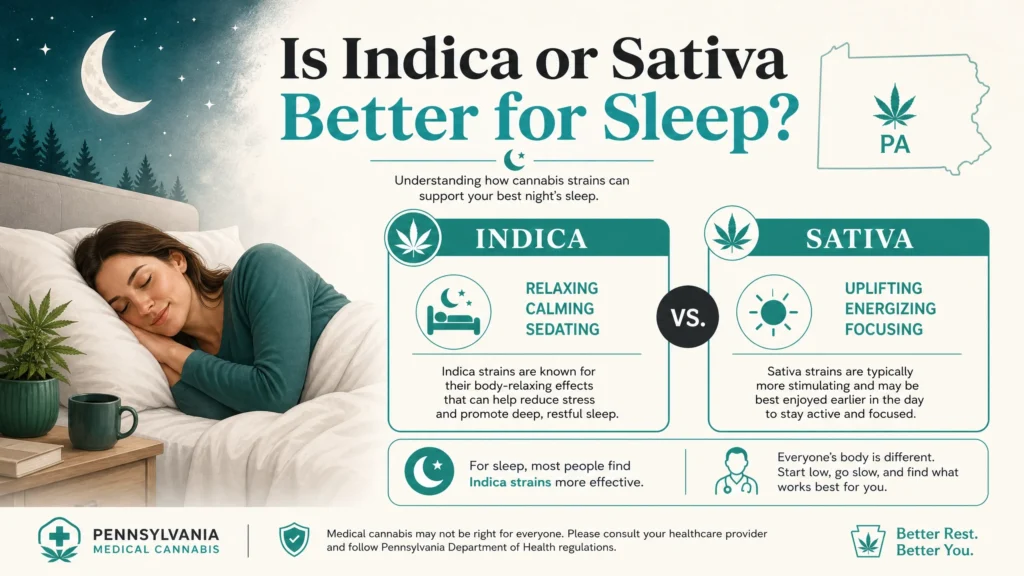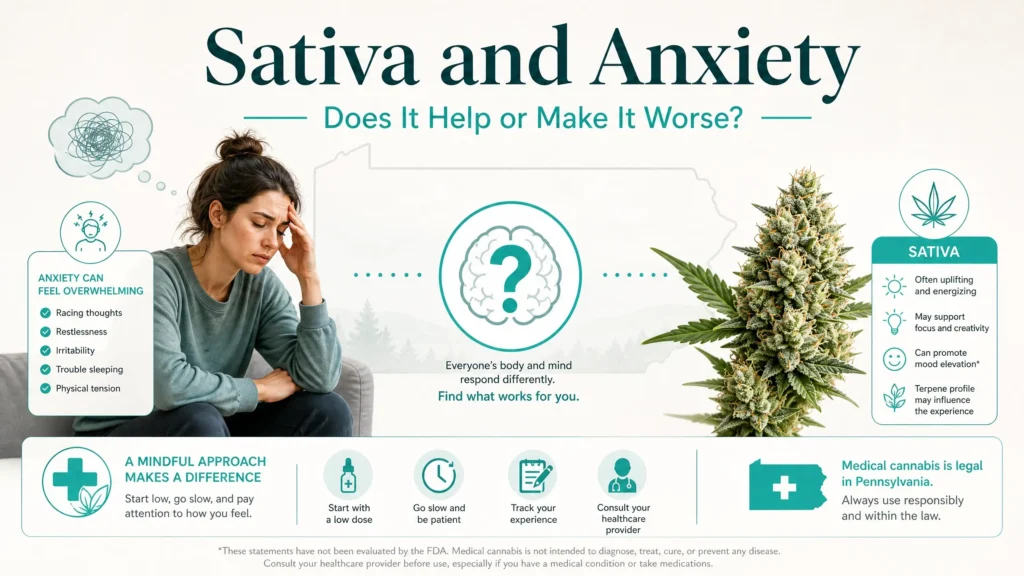
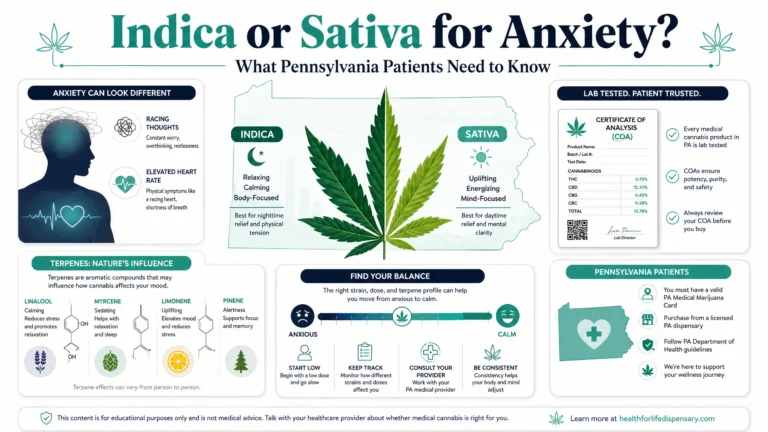

For Pennsylvania patients managing anxiety, the indica or sativa question matters — but not quite in the way most people expect. The label is a starting point, not a prescription. What actually determines whether a cannabis product helps or worsens anxiety is the terpene and cannabinoid profile of the specific product — information that every licensed Pennsylvania dispensary is required to provide on the Certificate of Analysis.
⚡ Quick Answer: Is Indica or Sativa Better for Anxiety?
Neither indica nor sativa is categorically better for anxiety — the terpene profile and THC:CBD ratio are what matter.
- Limonene has the strongest clinical evidence for reducing THC-induced anxiety (Johns Hopkins, 2024)
- Linalool and beta-caryophyllene show consistent anxiolytic properties in preclinical research
- High-THC products can worsen anxiety at higher doses regardless of indica or sativa label
- CBD presence alongside THC significantly reduces anxiety risk
- Always verify terpene content on the COA — not the strain name
For Pennsylvania residents: Anxiety disorders are the #1 qualifying condition under Act 16 of 2016, cited in more than 68% of PA MMJ certifications.

Key Takeaways
- The indica/sativa label does not reliably predict anxiety outcomes — terpene and cannabinoid profiles are the clinically relevant data
- Limonene is the most evidence-backed terpene for anxiety — a 2024 Johns Hopkins clinical trial confirmed it reduces THC-induced anxiety in humans
- THC has a dose-dependent relationship with anxiety — low doses may relieve it; high doses can trigger or worsen it
- CBD buffers THC-induced anxiety — products with a balanced THC:CBD ratio carry lower anxiety risk for sensitive patients
- PA dispensary pharmacists can match you to the right chemotype — describe your symptoms, not just the strain name
Why the Indica/Sativa Label Isn’t the Right Question for Anxiety
When patients ask whether indica or sativa is better for anxiety, they are asking the right question in the wrong language.
Need a PA Medical Marijuana Card?
Get certified online in 15 minutes. 100% Money-Back Guarantee.
Get Certified Now →The popular belief — that indicas are calming and sativas are energizing — has some statistical basis in terpene patterns. Products labeled indica do tend to show higher concentrations of myrcene and linalool, terpenes associated with sedating effects. Products labeled sativa tend toward limonene and terpinolene, associated with more uplifting profiles.
But these are tendencies, not guarantees. A 2021 genetic study published in Nature Plants confirmed no meaningful difference in cannabinoid content between indica and sativa-labeled cannabis. Two products carrying the same label can have entirely different terpene profiles — and therefore entirely different effects on anxiety.
The reliable guide for anxiety: The Certificate of Analysis (COA) at any licensed Pennsylvania dispensary shows the actual terpene percentages for the specific batch on the shelf. That data — not the indica or sativa label — is what a physician or dispensary pharmacist uses to recommend products for anxiety management.
How THC and CBD Affect Anxiety: What the Research Shows
Understanding THC and CBD’s relationship with anxiety is essential before choosing any product — regardless of whether it is labeled indica or sativa.

THC: Dose-Dependent and Bidirectional
THC’s relationship with anxiety is not simple. A 2024 critical review published in Medical Cannabis and Cannabinoids (PMC10890807) confirmed a well-documented dose-dependent pattern: low doses of THC tend to be anxiolytic, while higher doses are anxiogenic.
This means the same compound can both relieve and cause anxiety depending entirely on the amount consumed. Research from the University of Illinois at Chicago demonstrated this directly: very low doses of THC reduced anxiety in a public-speaking task, while slightly higher doses — just enough to produce mild psychoactive effects — increased it.
Do You Qualify for a PA MMJ Card?
Connect with a licensed Pennsylvania state physician online from home.
What this means for PA patients: High-THC products at Pennsylvania dispensaries can worsen anxiety, particularly at doses higher than what a new or tolerance-sensitive patient expects. THC percentage on the label is not a reason to choose a product — it is a reason to be cautious.
CBD: A Natural Anxiety Buffer
CBD interacts with anxiety through a different pathway than THC. A 2024 systematic review of randomized controlled trials published in PMC (PMC11595441) found that CBD demonstrates anxiolytic properties through partial agonism of the 5HT-1A serotonin receptor and negative allosteric modulation of CB1 receptors — the same receptors through which THC produces its psychoactive effects.
In practical terms, CBD’s presence in a product partially moderates THC’s anxiogenic potential. A 2022 Phase 2 clinical trial published in Communications Medicine (McLean Hospital/Harvard Medical School) found that a high-CBD, full-spectrum sublingual product produced significant anxiety reduction alongside mood, sleep, and quality-of-life improvements over four weeks.
The THC:CBD Ratio for Anxiety-Sensitive Patients
| THC:CBD Ratio | Anxiety Risk Level | Best For |
|---|---|---|
| High THC, no CBD (e.g. 25:1) | Higher risk | Experienced patients, pain-focused use |
| Balanced (e.g. 1:1 or 2:1) | Moderate — buffered | Anxiety + pain management |
| CBD-dominant (e.g. 1:4 or higher CBD) | Lower risk | New patients, anxiety-primary use |
| High-CBD, trace THC | Lowest risk | Maximum anxiety focus, THC-sensitive patients |
⚠️ Pennsylvania Legal Note: All ratios above are available at licensed PA dispensaries in legal formats — vaporizer cartridges, tinctures, capsules, and edibles. Always check the COA for the precise ratio of the specific batch you are purchasing.
The Best Terpenes for Anxiety at PA Dispensaries
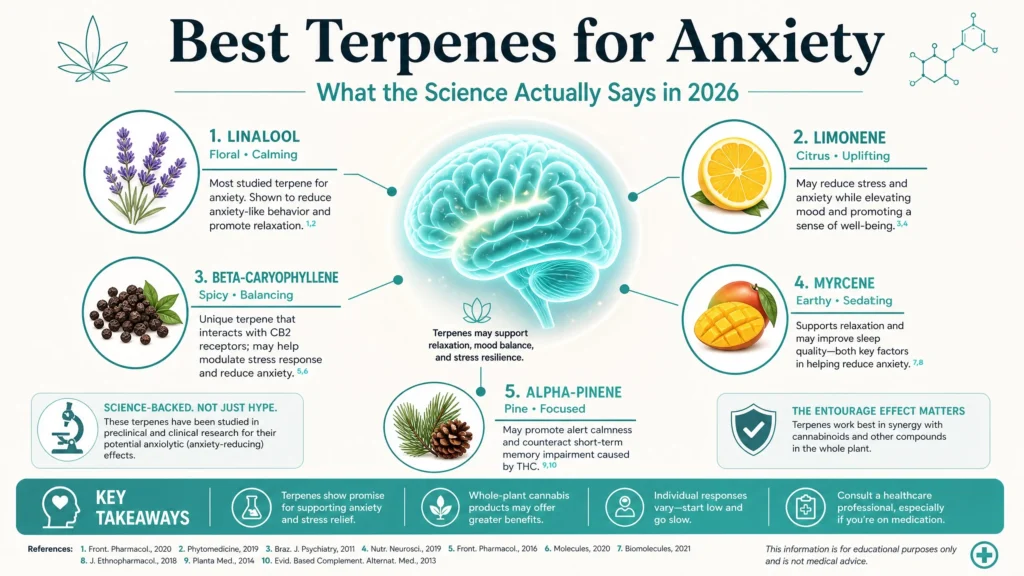
Terpenes are where the most clinically useful guidance for anxiety management lives. Three terpenes have meaningful research supporting their role in anxiety relief.

Limonene — Strongest Clinical Evidence

Aroma: Bright citrus — lemon, orange, lime
Why it matters for anxiety: Limonene now has the strongest human clinical evidence of any cannabis terpene for anxiety. A 2024 double-blind, placebo-controlled crossover trial from Johns Hopkins University and the University of Colorado — one of the first controlled human studies to demonstrate the entourage effect — found that vaporized d-limonene co-administered with THC significantly reduced anxiety and paranoia compared to THC alone. Critically, limonene’s effect was selective: it reduced anxiety without altering any other effects of THC.
The mechanism is documented in a PubMed-indexed preclinical study (Psychopharmacology, 2021): limonene exerts anxiolytic activity through adenosine A2A receptor-mediated regulation of dopaminergic and GABAergic neuronal function in the striatum.
- Evidence level: Human clinical trial (gold standard) + preclinical mechanistic data
- Research status: Strongest of any terpene for anxiety specifically
How to use this at a PA dispensary: Ask for the COA and confirm limonene appears in the top 2–3 terpenes by percentage. Products with limonene as the dominant or secondary terpene alongside moderate THC and some CBD present represent the most evidence-backed starting point for anxiety management.
Linalool — GABA-Based Calming
Aroma: Floral, lavender — soft and light
Why it matters for anxiety: Linalool is the same terpene responsible for lavender’s documented calming properties. Its anxiolytic mechanism operates through GABA-A receptor pathways — the same system targeted by benzodiazepine medications. A 2025 PMC systematic review (Pharmaceuticals, PMC11870048) summarized linalool as demonstrating consistent sleep-supporting and stress-relieving properties in preclinical models, with particularly strong interaction with GABAergic pathways.
⚡ Fast & 100% Online PA Medical Cards
Board-Certified Doctors • 100% Money-Back Guarantee
Book Evaluation Now →A 2025 preclinical study published in PMC (PMC11676933) investigated linalool and beta-myrcene specifically in the context of cannabis terpene exposure and anxiety-like behavior, finding anxiolytic effects for linalool under relevant dosing patterns — with important sex-based and dosing pattern differences noted.
- Evidence level: Strong preclinical; limited direct human clinical trials
- Research status: Consistent across multiple animal models; human RCTs still needed
How to use this at a PA dispensary: Products with linalool present alongside limonene or a modest CBD ratio offer a combined approach — limonene’s human-validated anxiolytic activity with linalool’s GABAergic calming support. Useful particularly for patients whose anxiety manifests as racing thoughts or difficulty winding down.
Beta-Caryophyllene — CB2-Mediated Calm
Aroma: Spicy, peppery, woody — also found in black pepper and cloves
Why it matters for anxiety: Beta-caryophyllene (BCP) is the only terpene that directly activates cannabinoid receptors — specifically the CB2 receptor, which is involved in inflammation, pain, and mood regulation. A study published in Journal of Psychopharmacology (PMC7531079) found that cannabis chemovars with higher expression of caryophyllene may be of specific clinical interest for anxiety, particularly when paired with higher CBD concentrations.
A 2014 study in Physiology & Behavior specifically documented anxiolytic and antidepressant-like effects of beta-caryophyllene in animal models, attributing these to CB2 receptor modulation of the body’s stress response. Unlike limonene and linalool, caryophyllene’s anxiolytic profile tends toward a “grounded and steady” quality without heavy sedation — useful for patients who need anxiety relief during the day without impaired function.
- Evidence level: Strong preclinical across multiple models; human trials still limited
- Research status: Consistent CB2 mechanism; excellent anti-inflammatory data; anxiolytic effects well-documented preclinically
How to use this at a PA dispensary: Caryophyllene-dominant or secondary products are well-suited for daytime anxiety management, particularly when combined with low-to-moderate THC and a meaningful CBD percentage.
Terpene Comparison for Anxiety Management
| Terpene | Aroma | Anxiety Mechanism | Evidence Level | Best Use Case |
|---|---|---|---|---|
| Limonene | Citrus | A2A receptor / dopamine / GABA | ✅ Human clinical trial | Primary anxiety target |
| Linalool | Lavender/floral | GABA-A receptor modulation | ✅ Strong preclinical | Racing thoughts, sleep-related anxiety |
| Beta-caryophyllene | Spicy/pepper | CB2 receptor activation | ✅ Strong preclinical | Daytime anxiety, inflammation co-occurring |
| Myrcene | Earthy/musky | GABA-A, sedating | ✅ Preclinical | Anxiety with sleep disruption |
Indica vs. Sativa for Anxiety: A Practical Comparison
With the terpene and cannabinoid science in place, the indica vs. sativa question for anxiety becomes clearer — and more nuanced.

When “Sativa-Leaning” Products May Help Anxiety
Products labeled sativa-dominant tend to carry higher limonene concentrations statistically — the terpene with the strongest human clinical evidence for anxiety reduction. For patients whose anxiety is driven primarily by racing thoughts, social anxiety, or situational stress during the day, a limonene-forward, sativa-leaning product with moderate THC and CBD present may offer the best anxiety profile.
The key caveat: Sativa-leaning products often carry higher THC concentrations. For anxiety-sensitive patients, this is where the dose-dependent relationship matters most. A high-THC sativa-leaning product may worsen anxiety at doses that would be comfortable for an experienced patient.
When “Indica-Leaning” Products May Help Anxiety
Indica-leaning products tend toward myrcene- and linalool-dominant profiles. For patients whose anxiety manifests as physical tension, difficulty sleeping, or hyperarousal in the evening, these profiles are commonly reported as more effective. The sedating properties of myrcene and the GABAergic calming of linalool suit patients who need anxiety relief that also supports sleep.
The key caveat: Indica-leaning does not mean anxiety-safe. High-THC indica products without CBD present can still trigger anxiogenic effects — the dose-dependent THC relationship applies regardless of classification.
The Most Honest Answer
Neither classification is reliably better for anxiety. The two questions that actually matter are:
- What is the dominant terpene on this product’s COA? (Target: limonene, linalool, or caryophyllene)
- What is the THC:CBD ratio? (For anxiety-sensitive patients, CBD presence significantly reduces risk)
What Conditions Qualify? Anxiety and Pennsylvania’s MMJ Program

Anxiety Disorder as a PA Qualifying Condition
Renewing Your PA MMJ Card?
Quick annual recertification online. No paperwork hassle.
Renew Card Online →Anxiety disorder is Pennsylvania’s single most common MMJ qualifying condition. Following its addition to the state’s qualifying conditions list in July 2019, anxiety quickly became — and has remained — the most-cited diagnosis for certification in Pennsylvania.
A July 2025 study published in Annals of Internal Medicine by researchers at the University of Pittsburgh and Johns Hopkins University found that more than 68% of Pennsylvania’s 440,000+ registered patients listed anxiety as their qualifying condition in 2024. Monthly certifications in the state nearly tripled between June 2019 and December 2023 — a direct result of anxiety being added to the qualifying list.
This is the most PA-specific piece of clinical data available: cannabis access for anxiety management is not a fringe application in Pennsylvania. It is the core of the state’s entire MMJ program.
Types of Anxiety That Qualify
Pennsylvania’s MMJ program recognizes anxiety disorder broadly. Conditions that commonly qualify include:
- Generalized Anxiety Disorder (GAD) — affects 6.8 million U.S. adults (3.1% of the population), yet only 43.2% receive treatment
- Social Anxiety Disorder (SAD)
- Panic Disorder
- PTSD — also a separate qualifying condition; view PTSD condition page
- Other diagnosed anxiety disorders — a certifying physician determines qualification
Pennsylvania MMJ context: More than 68% of PA MMJ certifications cite anxiety as a qualifying condition, according to research published in the Annals of Internal Medicine, July 2025 (Drake, Tran, Eisenberg — University of Pittsburgh and Johns Hopkins).
If you are a Pennsylvania resident managing anxiety and are interested in legal access to cannabis products at licensed PA dispensaries, you can learn whether your condition qualifies at our qualifying conditions page.
How to Choose an Anxiety-Focused Product at a PA Dispensary

Follow these 5 steps when selecting a cannabis product for anxiety at any licensed Pennsylvania dispensary:
Step 1 — Tell your dispensary pharmacist your specific anxiety symptoms.
Do not ask for “a sativa” or “something for anxiety.” Describe your experience:
- Is your anxiety primarily mental (racing thoughts, worry)?
- Is it physical (tension, heart racing, hyperarousal)?
- Does it primarily affect your sleep?
- Are you THC-sensitive or new to cannabis?
This lets the pharmacist identify products by chemotype — the specific terpene and cannabinoid profile most suited to your symptom pattern.
Step 2 — Ask for the COA for the specific batch.
Terpene profiles vary between batches even for the same product name. Request the COA for the specific batch on the shelf, not a generic product sheet.
Get Approved by a Licensed PA Doctor
Schedule your appointment in minutes. You only pay if approved.
Start Online Application →Step 3 — Verify the terpene target.
Confirm one or more of the following terpenes appear in the top 3 by percentage:
- Limonene — strongest clinical evidence for anxiety specifically
- Linalool — GABAergic calming, strongest for sleep-related anxiety
- Beta-caryophyllene — daytime anxiety, CB2-mediated steady calm
Step 4 — Check the THC:CBD ratio against your tolerance.
| If you are… | Look for… |
|---|---|
| New to cannabis | CBD-dominant (high CBD, trace THC) or 1:1 balanced |
| THC-sensitive or prone to paranoia | Balanced THC:CBD (1:1 or 2:1) with limonene present |
| Experienced, using for daytime anxiety | Moderate THC (15–20%), CBD present, limonene or caryophyllene dominant |
| Using primarily for sleep-related anxiety | Myrcene + linalool profile, evening use |
Step 5 — Start at the lowest available dose.
Begin with the smallest available dose — one draw from a vaporizer, the lowest capsule dose — and wait the full onset time before assessing:
| Delivery Method | Onset | Duration |
|---|---|---|
| Vaporized dry leaf or cartridge | 5–15 min | 2–3 hours |
| Tincture (sublingual) | 15–45 min | 3–6 hours |
| Edibles / capsules | 45–90 min | 4–8 hours |
Pro tip from the dispensary: Patients with anxiety should particularly avoid dosing and redosing before the onset window has fully passed. The most common cause of THC-induced anxiety spikes in new patients is consuming a second dose before the first has fully taken effect.
Pennsylvania Legal Notes
✅ You Must Have a Valid PA MMJ Card
Cannabis remains illegal for recreational use in Pennsylvania as of May 2026. To legally purchase any cannabis product — including products for anxiety management — at a licensed PA dispensary, you must hold a valid Pennsylvania medical marijuana card issued under Act 16 of 2016.
View Pennsylvania’s 24 qualifying conditions — anxiety disorder is specifically listed.
🚫 Smoking Is Prohibited Under PA Law
Pennsylvania’s Medical Marijuana Act prohibits smoking as a delivery method. Legal consumption methods for certified PA patients include:
- Vaporization of dry leaf flower ✅
- Vaporizer cartridges ✅
- Edibles and capsules ✅
- Tinctures ✅
- Topicals ✅
⚠️ Pennsylvania’s Per Se DUI Law Applies
Pennsylvania’s per se DUI law (75 Pa.C.S. § 3802(d)) means detectable THC metabolites in your blood while driving = DUI charge — regardless of your valid PA MMJ card. This was confirmed by the PA Superior Court in Commonwealth v. Stone (2022). Do not drive after consuming cannabis until effects have fully resolved. THC metabolites remain detectable in blood after psychoactive effects have passed.
Getting Certified in Pennsylvania
The certification process is done entirely online through telehealth — no in-person visit required.
| Fee | Amount |
|---|---|
| Physician certification (new patient) | $159 |
| PA state registration fee | $50 |
| Total — new patient | $209 |
| Physician certification (renewal) | $149 |
| PA state fee | $50 |
| Total — renewal | $199 |
MMAP fee waiver available for Medicaid, SNAP, WIC, CHIP, PACE, and PACENET recipients — the $50 state fee may be waived.
Start the process at Pennsylvania Marijuana Cards.
Frequently Asked Questions
Q: Is indica or sativa better for anxiety?
Ready to Get Your Official PA MMJ Card?
State-certified doctor consultations online. No risk—100% refund if not approved.
Claim Your MMJ Card Online →A: Neither indica nor sativa is categorically better for anxiety — the terpene profile and THC:CBD ratio are what determine outcomes. Products labeled sativa tend toward limonene-dominant profiles, which have the strongest human clinical evidence for anxiety reduction (Johns Hopkins, 2024). Products labeled indica tend toward myrcene and linalool profiles, which are better suited to anxiety accompanied by physical tension or sleep disruption. The most reliable approach is to review the Certificate of Analysis at your PA dispensary and target limonene, linalool, or beta-caryophyllene in the top terpenes, regardless of the indica or sativa label.
Q: Is sativa or indica better for anxiety and sleep?
A: For anxiety that primarily disrupts sleep, indica-leaning products with myrcene and linalool dominant terpene profiles are most commonly recommended by PA dispensary pharmacists. Myrcene has documented sedative-hypnotic properties through serotonergic pathways in multiple preclinical studies. Linalool supports sleep through GABA-A receptor modulation — the same mechanism as many sedative medications. A balanced or CBD-present product used in the evening via vaporization provides faster onset than edibles, which is relevant for sleep-onset anxiety. Evening timing and a lower THC dose alongside these terpenes is the most commonly effective protocol for this symptom pattern.
Q: Can high-THC cannabis make anxiety worse?
A: Yes — high-THC cannabis has a well-documented dose-dependent anxiogenic effect at higher doses. A 2024 critical review in Medical Cannabis and Cannabinoids confirmed that low doses of THC tend to reduce anxiety while higher doses tend to trigger or worsen it. This relationship holds regardless of whether the product is labeled indica or sativa. Pennsylvania dispensaries carry products across the full THC spectrum, from trace THC to 30%+. Anxiety-sensitive patients should start with the lowest available THC dose, confirm CBD is present to buffer the effect, and avoid escalating the dose before the full onset window has passed.
Q: What terpenes should I look for at a PA dispensary for anxiety?
A: The three terpenes with the strongest research support for anxiety management are limonene, linalool, and beta-caryophyllene. Limonene has human clinical trial evidence from a 2024 Johns Hopkins study showing it selectively reduces THC-induced anxiety in a dose-dependent manner. Linalool shows consistent anxiolytic properties through GABA-A receptor pathways in preclinical models. Beta-caryophyllene activates CB2 receptors and is associated with a grounded, steady calming effect. Ask your PA dispensary pharmacist for the COA and confirm one of these terpenes appears as a dominant or secondary terpene in the product you are considering.
Q: Is anxiety a qualifying condition for a Pennsylvania medical marijuana card?
A: Yes — anxiety disorder is one of Pennsylvania’s 24 qualifying conditions under Act 16 of 2016, and it is currently the most common qualifying diagnosis in the state. A July 2025 study in Annals of Internal Medicine by researchers at the University of Pittsburgh and Johns Hopkins found that more than 68% of Pennsylvania’s 440,000+ registered patients listed anxiety as their qualifying condition in 2024. To get certified, you must have a documented anxiety disorder and complete the online telehealth certification process. You can begin that process at pennsylvaniamarijuanacards.com.
Q: What is the best strain for anxiety at a Pennsylvania dispensary?
A: Rather than recommending a specific strain by name, the most effective approach for anxiety is to identify a product with a limonene- or linalool-dominant terpene profile and a balanced THC:CBD ratio on the COA. Strain names vary by dispensary and batch; the same strain name can have meaningfully different terpene profiles across grows. PA dispensary pharmacists are trained to help you identify products by chemotype — describe your anxiety symptoms specifically, and ask for products with verified limonene or linalool content alongside a CBD percentage that suits your THC sensitivity. This approach consistently produces better-matched selections than asking for a strain by name.
Q: How do I get a PA medical marijuana card for anxiety?
A: If you have a diagnosed anxiety disorder, you may qualify for a Pennsylvania medical marijuana card under Act 16 of 2016. The certification is completed entirely online through a telehealth appointment — no in-person visit is required. The cost is $159 for the physician certification fee plus a $50 state registration fee ($209 total for new patients). Pennsylvania residents qualifying for Medicaid, SNAP, WIC, CHIP, PACE, or PACENET may have the $50 state fee waived through the MMAP program. Cards are valid for one year and allow purchase of cannabis products at any of Pennsylvania’s 186+ licensed dispensaries. Visit pennsylvaniamarijuanacards.com to get started.
Medically reviewed by Dr. Johnathon Chance Miller, MD (License #MD474783). This content is for educational purposes only and does not constitute medical advice. Cannabis affects individuals differently. Consult a licensed healthcare provider before using cannabis for any medical condition. Pennsylvania medical marijuana patients must follow all state laws regarding legal methods of consumption. Smoking cannabis is prohibited under PA law. Do not drive after consuming cannabis. THC metabolites remain detectable in blood after psychoactive effects resolve — Pennsylvania’s per se DUI law applies regardless of MMJ card status.
Sources
- Drake, C., Tran, L., Eisenberg, M. “Medical Cannabis Certifications After Pennsylvania Added Anxiety Disorders as a Qualifying Condition.” Annals of Internal Medicine, July 8, 2025. DOI: 10.7326/ANNALS-25-01037.
- Spindle, T.R., Zamarripa, C.A., Russo, E., et al. “Vaporized D-limonene selectively mitigates the acute anxiogenic effects of Δ9-tetrahydrocannabinol in healthy adults.” Drug and Alcohol Dependence, 257:111267, 2024. (Johns Hopkins / University of Colorado clinical trial.)
- Cheng, Y., et al. “Limonene has anti-anxiety activity via adenosine A2A receptor-mediated regulation of dopaminergic and GABAergic neuronal function in the striatum.” Psychopharmacology, 2021.
- Beletsky, A., et al. “Cannabis and Anxiety: A Critical Review.” Medical Cannabis and Cannabinoids, 7(1):19–30, 2024. (Dose-dependent THC-anxiety relationship.)
- Tambaro, S. and Bortolato, M. “Cannabinoid-related agents in the treatment of anxiety disorders: current knowledge and future perspectives.” Recent Patents on CNS Drug Discovery, 2012. (PMC7531079 — THC anxiogenic at high doses, CBD anxiolytic.)
- Dahlgren, M.K., et al. “Clinical and cognitive improvement following full-spectrum, high-cannabidiol treatment for anxiety.” Communications Medicine, 2022. (McLean Hospital/Harvard Medical School Phase 2 trial.)
- Lins, B.R.W.M., et al. “The Impact of Cannabidiol Treatment on Anxiety Disorders: A Systematic Review of Randomized Controlled Clinical Trials.” PMC, 2024. (CBD mechanism: 5HT-1A agonism and CB1 negative allosteric modulation.)
- Nuutinen, T. “The Entourage Effect in Cannabis Medicinal Products: A Comprehensive Review.” Pharmaceuticals, 2025. (Terpene pharmacology: linalool, limonene, myrcene, caryophyllene.)
- Okey, S.A., et al. “An Ecological Examination of Indica Versus Sativa and Primary Terpenes on the Subjective Effects of Smoked Cannabis.” Cannabis and Cannabinoid Research, 2023.
- Russo, E.B. “Taming THC: potential cannabis synergy and phytocannabinoid-terpenoid entourage effects.” British Journal of Pharmacology, 163(7):1344–64, 2011.
- Anxiety and Depression Association of America. “Facts & Statistics.” ADAA, accessed May 2026.
- Pennsylvania Department of Health. “Medical Marijuana Program.” Commonwealth of Pennsylvania, 2026.
- Pennsylvania General Assembly. 75 Pa.C.S. § 3802(d) — DUI statute. PA General Assembly, 2026.