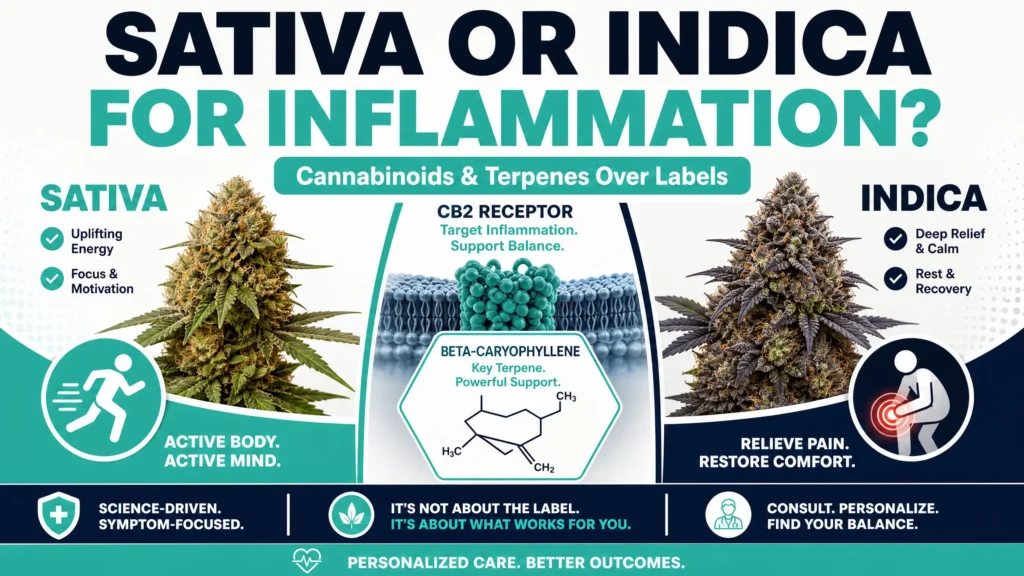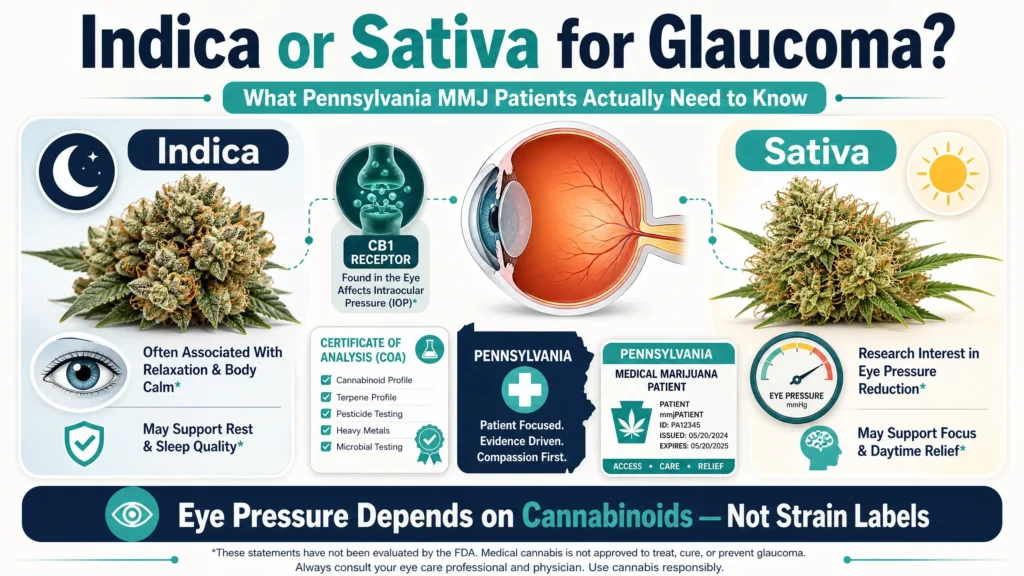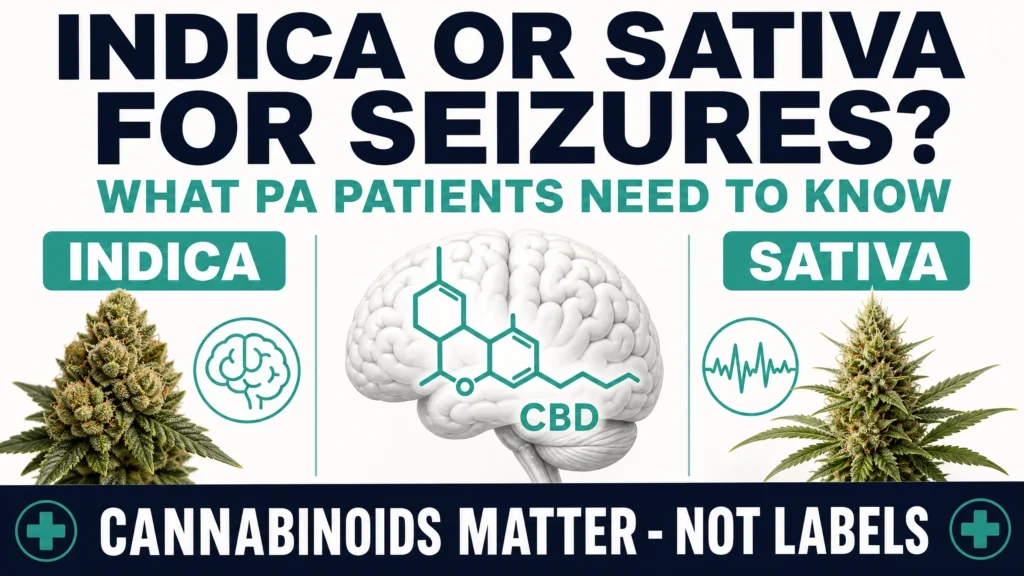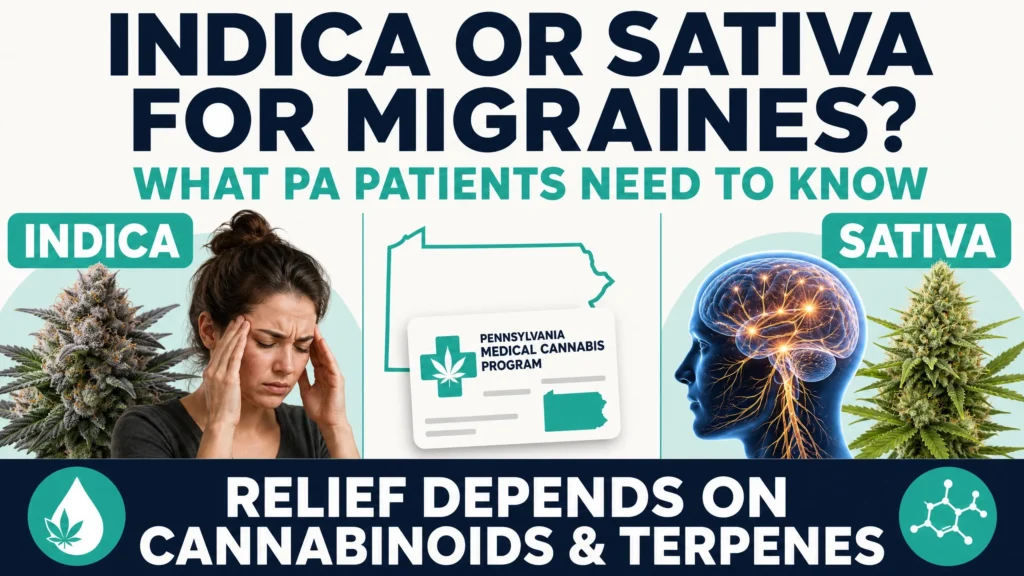
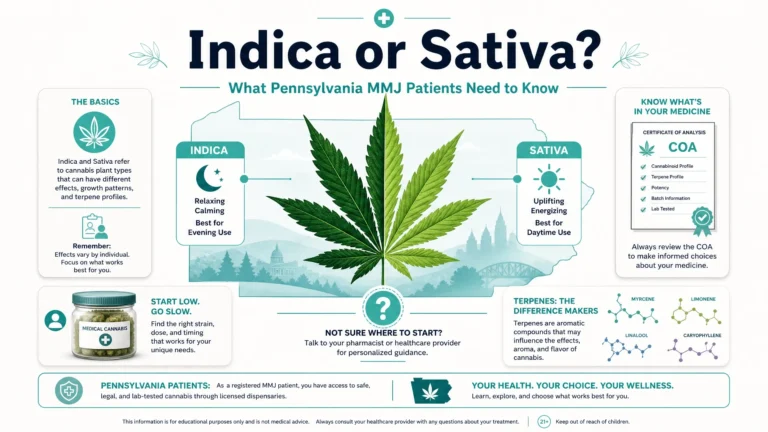

The indica or sativa question is one of the first things Pennsylvania medical marijuana patients ask at a dispensary. The honest answer: the label is a useful starting point — but terpene and cannabinoid profiles predict therapeutic outcomes far more reliably than the category alone. This guide explains what the science actually says and how PA patients can use that knowledge at any of the 186+ licensed dispensaries statewide.
⚡ Quick Answer: Indica or Sativa — Which Is Better?
Neither is categorically better. Terpenes and cannabinoids — not the label — determine how a cannabis product affects you.
- Indica trends toward myrcene-heavy profiles — associated with relaxation, sedation, pain relief
- Sativa trends toward limonene/terpinolene profiles — associated with uplifting, mood-elevating effects
- Most PA dispensary products are hybrids — the label tells you lineage, not guaranteed effects
- The COA terpene data at any licensed PA dispensary is more reliable than the strain category
- For anxiety — limonene-dominant products have the strongest clinical evidence (Johns Hopkins, 2024)
- For pain — beta-caryophyllene and myrcene-dominant products are most commonly recommended
For Pennsylvania residents: you need a valid PA MMJ card to legally purchase any cannabis product at a licensed dispensary.

Key Takeaways
- The indica/sativa label describes plant lineage, not pharmacological effects — research confirms no meaningful cannabinoid content difference between the two categories
- Terpenes are the real differentiator — myrcene, limonene, linalool, and beta-caryophyllene drive the actual therapeutic outcomes
- A 2024 Johns Hopkins clinical trial proved d-limonene significantly reduces THC-induced anxiety in humans — the first clinical entourage effect evidence
- PA dispensaries provide COAs showing exact terpene percentages for every product batch — use this, not the label
- Anxiety disorders qualify for a PA MMJ card — cited in ~60% of all PA certifications (Annals of Internal Medicine, July 2025)
- PA per se DUI law applies — detectable THC metabolites in blood = DUI regardless of card status
What “Indica” and “Sativa” Actually Mean

The terms are botanical classifications, not pharmacological ones.
Need a PA Medical Marijuana Card?
Get certified online in 15 minutes. 100% Money-Back Guarantee.
Get Certified Now →In 1753, botanist Carl Linnaeus classified European hemp as Cannabis sativa — tall, narrow-leafed, grown for fiber. In 1785, Jean-Baptiste Lamarck described Indian cannabis as Cannabis indica — shorter, bushier, with different properties. These were descriptions of how plants looked and where they grew — never intended to predict therapeutic effects.
Two centuries of crossbreeding made the original distinction largely irrelevant. Virtually every commercial cannabis product at Pennsylvania licensed dispensaries is a hybrid of both lineages regardless of its label.
The popular belief: indica = sedating body high, sativa = energizing head high. This became industry convention through marketing — not clinical research.
The label orients a new patient toward a general product category. It does not reliably predict how a specific product will affect your specific symptoms. What does? The terpene and cannabinoid profile — available on every Certificate of Analysis (COA) at licensed PA dispensaries.
Is Indica or Sativa Better? What the Research Shows
Neither is categorically better for medical use. Multiple peer-reviewed studies confirm this.
What the Studies Say
| Study | Key Finding |
|---|---|
| Watts et al., Nature Plants, 2021 | No substantial differences in cannabinoid content between indica and sativa labels |
| Hazekamp et al., 2016 | Sativas and indicas ARE distinguishable by terpene content — not cannabinoid content |
| Okey et al., Cannabis and Cannabinoid Research, 2023 | Terpene composition explained more variance in effects than the categorical label |
| University of British Columbia, 2018 | No chemical consistency between strains labeled indica vs. sativa |
Where the Labels Do Have Scientific Basis
Research confirms that terpene profiles do tend to differ between label categories:
Do You Qualify for a PA MMJ Card?
Connect with a licensed Pennsylvania state physician online from home.
Indica-leaning products typically contain more:
- Myrcene — earthy, sedating
- Linalool — floral, calming
- Beta/gamma-eudesmol and guaiol — associated with relaxation
Sativa-leaning products typically contain more:
- Limonene — citrus, uplifting
- Terpinolene — floral, energizing
- Trans-bergamotene — woody, stimulating
The honest clinical takeaway: The indica/sativa label is a rough starting point. Two products labeled “indica” with different terpene profiles may produce meaningfully different therapeutic outcomes. For PA patients managing specific qualifying conditions, the chemotype — the actual terpene and cannabinoid profile — is the clinically relevant data point.
Why Terpenes Matter More Than the Label
Terpenes are aromatic compounds that are also pharmacologically active. They interact with the endocannabinoid system and multiple neurological pathways — shaping the therapeutic outcome of any cannabis product.
The concept that terpenes and cannabinoids work together is known as the entourage effect, first formally described by researcher Ethan B. Russo in the British Journal of Pharmacology, 2011.
The Clinical Proof — 2024 Johns Hopkins Trial

Researchers from Johns Hopkins University and the University of Colorado conducted a double-blinded, placebo-controlled crossover study which found that limonene, when combined with THC, can significantly reduce anxiety that can be exacerbated by THC alone.
Participants who inhaled D-limonene concurrently with THC reported “significantly reduced” feelings of anxiety and paranoia compared to those who inhaled THC alone. The inhalation of higher quantities of D-limonene was associated with more pronounced effects.
Why this matters for PA patients: If you are using cannabis to manage anxiety — which accounts for approximately 60% of PA certifications — the terpene profile of your product may be as therapeutically relevant as the THC concentration.
The practical implication: Ask for the COA before purchasing. Every licensed Pennsylvania dispensary product undergoes mandatory third-party testing. A product labeled “sativa” with a myrcene-dominant profile may sedate more than a product labeled “indica” with a limonene-dominant profile. The label is a starting point; the COA is the map.
The 4 Key Terpenes PA Patients Should Know
Understanding four terpenes allows PA patients to make significantly better dispensary decisions.

1. Myrcene — Earthy, Musky, Herbal
The most abundant terpene in commercial cannabis — most concentrated in indica-leaning products.
| Property | Detail |
|---|---|
| Documented effect | Sedative, analgesic, muscle-relaxant |
| Mechanism | GABA-A receptor interactions; 5-lipoxygenase inhibition |
| Research status | Strong preclinical; limited human trials |
| Best for PA patients | Chronic pain, neuropathies, sleep disruption from anxiety/PTSD |
⚡ Fast & 100% Online PA Medical Cards
Board-Certified Doctors • 100% Money-Back Guarantee
Book Evaluation Now →Key research: A 2024 study in Pharmaceutics confirmed myrcene’s sedative-hypnotic effects — reducing sleep latency and extending sleep duration through serotonergic pathways.
Important caveat: Effects are well-documented in animal models. Individual human responses vary considerably by tolerance, dose, and delivery method.
Relevant PA qualifying conditions:
- Chronic intractable pain
- Neuropathies
- Sleep disruption from anxiety disorders or PTSD
2. Limonene — Bright Citrus, Lemon, Orange
Most concentrated in sativa-leaning products. Has the strongest clinical evidence for anxiety modulation.
| Property | Detail |
|---|---|
| Documented effect | Anxiolytic, mood-elevating, stress-reducing |
| Mechanism | Adenosine A2A receptor modulation; dopaminergic and GABAergic regulation |
| Research status | Human clinical trial completed (Johns Hopkins, 2024) |
| Best for PA patients | Anxiety disorders, THC-sensitivity management |
Key research: The 2024 Johns Hopkins trial published in Drug and Alcohol Dependence is the most significant: d-limonene reduced THC-induced anxiety in a dose-dependent manner without altering other THC effects. A follow-up oral administration trial is currently recruiting at ClinicalTrials.gov (NCT06378957).
Relevant PA qualifying conditions:
- Anxiety disorders — Pennsylvania’s #1 qualifying condition
3. Beta-Caryophyllene — Spicy, Woody, Peppery
The only terpene that directly activates CB2 receptors — giving it cannabinoid-like anti-inflammatory action.
| Property | Detail |
|---|---|
| Documented effect | Anti-inflammatory, analgesic, mild anxiolytic |
| Mechanism | CB2 receptor agonism; TNF-α and IL-1β reduction |
| Research status | Strong preclinical; FDA-designated GRAS as food additive |
| Best for PA patients | Chronic pain, neuropathic pain, inflammatory conditions |
Key research: A European Neuropsychopharmacology study documented beta-caryophyllene’s reduction of both inflammatory and neuropathic pain responses via CB2 activation, without psychoactive effects.
Relevant PA qualifying conditions:
- Chronic intractable pain
- Neuropathies
- Multiple sclerosis, inflammatory bowel disease
4. Linalool — Floral, Lavender, Calming
The same terpene responsible for lavender’s calming properties — found across both indica and sativa products.
| Property | Detail |
|---|---|
| Documented effect | Anxiolytic, sleep-supporting, stress-reducing |
| Mechanism | GABAergic pathway enhancement — similar to benzodiazepine mechanism |
| Research status | Consistent preclinical; limited direct human trials |
| Best for PA patients | Anxiety, PTSD, sleep disruption, stress-related symptoms |
Key research: A 2025 systematic review in Pharmaceuticals (PMC11870048) summarized linalool as demonstrating properties for relieving mental stress and supporting sleep through GABAergic interactions.
Renewing Your PA MMJ Card?
Quick annual recertification online. No paperwork hassle.
Renew Card Online →Relevant PA qualifying conditions:
Terpenes That Trend Stimulating — Know Before You Buy
Not all terpenes support relaxation. For patients with anxiety or sleep goals, high concentrations of these terpenes may work against your therapeutic target:
- Terpinolene — energizing, stimulating; dominant in some sativa products
- Limonene at very high concentrations — may over-stimulate in THC-sensitive patients
- Trans-bergamotene — stimulating; common in sativa-dominant profiles
Indica or Sativa by Condition: PA Patient Guide
Here is how the indica/sativa question maps directly onto Pennsylvania’s qualifying conditions.

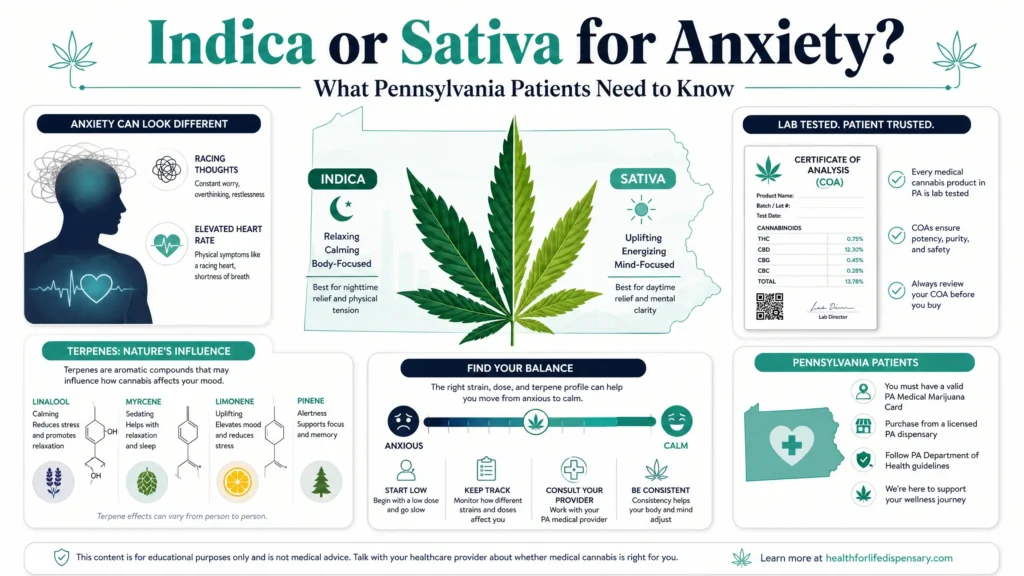
For Anxiety — Pennsylvania’s #1 Qualifying Condition
~60% of all PA MMJ certifications cite anxiety disorders according to research published in the Annals of Internal Medicine, July 2025.
Best terpene targets:
- Limonene — strongest clinical evidence for directly modulating THC-induced anxiety
- Linalool — consistent anxiolytic properties via GABAergic pathways
- Beta-caryophyllene — secondary anti-anxiety activity through CB2 pathway
Practical guidance for PA anxiety patients:
- Choose products with verified limonene or linalool as dominant terpenes on the COA
- Prioritize moderate THC with meaningful CBD content — CBD buffers THC’s anxiogenic potential
- Avoid high-THC, limonene/terpinolene-dominant sativa products if you have low tolerance or THC sensitivity — these can amplify anxiety at higher doses
If you are a Pennsylvania resident managing anxiety and do not yet have a medical marijuana card, learn more about anxiety as a PA qualifying condition here.
For Chronic Pain
Chronic intractable pain is among the top qualifying conditions in Pennsylvania.
Best terpene targets:
- Beta-caryophyllene — CB2 agonism with documented anti-inflammatory and analgesic effects
- Myrcene — analgesic properties through opioid receptor pathway interactions in preclinical research
Practical guidance:
- Products with caryophyllene and myrcene as co-dominant terpenes alongside moderate-to-higher THC are most commonly recommended by PA dispensary pharmacists for pain
- Edibles or capsules provide longer duration — preferable for sustained chronic pain management
- Learn more about chronic intractable pain as a PA MMJ qualifying condition
For Sleep Disruption (PTSD and Anxiety-Related)
Important PA note: Insomnia alone is not a qualifying condition in Pennsylvania. The Medical Marijuana Advisory Board voted against adding it as a standalone condition. However, sleep disruption associated with PTSD or anxiety disorders — both qualifying conditions — is one of the most commonly targeted symptoms among PA patients.
Best terpene targets for sleep:
- Myrcene — documented sedative-hypnotic effects; strongest sleep evidence of any cannabis terpene
- Linalool — GABAergic sleep-supporting properties consistent across preclinical models
Practical guidance:
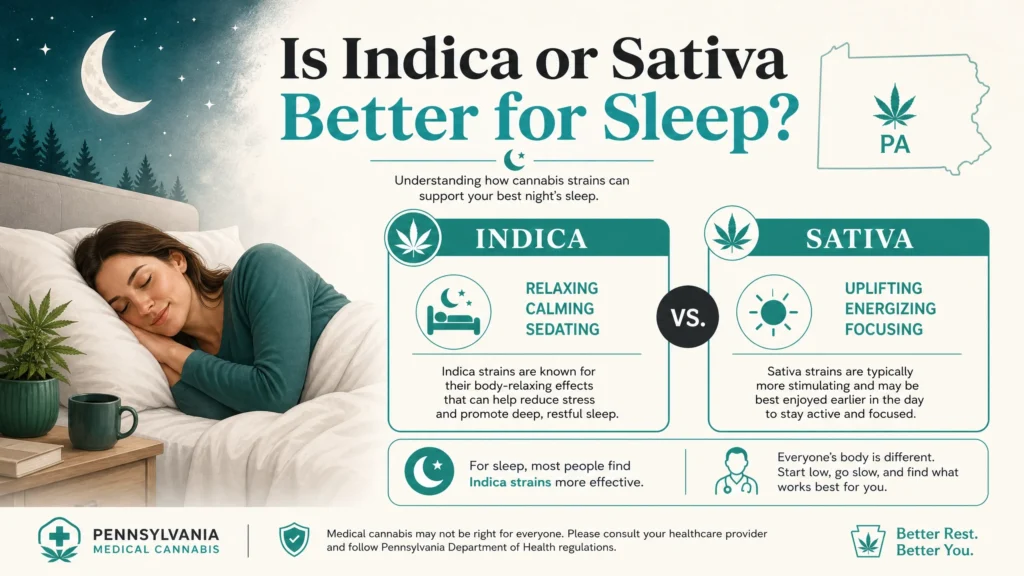
- Indica-leaning products are statistically more likely to be myrcene-dominant — making them a reasonable starting point for sleep
- Confirm via COA before purchasing — batch-to-batch variation is real
- Evening vaporization for faster onset (5–15 min); capsules or edibles for longer overnight duration (4–8 hours)
How to Choose at a PA Dispensary Using the COA

Get Approved by a Licensed PA Doctor
Schedule your appointment in minutes. You only pay if approved.
Start Online Application →The Certificate of Analysis is your most powerful tool as a Pennsylvania MMJ patient.
Every regulated cannabis product at any licensed PA dispensary undergoes mandatory third-party testing. Under Pennsylvania’s 2025 DOH labeling regulation update, full terpene profiles must be disclosed on all products.
5 Steps to Use the COA Effectively
Step 1 — Ask for the COA for the specific batch you are purchasing.
Terpene profiles vary between batches of the same product. Batch #A0312 may show different myrcene levels than batch #B0412. Always request the COA for the specific batch on the shelf — not a general product sheet.
Step 2 — Identify the dominant terpene (highest %).
This single compound has the most influence on the product’s therapeutic character. Match it to your symptom target:
| Your Primary Goal | Terpene to Look For |
|---|---|
| Anxiety relief | Limonene or Linalool as #1 |
| Pain management | Beta-Caryophyllene or Myrcene as #1 |
| Sleep support | Myrcene or Linalool as #1 |
| Mood elevation | Limonene as #1 |
| Inflammation | Beta-Caryophyllene as #1 |
Step 3 — Check the THC:CBD ratio.
- High THC, low CBD — stronger psychoactive effects; higher anxiety risk for sensitive patients
- Balanced 1:1 ratio — moderate effects; good for anxiety-sensitive patients
- CBD-dominant — minimal intoxication; strongest anxiety protection
Step 4 — Choose the delivery format for your timing needs.
| Format | Onset | Duration | Best For |
|---|---|---|---|
| Vaporized dry leaf | 5–15 min | 2–3 hours | Fast relief |
| Vaporizer cartridge | 5–15 min | 2–3 hours | Convenience |
| Edibles / capsules | 45–90 min | 4–8 hours | Sustained relief |
| Tinctures | 15–45 min | 3–6 hours | Dose control |
| Topicals | 15–30 min | 2–4 hours | Localized relief |
Step 5 — Start at the lowest available dose and adjust gradually.
This is especially important for:
- New patients — no established tolerance
- Anxiety patients — THC’s anxiogenic effects are dose-dependent
- Anyone switching products — terpene profiles and individual responses vary
Pro tip: Describe your specific symptoms to the dispensary pharmacist — not just the strain name. PA-licensed dispensary pharmacists can identify products by chemotype that match your therapeutic target far more precisely than a generic strain recommendation.
Pennsylvania Legal Notes Every MMJ Patient Needs
✅ You Must Have a Valid PA MMJ Card
Both indica and sativa cannabis products are controlled substances in Pennsylvania for anyone without a valid state medical marijuana card. Recreational cannabis remains illegal in Pennsylvania as of May 2026.
Ready to Get Your Official PA MMJ Card?
State-certified doctor consultations online. No risk—100% refund if not approved.
Claim Your MMJ Card Online →To legally purchase any cannabis product at a licensed PA dispensary, you must hold a current patient certification under Act 16 of 2016.
View the complete list of Pennsylvania’s 24 qualifying conditions here.
🚫 Smoking Is Prohibited Under PA Law
Pennsylvania’s Medical Marijuana Act prohibits smoking as a delivery method. Legal consumption methods include:
- Vaporization of dry leaf flower ✅
- Vaporizer cartridges ✅
- Edibles and capsules ✅
- Tinctures ✅
- Topicals ✅
⚠️ Pennsylvania’s Per Se DUI Law Applies to All MMJ Patients
Pennsylvania’s per se DUI law (75 Pa.C.S. § 3802(d)) means any detectable THC metabolites in your blood while driving = a DUI charge — regardless of your valid MMJ card. This was confirmed by the PA Superior Court in Commonwealth v. Stone (2022). Do not drive after consuming cannabis until effects have fully resolved.
Reform legislation (SB 63 / HB 983) that would require proof of actual impairment for MMJ patients has been introduced but is not yet law as of May 2026.
Getting Certified in Pennsylvania
The certification process is done entirely online through telehealth — no in-person visit required.

| Fee | Amount |
|---|---|
| Physician certification (new patient) | $159 |
| PA state registration fee | $50 |
| Total — new patient | $209 |
| Physician certification (renewal) | $149 |
| PA state fee | $50 |
| Total — renewal | $199 |
MMAP waiver available for Medicaid, SNAP, WIC, CHIP, PACE, and PACENET recipients — the $50 state fee is waived.
Start the process at Pennsylvania Marijuana Cards.
Frequently Asked Questions
Q: Is indica or sativa better for Pennsylvania medical marijuana patients?
A: Neither indica nor sativa is categorically better for medical use. Research published in Nature Plants (2021) confirmed no meaningful difference in cannabinoid content between the two categories. What reliably predicts therapeutic effects are the terpene and cannabinoid profiles visible on the Certificate of Analysis at any licensed PA dispensary. For most qualifying conditions, the relevant question is not “indica or sativa?” but “what is the dominant terpene, and does it match my symptom target?” Ask your PA dispensary pharmacist to help you identify products by chemotype rather than strain category.
Q: Which is better for anxiety — indica or sativa?
A: Products with limonene as the dominant terpene have the strongest clinical evidence for anxiety management. A 2024 Johns Hopkins double-blind controlled trial found that d-limonene significantly reduced THC-induced anxiety and paranoia in a dose-dependent manner. Linalool-dominant products also demonstrate consistent anxiolytic properties. Neither “indica” nor “sativa” as a category reliably predicts limonene or linalool content — those terpenes appear across both classifications. Anxiety disorders are Pennsylvania’s number one qualifying condition, cited in approximately 60% of all PA MMJ certifications. Learn more at our anxiety disorder and PA MMJ page.
Q: Which is better for pain — indica or sativa?
A: For chronic and neuropathic pain, beta-caryophyllene and myrcene are the most clinically relevant terpenes — not the indica or sativa label. Beta-caryophyllene acts as a CB2 receptor agonist with documented anti-inflammatory and analgesic effects. Myrcene shows analgesic properties through opioid receptor pathway interactions in preclinical research. Products with these terpenes as co-dominant on the COA are most commonly recommended for PA patients managing chronic intractable pain or neuropathies, regardless of whether they carry an indica or sativa label. Both conditions qualify under Pennsylvania’s Act 16 of 2016.
Q: Which is better for sleep — indica or sativa?
A: For sleep, myrcene-dominant products have the strongest evidence — and indica-leaning products are statistically more likely to be myrcene-dominant. Myrcene has documented sedative-hypnotic effects across multiple studies, including reduced sleep latency and extended sleep duration through serotonergic pathways. Linalool-dominant products provide additional sleep support through GABAergic interactions. That said, this is a tendency, not a guarantee — verify via the COA for the specific batch. Pennsylvania does not recognize insomnia as a standalone qualifying condition, but sleep disruption associated with anxiety disorders or PTSD — both qualifying conditions — is commonly addressed through the PA MMJ program.
Q: What is the difference between indica, sativa, and hybrid at PA dispensaries?
A: Most products at licensed Pennsylvania dispensaries are technically hybrids — crosses of both indica and sativa lineages. A product labeled “indica-dominant hybrid” suggests higher indica genetics and typically trends toward myrcene-heavy profiles. A “sativa-dominant hybrid” suggests more sativa lineage and often presents with limonene or terpinolene-forward profiles. Pure indicas and pure sativas are rare in the modern commercial cannabis market. For PA patients, the hybrid classification provides a reasonable initial guide, but COA terpene data is the accurate reference for clinical decision-making.
Q: Can I get a Pennsylvania medical marijuana card to access indica or sativa products?
A: Yes — if you have one of Pennsylvania’s 24 qualifying serious medical conditions under Act 16 of 2016, you may be eligible for a PA MMJ card. The certification is completed entirely through telehealth and costs $159 for the physician certification plus the $50 state registration fee ($209 total for new patients). Pennsylvania residents qualifying for Medicaid, SNAP, WIC, CHIP, PACE, or PACENET may have the $50 state fee waived through Pennsylvania’s MMAP program. View the complete list of qualifying conditions or begin the process at Pennsylvania Marijuana Cards.
Q: How do I know what terpenes are in a cannabis product at a PA dispensary?
A: Ask the dispensary pharmacist or budtender for the Certificate of Analysis (COA) for the specific batch you are considering. Under Pennsylvania’s 2025 labeling regulation update, all licensed dispensary products must disclose full terpene profiles. The COA lists each terpene by percentage — the dominant terpene (highest %) most significantly shapes the product’s therapeutic character. Rather than selecting by strain name or indica/sativa label, describe your specific symptoms and therapeutic goals to your dispensary pharmacist and ask for a recommendation by chemotype. This approach consistently produces better patient outcomes than label-based selection alone.
Medically reviewed by Dr. Johnathon Chance Miller, MD (License #MD474783). This content is for educational purposes only and does not constitute medical advice. Cannabis affects individuals differently. Consult a licensed healthcare provider before using cannabis for any medical condition. Pennsylvania medical marijuana patients must follow all state laws regarding legal methods of consumption. Smoking cannabis is prohibited under Pennsylvania’s Medical Marijuana Act. Do not drive after consuming cannabis. THC metabolites remain detectable in blood after psychoactive effects resolve — Pennsylvania’s per se DUI law applies regardless of MMJ card status.
Sources
- Watts S, et al. “Cannabis labelling is associated with genetic variation in terpene synthase genes.” Nature Plants, 2021.
- Hazekamp A, et al. Chemical analysis of cannabis varieties. Referenced via Curaleaf Clinic’s terpene profile research summary. 2024.
- Okey SA, et al. “An Ecological Examination of Indica Versus Sativa and Primary Terpenes on the Subjective Effects of Smoked Cannabis.” Cannabis and Cannabinoid Research, 2023.
- Russo EB. “Taming THC: potential cannabis synergy and phytocannabinoid-terpenoid entourage effects.” British Journal of Pharmacology, 2011.
- Spindle TR, et al. “Vaporized D-limonene selectively mitigates the acute anxiogenic effects of Δ9-THC in healthy adults.” Drug and Alcohol Dependence, 2024. (Johns Hopkins clinical trial — full text via PMC.)
- NORML. “Analysis: Limonene Terpene Reduces THC-induced Anxiety.” March 2024.
- ClinicalTrials.gov. “Behavioral Pharmacology of Orally Administered THC and D-limonene.” NCT06378957. Currently recruiting.
- Rufino AT, et al. “Beta-caryophyllene exerts analgesic effects in mouse models of inflammatory and neuropathic pain.” European Neuropsychopharmacology, 2014.
- Chen H, et al. “Beta-Myrcene as a Sedative-Hypnotic Component in DL-4-Chlorophenylalanine-Induced Insomnia Mice.” Pharmaceuticals, 2024.
- Nuutinen T. “The Entourage Effect in Cannabis Medicinal Products: A Comprehensive Review.” Pharmaceuticals, 2025. (PMC11870048.)
- Terpene Belt Farms. “Indica vs Sativa Terpenes: What Really Determines Effects.” February 2026.
- Drake C, et al. “Medical Cannabis Certifications After Pennsylvania Added Anxiety Disorders as a Qualifying Condition.” Annals of Internal Medicine, July 2025.
- PhillyVoice. “Pennsylvania’s medical marijuana program — anxiety is by far the most common qualifying condition.” July 2025.
- Pennsylvania Department of Health. “Medical Marijuana Program — Act 16 of 2016.” Commonwealth of Pennsylvania, 2026.
- Pennsylvania General Assembly. 75 Pa.C.S. § 3802(d) — DUI Controlled Substances.
- WebMD. “Indica vs. Sativa: What’s the Difference?” Updated April 2024.