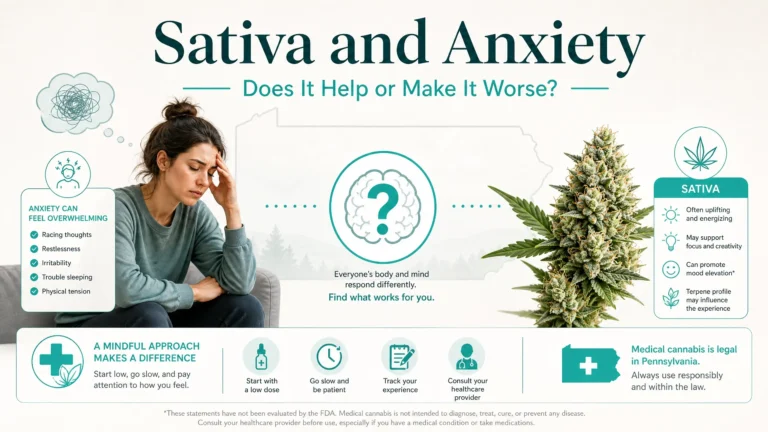

If you are searching “sativa and anxiety,” you are probably asking one of two questions and they are almost opposite.
Either you want to know if sativa will help your anxiety. Or you recently used a sativa product and your anxiety got significantly worse, and you want to understand why.
Need a PA Medical Marijuana Card?
Get certified online in 15 minutes. 100% Money-Back Guarantee.
Get Certified Now →Both are completely valid questions. And the honest answer to both is the same: it depends on THC content, on terpene profile, on dose, on your individual tolerance, and on which specific anxiety symptoms you are trying to address.
This guide breaks down exactly why sativa and anxiety have such a complicated relationship, what the research shows about cannabis and anxiety more broadly, and what Pennsylvania residents with anxiety need to know about their legal options in 2026.
Why the Sativa/Indica Label Is an Incomplete Answer

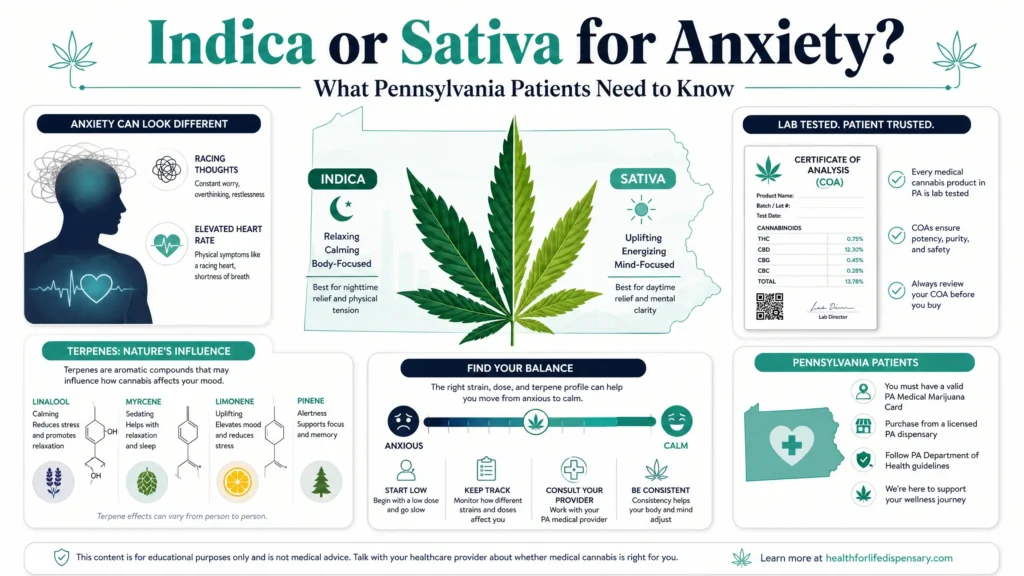
The conventional wisdom is simple: sativa is energizing and uplifting, indica is calming and sedating. For anxiety, that logic says indica is the obvious choice and sativa is something to avoid.
This framework is not entirely wrong. But it is far less reliable than most dispensary conversations suggest and understanding why matters directly for anyone using cannabis to manage anxiety.
Do You Qualify for a PA MMJ Card?
Connect with a licensed Pennsylvania state physician online from home.
As Ethan Russo, MD, a board-certified neurologist and leading cannabis researcher, noted in Cannabis and Cannabinoid Research, the sativa/indica distinction as commonly applied is scientifically unreliable. Decades of commercial crossbreeding mean that nearly every product on today’s market is a genetic hybrid. The category label tells you almost nothing about the actual cannabinoid and terpene content driving the experience.
What actually determines whether a cannabis product helps or worsens anxiety is its chemical profile, specifically the THC concentration, the THC:CBD ratio, and the terpene composition.
A product labeled “sativa” with low THC and high CBD may be genuinely calming. A product labeled “sativa” with 28% THC and minimal CBD may trigger panic in a sensitive user. Conversely, an “indica” with high THC and stimulating terpenes can produce the same anxious, racing-thoughts experience people associate with sativa.
The reason sativa products generally carry higher anxiety risk is not the plant category itself, it is that commercially marketed sativa products tend to have higher THC concentrations and lower CBD content than indica-leaning products. That chemical tendency, not the label, is where the anxiety risk actually lives.
The Real Reason Sativa Can Make Anxiety Worse
If you have ever used a high-THC sativa and felt your heart rate spike, your thoughts race, or a wave of dread wash over you, that was not a random reaction. It has a specific neurological explanation.
THC binds to CB1 receptors, the most abundant G-protein-coupled receptors in the brain, densely concentrated in the hippocampus, prefrontal cortex, basal ganglia, and amygdala. These are the exact brain regions responsible for memory, executive function, emotional processing, and fear response.
Under normal conditions, your endocannabinoid system produces its own cannabinoids on demand to briefly modulate these systems. THC does not work on demand, it persistently activates CB1 receptors regardless of what your brain actually needs in that moment. As research from Concordia University published in February 2026 explains: this persistent activation in the hippocampus and prefrontal cortex is directly linked to the anxiety and cognitive disruption that can follow high-dose THC use.
The amygdala connection is particularly important for anxiety specifically. A peer-reviewed study published in PMC used fMRI and PET imaging to demonstrate that THC’s anxiogenic effects in humans are directly related to CB1 receptor availability in the amygdala, the brain’s threat-detection and fear-processing center. Higher CB1 receptor availability in the amygdala correlated with stronger anxiety responses to THC. This is not an unpredictable side effect. It is a documented, measurable neurological mechanism.
The same mechanism that makes cannabis relaxing at one dose makes it anxiety-provoking at another. THC at low doses may reduce amygdala reactivity.
At high doses, the same CB1 activation flips, overstimulating the same circuits it gently modulated at lower doses, producing heightened fear processing, racing thoughts, elevated heart rate, and the characteristic sense of paranoia or dread that many users report from high-THC sativa products.
The Dose-Dependency Factor: Why the Same Product Can Help or Hurt

⚡ Fast & 100% Online PA Medical Cards
Board-Certified Doctors • 100% Money-Back Guarantee
Book Evaluation Now →This is arguably the most important concept in understanding cannabis and anxiety and most cannabis content handles it vaguely if at all.
THC’s effects on anxiety are dose-dependent in a consistent and well-documented pattern. According to a systematic review on THC, CBD, and anxiety published in PMC, which analyzed human clinical trials from multiple databases including PubMed, Ovid MEDLINE, and PsycINFO: preclinical and clinical literature consistently shows anxiolytic effects at lower THC doses and anxiogenic effects at higher doses.
What does this mean in practical terms?
At a low dose, roughly 2.5 to 5 mg THC for most adults, many people experience reduced tension, mild mood elevation, and a quieting of anxious thought patterns. The CB1 receptor activation is gentle enough to modulate the anxiety circuits without overwhelming them.
At a higher dose, 15 to 25mg or more, which is common in commercially sold products marketed as potent, the same CB1 pathway produces the opposite effect. Fear processing intensifies. Heart rate increases. The prefrontal cortex, which normally provides top-down regulation of anxiety, becomes impaired rather than supported.
The threshold between these two zones varies significantly between individuals based on tolerance, body composition, prior cannabis experience, and individual CB1 receptor density. Someone who uses cannabis regularly may experience the anxiolytic window at doses that would overwhelm a new user entirely.
High-THC sativa products, frequently marketed at 25–30% THC or higher, dramatically increase the risk of landing in the anxiogenic dose range, particularly for infrequent users or anyone whose anxiety disorder already sensitizes their threat-detection circuits.
A research review on cannabinoids for mood and anxiety disorders published in PMC found that in controlled trials, low-dose THC showed modest anxiety-reducing effects, while higher doses caused anxiety and psychotic symptoms to emerge in more than 50% of participants. This is not fringe research, it is a consistent finding across the literature.
Terpenes and Anxiety: The Chemical Profile That Actually Matters
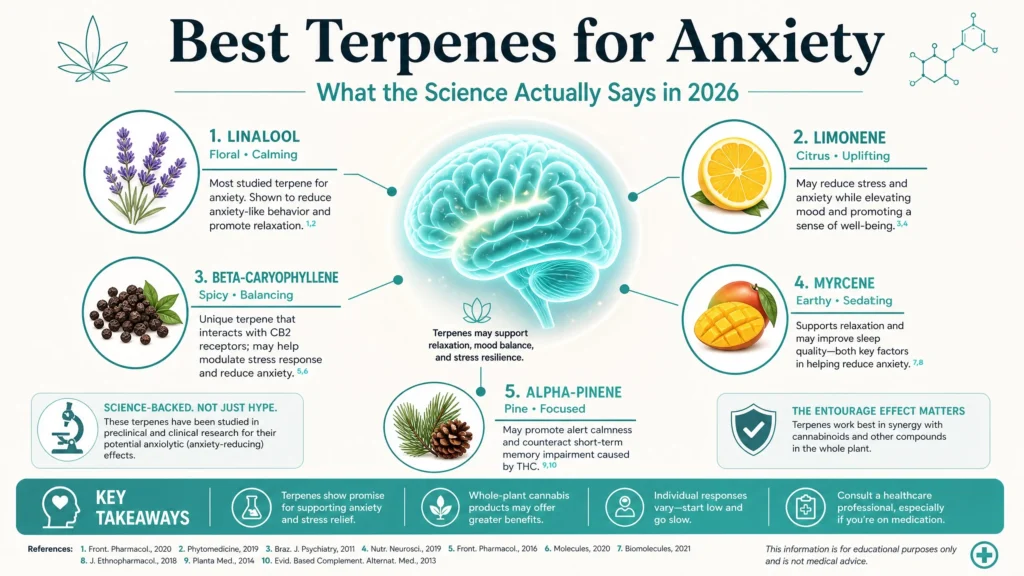
Beyond the THC:CBD ratio, the terpene profile of a cannabis product has a meaningful and under-appreciated impact on its anxiety effects. This is where the sativa/anxiety question gets genuinely nuanced.

Limonene — The Dominant Sativa Terpene
Limonene is the terpene most commonly associated with sativa-leaning products. It produces the characteristic citrus, lemon, and orange aromas found in many popular sativa strains.
As Mamedica’s terpene research summary notes, limonene has been shown to aid in the production of serotonin and dopamine in areas of the brain associated with anxiety and depression, which is why it is often marketed as mood-elevating and anti-anxiety.
Renewing Your PA MMJ Card?
Quick annual recertification online. No paperwork hassle.
Renew Card Online →This is partially accurate. Limonene does appear to have mood-elevating and stress-reducing properties at moderate concentrations. Research published in Royal Queen Seeds’ scientific review noted that D-limonene demonstrated antidepressant-like properties and reduced anxiety-related behaviors in preclinical models.
However, there is an important nuance: limonene is an energizing terpene. In someone whose anxiety manifests as low-level stress or mild social anxiety, that energizing quality may feel helpful.
In someone whose anxiety manifests as racing thoughts, restlessness, a pounding heart, or panic-adjacent symptoms, the stimulating properties of limonene-dominant products can amplify rather than soothe those symptoms, particularly when combined with high-THC content.
Terpinolene — The Hidden Stimulant
Many sativa-dominant products are also high in terpinolene, a terpene with a floral, woody aroma that trends noticeably stimulating and energizing.
Terpinolene-dominant products are among the most likely to produce the wired, head-focused, racing-thoughts quality that people with anxiety frequently find uncomfortable.
Linalool and Myrcene — The Anxiolytic Terpenes
In contrast, linalool and myrcene, more commonly dominant in indica-leaning products, have consistently shown anxiolytic and sedating properties in research. As research on cannabis terpene formulations and sleep published in medRxiv demonstrated, CBD combined with linalool and myrcene produced significantly greater anxiety and sleep benefits than CBD alone.
Linalool specifically enhances GABA receptor function, the same mechanism underlying anti-anxiety medications like benzodiazepines, producing neurological conditions of genuine calm rather than stimulation.
The practical implication: A sativa product high in limonene and low in linalool or myrcene, combined with high THC and minimal CBD, is the most likely chemical configuration to worsen anxiety.
A sativa product with moderate THC, meaningful CBD content, and a terpene profile that includes linalool or myrcene alongside limonene presents a substantially different and more balanced anxiety profile.
CBD’s Role: The Anxiolytic Counterbalance

One of the most consistent findings in cannabis and anxiety research is that CBD actively counterbalances THC’s anxiety-inducing effects. Understanding this relationship is essential for anyone with anxiety choosing cannabis products.
CBD works through different receptor pathways than THC. Rather than directly activating CB1 receptors, CBD acts as a partial antagonist at CB1, meaning it can actually reduce the intensity of THC’s CB1 activation. It also acts on 5-HT1A serotonin receptors, which are directly involved in anxiety regulation.
Get Approved by a Licensed PA Doctor
Schedule your appointment in minutes. You only pay if approved.
Start Online Application →According to a systematic review of CBD as a potential anxiety treatment published in PMC, which assessed 49 primary preclinical, clinical, and epidemiological studies, existing evidence strongly supports CBD as a treatment for generalized anxiety disorder, panic disorder, social anxiety disorder, OCD, and PTSD when administered acutely.
CBD also inhibits FAAH, the enzyme that breaks down anandamide, the endocannabinoid often called the “bliss molecule.” By slowing anandamide breakdown, CBD increases its availability in the brain, supporting natural anxiety regulation without directly overstimulating CB1 receptors the way THC does.
A double-blind CBD study in teenagers with social anxiety disorder published in PMC found that 300mg daily CBD for four weeks produced significant improvements in social anxiety symptoms versus placebo. Additional research under evaluation at ClinicalTrials.gov is currently investigating how CBD affects anandamide levels and anxiety reactivity in adults with social anxiety disorder.
The critical point for sativa product selection: most commercially marketed high-THC sativa products have CBD content below 1%. At that ratio, CBD has minimal ability to counterbalance THC’s anxiogenic potential. Products with a 1:1 THC:CBD ratio or higher CBD:THC ratios provide substantially more anxiety protection and are among the best options for PA dispensary patients managing anxiety with cannabis.
Who Should Be Most Cautious With High-THC Sativa Products
Not everyone with anxiety responds to cannabis the same way. Based on the research, certain groups face meaningfully higher risk of anxiety reactions from high-THC sativa products:
New or infrequent users. Tolerance matters significantly. Experienced users have developed CB1 receptor desensitization that provides a natural buffer against overstimulation. New users have no such buffer and the same dose that relaxes a regular user can produce a significant anxiety reaction in someone new to cannabis.
People with pre-existing anxiety disorders. Research consistently shows that individuals with anxiety disorders have heightened amygdala reactivity to THC. The same PMC fMRI study on THC and amygdala function noted that CB1 receptor availability in the amygdala, which correlates with THC’s anxiety effects, may be particularly relevant in people who already have hyperactive threat-detection circuits.
People with a history of panic attacks. High-THC sativa products can trigger or intensify panic attack symptoms, pounding heart, racing thoughts, derealization, and the overwhelming urge to escape. For anyone with a panic disorder diagnosis, high-THC products of any category require extreme caution.
Anyone under significant stress at the time of use. Cannabis does not exist in a vacuum, it interacts with your current physiological state. Using a stimulating high-THC sativa during a period of acute life stress dramatically increases the risk of an anxiety reaction.
Young adults and adolescents. The developing brain has higher CB1 receptor density and is more sensitive to THC’s effects on anxiety and mood. High-potency sativa products are particularly inappropriate for this group.
Ready to Get Your Official PA MMJ Card?
State-certified doctor consultations online. No risk—100% refund if not approved.
Claim Your MMJ Card Online →This is not a reason to avoid cannabis for anxiety altogether. It is a reason to be specific, intentional, and ideally to work with a licensed physician and dispensary pharmacist who can guide product selection based on your individual profile.
How to Read a PA Dispensary Product for Anxiety
If you are a Pennsylvania medical marijuana patient managing anxiety, every product at a licensed PA dispensary comes with a Certificate of Analysis (COA), a third-party lab report showing the actual cannabinoid and terpene content.
This is your single most useful tool for making informed product decisions.

Here is what to look for specifically for anxiety:
Step 1 — Check the THC:CBD ratio first.
For anxiety, products with meaningful CBD content are almost always preferable to high-THC, low-CBD products. A 1:1 ratio (equal THC and CBD) provides significant protection against THC-induced anxiety while still allowing therapeutic cannabis effects. Higher CBD:THC ratios (2:1, 4:1, or higher) provide even more anxiety protection with less intoxication.
| Anxiety Profile | Suggested Starting Ratio |
|---|---|
| Mild anxiety / social anxiety | CBD-dominant (10:1 or higher) |
| General anxiety, low tolerance | Balanced (1:1 THC:CBD), low dose |
| Anxiety + sleep disruption | Moderate THC + high CBD, evening use |
| Anxiety + chronic pain | Balanced THC:CBD with beta-caryophyllene |
| PTSD-related anxiety with nightmares | Low-dose THC — discuss with dispensary pharmacist |
Step 2 — Check the terpene profile.
For anxiety, look for linalool and myrcene as primary or co-primary terpenes. These signal a calmer, more genuinely sedating profile. High limonene and terpinolene as dominant terpenes with high THC, signals the stimulating, potentially anxiety-amplifying profile more common in marketed sativa products.
Step 3 — Start with the lowest effective dose.
Regardless of the product selected, start at the lowest dose available and wait the full onset time before assessing effects, particularly for edibles and tinctures, which can take 45–90 minutes to peak.
Step 4 — Ask the dispensary pharmacist.
This resource is underused. Licensed dispensary pharmacists at PA’s 186+ licensed dispensaries are trained specifically to help patients match products to conditions.
Describing your anxiety symptoms specifically, does it manifest as racing thoughts, physical tension, panic, or general worry, helps them guide you to the most appropriate product.
Important PA law note: Smoking cannabis is prohibited under Pennsylvania’s medical marijuana program. Legal consumption methods include vaporization, oral ingestion, tinctures, capsules, and topicals.
Pennsylvania-Specific Context: What Anxiety Patients Need to Know

If you are a Pennsylvania resident who has been using cannabis or considering using it for anxiety, there is a critical piece of context that makes this entire discussion much more relevant to your specific situation.
Anxiety disorder is Pennsylvania’s number one qualifying condition for a medical marijuana card.
Since anxiety was added to Pennsylvania’s MMJ qualifying conditions in July 2019, it has become by far the most common reason Pennsylvanians obtain a medical card.
A landmark study by researchers at the University of Pittsburgh and Johns Hopkins University, published in the Annals of Internal Medicine in July 2025, analyzed 1,730,600 Pennsylvania MMJ certifications and found that anxiety now accounts for 60.26% of all certifications statewide.
As EurekAlert reported on the study findings, certifications issued per month nearly tripled after anxiety was added as a qualifying condition, from approximately 11,000 per month in June 2019 to 30,000 per month by December 2023.
This means the person asking “does sativa help with anxiety” is, in a very real statistical sense, one of the most common people in Pennsylvania’s medical marijuana ecosystem.
Why this matters for you specifically:
If you are managing anxiety, whether generalized anxiety disorder, social anxiety, panic disorder, or anxiety related to another condition and you are currently obtaining cannabis through unregulated smoke shops, gray market hemp retailers, or street sources, you are accepting significant and unnecessary risk:
- Products with no verified THC content or terpene profile
- No dispensary pharmacist guidance on appropriate dosing for anxiety
- No legal protection for your access
- Potential legal exposure for possession in a state where recreational cannabis remains illegal as of May 2026
A Pennsylvania medical marijuana card changes all of this. It gives you legal access to lab-tested, accurately labeled products at over 186 licensed dispensaries across the state, with pharmacist guidance specifically for your conditions.
The certification process is entirely online through telehealth with a licensed Pennsylvania physician. You can learn more about whether your anxiety qualifies at our anxiety disorder and medical marijuana page, or view Pennsylvania’s complete list of 24 qualifying conditions here.
- Amyotrophic Lateral Sclerosis (ALS)
- Autism
- Cancer, including remission therapy
- Crohn’s Disease
- Damage to the nervous tissue of the central nervous system (brain-spinal cord) with objective neurological indication of intractable spasticity, and other associated neuropathies
- Epilepsy
- Glaucoma
- Positive status for Human Immunodeficiency Virus or Acquired Immune Deficiency Syndrome (HIV/AIDS)
- Huntington’s Disease
- Inflammatory Bowel Disease (IBD)
- Intractable Seizures
- Tourettes
- Multiple Sclerosis
- Neuropathies
- Parkinson’s Disease
- Post-traumatic Stress Disorder (PTSD)
- Severe chronic or intractable pain of neuropathic origin or severe chronic or intractable pain
- Sickle Cell Anemia
- Neurodegenerative diseases (i.e., Alzheimer’s Disease)
- Terminal illness
- Dyskinetic and spastic movement disorders
- Opioid use disorder for which conventional therapeutic interventions are contraindicated or ineffective, or for which adjunctive therapy is indicated in combination with primary therapeutic interventions
- Anxiety Disorder
- Chronic Hepatitis C
Cost breakdown:
| Fee | Amount |
|---|---|
| Physician certification fee (new patient) | $159 |
| PA state registration fee | $50 |
| Total (new patient) | $209 |
| Physician certification fee (renewal) | $149 |
| PA state registration fee | $50 |
| Total (renewal) | $199 |
Pennsylvania residents qualifying for Medicaid, SNAP, WIC, CHIP, PACE, or PACENET may have the $50 state fee waived through Pennsylvania’s MMAP program.
If you are ready to explore whether your anxiety qualifies, you can start the process at Pennsylvania Marijuana Cards.
Frequently Asked Questions
Q: Does sativa help with anxiety or make it worse?
A: The honest answer is that sativa can do either, depending on the product’s THC content, CBD ratio, terpene profile, your individual tolerance, and the dose. High-THC sativa products, particularly those marketed for their energizing, cerebral effects, carry real risk of worsening anxiety by overstimulating CB1 receptors in the amygdala and prefrontal cortex, the brain regions responsible for fear processing and emotional regulation. Lower-dose sativa products with meaningful CBD content and calming terpenes like linalool can provide genuine anxiety relief for some users. The sativa label alone tells you very little. The chemical profile on a product’s Certificate of Analysis tells you almost everything.
Q: Why does sativa give me anxiety?
A: If sativa consistently makes your anxiety worse, the most likely explanation is the product’s high THC content triggering CB1 receptor overstimulation in your amygdala, your brain’s threat-detection center. THC at higher doses has a well-documented dose-dependent anxiogenic effect: it activates the same circuits that produce anxiety rather than calming them. Sativa-leaning products also tend to be higher in energizing terpenes like limonene and terpinolene, which can amplify stimulation in someone already prone to anxious, racing-thoughts symptoms. New or infrequent cannabis users, people with diagnosed anxiety disorders, and anyone with low THC tolerance are most susceptible to this reaction.
Q: Is indica or sativa better for anxiety?
A: In general terms, indica-leaning products are more reliably calming for anxiety because they tend to have higher CBD content, higher myrcene and linalool concentrations, and lower THC levels. However, this is a tendency, not a guarantee, the indica/sativa label is an unreliable predictor of specific effects because most modern products are hybrids and the chemical profile varies enormously between products with the same label. The most reliable approach is to read the Certificate of Analysis rather than the strain category, prioritize products with a meaningful THC:CBD ratio, and look for linalool and myrcene as dominant terpenes regardless of whether the product is labeled indica or sativa.
Q: What THC level is safe for anxiety?
A: Research consistently shows that low-dose THC, roughly 2.5 to 5mg for most adults, tends to produce anxiolytic effects, while higher doses of 15mg or more increase the risk of anxiety reactions. However, individual thresholds vary significantly based on tolerance, body composition, and pre-existing anxiety sensitivity. For someone with an anxiety disorder, starting at the lowest available dose and working upward slowly over multiple sessions is the appropriate approach. For many anxiety patients, a CBD-dominant product with minimal THC may be more suitable than any THC-containing product, CBD has demonstrated anxiolytic effects in clinical trials without the dose-dependent anxiety risk of THC.
Q: Can CBD sativa products help anxiety without making it worse?
A: Yes, and this distinction is important. CBD-dominant sativa products (with high CBD content and minimal THC) behave very differently from high-THC sativa products. CBD acts on serotonin 5-HT1A receptors and partially antagonizes CB1 receptors, producing anxiolytic effects without the CB1 overstimulation that drives THC-induced anxiety. Multiple peer-reviewed studies, including a systematic review of 49 studies published in PMC, support CBD’s anxiolytic potential for generalized anxiety disorder, social anxiety disorder, panic disorder, and PTSD. If you want to use a sativa-leaning product for anxiety, choosing one with a high CBD:THC ratio, verified on the product’s lab report, dramatically reduces the risk of a negative anxiety reaction.
Q: Can I get a Pennsylvania medical marijuana card for anxiety?
A: Yes. Anxiety disorder is one of Pennsylvania’s 24 qualifying conditions under the state’s Medical Marijuana Program, established under Act 16 of 2016. It is currently the most common qualifying condition by a significant margin, accounting for 60.26% of all PA MMJ certifications since being added in July 2019, according to a July 2025 study published in the Annals of Internal Medicine analyzing over 1.7 million certification records. The certification process is done entirely online through telehealth, no clinic visit required. A licensed PA physician reviews your diagnosis and, if you qualify, submits your certification to the state. New patient certification costs $159 (physician fee) plus a $50 state registration fee, with the state fee waived for qualifying low-income patients through Pennsylvania’s MMAP program.
Medically reviewed by Dr. Johnathon Chance Miller, MD. This content is for educational purposes only and does not constitute medical advice. Cannabis affects individuals differently and responses to specific products vary significantly. Cannabis is not a substitute for professional treatment of anxiety disorders, cognitive behavioral therapy (CBT) remains a gold-standard first-line treatment. Pennsylvania medical marijuana patients should follow all state laws regarding legal methods of consumption. Smoking cannabis is prohibited under PA law. Do not drive after consuming cannabis.
Sources
- Russo EB. “The Case for the Entourage Effect and Conventional Breeding of Clinical Cannabis: No ‘Strain,’ No Gain.” Cannabis and Cannabinoid Research, 2019.
- Kamal BS, et al. “Cannabis and the Anxiety of Fragmentation — A Systems Approach for Finding an Anxiolytic Cannabis Chemotype.” Frontiers in Neuroscience, 2018.
- Concordia University / Cobbers on the Brain. “When Balance Becomes Overstimulation: How THC Hijacks the Brain.” February 2026.
- Bhattacharyya S, et al. “Acute induction of anxiety in humans by delta-9-tetrahydrocannabinol related to amygdalar cannabinoid-1 (CB1) receptors.” PMC, 2017.
- Rubino T, et al. “CB1 receptor stimulation in specific brain areas differently modulate anxiety-related behaviour.” PubMed, 2007.
- Turna J, et al. “THC, CBD, and Anxiety: A review of recent findings on the anxiolytic and anxiogenic effects of cannabis’ primary cannabinoids.” PMC, 2023.
- Walsh Z, et al. “Evidence for Use of Cannabinoids in Mood Disorders, Anxiety Disorders, and PTSD: A Systematic Review.” PMC, 2022.
- Blessing EM, et al. “Cannabidiol as a Potential Treatment for Anxiety Disorders.” PMC, 2015.
- Masataka N. “Anxiolytic Effects of Repeated Cannabidiol Treatment in Teenagers With Social Anxiety Disorders.” PMC, 2019.
- ClinicalTrials.gov. “Cannabidiol to Reduce Anxiety Reactivity.” NCT05823753.
- Campos AC, et al. “Cannabidiol: A Potential New Alternative for the Treatment of Anxiety, Depression, and Psychotic Disorders.” PMC, 2020.
- Mamedica. “The Cannabis Terpene Series: Key Things to Know About Limonene.”
- Royal Queen Seeds. “Limonene: A Medical, Recreational, and Flavorful Terpene.”
- medRxiv. “A Cannabidiol/Terpene Formulation Increases Restorative Sleep in Insomniacs: A Double-Blind, Placebo-controlled, Randomized, Crossover Study.” 2023.
- Drake C, et al. “Medical Cannabis Certifications After Pennsylvania Added Anxiety Disorders as a Qualifying Condition.” Annals of Internal Medicine, July 2025.
- EurekAlert / University of Pittsburgh. “Pennsylvania’s medical cannabis program changed drastically when anxiety was added as a qualifying condition.” July 2025.
- Cannabis Business Times. “Patients With Anxiety Fuel Pennsylvania’s $1.7 Billion Medical Cannabis Program.” July 2025.
- Pennsylvania Department of Health. Medical Marijuana Program.