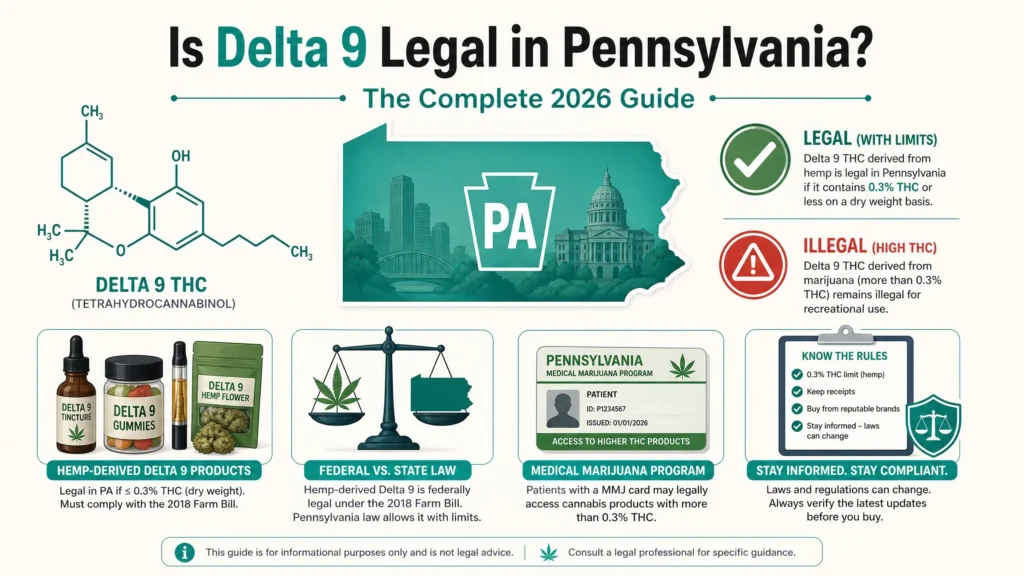
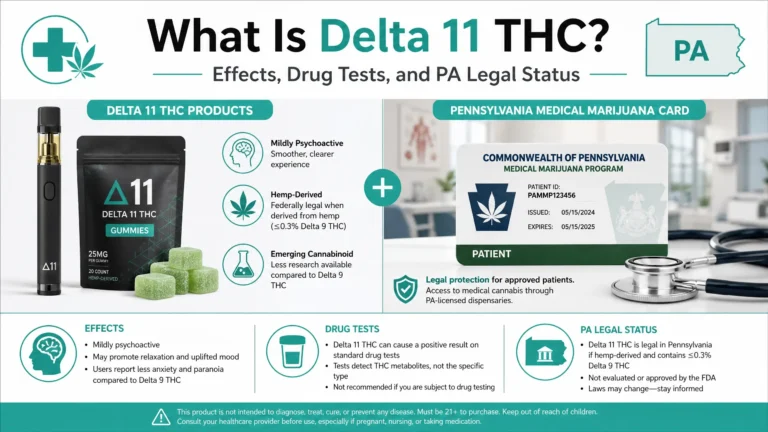

If you have seen “Delta 11” on a product at a smoke shop, vape store, or online hemp retailer and wondered what it actually is, you are in good company.
Delta 11 is one of the newest cannabinoids to appear on retail shelves, and the information available about it ranges from genuinely useful to outright misleading.
Need a PA Medical Marijuana Card?
Get certified online in 15 minutes. 100% Money-Back Guarantee.
Get Certified Now →Before buying anything labeled Delta 11 in Pennsylvania, there are several things you need to understand: what it actually is chemically, how it differs from a commonly confused compound called 11-hydroxy-THC, what the research honestly does and does not say about its effects, what it means for a drug test, and critically for Pennsylvania residents, where its legal status stands as of May 2026, and why that window is closing faster than most people realize.
This guide covers all of it, clearly and without the retailer bias that colors most content on this topic.
What Is Delta 11 THC? The Chemistry in Plain English

Delta 11 THC, full name delta-11-tetrahydrocannabinol is a minor cannabinoid found naturally in cannabis and hemp plants in extremely small trace amounts. It belongs to the same family of compounds as delta-9 THC (the primary psychoactive component of marijuana), delta-8 THC, and delta-10 THC.
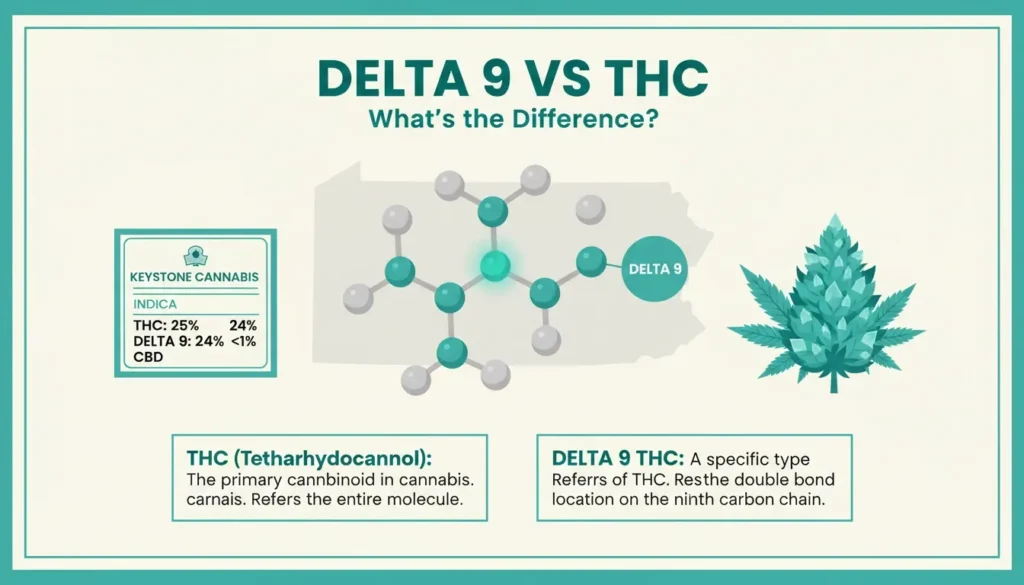
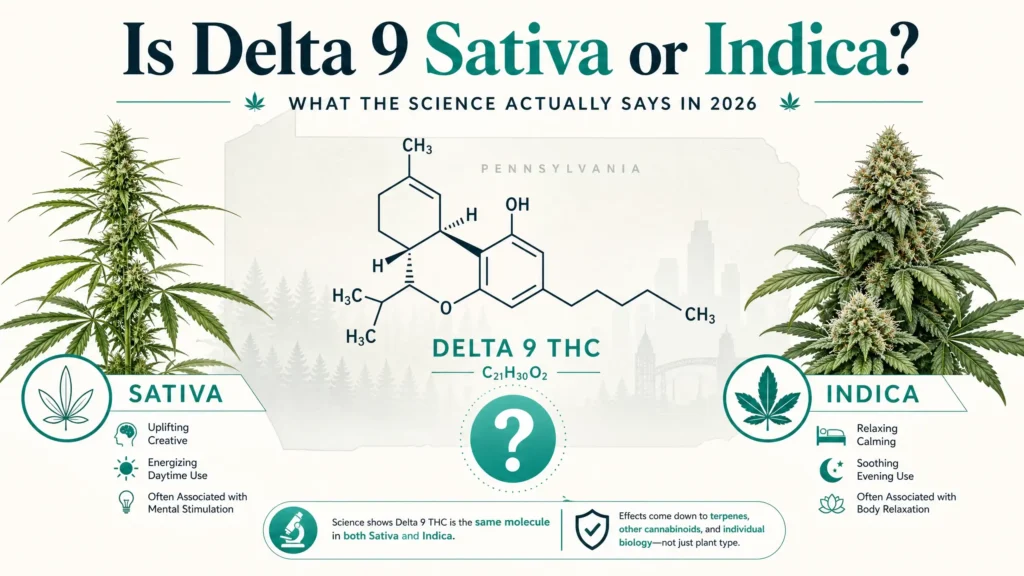
To understand what makes Delta 11 distinct, it helps to understand the basic chemistry shared by all these compounds. Each of these THC variants has the same molecular formula (C₂₁H₃₀O₂) meaning they are made of the same atoms.
Do You Qualify for a PA MMJ Card?
Connect with a licensed Pennsylvania state physician online from home.
What differs is how those atoms are arranged, specifically where a double bond sits on the carbon chain. As Zaleaf’s 2026 cannabinoid guide explains it well: think of these compounds like Lego sets with the same 50 bricks, in one arrangement you build a car, in another you build a plane.
- Delta 9 THC: Double bond on the 9th carbon. The most abundant psychoactive form found in marijuana. The most extensively researched cannabinoid.
- Delta 8 THC: Double bond on the 8th carbon. Milder psychoactive effects than Delta 9.
- Delta 10 THC: Double bond on the 10th carbon. Less studied, reported to be more energizing.
- Delta 11 THC: Double bond on the 11th carbon. Rare, minimal research, increasingly marketed in hemp-derived products.
That one-position shift in the double bond changes how the molecule interacts with your body’s endocannabinoid system, specifically with the CB1 and CB2 receptors that regulate pain, mood, appetite, memory, and numerous other functions.
Because Delta 11 occurs in such small concentrations naturally, commercially available Delta 11 products are not extracted directly from plants. As Elevate Holistics explains, manufacturers synthesize Delta 11 from other cannabinoids, typically CBD or Delta 8 THC, through laboratory conversion processes. This distinction matters significantly for both safety and legal reasons covered below.
Delta 11 was first synthesized in 1973, but it received virtually no meaningful scientific inquiry until the recent hemp-derived cannabinoid boom created commercial interest in marketing novel THC variants.
Delta 11 vs. 11-Hydroxy-THC: The Most Important Distinction in This Space

Before going any further, there is a critical point of confusion that needs to be addressed directly because it affects everything from how you understand the effects to how you evaluate retailer claims.
Delta 11 THC and 11-hydroxy-THC are two completely different compounds. They share a similar name, which causes enormous confusion, and some retailers deliberately blur the distinction in their marketing.
Here is the precise difference:
Delta 11 THC is a cannabinoid, a compound that exists in or can be derived from the cannabis plant. It is something you can consume directly in a product.
11-Hydroxy-THC (11-OH-THC) is a metabolite, a compound your own liver produces after you consume Delta 9 THC, particularly through edibles. It is not something you consume; it is something your body creates internally during the process of metabolizing THC. According to Secret Nature’s cannabinoid research, 11-hydroxy-THC only metabolizes from Delta 9, not from other THC forms.
Why does this matter? Because 11-hydroxy-THC is responsible for what many people experience as the intense, long-lasting, body-heavy effect of cannabis edibles.
⚡ Fast & 100% Online PA Medical Cards
Board-Certified Doctors • 100% Money-Back Guarantee
Book Evaluation Now →According to peer-reviewed research published in ScienceDirect, 11-OH-THC is a partial agonist of CB1 receptors with significantly higher binding affinity than Delta 9 THC itself, meaning it binds more powerfully to the receptors that produce psychoactive effects, and its effects last substantially longer.
Some Delta 11 retailers claim their products are “three times stronger than Delta 9” and use language that conflates Delta 11 with 11-hydroxy-THC to imply their products deliver an edible-like experience.
The honest assessment: claims about Delta 11’s specific potency are largely based on extrapolation from 11-hydroxy-THC research, on user anecdote, and on retailer marketing, not on independent clinical trials of Delta 11 itself.
How Does Delta 11 Make You Feel? What the Evidence Actually Says
This is where intellectual honesty requires a clear statement that most retailer-authored content avoids.
There is virtually no peer-reviewed clinical research specifically on Delta 11 THC’s effects in humans.
As Elevate Holistics notes directly, the lack of clinical research means optimal dosing ranges are unknown, long-term effects are completely unknown, and individual response variation is not understood. What is labeled as Delta 11 in retail products may also contain other compounds or impurities that affect the experience in ways that are not predictable or disclosed.
What we do know, based on pharmacological inference and user reports:
Delta 11 is psychoactive. Like all THC isomers, it interacts with CB1 receptors in the brain and produces intoxication. Users commonly report euphoria, relaxation, altered sensory perception, and appetite stimulation, effects consistent with THC-class cannabinoids generally.
Effects appear to be more potent than Delta 9 at equivalent doses, based on user reports and the theoretical basis of CB1 receptor binding affinity differences. However, this has not been confirmed in controlled human trials.
Potential risks consistent with high-potency THC products apply. A 2025 systematic review published in PubMed covering 99 studies and over 221,000 participants found that high-concentration THC products are associated with increased risk of anxiety, depression, psychosis, and cannabis use disorder.
A broader 2024 PubMed review confirmed that acute consumption of high THC doses can cause time-limited mental, gastrointestinal, and cardiovascular problems. Given that Delta 11 is marketed as significantly more potent than standard Delta 9, these risk factors are directly relevant.
Renewing Your PA MMJ Card?
Quick annual recertification online. No paperwork hassle.
Renew Card Online →The bottom line: Delta 11 will make you high. How high, for how long, and with what specific profile of effects depends on variables that current research cannot reliably predict for any specific individual.
Delta 11 vs. Delta 8 vs. Delta 9: Side-by-Side Comparison
| Feature | Delta 9 THC | Delta 8 THC | Delta 11 THC |
|---|---|---|---|
| Double bond position | 9th carbon | 8th carbon | 11th carbon |
| Psychoactive? | Yes — primary high | Yes — milder than D9 | Yes — reportedly stronger than D9 |
| Clinical research | Extensive | Limited | Virtually none |
| Natural abundance in plant | High | Trace | Trace |
| Commercial source | Cannabis plant | Converted from CBD | Converted from CBD or D8 |
| Drug test risk | High | High | High |
| Available at PA dispensaries? | ✅ Yes — via PA MMJ card only | ❌ No — hemp retail only | ❌ No — hemp retail only |
| Federal legal status post Nov 2026 | Legal via MMJ program | Banned as intoxicating hemp | Banned as intoxicating hemp |
| PA state legislation pending? | N/A | Yes — SB 49 | Yes — SB 49 |
Important note on the Delta 9 row: Delta-9 THC is available at Pennsylvania licensed dispensaries exclusively through the state’s medical marijuana program.
A valid PA MMJ card is required. Recreational Delta-9 THC, including hemp-derived Delta-9 products sold at smoke shops, exists in the same closing legal grey area as Delta 8 and Delta 11. The safe, regulated, legal route in Pennsylvania is always through a licensed dispensary with a physician-certified PA MMJ card.
Read More: Delta 11 vs Delta 9: Key Differences, Potency & PA Legal Guide
Delta 11 and Drug Tests: What Pennsylvania Residents Need to Know

This section may be the most practically important part of this entire guide for many readers.
If you use Delta 11 products and are drug tested, you will very likely fail.
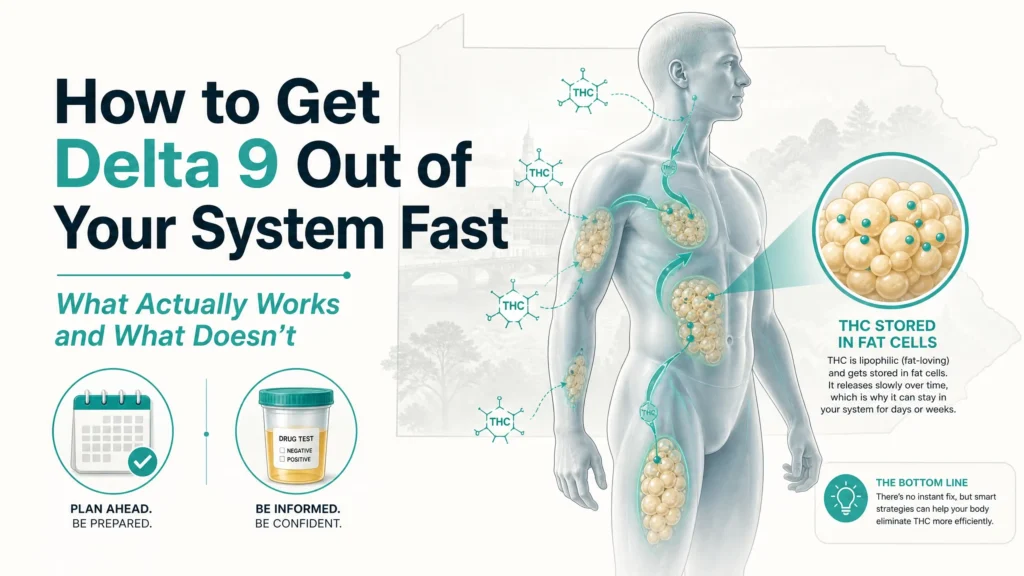
Standard urine drug tests do not screen for Delta 11, Delta 8, or Delta 10 specifically. What they detect is THC-COOH, the metabolite your liver produces when it breaks down any form of THC.
According to peer-reviewed research on workplace drug testing published in PMC, standard urine screens use a threshold of 50 ng/mL for the initial immunoassay test, confirmed at 15 ng/mL by GC-MS.
Because Delta 11 is a THC isomer that activates CB1 receptors, it is metabolized through the same hepatic pathways as Delta 9, producing THC-COOH as a metabolic byproduct.
The drug test cannot and does not distinguish between THC-COOH from a licensed PA dispensary product, from a recreational marijuana joint, or from a gas station Delta 11 vape cartridge. The metabolite is identical.
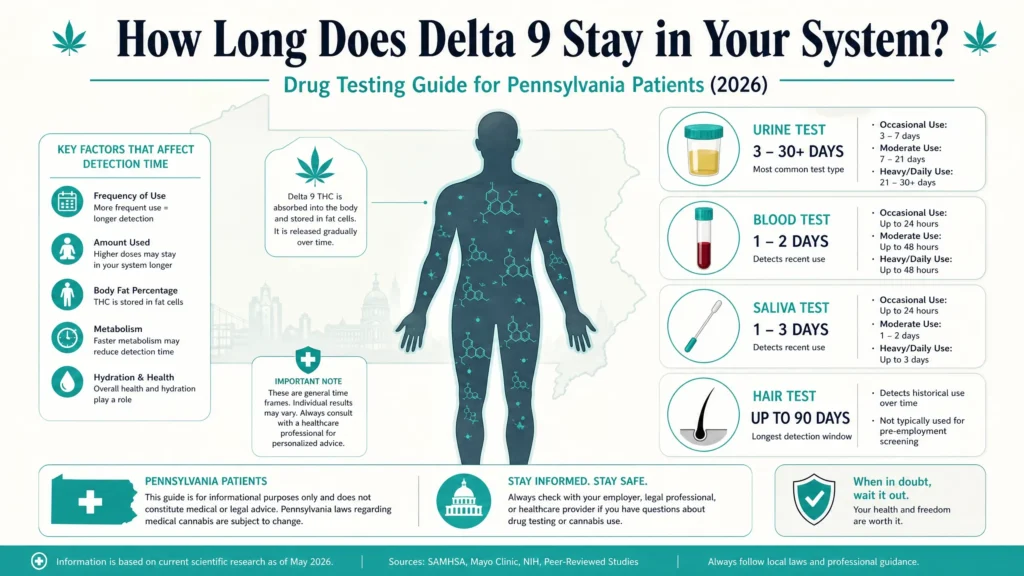
Detection windows for Delta 11 users are expected to mirror those of standard THC use:
| Test Type | Detection Window (occasional use) | Detection Window (regular use) |
|---|---|---|
| Urine | 3–7 days | Up to 30+ days |
| Blood | Up to 48 hours | Up to 48–72 hours |
| Saliva | Up to 24–72 hours | Up to 72 hours |
| Hair | Up to 90 days | Up to 90 days |
Get Approved by a Licensed PA Doctor
Schedule your appointment in minutes. You only pay if approved.
Start Online Application →Pennsylvania DUI exposure is also real and serious. Pennsylvania operates under a per se DUI law under 75 Pa. C.S. § 3802(d), if any amount of THC metabolites is detectable in your blood while driving, you can be charged with DUI.
Whether your THC metabolites came from Delta 11, Delta 8, THCA, or conventional marijuana is irrelevant to the charge. A valid PA medical marijuana card does not protect you from this law, which is why Pennsylvania patients should never drive after consuming any cannabis product.
The Unregulated Product Safety Problem

One of the most important and least-discussed dimensions of Delta 11 and all hemp-derived intoxicating cannabinoids, is the product quality and safety issue that is uniquely severe in Pennsylvania’s current regulatory environment.
Delta 11 products sold at smoke shops, convenience stores, and online retailers in Pennsylvania operate in a completely unregulated market. There is no mandatory third-party testing, no potency verification, no age restriction enforcement, and no contaminant screening required under current state law.
A January 2026 peer-reviewed toxicology study from the University of Rochester Medical Center published in PMC reviewed the health effects of delta-8, delta-9, delta-10, and other unregulated cannabinoids in vaping products.
Researchers identified Delta-11-THC among the most common compounds found in unregulated cannabis vaping products, alongside 26 other toxic compounds. The study drew explicit connections to E-cigarette or Vaping Use-Associated Lung Injury (EVALI) outbreaks and called for urgent regulatory oversight.
A product labeled “Delta 11 vape cartridge” at a Pennsylvania gas station or smoke shop:
- Has no verified potency — the label may not reflect actual cannabinoid content
- May contain chemical residues from the conversion process used to synthesize Delta 11 from CBD
- May contain cutting agents, pesticides, or heavy metals with no required testing
- Has no minimum age requirement enforced by any regulatory body in Pennsylvania
This is not a theoretical concern. Pennsylvania’s own law enforcement has conducted real-world testing of hemp-derived products purchased from retail shelves and found that products consistently contained THC levels exceeding legal limits, a finding cited in testimony before the Pennsylvania Senate Law and Justice Committee in March 2026.
This contrasts sharply with products available at Pennsylvania’s licensed medical marijuana dispensaries, where mandatory third-party testing, accurate potency labeling, and dispensary pharmacist oversight are required under PA Department of Health regulations.
Delta 11’s Legal Status in Pennsylvania — and the 2026 Deadline
Delta 11 currently exists in a rapidly closing legal gray zone. Pennsylvania residents need to understand the timeline clearly, because the window is not ambiguous. It is closing at both the federal and state level simultaneously.

At the Federal Level: H.R. 5371 Changes Everything
Ready to Get Your Official PA MMJ Card?
State-certified doctor consultations online. No risk—100% refund if not approved.
Claim Your MMJ Card Online →On November 12, 2025, Congress signed H.R. 5371 into law. As analyzed by Regulatory Oversight, this legislation replaces the old delta-9-only THC threshold with a “total THC” standard, meaning all THC isomers and analogs, including Delta 11, now count toward the 0.3% legal limit.
Products containing synthetic or chemically-converted cannabinoids, which includes most commercially available Delta 11 are explicitly excluded from the legal hemp definition.
The new standard takes effect November 12, 2026. After that date, Delta 11 will be treated as a federally controlled substance.
At the Pennsylvania State Level: SB 49 Is Moving Fast
Pennsylvania’s Senate Law and Justice Committee voted 10-1 in March 2026 to advance an amendment to Senate Bill 49 that explicitly bans the sale of intoxicating hemp-derived THC products, including Delta 8, Delta 10, THCA, and by necessary extension other THC isomers including Delta 11.
As reported by Cannabis Business Times and Marijuana Moment, the amendment has bipartisan support from the Pennsylvania Cannabis Coalition, the Pennsylvania Chamber of Business and Industry, and the Pennsylvania District Attorneys Association.
PA Senate Law and Justice Committee Chair Senator Daniel Laughlin stated directly: “We are seeing an explosion of unregulated hemp products being sold openly at gas stations, vape shops and convenience stores statewide.
These products are marketed with no known testing, labeling or age restrictions. This is a health risk and regulatory blind spot we can’t ignore any longer.”
What this means for Delta 11 users in Pennsylvania: The product you may be buying today at a Pennsylvania smoke shop will be federally banned by November 12, 2026 and Pennsylvania’s SB 49 may close that window at the state level even sooner.
Pennsylvania residents who use Delta 11 for health or wellness reasons should be actively exploring legal alternatives now.
What Pennsylvania Users Should Consider Next

If you have been using Delta 11, whether for relaxation, anxiety relief, pain management, sleep, or general wellness, the practical question you are now facing is: what is the legal, regulated, and lasting alternative once the ban takes effect?
For Pennsylvania residents, the answer is the Pennsylvania medical marijuana program.
The reasons people reach for Delta 11 products, anxiety, stress, chronic pain, sleep disruption, general discomfort, overlap substantially with the conditions Pennsylvania recognizes as qualifying for a medical marijuana card. Pennsylvania’s MMJ program, established under Act 16 of 2016, recognizes 24 qualifying conditions.
The most common by a significant margin is anxiety disorder. A study published in the Annals of Internal Medicine on July 7, 2025 by researchers at the University of Pittsburgh and Johns Hopkins University, analyzing 1.73 million PA DOH certification records, found that anxiety accounts for approximately 60% of all PA MMJ certifications, with monthly certifications nearly tripling after anxiety was added as a qualifying condition in July 2019.
You can view the complete list of Pennsylvania’s 24 qualifying conditions here.
- Amyotrophic Lateral Sclerosis (ALS)
- Autism
- Cancer, including remission therapy
- Crohn’s Disease
- Damage to the nervous tissue of the central nervous system (brain-spinal cord) with objective neurological indication of intractable spasticity, and other associated neuropathies
- Epilepsy
- Glaucoma
- Positive status for Human Immunodeficiency Virus or Acquired Immune Deficiency Syndrome (HIV/AIDS)
- Huntington’s Disease
- Inflammatory Bowel Disease (IBD)
- Intractable Seizures
- Tourettes
- Multiple Sclerosis
- Neuropathies
- Parkinson’s Disease
- Post-traumatic Stress Disorder (PTSD)
- Severe chronic or intractable pain of neuropathic origin or severe chronic or intractable pain
- Sickle Cell Anemia
- Neurodegenerative diseases (i.e., Alzheimer’s Disease)
- Terminal illness
- Dyskinetic and spastic movement disorders
- Opioid use disorder for which conventional therapeutic interventions are contraindicated or ineffective, or for which adjunctive therapy is indicated in combination with primary therapeutic interventions
- Anxiety Disorder
- Chronic Hepatitis C
What a PA medical marijuana card gives you that Delta 11 products cannot:
- Legal protection — your access to cannabis is authorized under Pennsylvania law and does not disappear in November 2026
- Tested, verified products — every product at a PA dispensary undergoes mandatory third-party testing for potency and contaminants under PA DOH regulations
- Accurate dosing information — you know exactly what you are consuming
- Licensed dispensary pharmacist guidance — a trained professional helps you select the right product for your specific condition
- Access to 186+ licensed PA dispensaries statewide carrying the full range of approved cannabis products
- No loophole risk — your access is protected by state law, not dependent on a regulatory grey area
The certification process is fully online through telehealth with Pennsylvania Marijuana Cards. No clinic visit required. No waiting room. The process takes approximately 15 to 20 minutes with Dr. Johnathon Chance Miller, MD — a licensed Pennsylvania physician registered with the PA Department of Health.
Cost Breakdown
| Fee | New Patient | Renewal |
|---|---|---|
| Physician Certification Fee | $159 | $149 |
| PA State Registration Fee | $50 | $50 |
| Total | $209 | $199 |
Pennsylvania residents who qualify for Medicaid, SNAP, WIC, CHIP, PACE, or PACENET may have the $50 state fee waived through Pennsylvania’s MMAP program. Renewal pricing ($199 total) is always lower than new patient pricing ($209 total).
If anxiety is the primary reason you have been using Delta 11 or other hemp-derived cannabinoids, you can learn specifically about how anxiety disorder qualifies for a PA medical marijuana card here.
Frequently Asked Questions
Q: What is Delta 11 THC and how is it different from regular THC?
A: Delta 11 THC is a minor cannabinoid and isomer of delta-9 THC, the primary psychoactive compound in marijuana. All THC variants share the same molecular formula but differ in where a double bond sits on the carbon chain. Delta 9’s bond sits on the 9th carbon; Delta 11’s sits on the 11th. That structural difference changes how the molecule interacts with CB1 receptors in your brain. Because Delta 11 occurs in only trace amounts naturally, commercial products are synthesized through laboratory conversion from other cannabinoids like CBD, as Elevate Holistics explains. Unlike delta-9 THC, which has decades of clinical research behind it, Delta 11 has virtually no peer-reviewed human trial data. Potency claims, optimal dosing, and long-term safety effects are all scientifically unverified at this point.
Q: Is Delta 11 the same as 11-hydroxy-THC?
A: No and this confusion is widespread enough that it deserves a direct answer. Delta 11 THC is a cannabinoid derived from or synthesized from the cannabis plant that you consume directly in a product. 11-Hydroxy-THC is a metabolite your own liver produces internally when it breaks down delta-9 THC, particularly through edibles. You cannot buy 11-hydroxy-THC in a product; your body makes it as part of digestion. According to research published in ScienceDirect, 11-OH-THC binds to CB1 receptors with significantly higher affinity than standard THC, which explains why edibles feel more intense and long-lasting than inhaled cannabis. Some Delta 11 retailers deliberately blur this distinction in marketing to imply their products deliver that same edibles-like potency, a claim not supported by independent clinical trials on Delta 11 as a standalone compound.
Q: Does Delta 11 get you high, and is it safe?
A: Yes, Delta 11 is psychoactive and will produce intoxication, users commonly report euphoria, body relaxation, and altered sensory perception consistent with THC-class cannabinoids. As for safety: the honest answer is that we do not know with scientific certainty, because adequate research does not exist. No human clinical trials have evaluated Delta 11’s safety profile, optimal dosing, or long-term effects. Beyond the research gap, a January 2026 study from the University of Rochester Medical Center published in PMC identified Delta-11-THC among compounds found in unregulated vaping products alongside 26 other toxic compounds, connecting unregulated cannabinoid vaping to serious lung injury risks. Because Delta 11 products sold in Pennsylvania are not subject to mandatory testing or contaminant screening, what is on the label may not accurately reflect what is in the product.
Q: Will Delta 11 show up on a drug test?
A: Yes, this is one of the most important practical facts to understand before using any Delta 11 product. Standard urine drug tests do not screen for Delta 11 specifically. What they detect is THC-COOH, the metabolite your liver produces when breaking down any form of THC. Because Delta 11 is a THC isomer metabolized through the same liver pathways as delta-9, it generates THC-COOH exactly as conventional marijuana does, as confirmed by PMC workplace drug testing research. The drug test cannot distinguish the source. Detection windows mirror those of standard cannabis use: roughly 3 to 7 days for occasional users in urine, up to 30+ days for regular users, and up to 90 days in hair follicle testing. Pennsylvania’s per se DUI law under 75 Pa. C.S. § 3802(d) adds another layer of risk, detectable THC metabolites in your blood while driving is legally sufficient for a DUI charge, regardless of whether the product was sold as legal hemp.
Q: Is Delta 11 still legal in Pennsylvania in 2026?
A: Delta 11 sits in a rapidly closing legal window. Federally, Congress signed H.R. 5371 on November 12, 2025, replacing the delta-9-only standard with a total THC threshold that encompasses all isomers including Delta 11, as analyzed by Regulatory Oversight. Most intoxicating hemp products will be federally banned as of November 12, 2026. At the state level, Pennsylvania’s Senate Law and Justice Committee voted 10-1 in March 2026 to advance SB 49, legislation explicitly banning intoxicating hemp-derived products, which may close access before the federal deadline. Pennsylvania residents who use Delta 11 for anxiety, pain, or other qualifying conditions should explore the PA MMJ program as a legal, tested alternative now rather than waiting for the ban to take effect.
Q: Can I get a Pennsylvania medical marijuana card instead of using Delta 11?
A: Yes and for many Pennsylvania Delta 11 users, this is worth exploring seriously before the 2026 ban takes effect. Pennsylvania recognizes 24 qualifying conditions, and anxiety disorder is the most common, cited in approximately 60% of all PA MMJ certifications according to a July 2025 study published in the Annals of Internal Medicine by researchers at the University of Pittsburgh and Johns Hopkins University. Other qualifying conditions include severe chronic pain and PTSD. The certification process is done entirely online through telehealth and takes approximately 15 to 20 minutes. New patient certification costs $159 (physician fee) plus a $50 PA state registration fee, with the state fee waived for qualifying low-income patients through Pennsylvania’s MMAP program. You can view the full list of qualifying conditions here and start the process at Pennsylvania Marijuana Cards.
Medically reviewed by Dr. Johnathon Chance Miller, MD. This content is for educational purposes only and does not constitute legal or medical advice. Cannabis and hemp laws are subject to rapid change, always verify current Pennsylvania and federal regulations before purchasing or using any cannabinoid product. Do not drive after consuming any THC-containing product. Consult a licensed physician before using cannabis for any medical condition.
Sources
- Zaleaf — Delta 11 THC: Ultimate Guide 2026 (March 2026)
- Elevate Holistics — What Is Delta 11 THC? Effects, Safety & Legality (January 2026)
- Secret Nature — Delta 11 vs Delta 10 vs Delta 9 vs Delta 8 (February 2026)
- ScienceDirect — The Intoxication Equivalency of 11-Hydroxy-Δ9-THC Relative to Δ9-THC (January 2025)
- PubMed — High-Concentration THC Products and Mental Health Outcomes: Systematic Review (October 2025)
- PubMed — Cannabis, cannabinoids and health: a review of evidence on risks and medical benefits (March 2025)
- University of Rochester Medical Center / PMC — Toxicity of delta-8, delta-9, delta-10 and unregulated cannabinoids in vaping products (January 2026)
- PMC / NIH — Interpretation of Workplace Tests for Cannabinoids
- Regulatory Oversight — Congress Narrows Federal Definition of Hemp (December 2025)
- Altoona Mirror — Pa. legislation aims to ban hemp-derived THC products (March 2026)
- Cannabis Business Times — Pennsylvania Moves to Align Hemp Product Regulations With Federal Ban (March 2026)
- Marijuana Moment — Pennsylvania Senators Amend Cannabis Regulation Bill to Ban Hemp THC Products (March 2026)
- Senator Daniel Laughlin — SB 49 Amendment Statement (March 2026)
- Pennsylvania Department of Health — Medical Marijuana Program (May 2026)
- Annals of Internal Medicine — Medical Cannabis Certifications After Pennsylvania Added Anxiety Disorders as a Qualifying Condition (July 2025)
- Pennsylvania General Assembly — 75 Pa. C.S. § 3802(d) Per Se DUI Law
- Wikipedia — 11-Hydroxy-THC Pharmacology