
You’re standing at the Pennsylvania dispensary counter. The budtender shows you two concentrate options: live resin and live rosin. Same price range. Both look golden. Both smell incredible. One letter separates their names.
So what actually makes them different — and does it matter?
Need a PA Medical Marijuana Card?
Get certified online in 15 minutes. 100% Money-Back Guarantee.
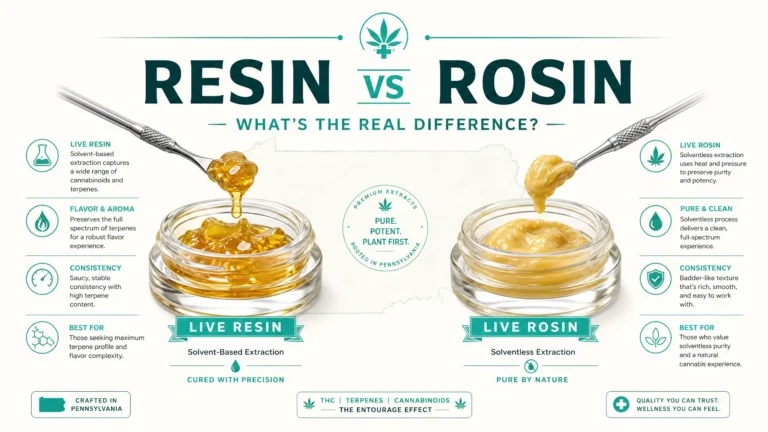
Get Certified Now →The short answer: resin uses chemical solvents to extract. Rosin uses heat and pressure only. That single difference in how they’re made changes the flavor, the price, the purity, and who each product is best for.
This guide breaks it all down without the jargon.
First: What Are Cannabis Concentrates?
Before getting into resin vs. rosin specifically, it helps to understand the category they both belong to.
Cannabis concentrates are products where cannabinoids and terpenes have been separated from raw plant material and refined into a more potent form. Think of flower as the whole fruit — concentrates are the juice. Everything that makes cannabis therapeutic and flavorful is present in a much smaller, denser format.
Do You Qualify for a PA MMJ Card?
Connect with a licensed Pennsylvania state physician online from home.
Concentrates are consumed by dabbing (using a dab rig or e-nail), vaping (concentrate-loaded cartridges or pods), or as infused additions to flower bowls and pre-rolls. They’re also increasingly used in edibles and tinctures.
Resin and rosin are both concentrates — but they are made in fundamentally different ways.
What Does “Live” Mean on a Concentrate Label?

Both live resin and live rosin share one word: live. This is not a marketing term — it has a specific technical meaning that applies equally to both products.
“Live” means the cannabis plant was flash-frozen immediately after harvest, before any drying or curing took place.
This matters because drying and curing degrades terpenes — the aromatic compounds responsible for flavor, aroma, and many of the therapeutic effects. Research on cannabis volatile compounds confirms that terpene loss during conventional drying and curing can exceed 30% within the first week of harvest and surpass 55% within three months of harvest. Freezing the plant immediately locks in those compounds at peak freshness.
When you see “live” on any concentrate label — whether resin or rosin — it means the product started from that fresh-frozen material. The next word tells you how it was processed from there.
What Is Live Resin?
Live resin is made using hydrocarbon solvents — typically butane or propane — to chemically dissolve cannabinoids and terpenes out of the fresh-frozen plant material.
How it’s made, step by step:

- Cannabis is harvested and immediately flash-frozen
- Frozen material is loaded into a closed-loop extraction system
- Cold hydrocarbon solvent (butane or propane) is passed through the material, dissolving cannabinoids and terpenes
- The solvent-rich solution is collected and filtered to remove plant matter
- Solvents are purged through heat and vacuum pressure
- The extract is post-processed into its final texture (sauce, diamonds, badder, sugar, wax)
The use of solvents makes live resin more efficient to produce at scale — which is why it’s widely available across PA dispensaries and typically priced lower than rosin.
Common live resin textures at PA dispensaries:
| Texture | Appearance | Notes |
|---|---|---|
| Sauce | Liquid, amber, runny | Highest terpene concentration |
| Diamonds & Sauce | Large THCa crystals in terpene sauce | Extremely potent |
| Badder / Budder | Creamy, smooth, cake-batter consistency | Easy to work with |
| Sugar | Wet, granular, golden | Good balance of flavor and potency |
| Wax | Soft, opaque, doughy | Widely available, good entry point |
What Is Live Rosin?
⚡ Fast & 100% Online PA Medical Cards
Board-Certified Doctors • 100% Money-Back Guarantee
Book Evaluation Now →Live rosin is the solventless alternative. No butane, propane, ethanol, or CO₂ ever touches the plant. Instead, only ice water, heat, and pressure are used.
How it’s made, step by step:

- Cannabis is harvested and immediately flash-frozen
- Frozen material is agitated in ice water, separating trichome heads from plant matter
- Trichomes are collected through fine mesh screens — this is called bubble hash or ice water hash
- The bubble hash is freeze-dried carefully to preserve terpenes
- Dried hash is placed in filter bags and pressed between heated plates at 180–220°F
- Heat and pressure cause the resin in the trichome heads to melt and flow out
- The resulting golden, sticky concentrate is collected from parchment paper — this is live rosin
The process is more labor-intensive and yields far less per pound of starting material (roughly 3–8% overall return, versus significantly higher yields from solvent extraction). That’s why rosin costs more and is made in smaller batches.
Think of it this way: rosin is cold-pressed juice. Resin is refined juice. Both deliver a great result — they just get there through completely different philosophies.
Resin vs. Rosin: Side-by-Side Comparison

| Feature | Live Resin | Live Rosin |
|---|---|---|
| Extraction method | Hydrocarbon solvents (butane/propane) | Heat and pressure only — no solvents |
| Starting material | Fresh-frozen cannabis | Fresh-frozen cannabis → bubble hash |
| Solvent use | Yes (purged before sale) | No solvents at any stage |
| Potency range | 65–90% total cannabinoids | 60–85% total cannabinoids |
| Terpene profile | Rich, bold, strain-specific | Clean, layered, full-spectrum |
| Typical price (per gram, PA) | $30–$60 | $50–$90+ |
| Production scale | Commercial, high-yield | Small-batch, artisanal |
| Common product formats | Vape carts, dabs, edibles, disposables | Dabs, vape carts, edibles, infused pre-rolls |
| Best for | Potency + flavor on a budget | Purity, solventless preference, connoisseurs |
Flavor: Which Actually Tastes Better?
This is genuinely subjective — but the distinction is real.
Live resin tends to deliver bold, intense, strain-specific flavor. Because hydrocarbon solvents are highly efficient at extracting aromatic compounds, live resin can capture a very strong expression of a cultivar’s terpene profile. The experience is often described as bright, pungent, and immediately recognizable.
Live rosin delivers a cleaner, more layered flavor. Because nothing chemical ever touches the plant, what you taste is the plant’s aromatic profile without any processing artifact. Connoisseurs often describe it as more nuanced and “true to the plant” — subtler but more complex.
Neither is objectively better. If you prefer big, punchy flavor, live resin often delivers it more intensely. If you prefer clarity and complexity, live rosin edges ahead. Most experienced concentrate users have tried both and settled on a preference.
Potency: Is One Stronger Than the Other?
Here’s something that surprises most people: the extraction method does not determine potency. The quality of the starting flower does.
Both live resin and live rosin typically test at 70–85% total cannabinoids, with premium lots from top-tier genetics exceeding 90% in both categories. A well-made live resin and a well-made live rosin from the same batch of starting flower will produce very similar potency numbers.
Where live resin sometimes edges out is in peak THC percentage — because solvent extraction is more efficient at pulling cannabinoids from plant material. But this margin is often small, and a poorly-made live resin from average flower will underperform a well-made live rosin from exceptional starting genetics.
Renewing Your PA MMJ Card?
Quick annual recertification online. No paperwork hassle.
Renew Card Online →The practical takeaway: don’t choose by potency percentage alone. At this level of concentration, the difference between 78% and 83% THC is rarely meaningful in practice. Terpene profile, flavor, and your personal preference for the extraction process matter more.
Price: Why Does Rosin Cost More?
Live rosin’s higher price tag has nothing to do with marketing — it comes directly from the economics of how it’s made.

Why rosin commands a premium:
- Ice water hash extraction yields roughly 10–20% from flower input
- Pressing that hash into rosin yields 70–90% of the hash — but the overall return from starting material is only 3–8%
- Rosin requires more plant material per gram of final product than any solvent-based method
- The process cannot be easily automated or scaled like BHO extraction
- Premium fresh-frozen genetics command higher input costs
According to BDSA market data, live rosin held an average retail price of approximately $35 per gram — around 73% higher than live resin in the same markets. In Pennsylvania’s medical market, expect to pay $50–$90+ per gram for quality live rosin, versus $30–$60 per gram for premium live resin.
The good news: rosin prices have been gradually declining as the category matures. Pennsylvania dispensaries including Vytal Options (through their “Solventless by Vytal” line), Verilife, and Liberty Cannabis Philadelphia now carry solventless products at increasingly competitive price points compared to just two years ago.
Safety: Are Solvents a Concern?

This question comes up often, and it deserves a direct, honest answer.
Properly manufactured and tested live resin is safe to consume. Licensed Pennsylvania growers and processors must submit all concentrate products to state-approved third-party labs before those products reach dispensary shelves. The COA for every live resin product must include residual solvent testing. Products that fail residual solvent thresholds cannot be sold.
Modern commercial BHO extraction uses closed-loop systems — solvents are contained, recovered, and recycled, not vented freely. Professional operations routinely achieve non-detectable residual solvent levels on lab tests.
Live rosin has zero solvent exposure at any stage — which appeals to patients who prefer to know no chemicals were ever part of the process. This is a process preference, not a safety necessity. Both products, when sourced from a licensed PA dispensary with valid COAs, are safe options.
The one caveat: always buy concentrates from a licensed Pennsylvania dispensary. Unregulated, unlicensed products are not subject to residual solvent testing, and those risks are real.
The 2026 Market Shift Toward Rosin
The numbers make clear that something significant is happening in the solventless category.
Get Approved by a Licensed PA Doctor
Schedule your appointment in minutes. You only pay if approved.
Start Online Application →A Q1 2026 consumer survey by BudPop (conducted across 1,200+ customers between January and March 2026) found that 68% of respondents had moved away from distillate-based products in favor of solventless formats in the prior 12 months. Among those, 71% preferred live rosin as their solventless format of choice.
Cannabis market tracking data confirms the trend: rosin products in licensed dispensaries grew 8% in dollar sales year-over-year, with the number of rosin SKUs on dispensary shelves rising 11% over the same period as of April 2026.
This shift is being driven primarily by consumer education. As patients understand more about what’s in their products — and begin reading COAs the way they read nutrition labels — the “no solvents” story has become genuinely compelling, not just a premium marketing angle.
Pennsylvania’s mature medical market is following this national pattern, with multiple major PA dispensary brands now maintaining dedicated solventless product lines.
Resin vs. Rosin at Pennsylvania Dispensaries

Both live resin and live rosin are widely available at licensed Pennsylvania medical marijuana dispensaries as of April 2026. Pennsylvania state law requires all concentrate products to carry a valid Certificate of Analysis before sale — which means every product on the shelf has verified potency, terpene profile, and residual solvent testing (where applicable).
How to shop concentrates at a PA dispensary:
- Ask to see the COA. Every PA dispensary can pull the lab report for any product. For live resin, check the residual solvents panel. For live rosin, verify it’s labeled solventless.
- Look at the terpene profile, not just THC%. Two products with similar THC can feel very different based on dominant terpenes.
- Ask the pharmacist or budtender about your condition. PA dispensaries employ licensed pharmacists who can advise on product formats appropriate for your qualifying condition.
- Start low with concentrates. Both live resin and live rosin are significantly more potent than flower. If you’re new to concentrates, start with a small amount and wait to assess the full effect before consuming more.
Which One Should You Choose?
There’s no universal answer — only the right answer for you.
Choose live resin if:
- You want bold, intense flavor and high potency at a more accessible price
- You use concentrates frequently and budget matters
- You prefer a wide range of textures and product formats (vape carts, disposables, dabs)
- You’re comfortable with solvent-based extraction from a licensed, tested source
Choose live rosin if:
- You prefer a completely solventless product — no exceptions
- You want the cleanest, most plant-authentic flavor profile available
- You’re a medical patient interested in the full-spectrum experience (all cannabinoids and terpenes, nothing removed or added)
- You’re willing to invest more per gram for artisanal, small-batch production
Choose neither yet if:
- You’re new to concentrates entirely — both are potent and the learning curve is real. Start with lower-dose formats like tinctures or low-dose edibles, and speak with a dispensary pharmacist first.
Do You Need a PA MMJ Card to Buy These?
Ready to Get Your Official PA MMJ Card?
State-certified doctor consultations online. No risk—100% refund if not approved.
Claim Your MMJ Card Online →Yes. Both live resin and live rosin are cannabis concentrates sold exclusively at licensed Pennsylvania medical marijuana dispensaries. To purchase any product at a PA dispensary, you must present a valid Pennsylvania MMJ patient ID card and a matching government-issued photo ID.
Pennsylvania has over 440,000 registered medical marijuana patients as of April 2026, and the certification process is completed entirely online via telehealth — typically in the same day.
If you have a qualifying condition — including anxiety disorders, chronic pain, PTSD, cancer, epilepsy, and 20+ others — you may be eligible. Anxiety disorder alone is the most common qualifying condition in the state, cited in approximately 60% of all PA certifications. You can learn more about anxiety as a qualifying condition here.
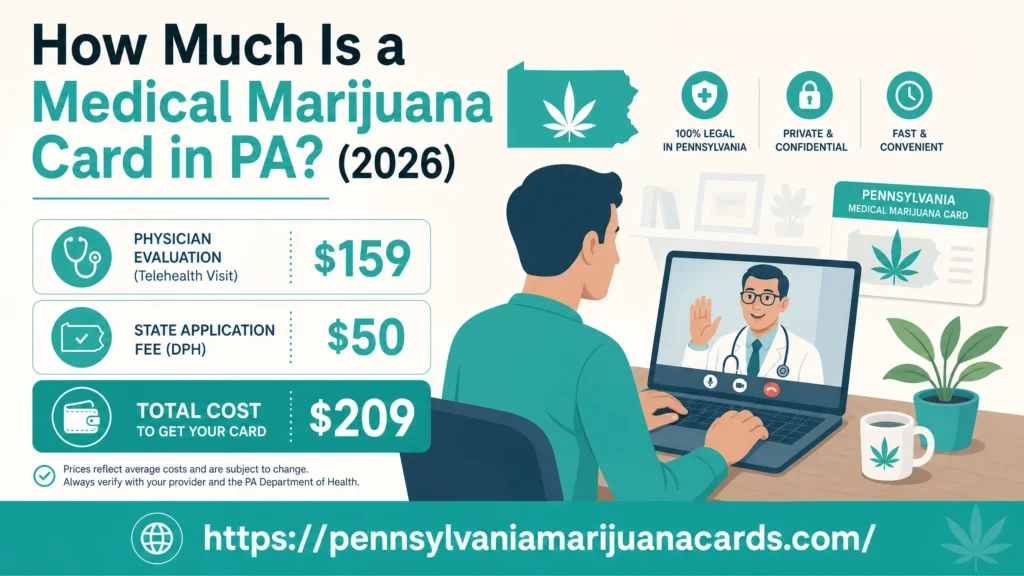
Certification pricing through Pennsylvania Marijuana Cards:
| Physician Fee | PA State Fee | Total | |
|---|---|---|---|
| New Patient | $159 | $50 | $209 |
| Renewal | $149 | $50 | $199 |
| MMAP Qualifying Patients (Medicaid, SNAP, WIC, CHIP, PACE, PACENET) | — | $0 (waived) | Physician fee only |
Ready to get started? Begin your same-day telehealth certification here.
Frequently Asked Questions — Resin vs. Rosin
Q: What is the main difference between resin and rosin?
A: The main difference is the extraction method. Live resin is made using hydrocarbon solvents — typically butane or propane — to pull cannabinoids and terpenes from flash-frozen cannabis. Live rosin is made using only heat and pressure (and ice water in the bubble hash step), with no chemical solvents at any stage. Both start from fresh-frozen cannabis to preserve terpenes, but rosin is considered the cleaner, solventless option. Resin is generally more affordable and widely available; rosin commands a higher price due to its labor-intensive, small-batch production process.
Q: Is live rosin stronger than live resin?
A: Not necessarily. Both live resin and live rosin typically test between 70–85% total cannabinoids, with premium batches of each exceeding 90%. Potency is determined primarily by the quality of the starting flower genetics, not the extraction method. A well-made live resin and a well-made live rosin from the same starting flower will produce very similar potency levels. The bigger distinctions between the two are flavor profile, extraction method, and price — not strength.
Q: Why is live rosin more expensive than live resin?
A: Live rosin costs more because of its production economics. The solventless extraction process — washing fresh-frozen cannabis in ice water to create bubble hash, then pressing it with heat — yields only 3–8% from the starting plant material. This is significantly lower than solvent-based extraction yields. Rosin also cannot be efficiently automated or mass-produced the way BHO extraction can. More plant material is required per gram of final product, and those input costs are reflected in the price. According to BDSA market data, rosin commands an average retail price approximately 73% higher than live resin.
Q: Is live resin safe if it’s made with solvents?
A: Yes, when purchased from a licensed Pennsylvania dispensary. All PA medical marijuana concentrate products must pass third-party laboratory testing — including residual solvent panels — before they can be sold. Modern commercial BHO extraction uses closed-loop systems and vacuum purging that routinely achieves non-detectable residual solvent levels. The concern about solvents is primarily a process preference for some consumers, not a safety risk when products come from licensed, tested sources. Unregulated products from unlicensed sources are a different matter — those carry real risks.
Q: Can PA medical marijuana patients buy both live resin and rosin at dispensaries?
A: Yes. Both live resin and live rosin are available at licensed Pennsylvania medical marijuana dispensaries. Pennsylvania law requires all dispensary products to carry a verified Certificate of Analysis, which covers cannabinoid potency, terpene profile, and residual solvent testing. Patients must present a valid PA MMJ patient card and matching photo ID to make purchases. As of April 2026, multiple PA dispensary brands — including Vytal Options’ “Solventless by Vytal” line, Verilife, and Liberty Cannabis Philadelphia — carry dedicated rosin product lines alongside live resin options.
Q: What does “live” mean on a cannabis concentrate label?
A: “Live” means the cannabis was flash-frozen immediately after harvest, before any drying or curing took place. This preserves the plant’s volatile terpenes, which begin to degrade within hours of harvest at room temperature. Research on cannabis volatile compounds shows that terpene loss during conventional drying and curing can exceed 30% in the first week and surpass 55% within three months. Both live resin and live rosin start from this fresh-frozen material — “live” describes the starting material, not the extraction method.
Q: Which is better for medical marijuana patients — live resin or live rosin?
A: Neither is universally better — the right choice depends on your priorities. Live rosin is often preferred by health-conscious patients who want zero solvent exposure and a full-spectrum, whole-plant experience with all original terpenes intact. Live resin may be preferable for patients who want comparable potency and flavor at a lower price point, or who need specific product formats like vape cartridges with a wider selection. Both are valid options from licensed PA dispensaries with verified COAs. Patients new to concentrates should consult with a dispensary pharmacist before starting, as both products are significantly more potent than flower.
Q: How do I know if a concentrate at a PA dispensary is truly solventless?
A: Ask to see the Certificate of Analysis (COA). Every licensed PA dispensary is required by state law to have a COA for each product before sale. For a product labeled live rosin, the COA should show the product as solventless — meaning the residual solvent panel shows non-detectable (ND) results for all solvents, or the product is explicitly documented as produced without solvent use. You can also simply ask the budtender or dispensary pharmacist to confirm. If a product can’t be verified with a COA, that’s a red flag.
Medical Disclaimer
This blog post is intended for general educational and informational purposes only and does not constitute medical advice. Cannabis concentrate products are significantly more potent than flower-based products. Patients new to concentrates should consult with a licensed dispensary pharmacist or their certifying physician before use. Pennsylvania medical marijuana products are for certified patients only. Information verified as of April 2026. Medically reviewed by Dr. Johnathon Chance Miller, MD.
Sources
All sources verified as of April 2026.
- BudPop Q1 2026 Customer Survey — “Live Rosin Gummies: Rising Demand for Solventless Cannabis Edibles” (April 8, 2026)
- Cannigma — “Fast-Acting Cannabis Edibles: What the Science Says About Live Rosin and Water-Soluble Technology” (March 2026)
- BDSA — “Is Solventless the New King of Premium Concentrates?” (Industry Report)
- The Haze Connect — “Live Resin vs Live Rosin: THCA Concentrates Compared” (April 2026)
- Green Rush News — “Cannabis Concentrates Explained: Shatter, Wax, Live Resin, Rosin, Diamonds” (March 2026)
- Verilife PA — “Live Resin vs. Rosin: What’s the Difference?” (March 2026)
- Vytal Options Pennsylvania — “Solventless by Vytal” Product Line (2026)
- THE Dispensary — “Rosin vs Resin: Key Differences (2026)” (January 2026)
- Ivy Hall Dispensary — “The Real Difference Between Resin and Rosin Edibles” (February 2026)
- Intel Market Research — “Rosin Market Outlook 2025–2032” (November 2025)
- Pennsylvania DOH — Licensed Dispensaries (Official State Registry)