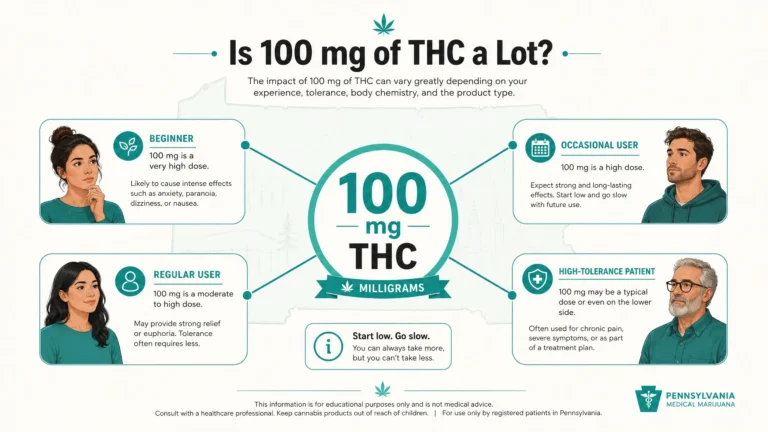

Is 100 mg of THC a lot? The direct answer: for most people is yes, 100mg of THC is a significant dose. For a complete beginner, it is an extremely large dose that carries a high risk of an overwhelming, uncomfortable experience.
For an experienced, high-tolerance cannabis user, 100mg may be within a manageable therapeutic range. For the average occasional user somewhere in between, it is too much.
Need a PA Medical Marijuana Card?
Get certified online in 15 minutes. 100% Money-Back Guarantee.
Get Certified Now →But the number alone only tells part of the story. How you consumed it, whether you ate it or inhaled it, what your personal tolerance is, whether you have eaten recently, and what product type you are using all dramatically affect what 100mg of THC actually does in your body.
Understanding these variables is the difference between a useful, therapeutic experience and a deeply unpleasant few hours.
This guide gives you the complete & honest picture, what 100mg actually feels like across different tolerance levels, why the same number hits completely differently depending on how you consume it, and what to do if you have already taken it and are feeling overwhelmed.
What Is a Standard THC Dose? Putting 100mg in Context

Before answering whether 100mg is a lot, it helps to understand what the medical and cannabis research community considers a “standard” dose because the gap between that standard and 100mg is significant.
Do You Qualify for a PA MMJ Card?
Connect with a licensed Pennsylvania state physician online from home.
The National Institute on Drug Abuse (NIDA) established 5mg of THC as the standard unit for cannabis research purposes.
This is the amount used as the baseline measurement in clinical studies, not because 5mg is the ideal dose for everyone, but because it represents a dose at which most people will experience measurable effects without being incapacitated.
For practical patient guidance, most licensed dispensary pharmacists and cannabis clinicians use the following framework, consistent with Leafly’s clinical dosage reference:
- 2.5mg: microdose, suitable for first-time users and those highly sensitive to THC
- 5mg: standard beginner dose, mild effects for most people
- 10mg: moderate dose, standard recreational serving in many states
- 20mg: higher dose, suitable for patients with some tolerance
- 50mg: high dose, appropriate for patients with significant tolerance
- 100mg: very high dose, only appropriate for experienced, high-tolerance users
100mg is 20 times the standard research unit and 10 times the standard beginner dose. That is the context.
This does not mean 100mg is dangerous for everyone, but it means it is genuinely significant and should be approached with a full understanding of what you are taking.
In states like Colorado and Canada, individual cannabis edible servings are legally capped at 10mg per serving, meaning a 100mg product must be divided into 10 separate servings.
Pennsylvania’s medical program does not impose the same single-serving cap, which means 100mg products at PA dispensaries are sold and labeled as they are, with the patient responsible for their own dosing decisions.
Is 100 mg of THC a Lot? The Answer by Tolerance Level

Here is what 100mg of THC actually feels like across different user profiles, the honest answer most guides avoid giving:
For a Complete Beginner — Yes, 100mg Is Far Too Much
If you have never used cannabis before, or have used it only a handful of times, 100mg of THC, particularly in edible form is an objectively excessive dose that carries a high probability of an unpleasant or alarming experience.
At this tolerance level, effects can include:
- Intense anxiety or panic — one of the most commonly reported responses to THC overconsumption in inexperienced users
- Paranoia and distorted thinking
- Rapid heart rate (tachycardia)
- Nausea and vomiting in some cases
- Extreme sedation and disorientation
- Derealization — a feeling of detachment from your surroundings
- Time distortion — minutes feeling like hours
- Difficulty breathing normally (not dangerous physically, but terrifying when anxious)
⚡ Fast & 100% Online PA Medical Cards
Board-Certified Doctors • 100% Money-Back Guarantee
Book Evaluation Now →These effects are not life-threatening, there is no confirmed lethal dose of THC for humans according to current research but they can last 6–12 hours from an edible and feel genuinely overwhelming during that time.
For beginners: Do not take 100mg. Start at 2.5–5mg and wait at least two full hours before considering more.
For a Light or Occasional User — 100mg Is Too Much
If you use cannabis occasionally, a few times per month and typically feel effects from a single 10mg edible or a small amount of flower, 100mg represents approximately 10x your typical effective dose.
Even with some tolerance developed, this amount is likely to produce intense, uncomfortable effects for several hours.
Occasional users at 100mg typically report:
- Strong, prolonged sedation lasting 8–12 hours
- Significant cognitive impairment
- Anxiety and paranoia — especially if in an unfamiliar environment
- Nausea and physical discomfort
- Inability to function or communicate normally
For light users: 10–25mg is a more appropriate range. 100mg is not recommended.
For a Regular User — 100mg Is Significant but Manageable for Some
If you use cannabis daily or near-daily and have developed meaningful tolerance, you regularly use 50mg+ doses or vaporize significant amounts of flower, 100mg of THC may fall within a manageable range, particularly through inhalation.
Through edibles, even regular users should approach 100mg with caution.
Regular users at 100mg typically report:
- Deep, prolonged relaxation and sedation
- Significant pain relief and muscle relaxation
- Enhanced sleep onset — often quite profound
- Possible residual grogginess the following morning
- Manageable cognitive effects — present but not incapacitating
For regular users: 100mg through edibles can be appropriate for end-of-day use, sleep, or significant pain management. Proceed with awareness of the duration, effects last 6–10 hours.
For High-Tolerance Medical Patients — 100mg May Be Appropriate
Patients who use cannabis daily for serious medical conditions, chronic pain, cancer, severe PTSD, end-of-life care, often develop tolerance that makes 100mg a clinically reasonable therapeutic dose.
Renewing Your PA MMJ Card?
Quick annual recertification online. No paperwork hassle.
Renew Card Online →According to Leafly’s clinical dosage reference, doses of 50mg–100mg are described as appropriate for “high-tolerance THC consumers” and “patients living with cancer, inflammatory disorders, or other conditions where high doses of THC may be therapeutic.”
At this tolerance level:
- 100mg delivers strong, sustained symptom relief
- Effects are intense but controlled within expected parameters
- Sedation is significant — this is typically an evening or nighttime dose
- Some patients at this level use 100mg specifically for sleep or breakthrough pain
For high-tolerance patients: 100mg may be your therapeutic dose. Work with your certifying physician or dispensary pharmacist to confirm this range is appropriate for your condition and history.
The Product Type Variable — 100mg Is Not the Same in Every Form

This is the most practically important variable that most dosage guides do not explain clearly enough: 100mg of THC delivers a fundamentally different experience depending on how it enters your body.
100mg in an edible (capsule, troche, infused product): Slowest onset (30 minutes to 2 hours). Longest duration (6–12 hours). Most intense peak effects. Most unpredictable timing.
This is the riskiest format for an untested high dose. The liver metabolizes oral THC into 11-hydroxy-THC, covered in the next section, producing effects that are qualitatively stronger than inhalation at the same nominal dose.
100mg in a tincture (sublingual): Faster onset than swallowed edibles (15–45 minutes for sublingual absorption). Shorter duration than full edibles (4–6 hours).
More predictable than swallowed edibles because some absorption happens directly through mucous membranes before the liver is involved. Still a very significant dose.
100mg through inhalation (vaporization): Fastest onset (minutes). Shortest duration (2–4 hours). Most controllable because effects are felt rapidly, you can stop when you have reached your threshold.
However, 100mg through inhalation is essentially impossible to measure precisely in practice since vaporizing whole flower produces variable bioavailability.
100mg through a topical: No psychoactive effect whatsoever. Topically applied THC does not cross the blood-brain barrier in meaningful quantities.
Get Approved by a Licensed PA Doctor
Schedule your appointment in minutes. You only pay if approved.
Start Online Application →100mg in a topical cream or balm is a localized anti-inflammatory application, completely different context from any of the above.
The key takeaway: if you are asking “is 100mg a lot” because you are looking at a tincture bottle that says 500mg total, and you are calculating that one serving is 100mg, that is different from a 100mg edible.
Always check the per-serving dose on the product label, not just the total product content.
The Science Behind Why Edibles Hit Differently — 11-Hydroxy-THC
This is the most important pharmacological concept for understanding why 100mg in an edible is so much more intense than 100mg through any other route and why it catches so many people off guard.
When you consume THC orally, swallowed in an edible, capsule, or mixed into food, it travels through your digestive system to your liver before entering your bloodstream. In the liver, THC is metabolized into a compound called 11-hydroxy-THC.
11-hydroxy-THC is not the same as THC. It is a metabolite with several important differences:
It crosses the blood-brain barrier more readily. 11-hydroxy-THC penetrates the brain more efficiently than delta-9 THC, meaning the psychoactive effect is often more intense per milligram than what you experience from inhalation.
It produces longer-lasting effects. The half-life of 11-hydroxy-THC is longer than delta-9 THC, explaining why edible effects persist for 6–12 hours rather than the 2–4 hours typical of inhaled cannabis.
It affects some users qualitatively differently. Many patients report that the edible experience, driven largely by 11-hydroxy-THC, feels more body-focused, more sedating, and more intense than an equivalent inhaled experience.
This is why experienced cannabis users who are comfortable vaporizing 50–100mg worth of flower can be completely overwhelmed by a 50mg edible. The compound acting on their brain is not the same compound, even though the milligram label is.
Ready to Get Your Official PA MMJ Card?
State-certified doctor consultations online. No risk—100% refund if not approved.
Claim Your MMJ Card Online →As Cannabiz Credit’s dosage analysis confirms: “Edibles produce stronger and longer-lasting effects compared to other consumption methods because THC is metabolized by the liver into 11-hydroxy-THC, which is more potent and crosses the blood-brain barrier more easily.”
The practical rule: If you are transitioning from inhalation to edibles, start at a dose that is 25–50% of what you would typically inhale. The liver conversion changes everything.
Bioavailability — What 100mg on the Label Actually Means in Your Body
Another critical variable that most dosage guides skip: the number on the label is not the number that reaches your bloodstream or brain.
Bioavailability refers to the fraction of the administered dose that reaches systemic circulation in active form. For THC across different consumption methods:
| Method | Estimated Bioavailability | What 100mg label delivers |
|---|---|---|
| Inhalation (vaporization) | 10–35% | ~10–35mg reaches circulation |
| Oral/edible | 4–20% | ~4–20mg reaches circulation |
| Sublingual (tincture) | 20–30% | ~20–30mg reaches circulation |
| Topical | Negligible | Near zero systemic effect |
This means a 100mg edible, at average 10% bioavailability, delivers approximately 10mg of active THC to your system. At higher bioavailability (20%), it delivers approximately 20mg.
The wide range reflects individual variation in digestive efficiency, liver metabolism, fat content of the edible, and other factors.
Why this seems contradictory to the earlier warnings: Lower bioavailability does not mean edibles are weaker than they seem.
It means the 11-hydroxy-THC conversion that happens in the liver creates a qualitatively more potent compound from whatever fraction does get absorbed.
Lower quantity of a more penetrating compound can produce more intense effects than higher quantity of a less penetrating one.
The bioavailability variability also explains why the same edible dose produces dramatically different effects on different days for the same person, your digestive state, food intake, gut motility, and liver enzyme activity all vary and affect how much THC converts and absorbs.
The Individual Factors That Change Everything
Beyond tolerance and product type, several individual variables significantly affect how 100mg of THC affects you:
Body weight and composition: Higher body mass generally but not reliably, correlates with requiring a higher dose to feel equivalent effects. THC is fat-soluble and distributes into body fat, which can reduce peak blood concentrations in larger individuals.
This relationship is not linear or predictable enough to rely on as a dosing guide, but it contributes to why recommended starting doses are sometimes presented on a per-kilogram basis.
Food intake: Consuming edibles on an empty stomach produces faster, more intense onset. Consuming them after a full meal, particularly a high-fat meal, slows onset but may increase total absorption.
According to Cornbread Hemp’s dosage analysis: “Empty stomach vs full stomach: consuming edibles on an empty stomach typically leads to faster onset and potentially stronger effects.”
Anxiety baseline: Patients with underlying anxiety disorders are significantly more susceptible to THC-induced anxiety and paranoia at higher doses.
For anxiety patients specifically, the dose-response relationship for anxiety is U-shaped, low doses may reduce anxiety while high doses can dramatically worsen it. 100mg is well into the territory where anxiety induction becomes a real risk for patients with anxiety disorders.
For this reason, anxiety patients should work carefully with lower doses and speak with their certifying physician before approaching 100mg.
CBD content of the product: CBD modulates THC’s psychoactive effects through CB1 receptor interaction.
Products with a balanced THC:CBD ratio (1:1 or 2:1) typically produce less anxiety and psychoactive intensity at equivalent THC doses than products with THC alone.
A 100mg THC product with 100mg CBD will feel significantly less overwhelming than a 100mg THC-only product.
Medications: Several common medications interact with THC metabolism through the CYP450 enzyme system, the same liver enzyme pathway that metabolizes many common drugs.
Patients on blood thinners, certain antidepressants, anti-seizure medications, or antifungals should consult their prescribing physician before using high-dose THC products, as interactions can affect both THC metabolism and the medications’ effectiveness.
Prior cannabis history: A person who used cannabis heavily years ago and has not used recently has lost their prior tolerance but may regain it more quickly than a true first-time user.
This residual pharmacological memory does not mean prior users should start at 100mg after a break, but it does mean their dose escalation may be faster than a complete novice.
The Complete THC Dosage Reference Chart
Here is a comprehensive dosage reference organized by experience level and consumption method, synthesizing guidance from Leafly, Cornbread Hemp, and CannabisMD TeleMed’s 2026 dosing guide:
Edibles and Capsules
| Dose | User Level | Expected Effects |
|---|---|---|
| 1–2.5mg | Beginner / microdose | Subtle mood lift, minimal impairment, good starting point |
| 5mg | Beginner | Mild euphoria, light relaxation, possible slight impairment |
| 10mg | Beginner–Intermediate | Moderate effects, clear intoxication for most users, standard recreational serving |
| 20–30mg | Intermediate | Strong effects, significant sedation, not for inexperienced users |
| 50mg | Experienced | High-dose effects, significant impairment, long duration (8–10 hours) |
| 100mg | High-tolerance only | Very strong sedation and pain relief, 8–12 hour duration, risk of overwhelming effects for non-high-tolerance users |
| 150mg+ | Medical patients, very high tolerance | Extreme doses for serious symptom management only, physician guidance recommended |
Read More: Are Edibles Legal in Pennsylvania?
Vaporization (Inhalation)
Effects are faster, shorter, and more controllable than edibles. The same milligram amounts produce less intense peak effects through inhalation due to different metabolism and shorter 11-hydroxy-THC exposure.
| Experience Level | Suggested Inhalation Amount |
|---|---|
| Beginner | 1–2 small inhalations, wait 15 minutes before more |
| Intermediate | 3–5 inhalations, standard session |
| Experienced | Multiple sessions as needed |
Tinctures (Sublingual)
Onset: 15–45 minutes. Duration: 4–6 hours. More predictable than edibles. Start at 2.5–5mg sublingual, wait 45 minutes before assessing.
If You Already Took 100mg — What to Do Right Now

A significant portion of people searching “is 100mg of THC a lot” have already taken it and are looking for reassurance. If that is you, here is what you need to know immediately:
You are not in physical danger. There is no documented fatal dose of THC for humans. What you may experience is intensely uncomfortable, but it will pass. Your body will metabolize the THC and effects will diminish over time.
What to expect if you are a non-high-tolerance user who took 100mg:
- Effects may take 30 minutes to 2 hours to fully arrive if consumed as an edible
- Peak effects will likely last 3–6 hours
- Total duration may be 8–12 hours, with gradual tapering
- You may feel very sedated, confused, anxious, or physically uncomfortable during this time
Immediate steps:
- Go somewhere safe and comfortable. Your home, a couch, a place where you can lie down if needed.
- Stay hydrated. Drink water — not alcohol, not caffeinated beverages.
- Do not take more. This seems obvious but is worth stating — if you are not feeling effects yet, do not take more. The delayed onset of edibles is the most common cause of overconsumption.
- Tell someone you trust. If you are with another person, let them know what you took and that you may need support. You do not need emergency services unless you experience chest pain, loss of consciousness, or an allergic reaction.
- Lie down if needed. Many people find that lying down in a cool, dark, quiet room significantly reduces the intensity of the experience.
- Remember: this will end. The most distressing aspect of THC overconsumption is the feeling that it will not end. It will. In 8–12 hours maximum, you will be substantially back to baseline.
The “Too High” Emergency Guide — Calm, Practical Steps
If you or someone with you is experiencing significant distress from THC overconsumption, here are evidence-based strategies for managing the experience:
The CBD rescue technique: CBD modulates THC’s psychoactive effect by partially blocking CB1 receptors.
Taking a significant dose of CBD — 25–50mg, when feeling overwhelmed by THC has been reported by many patients and has some pharmacological basis.
If you have a high-CBD tincture or CBD product available, this is worth trying. Do not take more THC-containing products.
Black pepper — the folk remedy with some evidence: Sniffing or chewing a few black peppercorns has been widely reported to reduce THC-induced anxiety.
This is attributed to beta-caryophyllene and other terpenes in black pepper that interact with the endocannabinoid system. While rigorous clinical evidence is limited, it is completely safe and many patients report meaningful relief.
Controlled breathing: Slow, deliberate breathing, inhale for 4 counts, hold for 4, exhale for 6, activates the parasympathetic nervous system and directly counteracts the anxiety response.
This physiological intervention works regardless of the cause of anxiety.
Cold water on wrists and face: Mild cold exposure activates the diving reflex, a parasympathetic response that slows heart rate and reduces anxiety.
Splashing cold water on your face or holding your wrists under cold running water can provide meaningful relief.
Distraction: Putting on a familiar, comforting show or movie, listening to calming music, or engaging in a simple task can redirect attention away from the discomfort of overconsumption. Avoid anything novel, intense, or stimulating.
What NOT to do:
- Do not drink alcohol — alcohol increases THC blood plasma levels and significantly worsens the experience
- Do not take more cannabis of any kind
- Do not drive under any circumstances
- Do not go to the emergency room unless you are experiencing a genuine medical emergency (chest pain, difficulty breathing, loss of consciousness, suspected allergic reaction)
How Tolerance Works — and How Quickly It Resets

Understanding tolerance is essential for understanding why 100mg is the right dose for some people and entirely wrong for others and why that can change.
How tolerance builds: THC produces tolerance through a process called CB1 receptor downregulation.
With frequent use, the brain reduces the number and sensitivity of the CB1 receptors that THC binds to, meaning higher doses are required to produce the same effect.
According to CannabisMD TeleMed’s 2026 dosing guide: “THC works by interacting with the body’s endocannabinoid system, specifically CB1 receptors in the brain. With frequent use, these receptors become less sensitive, meaning higher doses are required to feel the same effect.”
This process happens relatively quickly, regular daily use can produce measurable tolerance within 1–2 weeks.
How tolerance resets: The same receptor downregulation reverses when THC use stops. A tolerance break, a period of abstinence, allows CB1 receptors to resensitize. Research suggests meaningful tolerance reduction occurs within:
- 2–4 days: Some reduction begins
- 1 week: Significant reduction in most users
- 2–4 weeks: Near-full receptor resensitization in most users
- 4+ weeks: Complete resensitization in most cases
The practical implication for 100mg: If you are a regular user who has been taking 100mg daily and takes a 3-week break, returning to 100mg will feel dramatically more intense than before the break.
After a tolerance break, restart at 10–25mg and titrate upward again.
Planned tolerance breaks are therapeutic: Many experienced cannabis patients intentionally take periodic tolerance breaks, typically 1–2 weeks every 2–3 months to reduce their required dose, reduce costs, and allow their endocannabinoid system to resensitize.
This strategy is clinically reasonable and often recommended by MMJ physicians.
100mg THC at Pennsylvania Dispensaries — What You Need to Know
Pennsylvania medical marijuana patients encounter 100mg THC products in several specific contexts at licensed dispensaries. Here is what to know:
Where 100mg appears at PA dispensaries:
Tincture bottles: Many PA dispensary tinctures are sold in 250–500mg total THC bottles. A 500mg tincture with 1ml droppers contains approximately 16.7mg per dropper, not 500mg per dose. Always check the per-serving milligrams on the label, not the total bottle content.
Capsules: PA dispensaries carry capsule products in various per-capsule strengths, often 5mg, 10mg, or 25mg per capsule. A bottle of 4 × 25mg capsules contains 100mg total, not 100mg per dose.
RSO (Rick Simpson Oil): RSO products at PA dispensaries can be quite concentrated, often 60–70% total cannabinoids per gram, meaning a single gram may contain 600–700mg of THC.
Dosing RSO at 100mg would require a very small, rice-grain amount of the product. RSO is specifically intended for high-tolerance patients managing serious conditions and should never be used at high doses without physician guidance.
Troches: Pennsylvania-legal medical lozenges typically come in 5–10mg per troche. Ten troches would equal 100mg, not a single piece.
A critical PA patient safety note: Pennsylvania dispensary pharmacists are licensed, on-site professionals specifically available to help you understand product dosing.
Before using any new concentrate product or unfamiliar delivery format, ask for a pharmacist consultation.
This is a free service at every licensed PA dispensary and for products where dosing mistakes have meaningful consequences, it is worth taking advantage of.
PA’s 90-day supply allowance: Registered Pennsylvania patients can legally possess up to a 90-day supply as determined by the dispensary pharmacist.
For high-dose patients using 100mg daily, this can represent a significant quantity, understanding your supply limits is important for both legal compliance and treatment planning.
Finding the Right Dose for Your Medical Condition
Different qualifying conditions often respond to different dose ranges. Here is condition-specific guidance for Pennsylvania MMJ patients:
Chronic pain: Moderate to high doses (25–100mg) are often therapeutically appropriate for severe chronic pain, particularly through edibles for prolonged relief. The 6–12 hour duration of a 100mg edible can provide overnight pain management. Start at 25mg and escalate carefully.
Anxiety: Low to moderate doses (2.5–15mg) are the recommended range for most anxiety patients. High doses including 100mg can paradoxically worsen anxiety by overstimulating CB1 receptors.
For anxiety patients, staying well below 50mg is generally advisable unless a physician specifically recommends higher doses for a particular treatment protocol. See our Anxiety Disorder & Medical Marijuana in Pennsylvania guide for detailed anxiety-specific guidance.
Insomnia: Moderate to high doses (25–75mg) taken approximately 1–2 hours before sleep can be appropriate for patients with significant sleep disorders. 100mg is within range for high-tolerance insomnia patients but carries the risk of morning grogginess.
Cancer and serious illness: 100mg and above may be clinically appropriate for cancer patients managing pain, nausea, and treatment side effects. These patients often develop significant tolerance rapidly and work with their oncologist and MMJ physician on dosing.
PTSD: Highly individual. Some PTSD patients respond well to moderate-high doses for nightmare suppression and sleep. Others find high doses destabilizing. Work closely with your certifying physician.
The universal starting rule for every condition: Regardless of condition, the CannabisMD TeleMed 2026 dosing guide recommends: “Start with a low dose (5–10mg of THC) and wait at least two hours before considering more.”
This remains the gold standard regardless of what product you have purchased or what your target dose may eventually be.
Frequently Asked Questions
Q: Is 100mg of THC a lot?
A: Yes, for most people, 100mg of THC is a significant to very large dose. The National Institute on Drug Abuse defines 5mg as the standard THC research unit. A standard beginner dose is 2.5–5mg. 100mg is 20 times the standard research unit and is appropriate only for experienced, high-tolerance cannabis consumers. For beginners or occasional users, 100mg carries a high risk of overwhelming, uncomfortable effects lasting 8–12 hours.
Q: What does 100mg of THC feel like?
A: For beginners: severe anxiety, paranoia, sedation, nausea, disorientation, and time distortion, an extremely unpleasant experience. For occasional users: intense, prolonged sedation lasting 8+ hours with significant cognitive impairment. For regular users: strong body relaxation, sustained pain relief, deep sleep onset. For high-tolerance patients: a manageable therapeutic dose with predictable sedation and symptom relief.
Q: Is 100mg of THC dangerous?
A: There is no confirmed lethal dose of THC for humans. 100mg cannot kill you. However, it can cause extreme psychological distress, panic attacks, vomiting, and disorientation lasting many hours in unprepared users. While not medically dangerous in the traditional sense, the psychological experience of severe THC overconsumption can be traumatic and should be avoided by taking an appropriate dose for your tolerance level.
Q: Why do edibles with 100mg hit harder than inhaling 100mg worth of THC?
A: Because oral THC is metabolized by the liver into 11-hydroxy-THC, a more potent compound that crosses the blood-brain barrier more efficiently than delta-9 THC. Inhaled THC does not go through this liver conversion to the same degree. This is why the same milligram amount produces a qualitatively different, often more intense and longer-lasting, experience when consumed orally.
Q: How long does 100mg of THC last?
A: Through edibles: 8–12 hours total duration with peak effects typically 2–4 hours after onset. Through inhalation: 2–4 hours. Through sublingual tincture: 4–6 hours. The extreme duration of oral 100mg is one of the primary reasons high doses are recommended only for experienced users, the effects cannot be quickly ended if they become overwhelming.
Q: How much of a 100mg edible should I take?
A: If you are a beginner: 1/20th of the product (5mg). If you are an occasional user with some tolerance: 1/10th to 1/4 (10–25mg). If you are a regular user: 1/4 to 1/2 (25–50mg). If you are a high-tolerance patient: work with your dispensary pharmacist or MMJ physician to determine your appropriate dose. Wait a minimum of 2 hours between doses.
Q: What happens if I accidentally took too much THC?
A: Go somewhere safe and comfortable. Drink water. Do not take more cannabis or alcohol. Lie down if needed. The experience will end, typical duration is 6–12 hours for edibles. CBD (25–50mg) may help reduce THC-induced anxiety. Black pepper, controlled breathing, and cold water exposure are additional strategies that many people find helpful. Seek medical attention only if you experience chest pain, loss of consciousness, or suspect an allergic reaction.
Q: Can I get a PA MMJ card to access properly dosed THC products?
A: Yes. All THC products in Pennsylvania, including precisely dosed capsules, tinctures, and troches are available exclusively at licensed PA dispensaries, which require a valid Pennsylvania medical marijuana patient ID card. Getting a card gives you access to dispensary pharmacists who can help you find the right product and dose for your specific medical condition.
The Bottom Line
Is 100mg of THC a lot? For the vast majority of people – yes, it is a significant dose that requires respect, caution, and proper context. For a small segment of high-tolerance medical patients, it is a clinically appropriate therapeutic amount.
The most important things to remember:
If you are new to cannabis: Start at 2.5–5mg. Build your understanding of your own response before approaching anything close to 100mg. The “start low, go slow” principle is not caution for caution’s sake, it is the difference between a positive therapeutic experience and a frightening one.
If you already took 100mg and are worried: You are not in physical danger. Go somewhere safe, stay hydrated, do not take more, and wait. It will pass.
If you are a PA medical marijuana patient trying to find the right dose for your condition, your dispensary pharmacist is your best resource – a free, professional consultation available every time you visit a licensed Pennsylvania dispensary.
If you do not yet have a Pennsylvania medical marijuana card and want access to the full range of dispensary products and professional dosing guidance, get started with your certification today. Check whether your condition qualifies at our full qualifying conditions page.
- Amyotrophic Lateral Sclerosis (ALS)
- Autism
- Cancer, including remission therapy
- Crohn’s Disease
- Damage to the nervous tissue of the central nervous system (brain-spinal cord) with objective neurological indication of intractable spasticity, and other associated neuropathies
- Epilepsy
- Glaucoma
- Positive status for Human Immunodeficiency Virus or Acquired Immune Deficiency Syndrome (HIV/AIDS)
- Huntington’s Disease
- Inflammatory Bowel Disease (IBD)
- Intractable Seizures
- Tourettes
- Multiple Sclerosis
- Neuropathies
- Parkinson’s Disease
- Post-traumatic Stress Disorder (PTSD)
- Severe chronic or intractable pain of neuropathic origin or severe chronic or intractable pain
- Sickle Cell Anemia
- Neurodegenerative diseases (i.e., Alzheimer’s Disease)
- Terminal illness
- Dyskinetic and spastic movement disorders
- Opioid use disorder for which conventional therapeutic interventions are contraindicated or ineffective, or for which adjunctive therapy is indicated in combination with primary therapeutic interventions
- Anxiety Disorder
- Chronic Hepatitis C
Medically reviewed by Dr. Johnathon Chance Miller, MD. This article is for educational and informational purposes only and does not constitute medical advice. THC dosing is highly individual, consult your certifying physician or a licensed dispensary pharmacist before adjusting your dose. If you are experiencing a medical emergency, call 911.
Sources
- NIH — Establishment of Standard THC Unit for Research
- Leafly — Edibles Dosing Guide
- CannabisMD TeleMed — THC Dosing Guide 2026
- Cornbread Hemp — THC Dosage Chart
- Cannabiz Credit — Weed Dosage Chart
- Neurogan — THC Edible Dosing Guide
- Ashario Cannabis — 100mg THC Edibles Dosing Guide
- The Greener Institute — Effects of Edibles by Dosage and Tolerance
- GoodRx — How Much THC Dosage
- PA Department of Health — Medical Marijuana Program