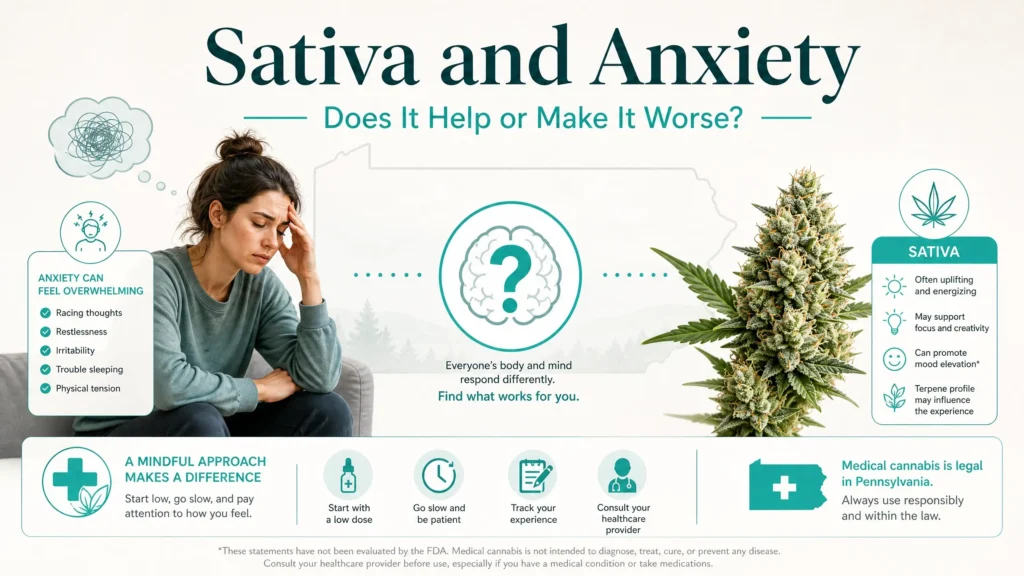

Two cannabis products can have the exact same THC percentage and feel completely different. One leaves you calm and clear-headed. The other sends your thoughts into overdrive.
The difference is usually not the THC. It’s the terpenes.
Need a PA Medical Marijuana Card?
Get certified online in 15 minutes. 100% Money-Back Guarantee.
Get Certified Now →Terpenes are the aromatic compounds that give cannabis — and hundreds of other plants — their distinctive smells. Lavender’s calming scent comes from linalool. Citrus peel gets its zing from limonene. Black pepper’s bite comes from beta-caryophyllene. These same compounds exist in cannabis, and a growing body of research suggests they do more than just smell good.
This guide breaks down the five best-researched terpenes for anxiety, what the most current science actually shows (including a white paper published April 28, 2026), which terpenes may make anxiety worse, and how to use this information practically when shopping at a Pennsylvania dispensary.
One important note before we begin: the research on terpenes and anxiety is promising but still developing. Most studies are preclinical — meaning they were conducted in animal models, not human clinical trials. Results in mice do not automatically translate to humans, and terpene effects vary by dose, delivery method, individual body chemistry, and the other compounds they’re consumed alongside. This guide presents what the science shows honestly, including where it is strong and where it remains limited.
What Are Terpenes and Why Do They Matter for Anxiety?

Terpenes are natural aromatic compounds produced in the resin glands (trichomes) of cannabis and hundreds of other plants. Cannabis alone produces over 150 distinct terpenes. They determine whether a strain smells like lemons, pine, lavender, pepper, or earth — and increasingly, research suggests they also meaningfully shape how cannabis affects the brain and nervous system.
Do You Qualify for a PA MMJ Card?
Connect with a licensed Pennsylvania state physician online from home.
For decades, terpenes were treated as irrelevant byproducts of cannabis chemistry — interesting for flavor and marketing but pharmacologically insignificant. That view has shifted substantially over the past five years as preclinical research began mapping the specific neurological pathways that terpenes act on.
For people managing anxiety, this matters for a concrete reason: two products with identical THC and CBD levels can produce very different experiences depending on which terpenes dominate the profile. A high-THC product rich in linalool may feel calming. The same THC level in a terpinolene-dominant product may feel stimulating and potentially anxiety-provoking.
Shopping by THC percentage alone — which most cannabis consumers still do — is the equivalent of choosing a medication based only on its dose without knowing what the drug actually is.
Terpenes interact with the body through several mechanisms:
- Direct receptor binding — Beta-caryophyllene is the best-documented example, binding directly to CB2 cannabinoid receptors
- Neurotransmitter modulation — Linalool modulates GABA-A receptors; limonene affects serotonin pathways
- Endocannabinoid system interaction — Myrcene may increase CB1 receptor permeability, affecting how THC is absorbed in the brain
- Olfactory pathway activation — Some terpenes appear to exert effects through smell alone, activating neural circuits via olfactory input without direct absorption
The Entourage Effect: Why Terpenes and Cannabinoids Work Together

Before covering individual terpenes, it helps to understand the framework that makes them relevant in the context of cannabis specifically.
The entourage effect is the hypothesis — first proposed by Israeli chemist Dr. Raphael Mechoulam in 1998, and supported by a growing body of preclinical evidence — that cannabinoids, terpenes, and other plant compounds work synergistically to produce effects that neither could achieve alone. A 2020 review published in the journal Frontiers in Psychiatry specifically examined the entourage effect in the context of mood and anxiety disorders, finding support for the idea that terpene-cannabinoid combinations outperform isolated cannabinoids for these conditions.
A 2021 study published in Scientific Reports provided animal model evidence that cannabis terpenes can selectively enhance cannabinoid activity — and that this interaction varies meaningfully by which terpene is present. A 2025 review in Pharmaceuticals cautioned that while the entourage effect is biologically plausible and supported in preclinical models, further human clinical trials are still needed to confirm its scope and consistency.
The practical takeaway: a full-spectrum cannabis product that preserves the plant’s natural terpene profile is likely to produce a different and, for many anxiety patients, more nuanced experience than an isolated THC product at the same dose.
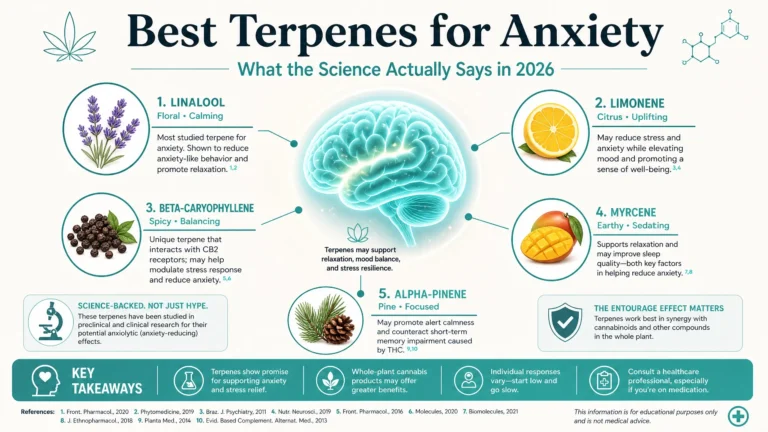
The 5 Best-Researched Terpenes for Anxiety

1. Linalool — The GABA Activator
Found in: Lavender, basil, coriander, some cannabis cultivars Aroma: Soft floral, lavender, light spice Anxiety mechanism: Modulates GABA-A receptors, the same receptor system targeted by benzodiazepines
Linalool is the most extensively studied terpene for anxiety, and the research is more specific than most people realize. It is not simply “relaxing” — it appears to activate a discrete neurological pathway.
⚡ Fast & 100% Online PA Medical Cards
Board-Certified Doctors • 100% Money-Back Guarantee
Book Evaluation Now →A 2018 study published in Frontiers in Behavioral Neuroscience demonstrated that inhaled linalool produced significant anxiolytic effects in mice through olfactory input — meaning it worked through smell, not just absorption. The effect was blocked by flumazenil, a benzodiazepine receptor antagonist, confirming the mechanism runs through GABA-A receptors sensitive to benzodiazepine binding. Critically, anosmic mice (those without the sense of smell) showed no anxiolytic effect from linalool exposure, establishing that olfactory input is required — not just chemical absorption.
A 2017 study in Frontiers in Chemistry confirmed that linalool and its metabolic products enhance GABAergic currents in an allosteric manner — essentially, they amplify the inhibitory signal that calms neural activity. This is the same signaling pathway that prescription anxiolytics work on, though linalool’s potency and mechanism are not equivalent to pharmaceutical-grade benzodiazepines.
A December 2024 peer-reviewed study in the journal NeuroSci — authored by researchers at Western Washington University and Abstrax Tech — found that linalool reduced anxiety-like behaviors in mice at cannabis-relevant exposure levels. The study also found that biological sex shaped the results meaningfully: female mice showed anxiolytic responses to repeated linalool exposure, while male mice showed comparable shifts primarily under single acute exposure. This sex-difference finding was highlighted in a white paper published April 28, 2026 (see the April 2026 section below).
Best for: Racing thoughts, mental tension, evening anxiety, difficulty unwinding Dispensary note: Look for linalool concentrations of 0.1% or higher on a COA terpene panel
2. Limonene — The THC Anxiety Buffer (Johns Hopkins Verified)
Found in: Citrus peel, lemons, limes, oranges, some cannabis cultivars Aroma: Bright citrus, lemon, orange peel Anxiety mechanism: Modulates serotonin and dopamine pathways; buffers THC-induced anxiety
Limonene is arguably the most clinically significant terpene for anxiety management in a cannabis context, thanks to landmark human research from Johns Hopkins University — one of the few terpene-anxiety studies conducted in actual humans rather than animal models.
In a double-blind, randomized, crossover clinical trial completed at the Johns Hopkins Behavioral Pharmacology Research Unit, 20 adult participants completed nine controlled vaporization sessions testing THC alone, d-limonene alone, and multiple combinations. The findings, published in Drug and Alcohol Dependence in April 2024, were clear: combining d-limonene with THC significantly reduced subjective ratings of “anxious/nervous” and “paranoid” compared to THC alone. These reductions were dose-dependent — higher doses of limonene produced greater reductions in anxiety. Importantly, limonene did not reduce THC’s desired analgesic or euphoric effects — it specifically dampened the anxiety response.
This has direct real-world implications for Pennsylvania medical marijuana patients who experience anxiety from higher-THC products: choosing limonene-rich formulations may reduce that side effect without sacrificing therapeutic benefit. Johns Hopkins researchers confirmed they are now testing oral administration of the THC-limonene combination in a Phase 1 clinical trial currently recruiting, building on the inhalation results.
Separate preclinical studies have found that limonene modulates activity in the hippocampus and prefrontal cortex, areas of the brain implicated in anxiety regulation. A study in Advances in Pharmacological Sciences found limonene exerted anti-anxiety effects by modulating neurotransmitter activity involving serotonin and dopamine pathways.
Best for: Anxiety that is stress-driven or mood-related; reducing THC-induced anxiety or paranoia; daytime use Dispensary note: Limonene-forward products tend to have citrusy, lemon-orange aromas. Look for products with limonene listed as a primary or secondary terpene on the COA.
3. Beta-Caryophyllene — The CB2 Receptor Terpene
Found in: Black pepper, cloves, cinnamon, rosemary, many cannabis cultivars Aroma: Spicy, peppery, woody, clove-like Anxiety mechanism: Directly binds and activates CB2 cannabinoid receptors — the only terpene known to do this
Renewing Your PA MMJ Card?
Quick annual recertification online. No paperwork hassle.
Renew Card Online →Beta-caryophyllene (BCP) is unique among terpenes. While most terpenes work indirectly through neurotransmitter pathways, BCP is the only known terpene that directly binds to a cannabinoid receptor — specifically, the CB2 receptor. Because CB2 receptors are concentrated in immune tissue rather than brain regions associated with psychoactivity, BCP can produce anxiolytic effects without intoxication. It is non-psychotropic.
A 2014 study in Physiology & Behavior tested BCP in multiple animal anxiety models — the elevated plus maze, open field test, and marble burying test. In all models, BCP at 50 mg/kg produced significant anxiolytic and antidepressant effects. Critically, pre-administration of AM630 (a CB2 receptor antagonist) completely blocked these effects, confirming that the mechanism runs through CB2 receptor activation. The researchers concluded that CB2 receptors may represent a viable alternative therapeutic target for both anxiety and depression.
A 2024 review in the International Journal of Molecular Sciences — published by researchers including psychiatrists at the University of Pisa — reviewed the accumulating evidence for BCP as an anxiolytic and antidepressant agent, highlighting its immunomodulatory and anti-inflammatory properties and its selectivity for CB2R, making it pharmacologically distinct from THC. A 2020 laboratory study in Natural Product Communications confirmed dose-dependent anxiolytic-like effects in animals.
For anxiety patients who are sensitive to THC’s psychoactive effects, beta-caryophyllene is a particularly compelling option — it may provide anxiety relief through the endocannabinoid system without any of the intoxicating effects associated with CB1 activation.
Best for: Anxiety combined with inflammation or pain; patients who are THC-sensitive or want non-intoxicating effects; evening use Dispensary note: BCP is one of the most abundant terpenes in many cannabis cultivars. Products with a peppery, spicy aroma are typically BCP-forward.
4. Myrcene — The Body Relaxer
Found in: Hops, thyme, lemongrass, mango, many cannabis cultivars Aroma: Earthy, musky, sometimes faintly fruity Anxiety mechanism: Sedative and muscle-relaxant properties; may enhance CB1 receptor permeability
Myrcene is consistently the most abundant terpene across cannabis cultivars, often accounting for a large share of a product’s total terpene content. Its associations with physical relaxation and sedation are well-documented, making it most relevant for anxiety that manifests as physical tension, restlessness, or the inability to physically unwind.
The December 2024 Western Washington University study — the same research that examined linalool — found that β-myrcene also produced anxiety-reducing behavioral effects in mice at cannabis-relevant exposure levels, though with a different sex-based pattern than linalool. Male mice showed stronger responses to myrcene under acute single-dose exposure, while the female response was more pronounced under repeated dosing protocols.
Preclinical research has documented myrcene’s ability to enhance sleep and relax muscles, which can reduce the physical tension component of anxiety indirectly. A 2021 study cited in the Scientific Reports entourage effect research also examined myrcene among terpenes that selectively enhance cannabinoid activity — consistent with the longstanding (though not fully confirmed) hypothesis that myrcene increases blood-brain barrier permeability, enabling THC to act more efficiently.
One practical note: myrcene is associated with sedation and “couch-lock” at higher doses. For patients managing anxiety that is primarily physical — muscle tension, restlessness, difficulty sleeping — myrcene-forward products are well-suited. For patients whose anxiety is primarily cognitive — racing thoughts, excessive worry, rumination — linalool or limonene may be more targeted options.
Best for: Physical tension and restlessness; anxiety that disrupts sleep; evening or nighttime use Dispensary note: Myrcene-dominant products have an earthy, musky aroma. Pairing with BCP (caryophyllene) can add a more balanced effect according to dispensary pharmacists.
5. Alpha-Pinene — The Focus and Calm Balancer
Get Approved by a Licensed PA Doctor
Schedule your appointment in minutes. You only pay if approved.
Start Online Application →Found in: Pine trees, rosemary, basil, cannabis Aroma: Fresh pine, forest air, crisp Anxiety mechanism: Binds to GABA-A benzodiazepine receptors; may counteract THC-induced cognitive impairment
Alpha-pinene is the most widely occurring terpene in nature and one of the more nuanced options for anxiety — because its effects are notably dose-dependent.
A 2014 PubMed study found that daily inhalation of alpha-pinene in mice produced consistent anxiolytic-like activity over five days without tolerance development. A subsequent study published in PubMed using inhaled alpha-pinene from a cypress essential oil source found that a therapeutic concentration produced anxiolytic-like effects, while a high concentration produced an excitatory-like effect. This dose-dependence is clinically important: at cannabis-relevant levels, alpha-pinene appears calming; at very high concentrations, it may become stimulating.
Alpha-pinene also has a notable secondary benefit for cannabis patients: it appears to counteract some of the short-term memory impairment associated with high THC levels. A 2025 review highlighted by Compassionate Certification Centers noted pinene’s role in boosting alertness and short-term recall, making it particularly relevant for patients who want daytime anxiety relief without cognitive fog. (Note: a separate Johns Hopkins study tested whether alpha-pinene could counteract THC-induced memory impairment and found no evidence supporting that claim in their specific protocol — this remains an area of active research.)
A comprehensive PMC review of pinene’s pharmacological activities confirmed that alpha-pinene displays sedative, hypnotic, and anxiolytic properties at therapeutic doses through GABA-A benzodiazepine receptor binding — the same family of receptors as linalool.
Best for: Daytime anxiety management; cognitive anxiety (mental fog, difficulty concentrating); use alongside higher-THC products where memory clarity matters Dispensary note: Products with a fresh pine aroma often contain higher alpha-pinene concentrations. Best suited for morning or daytime use rather than evenings.
April 2026: The Newest Research You Haven’t Seen Yet

On April 28, 2026, Abstrax and Western Washington University published a new white paper titled Moody Mice and Monoterpenes, distilling findings from their peer-reviewed NeuroSci study (PMC11676933) for cannabis formulators, brand developers, and researchers.
The release, published via GlobeNewswire, highlighted several findings that are directly relevant to anxiety patients:
Biological sex shapes terpene outcomes significantly. Repeated linalool inhalation produced measurable changes in stress-related behavioral markers in female mice. Male mice showed comparable shifts, but primarily under single acute exposure, not repeated dosing. This is one of the first preclinical studies to systematically account for sex as a biological variable in terpene research — a variable that has historically been overlooked.
Linalool + CBD produces a synergistic effect in females. When sub-effective doses of linalool were combined with CBD in female mice, the behavioral response was stronger than either compound produced alone. The same pattern was not observed with beta-myrcene or in male mice. This points toward sex-specific formulation implications for full-spectrum products targeting anxiety.
Ready to Get Your Official PA MMJ Card?
State-certified doctor consultations online. No risk—100% refund if not approved.
Claim Your MMJ Card Online →Locomotor data confirmed the effects were not sedation artifacts. The study specifically verified that the anxiolytic behavioral changes were not simply explained by sedation — meaning terpenes were producing targeted neurological activity rather than just making the mice less active overall.
This research is preclinical and conducted in mice. Human trials with these specific parameters are the necessary next step. But the specificity and rigor of this work — including its sex-disaggregated analysis and verification that locomotor effects don’t explain the results — makes it among the most methodologically solid terpene-anxiety research to date.
Terpenes That May Worsen Anxiety — What to Avoid

Just as certain terpenes appear to reduce anxiety, others are associated with stimulating or potentially anxiety-provoking effects. Understanding what to avoid is as important as knowing what to seek.
Terpinolene is the most commonly flagged terpene for anxiety-prone users. It tends to produce uplifting, energizing effects that can tip into overstimulation in people who are already anxious. Products with high terpinolene concentrations are frequently found in sativa-dominant cultivars marketed as “energizing.” For someone managing anxiety, these are generally not the right choice.
Guaiol, a sesquiterpenoid found in certain cannabis cultivars, is less commonly discussed but has also been flagged in dispensary practice as potentially worsening anxiety symptoms in sensitive users — particularly due to its stimulating character. If you find that certain products consistently make your anxiety worse even at low THC doses, checking the COA for terpinolene and guaiol is a useful diagnostic step.
Very high THC concentrations without terpene buffering remain one of the most reliable triggers for cannabis-induced anxiety. The Johns Hopkins limonene research demonstrated this clearly: limonene’s anxiety-reducing effect was most significant precisely because THC alone produced measurable anxiety. The terpene profile does not eliminate high-THC risk, but it modulates it. A product with 30% THC and a terpinolene-dominant profile is a significantly higher anxiety risk than the same THC level in a linalool-forward formulation.
Why Indica vs. Sativa Labels Are the Wrong Way to Shop?
This deserves direct acknowledgment because it affects how most cannabis patients — including PA MMJ patients — currently make product decisions.
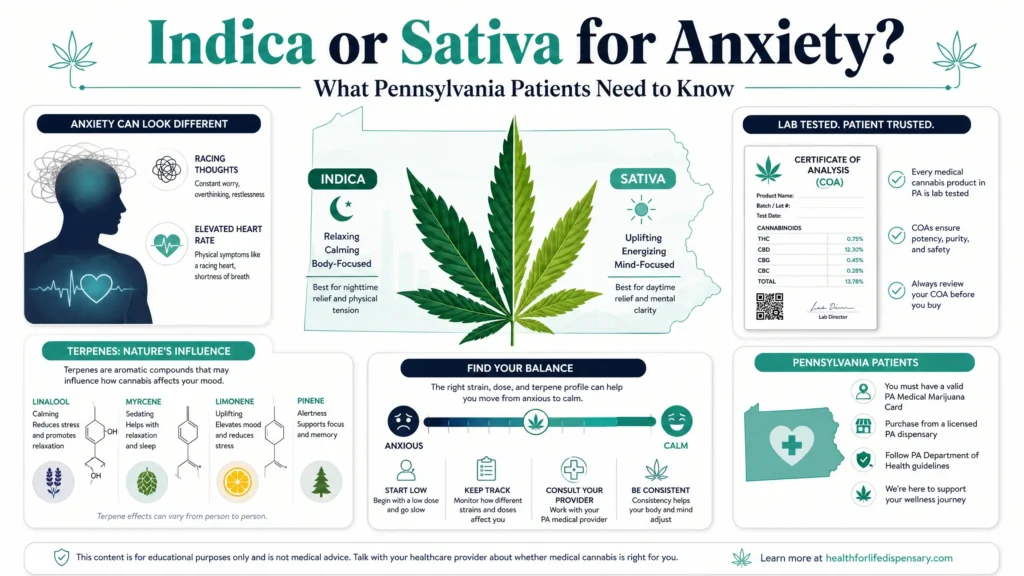
The indica/sativa distinction was originally a botanical classification based on plant morphology — leaf shape, plant height, geographic origin. It has no reliable pharmacological predictive value. Research analyzing thousands of cannabis samples has consistently found that strain names and indica/sativa labels do not predict chemical composition. Two products sold under the same strain name from different growers can have completely different cannabinoid and terpene profiles — and therefore produce different effects.
The modern, evidence-based approach uses chemovars — classification by actual chemical makeup. When choosing products for anxiety, focus on:
- Terpene profile (listed on the COA) — which terpenes are dominant and at what concentrations
- THC:CBD ratio — higher CBD relative to THC generally reduces anxiety risk
- Total THC concentration — lower is typically safer for anxiety-prone users until tolerance and individual response are established
A myrcene-dominant product labeled “sativa” may feel more sedating than a limonene-dominant product labeled “indica.” The label does not tell you that. The COA does.
How to Read a Terpene Profile at a PA Dispensary?

Pennsylvania state law requires all licensed dispensary products to carry a Certificate of Analysis (COA) — a third-party lab report that includes cannabinoid potency, terpene profile, and contaminant testing results — before they reach dispensary shelves. The PA Department of Health updated COA requirements in Q1 2025 to mandate expanded terpene profile reporting and lower detection thresholds.
This means every product at every licensed PA dispensary has a verifiable terpene profile. Here is how to use it:
Step 1: Request the COA. Many PA dispensary products have a QR code on the packaging that links directly to the lab report. If not, any budtender at a licensed Pennsylvania dispensary can pull the COA for any product on the shelf.
Step 2: Find the terpene panel. Terpenes are listed by name with their concentration, expressed as a percentage or in mg/g. The dominant terpene — listed first or at the highest concentration — is the strongest predictor of how the product will feel.
Step 3: Match terpenes to your anxiety type.
| Anxiety Type | Best Terpenes to Look For | Terpenes to Avoid |
|---|---|---|
| Racing thoughts, mental tension | Linalool, alpha-pinene | Terpinolene, guaiol |
| Physical tension, restlessness | Myrcene, beta-caryophyllene | Terpinolene |
| THC-induced anxiety/paranoia | Limonene | High-THC without terpene buffering |
| Stress and low mood | Limonene, linalool | Terpinolene |
| Evening / sleep-related anxiety | Myrcene, linalool | Terpinolene, high alpha-pinene |
| Daytime anxiety without cognitive fog | Alpha-pinene, limonene | Myrcene (high dose) |
Step 4: Start low on THC. Regardless of terpene profile, if you are anxiety-prone and new to a product, start at the lowest available dose and wait to assess the full effect before consuming more. The Johns Hopkins research confirmed that limonene’s buffering effect is dose-dependent — but high enough THC can still be anxiogenic even with limonene present.
Step 5: Keep a simple record. Note the COA batch number, dominant terpenes, THC/CBD levels, and how the product made you feel. Over two to three sessions, patterns will become clear, allowing you to shop with increasing precision.
Is Anxiety a Qualifying Condition for a PA MMJ Card?

Yes. Anxiety disorder is one of Pennsylvania’s 24 recognized qualifying conditions for medical marijuana under Act 16 of 2016. In fact, it is the most common qualifying condition in the state — cited in approximately 60% of all Pennsylvania MMJ certifications.
If you are managing anxiety and want access to the full range of terpene-rich medical cannabis products at licensed PA dispensaries — including full-spectrum flower, vapes, tinctures, and concentrates with verified COA terpene profiles — you need a valid PA MMJ card.
You can read more about how anxiety disorder qualifies for a PA medical marijuana card here, including which types of anxiety disorders qualify and what the physician evaluation covers.
The certification process is fully online via telehealth with Dr. Johnathon Chance Miller, MD, and is completed the same day. Pricing is as follows:
| Physician Fee | PA State Fee | Total | |
|---|---|---|---|
| New Patient Certification | $159 | $50 | $209 |
| Renewal Certification | $149 | $50 | $199 |
| MMAP Qualifying Patients (Medicaid, SNAP, WIC, CHIP, PACE, PACENET) | — | $0 (waived) | Physician fee only |
If you are ready to begin, you can start your same-day telehealth certification here.
FAQ Schema — Terpenes for Anxiety
Q: What are the best terpenes for anxiety?
A: The five best-researched terpenes for anxiety are linalool, limonene, beta-caryophyllene, myrcene, and alpha-pinene. Linalool works by activating GABA-A receptors — the same pathway as benzodiazepines — and is documented in peer-reviewed research to reduce anxiety-like behaviors through olfactory input. Limonene was confirmed in a Johns Hopkins human clinical trial (2024) to reduce THC-induced anxiety and paranoia dose-dependently. Beta-caryophyllene binds directly to CB2 cannabinoid receptors and reduces anxiety without psychoactive effects. Myrcene promotes physical relaxation and is best for anxiety that presents as body tension. Alpha-pinene binds to GABA-A receptors and may support daytime clarity alongside anxiety reduction.
Q: Which terpenes make anxiety worse?
A: Terpinolene is the most commonly identified terpene that may worsen anxiety. It tends to produce stimulating, energizing effects that can tip into overstimulation in anxiety-prone individuals. Guaiol is another sesquiterpenoid associated with potentially anxiety-worsening effects in sensitive users. Very high THC concentrations without balancing terpenes — especially linalool, limonene, or beta-caryophyllene — remain one of the most reliable triggers for cannabis-induced anxiety regardless of the product’s terpene profile.
Q: How do I find terpene information at a Pennsylvania dispensary?
A: Pennsylvania state law requires all licensed dispensary products to carry a Certificate of Analysis (COA) before sale. The COA lists the full terpene profile by compound and concentration. Many PA dispensary products include a QR code on packaging that links directly to the lab report. If not, ask the budtender to pull the COA for any product. The PA Department of Health updated COA requirements in Q1 2025 to mandate expanded terpene profile reporting across all licensed growers and processors. You can also request a COA at the point of purchase at any Pennsylvania licensed dispensary.
Medical Disclaimer
This blog post is intended for general educational and informational purposes only and does not constitute medical advice. The majority of research cited in this article consists of preclinical studies conducted in animal models. Results from animal studies do not always translate directly to human outcomes, and individual responses to terpenes vary significantly. Medical marijuana is not appropriate for everyone. Always consult a licensed physician before making changes to your treatment plan. Anxiety disorders are serious medical conditions — if you are experiencing significant anxiety, panic attacks, or impaired daily functioning, please seek professional clinical evaluation. Medically reviewed by Dr. Johnathon Chance Miller, MD.
Sources
All sources verified as of April 2026. Links open verified external pages for your review.
- Abstrax / Western Washington University — “Moody Mice and Monoterpenes” White Paper (April 28, 2026)
- Wagner et al. — “Sex Differences in the Anxiolytic Properties of Common Cannabis Terpenes, Linalool and β-Myrcene, in Mice” — NeuroSci, December 2024 (PMC11676933)
- Johns Hopkins Medicine — “Researchers Show Chemical Found Naturally in Cannabis May Reduce Anxiety-Inducing Effects of THC” (April 2024)
- ScienceDaily — “Chemical Found Naturally in Cannabis May Reduce Anxiety-Inducing Effects of THC” (April 2024 / reviewed April 2026)
- ClinicalTrials.gov — NCT06378957: Behavioral Pharmacology of Orally Administered THC and D-limonene (Johns Hopkins, currently recruiting 2026)
- Harada et al. — “Linalool Odor-Induced Anxiolytic Effects in Mice” — Frontiers in Behavioral Neuroscience (2018) — PMC6206409
- Milanos et al. — “Metabolic Products of Linalool and Modulation of GABAA Receptors” — Frontiers in Chemistry (2017)
- Bahi et al. — “β-Caryophyllene, a CB2 Receptor Agonist Produces Multiple Behavioral Changes Relevant to Anxiety and Depression in Mice” — Physiology & Behavior (2014)
- Scandiffio et al. — “Beta-Caryophyllene, a Cannabinoid Receptor Type 2 Selective Agonist, in Emotional and Cognitive Disorders” — International Journal of Molecular Sciences (March 2024) — PMC10970213 2024 peer-reviewed review of BCP’s therapeutic potential for anxiety and depression via CB2R; underscores non-psychotropic anxiolytic mechanism.
- Machado et al. — “Anxiety Therapeutic Interventions of β-Caryophyllene: A Laboratory-Based Study” — Natural Product Communications (2020)
- Kasuya et al. — “Daily Inhalation of α-Pinene in Mice: Effects on Behavior and Organ Accumulation” — PubMed (2014)
- Kasuya et al. — “Intracerebral Distribution of α-Pinene and the Anxiolytic-Like Effect in Mice Following Inhaled Administration” — PubMed (2015)
- LaVigne et al. — “Cannabis sativa Terpenes Are Cannabimimetic and Selectively Enhance Cannabinoid Activity” — Scientific Reports (2021) — PMC8050080
- Ferber et al. — “The Entourage Effect: Terpenes Coupled with Cannabinoids for the Treatment of Mood Disorders and Anxiety Disorders” — Frontiers in Psychiatry (2020)
- Borrelli et al. — “The Entourage Effect in Cannabis Medicinal Products: A Comprehensive Review” — Pharmaceuticals (2025) — PMC11870048
- Pennsylvania Medicinal Cannabis COA Requirements — PA DOH / Pennsylvania Cannabis Industry Resource (updated 2025–2026)
- Terrapin Care Station — Glossary of Pennsylvania Cannabis Terms (February 2026)