
You walk up to the menu screen at a Pennsylvania dispensary and there it is. Flower. Oil. Tincture. Capsules. Vapes. Concentrates. Topicals. Each one with a dozen variations underneath it.
If your first thought is “I just want something that helps with my condition, why is this so complicated,” you’re reacting the way almost every new patient does.
Need a PA Medical Marijuana Card?
Get certified online in 15 minutes. 100% Money-Back Guarantee.
Get Certified Now →Here’s the thing. The menu looks complicated because it’s covering a lot of ground at once, but the actual decision usually comes down to just a few questions. Once you know what those questions are, the menu stops being overwhelming and starts being useful.
This guide walks through the four formats new patients ask about most: flower, oil, tincture, and capsules. What each one actually is, how fast it works, how long it lasts, and a simple framework for figuring out which one fits your situation.
Key Takeaways
- Flower (vaporized) works fastest, in 1 to 5 minutes, but the effects fade in 2 to 3 hours. Good for acute symptoms that come on quickly.
- Tinctures are sublingual drops with a calibrated dropper. Onset is 15 to 45 minutes, with the most precise drop-by-drop dosing of any format.
- Oils are typically swallowed (often from a graduated oral syringe), with a slower onset of 45 to 90 minutes but a longer duration of 4 to 8 hours, similar to capsules.
- Capsules offer the most consistent, no-guesswork dosing. Same onset and duration as oil, but pre-measured every time, like any other pill.
- Pennsylvania law requires flower to be vaporized, never smoked, and dispensaries cannot sell gummies or traditional food-based edibles.
- Many patients don’t pick just one. A common approach is a capsule or oil as a daily baseline, with flower kept on hand for breakthrough symptoms.
The Three Questions That Actually Matter
Before getting into each format individually, here are the three questions worth answering for yourself first. Everything else in this guide builds on these.

1. How fast do you need relief?
If your symptoms come on suddenly and you need something to work within minutes, that points toward flower. If you’re managing something more ongoing, where waiting 30 to 90 minutes is fine, your options open up considerably.
2. How long do you want the effect to last?
Do You Qualify for a PA MMJ Card?
Connect with a licensed Pennsylvania state physician online from home.
A couple of hours, or most of the day or night? This is often the single biggest factor in choosing between flower and the other three formats.
3. How important is exact, repeatable dosing to you?
Some patients want to feel out their dose and adjust drop by drop. Others want to take the exact same thing every time without thinking about it. Both are completely valid, they just point toward different formats.
Keep these three questions in mind as you read through the formats below.
Flower: Fast On, Fast Off

Flower is what most people picture when they think of cannabis: the dried plant material itself.
In Pennsylvania, flower must be used in a dry-herb vaporizer. Smokable cannabis flower remains illegal in PA even for medical patients, so whatever device you use, it needs to heat the flower without combustion.
How it works: When vaporized and inhaled, cannabinoids enter your bloodstream through your lungs almost immediately.
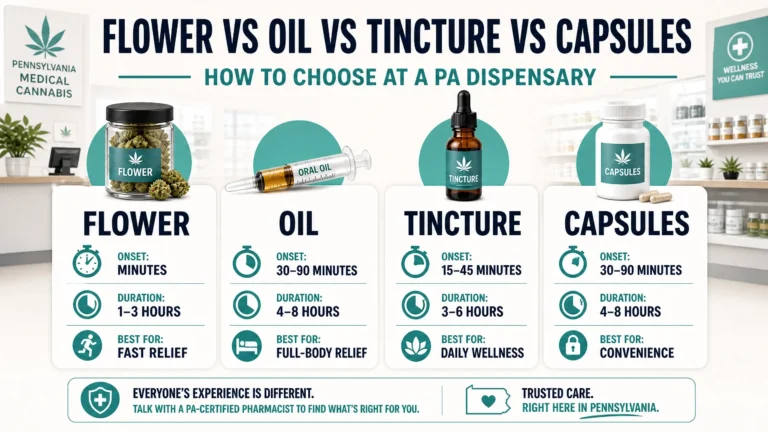
- Onset: 1 to 5 minutes
- Duration: 2 to 3 hours
- Dosing precision: Moderate.
You can control how much you inhale, but exact milligram dosing is harder to pin down than with the other formats.
One label quirk worth knowing: flower labels show both a THC% and a THCA% number. THCA is the non-active form that converts to THC when heated. The THCA number is usually the bigger one, and it’s the one that tells you how potent the flower will actually be once vaporized.
Best for: Symptoms that flare up and need fast relief, situations where you want to feel the effect build gradually so you can stop at the right point, and patients who are comfortable using a vaporizer device.
Less ideal for: Anyone who needs all-day or overnight coverage from a single dose, or anyone who’d rather not deal with a device at all.
Tincture: The Precision Tool

⚡ Fast & 100% Online PA Medical Cards
Board-Certified Doctors • 100% Money-Back Guarantee
Book Evaluation Now →Tinctures are liquid cannabis extracts, traditionally suspended in alcohol or MCT oil, that you take with a dropper under your tongue.
This isn’t a new invention. Cannabis tinctures were listed in the U.S. Pharmacopeia until 1942, and they’ve quietly remained a favorite among patients who want smoke-free, precise dosing.
How it works: Held under the tongue for 30 to 60 seconds, a portion of the cannabinoids absorb directly through the mucous membranes, bypassing some of the digestive process. The rest gets swallowed and absorbed more slowly, similar to an edible.
- Onset: 15 to 45 minutes
- Duration: 3 to 5 hours
- Dosing precision: Very high.
The calibrated dropper lets you adjust your dose in small increments, drop by drop, which makes tinctures the easiest format to fine-tune over time.
Best for: Patients who want to start low and titrate upward gradually, anyone who wants a smoke-free option with a moderate wait time, and patients who like having fine control over exactly how much they take.
Less ideal for: Anyone who finds the taste of alcohol-based tinctures unpleasant (MCT oil-based versions are usually milder), or anyone who wants the fastest possible onset.
Oil: The Slow, Steady Option

This is the format that confuses people most, mostly because “oil” sounds like it should be the same thing as a tincture. It isn’t quite.
At many PA dispensaries, oral cannabis oil comes in a graduated oral syringe or a dropper bottle meant to be swallowed rather than held under the tongue. Oral cannabis products are processed through the digestive system, which is what gives them their longer, slower profile.
How it works: Swallowed oil travels through your digestive system and liver before reaching your bloodstream, similar to how an edible works. This takes longer but produces effects that last considerably longer too.
- Onset: 45 to 90 minutes
- Duration: 4 to 8 hours
- Dosing precision: High.
Oral syringes typically have clear graduated markings, so you can measure consistent amounts, though not quite as finely adjustable drop by drop as a sublingual tincture.
Best for: Patients managing more persistent symptoms who want longer coverage from a single dose, overnight use, and patients who are comfortable waiting for onset in exchange for not needing a second dose later.
Renewing Your PA MMJ Card?
Quick annual recertification online. No paperwork hassle.
Renew Card Online →Less ideal for: Anyone who needs something to work quickly, or anyone new to cannabis who hasn’t yet learned how a slower-onset product affects them (the “wait, did that work?” question leads some new patients to take more before the first dose has even kicked in).
Capsules: Set It and Forget It

Capsules are exactly what they sound like: cannabis extract, pre-measured and sealed into a swallowable capsule, just like any other pill.
Capsules are precision-dosed using extraction methods designed for consistency, which means the capsule you take today should be functionally identical to the one you take next week.
How it works: Same as oil. Swallowed, digested, absorbed through the liver, producing a slower onset and longer duration.
- Onset: 45 to 90 minutes
- Duration: 4 to 8 hours
- Dosing precision: Highest of any format.
There’s nothing to measure. Every capsule of a given product is the same.
Best for: Patients who already manage other conditions with daily pills and want cannabis to fit into that same routine, anyone who wants zero guesswork, overnight or all-day symptom management, and patients who want a format with no taste and maximum discretion.
Less ideal for: Anyone who wants to adjust their dose in small increments without buying a different product, or anyone who needs fast-acting relief.
Side-by-Side Comparison

| Format | Flower (vaporized) | Tincture | Oil | Capsules |
|---|---|---|---|---|
| Onset | 1–5 minutes | 15–45 minutes | 45–90 minutes | 45–90 minutes |
| Duration | 2–3 hours | 3–5 hours | 4–8 hours | 4–8 hours |
| Dosing precision | Moderate | Very high (drop by drop) | High (graduated syringe) | Highest (pre-measured) |
| Discretion | Lower (needs a device) | High | High | Highest |
| Taste | Cannabis flavor | Varies (alcohol or MCT) | Minimal | None |
| Requires equipment | Yes (vaporizer) | No | No | No |
| Good for beginners | If comfortable vaping | Yes | Yes | Yes |
A Simple Decision Framework
If you’re still not sure where to start, here’s a quick way to think about it based on your priority.
If your top priority is speed: Start with flower. Nothing else gets there as fast.
If your top priority is fine-tuning your dose over time: Start with a tincture. The dropper makes it easy to nudge your dose up or down session by session until you find your spot.
If your top priority is long, steady coverage without re-dosing: Oil or capsules. Both last 4 to 8 hours, so this is the difference between needing one dose for a workday or an overnight, versus several smaller doses throughout the day.
Get Approved by a Licensed PA Doctor
Schedule your appointment in minutes. You only pay if approved.
Start Online Application →If your top priority is simplicity and consistency: Capsules. If you already take other medication on a schedule, capsules slot into that routine without anything new to learn.
If you’re not sure and just want to start somewhere low-risk: Tinctures or capsules are generally the easiest entry points for new patients. Both avoid inhalation, both have predictable effects, and both let you start with a small amount and adjust from there.
Why Many Patients Use More Than One Format

This is something a lot of first-timers don’t expect, but it’s extremely common once patients get a feel for how different formats work for them.
A typical pattern looks like this: a capsule or oil dose in the evening for steady overnight relief, with flower kept on hand for daytime situations where something flares up and needs faster attention. Or a tincture used daily for baseline management, with a vape or flower option available for occasional, more intense symptoms.
There’s nothing wrong with starting simple, picking one format, and seeing how it goes. But if you find yourself thinking “this works, but not for everything,” that’s often a sign that a second format addressing a different need, fast versus long-lasting, might round things out. This is exactly the kind of question a dispensary pharmacist can help with, and every licensed PA dispensary has one on staff.
What About Vapes, Concentrates, and Topicals?
This guide focuses on the four formats new patients ask about most, but PA dispensary menus include a few others worth knowing about briefly.
Vape cartridges work similarly to flower in terms of onset and duration (fast on, fast off), but in a prefilled, no-grinding format. A common choice for patients who want flower’s speed with more convenience.
Concentrates (wax, shatter, live resin, live rosin) are higher-potency extracts vaporized using compatible devices. These are generally recommended for patients with more cannabis experience, given their strength. If you’re curious about the difference between resin and rosin specifically, this guide breaks it down.
Topicals (creams, balms, lotions) are applied directly to the skin for localized effects, typically working within minutes and lasting one to two hours. Because they’re absorbed locally rather than entering the bloodstream broadly, topicals generally don’t produce the psychoactive effects associated with other formats. These are worth asking about specifically if your main concern is localized pain or inflammation rather than a more systemic symptom.
One format you won’t find at PA dispensaries: traditional gummies and food-based edibles. Pennsylvania’s Medical Marijuana Act does not permit dispensaries to sell these, so capsules and oils are the closest equivalents for patients who’d otherwise reach for an edible.
FAQs — Flower vs Oil vs Tincture vs Capsules
Q: What’s the difference between oil and tincture at a PA dispensary?
Ready to Get Your Official PA MMJ Card?
State-certified doctor consultations online. No risk—100% refund if not approved.
Claim Your MMJ Card Online →A: Both are liquid cannabis extracts, but they’re used differently. Tinctures are designed for sublingual use, held under the tongue for 30 to 60 seconds before swallowing, with an onset of 15 to 45 minutes. Oil typically comes in a graduated oral syringe meant to be swallowed directly, with a slower onset of 45 to 90 minutes but a longer duration of 4 to 8 hours, similar to capsules. Tinctures allow finer drop-by-drop dose adjustments, while oil tends to favor consistent, longer-lasting doses.
Q: What is the fastest-acting cannabis product at a PA dispensary?
A: Vaporized flower is the fastest, with effects typically felt within 1 to 5 minutes. This is because inhaled cannabinoids enter the bloodstream through the lungs almost immediately. However, flower’s effects also fade fastest, lasting about 2 to 3 hours. Pennsylvania law requires flower to be vaporized rather than smoked.
Q: Which cannabis product format is best for beginners in Pennsylvania?
A: Tinctures and capsules are generally considered the easiest starting points for new patients. Both avoid inhalation and have predictable, repeatable effects. Tinctures allow drop-by-drop dose adjustments using a calibrated dropper, which is useful for finding your starting dose. Capsules offer the most consistent, pre-measured dosing with no guesswork, similar to any other daily medication.
Q: How long do cannabis capsules last compared to flower?
A: Cannabis capsules typically last 4 to 8 hours, compared to 2 to 3 hours for vaporized flower. This is because capsules are swallowed and processed through the digestive system and liver, which produces a slower onset (45 to 90 minutes) but a much longer duration than inhaled products.
Q: Can you buy gummies or edibles at a Pennsylvania dispensary?
A: No. Pennsylvania’s Medical Marijuana Act does not permit licensed dispensaries to sell traditional food-based edibles like gummies, chocolates, or baked goods. Capsules and oral oils are the closest available alternatives for patients seeking a swallowed, long-lasting product format.
Q: Is it normal to use more than one cannabis product format as a medical patient?
A: Yes, this is extremely common. A typical approach is using a capsule or oil as a daily baseline dose for steady, long-lasting relief, while keeping flower or a vape on hand for situations that need faster-acting relief. Dispensary pharmacists, who are required on staff at every licensed PA dispensary, can help patients figure out whether combining formats makes sense for their specific symptoms.
Q: What does the THCA percentage mean on PA dispensary flower labels?
A: THCA is the non-active precursor to THC that converts to active THC when the flower is heated through vaporization. Flower labels typically show both a THC% (the already-active amount) and a THCA% (which is usually much higher). The THCA percentage is generally the more meaningful number for predicting how potent vaporized flower will actually feel.
Medical Disclaimer
This blog post is intended for general educational and informational purposes only and does not constitute medical advice. Onset and duration times are general ranges and can vary based on individual metabolism, dose, and other factors. Always start with a low dose when trying a new product or format, and consult a licensed dispensary pharmacist or your certifying physician with specific questions about which product format may be right for your condition. Medically reviewed by Dr. Johnathon Chance Miller, MD.