
If you’re living with anxiety, PTSD, or depression, you’ve probably noticed that not every cannabis product affects you the same way. Some leave you calm and clear-headed. Others send your thoughts racing. That difference is not random, it comes down to the specific strain, its cannabinoid profile, and, critically, its terpene content.
This guide breaks down the best strains for mood disorders in plain language, explains the science behind why certain strains work better than others, and shows Pennsylvania patients how to navigate the state’s medical marijuana program to access these products legally.
Need a PA Medical Marijuana Card?
Get certified online in 15 minutes. 100% Money-Back Guarantee.
Get Certified Now →What Are Mood Disorders — and Which Ones Qualify in Pennsylvania?

Mood disorders are a category of mental health conditions that primarily affect a person’s emotional state. They include depression, anxiety disorders, bipolar disorder, PTSD, and related conditions that disrupt how you feel, think, and function day to day.
According to the National Institute of Mental Health, more than one in five U.S. adults lives with a mental illness in any given year. Mood disorders represent some of the most prevalent and most undertreated, conditions in that group.
Pennsylvania’s medical marijuana program, established under Act 16 of 2016, recognizes several mood-related qualifying conditions:
| Mood-Related Condition | Qualifies in PA? |
|---|---|
| Anxiety Disorders (GAD, Panic Disorder, Social Anxiety, OCD) | ✅ Yes — added July 2019 |
| Post-Traumatic Stress Disorder (PTSD) | ✅ Yes — listed in Act 16 |
| Depression (standalone) | ❌ No — not a listed condition |
| Bipolar Disorder (standalone) | ❌ No — not a listed condition |
One important clarification: Depression and bipolar disorder are not standalone qualifying conditions in Pennsylvania. However, many patients with depression or bipolar disorder also experience qualifying anxiety symptoms, or have a co-occurring PTSD diagnosis, which may still make them eligible. Your best path is an honest conversation with a certified physician who can review your full health picture.
Do You Qualify for a PA MMJ Card?
Connect with a licensed Pennsylvania state physician online from home.
You can review the complete list of Pennsylvania’s 24 qualifying conditions here.
How Cannabis Affects Mood: The Endocannabinoid System

To understand why strains affect mood differently, you need to understand the endocannabinoid system (ECS), a network of receptors throughout your brain and body that regulates mood, stress response, sleep, and emotional balance.
Your body produces its own cannabinoids naturally. Cannabis introduces plant-based cannabinoids, primarily THC and CBD, that interact with this same system.
THC (Tetrahydrocannabinol) activates CB1 receptors in the brain, influencing dopamine and serotonin, the chemicals most directly tied to mood and motivation. In low doses, THC can produce euphoria and emotional relief. In high doses, especially in anxiety-prone individuals, it can trigger increased anxiety, paranoia, or emotional dysregulation.
CBD (Cannabidiol) works more indirectly. It doesn’t bind strongly to CB1 or CB2 receptors but influences serotonin signaling and reduces the psychoactive intensity of THC. Multiple studies have shown CBD has anxiolytic (anti-anxiety) and antidepressant-like effects, particularly when combined with the right terpenes.
The relationship between cannabinoids and mood is well-documented but nuanced. A 2015 systematic review published in Neuropsychopharmacology found that CBD demonstrated significant anti-anxiety effects in both human and animal studies across multiple anxiety disorder types.
Terpenes: The Hidden Key to Mood-Oriented Strain Selection

Most patients focus entirely on THC percentage when choosing a strain. That’s understandable, it’s the number dispensaries display most prominently. But for mood disorders, terpenes may matter just as much, if not more.
Terpenes are the aromatic compounds in cannabis that give each strain its distinctive smell. They also interact with your brain’s neurotransmitter systems in ways that meaningfully shape the emotional effect of a strain.
Here are the four terpenes most relevant to mood disorders:
Limonene
Found in citrus-forward strains, limonene is associated with mood elevation and stress reduction. Research in animal models has shown that limonene treatment increased dopamine levels in the brain’s striatum and upregulated key proteins linked to emotional regulation.
⚡ Fast & 100% Online PA Medical Cards
Board-Certified Doctors • 100% Money-Back Guarantee
Book Evaluation Now →A 2024 study also demonstrated that limonene can specifically counteract THC-induced anxiety, making high-limonene strains particularly useful for anxiety-prone patients who still want some THC benefit.
Strains high in limonene: Super Lemon Haze, Jack Herer, Durban Poison, Tangie
Linalool
This is the same compound found in lavender and is widely associated with calm and anxiety relief. A peer-reviewed study in Frontiers in Psychiatry found that both linalool and β-pinene showed antidepressant-like effects in animal models through interaction with the monoaminergic system, the same system targeted by many antidepressant medications. Research also shows that linalool can reduce cortisol levels, the body’s primary stress hormone.
Strains high in linalool: Lavender, Do-Si-Dos, Amnesia Haze, LA Confidential
Beta-Caryophyllene
A peppery, spicy terpene found in black pepper and many cannabis strains. What makes it unique is that it acts as a selective agonist at CB2 receptors, meaning it can interact directly with the endocannabinoid system in a way most other terpenes cannot.
Research suggests CB2 receptor activity plays a role in mood and anxiety regulation. Caryophyllene may also soften the anxiety-provoking edge of high-THC strains.
Strains high in beta-caryophyllene: Girl Scout Cookies, OG Kush, Blue Dream, Gelato
Myrcene
The most common cannabis terpene, myrcene is responsible for the heavy, sedating “couch-lock” effect associated with many indica strains. It promotes physical relaxation and may enhance THC absorption across the blood-brain barrier.
For mood disorders, myrcene can be beneficial for nighttime anxiety and sleep-related PTSD symptoms but can worsen low motivation and fatigue if used during the day.
Strains high in myrcene: Northern Lights, Granddaddy Purple, Blue Dream, Mango Kush
Best Cannabis Strains for Anxiety

For anxiety, the goal is calming without mental cloudiness. High-THC strains without adequate CBD or calming terpenes can backfire, temporarily increasing the very anxiety you’re trying to reduce.
Renewing Your PA MMJ Card?
Quick annual recertification online. No paperwork hassle.
Renew Card Online →What to look for: Balanced THC:CBD ratios or CBD-dominant products. Prioritize linalool, limonene, and moderate caryophyllene in the terpene panel.
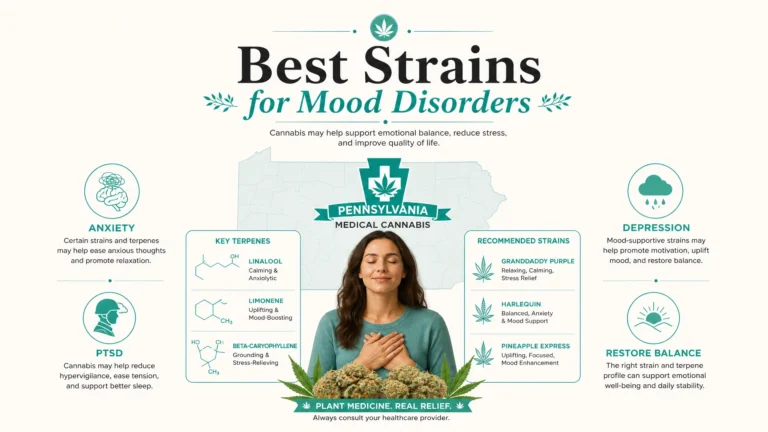
| Strain | Type | Key Terpenes | Best For |
|---|---|---|---|
| Blue Dream | Sativa-dominant hybrid | Caryophyllene, myrcene, pinene | Daytime calm without sedation |
| Harlequin | High-CBD hybrid | Myrcene, pinene, caryophyllene | Daytime anxiety, minimal psychoactivity |
| Northern Lights | Indica | Myrcene, caryophyllene | Nighttime anxiety, sleep support |
| ACDC | High-CBD strain | Myrcene, pinene | Anxious patients who want zero intoxication |
| Jack Herer | Sativa-dominant | Limonene, caryophyllene, pinene | Uplifted mood with mental clarity |
Blue Dream is one of the most consistently recommended strains for anxiety. It delivers a mood boost and gentle invigoration without the heavy sedation of a pure indica or the racing thoughts some patients get from strong sativas. Its balanced profile makes it forgiving for new patients.
Harlequin is worth highlighting because its high CBD content means it can take the edge off anxiety without significant intoxication, making it suitable for daytime use at work or while managing responsibilities.
Best Cannabis Strains for PTSD
PTSD involves a distinct set of symptoms: intrusive memories, nighttime hyperarousal, nightmares, and emotional numbing. Strain selection for PTSD tends to differ from general anxiety.
Research, including a study published in the Journal of Psychoactive Drugs, has found that cannabis may help reduce the severity of PTSD symptoms including nightmares and hyperarousal, particularly through THC’s interaction with memory consolidation during sleep.
What to look for: Indica-dominant or balanced hybrids for evening and nighttime use. Strains with myrcene, linalool, and caryophyllene for sleep and trauma-response regulation. Lower-THC options for daytime management.
| Strain | Type | Key Terpenes | Best For |
|---|---|---|---|
| Granddaddy Purple | Indica | Myrcene, caryophyllene, linalool | Nighttime, nightmare reduction, sleep |
| OG Kush | Indica-dominant hybrid | Caryophyllene, myrcene, limonene | Stress relief, emotional grounding |
| Girl Scout Cookies | Hybrid | Caryophyllene, linalool, limonene | Balanced day-to-evening use |
| Pineapple Express | Sativa-dominant hybrid | Caryophyllene, limonene | Daytime mood elevation |
For PTSD, many patients benefit from separating their day and night strains. A balanced hybrid like Girl Scout Cookies for daytime, and an indica like Granddaddy Purple for sleep, is a common framework that dispensary pharmacists in Pennsylvania regularly recommend.
Best Cannabis Strains for Depression
This section requires an honest clarification upfront: depression is not a standalone qualifying condition in Pennsylvania’s medical marijuana program. If your primary diagnosis is major depressive disorder without accompanying anxiety or PTSD, you may not qualify for a PA MMJ card based on that diagnosis alone.
That said, depression is extremely common as a co-occurring condition alongside anxiety disorders and PTSD, both of which do qualify in Pennsylvania. Many patients managing depression find cannabis helpful as part of a broader treatment plan that includes therapy and, where appropriate, medication.
For depression symptoms, low energy, emotional flatness, loss of motivation, sativa-dominant and limonene-rich strains tend to be most frequently reported as helpful.
What to look for: Strains high in limonene and pinene for an uplifting, energizing effect. Avoid heavy myrcene during the day, as sedation can compound low-energy depression symptoms.
| Strain | Type | Key Terpenes | Best For |
|---|---|---|---|
| Jack Herer | Sativa-dominant | Limonene, pinene, caryophyllene | Morning motivation, mood lift |
| Super Lemon Haze | Sativa-dominant | Limonene, caryophyllene | Energy, creativity, emotional uplift |
| Sour Diesel | Sativa-dominant | Caryophyllene, limonene, myrcene | Fast-acting mood elevation |
| Durban Poison | Pure sativa | Terpinolene, myrcene, ocimene | Clear-headed focus and energy |
| Gelato | Hybrid | Caryophyllene, limonene, linalool | Balanced euphoria without heavy sedation |
Get Approved by a Licensed PA Doctor
Schedule your appointment in minutes. You only pay if approved.
Start Online Application →Sour Diesel is a classic for a reason. Its fast-acting, cerebral effects have made it a go-to for patients who describe depression as mental fog or emotional flatness. It won’t work for everyone, but its energy-forward profile makes it worth discussing with a dispensary pharmacist.
Indica vs. Sativa vs. Hybrid: Does the Label Actually Matter?
Dispensary menus still organize products by indica, sativa, and hybrid but cannabis science has moved beyond this framework. The reality is that the indica/sativa distinction is a rough approximation of growth characteristics, not a precise predictor of effects.
What actually drives the effect of a strain is its full cannabinoid and terpene profile. Two strains both labeled “sativa” can produce dramatically different experiences if their terpene compositions are different.
That said, the general heuristics are useful as a starting point:
- Indica-dominant strains tend to be higher in myrcene and produce more sedating, body-focused effects — better for nighttime use, sleep, and physical tension.
- Sativa-dominant strains tend to be higher in limonene and terpinolene and produce more uplifting, energizing effects — better for daytime mood support.
- Hybrids land across a wide spectrum and often represent the most versatile options for mood disorders.
The most important advice: ask to see the terpene panel on any product you’re considering at a Pennsylvania dispensary. Most licensed PA dispensaries now provide this information, and dispensary pharmacists can guide your selection based on your specific symptoms.
Read More: Indica or Sativa: What’s the Difference for Pennsylvania MMJ Patients?
Important Risks: When Cannabis Can Worsen Mood Symptoms

This section matters. No guide on cannabis and mood disorders is complete without an honest look at the risks.
High-THC strains and anxiety: For patients already prone to anxiety, strains with very high THC content (above 20-25%) and limited CBD or calming terpenes can worsen rather than relieve anxiety symptoms. The same THC that provides euphoria in a calm environment can intensify anxious thoughts in a stressful one. This is why many clinicians recommend starting with balanced THC:CBD ratios rather than the highest-THC product on the shelf.
Overconsumption: Too much THC, especially with edibles, where onset is delayed, can produce acute anxiety, paranoia, or emotional distress. The cardinal rule is: start low, go slow. A starting dose of 2.5–5mg THC is appropriate for most new patients.
Dependency: Regular heavy cannabis use carries a real risk of dependency for some individuals, particularly those with pre-existing mood disorders. The National Institute on Drug Abuse estimates that approximately 9% of people who use cannabis will develop cannabis use disorder. Patients using cannabis for mood disorders should discuss this risk openly with their certifying physician.
Ready to Get Your Official PA MMJ Card?
State-certified doctor consultations online. No risk—100% refund if not approved.
Claim Your MMJ Card Online →Drug interactions: Cannabis can interact with certain antidepressants, benzodiazepines, and mood stabilizers. Always discuss your full medication list with your physician before beginning any cannabis regimen.
Not a replacement for therapy: Cannabis may support mood regulation as part of a broader plan. It is not a substitute for cognitive behavioral therapy, medication where indicated, or other evidence-based mental health treatment.
How to Access These Strains in Pennsylvania
Pennsylvania’s medical marijuana program gives registered patients access to over 186 licensed dispensaries statewide. To purchase any of the strains discussed in this guide, you need a valid PA medical marijuana card.
A few important things to know as a Pennsylvania patient:
Vaporization only — no smoking. Pennsylvania law permits dry leaf cannabis for vaporization, but smoking is not allowed. Every dispensary carries vaporizer-compatible products including flower for vaporization, vape cartridges, concentrates, tinctures, and capsules.
Talk to the dispensary pharmacist. Every licensed PA dispensary employs a pharmacist or trained staff member who can discuss strain selection based on your symptoms. Ask to see the full terpene profile before purchasing. Don’t just look at THC percentage.
Your possession limit. Pennsylvania patients may possess up to a 90-day supply, as determined by your dispensary pharmacist based on your usage needs.
Home cultivation is not legal. Even as a registered patient, growing your own cannabis at home is prohibited under Pennsylvania law.
How Pennsylvania Marijuana Cards Can Help
If you’re managing anxiety, PTSD, or a co-occurring mood condition and you’d like to explore medical marijuana as part of your treatment plan, the first step is a certification with a licensed Pennsylvania physician.
At Pennsylvania Marijuana Cards, Dr. Johnathon Chance Miller, MD provides telehealth certifications from the comfort of your home, no office visit required.

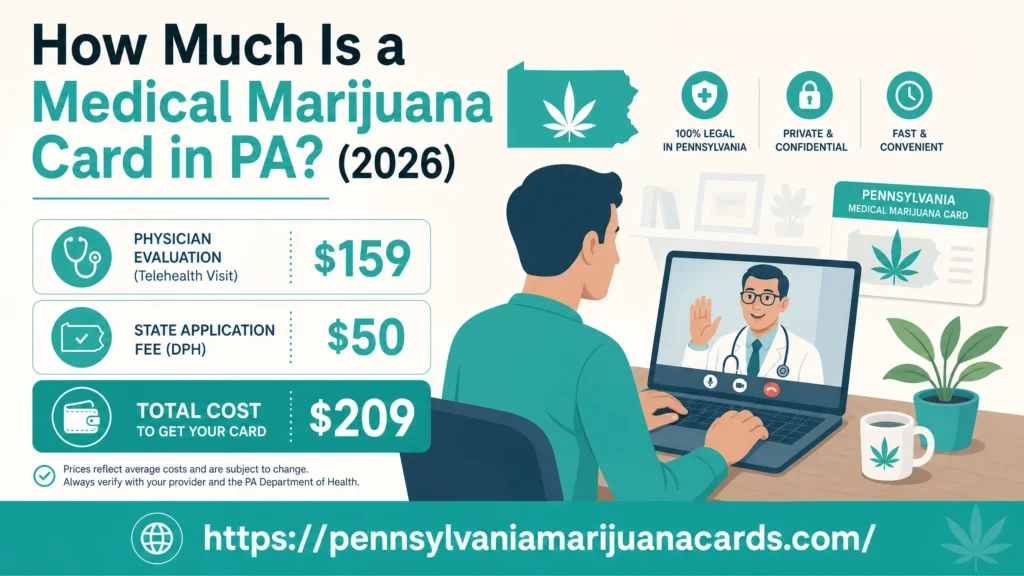
Pricing Breakdown
| Fee Type | New Patient | Renewal |
|---|---|---|
| Physician Certification Fee | $159 | $149 |
| PA State Registration Fee | $50 | $50 |
| Total | $209 | $199 |
MMAP waiver available: If you qualify for Medicaid, SNAP, WIC, CHIP, PACE, or PACENET, the $50 state fee is waived through Pennsylvania’s Medical Marijuana Patient Assistance Program. Learn more about Pennsylvania’s qualifying conditions here.
Anxiety disorders are the number one qualifying condition in Pennsylvania’s medical marijuana program. If anxiety including generalized anxiety, panic disorder, social anxiety or OCD, is part of your experience, you may qualify for a PA MMJ card. See the full anxiety disorder qualification page here.
For PTSD patients, Pennsylvania also explicitly recognizes PTSD as a qualifying condition.
The certification process takes less than 15 minutes via telehealth. If you qualify, Dr. Miller will submit your certification directly to the Pennsylvania Department of Health, and you can complete your state registration online the same day.
- Amyotrophic Lateral Sclerosis (ALS)
- Autism
- Cancer, including remission therapy
- Crohn’s Disease
- Damage to the nervous tissue of the central nervous system (brain-spinal cord) with objective neurological indication of intractable spasticity, and other associated neuropathies
- Epilepsy
- Glaucoma
- Positive status for Human Immunodeficiency Virus or Acquired Immune Deficiency Syndrome (HIV/AIDS)
- Huntington’s Disease
- Inflammatory Bowel Disease (IBD)
- Intractable Seizures
- Tourettes
- Multiple Sclerosis
- Neuropathies
- Parkinson’s Disease
- Post-traumatic Stress Disorder (PTSD)
- Severe chronic or intractable pain of neuropathic origin or severe chronic or intractable pain
- Sickle Cell Anemia
- Neurodegenerative diseases (i.e., Alzheimer’s Disease)
- Terminal illness
- Dyskinetic and spastic movement disorders
- Opioid use disorder for which conventional therapeutic interventions are contraindicated or ineffective, or for which adjunctive therapy is indicated in combination with primary therapeutic interventions
- Anxiety Disorder
- Chronic Hepatitis C
Frequently Asked Questions
Q: What are the best strains for mood disorders in Pennsylvania?
A: The best cannabis strains for mood disorders in Pennsylvania depend on your specific condition. For anxiety, Blue Dream, Harlequin, and ACDC are frequently recommended for their calming, balanced profiles. For PTSD, Granddaddy Purple and Girl Scout Cookies are commonly used, the former for nighttime symptom relief, the latter for balanced day-to-evening use. For depression symptoms, limonene-rich, sativa-dominant strains like Jack Herer, Sour Diesel, and Super Lemon Haze tend to offer the most uplifting effects. Pennsylvania dispensary pharmacists can review your terpene panel and help you select a product matched to your specific symptoms.
Q: Does depression qualify for a medical marijuana card in Pennsylvania?
A: Depression alone is not a listed qualifying condition under Pennsylvania’s medical marijuana program (Act 16 of 2016). However, anxiety disorders and PTSD, both of which frequently co-occur with depression, are qualifying conditions. Many patients with depression also have a diagnosable anxiety disorder that does qualify. A certified PA MMJ physician can review your full health history and determine whether your condition qualifies under the program’s existing categories.
Q: What terpenes are best for mood and anxiety?
A: For anxiety relief, linalool and limonene are considered the most useful terpenes. Linalool, also found in lavender, has demonstrated cortisol-reducing and calming effects in research, while limonene has been shown to counteract THC-induced anxiety and support dopamine activity in the brain. Beta-caryophyllene, a peppery terpene found in many cannabis strains, uniquely activates CB2 receptors and is being studied for its role in mood and anxiety regulation. When selecting cannabis for mood disorders, ask your Pennsylvania dispensary for the full terpene profile of any product rather than relying solely on THC percentage.
Medically reviewed by Dr. Johnathon Chance Miller, MD. This content is for informational purposes only and does not constitute medical advice. Cannabis affects individuals differently. Consult a licensed physician before using medical marijuana, particularly if you are currently taking antidepressants, mood stabilizers, benzodiazepines, or other psychiatric medications.
Sources
- National Institute of Mental Health — Mental Illness Statistics
- Pennsylvania Act 16 of 2016 (Medical Marijuana Act)
- Bergamaschi et al. (2011) — CBD and Anxiety Disorders, Neuropsychopharmacology
- Frontiers in Psychiatry — Pinene and Linalool for Brain Health (2021)
- NCBI / PubMed — Cannabis Terpenes and Chronic Pain (2024)
- Journal of Psychoactive Drugs — Cannabis and PTSD Symptom Reduction
- Lab Effects — Terpenes for Depression and Anxiety
- National Institute on Drug Abuse — Cannabis Use Disorder
- PA Department of Health — Medical Marijuana Program
- Marijuana Policy Project — Act 16 Qualifying Conditions Research
- MMJ.com — Pennsylvania Qualifying Conditions (2026)
- LegalClarity — Pennsylvania Medical Marijuana Act Explained