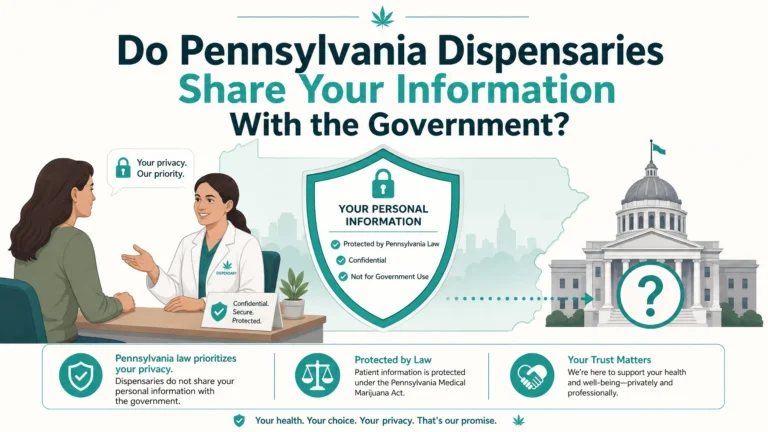

Short Answer: Pennsylvania dispensaries do not routinely share your personal information with the government. Your identity, purchase history, and medical condition are protected under a combination of Pennsylvania’s Medical Marijuana Act (Act 16 of 2016) and federal HIPAA law. The state’s Electronic Tracking System monitors product movement, not patient identities and the PA Department of Health has explicitly chosen not to share the patient registry with state law enforcement.
There are narrow, specific circumstances where records can be accessed, a court order, a valid subpoena, or a targeted law enforcement investigation but these are legal processes that require a significant threshold, not routine government surveillance of who buys cannabis.
Need a PA Medical Marijuana Card?
Get certified online in 15 minutes. 100% Money-Back Guarantee.
Get Certified Now →This guide explains exactly how PA patient privacy works, where the real protections lie, and where the limited genuine risks actually exist.
What Information Does a PA Dispensary Actually Collect?
When you visit a Pennsylvania medical marijuana dispensary, the dispensary typically collects or verifies:

- Your Pennsylvania-issued MMJ patient ID card
- Your state-issued photo ID (to verify identity against the patient registry)
- Your purchase — product type, quantity, and price
- Your remaining allowable purchase amount (tied to your 90-day supply limit)
The information your dispensary accesses is drawn from the Pennsylvania DOH patient registry, which the dispensary queries electronically to confirm you are an active, verified patient before completing a sale. The dispensary does not create this registry, it reads from it.
Your purchase data is recorded in the dispensary’s own point-of-sale (POS) system and reported into the state’s Electronic Tracking System for inventory purposes. This tracks products, not patient profiles. The distinction matters, and it’s explained in detail in the next section.
Do You Qualify for a PA MMJ Card?
Connect with a licensed Pennsylvania state physician online from home.
Most Pennsylvania dispensaries also maintain internal privacy policies and are bound by HIPAA obligations to the extent they handle your protected health information. Many use HIPAA-compliant software and access controls to limit who within the organization can view patient records.
Pennsylvania’s Seed-to-Sale Tracking System: What It Tracks (and What It Doesn’t)
Pennsylvania uses a state-mandated Electronic Tracking System (ETS) that follows medical marijuana products from cultivation through sale, sometimes called “seed-to-sale” tracking. The PA Medical Marijuana Act explicitly requires the PA DOH to maintain this system.

What the ETS tracks:
- Product batch IDs from grower/processor through dispensary
- Inventory levels at each licensed facility
- Transaction amounts — how much of a particular product was sold in a given period
- Compliance with packaging, testing, and labeling requirements
What the ETS does not do:
- Create a personally identified log of which patient purchased which product
- Export individual patient purchase histories to any government database
- Link your name or ID to a specific product transaction in a way that is accessible to outside agencies
The seed-to-sale system is primarily a supply chain compliance tool. Its purpose is ensuring cannabis products are accounted for, not surveilling individual patients. State regulators use it to verify that dispensaries are not selling beyond authorized limits or sourcing unlicensed product, not to monitor what individual patients are buying.
This is a critical distinction that many patients don’t fully understand when they worry about “the government knowing what I bought.”
How HIPAA Protects Your PA Medical Marijuana Records

The Health Insurance Portability and Accountability Act (HIPAA) is a federal privacy law that governs how protected health information (PHI) can be used and disclosed. Despite the fact that marijuana remains federally illegal, HIPAA’s protections apply to the healthcare context in which PA patients receive MMJ certifications.
When you see a physician and receive a medical marijuana certification in Pennsylvania, that interaction, your medical history, the qualifying condition documented, the physician’s recommendation, constitutes protected health information under HIPAA. The physician certifying you is a HIPAA-covered healthcare provider. The information they collect and transmit cannot be shared without your consent, except in the specific, narrow circumstances HIPAA permits (such as treatment, payment, or certain legal obligations).
Pennsylvania dispensaries that handle PHI in connection with patient treatment also carry HIPAA obligations. This includes maintaining access controls, encrypting stored patient data, training staff on privacy protocols, and notifying patients in the event of a data breach.
What HIPAA means practically for you as a PA patient:
- Your certifying physician cannot share your qualifying condition with your employer
- Your dispensary cannot voluntarily hand over your purchase history to a government agency
- Your patient records cannot be shared with third parties for marketing without your explicit consent
- If a breach occurs, you must be notified
⚡ Fast & 100% Online PA Medical Cards
Board-Certified Doctors • 100% Money-Back Guarantee
Book Evaluation Now →HIPAA does not make records completely inaccessible in every circumstance, valid court orders and law enforcement processes can override HIPAA protections under specific conditions. But casual government inquiry, employer requests, or general background check systems cannot pierce HIPAA protection.
What the PA DOH Registry Contains — and Who Can See It

The Pennsylvania Department of Health maintains the official Medical Marijuana Program registry at padohmmp.custhelp.com. This registry contains patient registration data, including your name, date of birth, patient ID number, and verified qualifying condition.
Under Pennsylvania law and HIPAA, the PA DOH does not use, maintain, or disseminate personal information belonging to registered patients to the general public or to unauthorized agencies. The registry is not a public record. It is not searchable by members of the public, employers, or general law enforcement requests.
Access to the registry is limited to:
- The patient themselves
- Authorized dispensary staff verifying patient eligibility at the point of sale
- PA DOH officials administering the program
- Parties with a valid legal process (court order, subpoena) in specific circumstances
It is also worth noting what the PA DOH has made public and what it hasn’t. Following an open records dispute litigated by Spotlight PA, courts ruled that aggregate data about the number of certifications issued by individual physicians could be released. This was a transparency decision affecting provider-level statistics, not patient identity. Individual patient data, who you are, what you purchased, what condition you have, remains protected and was explicitly not part of what was ordered released.
PA Has Chosen Not to Share the MMJ Registry With State Law Enforcement
This is perhaps the most important privacy protection in Pennsylvania’s program that patients rarely hear about.
Pennsylvania has made a deliberate policy choice: the PA medical marijuana patient registry is not shared with state law enforcement agencies. Police cannot simply run your name through a database and learn that you are a registered MMJ patient. Pennsylvania state troopers, local police, and county prosecutors do not have routine access to the patient registry.
This protection is meaningful. It means that in typical interactions with state or local law enforcement, a traffic stop, a routine inquiry, your MMJ card status is not something authorities can discover through standard channels. The Commonwealth v. Barr ruling (December 2021) further strengthened this environment by establishing that the smell of marijuana alone is no longer sufficient probable cause for a vehicle search in Pennsylvania.
The combination of these protections, no registry sharing with police, no odor-based probable cause, means that PA MMJ patients have meaningful legal protections in most routine encounters with state law enforcement.
The federal picture is more complicated, which is addressed below.
When Can the Government Access Your Dispensary Records?
There are real, though narrow, circumstances in which government actors can access your dispensary or registry records. Being clear about these is more useful than vague reassurances that “your data is private.”
Renewing Your PA MMJ Card?
Quick annual recertification online. No paperwork hassle.
Renew Card Online →Court orders and subpoenas. If you are subject to a criminal investigation or civil legal proceeding, a court can issue an order compelling a dispensary or the PA DOH to produce records related to you. This requires a legal threshold, it is not available to law enforcement on demand.
Federal investigation of a dispensary. If the federal government were to investigate or take action against a Pennsylvania dispensary for federal law violations (marijuana remains a Schedule I controlled substance federally), federal investigators could potentially access the records held by that dispensary as part of that investigation. This is a scenario with some historical precedent, federal actions against dispensaries in states like California have resulted in federal access to business records. It is a low-probability risk for a compliant, licensed PA dispensary, but it is worth knowing exists.
Targeted federal investigation of a patient. If you were individually the subject of a federal criminal investigation (unrelated to your MMJ use), and investigators obtained a valid legal order, your dispensary records could be accessed. This would require substantive federal interest in your activities, not merely your MMJ patient status.
For the vast majority of registered Pennsylvania MMJ patients going about their lives, none of these scenarios are a realistic concern. The routine government surveillance many people fear, “will the government see I bought cannabis?” does not describe how any of these systems actually work.
Does a PA Medical Marijuana Card Show Up on a Background Check?
This is one of the most common questions prospective PA patients ask, and the answer for most people is no.

Standard employment background checks do not access the PA DOH medical marijuana registry. Because your MMJ card registration is protected health information under HIPAA and PA Act 16, it does not appear in the criminal history databases, public records searches, or credit reporting systems that standard background checks draw from.
An employer running a standard background check through a consumer reporting agency (TransUnion, Checkr, Sterling, etc.) will not see that you are a PA MMJ patient. Your employer cannot discover your MMJ status through background check systems without your consent.
There are important caveats:
Drug testing is a separate question. An employer who drug tests you will detect THC in your system regardless of your card status. Pennsylvania’s Medical Marijuana Act provides some workplace protections, employers generally cannot discipline you solely for being a registered patient but these protections have limits, especially for safety-sensitive roles. If you test positive on an employer drug test, your card status will not necessarily protect your job.
Federal employment and security clearances are different. See the section below.
Licensing boards with specific disclosure requirements may require you to self-report. Always review the requirements of your specific professional license if you hold one.
The Firearms Exception: A Real Federal Risk Worth Knowing
Get Approved by a Licensed PA Doctor
Schedule your appointment in minutes. You only pay if approved.
Start Online Application →One area where PA’s privacy protections do not fully shield you involves firearms.
Pennsylvania has chosen not to share the MMJ registry with state law enforcement. However, purchasing a firearm from a federally licensed dealer requires completing ATF Form 4473, which asks directly whether you are an unlawful user of, or addicted to, marijuana or any depressant, stimulant, narcotic drug, or any other controlled substance.
Because marijuana remains a Schedule I federal controlled substance, a registered PA MMJ patient is technically an unlawful user of a controlled substance under federal law, regardless of PA’s state-level protections. Answering “yes” to that question on Form 4473 disqualifies you from purchasing the firearm. Answering “no” knowingly while being an active MMJ user constitutes a federal felony.
The PA MMJ registry is not connected to the FBI’s National Instant Criminal Background Check System (NICS). The federal government cannot see your MMJ status automatically when you attempt to buy a gun. However, the legal exposure from the self-disclosure question on Form 4473 is real, and federal courts have consistently upheld the firearms disqualification for marijuana users even in legal states.
If you hold a concealed carry permit in Pennsylvania, renewal or new applications also carry risk given this federal conflict. This is a genuine area of legal complexity that PA MMJ patients who own or wish to purchase firearms should discuss with a Pennsylvania attorney.
Federal Employees and Security Clearances: A Different Standard
Federal employees, military personnel, and those holding or seeking security clearances face a meaningfully different privacy landscape than most PA MMJ patients.
Federal security clearance investigations are not limited to standard background checks. They involve in-depth investigation of financial history, personal associations, foreign contacts, and drug use. Many clearance applications specifically ask about marijuana use. Disclosing MMJ card status or marijuana use can result in clearance denial or revocation, regardless of Pennsylvania’s state-level legality.
Federal employees are also subject to Executive Branch drug-free workplace policies. Many federal agencies require drug testing, and marijuana use, even state-legal, even with an MMJ card, can cost a federal employee their job.
This is not a theoretical risk. Federal personnel who have been open about state-legal MMJ use have faced security clearance issues in documented cases. If you work in a federal position or hold a clearance, the state-level protections of the PA MMJ program do not apply in the federal employment context.
What Patients Can Do to Further Protect Their Privacy

For most patients, the existing legal protections are robust. But if privacy is a specific concern, a few practical steps can further limit your data footprint:
Ready to Get Your Official PA MMJ Card?
State-certified doctor consultations online. No risk—100% refund if not approved.
Claim Your MMJ Card Online →Pay with cash. Credit and debit card transactions create records with your bank and payment processor. Cash purchases at a dispensary create no financial paper trail connecting you to the transaction.
Skip loyalty programs. Dispensary loyalty and rewards programs require registering personal information and build a detailed purchase history in the dispensary’s own systems. If you’re concerned about long-term data exposure, opting out of these programs limits that accumulation.
Understand your dispensary’s privacy policy. PA-licensed dispensaries are required to maintain privacy policies. You have the right to ask how your data is stored, who can access it, and what their data breach procedures are.
Know your rights. Under HIPAA, you have the right to request copies of your records, request corrections to inaccurate information, and ask how your information has been disclosed. These rights apply even in the cannabis context.
Should Privacy Concerns Stop You From Getting a PA MMJ Card?
For the large majority of Pennsylvanians, the answer is no.
The privacy protections built into Pennsylvania’s medical marijuana program are genuinely strong. The patient registry is HIPAA-protected, not shared with state police, not searchable by employers, and not accessible through standard background checks. The state’s seed-to-sale tracking system monitors product flow, not patient behavior. Your qualifying condition and certification are protected health information under both state and federal law.
The real risk areas, firearms purchases and federal employment, are specific and knowable in advance. If neither applies to you, the privacy protections in place are meaningful and well-enforced.
Thousands of Pennsylvanians dealing with conditions like anxiety disorders, chronic pain, PTSD, and others have found that the benefits of medical cannabis access outweigh the well-understood and limited privacy considerations. Over 440,000 Pennsylvania residents are currently registered in the program.
If you’re considering a PA medical marijuana card and want to understand whether you qualify, Dr. Johnathon Chance Miller, MD conducts certifications entirely online via telehealth. There’s no in-person visit, no waiting room, and your evaluation is fully HIPAA-protected. You can review Pennsylvania’s 24 qualifying conditions to see if your condition is covered, and learn more about Pennsylvania’s medical marijuana laws if you want a fuller picture of your rights as a patient.
Pennsylvania Marijuana Cards — Certification Pricing:
| Physician Fee | PA State Fee | Total | |
|---|---|---|---|
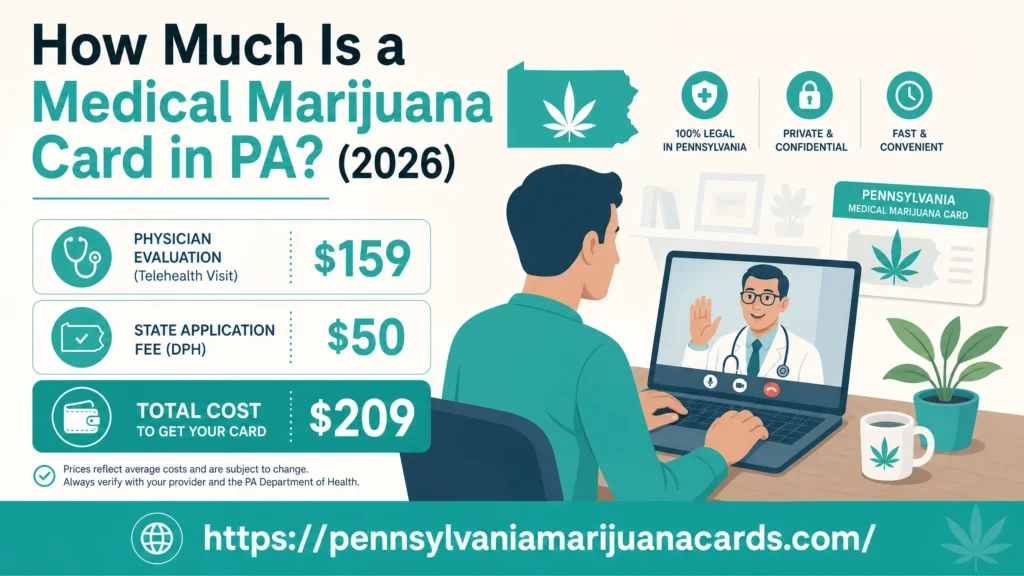
| New Patient Certification | $159 | $50 | $209 |
| Renewal Certification | $149 | $50 | $199 |
| MMAP-Qualifying Patients (Medicaid, SNAP, WIC, CHIP, PACE, PACENET) | Same | Waived | $159 / $149 |
Frequently Asked Questions
Q: Do Pennsylvania dispensaries share patient information with the government?
A: Pennsylvania dispensaries do not routinely share personal patient information with the government. The PA Medical Marijuana Program patient registry is protected under both Pennsylvania’s Medical Marijuana Act (Act 16 of 2016) and federal HIPAA law. The state’s Electronic Tracking System monitors product inventory and sales flow, not individual patient purchase histories. Pennsylvania has also made a deliberate policy choice not to share the patient registry with state law enforcement. Your identity and purchase records can only be accessed by government actors through a valid court order or subpoena in specific legal circumstances, not through routine inquiry.
Q: Does a Pennsylvania medical marijuana card show up on a background check?
A: No. A Pennsylvania MMJ card does not appear on standard employment background checks. Because it is classified as protected health information under HIPAA and PA Act 16, it does not appear in criminal history databases, consumer reporting agencies, or public records searches used by most employers. The PA DOH medical marijuana registry is not shared with employers and is not accessible through standard background check systems. The notable exceptions are federal employment, security clearance investigations, and certain professional licensing boards that may require self-disclosure.
Q: Can the federal government access my Pennsylvania dispensary records?
A: The federal government does not have routine access to Pennsylvania MMJ patient records or dispensary purchase histories. The PA patient registry is HIPAA-protected and not connected to federal databases. However, in specific circumstances, such as a federal investigation of a dispensary or a targeted federal criminal investigation involving a patient, federal agents can seek records through a valid legal process such as a court order or subpoena. Additionally, PA MMJ patients who purchase firearms must self-disclose marijuana use on ATF Form 4473, which creates a separate and distinct federal legal risk unrelated to the registry.
Medically reviewed by Dr. Johnathon Chance Miller, MD. This article is for informational purposes only and does not constitute legal advice. Patients with specific concerns about their employment, security clearance, or legal situation should consult a licensed Pennsylvania attorney.
Sources
- Pennsylvania Medical Marijuana Act, Act 16 of 2016 — Full Text
- Pennsylvania Department of Health — Medical Marijuana Program
- PA DOH Medical Marijuana Patient Registry Portal
- U.S. Department of Health and Human Services — HIPAA Privacy Rule Overview
- Spotlight PA — Court Orders Release of PA Medical Marijuana Doctor Data (Nov. 2023)
- Commonwealth v. Barr, 266 A.3d 25 (Pa. 2021) — Marijuana Odor Not Standalone Probable Cause
- ATF Form 4473 — Firearms Transaction Record (Question 21.e)
- FBI — National Instant Criminal Background Check System (NICS)
- IDScan.net — Do Dispensaries Share My Information With the Government?
- Compliancy Group — HIPAA and Medical Marijuana Dispensaries
- Allegheny County Bar Association — PA Medical Marijuana Program FAQ
- Marijuana Policy Project — Pennsylvania Medical Marijuana Law Guide