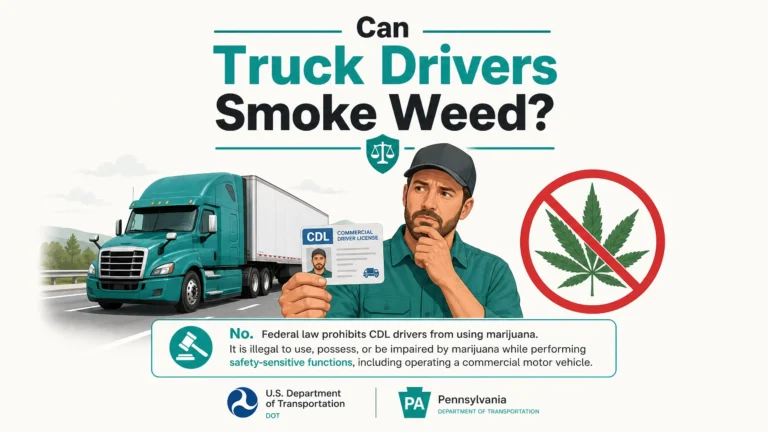

Short Answer: No. Truck drivers cannot legally smoke weed, not on duty, not off duty, not even in a state where marijuana is legal, and not even with a valid medical marijuana card.
That’s the straightforward answer. But if you hold a Commercial Driver’s License (CDL) in Pennsylvania or anywhere else in the United States, the details matter enormously because a single positive drug test can end your career, and the rules here are more unforgiving than most drivers realize.
Need a PA Medical Marijuana Card?
Get certified online in 15 minutes. 100% Money-Back Guarantee.
Get Certified Now →This guide covers everything a CDL driver needs to understand: federal law, Pennsylvania-specific rules, what a positive test actually triggers, and why even occasional off-duty marijuana use creates real professional risk.
Why Federal Law Overrides State Law for CDL Drivers

Pennsylvania legalized medical marijuana under Act 16 of 2016. More than 440,000 Pennsylvanians are now registered patients. But state law cannot override federal law and for CDL holders, federal law is the only law that matters.
Commercial motor vehicle (CMV) drivers operate under federal jurisdiction because their routes typically cross state lines and their vehicles are regulated by the U.S. Department of Transportation (DOT). That federal oversight supersedes any state-level marijuana policy, whether recreational or medical.
Marijuana remains a Schedule I controlled substance under the Controlled Substances Act. Until Congress changes that classification at the federal level and enforcing agencies change their rules along with it, CDL drivers are fully prohibited from using marijuana under any circumstances.
Do You Qualify for a PA MMJ Card?
Connect with a licensed Pennsylvania state physician online from home.
This isn’t a gray area. It’s one of the clearest legal lines in the commercial driving industry.
What the DOT and FMCSA Actually Say

The Federal Motor Carrier Safety Administration (FMCSA) is the DOT sub-agency that governs the trucking industry. Its position on marijuana has never wavered.
Under 49 CFR Part 40, the DOT’s drug and alcohol testing regulation, marijuana is explicitly prohibited for all safety-sensitive transportation workers. The regulation does not recognize state medical marijuana laws as a valid exception. A physician’s recommendation for marijuana is not an acceptable medical explanation for a positive drug test result, this is spelled out directly in 49 CFR 40.151(e).
The DOT has also addressed confusion created by DEA rescheduling discussions and Executive Orders head-on. In a formal notice issued by the U.S. Department of Transportation, the agency confirmed that marijuana remains a prohibited substance for safety-sensitive employees, including truck drivers, until any federal rescheduling process is fully complete. The notice makes clear that DOT drug testing rules will not change in the interim.
The FMCSA mandates testing at the following points for CDL drivers:
- Pre-employment — before operating a CMV for a new employer
- Random — unannounced, throughout the year
- Post-accident — after any qualifying accident
- Reasonable suspicion — when a supervisor has observable cause
- Return-to-duty — after a prior positive test
- Follow-up — for up to 5 years after returning to duty
There is no opt-out, no appeal based on state law, and no medical exemption for marijuana.
Can You Have a CDL and a Medical Marijuana Card in Pennsylvania?
This is the question many Pennsylvania drivers ask and the answer is no.
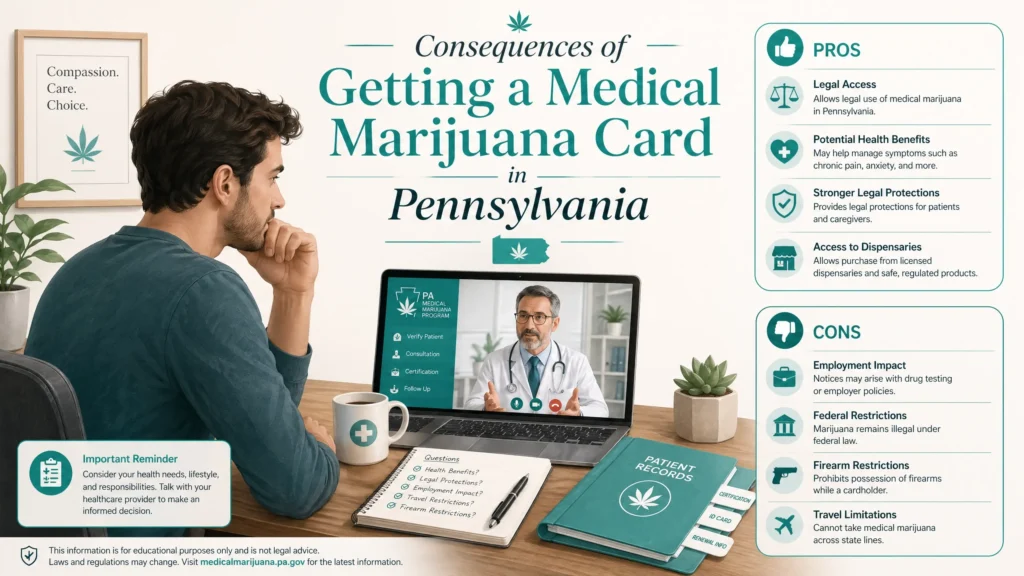
Pennsylvania’s Medical Marijuana Act does provide meaningful workplace protections for most employees. Under the Act, employers generally cannot discriminate against or terminate an employee solely because they are a registered MMJ patient.
However, the Act contains an important carve-out in Section 2103(b)(3): nothing in the Act requires an employer to violate federal law.
Because CDL drivers are subject to federal DOT drug testing requirements, trucking companies are not required and in practice cannot legally be required, to accommodate marijuana use by their CDL-holding employees.
⚡ Fast & 100% Online PA Medical Cards
Board-Certified Doctors • 100% Money-Back Guarantee
Book Evaluation Now →PennDOT’s own Employee Guide to CDL Drug and Alcohol Testing states this directly: “Medical marijuana, even if legally prescribed in a state, is an illegal drug under federal law. The use of medical marijuana is thus prohibited conduct for CDL-covered employees.”
What this means practically:
- Registering as a PA MMJ patient and holding a CDL at the same time creates direct legal conflict
- If you test positive on a DOT drug test, your state MMJ card does not protect you from termination or CDL consequences
- A positive test result cannot be excused by a physician’s recommendation under federal rules
CDL drivers facing serious medical conditions deserve honest information here: they must choose between their commercial driving career and using medical marijuana. There is currently no federal exemption that makes both possible simultaneously.
What Happens If a Truck Driver Tests Positive for Marijuana?

The consequences are immediate and significant.
When a CDL driver tests positive for marijuana on a DOT-mandated drug test, the employer is required to remove the driver from all safety-sensitive functions right away. The driver cannot get back behind the wheel until they complete the federal Return-to-Duty (RTD) process, which involves:
- An evaluation by a DOT-qualified Substance Abuse Professional (SAP)
- Completion of any education or treatment program prescribed by the SAP
- Passing a return-to-duty drug test
- A follow-up testing program for up to 5 years, with unannounced tests
This process typically takes several weeks to months. Many drivers never return to commercial driving, either because they cannot complete the process, because employers implement lifetime bans after a first positive, or because the Clearinghouse record makes future employment difficult.
The violation also remains on a driver’s federal record for 5 years from the date of the positive test, or until the RTD process is successfully completed, whichever is later.
The FMCSA Drug & Alcohol Clearinghouse — What It Means for Your Career
The FMCSA Drug & Alcohol Clearinghouse is a federal database that records CDL drug and alcohol violations. Every employer that hires CDL drivers is required by law to query the Clearinghouse before hiring a new driver and at least once annually for current employees.
This means a positive marijuana test does not just affect your current job, it follows you to every future employer in the trucking industry. A hiring company will see the violation before they make an offer. Even if you complete the RTD process successfully, the record of the original violation stays in the system for 5 years.
The practical consequence: a positive marijuana test can make it significantly harder to find CDL employment for years, regardless of how well you complete the return-to-duty process.
How Long Does THC Stay in Your System? The Detection Window Problem

This is where many CDL drivers get caught off guard.
Renewing Your PA MMJ Card?
Quick annual recertification online. No paperwork hassle.
Renew Card Online →Unlike alcohol, which metabolizes out of the body within hours, THC, the active compound in marijuana, leaves metabolites in the body that can be detectable for weeks after use. For a regular or heavy user, THC metabolites in urine can remain above the DOT’s 50 ng/mL cutoff threshold for 30 days or more after last use.
This creates a critical professional risk that doesn’t exist with alcohol: a driver who used marijuana legally on a personal trip two weekends ago may not be impaired at all today but could still fail a DOT drug test that triggers full career consequences.
Current standard DOT testing (urinalysis) cannot distinguish between recent use and use from two weeks prior. More sophisticated tests that detect active THC versus inactive metabolites exist but are not currently part of the DOT testing protocol.
Many trucking companies also supplement DOT-mandated urinalysis with hair follicle testing, which can detect THC metabolites from up to 90 days prior. Company policies that use hair testing effectively close the window even further, meaning past use, not present impairment, is what ends careers.
For CDL drivers, this makes any marijuana use, even occasional, even off-duty, even in a legal state, a genuine career risk.
What About CBD? Is It Safe for CDL Drivers?

Many drivers assume CBD is a safe alternative since it’s federally legal under the 2018 Farm Bill. The reality is more complicated.
Hemp-derived CBD with less than 0.3% THC is legal at the federal level.
However, the DOT does not distinguish between THC derived from marijuana and THC metabolites that may appear in your system from CBD product use. Because CBD products are not regulated by the FDA for THC consistency, a product labeled “THC-free” may still contain trace amounts of THC that accumulate with regular use and trigger a positive drug test.
The DOT has issued a formal CBD notice stating explicitly that the agency’s testing program will not accept CBD use as a valid medical explanation for a positive THC result.
In practical terms: if you use CBD regularly and test positive for THC metabolites, you face the same career consequences as if you had used marijuana. The DOT has no mechanism to distinguish the source. For CDL drivers, the risk is real enough that many safety professionals recommend avoiding CBD products entirely while holding a commercial license.
DEA Rescheduling and What It Does NOT Change for Truck Drivers
There has been significant public discussion about the DEA’s consideration of rescheduling marijuana from Schedule I to Schedule III under the Controlled Substances Act. It’s worth addressing this directly.
Get Approved by a Licensed PA Doctor
Schedule your appointment in minutes. You only pay if approved.
Start Online Application →Even if rescheduling were completed, it would not automatically change DOT drug testing rules for CDL drivers.
The DOT has stated this explicitly. Rescheduling to Schedule III would not make marijuana legal under federal law in the context of safety-sensitive transportation employment, it would simply move it to a different scheduling category. The FMCSA and Commercial Vehicle Safety Alliance have separately confirmed they have not changed their positions on marijuana testing in response to rescheduling discussions.
For CDL drivers: rescheduling rumors should not be used as a basis for changing behavior around marijuana use. The rules in place today apply until DOT explicitly announces otherwise and even then, any transition would not happen overnight.
Pennsylvania’s Per Se DUI Law and CDL Drivers
Pennsylvania has one of the strictest marijuana DUI laws in the country, and CDL drivers face additional exposure under it.
Under Pennsylvania’s per se DUI law, any driver, including medical marijuana patients, found operating a vehicle with more than 1 nanogram of active THC per milliliter of blood can be charged with a DUI. Unlike alcohol, where impairment can be argued based on individual tolerance, this threshold is based on presence alone, not observable impairment.
For CDL drivers, a marijuana-related DUI creates compounding consequences: criminal exposure under state law, automatic CDL disqualification under federal regulations, and a clearinghouse record. It’s also worth noting that Pennsylvania’s 1 ng/mL threshold is significantly lower than the 10 ng/mL threshold in some other contexts, making any recent use dangerous for anyone planning to drive.
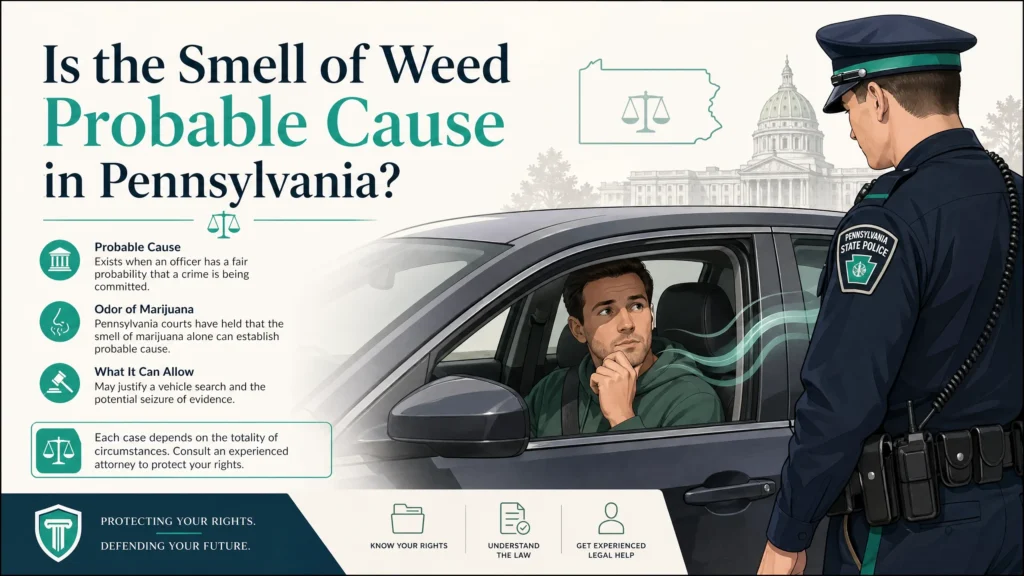
The important 2021 Commonwealth v. Barr ruling established that the smell of marijuana alone is no longer probable cause for a vehicle search in Pennsylvania but this protection applies to lawful stops, not to drivers who are already subject to DOT drug testing requirements.
Who CAN Get a PA Medical Marijuana Card?

The CDL restriction is specific. Many professional and personal drivers who do not hold a CDL are fully eligible for a Pennsylvania medical marijuana card and may be excellent candidates if they have a qualifying condition.
A PA MMJ card is available to Pennsylvania residents who have been diagnosed with one of 24 qualifying conditions, including anxiety disorder, PTSD, chronic pain, cancer, multiple sclerosis, Parkinson’s disease, and many others.
Who is NOT affected by the CDL restriction:
- Drivers with a standard, non-commercial Pennsylvania driver’s license
- People who use a personal vehicle for work but do not hold a CDL
- Individuals who have retired or transitioned out of commercial driving
Ready to Get Your Official PA MMJ Card?
State-certified doctor consultations online. No risk—100% refund if not approved.
Claim Your MMJ Card Online →Who IS affected:
- Active CDL holders operating commercial motor vehicles
- Anyone subject to DOT drug testing under federal safety-sensitive employment rules
If you do not hold a CDL and are dealing with a serious medical condition, a PA medical marijuana card may be a relevant option worth exploring with a licensed physician.
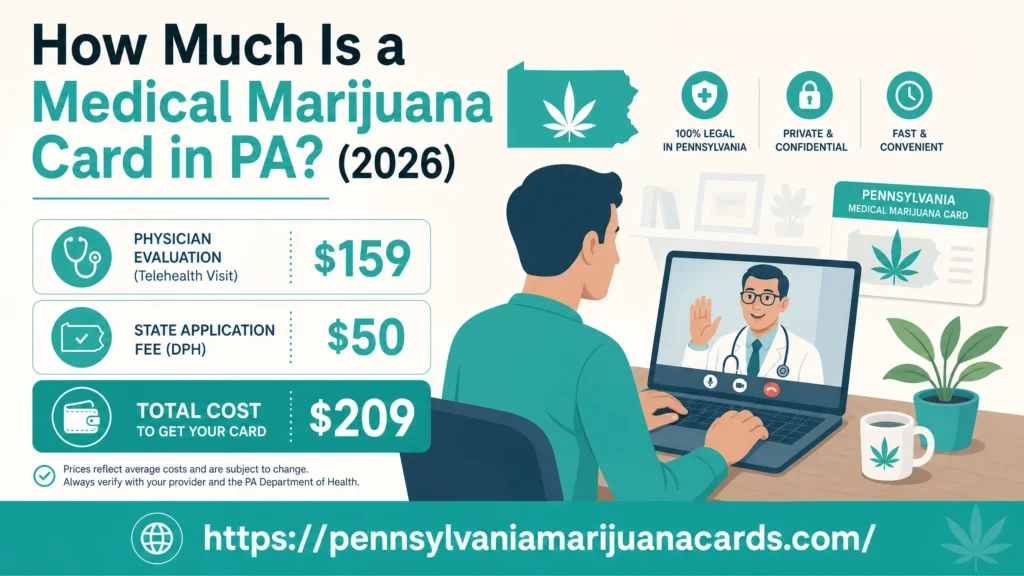
At Pennsylvania Marijuana Cards, board-certified physician Dr. Johnathon Chance Miller, MD certifies patients entirely online via telehealth, no in-person appointment needed. Certification fees are $159 for new patients and $149 for renewals (physician fee), plus the $50 Pennsylvania state fee. For patients enrolled in Medicaid, SNAP, WIC, CHIP, PACE, or PACENET, the state fee is waived through the MMAP program.
Pennsylvania Marijuana Cards Pricing:
| Physician Fee | PA State Fee | Total | |
|---|---|---|---|
| New Patient Certification | $159 | $50 | $209 |
| Renewal Certification | $149 | $50 | $199 |
| MMAP-Qualifying Patients | Same | Waived | $159–$149 |
Summary: What CDL Drivers Need to Know
- Truck drivers cannot legally use marijuana — on or off duty — under any circumstances while holding a CDL
- Pennsylvania’s Medical Marijuana Act does not protect CDL drivers from DOT drug testing consequences
- A positive marijuana test triggers immediate removal from safety-sensitive duties, a mandatory RTD process, and a 5-year Clearinghouse record
- THC metabolites can be detected in urine for 30+ days after use — off-duty use is not safe
- CBD products are not risk-free for CDL drivers — they can still produce a positive THC result
- DEA rescheduling, if completed, will not automatically change DOT drug testing rules
- Pennsylvania’s per se DUI law (1 ng/mL THC) creates additional legal exposure for any CDL driver with recent marijuana use
- Non-CDL holders who qualify medically may be eligible for a PA medical marijuana card
Frequently Asked Questions
Q: Can truck drivers smoke weed in Pennsylvania if they have a medical marijuana card?
A: No. CDL drivers in Pennsylvania cannot use medical marijuana, regardless of whether they hold a valid PA medical marijuana card. Under 49 CFR Part 40, the Department of Transportation does not recognize state medical marijuana laws as a valid exception to its drug testing regulations. A positive drug test for THC results in immediate removal from safety-sensitive duties and triggers the federal Return-to-Duty process, which can take months to complete. Pennsylvania’s Medical Marijuana Act explicitly exempts employers from accommodating marijuana use when federal law prohibits it, which applies to all CDL-regulated trucking employment.
Q: How long does marijuana stay in a truck driver’s system for a DOT drug test?
A: THC metabolites can remain detectable in urine for up to 30 days or more after last use, depending on frequency of use and individual metabolism. The DOT’s current drug testing cutoff for marijuana is 50 nanograms per milliliter in urine. Because the standard DOT urinalysis cannot distinguish between recent use and use from weeks prior, off-duty marijuana use, even in a state where it is legal, creates real risk of a positive test result. Many trucking companies also use hair follicle testing, which can detect marijuana use from up to 90 days prior.
Q: Does DEA marijuana rescheduling mean truck drivers can legally use weed?
A: No. Even if the DEA completes the rescheduling of marijuana from Schedule I to Schedule III, this does not automatically change Department of Transportation drug testing rules for CDL holders. The DOT has formally confirmed its drug testing regulations for safety-sensitive transportation workers, including truck drivers, will not change as a result of rescheduling alone. Until Congress changes federal marijuana law and the DOT updates its regulations accordingly, CDL drivers remain fully prohibited from marijuana use under any circumstances.
Medically reviewed by Dr. Johnathon Chance Miller, MD. This article is for informational purposes only and does not constitute legal or medical advice. CDL drivers with questions about their specific situation should consult a DOT-qualified substance abuse professional or transportation attorney.
Sources
- U.S. Department of Transportation — Notice on Marijuana and Safety-Sensitive Employees
- FMCSA — 49 CFR Part 40, DOT Drug and Alcohol Testing Regulation
- FMCSA Drug & Alcohol Clearinghouse
- U.S. DOT — CBD Notice for Safety-Sensitive Employees
- Pennsylvania Medical Marijuana Act, Act 16 of 2016, Section 2103(b)(3)
- DEA — Controlled Substances Act ScheduleI
- FMCSA — Requirements for Positive Tests or Refusals (CDL)
- PennDOT — CDL Drug and Alcohol Testing (Management Directive 505.34)
- Pennsylvania Vehicle Code — DUI Per Se (75 Pa. C.S. § 3802)
- Commonwealth v. Barr, 266 A.3d 25 (Pa. 2021) — Marijuana odor not standalone probable cause
- American Transportation Research Institute (ATRI) — Marijuana and Truck Driver Safety
- FMCSA — Drug and Alcohol Clearinghouse Annual Report 2023