
You pick up a Pennsylvania dispensary flower product and the label shows two numbers side by side: THC 1.2% and THCA 22.4%. The THC number looks almost irrelevant. The THCA number is huge. And nobody explained what either of them actually means.
This is one of the most common points of confusion for new PA MMJ patients, and it has a clear explanation.
Need a PA Medical Marijuana Card?
Get certified online in 15 minutes. 100% Money-Back Guarantee.
Get Certified Now →THCA is the raw, non-psychoactive form of THC found in unheated cannabis. When you apply heat, a simple chemical reaction converts it into delta-9 THC, the compound responsible for cannabis’s therapeutic and psychoactive effects. At a Pennsylvania dispensary, the THCA percentage on a flower label is the number that actually tells you how potent the product will be when you vaporize it.
This guide explains exactly how that conversion works, the math behind PA dispensary labels, how to turn THCA into THC, and where delta 9 fits into all of this.
Key Takeaways
- Yes, THCA turns into THC when heated. The process is called decarboxylation. It happens automatically when you vaporize cannabis flower in a dry-herb device.
- On PA dispensary flower labels, the THCA% is the most important number. A product showing 1% THC and 22% THCA is a high-potency product, not a weak one.
- The conversion formula is: Total THC = THC% + (THCA% x 0.877). The 0.877 factor accounts for the molecular weight lost when the carboxyl group is released during decarboxylation.
- Delta-9 THC and THC refer to the same molecule. When PA dispensary labels say “THC%”, they mean delta-9-tetrahydrocannabinol. The two terms are interchangeable.
- THCA in its raw form is not psychoactive. Eating raw cannabis or unheated flower will not produce the effects associated with THC. Heat is required.
- Pennsylvania dispensaries are required to list both THCA% and THC% on flower products under state testing and labeling regulations.
What Is THCA and How Is It Different From THC?
Cannabis plants do not naturally produce THC. What they actually produce is THCA: tetrahydrocannabinolic acid.

THCA and THC are nearly identical molecules. The only structural difference is a carboxyl group, a cluster of one carbon, two oxygen, and one hydrogen atom, attached to THCA’s molecular structure. That single addition changes everything about how the compound interacts with the human body.
Do You Qualify for a PA MMJ Card?
Connect with a licensed Pennsylvania state physician online from home.
THC binds directly and strongly to CB1 receptors throughout the brain and central nervous system, producing the therapeutic and psychoactive effects associated with cannabis: pain relief, appetite stimulation, anti-nausea action, mood elevation, and sleep support.
THCA does not bind effectively to CB1 receptors in its acidic form. The carboxyl group creates a steric barrier that prevents it from fitting into the receptor the way THC does. This is why raw cannabis flower, eaten directly without any heating, produces minimal to no psychoactive effect despite containing significant THCA concentrations.
The carboxyl group is also why THCA weighs more per molecule than THC. When THCA converts to THC through heat, it loses that carboxyl group as carbon dioxide and water vapor. This mass loss is exactly what the 0.877 conversion factor in the label formula accounts for.
Does THCA Turn Into THC? The Chemistry Explained Simply
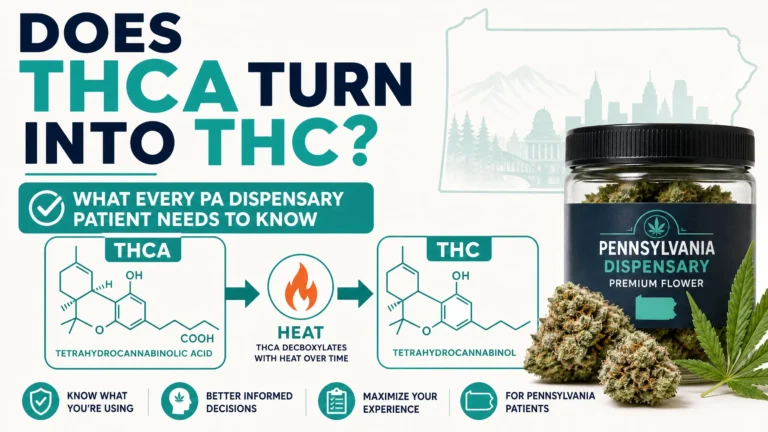
Yes. THCA converts to delta-9 THC through a chemical process called decarboxylation.

Decarboxylation literally means “removal of a carboxyl group.” When THCA is exposed to sufficient heat, the bond holding the carboxyl group to the THCA molecule breaks. The carboxyl group releases as carbon dioxide (CO2) and water vapor (H2O). What remains is delta-9 THC.
The reaction equation looks like this:
THCA (C22H30O4) + heat → THC (C21H30O2) + CO2
The process is irreversible. Once THCA has decarboxylated into THC, it does not convert back to THCA. It can, however, continue degrading into CBN (cannabinol) if exposed to excessive heat or prolonged storage, which is why overheating cannabis produces a more sedating and less potent experience.

According to research published in the Journal of Chromatography A by Wang and colleagues, decarboxylation follows first-order kinetics, meaning the reaction rate is predictable and temperature-dependent. At lower temperatures, conversion is slower and more complete. At very high temperatures, conversion is fast but CBN formation increases as THC begins to degrade.
What Temperature Does THCA Convert to THC?
Decarboxylation does not happen at a single precise temperature. It is a range, and the rate of conversion accelerates as temperature increases.

⚡ Fast & 100% Online PA Medical Cards
Board-Certified Doctors • 100% Money-Back Guarantee
Book Evaluation Now →Here is what the science shows:
| Temperature | What Happens |
|---|---|
| Room temperature (68-77°F) | Extremely slow natural conversion over months or years |
| 220°F (104°C) | Decarboxylation begins, slow conversion rate |
| 230-250°F (110-121°C) | Peak efficiency zone. Approximately 70-88% of THCA converts to THC at 30-40 minutes |
| 300-400°F (149-204°C) | Rapid conversion but THC begins degrading to CBN |
| 600-900°F (315-482°C) | Near-instant conversion (combustion). 15-30% of cannabinoids lost to pyrolysis |
For vaporizer users: a well-calibrated dry-herb vaporizer operating between 350 and 410°F hits the sweet spot where decarboxylation is efficient and cannabinoid degradation is minimal. This is why vaporization at controlled temperatures is recommended over combustion in Pennsylvania: you get efficient THCA-to-THC conversion with less destruction of cannabinoids and terpenes.
How to Turn THCA Into THC: Every Method Explained
There are several ways to trigger decarboxylation. The method determines the speed, efficiency, and what else is preserved alongside the THC.
Vaporization (most relevant for PA patients)
Loading flower into a dry-herb vaporizer and heating to 350-410°F triggers rapid decarboxylation in the material itself. The vapor you inhale contains active THC. This is the method Pennsylvania law specifies for dry-leaf cannabis products. Smoking is prohibited under the Medical Marijuana Act; vaporization is the legally approved inhalation method.
Vaporization is the fastest path from THCA to active THC: conversion happens in seconds, and effects are felt within 1 to 5 minutes.
Oven decarboxylation (for making tinctures or infused oils)
Breaking flower down and placing it in an oven at 240°F (115°C) for 30 to 40 minutes achieves approximately 88% conversion efficiency according to laboratory data from DankLog’s decarboxylation testing. This is the method used before infusing cannabis into butter or oil for home use. The finished infused product then contains active THC.
Natural degradation over time
THCA converts very slowly to THC at room temperature over months or years. This is why well-aged, stored cannabis flower contains slightly more active THC and slightly less THCA than freshly harvested material. This is not a practical conversion method, but it explains why very old cannabis feels different from fresh product and why proper storage conditions matter for preserving THCA.
The Label Math: Reading PA Dispensary Flower Products Correctly
This is the section that changes how you shop.

When Pennsylvania dispensary flower is lab-tested, the result shows two separate numbers: the amount of already-active THC (decarboxylated delta-9 THC already present in the product) and the amount of THCA (the precursor that will convert to THC when heated).
In fresh, properly processed cannabis flower, the THC% is almost always low, sometimes only 0.5 to 2%, because very little decarboxylation has occurred before you vaporize it. The THCA% is high because the plant converted most of its cannabinoid content into the acidic form during growth.
To calculate how much active THC the flower will actually deliver when vaporized, use this formula:
Renewing Your PA MMJ Card?
Quick annual recertification online. No paperwork hassle.
Renew Card Online →Total THC = THC% + (THCA% x 0.877)
The 0.877 factor comes from the molecular weight difference between THCA (314.45 g/mol) and THC (314.45 – 44.01 for CO2 released = 270.45 g/mol). Expressed as a ratio: 270.45 / 314.45 = 0.8597, rounded to 0.877 in standard industry use.
This is the same formula used by the Pennsylvania Department of Health testing framework and by hemp compliance total-THC calculations.
A Real-World PA Dispensary Label Example
Here is how to apply the formula to an actual PA dispensary flower product:

Example label:
- THC: 1.3%
- THCA: 23.6%
Most new patients think: “This product is only 1.3% THC. That seems weak.”
What is actually true:
Total THC = 1.3 + (23.6 x 0.877) Total THC = 1.3 + 20.70 Total THC = 22.0%
That is a high-potency product. The 1.3% active THC you see on the label before vaporization becomes approximately 22% usable THC once the vaporizer does its work.
Here is another example showing why two products that look similar on the label can be very different in actual potency:
| Product | THC% | THCA% | Total THC (formula) |
|---|---|---|---|
| Product A | 1.3% | 23.6% | 22.0% |
| Product B | 3.1% | 14.8% | 16.1% |
| Product C | 0.9% | 19.2% | 17.7% |
Product A looks weakest based on the raw THC number. It is actually the strongest by total deliverable THC. Shopping by the raw THC% alone gets this exactly backward.
Why Do PA Dispensary Labels Show Both Numbers?
Get Approved by a Licensed PA Doctor
Schedule your appointment in minutes. You only pay if approved.
Start Online Application →Pennsylvania’s Medical Marijuana Act and associated regulations require licensed growers and processors to submit all flower and plant material for third-party laboratory testing before any product reaches a dispensary shelf. The resulting Certificate of Analysis (COA) reports both cannabinoid concentrations separately: pre-decarboxylation (THC and THCA individually) rather than a calculated total.
This is actually the more precise approach. The calculated total (using the 0.877 formula) represents the maximum potential THC assuming perfect conversion efficiency, which in real vaporization conditions typically runs at 40 to 80% depending on device temperature and draw technique.
The dual-number label exists so patients and physicians have both the actual measured cannabinoid content and the means to calculate potential. Dispensary pharmacists are required on staff at every licensed PA dispensary and can walk you through interpreting a specific product’s COA if the label math is still unclear.
Is Delta 9 THC the Same as THC?
Yes. Delta-9 THC and THC refer to the same molecule.

The full chemical name of the compound most people simply call “THC” is delta-9-tetrahydrocannabinol. The “delta-9” refers to the position of a double bond on the carbon chain of the molecule, at the 9th carbon atom.
When Pennsylvania dispensary labels, physicians, researchers, or state regulations use the term “THC,” they mean delta-9-tetrahydrocannabinol. When hemp product manufacturers label something as “delta 9,” they are also referring to the same compound, typically to specify it is delta-9 (not delta-8 or delta-10) for legal compliance purposes.
The two terms became used alongside each other primarily after the 2018 Farm Bill, when hemp-derived delta-9 products began appearing in the market and brands used the “delta 9” label to distinguish their products from other THC variants. In medical and scientific contexts, “THC” has always meant delta-9.
So: is delta-9 THC the same as regular THC? Yes. Completely.
What Is the Difference Between Delta 9 and THC?
There is no difference in the molecule itself. Delta 9 is simply a more specific way of saying THC that identifies which THC variant you mean.

The reason specificity matters is that the cannabis plant produces several structurally related compounds that are all technically forms of THC:
| Compound | Common Name | Key Feature |
|---|---|---|
| Delta-9-tetrahydrocannabinol | THC / Delta 9 | Primary psychoactive compound. Double bond at 9th carbon. Most abundant, most studied. |
| Delta-8-tetrahydrocannabinol | Delta 8 | Double bond at 8th carbon. About 50% as potent as delta-9. Synthesized from CBD. |
| Delta-10-tetrahydrocannabinol | Delta 10 | Double bond at 10th carbon. Milder, more energizing. Also synthesized. |
| THCA | THCA | Acidic precursor to delta-9. Non-psychoactive until heated. |
| THCV | THCV | Propyl sidechain variant. Lower potency, different effect profile. |
Ready to Get Your Official PA MMJ Card?
State-certified doctor consultations online. No risk—100% refund if not approved.
Claim Your MMJ Card Online →In common usage: when someone says “THC,” they mean delta-9. When someone says “delta 9,” they also mean THC. The only situation where the distinction matters is when comparing delta-9 specifically against delta-8 or delta-10.
At Pennsylvania licensed dispensaries, all products containing THC contain delta-9-tetrahydrocannabinol. The dispensary market in PA operates under the Medical Marijuana Act, not the Farm Bill, so hemp-derived delta-8 products are not part of the licensed dispensary product lineup.
THCA vs THC: Quick Reference Table
| THCA | THC (Delta-9) | |
|---|---|---|
| Full name | Tetrahydrocannabinolic acid | Delta-9-tetrahydrocannabinol |
| Psychoactive? | No (in raw form) | Yes |
| Found in raw cannabis? | Yes, in large amounts | Only in small amounts |
| What happens with heat? | Converts to THC via decarboxylation | Can degrade to CBN with excessive heat |
| PA dispensary label position | THCA% | THC% |
| Formula role | THCA% x 0.877 | THC% (already active) |
| CB1 receptor binding? | Poor (carboxyl group blocks it) | Strong |
| Produces “high”? | No | Yes |
Does THCA Have Effects Without Heat?
THCA in its raw form is not psychoactive. It does not produce a high or the therapeutic effects most people seek from medical cannabis.
However, research into THCA’s own properties has found some potential effects that occur without decarboxylation:
THCA has been studied for anti-inflammatory and neuroprotective properties in preclinical research. A 2023 PMC study documented THCA’s anti-inflammatory activity at the cellular level. Some patients consume raw cannabis in smoothies or salads specifically to access these potential benefits without psychoactivity.
This is a separate therapeutic use case from the active THC content you’re looking for in a vaporizable dispensary flower product. For the purposes of understanding a PA dispensary label and what you’ll experience from vaporization, THCA’s non-heated properties are not relevant. What matters is how efficiently it converts to active THC when you use the product as intended.
Why This Matters Specifically for PA Patients

Pennsylvania’s Medical Marijuana Act requires that all dispensary flower products be used through vaporization, not combustion. This distinction matters beyond just legal compliance: it also affects how efficiently THCA converts to active THC.
A well-calibrated dry-herb vaporizer operating at 350 to 410°F delivers controlled, consistent decarboxylation temperatures. This means more predictable THCA-to-THC conversion per draw compared to combustion, where inconsistent flame temperatures can destroy a meaningful portion of cannabinoids before you inhale them.
For PA patients reading dispensary menus, the practical takeaway is simple: the THCA percentage predicts potency more accurately than the THC percentage for flower products. Two products with identical THCA concentrations will deliver approximately the same amount of active THC when vaporized at the same temperature, regardless of how different their labeled THC percentages look.
If you want to compare the actual potency of two PA dispensary flower products, run both through the formula (THC% + THCA% x 0.877) and compare the results. The raw THC% number on the front of the label is not the comparison point that matters.
For a full breakdown of which PA dispensary product formats include pre-decarboxylated THC versus THCA that converts on use, the guide to choosing between flower, oil, tincture, and capsules covers this in detail.
If you have a qualifying condition and are not yet certified, Pennsylvania Marijuana Cards offers same-day telehealth certifications with Dr. Johnathon Chance Miller, MD, completed entirely online.
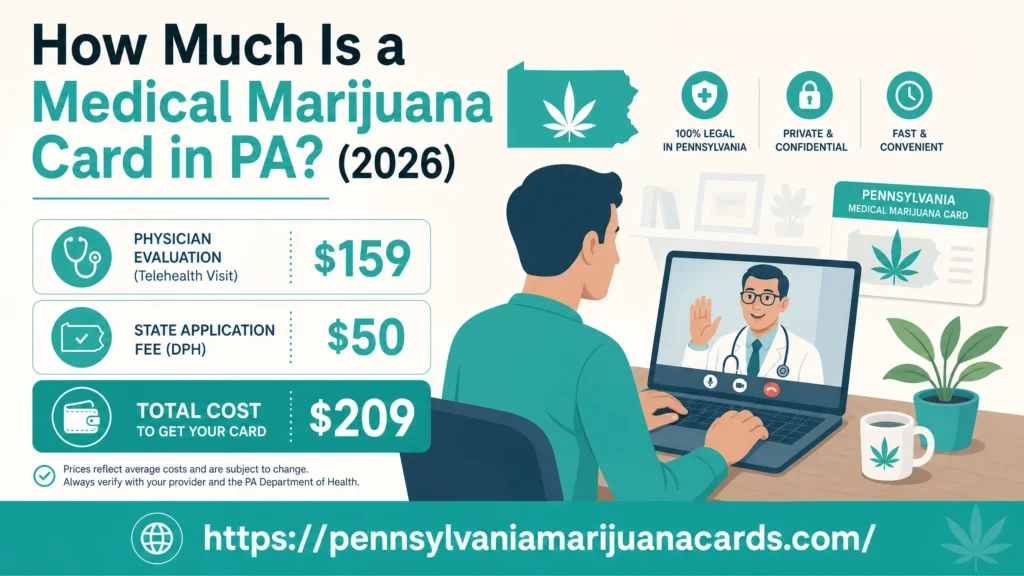
| Physician Fee | PA State Fee | Total | |
|---|---|---|---|
| New Patient | $159 | $50 | $209 |
| Renewal | $149 | $50 | $199 |
| MMAP Qualifying Patients (Medicaid, SNAP, WIC, CHIP, PACE, PACENET) | — | $0 (waived) | Physician fee only |
Start your same-day certification here.
Frequently Asked Questions
Q: Does THCA turn into THC?
A: Yes. THCA (tetrahydrocannabinolic acid) converts to delta-9 THC through a chemical process called decarboxylation. When THCA is exposed to heat, the carboxyl group attached to its molecular structure releases as carbon dioxide and water vapor, leaving behind active delta-9 THC. This happens automatically when cannabis flower is vaporized in a dry-herb device. THCA is non-psychoactive in its raw form because the carboxyl group prevents it from binding effectively to CB1 receptors. Once converted to THC through heat, it binds strongly and produces the therapeutic and psychoactive effects associated with medical cannabis.
Q: How do you turn THCA into THC?
A: The most efficient method for PA medical marijuana patients is vaporization in a calibrated dry-herb vaporizer at 350 to 410°F, which triggers rapid decarboxylation. At this temperature range, THCA converts to active THC efficiently while preserving terpenes and minimizing cannabinoid degradation. Oven decarboxylation at 240°F for 30 to 40 minutes achieves approximately 88% conversion efficiency and is used when making infused tinctures or oils. Combustion also converts THCA instantly but destroys 15 to 30% of cannabinoids through pyrolysis, making it less efficient. Pennsylvania’s Medical Marijuana Act specifies vaporization as the legally approved method for flower consumption.
Q: Is delta 9 THC the same as THC?
A: Yes. Delta-9 THC and THC refer to the same molecule: delta-9-tetrahydrocannabinol. When Pennsylvania dispensaries, physicians, and researchers use the term “THC,” they mean delta-9-tetrahydrocannabinol. The “delta 9” label became more common in the hemp market after the 2018 Farm Bill to distinguish hemp-derived delta-9 from other THC variants like delta-8 and delta-10. In medical and scientific contexts, “THC” has always meant delta-9. All THC products at licensed Pennsylvania dispensaries contain delta-9-tetrahydrocannabinol.
Q: What is the difference between delta 9 and THC?
A: There is no difference. Delta-9 and THC are two names for the same compound. “Delta-9” specifies the position of a double bond on the molecule’s carbon chain (at the 9th carbon atom) and is used to distinguish it from structural variants like delta-8-THC and delta-10-THC. In everyday medical and dispensary usage, “THC%” on a PA dispensary label means delta-9-tetrahydrocannabinol content. The distinction between the names only matters when comparing delta-9 specifically against delta-8 or delta-10, which are different molecules with different potency and legal status.
Q: Why does a PA dispensary flower label show both THC% and THCA%?
A: Pennsylvania dispensary flower labels show both numbers because cannabis flower in its raw, unheated state contains mostly THCA (the non-psychoactive precursor), with only small amounts of already-active THC. The THCA converts to active delta-9 THC when you vaporize it. The THC% tells you what is already active before any heat is applied. The THCA% tells you what will become active when you use the product. The formula to calculate total deliverable THC is: Total THC = THC% + (THCA% x 0.877). A product showing 1.2% THC and 22% THCA delivers approximately 20.5% total THC when vaporized, making the THCA number far more meaningful for predicting potency than the THC% alone.
Q: What is the total THC formula for PA dispensary flower?
A: The formula is: Total THC = THC% + (THCA% x 0.877). The 0.877 factor accounts for the molecular weight difference between THCA and THC: when the carboxyl group is released during decarboxylation, the resulting THC molecule weighs about 12.3% less than the original THCA. Applied to a real example: a product with 1.3% THC and 23.6% THCA would yield Total THC = 1.3 + (23.6 x 0.877) = 1.3 + 20.7 = 22.0% total THC. This is the same formula used in Pennsylvania Department of Health testing protocols and hemp compliance total-THC calculations.
Q: Is THCA psychoactive without heating?
A: No. THCA does not produce psychoactive effects in its raw, unheated form. The carboxyl group in THCA’s molecular structure prevents it from binding effectively to CB1 receptors in the brain and central nervous system, which is the mechanism through which delta-9 THC produces its effects. Eating raw cannabis flower or other unheated cannabis products will not produce a high. Some research has found that THCA has its own anti-inflammatory and neuroprotective properties, but these effects occur through different pathways and are separate from THC’s therapeutic and psychoactive effects.
Medical Disclaimer
This blog post is intended for general educational and informational purposes only and does not constitute medical advice. Information about decarboxylation temperatures and efficiency ranges reflects published scientific research as of July 2026 and represents general ranges, not guaranteed outcomes for any specific product or device. Always consult with the licensed pharmacist on duty at your PA dispensary or your certifying physician with specific questions about product potency and dosing. Medically reviewed by Dr. Johnathon Chance Miller, MD.
Sources
- Wang et al. — Optimization of the Decarboxylation of Cannabis for Commercial Applications. Industrial and Engineering Chemistry Research (ACS Publications)
- Hurcann — Does THCA Turn Into THC When Smoked? 2026 Guide (April 2026)
- Mellow Fellow — How to Decarb THCA Flower: Temperature Guide and Methods (February 2026)
- Bluntys — Cannabis Decarboxylation Science: Temperature Charts and Time Guides (April 2025)
- Ripper Seeds — Cannabis Decarboxylation: Optimal Temperature, Time and Methods (February 2026)
- DankLog — Exact Temp, Time and THCA-to-THC Science: Complete Decarboxylation Guide (March 2026)
- BlimBurn Seeds — What Temperature Does THCA Convert to THC? (December 2024)
- Inheal — Does THCA Become THC When Heated? The Science of Decarboxylation (December 2024)
- CBG Biotech — Cannabis Decarboxylation Methods: THCA to THC, Temperature and Cannabinoids (March 2026)
- Pennsylvania Medical Marijuana Act, Act 16 of 2016 — Laboratory testing requirements, labeling requirements for dispensary flower products
- PennsylvaniaStateCannabis.org — Pennsylvania Marijuana Laws 2026 (vaporization requirement for flower, dispensary pharmacist requirement)
- Pennsylvania Marijuana Cards — How to Choose Between Flower, Oil, Tincture, and Capsules at a PA Dispensary
- Pennsylvania Marijuana Cards — Qualifying Conditions