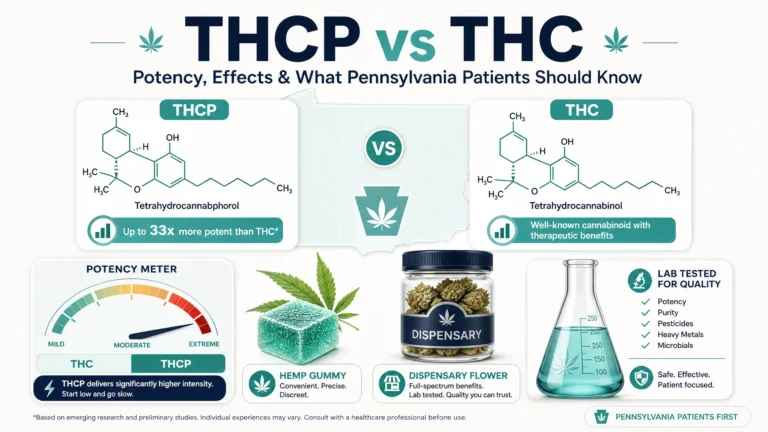
What is THCP vs THC?
THCP (tetrahydrocannabiphorol) is a naturally occurring cannabinoid discovered in 2019 that is structurally similar to delta-9 THC but significantly more potent. In laboratory studies, THCP binds to CB1 receptors approximately 33 times more strongly than delta-9 THC. In real-world use, the practical potency difference is closer to 5 to 10 times stronger than regular THC, not 33 times, because of how cannabinoid receptors work.
Need a PA Medical Marijuana Card?
Get certified online in 15 minutes. 100% Money-Back Guarantee.
Get Certified Now →If you are a Pennsylvania resident, here is why this matters right now: THCP products are appearing on shelves at PA smoke shops and hemp retailers without any age restriction or medical card requirement. PA dispensaries do not carry THCP. And unlike dispensary-purchased delta 9 THC, hemp-derived THCP provides no employment protections if you test positive on a drug test.
This guide covers the science, the honest potency picture, the legal status, and the specific risks PA residents should understand before purchasing.
Key Takeaways
- THCP was discovered in 2019 by Italian researchers who found it occurs naturally in cannabis in trace amounts under 0.1% of total cannabinoids. Most commercial THCP is semi-synthetically produced from CBD.
- The 33x stronger claim refers to CB1 receptor binding affinity, not actual effect intensity. Real-world experience is closer to 5 to 10 times stronger than delta 9 THC, according to consistent user reports.
- Practical dosing starts at 1 to 2mg of THCP to achieve effects similar to 10mg of THC. Standard THC starting doses (5 to 10mg) are far too high for THCP beginners.
- THCP is legal in Pennsylvania right now under the 2018 Farm Bill framework, but H.R. 5371 effective November 12, 2026 may reclassify it alongside other intoxicating hemp cannabinoids.
- THCP will show up on a drug test. It produces the same THC-COOH metabolites as delta 9 THC, and hemp-derived THCP provides no employment protection under Pennsylvania’s Medical Marijuana Act.
- No clinical research on THCP in humans exists as of July 2026. All dosing guidance comes from the 2019 discovery study and user reports, not controlled clinical trials.
What Is THCP? The 2019 Discovery Explained
THCP (delta-9-tetrahydrocannabiphorol) is a minor cannabinoid found naturally in cannabis plants. Until recently, it was unknown to science.
A team of Italian researchers led by Giuseppe Citti published their discovery of THCP in December 2019 in the journal Scientific Reports. They identified the compound using advanced mass spectrometry while analyzing a specific cannabis strain. What they found surprised them: THCP was present in the sample at extremely low concentrations, typically under 0.1% of total cannabinoid content, but showed receptor binding properties significantly exceeding those of delta 9 THC.
Do You Qualify for a PA MMJ Card?
Connect with a licensed Pennsylvania state physician online from home.
The Citti et al. 2019 study is the foundational document for everything known about THCP. As of July 2026, it remains the primary peer-reviewed research source on this cannabinoid. There are no published human clinical trials on THCP as of this writing. The current understanding of THCP’s effects in humans comes from: the 2019 in vitro and animal study findings, anecdotal user reports since THCP products entered the commercial hemp market in 2021 and 2022, and comparative analysis with structurally similar cannabinoids.
This research limitation matters. When evaluating any claims about THCP, the honest baseline is this: we know its molecular structure, its receptor binding profile in lab settings, and what users report. We do not have clinical trial data on its safety profile, drug interactions, or long-term effects in humans.
What Is THCP vs THC? The Molecular Difference
To understand what makes THCP different from delta 9 THC, the key is in the alkyl side chain, a structural component of the molecule that determines how tightly it fits into cannabinoid receptors.

Delta 9 THC has a five-carbon alkyl side chain.
THCP has a seven-carbon alkyl side chain.
Two extra carbon atoms. That is the entire structural difference. But as Triangle Hemp Wellness’s 2026 analysis explains: “The longer the chain, the more tightly the molecule binds to cannabinoid receptors in the human body.”
The comparison table below shows how THCP and delta 9 THC differ at the molecular and functional level:

| Feature | Delta 9 THC | THCP |
|---|---|---|
| Chemical name | Tetrahydrocannabinol | Tetrahydrocannabiphorol |
| Alkyl side chain length | 5 carbons | 7 carbons |
| Discovery year | 1964 | 2019 |
| CB1 receptor binding affinity | Reference (1x) | Approximately 33x |
| Natural abundance in cannabis | High (15-30% of cannabinoids) | Trace (under 0.1%) |
| Psychoactive without heat | No (exists as THCA in raw flower) | Yes, directly psychoactive |
| Available at PA dispensaries | Yes (with MMJ card) | No |
| Available at PA hemp shops | Yes (hemp-derived, no card) | Yes (hemp-derived, no card) |
| Employment protection (PA) | Yes, if dispensary-purchased | No |
This structural difference explains why THCP was so significant to the research team that discovered it. Prior to 2019, the scientific assumption was that a cannabinoid needed a minimum side chain of three carbons to bind to receptors at all. THCP demonstrated that extending the chain beyond five carbons, as seen in THC, dramatically increased binding potency rather than simply changing the effect profile.
Is THCP Stronger Than THC? The Honest Potency Answer
Yes, THCP is significantly stronger than THC. But the “33x stronger” figure that appears on most THCP product marketing needs careful unpacking, because it does not mean what most consumers assume.

The 33x figure refers specifically to CB1 receptor binding affinity, as measured in the original Citti et al. 2019 laboratory study. THCP was found to bind to CB1 receptors approximately 33 times more strongly than delta 9 THC in in vitro testing. That is a meaningful scientific finding.
⚡ Fast & 100% Online PA Medical Cards
Board-Certified Doctors • 100% Money-Back Guarantee
Book Evaluation Now →What it does not mean is that consuming THCP produces an experience 33 times more intense than consuming the same amount of THC. Here is why.
Cannabinoid receptors have a biological ceiling for activation. Once fully activated, additional binding strength does not produce proportionally stronger effects. The speaker volume analogy explains this well: turning a speaker from 10 to 330 does not produce 33 times more sound, because the speaker reaches its physical maximum at some point along that scale. Cannabinoid receptors work similarly. As Galaxy Treats’ 2026 analysis states: “Receptor binding affinity measured in a lab is not the same thing as a 33x stronger high in a human.”
Real-world user reports and comparative analysis consistently describe THCP as 5 to 10 times stronger than THC in practice, not 33 times. According to Zazzy’s December 2025 THCP analysis, “users report needing 1 to 2mg of THCP to achieve effects similar to 10mg of THC.”
Five to ten times stronger than THC is still an extraordinary potency level. This is not a marketing caveat designed to downplay THCP. A cannabinoid that produces THC-like effects at one-fifth to one-tenth the dose requires a completely different approach to dosing than anything most cannabis users are accustomed to.
How THCP Actually Feels: Effects and Duration
Based on user reports and what is understood from THCP’s receptor activity, the effect profile closely resembles delta 9 THC but with important differences in intensity and duration.

Effects reported consistently:
- Euphoria and mood elevation, similar to THC but more pronounced at equivalent doses
- Physical relaxation, often described as heavier and more sedating than standard THC
- Altered sensory perception, typically more intense than users expect
- Appetite stimulation
- Time distortion, more significant than typical THC experiences
- At higher doses, significant sedation that some users describe as overwhelming
The duration difference is one of the most important practical distinctions. Delta 9 THC through vaporization typically produces effects lasting 2 to 4 hours. THCP effects are reported to last considerably longer, with some users describing effects persisting for 6 to 8 hours or beyond.
This extended duration makes overconsumption significantly more uncomfortable to manage than with standard THC. While the management approach is the same (CBD if available, calm environment, water, rest, and waiting it out), the waiting period is potentially much longer with THCP.
Who is at higher risk of an overwhelming experience:
| User Profile | Risk Level | Reason |
|---|---|---|
| New cannabis users | Very High | No established tolerance, no reference point |
| Occasional THC users | High | THCP effective dose is far below what feels familiar with THC |
| Anxiety disorder patients | High | Potency amplifies THC-induced anxiety risk significantly |
| Regular THC users without THCP experience | Moderate | Tolerance to THC does not fully transfer to THCP |
| Experienced high-tolerance users | Lower but not low | Still requires careful dose reduction from normal THC amounts |
For Pennsylvania’s largest patient population, anxiety disorder patients (approximately 60% of PA MMJ certifications), the risk profile of THCP is particularly significant. If very high doses of standard THC already carry an anxiety and paranoia risk, THCP compounds that risk substantially.
How Is Commercial THCP Made?
This is a practical detail that most THCP coverage skips entirely, and it matters for understanding what you are actually buying at a Pennsylvania hemp shop.
Renewing Your PA MMJ Card?
Quick annual recertification online. No paperwork hassle.
Renew Card Online →THCP does occur naturally in cannabis plants, but at trace levels under 0.1% of total cannabinoid content. Extracting meaningful quantities of THCP directly from plant material would be extraordinarily inefficient and expensive. As Miraculix Lab’s cannabinoid analysis explains: “Most THC-P available today is made by semi-synthetic conversion from CBD, since extracting it directly from cannabis flowers is inefficient.”
The production process converts CBD (extracted from legal hemp) into THCP through chemical synthesis. This is the same general approach used to produce most commercial delta 8, delta 10, and HHC products in the hemp market.
The semi-synthetic nature of commercial THCP has two important implications for consumers:
The first is about sourcing. The “naturally occurring” claim in THCP marketing is technically accurate but practically describes a different situation from what is in the product. The THCP you buy was almost certainly created in a lab from hemp-derived CBD, not extracted from cannabis flower.
The second is about quality control. The conversion process requires chemistry expertise and clean reagents. Poorly manufactured THCP products can contain reaction byproducts or residual solvents from the conversion process. A Certificate of Analysis (COA) from a reputable third-party laboratory is the only way to verify what is actually in a product. For guidance on reading lab results for any cannabis product, our How to Read a Pennsylvania Dispensary COA guide covers the key sections, though hemp product COAs vary from PA dispensary COAs in their regulatory requirements.
THCP Dosing: What the Numbers Actually Mean

This is the section that matters most from a safety perspective. THCP dosing is fundamentally different from THC dosing, and applying your normal cannabis dose to THCP is how people end up in an extremely uncomfortable situation.
The reference point from consistent user reports: 1 to 2mg of THCP produces effects comparable to 10mg of THC.
That means if you typically use 10mg of THC as a comfortable dose, your equivalent THCP starting point would be 1 to 2mg. Not 10mg. Not 5mg. One to two milligrams.
THCP vs THC dose equivalence table:
| Typical THC Dose | Equivalent THCP Dose | Notes |
|---|---|---|
| 2.5mg (beginner) | 0.25 to 0.5mg | Microdose level for THCP |
| 5mg (standard beginner) | 0.5 to 1mg | Low THCP starting dose |
| 10mg (moderate user) | 1 to 2mg | Standard THCP reference dose |
| 20mg (experienced user) | 2 to 4mg | Higher THCP dose, experienced users only |
| 50mg (high tolerance) | 5 to 10mg | Very high THCP dose, not recommended without significant experience |
Most commercial THCP products are formulated as gummies, vape cartridges, or tinctures at 2 to 5mg per serving. Products labeled “5mg THCP per gummy” are delivering a dose comparable to approximately 25 to 50mg of THC. For context, our guide on is 100mg of THC a lot explains why anything above 50mg of THC is a significant dose for most adults. A 5mg THCP gummy can easily land in that territory.
Practical dosing guidance for THCP:
Get Approved by a Licensed PA Doctor
Schedule your appointment in minutes. You only pay if approved.
Start Online Application →Start at 1mg or less if you have never used THCP. Use a product where dosing can be controlled precisely, such as a tincture rather than a full gummy. Wait a minimum of 90 minutes before considering any additional dose, as THCP has a longer onset curve than vaporized THC. Do not mix with alcohol, which amplifies effects unpredictably. Do not drive or operate machinery.
THCP Legal Status in Pennsylvania (July 2026)
THCP occupies the same hemp legal gray area as delta 8, delta 10, and other hemp-derived cannabinoid isomers in Pennsylvania.
Under the federal 2018 Farm Bill and Pennsylvania’s Industrial Hemp Act (3 Pa.C.S. §701), hemp-derived products containing 0.3% or less delta-9 THC by dry weight are legal. THCP products sold at Pennsylvania hemp shops and online are marketed under this framework: the product itself tests below 0.3% delta-9 THC by dry weight, making the product technically hemp under current law.
Pennsylvania has not enacted any specific statute banning THCP as of July 2026. However, Pennsylvania’s Controlled Substances Act (Act 64) lists tetrahydrocannabinols as Schedule I controlled substances, the same provision that creates county-level enforcement ambiguity for delta 8 products. Whether and how this provision applies to THCP has not been tested in Pennsylvania courts.
The practical current situation: THCP products are being sold at Pennsylvania smoke shops and hemp retailers without any state-level enforcement action. No card is required to purchase them. Most products are not age-gated by law, though responsible retailers card at 21.
What is not available: Pennsylvania licensed medical marijuana dispensaries do not carry THCP. Dispensary products are regulated under the Medical Marijuana Act (Act 16), which governs only delta-9 THC and approved cannabis products tested by PA DOH-certified laboratories.
Does THCP Show Up on a Drug Test?
Yes. This is important and needs a clear, direct answer.

THCP is metabolized by the liver into the same THC-COOH metabolite that standard drug tests detect. The test has no ability to distinguish between metabolites produced by delta 9 THC, THCP, delta 8, delta 10, or any other THC variant. If THCP is in your system, you will test positive for THC on any standard immunoassay drug test.
There is an additional consideration for THCP specifically. Because THCP has a significantly longer duration of effects than delta 9 THC, it is plausible that its metabolites also linger in the body for an extended period. No specific pharmacokinetic studies have been published on THCP’s detection windows as of July 2026. As a conservative assumption, apply the same detection windows as heavy THC use, which includes up to 30 days in urine for regular consumers.
If you are subject to any employment drug testing, probation testing, or court-ordered testing, THCP carries exactly the same drug test risk as dispensary cannabis. It produces no employment protection, unlike dispensary-purchased cannabis for registered PA MMJ patients.
PA Dispensaries vs Hemp Shops: Why the Source Matters
Ready to Get Your Official PA MMJ Card?
State-certified doctor consultations online. No risk—100% refund if not approved.
Claim Your MMJ Card Online →This is the distinction that matters most for Pennsylvania residents thinking about using THCP or any highly potent hemp cannabinoid.
Hemp-derived THCP from a PA smoke shop or hemp retailer:

Products are tested only to the extent the vendor chooses to have them tested. There is no mandatory PA DOH oversight of hemp product testing. COA quality varies dramatically, and some products in the unregulated hemp market have tested with inaccurate cannabinoid content versus their label claims. No employment protection under Pennsylvania’s Medical Marijuana Act. No dispensary pharmacist to guide dosing decisions. No guarantee of contaminant testing to PA dispensary standards.
Dispensary-purchased delta 9 THC with a PA MMJ card:
Mandatory testing by two separate, independent ISO 17025-accredited laboratories before sale. Required COA covering cannabinoid potency, terpene profile, heavy metals, mycotoxins, microbials, and pesticides. Employment anti-discrimination protection under Act 16 and Palmiter v. Commonwealth Health Systems for most non-safety-sensitive jobs. Licensed pharmacist consultation available at every visit. Legal certainty unaffected by November 2026 federal hemp regulation changes.
THCP, because of its extraordinary potency, is precisely the type of product where product accuracy matters most. A gummy labeled at 2mg THCP that actually contains 5mg is a significant overconsumption risk. In the regulated dispensary system, that labeling accuracy is legally mandated and verified by independent labs. In the hemp market, it is the vendor’s own quality standards.
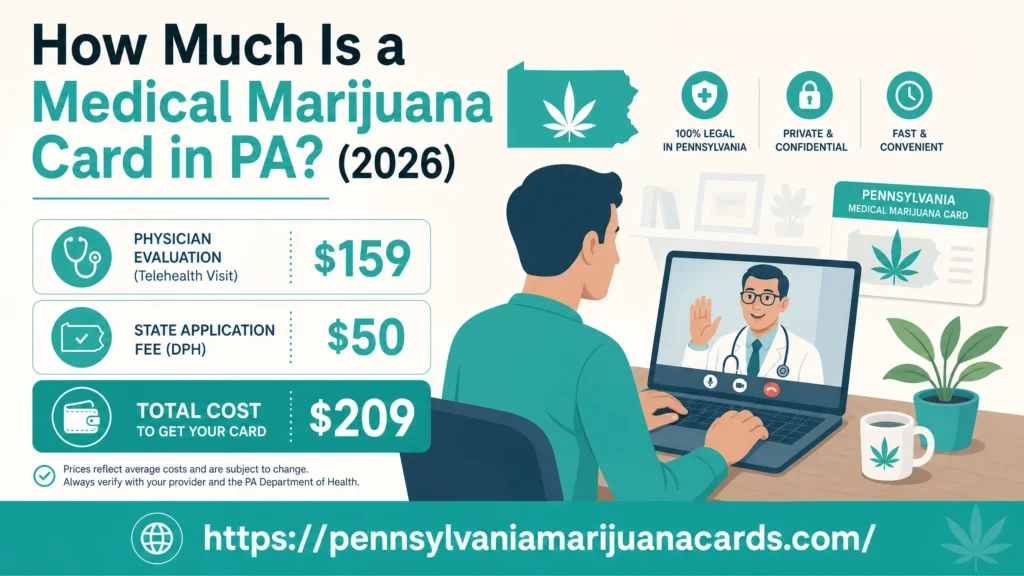
If you have a qualifying medical condition and want cannabis access with the full protection of Pennsylvania’s regulatory framework, our qualifying conditions page covers all 24 recognized conditions. Pennsylvania Marijuana Cards offers same-day telehealth certifications for new patients at $159 plus the $50 state fee.
The November 2026 Federal Deadline and THCP
THCP’s future legal availability in Pennsylvania after November 12, 2026 is uncertain.

Federal law H.R. 5371, signed November 12, 2025 and effective exactly one year later, imposes a 0.4mg per-container total THC cap on hemp-derived products. This provision was designed specifically to address the intoxicating hemp cannabinoid market, including products that are technically compliant with the 0.3% delta-9 dry-weight rule but contain significant amounts of other psychoactive compounds.
The question for THCP under H.R. 5371 is not fully resolved as of July 2026. The 0.4mg cap applies to “total THC,” and the specific regulatory definition of whether THCP is counted in “total THC” under the new framework will depend on final agency rulemaking. However, the intent of the legislation was clearly to limit intoxicating hemp products. THCP, as one of the most potent intoxicating hemp cannabinoids available, would fall squarely within the regulatory concern that motivated the law.
Industry legal analysts expect that most THCP products currently on PA shelves will be significantly affected by November 2026 enforcement, whether through reclassification as Schedule I substances or through product reformulation that reduces THCP to sub-threshold levels.
If you are using THCP products currently for a medical purpose, the November 2026 deadline is an additional reason to explore whether a PA MMJ card would give you stable, regulated access to THC products beyond that date.
THCP Safety: What We Know and What We Do Not
Being direct about the research gaps here is more useful than overstating what is known.
What we know?
THCP binds to CB1 and CB2 receptors significantly more strongly than delta 9 THC. This is established in the 2019 Citti et al. study published in Scientific Reports. The compound produces psychoactive effects in animal models at lower doses than delta 9 THC, consistent with its higher receptor affinity. User reports are broadly consistent: effects are more intense and longer-lasting than delta 9 THC, and overconsumption is common among people who apply their standard THC dose.
What we do not know?
There are no published human clinical trials on THCP. There is no clinical data on THCP’s safety profile in people with cardiovascular conditions, liver conditions, psychiatric conditions, or those taking medications. Drug interaction data with common medications (SSRIs, blood thinners, anti-epileptics) does not exist for THCP specifically. Long-term use effects are completely unknown. Pharmacokinetic data on how long THCP metabolites persist in various body systems has not been published.
What to do if you overconsume?
The management approach is the same as any THC overconsumption: move to a safe, calm environment, take CBD if available (it can moderate CB1 activation), drink water, lie down, and wait. Because THCP’s duration of effects is significantly longer than standard THC, the waiting period may be considerably extended. Do not take additional cannabis products and do not take alcohol. Seek medical attention if you experience chest pain, difficulty breathing, or loss of consciousness.
Frequently Asked Questions
Q: What is THCP vs THC?
A: THCP (tetrahydrocannabiphorol) is a naturally occurring cannabinoid discovered in 2019 by Italian researchers. It is structurally similar to delta 9 THC but has a seven-carbon alkyl side chain instead of THC’s five-carbon chain. This structural difference allows THCP to bind to CB1 receptors approximately 33 times more strongly than delta 9 THC in laboratory testing. Real-world potency is closer to 5 to 10 times stronger than THC, because cannabinoid receptors reach a biological activation ceiling regardless of binding strength.
Q: Is THCP stronger than THC?
A: Yes, significantly. THCP binds to CB1 receptors 33 times more strongly than delta 9 THC in laboratory settings, and real-world effects are consistently reported as 5 to 10 times more potent than THC by users. The practical dosing implication: 1 to 2mg of THCP produces effects comparable to approximately 10mg of THC. Standard THC starting doses (5 to 10mg) are far too high for someone new to THCP.
Q: Is THCP legal in Pennsylvania?
A: Hemp-derived THCP is currently legal in Pennsylvania under the federal 2018 Farm Bill framework, as long as the finished product contains 0.3% or less delta-9 THC by dry weight. Pennsylvania has no specific statute banning THCP as of July 2026. However, federal law H.R. 5371 effective November 12, 2026 may significantly affect the legal availability of THCP and other intoxicating hemp cannabinoids. No PA MMJ card is required to purchase hemp-derived THCP at smoke shops or online.
Q: Does THCP show up on a drug test?
A: Yes. THCP is metabolized into the same THC-COOH metabolite that standard urine, blood, saliva, and hair drug tests detect. The test cannot distinguish between THCP, delta 9 THC, delta 8, or any other THC variant. Because no pharmacokinetic research exists specifically for THCP, detection windows are unknown but likely at least as long as heavy THC use, which can be 30 or more days in urine. THCP provides no employment protection under Pennsylvania’s Medical Marijuana Act.
Q: Can I buy THCP at a Pennsylvania dispensary?
A: No. Pennsylvania’s licensed medical marijuana dispensaries operate under the Medical Marijuana Act and carry only state-approved delta-9 THC products that have been tested by PA DOH-certified laboratories. THCP is not an approved product at PA dispensaries. THCP is available at hemp shops, smoke shops, and online retailers in Pennsylvania without a medical card.
Q: What is the safe starting dose for THCP?
A: Start at 1mg or less if you have no prior THCP experience. This is equivalent to approximately 5 to 10mg of THC in terms of expected effect. Wait a minimum of 90 minutes before considering any additional dose. Most commercial THCP gummies contain 2 to 5mg per piece, which represents a significant dose for beginners. Products where you can control dose more precisely, such as tinctures, are better options for first-time THCP users.
Q: How long does THCP last compared to THC?
A: Delta 9 THC through vaporization typically produces effects lasting 2 to 4 hours. THCP is reported to produce effects lasting considerably longer, with many users describing 6 to 8 hours or beyond. This extended duration makes overconsumption more significant with THCP, as an uncomfortable experience lasts much longer than it would with standard THC.
Q: What is the difference between THCP and delta 9 THC on a PA dispensary label?
A: PA dispensary products contain delta 9 THC (from cannabis flower expressed as Total THC after applying the THCA conversion formula). THCP does not appear on any PA dispensary label because it is not an approved product in Pennsylvania’s medical marijuana program. If you see THCP listed on a product label, that product is from the unregulated hemp market, not a licensed PA dispensary.
The Bottom Line

THCP is an unusual cannabinoid. Its receptor binding profile is the strongest of any naturally occurring cannabinoid identified so far. Its potency in practice is real, meaningful, and dramatically different from what most cannabis users expect based on experience with standard THC products.
For Pennsylvania residents considering THCP products available at local hemp shops, the most important things to carry from this guide are: start at 1mg or less, wait 90 minutes before assessing, understand that a drug test will not distinguish it from dispensary cannabis, and know that no employment protection applies to hemp-sourced products under PA law.
For PA residents using cannabis for a medical condition and wanting access to high-quality, potency-verified products with employment protections and pharmacist guidance, the PA dispensary system remains the most regulated and legally protected option available. Check whether your condition qualifies or get certified today.
This blog post is intended for general educational and informational purposes only and does not constitute medical advice. THCP research is extremely limited as of July 2026, with no published human clinical trials. All dosing guidance reflects available user reports and comparative research, not clinical data. If you take prescription medications or have a pre-existing health condition, consult a licensed physician before using any cannabis or hemp product. Do not drive or operate machinery after consuming THCP or any cannabinoid product. Medically reviewed by Dr. Johnathon Chance Miller, MD.
Sources
- Citti et al. 2019: A novel phytocannabinoid isolated from Cannabis sativa L., Scientific Reports
- Triangle Hemp Wellness: THCP vs THC: Is It Really 33x Stronger? (March 2026)
- Galaxy Treats: THCP vs THC Explained (May 2026)
- Zazzy: THCP vs THC 33x Stronger? Effects, Dosage and Products (December 2025)
- Cornbread Hemp: THCP vs THC Explained Potency Effects (March 2026)
- Premium Jane: THCP: The New Cannabinoid Explained (March 2026)
- Miraculix Lab: THC-P The New Cannabinoid Explained
- Twenty One Cannabis: Is THCP Really Stronger Than THC? (February 2026)
- Elevate Right: THCP vs THC (June 2025)
- Pennsylvania State Cannabis: Drug Testing Law 2026
- HempData: What H.R. 5371 Means for Your Hemp Business (April 2026)
- PA Department of Health: Medical Marijuana Program
- Pennsylvania Marijuana Cards: Qualifying Conditions