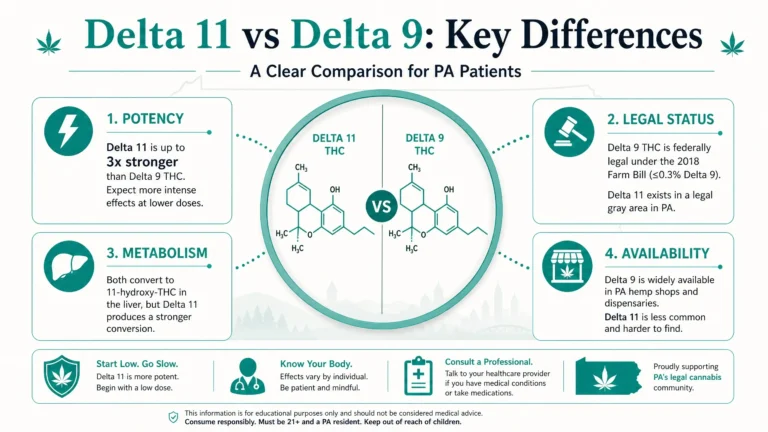

Delta 11 vs delta 9 — two cannabinoids that are generating significant buzz in Pennsylvania’s cannabis and hemp markets in 2026, and causing genuine confusion for patients and consumers trying to understand what they are actually buying. Both are forms of THC. Both produce psychoactive effects. But they differ in molecular structure, reported potency, legal status pathway, availability in Pennsylvania, and the protections available to you when you test positive on a drug test.
This guide gives you the complete, honest comparison — including the most important distinction that most competing articles get completely wrong, what the research actually says about delta 11’s potency claims, and what Pennsylvania residents specifically need to know before choosing between these two cannabinoids.
Need a PA Medical Marijuana Card?
Get certified online in 15 minutes. 100% Money-Back Guarantee.
Get Certified Now →What Is Delta 9 THC? The Foundation
Delta-9-tetrahydrocannabinol — delta 9 THC — is the primary psychoactive compound in cannabis. When people say “THC” without any qualifier, they almost always mean delta 9. It is the compound that has been studied for decades, the one found in high concentrations in cannabis flower, and the one that gives cannabis its well-known effects.
Delta 9 THC works by binding to CB1 and CB2 receptors in the body’s endocannabinoid system — particularly CB1 receptors in the brain, which produce the psychoactive effects. When consumed through vaporization, its effects begin within minutes and last 2–4 hours. When consumed orally through capsules, troches, or tinctures, onset is slower (30 minutes to 2 hours) and effects last considerably longer (4–8 hours) due to liver metabolism into 11-hydroxy-THC — more on that important conversion in Section 3.
Delta 9 in Pennsylvania: Delta 9 THC is the primary psychoactive compound available at all licensed Pennsylvania medical marijuana dispensaries. Every product — flower, vape cartridges, tinctures, capsules, troches, concentrates — contains delta 9 as the dominant cannabinoid. Purchasing dispensary delta 9 requires a valid PA medical marijuana patient ID card.
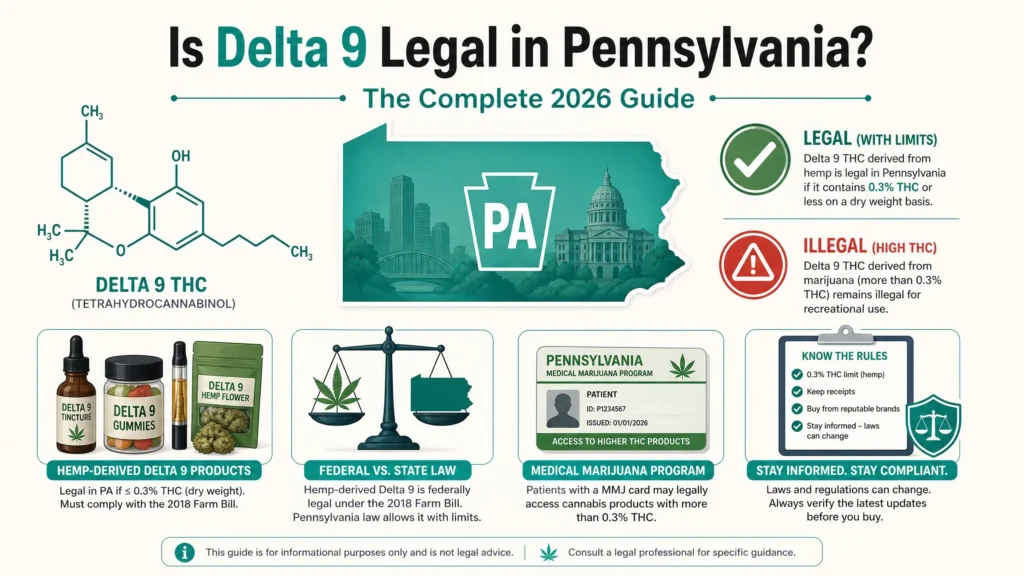
Hemp-derived delta 9 products containing 0.3% or less THC by dry weight are also available in Pennsylvania without a card — in hemp shops, some convenience stores, and online. Both sources produce the same compound. What differs is the legal framework, available protections, and product quality standards.
What Is Delta 11 THC? The Honest Explanation
Do You Qualify for a PA MMJ Card?
Connect with a licensed Pennsylvania state physician online from home.
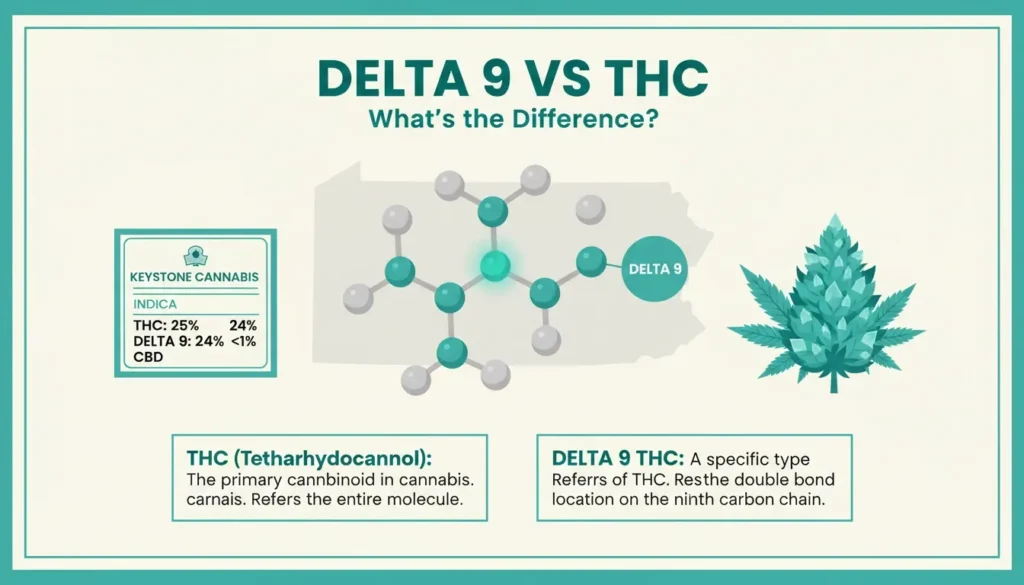
Delta-11-tetrahydrocannabinol — delta 11 THC — is a naturally occurring cannabinoid found in cannabis plants, though in significantly smaller concentrations than delta 9. It is classified as a THC isomer — meaning it shares the same molecular formula as delta 9 but has a slightly different atomic arrangement.
Like other THC isomers — delta 8, delta 9, delta 10 — the “number” in the name refers to the position of a specific double bond in the molecule’s carbon chain. Delta 9 has its double bond on the 9th carbon. Delta 11 has its double bond on the 11th carbon.
This small structural shift changes how the molecule interacts with CB1 and CB2 receptors in your endocannabinoid system — which is believed to account for the reported differences in potency and effect profile. The key word is “believed” — because the honest reality is that scientific research on delta 11 THC is extremely limited as of May 2026.
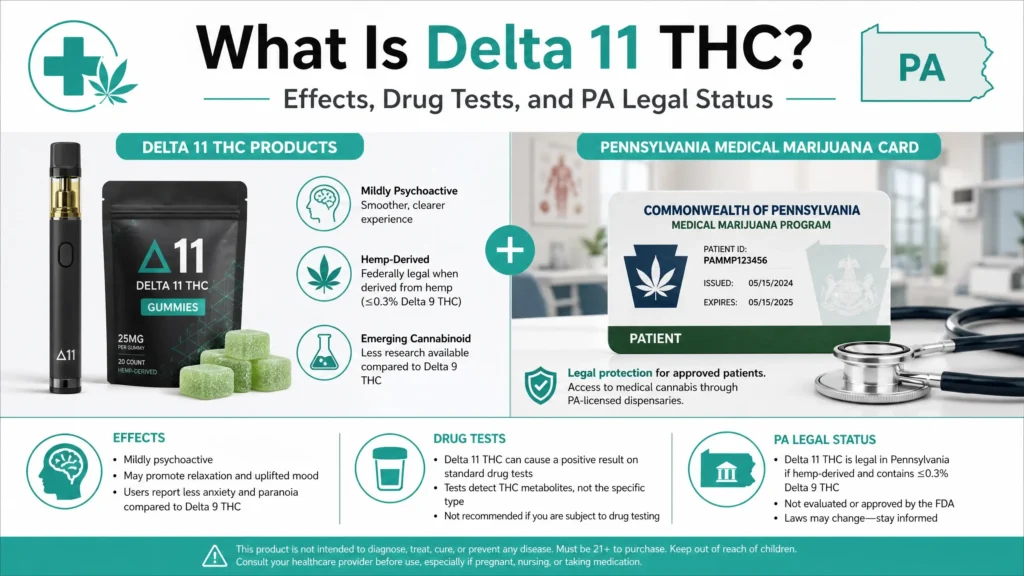
Delta 11 in Pennsylvania: Delta 11 THC is primarily available as a hemp-derived product in Pennsylvania — at hemp retailers, smoke shops, and online vendors. It is not typically found at licensed PA medical marijuana dispensaries, which carry regulated, standardized products. Because delta 11 is present in very small concentrations in cannabis plants naturally, commercial delta 11 products are typically produced by converting other cannabinoids through chemical processes.
The Critical Confusion — Delta 11 vs. 11-Hydroxy-THC

This is the most important section in this entire guide — and the distinction that most competing articles either miss entirely or explain poorly.
There are two completely different compounds that both involve the number 11:
Delta 11 THC — the cannabinoid we are discussing in this blog. A naturally occurring isomer of THC with a double bond on the 11th carbon. An external compound you can consume through a product.
11-Hydroxy-THC (11-OH-THC) — a metabolite that your body produces internally when your liver processes delta 9 THC. This is not something you consume — it is something your body creates when you eat an edible, swallow a capsule, or take a tincture. It is responsible for the famously more intense effect of edibles compared to inhalation.
As Zaleaf’s 2026 analysis explains: “When you eat a weed brownie, your liver processes the delta 9 and turns it into 11-hydroxy-THC, which is famous for being much more potent and long-lasting than inhaled THC. While delta 11 might share some of that heavy potency, it is a distinct molecule that you can vape or smoke, whereas 11-hydroxy-THC is something your body makes internally.”
Why this confusion matters: Many users who try delta 11 and find it “more intense than expected” may be experiencing edible 11-hydroxy-THC effects — not delta 11 itself — because most delta 11 products are sold as edibles and gummies. The intensity may have nothing to do with delta 11’s unique properties and everything to do with the 11-hydroxy-THC conversion happening in their liver.
⚡ Fast & 100% Online PA Medical Cards
Board-Certified Doctors • 100% Money-Back Guarantee
Book Evaluation Now →This is why honest, rigorous comparison of delta 11 vs delta 9 requires acknowledging that dosage form significantly confounds potency comparisons — something virtually no competing guide acknowledges.
Delta 11 vs Delta 9 — The Molecular Difference
Here is the structural distinction explained as simply as possible:

| Feature | Delta 9 THC | Delta 11 THC |
|---|---|---|
| Full name | Delta-9-tetrahydrocannabinol | Delta-11-tetrahydrocannabinol |
| Double bond position | Carbon chain position 9 | Carbon chain position 11 |
| Molecular formula | C₂₁H₃₀O₂ | C₂₁H₃₀O₂ (same) |
| Relationship | Primary cannabis cannabinoid | Isomer of delta 9 |
| Natural abundance | High in cannabis | Very low — trace amounts |
| Commercial production | Direct extraction from cannabis | Often synthesized from other cannabinoids |
| ECS binding | Strong CB1 affinity | Believed higher CB1 affinity — limited research |
The identical molecular formula tells you these are structural isomers — the atoms are the same, just arranged differently. That arrangement difference, however small it appears on paper, changes how the molecule fits into and activates your cannabinoid receptors.
The position of the double bond affects the compound’s three-dimensional shape — and that shape determines how precisely it locks into CB1 and CB2 receptors. Delta 11’s bond position is believed to allow slightly different receptor interaction than delta 9’s, which is the proposed explanation for its reportedly higher potency. Proposed — because rigorous receptor binding studies on delta 11 remain limited.
Potency — Is Delta 11 Really 3x Stronger Than Delta 9?

This claim circulates widely across delta 11 product marketing and cannabis blogs: “Delta 11 is up to three times more potent than delta 9.” Before accepting this at face value — it deserves careful scrutiny.
Where does the “3x potency” claim come from?
The honest answer: primarily from user reports and marketing claims, not from peer-reviewed pharmacological research. As Mellow Fellow’s cannabinoid analysis states: “Delta 11 THC is thought to be between two and three times stronger than delta 9 THC. Again, the scientific literature here is scarce.”
Similarly, Elevate Holistics’ January 2026 guide notes: “Some users report effects similar to delta 8 THC (milder than delta 9), while others claim more intense euphoria and relaxation, though marketing claims of being three times stronger are not consistently supported.”
The confounding variables that make this claim unreliable:
Most delta 11 products sold in 2026 are edibles — gummies, capsules, and similar oral products. Because oral THC is metabolized through the liver into 11-hydroxy-THC, any comparison of “delta 11 edibles vs delta 9 flower” is not actually measuring the compounds’ intrinsic potency differences. It is measuring edible effects vs. inhalation effects — and edibles are famously more intense regardless of which THC isomer they contain.
What we can say with reasonable confidence:
- Delta 11 does appear to produce psychoactive effects at lower doses than delta 9 in many user reports
- The potency difference likely exists — but whether it is 2x, 3x, or some other figure has not been established through controlled research
- Hollyweed’s cannabinoid guide recommends: “If you’re accustomed to delta 9 THC and trying delta 11 for the first time, reduce your dose by 30% to avoid overconsumption”
Renewing Your PA MMJ Card?
Quick annual recertification online. No paperwork hassle.
Renew Card Online →That 30% dose reduction guidance is the most practically useful takeaway from available evidence — regardless of whether the underlying potency difference is precisely 2x or 3x.
The practical implication: Treat delta 11 as meaningfully more potent than delta 9 until proven otherwise. Start at a significantly lower dose. Do not assume your usual delta 9 dose will produce the same experience.
Effects — How Do They Actually Differ?
Based on available user reports and the limited research that exists as of May 2026, here is how the effect profiles of delta 11 and delta 9 compare:
Delta 9 THC Effect Profile
Delta 9 is the reference point — the classic cannabis experience that millions of users and decades of anecdotal and clinical evidence describe. Effects typically include:
- Euphoria and mood elevation — the signature effect
- Relaxation — physical and mental, dose-dependent
- Altered sensory perception — heightened appreciation of music, food, and sensory experiences
- Appetite stimulation — the well-known “munchies” effect
- Pain relief — one of its most clinically documented therapeutic effects
- Sedation — particularly at higher doses and with indica-dominant strains
- Anxiety and paranoia risk — at higher doses, particularly in inexperienced users or those with anxiety disorders
The effects of delta 9 are dose-dependent and highly variable based on strain, consumption method, tolerance, and individual biology.
Delta 11 THC Effect Profile
Delta 11’s effect profile is reported as similar to delta 9 but with some notable reported differences from user communities:
- More intense euphoria — users consistently report a stronger euphoric component at equivalent doses
- Longer duration — several user accounts describe longer-lasting effects compared to delta 9 at similar doses
- Body-heavy relaxation — many users describe a more pronounced body effect alongside the cerebral component
- Potentially clearer-headed — some users report less cognitive fog than heavy delta 9 use at comparable effect intensity
- Higher anxiety risk — because effects are more intense, the risk of anxiety and paranoia is amplified, particularly for new users or anxiety patients
The honest comparison: As Munchies’ cannabinoid blog describes: “Delta 9 is the real deal THC. It produces that classic euphoria, those mind-bending effects… Delta 11 is shrouded in a bit more mystery. It’s a lot less understood than delta 9, but we do know this: it can produce some pretty powerful psychoactive effects.”
The effect comparison is genuinely limited by the research gap. Most of what we know comes from self-reported user experiences — which, while valuable, introduce significant bias, dosage inconsistency, and the edible confound discussed in Section 3.
The Honest Research Gap — What We Don’t Know About Delta 11
This section is one that most competing guides skip — because acknowledging limited evidence is uncomfortable for content that wants to seem authoritative. But E-E-A-T requires honesty, and honesty here serves patients better than confident claims without evidence.
What we do not know about delta 11 as of May 2026:
Precise receptor binding affinity: No published peer-reviewed studies have specifically measured delta 11’s CB1 and CB2 receptor binding affinity compared to delta 9 in controlled laboratory conditions. The claim that delta 11 has “higher binding affinity” is theoretical — based on molecular structure analysis, not direct measurement.
Get Approved by a Licensed PA Doctor
Schedule your appointment in minutes. You only pay if approved.
Start Online Application →Pharmacokinetics: How quickly is delta 11 absorbed? How is it metabolized by the liver? What metabolites does it produce? How long does it remain active? These fundamental pharmacokinetic parameters have not been published for delta 11 in peer-reviewed literature as of May 2026.
Clinical safety: No clinical studies have specifically examined the safety profile of delta 11 THC in humans. The lack of regulation of hemp-derived cannabinoid products means manufacturing processes, purity, and contamination risks are not standardized.
Drug interactions: How delta 11 might interact with common medications — SSRIs, blood thinners, anti-seizure medications — is completely unknown from a research standpoint. As Elevate Holistics’ guide states: “Drug Interactions: We don’t know how delta 11 might interact with medications, alcohol, or other substances.”
Long-term effects: No longitudinal studies exist on long-term delta 11 use.
This is not a reason to assume delta 11 is dangerous — cannabis isomers generally share a broadly similar safety profile. But it is a reason to approach delta 11 with more caution than delta 9, which has decades of research behind it, particularly if you are using it for therapeutic purposes.
Legal Status in Pennsylvania — May 2026
Understanding the legal status of both compounds in Pennsylvania requires understanding the framework Pennsylvania uses.
Pennsylvania follows federal hemp law based on delta 9 THC concentration. As confirmed by the PA Department of Agriculture’s Hemp Program FAQ and BD Logistics’ 2026 PA hemp law analysis: “Pennsylvania continues to distinguish hemp-derived cannabinoids from marijuana based on Delta-9 THC concentration, not chemical structure or psychoactivity alone. Pennsylvania follows the federal definition of hemp established by the 2018 Farm Bill: Hemp is legal if it contains no more than 0.3% Delta-9 THC by dry weight.”
Delta 9 THC in Pennsylvania:
- From licensed dispensaries (medical use): Legal for registered PA MMJ patients with valid patient ID card
- Hemp-derived (under 0.3% delta 9 by dry weight): Legal for adults without a card — available at hemp retailers and online
- Recreational use: Still illegal in Pennsylvania as of May 2026
Delta 11 THC in Pennsylvania: Hemp-derived delta 11 THC is legal in Pennsylvania provided the product contains 0.3% or less delta 9 THC by dry weight. Pennsylvania has no specific state statute banning delta 11 or other hemp-derived cannabinoid isomers.
However, there is an important legal nuance: Pennsylvania’s Controlled Substances Act (Act 64) lists “tetrahydrocannabinols” as Schedule I controlled substances. Some Pennsylvania law enforcement agencies have used this provision to challenge hemp-derived THC isomers including delta 8. Whether this interpretation extends to delta 11 has not been tested in Pennsylvania courts.
Ready to Get Your Official PA MMJ Card?
State-certified doctor consultations online. No risk—100% refund if not approved.
Claim Your MMJ Card Online →The safest approach for PA residents using delta 11:
- Purchase only from vendors who provide third-party Certificates of Analysis (COAs) confirming delta 9 THC is below 0.3% by dry weight
- Retain product packaging and COA documentation
- Be aware that enforcement interpretations can vary by county in Pennsylvania
Where to Find Each in Pennsylvania
Delta 9 THC — two pathways in Pennsylvania:
Licensed PA dispensaries (with MMJ card): All 186+ licensed Pennsylvania medical marijuana dispensaries carry delta 9 THC products — flower, vapes, tinctures, capsules, troches, concentrates, and rosin. These products are state-regulated, lab-tested, and accurately labeled. Requires a valid PA medical marijuana patient ID card to purchase.
Hemp retailers and online (without card): Hemp-derived delta 9 products (under 0.3% by dry weight) are available at hemp shops, some convenience stores, and online vendors throughout Pennsylvania. These products have no state-level quality oversight. No card required.
Delta 11 THC — available in Pennsylvania: Delta 11 products are available primarily at hemp retailers, smoke shops, and online vendors in Pennsylvania. They are not typically available at licensed PA medical marijuana dispensaries. As of May 2026, commercial delta 11 products include gummies, vape cartridges, and tinctures from hemp-focused brands.

The quality difference matters: Licensed PA dispensary products undergo mandatory testing by state-approved laboratories covering cannabinoid content, terpenes, contaminants, heavy metals, and pesticides. Hemp delta 11 products are not subject to the same mandatory testing regime. Always verify third-party COA documentation before purchasing any hemp-derived delta 11 product.
Drug Testing — Does Delta 11 Show Up?

Yes — and this is a point that deserves clear, direct communication.
Delta 11 THC produces THC-COOH when metabolized — the same metabolite that standard drug tests detect, regardless of which THC isomer produced it. Standard immunoassay drug tests cannot distinguish between metabolites from delta 9, delta 11, delta 8, or delta 10. They detect the presence of THC-COOH above the cutoff threshold.
As Elevate Holistics states unambiguously: “Standard drug tests detect THC-COOH, a metabolite your body creates when breaking down any form of THC, including delta 11, delta 8, delta 9, and delta 10. If you face employment screening, probation monitoring, or any other drug testing, avoid delta 11 and all THC products entirely.”
The “legal hemp” defense does not work for drug tests: Just as with hemp-derived delta 9 products — the legality of the product you consumed has no bearing on whether it triggers a positive drug test result. A delta 11 gummy purchased legally at a Pennsylvania hemp store produces the same drug test outcome as illegal cannabis.
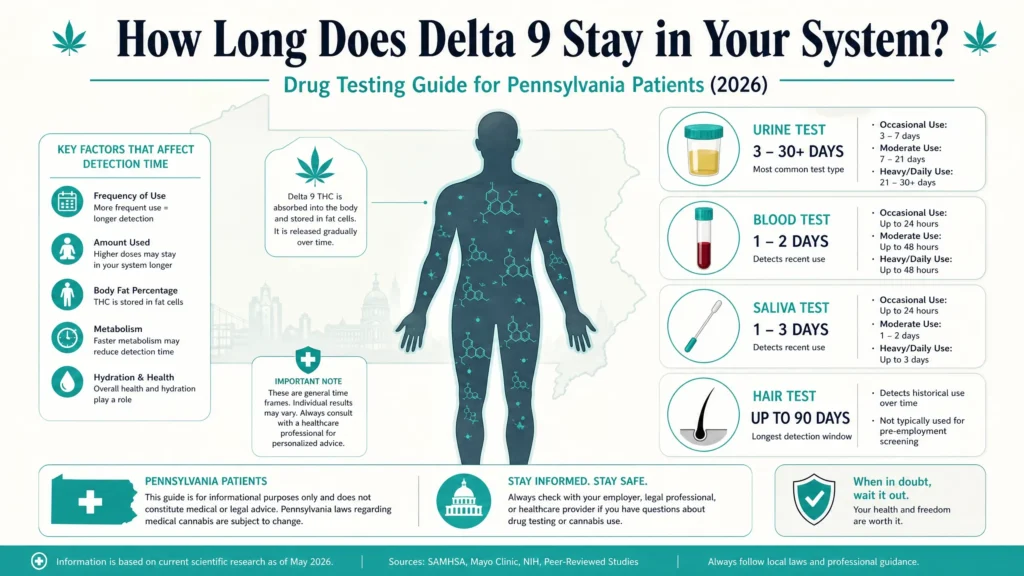
Detection windows for delta 11: Because no specific pharmacokinetic studies exist for delta 11, we apply the same detection windows as delta 9 THC — which is the closest known analog. See our companion guide How Long Does Delta 9 Stay in Your System? for complete detection window data by test type and frequency of use.
If you are subject to any drug testing: Do not use delta 11 or any THC-containing product regardless of its hemp-derived legal status.
The November 2026 Federal Deadline — What It Means for Delta 11

This is the most important May 2026 development affecting delta 11 and all hemp-derived intoxicating cannabinoids — and it is largely absent from competing guides.
Under the current federal regulatory timeline, hemp-derived intoxicating cannabinoid products face potential legal status changes tied to a November 2026 federal deadline — which could severely restrict or eliminate the hemp-derived THC market as currently structured.
The proposed changes would move away from the 2018 Farm Bill’s dry-weight delta 9 THC threshold as the sole compliance measure, potentially reclassifying products based on total psychoactive cannabinoid content. If implemented, this would significantly impact delta 11 products — which are marketed precisely because of their intoxicating properties.
As Enjoy Hemp’s February 2026 industry analysis notes: “Intoxicating hemp products will largely disappear from legal online markets after November 2026. Consumers seeking THC will need to purchase through state-licensed marijuana dispensaries.”
What this means for Pennsylvania delta 11 users:
If the November 2026 deadline takes effect without Congressional intervention:
- Hemp-derived delta 11 products may no longer be legally available through hemp retailers or online
- Access to legal THC products would shift primarily to licensed state dispensaries
- Pennsylvania patients would need a valid PA MMJ card to legally access THC products
This regulatory uncertainty is an additional reason why Pennsylvania residents who use cannabis for therapeutic purposes are better served by the state’s licensed medical marijuana program — which provides legal certainty, quality-tested products, and employment protections that the unregulated hemp market cannot offer.
The PA MMJ Card Advantage — Why It Matters for This Comparison

The most practically significant difference between delta 11 and dispensary delta 9 for Pennsylvania residents is not potency or effect profile — it is the legal framework surrounding each.
Dispensary delta 9 (with PA MMJ card):
- Products are state-regulated and quality-tested
- Purchase and possession are fully protected under PA Medical Marijuana Act
- Registered patients have employment anti-discrimination protections under Act 16 and Palmiter v. Commonwealth Health Systems (2021)
- Products are consistently and accurately labeled
- Available at 186+ locations statewide with pharmacist consultation
- Employment protections apply when you test positive — for most non-safety-sensitive jobs
Hemp-derived delta 11 (no card required):
- Products are unregulated — quality and accuracy of labeling varies significantly
- No employment protections under PA Medical Marijuana Act — testing positive is treated identically to illegal marijuana use
- Legal status subject to regulatory change by November 2026
- No dispensary pharmacist consultation available
- Research on safety and interactions is extremely limited
The bottom line: If you are using cannabis for a qualifying medical condition in Pennsylvania, registered dispensary access with a PA MMJ card provides a level of legal protection, product safety, and employment security that hemp-derived delta 11 products fundamentally cannot.
Pennsylvania recognizes 24 qualifying conditions including anxiety disorders, chronic pain, PTSD, cancer, and many more. Review the full qualifying conditions list or get certified today.
Which Is Right for You? A Decision Framework for PA Patients
Choose dispensary delta 9 (with PA MMJ card) if:
- You have a qualifying medical condition and want legal, protected access to THC
- You need employment anti-discrimination protections
- You want quality-tested, accurately labeled products with pharmacist guidance
- You want legal certainty that is not subject to November 2026 federal regulatory changes
- You are managing anxiety, chronic pain, PTSD, or another serious condition
Choose hemp-derived delta 9 (no card) if:
- You do not have a qualifying condition for the PA MMJ program
- You want occasional casual use without a physician consultation
- You understand there are no employment protections and accept that risk
Consider delta 11 only if:
- You are an experienced delta 9 user seeking a potentially more intense experience
- You are not subject to any drug testing
- You have no qualifying condition for the PA MMJ program
- You understand the very limited research base and accept the uncertainty
- You source products exclusively from vendors with verified third-party COAs
- You reduce your typical delta 9 dose by at least 30% when starting
Do NOT use delta 11 if:
- You are subject to any employment, probation, or legal drug testing
- You have anxiety disorder or a history of THC-induced anxiety
- You are taking medications without first consulting your physician about interactions
- You are pregnant, breastfeeding, or have cardiovascular conditions
- You are a new cannabis user with no established THC tolerance
For PA patients managing anxiety specifically — whether delta 9 or delta 11, the dose-anxiety relationship applies to both. Higher doses increase anxiety risk regardless of the isomer. See our Anxiety Disorder & Medical Marijuana in Pennsylvania guide for condition-specific dosing guidance.
Frequently Asked Questions
Q: What is the difference between delta 11 and delta 9?
A: Delta 9 and delta 11 are both forms of THC — structural isomers with identical molecular formulas but different double bond positions (carbon 9 vs. carbon 11). Delta 9 is the primary psychoactive compound in cannabis with extensive research behind it. Delta 11 is a rare, naturally occurring cannabinoid found in trace amounts that is typically synthesized commercially. Delta 11 is believed to be more potent than delta 9, though rigorous scientific research confirming the precise potency difference is limited as of May 2026.
Q: Is delta 11 stronger than delta 9?
A: User reports and limited available evidence suggest delta 11 is more potent than delta 9, with estimates ranging from 2x to 3x stronger. However, these claims are primarily based on anecdotal user reports rather than peer-reviewed research. The “3x potency” claim widely circulated in marketing has not been confirmed through controlled pharmacological studies. If trying delta 11 for the first time, most guides recommend reducing your typical delta 9 dose by approximately 30%.
Q: Is delta 11 THC the same as 11-hydroxy-THC?
A: No — these are completely different compounds. Delta 11 THC is a cannabinoid you can consume through a product. 11-Hydroxy-THC (11-OH-THC) is a metabolite your body produces internally when your liver processes delta 9 THC — responsible for why edibles feel more intense than inhalation. Confusing these two is one of the most common errors in delta 11 content online.
Q: Is delta 11 legal in Pennsylvania?
A: Hemp-derived delta 11 THC is currently legal in Pennsylvania provided the product contains 0.3% or less delta 9 THC by dry weight — consistent with Pennsylvania’s adoption of the 2018 Farm Bill framework. However, Pennsylvania’s Controlled Substances Act lists tetrahydrocannabinols as Schedule I, and enforcement interpretation of this provision for hemp isomers has varied by county. Additionally, a November 2026 federal regulatory deadline could significantly restrict hemp-derived intoxicating cannabinoid products including delta 11.
Q: Does delta 11 show up on a drug test?
A: Yes. Delta 11 THC is metabolized into THC-COOH — the same metabolite standard drug tests detect regardless of which THC isomer produced it. Using delta 11 instead of delta 9 will not help you pass a drug test. Detection windows are similar to delta 9 since pharmacokinetic data specific to delta 11 is not yet available.
Q: Can I find delta 11 at Pennsylvania dispensaries?
A: Delta 11 is not typically available at licensed Pennsylvania medical marijuana dispensaries, which carry state-regulated delta 9 products. Delta 11 is primarily available at hemp retailers, smoke shops, and online vendors in Pennsylvania. Licensed PA dispensaries carry dispensary-grade delta 9 products that are mandatory tested and come with employment protections for registered patients.
Q: What is the November 2026 federal deadline for delta 11?
A: A federal regulatory deadline in November 2026 could significantly restrict hemp-derived intoxicating cannabinoid products, potentially including delta 11. Under proposed changes, products would be assessed on total psychoactive cannabinoid content rather than just delta 9 dry-weight concentration — which would affect delta 11 products currently marketed as legal hemp. Pennsylvania residents who use cannabis therapeutically are better insulated from this regulatory uncertainty by obtaining a PA medical marijuana card and purchasing from licensed dispensaries.
Q: Should I get a PA MMJ card instead of using hemp delta 11?
A: If you have a qualifying medical condition — anxiety, chronic pain, PTSD, cancer, epilepsy, or one of Pennsylvania’s 24 recognized conditions — a PA MMJ card provides access to dispensary-grade delta 9 products with employment protections, pharmacist guidance, quality-tested products, and legal certainty that hemp delta 11 cannot offer. The card costs $159 (physician fee) plus $50 state registration fee at Pennsylvania Marijuana Cards, with the state fee waived for qualifying Medicaid, SNAP, WIC, CHIP, PACE, or PACENET patients.
The Bottom Line
Delta 11 vs delta 9 — the core differences in 2026 come down to four things:
Research: Delta 9 has decades of research. Delta 11 has almost none. Honest comparison requires acknowledging this gap rather than presenting marketing claims as scientific fact.
Potency: Delta 11 appears more potent than delta 9 based on available user reports — likely in the 2–3x range — but this has not been confirmed through controlled research. Reduce your dose by at least 30% when transitioning.
Legal framework in Pennsylvania: Both hemp-derived versions are currently legal under PA’s hemp law framework. But dispensary delta 9 purchased with a PA MMJ card comes with employment protections, quality testing, pharmacist guidance, and legal certainty that hemp delta 11 products do not provide.
November 2026 deadline: Hemp-derived intoxicating cannabinoids including delta 11 face potential federal restriction by November 2026, creating regulatory uncertainty that licensed PA dispensary products do not face.
For Pennsylvania residents managing qualifying medical conditions, the path that provides the most protection, the most oversight, and the most legal certainty remains a registered PA medical marijuana card with dispensary access.
Learn whether your condition qualifies or get certified today.
Medically reviewed by Dr. Johnathon Chance Miller, MD. This article is for educational and informational purposes only and does not constitute medical or legal advice. Cannabis and hemp laws in Pennsylvania and at the federal level are actively evolving as of May 2026. Verify current regulations with the Pennsylvania Department of Agriculture and consult a licensed attorney for legal advice specific to your situation.
Sources:
- PA Department of Agriculture — Hemp Program FAQs
- Pennsylvania State Cannabis — Delta THC Legal Status
- BD Logistics — Pennsylvania Cannabis & Hemp Laws 2026
- Elevate Holistics — What Is Delta 11 THC (January 2026)
- Zaleaf — Delta 11 THC Ultimate Guide 2026 (March 2026)
- Mellow Fellow — Delta 11 vs Delta 9 THC
- Hollyweed — Delta 11 vs Delta 9
- Herb.co — Delta-11 vs Delta 9 Key Differences
- Delta Munchies — Delta 11 THC vs Delta 9 THC (February 2026)
- Triangle Hemp Wellness — 11-Hydroxy-THC vs Delta-9 (January 2026)
- Enjoy Hemp — How to Buy Legal Weed Online 2026 (February 2026)
- Elevate Right — Is Delta 8 Legal in Pennsylvania 2026
- The Marijuana Herald — Legal Status Hemp-Derived THC All 50 States
- PA Department of Health — Medical Marijuana Program