
Is THC banned by the Big Beautiful Bill?
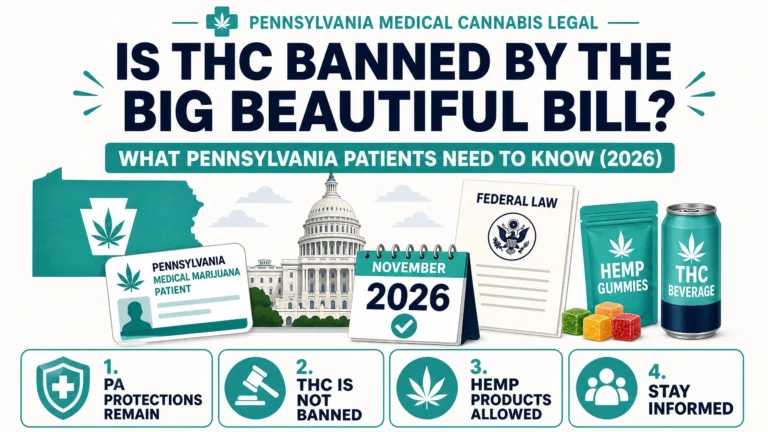
This is one of the most searched cannabis law questions of 2026, and the short answer is NO. The One Big Beautiful Bill Act, signed into law on July 4, 2025, does not ban THC or affect the hemp industry directly.
Need a PA Medical Marijuana Card?
Get certified online in 15 minutes. 100% Money-Back Guarantee.
Get Certified Now →The confusion is understandable. A major federal law did ban most hemp-derived THC products, but it was a completely different piece of legislation signed four months earlier. That law is already on the books.
It’s deadline is November 12, 2026. And if you are a Pennsylvania resident buying hemp delta 9 gummies, THC drinks, or other hemp cannabinoid products at smoke shops or online, you have four months left before most of those products become federally illegal.
This guide clears up the confusion between the two laws, explains exactly what the real hemp THC ban says, what it means for PA residents, and what is not affected at all.
Key Takeaways
- The Big Beautiful Bill did not ban THC. The One Big Beautiful Bill Act (signed July 4, 2025) is a tax and spending reconciliation bill with no hemp-specific provisions.
- The actual hemp THC ban came from H.R. 5371, signed November 12, 2025, which rewrites the federal definition of hemp effective November 12, 2026.
- The 0.4mg per-container THC cap is the specific provision that eliminates most hemp delta 9 gummies, drinks, vapes, and edibles currently sold at PA smoke shops and online.
- Pennsylvania dispensary MMJ products are completely unaffected. Licensed dispensary cannabis is regulated under the Medical Marijuana Act, not the Farm Bill, and will remain fully legal regardless of what happens with H.R. 5371.
- Several counter-bills are pending in the Senate as of July 2026, including proposals to delay the November deadline by two to three years. None have passed into law as of publication.
- PA residents currently relying on hemp products for a qualifying medical condition should explore PA MMJ certification now, not in October.
The Two Laws People Are Confusing: A Quick Clarifier
Before anything else, here is the clearest possible side-by-side explanation of the two laws creating all this confusion:

| One Big Beautiful Bill Act | H.R. 5371 (The Actual Hemp Ban) | |
|---|---|---|
| Official name | One Big Beautiful Bill Act | Continuing Appropriations, Agriculture, Legislative Branch, Military Construction and Veterans Affairs, and Extensions Act, 2026 |
| Signed into law | July 4, 2025 | November 12, 2025 |
| Primary purpose | Federal tax cuts, spending, and budget reconciliation | End a 43-day government shutdown, fund the federal government |
| Does it affect hemp or THC? | No | Yes, through Section 781 |
| Effective date of hemp provision | N/A | November 12, 2026 |
| Impact on PA MMJ dispensary products | None | None |
| Impact on hemp shop THC products | None | Most eliminated |
Do You Qualify for a PA MMJ Card?
Connect with a licensed Pennsylvania state physician online from home.
The confusion comes from timing. Both are high-profile pieces of legislation from the Trump administration.
Both were widely discussed in 2025 and 2026. And both touched on cannabis-adjacent topics in some coverage. But only one of them actually affects THC products, and it is not the one most people are asking about.
What Is the One Big Beautiful Bill Act?
The One Big Beautiful Bill Act is a large federal budget reconciliation bill. It was signed into law by President Trump on July 4, 2025.
At nearly 1,000 pages, it addresses a wide range of areas including federal tax rates, military spending, border security, Medicaid restructuring, and energy policy. It is primarily a fiscal and policy legislation package, not a drug or hemp regulation bill.
The Big Beautiful Bill does not affect the hemp industry, though a separate piece of legislation, the 2025 Agriculture Appropriations Bill, could ban hemp-derived intoxicating cannabinoids like delta-8 THC and THCA if passed.
The bill does have indirect consequences for cannabis-adjacent topics. Its Medicaid spending provisions affect low-income patients who rely on Medicaid coverage for various health conditions, some of whom are also PA MMJ patients who qualify for MMAP fee waivers. But on the specific question of whether it bans THC: no, it does not.
If you searched “is THC banned by the Big Beautiful Bill” and landed here, the answer to your actual underlying question is: a different law does ban most hemp THC products, and the details follow below.
What Is H.R. 5371 and What Does It Actually Do?
H.R. 5371 is the legislation that actually rewrites federal hemp law. The law is known as the Continuing Appropriations, Agriculture, Legislative Branch, Military Construction and Veterans Affairs, and Extensions Act, 2026.

It funds the federal government through January 30, 2026, and includes three full fiscal year appropriations for agriculture, military and veterans affairs, and the legislative branch.
Within its agriculture section lies Section 781, a provision that quietly rewrites Section 297A of the Agricultural Marketing Act of 1946 and narrows the definition of hemp that was originally established under the 2018 Farm Bill.
⚡ Fast & 100% Online PA Medical Cards
Board-Certified Doctors • 100% Money-Back Guarantee
Book Evaluation Now →The new definition is set to take effect 365 days after enactment, meaning the changes will become enforceable on November 13, 2026.
How did a provision this significant end up in a government funding bill?
The Senate passed the legislation earlier in the week, and following the House vote, President Trump signed it into law later that night, ending a forty-three-day government shutdown.
When Congress is under pressure to pass a continuing resolution and avoid a prolonged shutdown, provisions get attached that would not survive standalone scrutiny. Section 781 was one of them.
Supporters of the new definition, including Senate Minority Leader Mitch McConnell, who authored the hemp legalization language in the 2018 Farm Bill, argue that this change is long overdue.
The hemp industry was not given advance notice or a comment period. The provision was included, debated briefly, and signed. An attempt by Senator Rand Paul to strip the provision entirely was tabled during Senate consideration.
The 0.4mg Per-Container Cap: What It Means in Plain Terms
Section 781 of H.R. 5371 changes the federal definition of hemp in two critical ways.

Change 1: Total THC replaces delta-9 THC only
The 2018 Farm Bill defined hemp as cannabis containing 0.3% or less delta-9 THC by dry weight. This is the definition that allowed the entire hemp-derived cannabinoid market to exist.
Manufacturers could load products with delta-8, delta-10, THCP, HHC, and other psychoactive compounds as long as the finished product stayed below 0.3% delta-9 THC specifically.
The key change to the definition of hemp is adjusting the prior maximum concentration of cannabinoids from 0.3% delta-9 THC by dry weight to 0.3% total THC. This closes the loophole that allowed high-dose hemp products to exist.
Change 2: The 0.4mg per-container absolute cap
The legislation also establishes new THC limits of 0.4 milligrams of total THC per container, creating an additional limiting factor on the potential sale of these products.
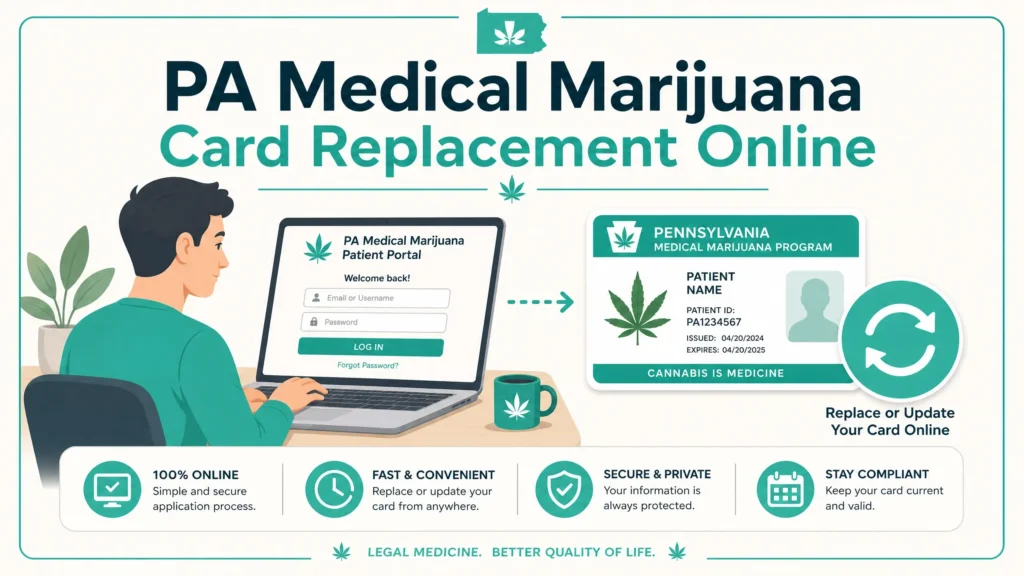
Renewing Your PA MMJ Card?
Quick annual recertification online. No paperwork hassle.
Renew Card Online →To understand what 0.4mg means in practice, consider that a standard hemp delta 9 gummy currently sold at Pennsylvania smoke shops contains 5 to 10mg of THC per piece.
A THC seltzer contains 5mg to 10mg per can. Many hemp products available to consumers today far exceed that limit, with some products containing thousands of milligrams.
At 0.4mg per container, a product would contain approximately one-twelfth to one-twenty-fifth of what a current standard gummy contains. At that level, psychoactive effects would be negligible for nearly all users.
What Gets Banned on November 12, 2026?
Under H.R. 5371 Section 781, effective November 12, 2026, the following products will no longer qualify as legal hemp and will be reclassified as federally illegal:

| Product Type | Current THC Content | Status After Nov 12, 2026 |
|---|---|---|
| Hemp delta 9 gummies (5mg to 10mg per piece) | 5,000 to 10,000 mcg per container | Federally illegal |
| THC seltzers and drinks (5mg to 10mg per can) | 5,000 to 10,000 mcg per container | Federally illegal |
| Delta-8 THC products (any dose) | Synthesized, not naturally occurring | Federally illegal |
| HHC products | Not naturally produced in plant | Federally illegal |
| THCP products (any dose) | Semi-synthetic | Federally illegal |
| High-dose CBD tinctures with trace THC | Varies, may exceed 0.4mg total | Likely federally illegal |
| 0.4mg or less per-container hemp products | Within the new limit | Remain legal |
Initial estimates by hemp industry economists and executives suggest that 95% of the industry as it exists today would be eliminated.
The intoxicating hemp sector was valued at approximately $28.4 billion, supported an estimated 300,000 jobs, and generated roughly $1.5 billion in state tax revenue. All of that is at risk under the current November 2026 timeline.
Additionally, the new law explicitly includes industrial hemp, defined as hemp grown for the use of the stalk, whole grain, oil, cake, nut, hull, or any other non-cannabinoid derivative of the seeds, and hemp used for fiber or for immature plants.
This means the agricultural side of the industry is protected within the new framework, but consumer cannabinoid products above the 0.4mg threshold are not.
What Does NOT Get Banned: PA Dispensary Products Are Safe
This is the single most important point for Pennsylvania medical marijuana patients and cardholders.

Pennsylvania’s licensed medical marijuana program operates under the Medical Marijuana Act (Act 16 of 2016), which is state law. PA dispensary products are not hemp products under the Farm Bill framework.
They are medical cannabis products regulated by the Pennsylvania Department of Health.
Get Approved by a Licensed PA Doctor
Schedule your appointment in minutes. You only pay if approved.
Start Online Application →H.R. 5371 Section 781 rewrites the federal definition of hemp. It has no effect on state-licensed medical marijuana programs.
Your PA MMJ card, your ability to purchase at any of Pennsylvania’s 186+ licensed dispensaries, and the products available to you there are completely unaffected by the November 2026 deadline.
| Product Source | Affected by H.R. 5371 Nov 2026 Deadline? | Legal Protection After Deadline? |
|---|---|---|
| PA licensed dispensary (with MMJ card) | No | Full state protection under Act 16 |
| Hemp shop delta 9 gummies (no card) | Yes, most eliminated | None under current law |
| Online hemp THC drinks | Yes, most eliminated | None under current law |
| Hemp-derived delta-8 products | Yes, fully eliminated | None under current law |
| Hemp-derived THCP products | Yes, fully eliminated | None under current law |
This distinction is why PA MMJ cardholders are in a fundamentally different legal position than Pennsylvania residents who rely on hemp shop products for therapeutic cannabis use.
The dispensary system is built on state law that predates and operates independently from the Farm Bill’s hemp definitions.
Where Does the 2026 Farm Bill Fit In?
The 2026 Farm Bill adds another layer to an already complicated picture.

The U.S. House voted, 224-200, on April 30 to pass the Farm, Food, and National Security Act of 2026.
The House-passed 2026 Farm Bill would redefine hemp as a cannabis plant that does not test higher than 0.3% total THC (including THCA), rather than using the delta-9 THC threshold established in the 2018 Farm Bill that led to the boom in intoxicating hemp products.
This means the House-passed 2026 Farm Bill would codify and extend the H.R. 5371 hemp redefinition into long-term agriculture policy. It now heads to the Senate.
The 2026 Farm Bill now heads to the Senate, where hemp-related provisions are likely to be addressed by Sen. Rand Paul, R-Ky., who filed the Hemp Safety Enforcement Act on April 16 in an attempt to let states “opt out” of the intoxicating product ban.
The 2026 Farm Bill is a separate vehicle from H.R. 5371. The November 12, 2026 deadline comes from H.R. 5371, which is already law. The Farm Bill’s passage or failure does not affect that deadline unless it specifically amends or delays Section 781.
Counter-Bills in the Senate: Is There a Chance the Deadline Gets Delayed?
Ready to Get Your Official PA MMJ Card?
State-certified doctor consultations online. No risk—100% refund if not approved.
Claim Your MMJ Card Online →Yes, there is a chance. Several bills have been introduced specifically to delay or replace the H.R. 5371 hemp ban. As of July 2026, none have passed.

The Hemp Planting Predictability Act (H.R. 7024): Introduced January 13, 2026, by Representative Baird (R-IN) with bipartisan co-sponsors including Representatives Comer (R-KY) and Craig (D-MN), would amend the implementation language of Section 781 by replacing “365 days” with “3 years,” thereby deferring the effective date to November 12, 2028.
A Senate companion was introduced by Senators Klobuchar (D-MN), Paul (R-KY), and Merkley (D-OR).
The Cannabinoid Safety and Regulation Act (CSRA): Democratic U.S. Sens. Ron Wyden and Jeff Merkley filed the Cannabinoid Safety and Regulation Act, the first bill to attempt to preserve a $28-billion national marketplace since Congress included prohibition language.
The CSRA would establish a regulatory framework rather than outright prohibition, setting THC limits of 5mg per serving and 50mg per container for edibles, and 10mg per container for beverages.
The HEMP Act of 2025 (S. 2112): Introduced by Sen. Rand Paul, this bill would raise the THC threshold for hemp to 1% on a dry-weight basis, effectively creating significantly more room for hemp-derived cannabinoid products.
The American Hemp Protection Act (H.R. 6209): Introduced by Rep. Nancy Mace, this bill would strike Section 781 entirely and restore the 2018 Farm Bill definition with no replacement framework.
The practical reality for Pennsylvania residents: as of July 2026, the November 12, 2026 deadline is the law.
Plan around it, not around the possibility of a fix. If a delay passes before November, your situation improves. If it doesn’t, you are prepared either way.
Pennsylvania-Specific Implications
Pennsylvania has not enacted its own parallel hemp ban as of July 2026. Unlike Ohio (which enacted a categorical ban in December 2025) and New Jersey (which has accelerated product liquidation timelines), Pennsylvania has not passed state-level legislation directly targeting hemp cannabinoid products in the H.R. 5371 context.
However, Pennsylvania’s existing legal framework already creates relevant constraints:
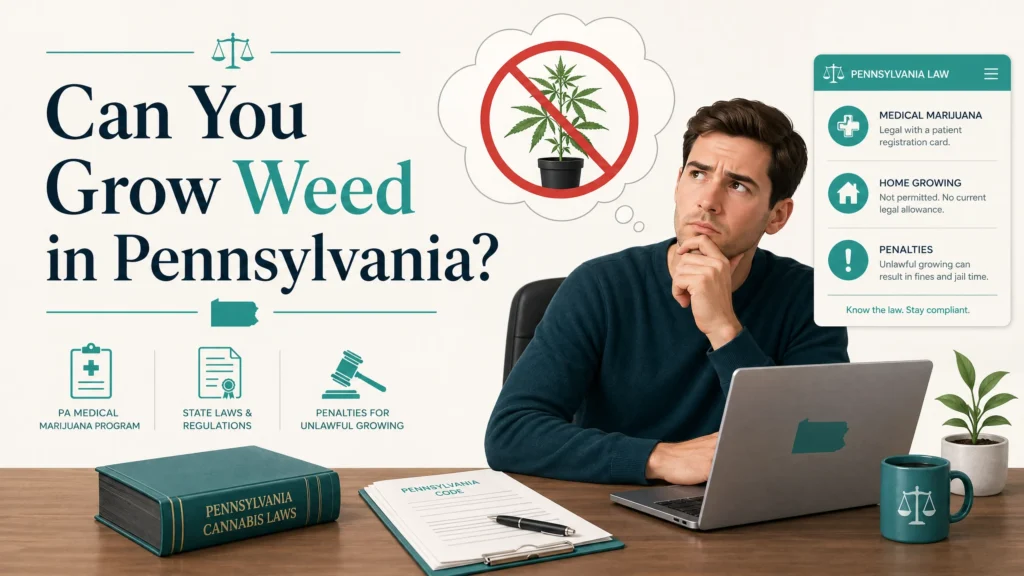
Pennsylvania’s Controlled Substances Act (Act 64) lists tetrahydrocannabinols as Schedule I controlled substances. Once H.R. 5371 takes effect and hemp-derived THC products above 0.4mg per container lose their federal hemp classification, state enforcement in Pennsylvania would have a clearer basis for treating those products as Schedule I violations under Act 64.
For Pennsylvania residents currently purchasing hemp delta 9 products from smoke shops, the November 12, 2026 timeline means retail availability will begin declining well before the deadline as brands reformulate, exit the market, or exhaust inventory.
Expect shelves to change significantly beginning in September and October 2026.
For Pennsylvania’s licensed dispensary system, H.R. 5371 changes nothing. The 186+ licensed dispensaries across Pennsylvania will continue operating under the Medical Marijuana Act with exactly the same product range, patient protections, and regulatory framework they have today.
What PA Residents Should Do Before November 2026
If you are a Pennsylvania resident currently using hemp THC products from smoke shops, gas stations, or online retailers, here is a practical action framework organized by situation:

If you use hemp products for a qualifying medical condition:
This is the most important scenario. Anxiety disorders, chronic pain, PTSD, insomnia, and many other conditions that hemp THC helps manage are also qualifying conditions for Pennsylvania’s medical marijuana program.
Getting a PA MMJ card before November 2026 means:
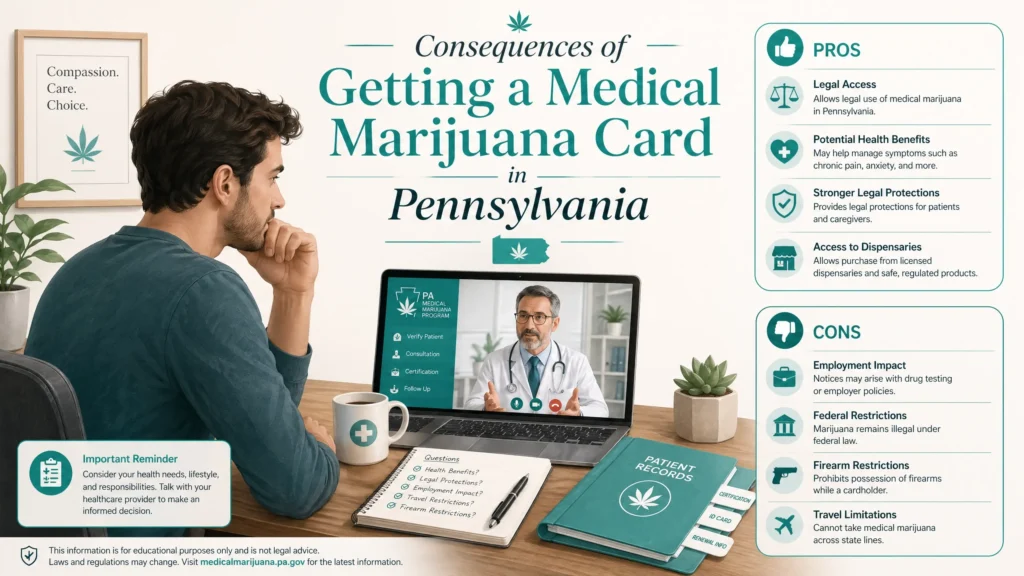
- Continued legal access to THC products regardless of what happens to the hemp market
- Employment anti-discrimination protection under Act 16 and Palmiter v. Commonwealth Health Systems
- Access to state-tested, accurately labeled products at 186+ licensed dispensaries
- Dispensary pharmacist guidance on the right product for your specific condition
- No employment protection gap when you test positive on a drug test
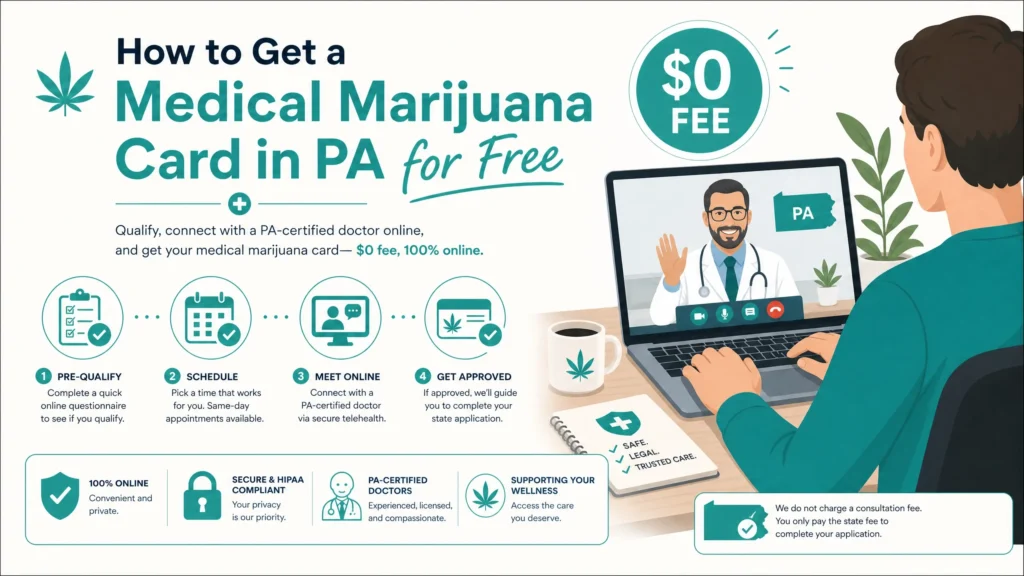
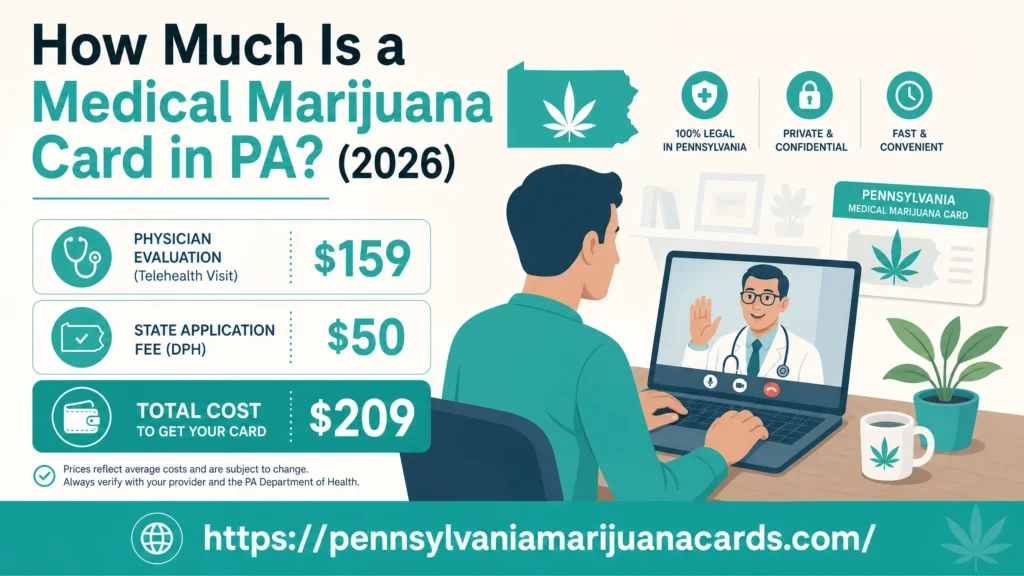
The certification process through Pennsylvania Marijuana Cards is entirely online, takes 15 to 20 minutes, and is available same-day. New patient certification is $159 (physician fee) plus the $50 state registration fee.
Patients enrolled in Medicaid, SNAP, WIC, CHIP, PACE, or PACENET have the $50 state fee waived through MMAP.
If you use hemp products recreationally with no qualifying condition:
You are in a more limited situation. PA dispensaries require a qualifying condition.
Options after November 2026 include very low-dose hemp products that comply with the 0.4mg cap (negligible psychoactive effect), waiting for the potential Farm Bill Senate revision, or recreational cannabis if Pennsylvania legalizes it (SB 120 is pending but not yet passed).
If you are already a registered PA MMJ patient:
Nothing changes for you on November 12, 2026. Continue using your card as normal.
If you want to explore whether your condition qualifies for Pennsylvania’s medical marijuana program, the full list of 24 qualifying conditions is here. Get started with your same-day certification here.
Frequently Asked Questions
Q: Is THC banned by the Big Beautiful Bill?
A: No. The One Big Beautiful Bill Act, signed July 4, 2025, is a tax and spending reconciliation bill with no hemp or THC provisions. It does not ban any cannabis products. The actual law that bans most hemp-derived THC products is H.R. 5371, the Continuing Appropriations Act signed November 12, 2025. That law’s hemp provision (Section 781) takes effect November 12, 2026 and imposes a 0.4mg per-container total THC cap that eliminates most hemp gummies, drinks, and cannabinoid products currently at smoke shops and online.
Q: What does the actual hemp THC ban say?
A: Section 781 of H.R. 5371 rewrites the federal definition of hemp effective November 12, 2026. It changes the THC threshold from 0.3% delta-9 THC by dry weight to 0.3% total THC (including THCA and other isomers). It also imposes a 0.4mg per-container absolute cap on total THC in any final hemp-derived cannabinoid product for retail sale. Products exceeding these limits will be federally reclassified as Schedule I controlled substances.
Q: Are Pennsylvania dispensary products affected by the November 2026 hemp ban?
A: No. Pennsylvania’s licensed medical marijuana dispensaries operate under state law (Act 16 of 2016), not the federal Farm Bill hemp framework. H.R. 5371 rewrites the federal definition of hemp. It has no effect on state-licensed cannabis programs. PA dispensary products, patient cards, and all Act 16 protections remain fully intact after November 12, 2026.
Q: What hemp products will still be legal after November 12, 2026?
A: Products containing 0.4mg or less of total THC per container will still qualify as hemp. At that level, psychoactive effects are negligible for most users. Non-intoxicating CBD isolate and broad-spectrum CBD products (with no detectable THC) are also unaffected. Non-cannabinoid hemp products such as hemp fiber, hemp seeds, and hemp oil (for food) are specifically preserved in the new definition.
Q: Could Congress delay the November 2026 deadline?
A: Yes, it is possible. Several bills have been introduced to delay or replace the H.R. 5371 hemp provision, including the Hemp Planting Predictability Act (which would delay to November 2028), the Cannabinoid Safety and Regulation Act (which would establish a regulatory framework), and the HEMP Act of 2025 (which would raise the THC threshold to 1%). As of July 2026, none have passed into law. The November 12, 2026 deadline should be treated as current law until a delay is actually enacted.
Q: Does the hemp ban affect delta-8 THC products in Pennsylvania?
A: Yes. Delta-8 THC is synthesized outside the cannabis plant (typically from CBD) and is specifically listed among the cannabinoids excluded under the new federal definition. Regardless of total THC content, products containing synthetically-derived or non-naturally-occurring cannabinoids will not qualify as hemp after November 12, 2026. This effectively eliminates the entire delta-8 market.
Q: I use hemp products for anxiety. Can I get a PA MMJ card instead?
A: Anxiety disorders are the number one qualifying condition for Pennsylvania’s medical marijuana program, cited in approximately 60% of all PA MMJ certifications. If you have been diagnosed with an anxiety disorder, you almost certainly qualify. A PA MMJ card gives you legal access to dispensary THC products unaffected by the November 2026 deadline, plus employment protection under Act 16 and pharmacist guidance at every dispensary visit. Certification is available same-day online.
The Bottom Line
The Big Beautiful Bill did not ban THC. But a major federal law signed in November 2025 did, and its effective date of November 12, 2026 is four months away as of this publication.

For Pennsylvania residents using hemp THC products from smoke shops or online, the honest message is this: the products you are buying today are likely unavailable in their current form by December 2026 at the latest. Planning around a legislative fix that has not passed is not a strategy.
For PA MMJ cardholders, nothing changes. Your dispensary access, your legal protections, and your product availability are completely untouched by any of this.
And for Pennsylvania residents using hemp products for a qualifying medical condition who do not yet have a PA MMJ card, the next four months are the time to make the switch to a system that does not disappear in November.
This blog post is intended for general educational and informational purposes only and does not constitute legal advice. Federal hemp law and the status of pending counter-legislation are subject to change. This article reflects the legal and legislative landscape as of July 2026. Verify current bill status at congress.gov before making any business or purchasing decisions based on this information. Medically reviewed by Dr. Johnathon Chance Miller, MD.
Sources:
- Congress.gov CRS: Changes to the Statutory Definition of Hemp and Issues for Congress (May 2026)
- MB Law Firm: Trump Signs Spending Bill Ending Shutdown and Redefining Hemp (April 2026)
- McDonald Hopkins: Spending Bill Threatens to Decimate the Existing Intoxicating Hemp Industry (November 2025)
- Cannabis Business Times: House Passes 2026 Farm Bill; Intoxicating Hemp Product Ban Remains (April 2026)
- Cannabis Business Times: 3 Senators File Bill to Keep Intoxicating Hemp Products Legal Until Late 2028
- Cannabis Business Times: 2 US Senators Introduce Bill to Keep Hemp Legal (December 2025)
- Frier Levitt: The Redefinition of Hemp Under Federal Law (March 2026)
- Leafwell: How Will the Big Beautiful Bill Affect the Weed Industry? (April 2026)
- HempData: What H.R. 5371 Means for Your Hemp Business (April 2026)
- Cornbread Hemp: Federal Hemp Ban: What It Means and What’s Happening Now (February 2026)
- Congress.gov: S.2112 HEMP Act of 2025
- PA Department of Health: Medical Marijuana Program
- Pennsylvania Marijuana Cards: Qualifying Conditions