
Walk into any Pennsylvania smoke shop right now and you will likely find HHC products on the shelf alongside delta 8 and delta 9 gummies. Vape cartridges, pre-rolls, tinctures, and gummies labeled HHC are marketed as legal hemp alternatives to traditional THC.
So what actually is HHC, how does it compare to THC, and is it worth using?
Need a PA Medical Marijuana Card?
Get certified online in 15 minutes. 100% Money-Back Guarantee.
Get Certified Now →Here is the direct answer: HHC (hexahydrocannabinol) is a semi-synthetic, hydrogenated form of THC. It produces psychoactive effects at roughly 70 to 80% of delta-9 THC’s potency. It will likely show up on a drug test. And like most hemp-derived cannabinoids, it faces a federal regulatory deadline in November 2026 that could eliminate most commercial HHC products from Pennsylvania shelves.
This guide covers what HHC actually is, how it differs from THC scientifically, whether it is stronger or weaker, drug test risks, legal status in Pennsylvania, and why PA MMJ patients have a more reliable access path.
Key Takeaways
- HHC is a hydrogenated form of THC, created by adding hydrogen atoms to THC’s molecular structure. It is semi-synthetic and not found in significant natural quantities in hemp plants.
- HHC is less potent than delta-9 THC, delivering approximately 70 to 80% of THC’s psychoactive effect. Users generally report a clearer, milder, less anxiety-prone high.
- HHC will likely show up on a drug test. It produces metabolites detected by standard cannabis immunoassay screens. Do not assume HHC evades drug testing.
- HHC is in a federal legal gray area that ends November 12, 2026 under H.R. 5371, which will reclassify most hemp-derived intoxicating cannabinoids including HHC under federal controlled substance law.
- HHC is not available at Pennsylvania licensed dispensaries. PA dispensaries carry only products authorized under Act 16 of 2016, which does not include HHC.
- No clinical research exists on HHC’s therapeutic applications. Unlike regulated THC, HHC has no peer-reviewed evidence supporting specific medical uses.
What Is HHC? The Chemistry Explained

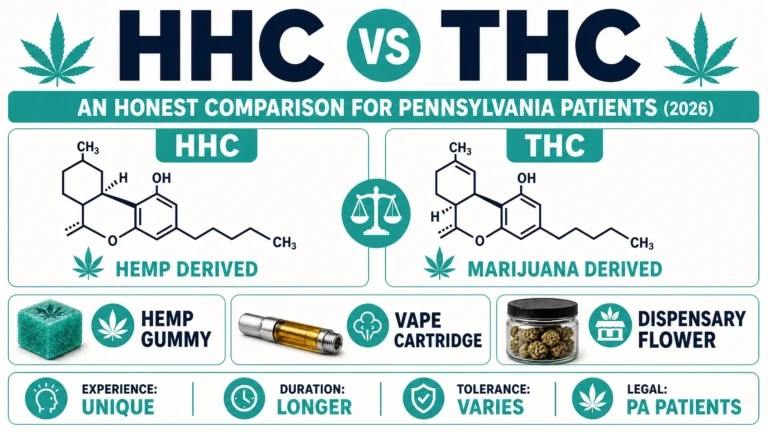
HHC stands for hexahydrocannabinol. It is a hydrogenated form of THC, meaning hydrogen atoms have been added to THC’s molecular structure through a chemical process called hydrogenation.
The same process is used to turn liquid vegetable oils into solid margarine. In cannabis chemistry, it converts delta-9 THC’s reactive double bond into a saturated single bond. The result is a molecule with the chemical formula C21H32O2, compared to THC’s C21H30O2.
Do You Qualify for a PA MMJ Card?
Connect with a licensed Pennsylvania state physician online from home.
That additional pair of hydrogen atoms creates two meaningful changes:
First, HHC is significantly more stable than THC. It resists oxidation, heat, and UV light better than delta-9 THC. This is why HHC products have longer shelf life claims than comparable THC products.
Second, HHC binds slightly less effectively to CB1 receptors in the brain, which is the primary mechanism through which THC produces its effects. Reduced CB1 binding affinity is the direct cause of HHC’s reduced potency relative to delta-9 THC.
HHC exists naturally in cannabis plants, but only in trace amounts, fractions of a percent of total cannabinoid content. All commercial HHC is produced synthetically in a laboratory using CBD extracted from hemp as the starting material. CBD is first converted to delta-9 or delta-8 THC, then hydrogenated into HHC. This is why HHC is accurately described as semi-synthetic.
What Is THC? The Baseline Comparison
For this comparison, THC refers to delta-9-tetrahydrocannabinol, the primary psychoactive cannabinoid in cannabis and the compound used in all Pennsylvania licensed dispensary products.
Delta-9 THC is the most extensively studied cannabinoid in existence. It has over seven decades of clinical and pharmacological research behind it. The FDA has approved two synthetic delta-9 medications (dronabinol and nabilone) for chemotherapy-induced nausea and AIDS-related appetite loss. Pennsylvania’s Medical Marijuana Act authorizes it for 24 qualifying conditions.
THC works by binding strongly to CB1 receptors concentrated in the brain’s reward, pain, memory, and sensory pathways. This binding triggers a cascade of neurotransmitter changes that produces cannabis’s therapeutic and psychoactive effects.
Unlike HHC, THC at PA dispensaries comes from regulated, state-licensed growers and processors. Every product carries a state-mandated Certificate of Analysis (COA) verifying potency, terpene profile, pesticides, heavy metals, and microbial contamination before it reaches the shelf.
HHC vs THC: Side-by-Side Comparison

| Feature | HHC | THC (Delta-9) |
|---|---|---|
| Full name | Hexahydrocannabinol | Delta-9-tetrahydrocannabinol |
| Origin | Semi-synthetic (lab-made from CBD) | Natural (from cannabis/hemp plants) |
| Potency vs delta-9 | 70 to 80% of delta-9 | Baseline (100%) |
| CB1 receptor binding | Weaker | Stronger |
| Psychoactive? | Yes | Yes |
| Effect character | Milder, clearer-headed, less anxiogenic | Stronger, more euphoric, more intense |
| Molecular stability | Higher (resists oxidation and heat) | Lower |
| Clinical research | None established | Extensive (7+ decades) |
| FDA-approved form? | No | Yes (dronabinol, nabilone) |
| Available at PA dispensaries? | No | Yes (MMJ card required) |
| Drug test risk | Likely yes | Yes |
| Legal status PA (July 2026) | Hemp gray area | MMJ: legal / Recreational: illegal |
| After November 2026 | Federal reclassification likely | Dispensary products unaffected |
Is HHC Stronger Than THC?
No. THC is stronger than HHC.

HHC delivers approximately 70 to 80% of delta-9 THC’s psychoactive potency. This is because HHC’s hydrogenated structure reduces its affinity for CB1 receptors, which are the primary binding sites through which cannabis produces its effects.
⚡ Fast & 100% Online PA Medical Cards
Board-Certified Doctors • 100% Money-Back Guarantee
Book Evaluation Now →Research published in a February 2026 PMC study (PMC11035541) examining CB1 receptor activation confirmed that HHC and delta-9 THC both activate CB1 receptors but do so through biased intracellular signaling pathways.
The study found meaningful differences in how the two compounds activate downstream signaling, which helps explain why the subjective experiences differ even at similar receptor occupancy levels.
The 70 to 80% potency estimate is a general range, not a precise clinical measurement. HHC’s actual relative potency varies based on dose, consumption method, and significantly, which form of HHC you are getting. This brings us to the epimer problem.
The 9R and 9S Epimer Problem Nobody Talks About
This is the most underreported issue with HHC and it matters significantly for understanding whether any given HHC product will produce meaningful effects.
HHC exists in two forms called epimers: (9R)-HHC and (9S)-HHC. These are mirror-image molecular configurations with very different pharmacological properties:

- (9R)-HHC binds effectively to CB1 receptors and produces psychoactive effects. This is the “active” form.
- (9S)-HHC has much weaker CB1 binding and produces minimal psychoactive effects. This is largely the “inactive” form.
When HHC is produced commercially through hydrogenation, the result is a mixture of both epimers. The ratio varies by manufacturer and batch. A product with a high proportion of 9R-HHC will feel much stronger than one dominated by 9S-HHC, even if the total labeled HHC content is identical.
No standardized method exists for determining or labeling the 9R/9S ratio in commercial HHC products.
Most products simply state “HHC %” without specifying which form. This means two 10mg HHC products from different manufacturers can produce very different effects, and neither the consumer nor a COA reviewer can reliably predict which one they are getting without specific isomer-separated testing.
This is a fundamental product quality problem that does not exist with regulated THC at Pennsylvania licensed dispensaries, where all products undergo standardized testing and labeling.
How Does HHC Feel Compared to THC?
User reports and limited research consistently describe HHC’s effect as:

Milder overall. At equivalent doses, HHC produces less intense psychoactivity than delta-9 THC. This can be an advantage for people who find standard THC too strong.
Renewing Your PA MMJ Card?
Quick annual recertification online. No paperwork hassle.
Renew Card Online →Clearer-headed. Most users describe HHC as producing less cognitive fog than high-dose THC. Some compare it to the character of a lower-dose THC experience.
Less anxiogenic. Users sensitive to THC-induced anxiety or paranoia often report HHC is more comfortable. This tracks with its reduced CB1 binding affinity, which generally correlates with lower anxiety risk.
More variable. Because of the 9R/9S epimer ratio issue described above, HHC products are less consistent than THC products. One batch may feel substantially different from the next even from the same brand.
Shorter duration (possibly). Some users report HHC effects clear faster than equivalent THC doses, though this has not been studied systematically.
The honest summary: HHC offers a milder, potentially more approachable alternative to delta-9 THC for people who want psychoactive effects with reduced anxiety risk. But the variability in commercial products and the absence of clinical research make dosing and effect prediction less reliable than with regulated dispensary THC.
Does HHC Show Up on a Drug Test?
Almost certainly yes, and anyone assuming otherwise is taking a significant risk.

Standard urine drug tests use immunoassay panels designed to detect THC metabolites, primarily 11-nor-9-carboxy-THC (THC-COOH). When your body processes HHC, it produces metabolites including 8-beta-hydroxy-HHC and 8-alpha-hydroxy-HHC.
Research into whether these metabolites cross-react with standard THC immunoassays suggests they likely do, though the cross-reactivity rate has not been formally established across all commercial panel types.
Mellow Fellow’s pharmacology analysis confirms: “Recent evidence suggests HHC metabolizes into compounds detectable by modern drug screening panels.
As testing technology advances, laboratories increasingly adapt to detect new cannabinoids including HHC. Users subject to employment or legal drug testing should avoid both HHC and THC products regardless of metabolite differences.”
The specific concern for Pennsylvania residents: workplace drug testing in PA is governed by standard immunoassay panels, which most toxicology labs are now specifically updating to include novel cannabinoid detection. If you are subject to workplace drug testing, treating HHC as drug-test-safe is not a reasonable assumption in 2026.
Get Approved by a Licensed PA Doctor
Schedule your appointment in minutes. You only pay if approved.
Start Online Application →Additionally, Pennsylvania’s per se DUI law creates another layer of risk. The law (75 Pa. C.S. § 3802(d)) makes any detectable level of THC or its metabolites in blood while driving a DUI offense. Whether HHC metabolites specifically trigger this provision is legally untested in Pennsylvania courts, but the conservative legal guidance is to treat HHC and THC equivalently for DUI risk purposes.
Is HHC Legal in Pennsylvania?
As of July 2026, HHC occupies a legal gray area in Pennsylvania.
Federally, the 2018 Farm Bill legalized hemp and hemp-derived compounds containing less than 0.3% delta-9 THC by dry weight. HHC is not specifically named as a controlled substance in the federal Controlled Substances Act, which is the basis for its current legal status as a hemp-derived product.
Pennsylvania has not enacted a specific state-level ban on HHC as of July 2026, unlike some states that have explicitly prohibited novel synthetic cannabinoids. This means HHC products continue to be sold at PA smoke shops and online retailers serving Pennsylvania customers.
However, the DEA’s position is relevant: the agency has stated that cannabinoids produced through chemical synthesis from hemp are not protected by the Farm Bill’s hemp exemption. Since all commercial HHC is synthesized from CBD rather than occurring naturally in the plant in meaningful quantities, a DEA challenge to HHC’s hemp-legal status is legally coherent.
The practical answer for most PA residents: HHC is available and not currently being actively enforced against in Pennsylvania. But its legal status is not as clear as the smoke shop shelving would suggest.
The November 2026 Federal Deadline

The most significant near-term legal development for HHC in Pennsylvania is the same federal deadline affecting delta-8, THCP, and most other hemp-derived cannabinoids: H.R. 5371.
On November 12, 2025, President Trump signed H.R. 5371 into law. Section 781 of that legislation fundamentally redefines hemp, shifting from a delta-9-only threshold to a total THC standard and imposing a 0.4 milligram per-container cap. The changes take effect November 12, 2026.
Under this framework, HHC products that produce meaningful psychoactive effects will almost certainly be reclassified as controlled substances. HHC is not delta-9 THC, but the new “total THC” framework broadly captures intoxicating cannabinoids regardless of specific isomer.
Congressional Research Service analysis confirms these changes will “push many currently marketed intoxicating hemp products back into Schedule I status under the CSA.”
Ready to Get Your Official PA MMJ Card?
State-certified doctor consultations online. No risk—100% refund if not approved.
Claim Your MMJ Card Online →Active legislative efforts to reverse this deadline include H.R. 6209 (the Mace/Massie Bill) and the HEMP Act (H.R. 1287). As of July 2026, neither has passed.
For Pennsylvania residents relying on HHC products to manage a qualifying medical condition, the November 2026 deadline creates urgency. The PA medical marijuana program, operating under Act 16 of 2016, is completely unaffected by H.R. 5371. Dispensary products are governed by state medical law, not the Farm Bill.
Is HHC Safe? The Research Gap
This is where an honest answer requires acknowledging a significant limitation: there is almost no clinical research on HHC in humans.
The February 2026 PMC study on HHC and delta-9 THC CB1 receptor activation is among the few peer-reviewed studies examining HHC’s pharmacology directly. It is a laboratory study, not a human clinical trial.
What the absence of research means practically:
- No established therapeutic dosing. There is no clinical data to guide what dose of HHC produces a specific therapeutic effect for any condition.
- No safety profile. Long-term effects of HHC use are unknown. Short-term effects are known only through user reports and limited preclinical research.
- Manufacturing quality varies widely. Commercial HHC is produced through chemical synthesis from CBD. The process can introduce byproducts or impurities if not performed correctly. Unlike PA dispensary products, HHC at smoke shops is not subject to mandatory pre-sale contaminant testing under state law.
- No FDA oversight. HHC products are sold as hemp products with no pre-market safety review.
The National Center for Complementary and Integrative Health (NCCIH) advises speaking with a physician before considering cannabis products for potential medical benefits. For HHC specifically, that advice carries extra weight given the absence of clinical evidence.
HHC vs THC in Pennsylvania: Which Makes More Sense?
For recreational experimentation with no medical purpose and no drug testing concerns, HHC offers a milder, legal-for-now alternative to regulated THC. Some people prefer its lower anxiety profile and more manageable potency.
For anyone with a genuine medical condition that overlaps with Pennsylvania’s qualifying conditions, the comparison is straightforward:

Regulated PA dispensary THC offers:
- State-mandated COA testing for every product
- Verified potency, terpene profile, pesticides, and contaminants
- Pharmacist guidance at every licensed dispensary
- Full state legal protection under Act 16
- Physician-supervised access through a certifying doctor
- Legal stability through November 2026 and beyond
- Seven decades of clinical research supporting therapeutic use
HHC from PA smoke shops offers:
- Milder effects than delta-9 at comparable doses
- No state-mandated testing requirements
- Variable epimer ratios that make product-to-product consistency unreliable
- A federal legal deadline in November 2026 that threatens the entire product category
- No clinical evidence for any specific medical application
- Drug test risk comparable to standard THC
If you are managing anxiety, chronic pain, PTSD, or any other qualifying condition with HHC products from a PA smoke shop, the PA medical marijuana program gives you access to tested, regulated, physician-supervised cannabis with legal protections HHC cannot offer.

Certification at Pennsylvania Marijuana Cards is completed via same-day telehealth with Dr. Johnathon Chance Miller, MD, entirely online.
| Physician Fee | PA State Fee | Total | |
|---|---|---|---|
| New Patient | $159 | $50 | $209 |
| Renewal | $149 | $50 | $199 |
| MMAP Qualifying Patients (Medicaid, SNAP, WIC, CHIP, PACE, PACENET) | $0 (waived) | Physician fee only |
Start your same-day certification here.
Frequently Asked Questions
Q: What is HHC vs THC?
A: HHC (hexahydrocannabinol) is a semi-synthetic, hydrogenated form of THC produced in a laboratory by adding hydrogen atoms to delta-9 THC’s molecular structure. Both are psychoactive cannabinoids that bind to CB1 receptors in the brain, but HHC binds with less affinity than delta-9 THC, producing approximately 70 to 80% of THC’s psychoactive potency. THC (delta-9-tetrahydrocannabinol) is the primary psychoactive compound in cannabis, the most extensively researched cannabinoid in existence, and the compound used in all Pennsylvania licensed dispensary products. HHC is sold at PA smoke shops as a hemp-derived alternative. PA dispensaries do not carry HHC.
Q: Is HHC stronger than THC?
A: No. HHC is less potent than delta-9 THC, delivering approximately 70 to 80% of delta-9’s psychoactive effect. This is because HHC’s hydrogenated molecular structure reduces its binding affinity for CB1 receptors in the brain. A February 2026 PMC study (PMC11035541) confirmed that HHC and delta-9 THC activate CB1 receptors through different biased intracellular signaling pathways, contributing to their different effect profiles. HHC is generally described as producing a clearer-headed, milder, less anxiety-prone experience compared to delta-9 THC at similar doses.
Q: Does HHC show up on a drug test?
A: Almost certainly yes. When your body processes HHC, it produces metabolites including 8-beta-hydroxy-HHC and 8-alpha-hydroxy-HHC. Evidence suggests these metabolites cross-react with standard cannabis immunoassay drug screens designed to detect THC metabolites. Drug testing laboratories are increasingly updating their panels to detect novel cannabinoids including HHC. Anyone subject to workplace drug testing should treat HHC as carrying the same drug test risk as standard delta-9 THC. Do not assume HHC evades detection on modern employment drug panels.
Q: Is HHC legal in Pennsylvania?
A: As of July 2026, HHC exists in a legal gray area in Pennsylvania. It is sold at PA smoke shops under the 2018 Farm Bill’s hemp exemption because it is produced from hemp-derived CBD and does not explicitly appear on the federal controlled substances list. Pennsylvania has not enacted a specific state-level HHC ban. However, federal law H.R. 5371 (signed November 2025, effective November 12, 2026) will reclassify most intoxicating hemp cannabinoids including HHC under federal controlled substance law. PA licensed dispensaries operate under Act 16 and do not carry HHC.
Q: What is the difference between HHC and delta-9 THC?
A: The primary structural difference is hydrogenation: HHC has two additional hydrogen atoms that saturate delta-9 THC’s double bond. This makes HHC more molecularly stable but less potent at CB1 receptors. Practically, THC produces stronger, more intense psychoactive effects while HHC produces a milder, clearer-headed experience. THC has seven decades of clinical research and FDA-approved pharmaceutical forms (dronabinol). HHC has no established therapeutic research or FDA oversight. THC is available at PA licensed dispensaries with state-mandated COA testing. HHC is available at PA smoke shops with no mandatory pre-sale testing requirements.
Q: Can I buy HHC at a Pennsylvania dispensary?
A: No. Pennsylvania licensed medical marijuana dispensaries do not carry HHC. PA dispensaries are authorized under the Pennsylvania Medical Marijuana Act (Act 16 of 2016), which covers specific cannabis-derived products tested and regulated by the PA Department of Health. HHC is a hemp-derived synthesized cannabinoid that does not fall within the Act 16 framework. HHC products in Pennsylvania are sold at smoke shops, vape stores, and online hemp retailers under the federal Farm Bill. These products face potential federal reclassification under H.R. 5371 effective November 12, 2026.
Q: Should Pennsylvania patients use HHC or get a PA MMJ card?
A: For Pennsylvania residents managing a qualifying medical condition, the PA medical marijuana program provides significant advantages over HHC products from smoke shops. PA dispensary products are required by state law to carry Certificates of Analysis verifying potency, terpene profiles, and contaminants. Every PA dispensary has a licensed pharmacist on staff. Patients receive legal protection under Act 16 and have physician-supervised access to regulated cannabis. HHC products have no mandatory pre-sale testing requirements, highly variable potency due to the 9R/9S epimer issue, no clinical evidence for any specific medical application, and face federal legal changes effective November 2026. Pennsylvania recognizes 24 qualifying conditions including anxiety, chronic pain, PTSD, and many others.
Medical Disclaimer
This blog post is intended for general educational and informational purposes only and does not constitute medical or legal advice. HHC’s legal status, safety profile, and regulatory framework are subject to ongoing change, with significant federal changes scheduled for November 12, 2026. HHC has not been evaluated by the FDA for any therapeutic application. Do not make medical or legal decisions based solely on this article. Consult a licensed physician before using any cannabis or hemp-derived product for a medical condition. Medically reviewed by Dr. Johnathon Chance Miller, MD.
Sources
- Durydivka et al. — Hexahydrocannabinol (HHC) and delta-9-THC CB1 receptor activation, biased intracellular signaling (PMC11035541, February 2026)
- Miraculix Lab — HHC vs THC (2026): Effects, High, Potency and Drug Test (updated January 2026)
- Mellow Fellow — HHC vs THC: Effects and Potency Guide (December 2025)
- Santa Barbara Recovery — HHC Effects vs THC: High, Potency, and How They Feel Different (April 2026)
- Cornbread Hemp — HHC vs THC Explained: Potency, Legality, Effects and More (April 2026)
- ACS Laboratory — Comparing Hemp Alternative Cannabinoids: Delta-9, Delta-8, HHC, THCP (May 2026)
- Regulatory Oversight — Congress Narrows Federal Definition of Hemp, H.R. 5371 (December 2025)
- Congressional Research Service — Change to Federal Definition of Hemp and Implications for Federal Enforcement
- NCCIH — Cannabis, Marijuana, and Cannabinoids: What You Need to Know (updated February 2026)
- Pennsylvania Medical Marijuana Act, Act 16 of 2016
- Pennsylvania Marijuana Cards — Qualifying Conditions
- Pennsylvania Marijuana Cards — PA Medical Marijuana Laws