
Medical marijuana is legal in Pennsylvania. Recreational marijuana is not. That is the direct answer as of July 2026.
Pennsylvania has a well-established medical marijuana program under Act 16 of 2016, with over 440,000 registered patients, 186+ licensed dispensaries, and 24 qualifying conditions.
Need a PA Medical Marijuana Card?
Get certified online in 15 minutes. 100% Money-Back Guarantee.
Get Certified Now →If you have one of those conditions and go through the certification process, cannabis is fully legal for you to purchase and use in Pennsylvania.
Without a medical card, any amount of marijuana is a criminal offense under state law. The state House passed a legalization bill in May 2025 by a single vote. The Senate killed it six days later.
A bipartisan Senate bill, SB 120, advanced out of committee in late 2025 but has not received a floor vote. Pennsylvania remains the only state in its region that has not legalized adult use.
Key Takeaways
- Medical marijuana is legal in Pennsylvania under Act 16 of 2016 for patients with one of 24 qualifying conditions, with 186+ licensed dispensaries statewide
- Recreational marijuana is illegal under state law as of July 2026 — possession of any amount without a medical card is a criminal misdemeanor
- Philadelphia and Pittsburgh have decriminalized possession of 30 grams or less, replacing criminal charges with civil fines of $25, but state law still technically applies and officers retain discretion to charge
- Pennsylvania is surrounded by legal states: New York, New Jersey, Delaware, Maryland, and Ohio have all legalized recreational cannabis and an estimated 60% of their border dispensary customers drive in from Pennsylvania
- SB 120 is the active legalization bill. A bipartisan private retail model that advanced out of Senate committee in October 2025 but has not received a Senate floor vote as of July 2026
- A PA MMJ card is the only legal path to purchasing cannabis in Pennsylvania right now, the certification is done entirely online through telehealth
What Is Legal and What Is Not in Pennsylvania?

Do You Qualify for a PA MMJ Card?
Connect with a licensed Pennsylvania state physician online from home.
Pennsylvania cannabis law has multiple layers that confuse people. Here is the complete picture in one table.

| Activity | Legal Status in PA (July 2026) |
|---|---|
| Purchasing cannabis with a valid PA MMJ card | Legal — at licensed PA dispensaries |
| Possessing cannabis with a valid PA MMJ card | Legal — up to a 90-day supply |
| Smoking cannabis even with an MMJ card | Illegal — vaporization only under PA law |
| Recreational possession (any amount, no card) | Illegal — misdemeanor under state law |
| Home cultivation — patients and caregivers | Illegal — felony under state law |
| Home cultivation — licensed growers only | Legal with state license |
| Purchasing hemp delta 9 gummies at smoke shops | Legal currently — but see November 2026 deadline |
| Bringing cannabis from NJ, MD, or OH into PA | Illegal — federal offense |
| Using cannabis on federal property | Illegal — federal law applies |
| Purchasing firearms while registered as MMJ patient | Prohibited under federal law (18 U.S.C. 922(g)(3)) |
Pennsylvania Medical Marijuana: Who Qualifies and How It Works
Pennsylvania’s medical marijuana program is one of the largest in the country. As of July 2026, it has:

- 440,000+ registered patients statewide
- 186+ licensed dispensaries across all regions of Pennsylvania
- 24 qualifying conditions recognized under Act 16 of 2016
- First-in-region status for medical-only as the only neighboring state without adult use
The 24 Qualifying Conditions
Pennsylvania recognizes these serious medical conditions for MMJ certification:
- Amyotrophic Lateral Sclerosis (ALS)
- Autism
- Cancer, including remission therapy
- Crohn’s Disease
- Damage to the nervous tissue of the central nervous system (brain-spinal cord) with objective neurological indication of intractable spasticity, and other associated neuropathies
- Epilepsy
- Glaucoma
- Positive status for Human Immunodeficiency Virus or Acquired Immune Deficiency Syndrome (HIV/AIDS)
- Huntington’s Disease
- Inflammatory Bowel Disease (IBD)
- Intractable Seizures
- Tourettes
- Multiple Sclerosis
- Neuropathies
- Parkinson’s Disease
- Post-traumatic Stress Disorder (PTSD)
- Severe chronic or intractable pain of neuropathic origin or severe chronic or intractable pain
- Sickle Cell Anemia
- Neurodegenerative diseases (i.e., Alzheimer’s Disease)
- Terminal illness
- Dyskinetic and spastic movement disorders
- Opioid use disorder for which conventional therapeutic interventions are contraindicated or ineffective, or for which adjunctive therapy is indicated in combination with primary therapeutic interventions
- Anxiety Disorder
- Chronic Hepatitis C
You can view the full qualifying conditions list with condition-specific pages here.
What a PA MMJ Card Allows You to Do
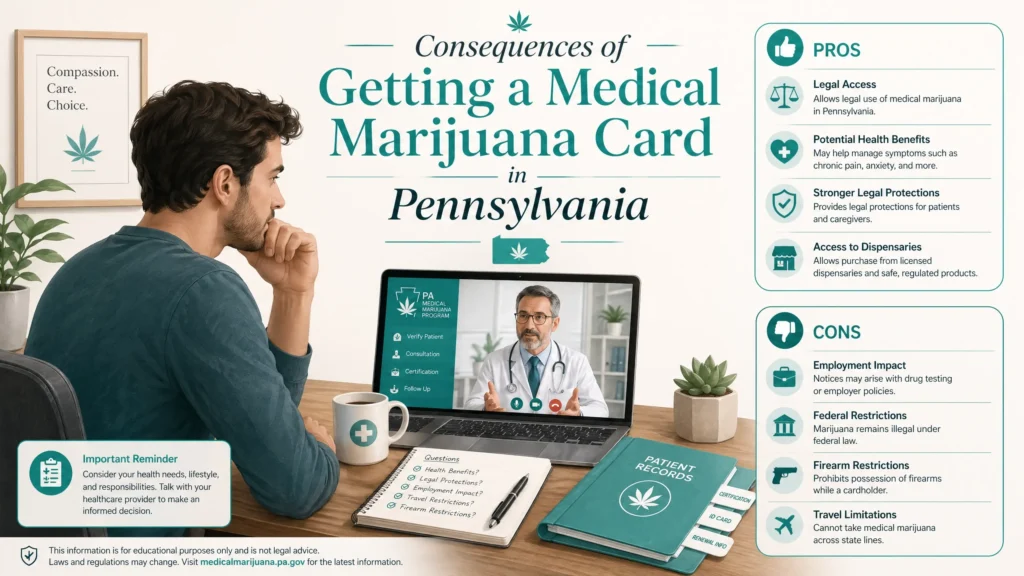
With a valid Pennsylvania medical marijuana card, you can:
- Purchase cannabis at any of Pennsylvania’s 186+ licensed dispensaries
- Possess up to a 90-day supply as determined by the dispensary pharmacist
- Use all legal product formats: dry leaf flower (vaporized only), vape cartridges, tinctures, oils, capsules, and topicals
- Access on-site dispensary pharmacist guidance on products and dosing
- Shop at multiple dispensaries across the state
- Receive a complete exemption from Pennsylvania’s 6% state sales tax on all dispensary purchases
You cannot smoke cannabis (vaporization only), grow your own plants, purchase edibles or gummies at PA dispensaries (not currently permitted under PA law), or cross state lines with your Pennsylvania cannabis products.
Recreational Marijuana Penalties in Pennsylvania
⚡ Fast & 100% Online PA Medical Cards
Board-Certified Doctors • 100% Money-Back Guarantee
Book Evaluation Now →Without a valid PA MMJ card, any amount of marijuana in your possession is a crime under 35 P.S. 780-113, the Pennsylvania Controlled Substance, Drug, Device and Cosmetic Act.

Possession Penalties
| Amount Possessed | Charge | Maximum Penalty |
|---|---|---|
| 30 grams or less | Misdemeanor | 30 days jail, $500 fine |
| More than 30 grams | Misdemeanor | 1 year jail, $5,000 fine |
| Any amount (second offense) | Enhanced penalties | Up to doubled sentence |
Note: All marijuana possession convictions in Pennsylvania also trigger an automatic driver’s license suspension, even if you were not driving. This is one of the most overlooked consequences of a possession charge.
Sale and Distribution Penalties
Sale or distribution of marijuana in Pennsylvania carries significantly harsher penalties. Distributing even a small amount carries potential felony charges and mandatory license suspension.
Home Cultivation Penalties
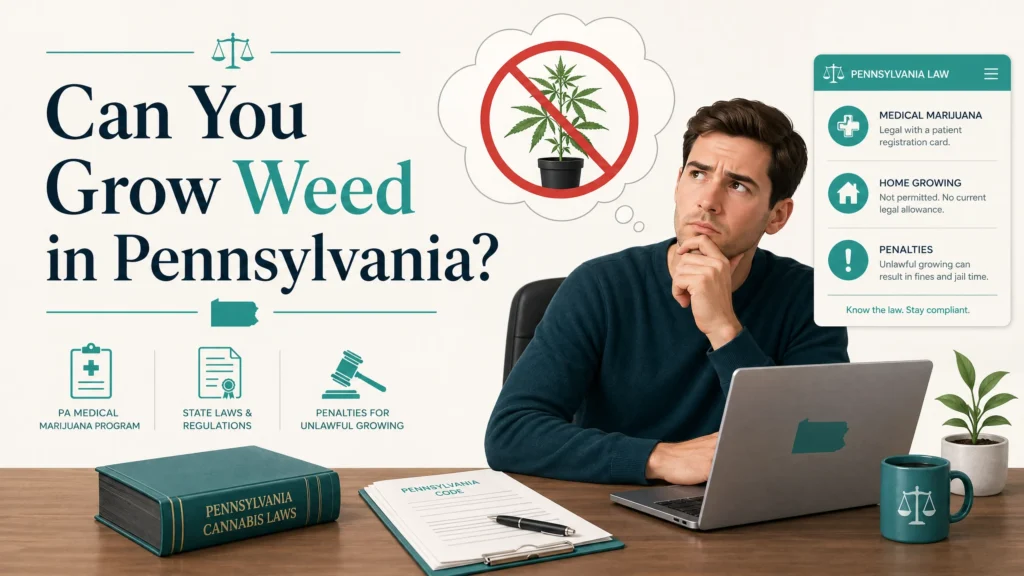
Growing marijuana at home is a felony in Pennsylvania for everyone, including registered medical marijuana patients.
The Medical Marijuana Act contains no provision for personal cultivation. All medical cannabis must come from a licensed dispensary.
| Plants | Penalty |
|---|---|
| Fewer than 10 plants | 2.5 to 5 years, $15,000 fine |
| 10 to 20 plants | Up to 1 year, $5,000 fine |
| 21 to 50 plants | Up to 3 years, $15,000 fine |
| More than 51 plants | Up to 5 years, $50,000 fine |
A 2025 bill (SB 76) that would have allowed medical patients to home cultivate with a $100 permit did not pass and remains in Senate committee.
Paraphernalia
Possession of marijuana paraphernalia is a misdemeanor for non-patients, carrying up to 1 year in jail and a $2,500 fine. For registered PA MMJ patients, paraphernalia possession related to legal medical use is permitted.
DUI
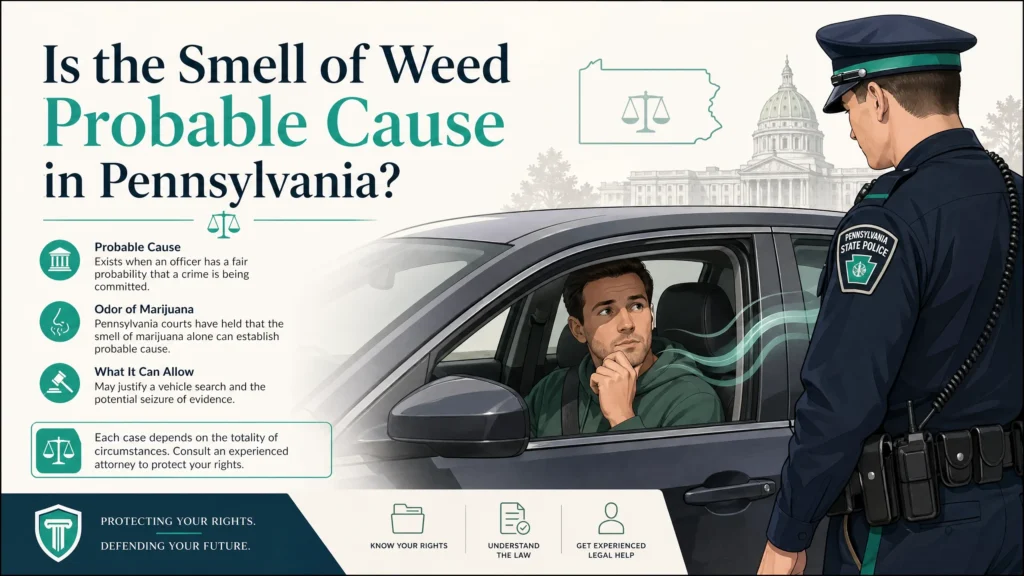
Pennsylvania operates under a per se DUI law (75 Pa.C.S. 3802(d)). Any detectable THC metabolites in your blood while driving constitutes a DUI, regardless of whether you hold a valid PA MMJ card or whether you are actually impaired.
Philadelphia and Pittsburgh: Decriminalization Explained
Two of Pennsylvania’s largest cities have passed local ordinances reducing penalties for small-amount marijuana possession. It is critical to understand what decriminalization does and does not mean.
Renewing Your PA MMJ Card?
Quick annual recertification online. No paperwork hassle.
Renew Card Online →Decriminalization is not legalization. Marijuana remains illegal in both cities. What changes is how police typically respond to small amounts.

Philadelphia
Philadelphia decriminalized marijuana possession in 2014 under Chapter 10-2100 of the Philadelphia Code:
- Possession of 30 grams or less: $25 civil fine (not a criminal charge)
- Public smoking of 30 grams or less: $100 fine or 9 hours community service
- Civil violations do not appear on criminal or driving records
- Police retain discretion to issue criminal charges rather than civil violations
- If you are stopped while committing another offense, the civil citation disappears and standard criminal processing applies
- These protections do not apply to people on parole or probation
Pittsburgh
Pittsburgh decriminalized marijuana possession in December 2015:
- Possession of up to 30 grams or 8 grams of hashish: $25 to $100 fine (civil, not criminal)
- Public use carries a higher civil fine
- Minors face no criminal charges — parents receive notification and are responsible for paying the fine
- Police retain discretion; state law still technically applies
The Critical Limitation
Both cities’ ordinances reduce how officers typically respond to minor possession.
They do not change the underlying state law, which still classifies possession as a misdemeanor. An officer can choose to apply state law rather than the civil ordinance.
The Pennsylvania Supreme Court in Holt’s Cigar Co. v. City of Philadelphia (2011) confirmed that local ordinances that do not create an irreconcilable conflict with state law are permissible, but state law remains the final authority.
Other Decriminalized Cities in Pennsylvania
Decriminalization in Pennsylvania extends well beyond Philadelphia and Pittsburgh.
According to NORML’s Pennsylvania local decriminalization tracker, municipalities with decriminalization ordinances in effect as of July 2026 include:
- Harrisburg: Civil fines for possession of 30 grams or less
- York: $100 civil fine
- Erie: Civil fine structure
- Lancaster: Civil fine structure
- Allentown: Civil fine structure
- Bethlehem: Tiered fines: $25 first offense, $50 second, $100 third
- State College: Civil fine
- Reading: Civil fine
- Norristown, Steelton, Phoenixville: Various civil fine structures
The same critical limitation applies to all of these municipalities: state law still applies and officers retain discretion.
In cities that span county lines, like Bethlehem, enforcement can vary between Lehigh and Northampton County sections of the same city.
Hemp and CBD Products in Pennsylvania
Get Approved by a Licensed PA Doctor
Schedule your appointment in minutes. You only pay if approved.
Start Online Application →Pennsylvania residents can legally purchase hemp-derived CBD and hemp-derived delta 9 THC products at smoke shops and online retailers without a medical marijuana card under the federal 2018 Farm Bill framework and Pennsylvania’s Industrial Hemp Act (3 Pa.C.S. 701).

These products include CBD tinctures, gummies, hemp delta 9 beverages, and vape cartridges, provided finished products contain no more than 0.3% delta-9 THC by dry weight.
Important warning for July 2026: Federal law H.R. 5371, signed November 2025, imposes a 0.4mg per-container total THC cap effective November 12, 2026.
Most hemp delta 9 gummies and drinks currently sold at PA smoke shops contain 5 to 10mg per serving, between 12 and 25 times the new cap. Without a legislative fix, these products will be reclassified as Schedule I controlled substances on November 12, 2026.
Pennsylvania’s own Senate Bill 49 advanced 10-1 out of the Law and Justice Committee in March 2026 and may close access at the state level even sooner.
If you currently rely on hemp delta 9 products from smoke shops for health-related reasons, the PA MMJ program is the only legal path forward after that deadline.
Pennsylvania Legalization Status: Where Things Stand in July 2026
Pennsylvania remains a medical-only state as of July 2026. It is the only state in its region that has not legalized adult-use cannabis.

The surrounding states for context:
| State | Status |
|---|---|
| New York | Recreational legal since 2021 |
| New Jersey | Recreational legal since 2021 |
| Delaware | Recreational legal since 2023 |
| Maryland | Recreational legal since 2023 |
| Ohio | Recreational legal since 2023 |
| West Virginia | Medical only |
| Pennsylvania | Medical only |
Governor Josh Shapiro has proposed legalization in three consecutive budget addresses. He has stated that Pennsylvania is “currently at a competitive disadvantage, losing out on critical revenue and new business opportunities.”
Border-state dispensaries report that an estimated 60% of their customers drive in from Pennsylvania, costing Pennsylvania an estimated $1.3 billion in potential tax revenue over five years.
Ready to Get Your Official PA MMJ Card?
State-certified doctor consultations online. No risk—100% refund if not approved.
Claim Your MMJ Card Online →The Pennsylvania Independent Fiscal Office projects that legalization would generate $140 million in revenue in fiscal year 2026-2027, growing to $432 million by 2030-2031.
The Active Bills: SB 120, HB 20, and What They Would Do
Two active bills represent Pennsylvania’s most realistic path to recreational legalization.

Senate Bill 120 (Laughlin and Street — Bipartisan)
SB 120 is the furthest-advanced legalization bill in Pennsylvania legislative history. It was approved by the Senate Law and Justice Committee in October 2025, the same committee that killed HB 1200 and sent to the full Senate for consideration. As of July 2026, it has not received a floor vote.
Key provisions of SB 120:
- Adults 21+ could purchase from privately owned, state-licensed cannabis retailers
- A new Cannabis Control Board would regulate the market
- 14% excise tax plus standard sales tax
- Medical marijuana program absorbed into the new Board
- Cannabis expunged from Schedule I under Pennsylvania state law
- Cannabis Clean Slate expunging nonviolent marijuana conviction records
- A discharge petition filed by all 23 Senate Democrats in July 2026 attempts to force a floor vote
Current status: SB 120 awaits action by Senate Majority Leader Joe Pittman (R), who has stated he does not see prevailing support for legalization within the Republican caucus.
The discharge petition requires at least two Republican senators to join Democrats for the bill to advance past this barrier.
House Bill 20 (Kinkead and Major — Bipartisan)
HB 20 offers a similar private retail model under a new Keystone Cannabis Authority, with:
- 13% tax rate (lowest of the three bills)
- 2.5-ounce possession limit
- 60 permits reserved for social equity applicants
- Firearms protections for responsible adult users
Current status: HB 20 has not received a committee hearing as of July 2026.
Why Pennsylvania Has Not Legalized Yet?
The short answer is a split legislature and a fundamental disagreement about how legalization should be structured.
The House (102-101 Democratic majority) passed HB 1200’s state-run model. The Senate (27-23 Republican majority) rejected it immediately.
The bipartisan private retail model of SB 120 and HB 20 has broader support in principle, but Senate Majority Leader Pittman has not scheduled hearings or a floor vote.
As NORML regional director Chris Goldstein told the Philadelphia Voice: “We are still spinning our wheels in Pennsylvania.
I don’t see the traction that’s required to advance the legislation. With the split between the Senate and the House, the whole strategy for legalization at this point is so far apart.”
The political and structural barriers:
- Senate Republican leadership opposes legalization, citing workplace safety and health concerns
- The House and Senate cannot agree on a regulatory model (state-run vs. private)
- Pennsylvania’s budget deadlock absorbs most legislative bandwidth, the Senate adjourned for its July 4, 2026 recess without completing the state budget
- Governor Shapiro supports legalization but cannot advance it without legislative votes
Most analysts do not expect recreational legalization to pass in 2026. The more realistic scenario is continued pressure into the 2027 legislative session, particularly if the November 2026 elections shift the Senate balance.
What Federal Rescheduling Means for PA
On April 28, 2026, the federal government rescheduled state-licensed medical marijuana from Schedule I to Schedule III of the Controlled Substances Act.
A DEA administrative hearing on broader rescheduling of all cannabis began June 29, 2026.

What this means for Pennsylvania specifically:
Rescheduling does not legalize recreational marijuana in Pennsylvania or any state. It does not change PA state law. It does not eliminate the firearms prohibition for MMJ patients under 18 U.S.C. 922(g)(3). It does not eliminate the per se DUI standard for THC.
What it does do is reduce federal enforcement pressure on state MMJ programs and provide political cover for legislators in both parties who support legalization.
Several Pennsylvania lawmakers have cited federal rescheduling as shifting the dynamics of the legalization debate.
It also reduces barriers to FDA clinical trials for cannabis-derived medications, which could eventually produce insurance-coverable cannabis treatments.
For practical day-to-day purposes in Pennsylvania, the April 2026 rescheduling has not yet changed anything that affects patients, employers, or law enforcement.
If You Have a Qualifying Condition: Your Legal Path Now
If you have been waiting for Pennsylvania to legalize recreational marijuana, that wait has no guaranteed end date. What does exist right now is a medical marijuana program that covers 24 serious conditions and is entirely accessible online through telehealth.

Anxiety disorder, the most common qualifying condition, is cited in approximately 60% of all PA MMJ certifications according to research published in the Annals of Internal Medicine in July 2025. Chronic pain and PTSD are the next most common.
If you have any of the 24 qualifying conditions and want legal cannabis access in Pennsylvania today, not after an uncertain legislative timeline, the PA MMJ card process involves:
- Creating a patient account at the PA DOH registry
- Completing a 15-minute telehealth appointment with a PA-registered physician
- Paying the $50 state registration fee after your physician submits your certification
- Receiving a temporary digital patient ID within hours
- Visiting any of Pennsylvania’s 186+ licensed dispensaries

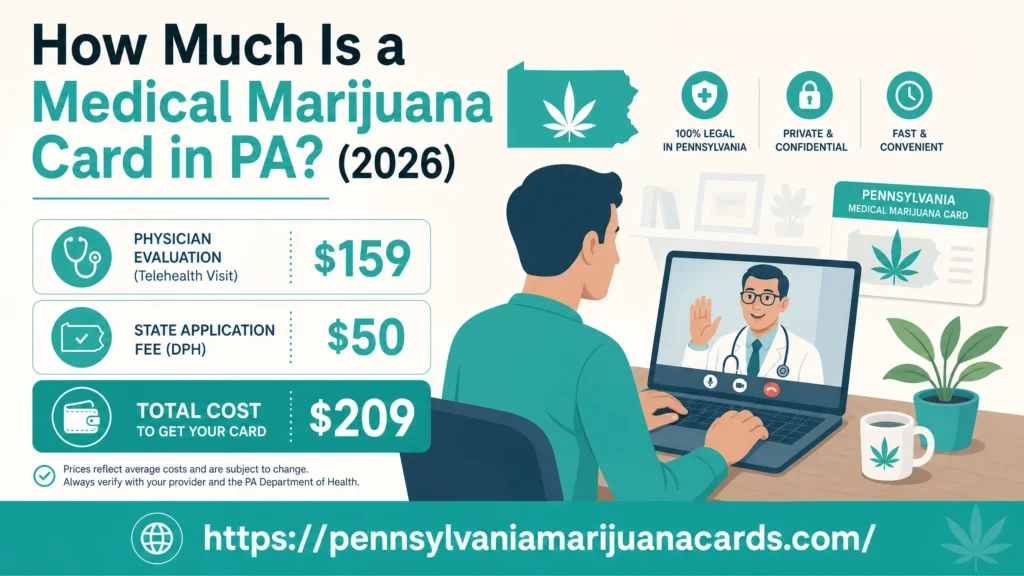
| Physician Fee | PA State Fee | Total | |
|---|---|---|---|
| New Patient | $159 | $50 | $209 |
| Renewal | $149 | $50 | $199 |
| MMAP Qualifying Patients | $159/$149 | $0 waived | Physician fee only |
Pennsylvania residents enrolled in Medicaid, SNAP, WIC, CHIP, PACE, or PACENET have the $50 state fee waived through Pennsylvania’s MMAP program.
If you have a qualifying condition and want to explore legal access now, Pennsylvania Marijuana Cards offers same-day telehealth certifications with Dr. Johnathon Chance Miller, MD. View the full list of qualifying conditions here.
Frequently Asked Questions
Q: Is weed legal in Pennsylvania in 2026?
A: Medical marijuana is legal in Pennsylvania. Recreational marijuana is not. Pennsylvania has a state-regulated medical marijuana program under Act 16 of 2016, with over 440,000 registered patients and 186+ licensed dispensaries. Patients with one of 24 qualifying conditions can purchase and possess cannabis legally after receiving a physician certification and state registration. Without a valid PA MMJ card, any amount of marijuana is a criminal misdemeanor under state law, regardless of city-level decriminalization ordinances.
Q: Did Pennsylvania legalize recreational marijuana?
A: No. As of July 2026, Pennsylvania has not legalized recreational marijuana. The state House passed a legalization bill (HB 1200) for the first time in history on May 7, 2025, by a 102-101 vote, but the Senate Law and Justice Committee killed it six days later. A bipartisan Senate bill, SB 120, advanced out of committee in October 2025 and represents the most viable current path to legalization, but it has not received a Senate floor vote. Senate Majority Leader Joe Pittman has stated he does not see prevailing support for legalization in the Republican caucus. Pennsylvania remains the only state in its immediate region without adult-use cannabis.
Q: What are the penalties for marijuana possession in Pennsylvania?
A: Possession of any amount of marijuana without a PA MMJ card is a criminal misdemeanor in Pennsylvania. Possessing 30 grams or less carries up to 30 days in jail and a $500 fine. Possessing more than 30 grams carries up to 1 year in jail and a $5,000 fine. All marijuana possession convictions in Pennsylvania also trigger an automatic driver’s license suspension, even if you were not driving at the time. In Philadelphia and Pittsburgh, possession of 30 grams or less is typically handled as a civil fine of $25 rather than a criminal charge, but state law still applies and officers retain discretion to issue criminal charges.
Q: Is marijuana decriminalized in Pennsylvania?
A: There is no statewide decriminalization in Pennsylvania. However, more than a dozen municipalities have passed local ordinances reducing penalties for small-amount possession from criminal charges to civil fines. Philadelphia (since 2014) and Pittsburgh (since 2015) are the most notable, both treating possession of 30 grams or less as a $25 civil fine rather than a criminal offense. Other decriminalized municipalities include Harrisburg, York, Erie, Lancaster, Allentown, Bethlehem, State College, and Reading. These ordinances reduce how police typically respond, they do not make marijuana legal, and state criminal law remains in effect in all of these cities.
Q: What is SB 120 and could it legalize weed in Pennsylvania?
A: SB 120 is Pennsylvania’s most advanced recreational marijuana legalization bill. Introduced by Senator Dan Laughlin (R) and Senator Sharif Street (D), it would establish a private retail cannabis market regulated by a new Cannabis Control Board, with a 14% excise tax, expungement of nonviolent marijuana convictions, and absorption of the existing medical marijuana program. SB 120 cleared the Senate Law and Justice Committee in October 2025, making it the furthest any Pennsylvania legalization bill has advanced in state history. As of July 2026, it has not received a Senate floor vote. Senate Majority Leader Joe Pittman remains a barrier, and all 23 Senate Democrats filed a discharge petition in July 2026 attempting to force a vote. Passage in 2026 is possible but not expected by most analysts.
Q: Can I legally bring marijuana from New Jersey, Maryland, or Ohio into Pennsylvania?
A: No. Purchasing cannabis legally in a neighboring state does not make it legal to transport across state lines. Crossing state lines with marijuana is a federal offense under the Controlled Substances Act, regardless of the legality of the purchase at its source or your destination. This applies even if you hold a valid PA MMJ card. Pennsylvania MMJ cardholders cannot cross state lines with dispensary products. The practical risk of being stopped and charged for personal-use amounts during a commute is low, but the activity is federally illegal and carries real exposure if discovered.
Q: What qualifies you for a medical marijuana card in Pennsylvania?
A: Pennsylvania recognizes 24 qualifying serious medical conditions under Act 16 of 2016. The most common is anxiety disorder, cited in approximately 60% of all PA MMJ certifications. Other common qualifying conditions include severe chronic pain, PTSD, cancer, epilepsy, multiple sclerosis, Crohn’s disease, Parkinson’s disease, autism, ALS, HIV/AIDS, and glaucoma. You do not need a prior formal diagnosis in your medical records, the certifying physician evaluates your condition during your appointment and makes their own clinical determination. The certification process is done entirely through telehealth. New patient certification costs $159 (physician fee) plus a $50 state registration fee, with the state fee waived for patients enrolled in Medicaid, SNAP, WIC, CHIP, PACE, or PACENET.
Q: Will Pennsylvania legalize recreational marijuana in 2026?
A: It is unlikely but not impossible. The political environment in July 2026 shows the Senate Democratic caucus filing a discharge petition to force a floor vote on SB 120, while Senate Majority Leader Pittman remains opposed. For SB 120 to pass, at least two Senate Republicans in addition to co-sponsor Dan McLaughlin (formerly Laughlin) would need to vote yes, and the Senate would need to actually hold a floor vote. The legislature also faces a budget impasse and adjourned for its July 4 recess without completing the state budget. Most analysts and advocates do not expect recreational legalization to pass before 2027 at the earliest. Pennsylvania MMJ patients are unaffected by this timeline and have legal access now through the medical program.
This blog post is intended for general educational and informational purposes only and does not constitute legal advice. Pennsylvania marijuana laws are subject to change. Local ordinances, bill statuses, and penalties may change after this article’s publication date. Always verify current requirements with official Pennsylvania sources or a licensed Pennsylvania attorney before making any decisions related to cannabis. Information in this article reflects the legal landscape as of July 2026. Medically reviewed by Dr. Johnathon Chance Miller, MD (License #MD474783).
Sources
- Pennsylvania General Assembly. “Act No. 16 of 2016 — Medical Marijuana Act.“
- Pennsylvania General Assembly. “35 P.S. 780-113 — Prohibited Acts and Penalties.“
- Pennsylvania General Assembly. “75 Pa.C.S. 3802(d) — DUI Controlled Substances.“
- Pennsylvania General Assembly. “Senate Bill 120, 2025-2026 Regular Session.“
- Pennsylvania General Assembly. “House Bill 1200, 2025-2026 Regular Session.“
- MJBizDaily. “Pennsylvania marijuana legalization to be decided by Republicans.” July 2026.
- MMJ.com. “Pennsylvania Marijuana Legalization 2026: Full Guide.” Updated May 2026.
- MarijuanaAndTheLaw.com. “Pennsylvania Marijuana Laws 2026.” Updated May 2026.
- PennsylvaniaStateCannabis.org. “Pennsylvania Marijuana Laws.“
- LegalClarity. “Is Weed Legal in PA? Recreational Laws and Penalties.” May 2026.
- LegalClarity. “Does Pennsylvania Have Recreational Cannabis Yet?” April 2026.
- NORML. “Pennsylvania Local Decriminalization.“
- NORML. “Pennsylvania State Laws.“
- Marijuana Policy Project. “Pennsylvania Cannabis Policy Overview.“
- Prince Law. “Local Marijuana Decriminalization in Pennsylvania.“
- Philadelphia Inquirer. “How do Philly’s marijuana laws work?“
- LegalClarity. “Is Philadelphia Weed Legal or Just Decriminalized?” April 2026.
- Pittsburgh Criminal Attorney. “Marijuana Decriminalization Pittsburgh.“
- Montgomery McCracken. “Pennsylvania Recreational Marijuana: Where It Stands Now.“
- Duquesne University Juris Magazine. “Pennsylvania Efforts to Legalize Recreational Marijuana Continue to Encounter Obstacles.” April 2026.
- Drake C, et al. “Medical Cannabis Certifications After Pennsylvania Added Anxiety Disorders as a Qualifying Condition.” Annals of Internal Medicine, July 2025.
- Federal Register. “Schedules of Controlled Substances: Rescheduling — effective April 28, 2026.“
- Regulatory Oversight. “Congress Narrows Federal Definition of Hemp.” December 2025.
- Pennsylvania Department of Health. “Medical Marijuana Program.“