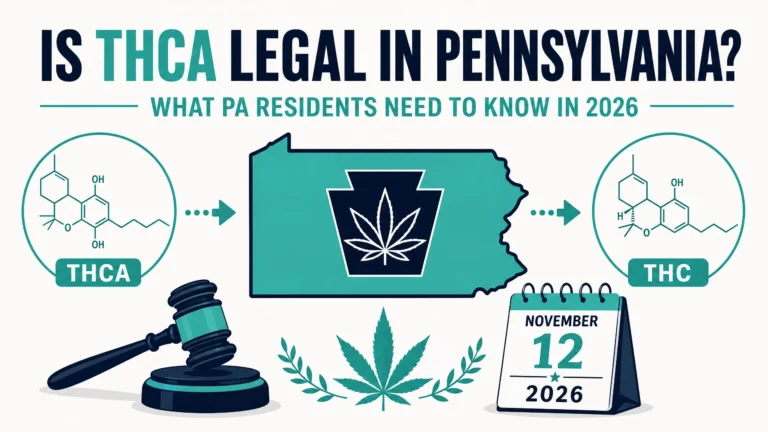

Is THCA legal in Pennsylvania? The technical answer is yes, with conditions.
Under both federal law and Pennsylvania’s Industrial Hemp Act (3 Pa. C.S.A. § 701 et seq.), hemp-derived THCA products are legal in Pennsylvania if they contain 0.3% or less delta-9 THC by dry weight. That is the standard that currently keeps THCA flower and other THCA products on PA smoke shop shelves.
Need a PA Medical Marijuana Card?
Get certified online in 15 minutes. 100% Money-Back Guarantee.
Get Certified Now →But the full answer requires understanding three separate layers of law that are all pulling in different directions right now. How you use THCA, which county you are in, and what month it is all affect the real-world legal risk. And a federal deadline arriving November 12, 2026 will eliminate most THCA products from the market entirely.
This guide maps out exactly where things stand for Pennsylvania residents in July 2026.
Key Takeaways
- THCA is currently legal in Pennsylvania under the 2018 Farm Bill and the PA Industrial Hemp Act (3 Pa. C.S.A. § 701), provided the product contains 0.3% or less delta-9 THC by dry weight.
- Heating THCA converts it to active delta-9 THC. When you vape or smoke THCA flower, you are consuming active THC. The DEA has clarified that hemp products converted to THC through use are not protected by the Farm Bill.
- Pennsylvania’s THCA legal status is a genuine gray area. The PA Senate Law and Justice Committee approved amendments in March 2026 that would ban THCA products statewide. As of July 2026, the ban has not been signed into law.
- County-level enforcement is inconsistent. Some Pennsylvania counties treat THCA flower as marijuana during possession encounters because it is visually identical and cannot be distinguished in the field.
- THCA will trigger a positive drug test if you heat and inhale it. Raw THCA produces different metabolites, but vaporized or smoked THCA converts to THC immediately and produces THC-COOH identically to dispensary cannabis.
- November 12, 2026 is the federal deadline. H.R. 5371 imposes a 0.4mg per-container total THC cap that will eliminate virtually all commercial THCA products from the market.
What Is THCA and Why Does It Matter for Pennsylvania Law?
THCA (tetrahydrocannabinolic acid) is the raw, non-psychoactive form of THC found in living and freshly harvested cannabis plants. In its natural state, THCA does not produce a high. It only becomes psychoactive delta-9 THC when exposed to heat, through a process called decarboxylation.
This chemistry is exactly what created the THCA market.

Do You Qualify for a PA MMJ Card?
Connect with a licensed Pennsylvania state physician online from home.
Because THCA is non-psychoactive in raw form and the 2018 Farm Bill defined hemp based on delta-9 THC content only, cannabis plants with very high THCA levels could be legally harvested, processed, and sold as hemp products, as long as the plant’s delta-9 THC stayed at or below 0.3% by dry weight.
A flower with 25% THCA and 0.2% delta-9 THC technically qualifies as legal hemp on paper.
Consumers then purchase that flower, vaporize or smoke it, instantly convert the THCA to active delta-9 THC through heat, and experience effects identical to marijuana. This is why THCA flower has been called “legal weed” across Pennsylvania smoke shops and online retailers since 2022.
It is also why the legal situation is far more complicated than “yes, it’s legal.”
The Three-Layer Legal Framework for THCA in Pennsylvania
Understanding THCA’s legal status in Pennsylvania requires looking at three separate legal frameworks simultaneously. Most coverage focuses on only one or two of them, which is why so many consumers are surprised when problems arise.

| Legal Layer | What It Says About THCA | Current Status |
|---|---|---|
| Federal Farm Bill (2018) | Hemp-derived THCA is legal if finished product tests at or below 0.3% delta-9 THC by dry weight | Currently legal, but expires effectively November 12, 2026 under H.R. 5371 |
| DEA Position (2023 clarification) | Converting hemp to THC through use (vaping/smoking) removes Farm Bill protection | Published guidance, not yet widely enforced |
| Pennsylvania Act 64 / Controlled Substances Act | Lists “tetrahydrocannabinols” as Schedule I without specifying source | Creates county-level enforcement risk, especially when product is indistinguishable from marijuana |
Each layer tells a different part of the story. The Farm Bill says THCA is legal hemp before use. The DEA says the Farm Bill protection ends at the point of conversion to THC. Pennsylvania’s own drug law creates a potential Schedule I classification issue that different counties enforce differently.
The result is a product that is purchased legally at a Pennsylvania smoke shop, is arguably federally unprotected the moment you heat it, and may be treated as marijuana by law enforcement depending on where in Pennsylvania you are stopped.
The Dry-Weight Math: Why High-THCA Flower Is a Gray Area
The 2018 Farm Bill’s 0.3% delta-9 THC by dry weight standard is what keeps THCA flower on shelves. But the USDA uses a different calculation for compliance testing of hemp pre-harvest, one that includes total THC, and this creates a significant gap.

The total THC formula, used in our How to Read a Pennsylvania Dispensary COA guide, calculates:
Total THC = (THCA% x 0.877) + Delta-9 THC%
⚡ Fast & 100% Online PA Medical Cards
Board-Certified Doctors • 100% Money-Back Guarantee
Book Evaluation Now →This formula represents what the product would actually contain in active THC after heating. Here is what the math shows for a typical high-THCA smoke shop product:
| Measurement | Value |
|---|---|
| THCA percentage (label) | 25% |
| Delta-9 THC percentage (label) | 0.2% |
| Total THC after decarboxylation | (25 x 0.877) + 0.2 = 22.1% |
| Classification under delta-9 only rule | Legal hemp (0.2% delta-9) |
| Classification under total-THC rule | Marijuana (22.1% total THC) |
As CannabisRegulations.ai’s Pennsylvania compliance analysis explains: “THCA flower that tests below 0.3% delta-9 THC technically qualifies as legal hemp. However, the USDA’s total-THC testing protocol includes THCA converted to THC in the calculation, meaning high-THCA flower may fail compliance testing.”
Pennsylvania currently uses the delta-9-only standard for retail compliance, not the total-THC formula.
This is why THCA flower is legally sold in the state right now. But federal H.R. 5371, effective November 12, 2026, closes this gap by shifting the federal standard to total THC. After that date, any product that would produce more than 0.4mg total THC per container (after decarboxylation is factored in) will no longer qualify as hemp.
The DEA’s Position on THCA

The DEA’s position on THCA is one of the most important and least-discussed aspects of this topic. In a 2023 clarification letter, the DEA stated that hemp-derived products that are converted into controlled substances through processing or use lose their Farm Bill protection.
The relevant language from the DEA’s position, as analyzed by Frier Levitt’s hemp law practice: stating that THCA is federally legal based solely on the 2018 Farm Bill’s delta-9 standard is no longer accurate given both the DEA’s guidance and the passage of H.R. 5371.
What this means in practice is straightforward but significant. When you purchase THCA flower at a Pennsylvania smoke shop, you are purchasing a product that currently tests as legal hemp.
The moment you apply heat through vaporization or smoking, you convert that THCA to active delta-9 THC. According to the DEA’s position, at that point the product is no longer protected by the Farm Bill’s hemp exemption. It has been converted into a controlled substance.
This does not mean DEA agents are stationed at Pennsylvania smoke shops enforcing this interpretation.
Federal enforcement of this guidance against individual consumers has been minimal. But it does mean the legal protection most consumers assume they have under the Farm Bill may be thinner than advertised, particularly as federal scrutiny of the hemp THC market increases ahead of November 2026.
Pennsylvania’s Own Legislative Moves on THCA in 2026
Beyond the federal picture, Pennsylvania has taken its own steps toward restricting THCA products in 2026. These are not yet law but represent the direction the state legislature is moving.

PA Senate Law and Justice Committee vote, March 2026
Renewing Your PA MMJ Card?
Quick annual recertification online. No paperwork hassle.
Renew Card Online →As confirmed by LoDo’s Pennsylvania hemp law guide and Nurse Wellness’s PA cannabis laws 2026 overview, the Pennsylvania Senate Law and Justice Committee approved amendments in 2026 to a marijuana bill that would ban the sale of intoxicating hemp-derived products including delta-8 THC, delta-10 THC, and THCA. The committee vote was 10-1 in favor of the amendment.
As of July 2026, this proposal has not been signed into law. THCA remains legally available at Pennsylvania retailers. But a 10-1 committee vote is a strong signal of where state legislative sentiment sits, and floor action on the broader bill remains possible in the current session.
Pennsylvania Attorney General’s position
Pennsylvania AG Dave Sunday joined a coalition letter from 39 attorneys general in November 2025 urging Congress to close the federal hemp loophole. The letter specifically targeted intoxicating hemp products, including high-THCA flower. While an attorney general’s letter does not change state law, it signals active enforcement interest at the state level.
SB 49
Pennsylvania Senate Bill 49 would align Pennsylvania state law with the federal H.R. 5371 framework, imposing the same 0.4mg per-container total THC cap at the state level. As of July 2026 this bill has not passed. If it does, THCA products would be banned in Pennsylvania under state law independently of the federal timeline.
County-Level Enforcement: The Practical Risk Nobody Talks About
Here is the on-the-ground reality that most legal guides skip over because it is uncomfortable to explain: your legal risk when possessing THCA flower in Pennsylvania depends significantly on which county you are in.

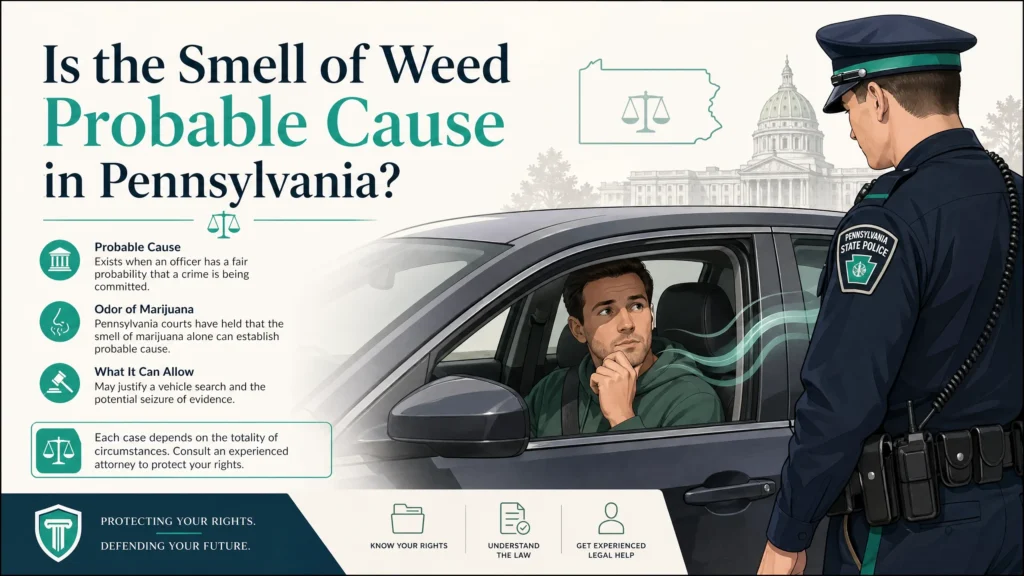
THCA flower is visually identical to marijuana. It has the same appearance, the same smell, and the same texture. Law enforcement officers in the field cannot distinguish THCA flower from marijuana without laboratory testing.
A COA document on your phone or in your packaging establishes the hemp origin of the product, but not all law enforcement officers accept this in the field, and some counties have treated THCA flower as marijuana regardless of documentation.
As Hemp Hop’s Pennsylvania THCA law guide notes: “Some officers go by the product’s label, others may test for total THC. And since Pennsylvania THCA law does not clearly explain every scenario, outcomes can vary by county.”
Pennsylvania’s Controlled Substances Act (Act 64) lists “tetrahydrocannabinols” as Schedule I controlled substances. CannabisRegulations.ai’s Pennsylvania compliance guide confirms that “local prosecutors may apply the total-THC reading under the state Controlled Substance, Drug, Device and Cosmetic Act” when THCA flower is in question.
Practical guidance if you use THCA products in Pennsylvania:
Always carry the original product packaging with the hemp-derived label visible. Carry the COA showing delta-9 THC below 0.3%, including total THC calculations. Purchase only from vendors who provide ISO 17025-accredited third-party lab results.
Get Approved by a Licensed PA Doctor
Schedule your appointment in minutes. You only pay if approved.
Start Online Application →Understand that in some Pennsylvania counties and municipalities, these precautions may not prevent a possession encounter from escalating.
Does THCA Show Up on a Drug Test?
This question has two different answers depending on how you use the THCA product.

Raw, unheated THCA
Standard drug tests screen for THC-COOH, the metabolite produced when your body processes active delta-9 THC. Raw THCA, in its undecarboxylated form, is not directly converted to THC-COOH in the same way. Technically, consuming raw THCA (in a tincture designed for sublingual use without heat, for example) may not produce a positive drug test result.
Heated THCA (vaporized or smoked)
This is how virtually all THCA flower and THCA vape products are consumed. When you apply heat, THCA instantly converts to active delta-9 THC. Your body then processes that THC identically to any other source of delta-9 THC. The result is exactly the same THC-COOH metabolite profile as dispensary cannabis or any other THC source.
As ATLRx’s Pennsylvania THCA guide explains: “When THCA is converted to delta-9 THC through decarboxylation (smoking, vaping, or cooking), your body processes the resulting THC the same way it would from any cannabis source. THC metabolites can remain detectable in urine for days or weeks, depending on usage frequency and metabolism.”
The employment protection gap
A positive drug test from THCA products provides no employment protection under Pennsylvania’s Medical Marijuana Act. The Act 16 protections confirmed by Palmiter v. Commonwealth Health Systems apply to registered MMJ patients using dispensary-purchased cannabis.
They do not apply to hemp-derived products purchased outside the licensed dispensary system. If your employer takes adverse action based on a positive drug test from THCA use, you have no legal recourse under Act 16.
Detection windows for heated THCA are the same as for any THC product. For full detection window data by test type and use frequency, see our companion guide on how long delta-9 stays in your system.
Is CBD Legal in Pennsylvania?
Since many readers arrive at this page researching Pennsylvania hemp law more broadly, this is worth answering directly.
Yes, CBD is legal in Pennsylvania. Hemp-derived CBD products containing 0.3% or less delta-9 THC by dry weight are legal under the same framework as THCA products, the Pennsylvania Industrial Hemp Act (3 Pa. C.S.A. § 701) and the 2018 Farm Bill. CBD products are widely available at retailers, pharmacies, and wellness stores throughout the state.
Ready to Get Your Official PA MMJ Card?
State-certified doctor consultations online. No risk—100% refund if not approved.
Claim Your MMJ Card Online →The November 2026 H.R. 5371 deadline primarily affects intoxicating cannabinoid products. Non-intoxicating CBD isolate and broad-spectrum CBD products with no detectable THC are generally expected to remain legal under the new framework, as they would either test at zero total THC or far below the 0.4mg per-container cap.
Full-spectrum CBD products that contain trace amounts of THC should be reviewed against the 0.4mg per-container cap. For most full-spectrum CBD tinctures with minimal THC content, compliance is likely. High-dose full-spectrum products with significant trace THC may face the same reclassification issues as THCA and hemp delta-9 products.
What Does Not Change: PA Dispensary Products Under Act 16
For Pennsylvania medical marijuana patients, none of this legislative activity affects your access or protections in any way.

Pennsylvania’s licensed medical marijuana dispensaries operate under the Medical Marijuana Act (Act 16 of 2016), which is state law entirely separate from the federal Farm Bill hemp framework.
Your ability to purchase from licensed dispensaries, your Act 16 employment protections, your 90-day supply allowance, and every other benefit of your registered patient status remain fully intact regardless of what happens to THCA, hemp delta-9, or the November 2026 federal deadline.
The comparative picture for PA residents:
| Product Access | Legal Framework | Employment Protection | Drug Test Risk | Affected by Nov 2026? |
|---|---|---|---|---|
| PA dispensary cannabis (with MMJ card) | Act 16 of 2016, state law | Full protection under Palmiter | Yes, but card protects you | No |
| Hemp THCA flower (no card) | Farm Bill / PA Industrial Hemp Act | None | Yes, no protection | Yes, eliminated |
| Hemp delta-9 gummies (no card) | Farm Bill / PA Industrial Hemp Act | None | Yes, no protection | Yes, eliminated |
| CBD isolate products | Farm Bill / PA Industrial Hemp Act | N/A (non-intoxicating) | Generally no | Generally no |
This table illustrates why the difference between the licensed dispensary system and the unregulated hemp market matters so much for Pennsylvania residents, particularly those using cannabis products for a medical purpose.
November 12, 2026: The Federal Deadline for THCA Products
H.R. 5371, signed into law November 12, 2025, is the federal legislation that changes the definition of hemp effective November 12, 2026. Its key provisions for THCA:

The new federal definition shifts the compliance test from delta-9 THC only to total THC, calculated using the same formula as the USDA’s pre-harvest compliance standard: (THCA x 0.877) + delta-9 THC. Under this standard, high-THCA flower would exceed the 0.3% total THC threshold and would no longer qualify as hemp.
Additionally, the 0.4mg per-container total THC cap means that even products with lower THCA concentrations would need to contain a truly negligible amount to comply.
As CannabisRegulations.ai’s H.R. 5371 analysis confirms: “Federal hemp testing shifts to a total-THC standard (delta-9 + 0.877 x THCA), eliminating the delta-9-only loophole at the federal level.”
The practical result: THCA flower as currently sold in Pennsylvania becomes federally reclassified as a Schedule I controlled substance after November 12, 2026. Pennsylvania enforcement of this federal reclassification would depend on state-level implementation, but the legal protection that currently makes THCA flower available without a medical card disappears at the federal level on that date.
Several counter-bills are pending in the Senate as of July 2026, including proposals to delay the deadline to November 2028. None have passed. Plan around the current deadline until a delay is enacted into law.
What PA Residents Should Do Based on Their Situation

1. If you currently use THCA products for a medical condition
Consider whether your condition qualifies for Pennsylvania’s medical marijuana program. Qualifying conditions include anxiety disorders, chronic pain, PTSD, cancer, epilepsy, Crohn’s disease, and 19 others.
Getting a PA MMJ card before November 2026 gives you continuous legal access to THC products through licensed dispensaries, employment protection, and pharmacist guidance. The certification process is entirely online and available same-day.
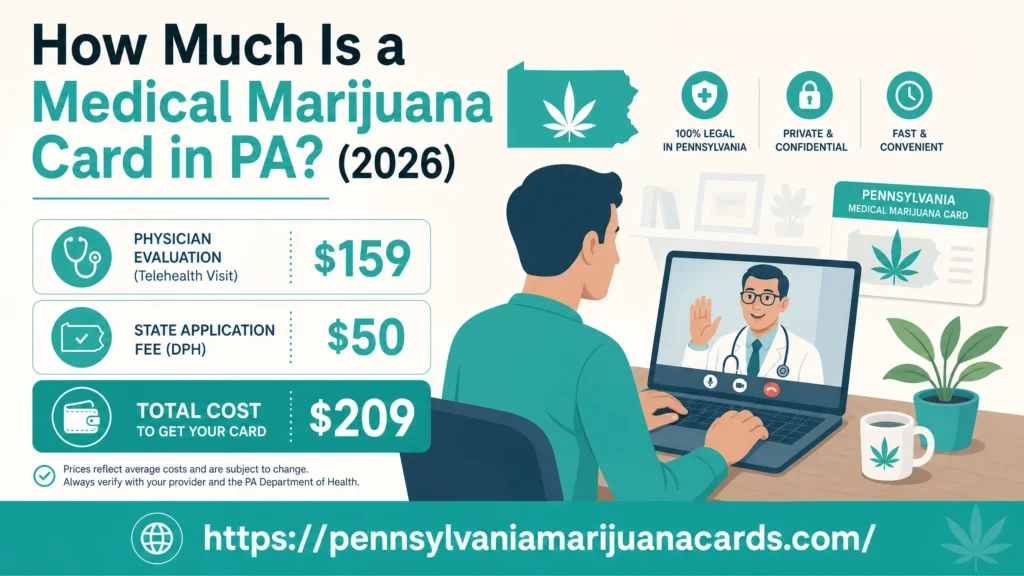
Check whether your condition qualifies at our qualifying conditions page. New patient certification is $159 plus the $50 state fee, reduced to $159 total for patients enrolled in Medicaid, SNAP, WIC, CHIP, PACE, or PACENET through MMAP. Get started at Pennsylvania Marijuana Cards.
2. If you are already a PA MMJ patient
Nothing changes for you. Your dispensary access and patient protections are completely unaffected by THCA legislation, H.R. 5371, or any pending Pennsylvania state bills.
3. If you use THCA products recreationally with no qualifying condition
Be aware of the November 2026 federal deadline. Understand the county-level enforcement inconsistency. Always carry product COAs and keep original packaging. Know that a positive drug test from THCA products provides no employment protection. And understand that Pennsylvania’s THCA landscape is likely to become significantly more restricted in the next six to twelve months.
4. If you are considering trying THCA products for the first time
Understand clearly what you are purchasing. THCA flower, once vaporized or smoked, produces effects identical to marijuana. It will cause a positive drug test. It carries county-level legal risk in Pennsylvania. And it will almost certainly be unavailable in its current legal form after November 2026. For anyone managing a qualifying medical condition, a PA MMJ card is a more stable and legally protected path.
Frequently Asked Questions
Q: Is THCA legal in Pennsylvania in 2026?
A: Currently yes, with significant caveats. Under the Pennsylvania Industrial Hemp Act (3 Pa. C.S.A. § 701) and the federal 2018 Farm Bill, hemp-derived THCA products testing at or below 0.3% delta-9 THC by dry weight are legal to purchase and possess in Pennsylvania. However, the DEA has stated that converting hemp to THC through use removes Farm Bill protection, Pennsylvania’s Senate Law and Justice Committee voted 10-1 in 2026 to ban THCA products (though the ban has not passed), and H.R. 5371 eliminates the delta-9-only loophole effective November 12, 2026, effectively ending the legal THCA market at the federal level.
Q: Is THCA the same as THC?
A: In raw form, no. THCA is the non-psychoactive acid precursor to THC found in raw cannabis plants. It does not produce a high. When heated through vaporization, smoking, or cooking, THCA instantly converts to active delta-9 THC through decarboxylation. Once converted, it is chemically and pharmacologically identical to any other source of delta-9 THC. This conversion is the central legal issue: THCA flower is legal hemp before use, but it becomes THC (a controlled substance for recreational use) at the moment you apply heat.
Q: Does THCA show up on a drug test?
A: Raw, unheated THCA generally does not trigger standard drug tests. However, this is irrelevant for most consumers, because THCA flower and vape products are consumed by heating. Heated THCA converts to delta-9 THC, which your body metabolizes into THC-COOH, the exact compound that standard drug tests detect. If you vape or smoke THCA flower, expect a positive drug test with the same detection windows as regular THC use. THCA products provide no employment protection under Pennsylvania’s Medical Marijuana Act.
Q: What happens to THCA products after November 12, 2026?
A: H.R. 5371, signed November 12, 2025, rewrites the federal definition of hemp effective November 12, 2026. The new standard uses total THC (including THCA converted to THC) rather than delta-9 alone, and caps finished products at 0.4mg total THC per container. High-THCA flower, which would produce 20-25% total THC after heating, cannot comply with this standard. It will be federally reclassified as a Schedule I controlled substance on that date.
Q: Is CBD legal in Pennsylvania?
A: Yes. Hemp-derived CBD products containing 0.3% or less delta-9 THC by dry weight are legal in Pennsylvania under the same framework as THCA products. Non-intoxicating CBD isolate and broad-spectrum CBD products are generally expected to remain legal after November 2026, as they contain negligible total THC. Full-spectrum CBD products with trace THC should be reviewed against the 0.4mg per-container cap.
Q: Can I buy THCA products at a Pennsylvania dispensary?
A: No. Pennsylvania’s licensed medical marijuana dispensaries operate under the Medical Marijuana Act and carry only state-approved delta-9 THC products. THCA-specific products are not currently listed as approved PA dispensary products. THCA is available at hemp retailers, smoke shops, and online vendors in Pennsylvania without a medical card, but carries the legal risks and November 2026 deadline described throughout this guide.
Q: Is recreational marijuana legal in Pennsylvania?
A: No. Recreational cannabis remains illegal in Pennsylvania as of July 2026. Medical marijuana is fully legal under the Medical Marijuana Act for registered patients with qualifying conditions. SB 120, a bipartisan legalization bill, has advanced further through the Pennsylvania Senate than any previous legislation but has not passed into law.
Q: What are the risks of possessing THCA flower in Pennsylvania?
A: The primary risks are county-level law enforcement inconsistency (THCA flower is visually identical to marijuana and some PA law enforcement treat it as such regardless of documentation), the DEA’s position that heated THCA is not protected by the Farm Bill, and the November 2026 federal reclassification deadline. To minimize risk, carry original product packaging showing hemp-derived status, carry the COA showing delta-9 THC below 0.3%, and purchase only from vendors with ISO 17025-accredited third-party lab results.
The Bottom Line
Is THCA legal in Pennsylvania?
Technically yes today, with more layers of risk and uncertainty than most smoke shop marketing suggests. The raw product qualifies as hemp. The moment you heat it, the DEA’s position removes the Farm Bill protection. County enforcement varies. And the November 12, 2026 federal deadline is the most significant legal change to the hemp THCA market in its history.
For Pennsylvania residents using THCA for a qualifying medical condition, the PA medical marijuana program offers a path that provides legal certainty, employment protection, quality-tested products, and pharmacist guidance that the hemp market simply cannot match. And unlike hemp THCA products, PA dispensary access does not disappear on a federal deadline.
This blog post is intended for general educational and informational purposes only and does not constitute legal advice. Pennsylvania hemp law and federal hemp regulations are actively evolving. This article reflects the legal and regulatory landscape as of July 2026. Individual legal situations vary, especially given county-level enforcement inconsistencies described above. Consult a licensed Pennsylvania attorney for legal advice specific to your situation. Medically reviewed by Dr. Johnathon Chance Miller, MD.
Sources
- Pennsylvania Industrial Hemp Act, 3 Pa. C.S.A. § 701 et seq.
- CannabisRegulations.ai: Pennsylvania 2025 Delta-8 and Adult-Use Compliance Plan (June 2026)
- CannabisRegulations.ai: Is Delta-8 Legal in Pennsylvania? 2025 PA Hemp Law (April 2026)
- ATLRx: Is THCA Legal in Pennsylvania? 2026 Legal Guide (April 2026)
- Elevate Right: Is THCA Legal in Pennsylvania? 2026 Hemp Law Guide (March 2026)
- BD Logistics: Pennsylvania Cannabis & Hemp Laws 2026 THCA and Delta Update (January 2026)
- Hemp Hop: Is THCA Legal in Pennsylvania? THCA Pennsylvania Law (July 2025)
- Exhale Wellness: Is THCA Legal in 2026? Complete State-by-State Guide (February 2026)
- Frier Levitt: The Redefinition of Hemp Under Federal Law 2026 (March 2026)
- LoDo: Yes, THC Drinks Are Legal in Pennsylvania (May 2026)
- Nurse Wellness: PA Cannabis Laws 2026 What You Need to Know
- CannabisRegulations.ai: Is Hemp-Derived Delta-9 THC Legal in Pennsylvania? 2026 Status (May 2026)
- PA Department of Health: Medical Marijuana Program
- Pennsylvania Marijuana Cards: Qualifying Conditions