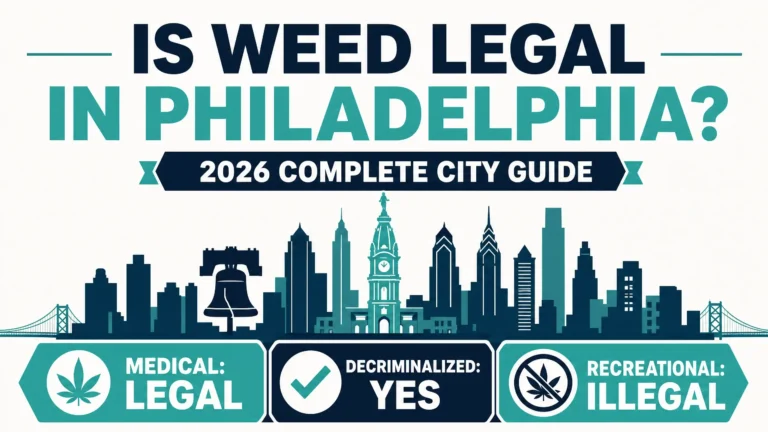

Is weed legal in Philadelphia?
Not fully. Recreational marijuana is not legal anywhere in Pennsylvania, including Philadelphia. But Philadelphia has gone further than most Pennsylvania cities by decriminalizing possession of 30 grams or less since 2014, which means getting caught with a small amount in the city typically results in a $25 civil fine rather than a criminal charge.
Need a PA Medical Marijuana Card?
Get certified online in 15 minutes. 100% Money-Back Guarantee.
Get Certified Now →That distinction matters enormously in practice. But it does not mean weed is legal in Philly.
Buying without a medical marijuana card, carrying more than 30 grams, selling, and consuming in public all still carry serious legal consequences. And Pennsylvania state law, which classifies any marijuana possession as a misdemeanor, never went away.
This guide explains exactly what is and is not legal in Philadelphia in 2026, who enforces what, and what the city’s laws actually protect you from.
Key Takeaways
- Recreational weed is not legal in Philadelphia or anywhere in Pennsylvania. Philadelphia has decriminalized small amounts, which is different from legalization.
- Possession of 30 grams or less in Philadelphia results in a $25 civil fine under Philadelphia City Code Chapter 10-2100, not a criminal charge at the city level.
- State law still applies. Pennsylvania state police and other state-level enforcement can still charge you under state law for the same 30 grams that would only get a city fine from the Philadelphia Police Department.
- Philadelphia banned pre-employment marijuana drug testing for most jobs effective January 1, 2022, giving Philadelphia workers a protection that does not exist in the rest of Pennsylvania.
- Medical marijuana is fully legal in Philadelphia for registered PA MMJ patients, with more licensed dispensaries per capita than almost anywhere in the Northeast.
- Buying weed legally in New Jersey and bringing it back to Philadelphia is still a federal crime, even if the amount is under 30 grams. Interstate transport is federally illegal regardless of local decriminalization.
Philadelphia Weed Laws 2026: The Two-Layer System
Understanding Philadelphia weed laws in 2026 requires keeping two completely separate legal frameworks in your head at the same time.

Layer 1: Philadelphia City Law
Do You Qualify for a PA MMJ Card?
Connect with a licensed Pennsylvania state physician online from home.
Philadelphia’s decriminalization ordinance, City Code Chapter 10-2100, went into effect in October 2014. Under city law, possession of 30 grams or less is a civil violation, not a crime.
Philadelphia Police Department officers may issue a Civil Violation Notice (CVN), a fine you pay like a parking ticket, rather than making an arrest.
Layer 2: Pennsylvania State Law
The Pennsylvania Controlled Substance, Drug, Device and Cosmetic Act (35 P.S. § 780-113) classifies marijuana possession as a criminal offense statewide, regardless of what the city of Philadelphia has done.
Under state law, possession of 30 grams or less is a misdemeanor carrying up to 30 days in jail and a $500 fine for a first offense.
The critical point: Both laws exist simultaneously. Philadelphia decriminalization removes the typical city police response to small amounts. It does not remove state law.
As Leafwell’s April 2026 Philadelphia guide states clearly: “The city decriminalized possession of up to 30 grams in 2014, making it a $25 civil fine under city enforcement, but Pennsylvania state law still classifies it as a misdemeanor, and state law enforcement can still arrest and charge you.”
This two-layer system is why Philadelphia weed laws confuse so many residents. The city treats small amounts as a civil matter. The state never changed its position.
Your actual legal exposure in any given situation depends on who stops you and which law they choose to enforce.
What Decriminalization Actually Means in Philadelphia
Decriminalization is a specific legal category that sits between prohibition and legalization. It is worth understanding clearly before relying on it for protection.

What decriminalization does?
It removes criminal penalties for a defined amount and replaces them with civil penalties.
⚡ Fast & 100% Online PA Medical Cards
Board-Certified Doctors • 100% Money-Back Guarantee
Book Evaluation Now →In Philadelphia’s case, it means that if a Philadelphia Police officer finds you with 30 grams or less of marijuana, the standard response under current city policy is to issue a CVN rather than arrest you. The CVN carries a $25 fine for possession and a $100 fine for public consumption.
What decriminalization does not do?
It does not make marijuana legal. It does not remove state criminal penalties. It does not protect you from state police or other non-Philadelphia law enforcement.
It does not protect you from consequences in federal housing, federal employment, or drug testing. It does not allow you to purchase marijuana from any source legally. And it does not apply outside Philadelphia city limits.
As the Philadelphia Inquirer’s cannabis law guide states: “Marijuana is not legal in Philly, but small amounts have been decriminalized. You can get a ticket for possessing, smoking, or buying any amount of weed, even if you bought it legally in New Jersey.”
The intent behind Philadelphia’s 2014 ordinance was to reduce the volume of low-level marijuana arrests that historically disproportionately affected Black and low-income residents.
Before decriminalization, more than 300 people were arrested for marijuana offenses in Philadelphia each month. The ordinance reduced arrests dramatically, though state charges remain possible.
What the $25 Fine Actually Looks Like in Practice
If a Philadelphia Police officer issues you a Civil Violation Notice for marijuana possession (30 grams or less), here is what the practical process looks like:
The CVN is a paper ticket similar in format to a parking citation. It identifies the violation, the fine amount ($25 for possession, $100 for public consumption), and instructions for payment or contest. You pay it through the Philadelphia Municipal Court system, typically online or by mail.
A CVN for marijuana possession does not appear on your criminal record. It is a civil matter handled outside the criminal court system. It does not typically affect your driving record, employment background checks (for most positions), or immigration status in the way a criminal charge would.
However, several important exceptions apply. If you are on parole or probation, even a CVN can trigger violation proceedings.
If your probation terms require drug-free status, a city civil fine does not shield you from your probation officer’s authority. Federal housing and federal employment also operate outside the city ordinance entirely.
Renewing Your PA MMJ Card?
Quick annual recertification online. No paperwork hassle.
Renew Card Online →If you receive a CVN and do not pay it, the fine can escalate and be sent to collections like any unpaid civil debt. Ignoring it is not advisable.
What Is Still Illegal in Philadelphia: The Full List
Decriminalization covers a narrow slice of cannabis activity. The following remain fully illegal in Philadelphia under state law and carry criminal penalties:

| Activity | Legal Status | Potential Penalty |
|---|---|---|
| Possession under 30g (city enforcement) | Civil fine only | $25 CVN |
| Possession under 30g (state enforcement) | Criminal misdemeanor | Up to 30 days, $500 fine |
| Possession over 30g | Criminal misdemeanor (state) | Up to 1 year, $5,000 fine |
| Public consumption under 30g (city) | Civil fine | $100 CVN |
| Purchasing without MMJ card | Criminal offense | State misdemeanor penalties |
| Selling any amount | Felony | Up to 2 years+ depending on amount |
| Growing any amount | Felony | Up to 5 years for larger grows |
| Bringing weed from another state | Federal crime | Federal trafficking charges |
| Driving under the influence | Criminal DUI | Per se DUI, 1 ng/mL blood THC threshold |
As Marijuana and the Law’s May 2026 PA guide confirms, selling marijuana or possessing large amounts can escalate quickly to felony charges. Decriminalization applies only to simple possession of small amounts.
Distribution, cultivation, and interstate transport remain serious criminal offenses regardless of Philadelphia’s local ordinance.
Who Enforces What: City Police vs State Police
This is one of the most practically important distinctions in Philadelphia cannabis law, and it is almost never explained clearly.

Philadelphia Police Department
Philadelphia PD officers typically operate under city policy and issue CVNs for small-amount possession rather than making arrests.
This reflects both the city ordinance and a general departmental approach aligned with the DA’s office prosecution policies. In practice, a Philadelphia officer finding you with under 30 grams is likely to issue a ticket rather than arrest you.
Pennsylvania State Police
State troopers are not bound by Philadelphia’s city ordinance. They enforce Pennsylvania state law.
A Pennsylvania State Police officer who finds you with 30 grams of marijuana in Philadelphia can and may charge you with a state misdemeanor. The city ordinance has no authority over state law enforcement.
Philadelphia District Attorney’s Office
DA Larry Krasner’s office has maintained a written policy of not prosecuting small-amount possession cases, even when charged by state actors.
This adds another layer of protection for Philadelphia residents, but it is prosecutorial discretion, not law. A future DA could reverse this policy without any legislative action.
The practical result
Get Approved by a Licensed PA Doctor
Schedule your appointment in minutes. You only pay if approved.
Start Online Application →In most day-to-day encounters in Philadelphia involving small amounts, you are likely to receive a CVN rather than face arrest. But this reflects current enforcement policy, not legal protection.
The underlying state criminal law has not changed. If you encounter state law enforcement, are near a school or playground, are also suspected of distribution, or are on parole, the city ordinance does not help you.
Commonwealth v. Barr and Probable Cause in Philadelphia
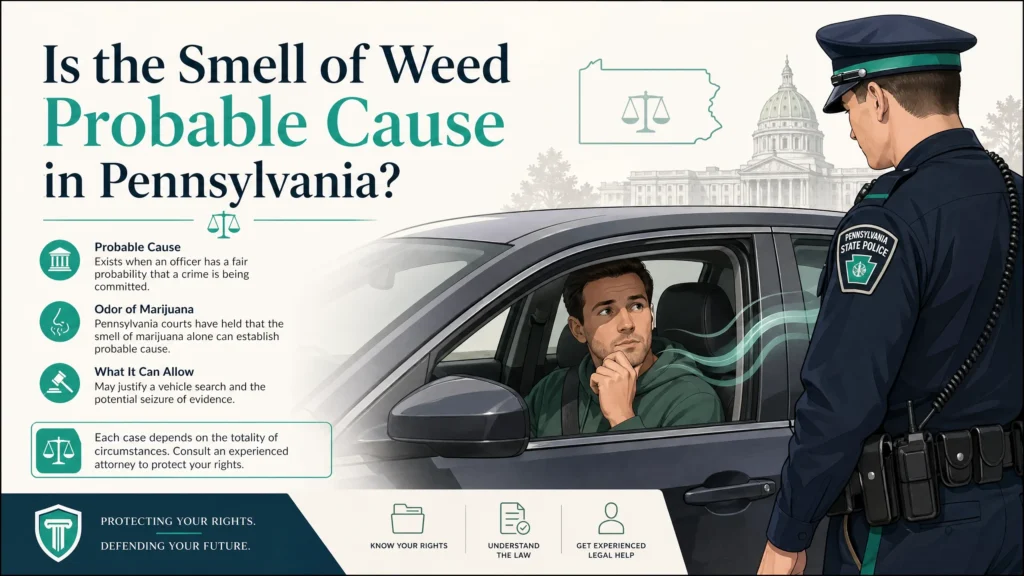
Philadelphia residents benefit from the Pennsylvania Supreme Court’s December 2021 ruling in Commonwealth v. Barr, 252 A.3d 1086 that ended the “plain smell doctrine” for marijuana in Pennsylvania.

Before that ruling, the smell of marijuana alone gave police probable cause to conduct a warrantless vehicle search in Pennsylvania. After the ruling, marijuana odor alone is no longer sufficient probable cause.
As the Supreme Court held, because the Medical Marijuana Act made cannabis legally possessable by registered patients, its odor can no longer automatically signal criminal activity.
For Philadelphia residents, this ruling has practical significance during any police encounter involving cannabis. An officer smelling marijuana cannot use that smell alone to justify searching your vehicle or escalating an encounter beyond a civil fine situation.
Additional factors must exist to establish probable cause beyond the odor.
For more detail on this ruling and what it means for your rights during a police stop, see our full guide on whether the smell of weed is probable cause in PA.
The Philadelphia Pre-Employment Drug Test Ban
This is one of the most significant Philadelphia-specific cannabis protections and one that almost no weed-law guide covers adequately.

Effective January 1, 2022, a Philadelphia City Council ordinance prohibits most Philadelphia employers from requiring job applicants to submit to pre-employment drug tests that include marijuana screening.
Ready to Get Your Official PA MMJ Card?
State-certified doctor consultations online. No risk—100% refund if not approved.
Claim Your MMJ Card Online →This protection applies to job applicants in Philadelphia, not employees already working. It means that a prospective employer in Philadelphia generally cannot screen you out of a job application based on a positive pre-employment marijuana test.
This applies whether or not you have a PA MMJ card.
Important exceptions to the Philadelphia pre-employment test ban:
- Police officers and sworn law enforcement
- CDL operators and positions requiring federal drug testing
- Positions involving supervision or care of children, medical patients, or people with disabilities
- Positions where the employer reasonably believes marijuana impairment would create safety risks
- Federal contractors whose drug testing is required by federal law
Outside these exceptions, if you are applying for a job in Philadelphia, pre-employment marijuana testing is generally prohibited under city law.
This is a meaningful, city-specific protection that goes beyond what Pennsylvania state law provides in the rest of the Commonwealth.
Can I Buy Weed in New Jersey and Bring It Back to Philly?
This is one of the most frequently asked questions from Philadelphia residents, and the answer is clear: NO.

New Jersey has legal recreational cannabis sales. Philadelphia is approximately 20 minutes from several New Jersey dispensaries.
The proximity makes this tempting. But bringing marijuana across state lines is a federal crime under the Controlled Substances Act, regardless of the legality in either state.
As the Philadelphia Inquirer’s marijuana law guide confirms: “While New Jersey legalized the sale of marijuana for adult use, Philly residents still can’t bring that legal New Jersey weed back to Pennsylvania. To do so, you’d have to cross state lines with it and that can land you in serious trouble.”
Even if you possess the cannabis legally in New Jersey (where you bought it at a licensed store), transporting it across the Delaware River into Pennsylvania makes you guilty of interstate drug trafficking under federal law.
Philadelphia’s decriminalization does not create any exemption to federal interstate transport laws. A $25 civil fine regime does not apply when federal law enforcement is involved.
The same principle applies to cannabis purchased legally in Delaware, Maryland, Ohio, or New York. Legal in those states does not mean legal to transport into Pennsylvania.
Medical Marijuana in Philadelphia: Full Legal Access
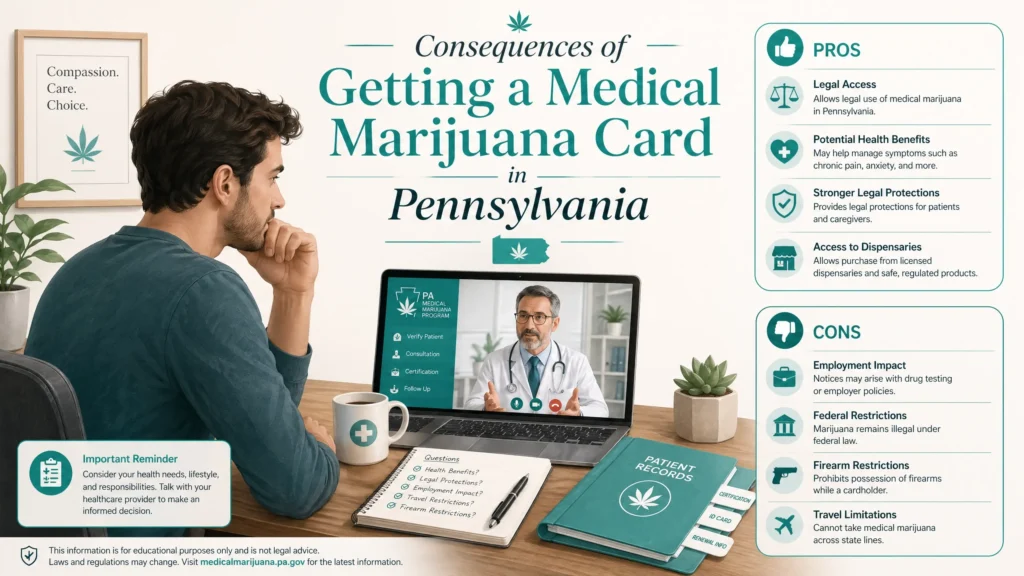
While recreational cannabis remains decriminalized but not legal in Philadelphia, registered PA medical marijuana patients have full, legal cannabis access in the city.
Philadelphia has one of the highest concentrations of licensed dispensaries in the Northeast. Multiple licensed dispensaries operate in and around the city, with more options in the surrounding suburbs.
All are regulated by the Pennsylvania Department of Health and carry state-tested, COA-verified products.
As a registered PA patient in Philadelphia, you can:
- Legally purchase cannabis from any licensed PA dispensary in Philadelphia or statewide
- Legally possess up to a 90-day supply of dispensary-purchased cannabis
- Legally vaporize cannabis (smoking is prohibited under PA law, but dry-leaf flower for vaporization is permitted)
- Access Act 16 employment anti-discrimination protections for most non-safety-sensitive jobs
- Benefit from Commonwealth v. Barr protections during any police encounter involving your card-covered cannabis
The PA Department of Health’s dispensary locator lists every licensed Philadelphia-area dispensary with current operating hours.
Pennsylvania recognizes 24 qualifying conditions for the medical marijuana program. Anxiety disorders are the most commonly certified condition, accounting for approximately 60% of all PA MMJ certifications. For the full conditions list, see our qualifying conditions page.
What an MMJ Card Gets You That Decriminalization Does Not
Philadelphia’s decriminalization gives you reduced penalties for small amounts. A PA MMJ card gives you something decriminalization never can: actual legal protection.

The comparison matters:
| Situation | With Only Decriminalization | With PA MMJ Card |
|---|---|---|
| Caught with under 30g by city police | $25 fine (CVN) | Legal possession, no fine |
| Caught with under 30g by state police | State misdemeanor charges possible | Legal possession, Act 16 protection |
| Employer takes adverse action after positive test | No protection | Palmiter v. Commonwealth Health Systems protection for most jobs |
| Pre-employment test in Philadelphia | City ban applies to applicants | City ban applies, plus Act 16 patient protection |
| Smell of weed during police encounter | Commonwealth v. Barr applies | Commonwealth v. Barr applies, plus card demonstrates lawful possession |
| Purchasing cannabis legally | No legal purchase option | Licensed dispensary access statewide |
| Product quality and safety | No guarantee, unregulated sources | State-mandated COA testing on all products |
The difference is not just legal technicality. It is the difference between “the city will probably just fine you” and “you have actual legal authorization to possess this product.”
If you have a qualifying condition and are using cannabis in Philadelphia, getting your PA MMJ card is the single most meaningful step you can take to protect yourself.
Get started with your certification at Pennsylvania Marijuana Cards.
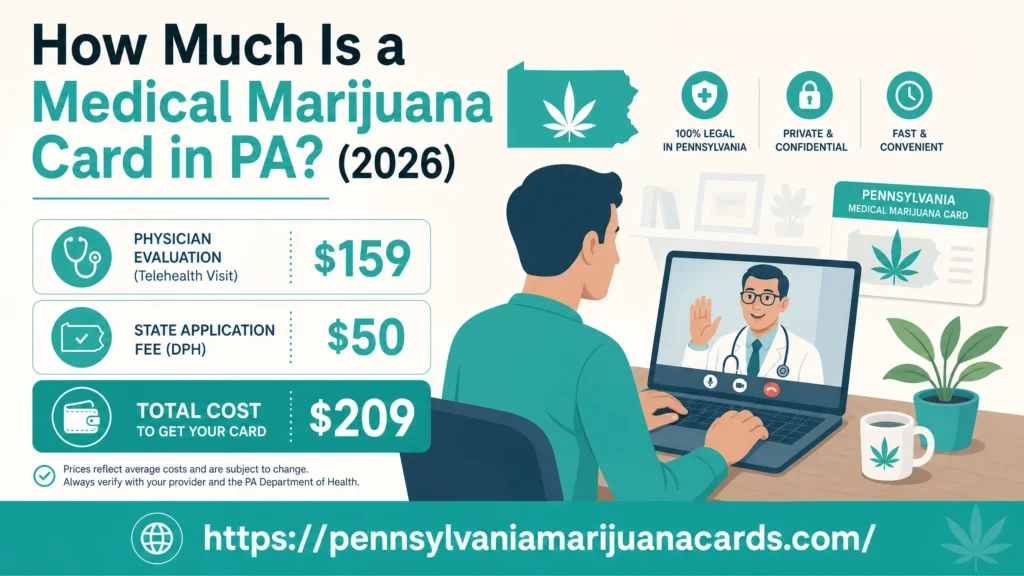
New patient certifications are $159 plus the $50 state fee, with the state fee waived for Medicaid, SNAP, WIC, CHIP, PACE, or PACENET enrollees through MMAP.
Philadelphia Weed Laws and Federal Rules: The Hidden Risks
Philadelphia’s decriminalization and Pennsylvania’s medical marijuana program provide meaningful state and local protections. They do not override federal law. Several federal consequences catch Philadelphia residents off guard.
Firearms and cannabis
Under 18 U.S.C. § 922(g)(3), it is illegal for any unlawful user of a controlled substance to possess a firearm. Cannabis remains a federal Schedule I substance.
A revised federal rule effective January 2026 narrowed this definition to require evidence of regular and recent use rather than any past use. But regular cannabis users, including PA MMJ patients, remain legally prohibited from purchasing or possessing firearms under federal law.
Philadelphia’s decriminalization provides no exception.
Federal and federally assisted housing
HUD policy prohibits cannabis use in federally assisted housing, including Section 8 and HUD public housing. Philadelphia’s decriminalization does not apply to residents of these properties. PA MMJ card status provides no exemption from federal housing rules.
Federal employment and contractors
Federal employees and employees of federal contractors are subject to federal drug-free workplace rules. A PA MMJ card and Philadelphia’s decriminalization provide no protection in these employment contexts.
Professional licensing
Some Pennsylvania professional licenses trigger reporting requirements or licensing consequences for drug offense records. A CVN for cannabis possession is civil and generally does not affect state professional licenses. A state criminal charge, even from a Philadelphia encounter where state police were involved, can.
Pennsylvania Recreational Weed: Where Things Stand in 2026
Many Philadelphia residents are waiting for full legalization and want to know how close Pennsylvania actually is.
The honest answer as of July 2026: closer than it has ever been, but still not there.
HB 1200 passed the Pennsylvania House on May 7, 2025 by a 102-101 vote, the first time either chamber had passed a recreational legalization bill. The Pennsylvania Senate Law and Justice Committee killed it 7-3 six days later, largely over objections to the state-store sales model.
SB 120, a bipartisan bill from Senators Dan Laughlin (R) and Sharif Street (D) using a private retail model, was approved by the Senate Law and Justice Committee in October 2025 and sent to the full Senate floor. As of July 2026, it has not received a floor vote.
The primary obstacle remains Senate Majority Leader Joe Pittman, who has said he does not see a majority within the Republican caucus for legalization. All 23 Democratic Senate members filed a discharge petition in July 2026 to force a floor vote, but whether Pittman schedules one is his decision.
Governor Josh Shapiro has supported legalization in three consecutive budget addresses and projects $250 million in annual revenue from a legal cannabis market. His administration estimates Pennsylvania loses out on $730 million in revenue in the first year alone.
If SB 120 passed and was signed into law, Pennsylvania could see licensed adult-use sales beginning approximately 12 months after enactment. That means a realistic best-case scenario for Philadelphia recreational dispensary sales would be sometime in 2027.
For the full legislative picture, see our Pennsylvania recreational weed guide.
Frequently Asked Questions
Q: Is weed legal in Philadelphia in 2026?
A: No. Recreational marijuana is not legal in Philadelphia or anywhere in Pennsylvania. Philadelphia has decriminalized possession of 30 grams or less, meaning city police typically issue a $25 civil fine instead of making an arrest. But cannabis is not legal in Philadelphia. Purchasing without a medical marijuana card, selling, growing, carrying more than 30 grams, consuming in public, and transporting across state lines all remain illegal with criminal consequences.
Q: Is weed legal in Philly if you bought it in New Jersey?
A: No. New Jersey has legal recreational sales, but bringing cannabis across state lines is a federal crime under the Controlled Substances Act regardless of local or state law. If you drive from New Jersey into Philadelphia with legally purchased NJ cannabis, you are committing federal interstate drug trafficking. Philadelphia’s decriminalization ordinance does not apply to federally illegal conduct.
Q: What happens if you get caught with weed in Philadelphia?
A: If Philadelphia Police find you with 30 grams or less, they typically issue a Civil Violation Notice (CVN): a $25 fine for possession or a $100 fine for public consumption. No arrest, no criminal record at the city level. If Pennsylvania State Police or other state law enforcement finds you with the same amount, they can charge you with a state misdemeanor carrying up to 30 days in jail and a $500 fine. More than 30 grams, any sale, or any cultivation bring felony charges under state law regardless of the decriminalization ordinance.
Q: Can Philadelphia employers drug test for marijuana?
A: For pre-employment testing, generally no. Philadelphia’s January 2022 ordinance prohibits most employers from requiring marijuana screening as part of pre-employment drug tests. Exceptions include law enforcement, CDL positions, roles involving care of children or vulnerable populations, and federal contractors. For existing employees, employers may still maintain drug-free workplace policies and conduct random or post-incident testing.
Q: Does a PA MMJ card protect you from Philadelphia marijuana fines?
A: A PA MMJ card does more than protect you from fines. It gives you full legal authorization to possess your physician-determined supply of dispensary-purchased cannabis under state law. Where Philadelphia decriminalization reduces a criminal charge to a $25 civil fine, a PA MMJ card means no fine and no charge at all for legally obtained cannabis within your authorized supply. It also gives you employment protections under Act 16 and Palmiter v. Commonwealth Health Systems that decriminalization does not provide.
Q: How many dispensaries are in Philadelphia?
A: Philadelphia and the surrounding metro area have a high concentration of licensed PA dispensaries. The Pennsylvania Department of Health maintains an updated dispensary locator at pa.gov. Philadelphia proper has multiple licensed dispensaries, and dozens more operate in the suburbs. All require a valid PA MMJ card for entry and purchase.
Q: Will recreational weed be legal in Philadelphia soon?
A: This depends on the Pennsylvania legislature, not Philadelphia itself. Cannabis law in Pennsylvania is state law. Philadelphia cannot legalize recreational marijuana on its own. SB 120, a bipartisan legalization bill, has advanced further through the PA Senate process than any previous bill and was approved by the Senate Law and Justice Committee in October 2025. As of July 2026, it has not received a full Senate floor vote. If passed and signed, licensed adult-use sales could begin approximately 12 months after enactment, making 2027 the earliest realistic timeline for legal recreational sales in Philadelphia.
Q: Can you smoke weed in public in Philadelphia?
A: No. Public consumption is prohibited under both Philadelphia’s city ordinance and Pennsylvania state law. Under city law, a CVN of $100 applies for public smoking of small amounts. Under state law, public consumption can be treated as a criminal offense. Even registered PA MMJ patients are prohibited from consuming cannabis in public spaces. Medical marijuana consumption is limited to private residences where you have permission.
The Bottom Line
Is weed legal in Philadelphia?
The clearest honest answer is: not in the sense that most people mean when they ask. Recreational marijuana is illegal throughout Pennsylvania. Philadelphia has decriminalized small amounts to reduce the criminal justice burden of minor possession, and that matters. But decriminalization is not legalization.

What that means practically in 2026: If a Philadelphia officer finds you with a small amount, you are likely getting a ticket, not an arrest. If a state officer finds you with the same amount, you may still face criminal charges. If you are buying, selling, growing, or crossing state lines, criminal law applies fully.
The single most useful step a Philadelphia resident can take to move from “probably just a fine” to actual legal protection is getting a PA medical marijuana card.
If you have a qualifying condition, you have the right to purchase, possess, and use cannabis legally, with employment protections, product quality guarantees, and legal standing that decriminalization alone cannot provide.
This blog post is intended for general educational and informational purposes only and does not constitute legal advice. Philadelphia and Pennsylvania cannabis laws are subject to change. This article reflects the legal landscape as of July 2026. If you are facing criminal charges related to marijuana in Philadelphia or anywhere in Pennsylvania, consult a licensed Pennsylvania criminal defense attorney. Medically reviewed by Dr. Johnathon Chance Miller, MD.
Sources
- Philadelphia City Code Chapter 10-2100: Decriminalization Ordinance
- Philadelphia Inquirer: How Do Philly’s Marijuana Laws Work?
- Leafwell: Is Weed Legal in Philadelphia? April 2026
- LegalClarity: Is Philadelphia Weed Legal or Just Decriminalized? April 2026
- Snyder Law: Is Marijuana Legal in Philadelphia?
- Marijuana and the Law: Pennsylvania Marijuana Laws 2026
- Cannacon: Is Weed Legal in PA? Pennsylvania Marijuana Laws 2026
- Philly Cannabis News: Philadelphia Cannabis Laws 2025 Complete Guide
- How to Grow Marijuana: Is Weed Legal in Philly?
- MPP: Pennsylvania Cannabis Policy
- City of Philadelphia: Pre-Employment Marijuana Testing Ban
- PA Department of Health: Medical Marijuana Dispensary Locator
- Pennsylvania General Assembly: SB 120 Bill Text