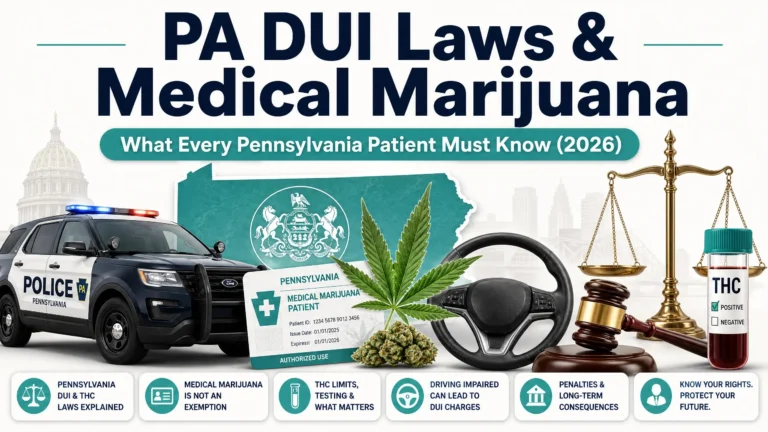

Pennsylvania DUI law operates on a three-tier system based on blood alcohol concentration. The higher your BAC or if any controlled substance is involved, the steeper the penalties.
For medical marijuana patients, the situation is uniquely complicated: marijuana DUI automatically falls under Tier 3, the harshest penalty level, regardless of whether you were actually impaired.
Need a PA Medical Marijuana Card?
Get certified online in 15 minutes. 100% Money-Back Guarantee.
Get Certified Now →This guide covers how PA DUI laws work for both alcohol and marijuana, what the penalties look like across all three tiers, what reform legislation is pending for MMJ patients, and the practical guidance every Pennsylvania cannabis user needs before getting behind the wheel.
Key Takeaways
- PA DUI law uses three tiers based on BAC: Tier 1 (0.08 to 0.099%), Tier 2 (0.10 to 0.159%), and Tier 3 (0.16% or above, refusal to test, or any controlled substance including THC)
- Medical marijuana patients face Tier 3 penalties for any detectable THC in blood above 1 ng/mL under 75 Pa. C.S. 3802(d), even if they are completely unimpaired while driving
- THC metabolites remain detectable for days to weeks after any psychoactive effects have resolved, meaning a patient who used cannabis legally days earlier can still be charged
- SB 63 and HB 983 are the active reform bills that would require proof of actual impairment for MMJ patients, both advanced through committee but neither has been signed into law as of July 2026
- Commercial drivers face zero tolerance — federal DOT regulations override state MMJ protections entirely for CDL holders
- Never refuse a chemical test — refusal in Pennsylvania automatically escalates you to Tier 3 penalties plus a separate 12-month civil license suspension, regardless of what your actual results would have shown
How Pennsylvania DUI Law Works: The Three-Tier System
Pennsylvania DUI law is governed by 75 Pa. C.S. 3802, enacted through Act 24 in 2003 and amended several times since.
The core principle is a tiered approach: your BAC at the time of arrest determines which penalty tier applies, and each tier has its own mandatory minimums for jail time, fines, and license suspension.
The three tiers are:

Tier 1: General Impairment (BAC 0.08% to 0.099%)
Do You Qualify for a PA MMJ Card?
Connect with a licensed Pennsylvania state physician online from home.
The lowest level. Covers drivers who are above the legal limit but not excessively so. First offenses at this tier have the most lenient penalties and the broadest ARD program eligibility.
Tier 2: High Rate (BAC 0.10% to 0.159%)
The middle level. Carries mandatory jail time even for first offenses and a 12-month license suspension. Also applies to minors, commercial drivers in a commercial vehicle, and school bus drivers at lower BAC levels.
Tier 3: Highest Rate (BAC 0.16% or above, refusal to test, or any controlled substance)
The harshest tier. This is where marijuana DUI and all controlled substance DUI, automatically falls.
A first offense carries mandatory jail time, up to $5,000 in fines, and a 12-month license suspension. Repeat offenses escalate rapidly into felony territory.
The tier determination is critical because it sets the mandatory minimum sentence. Judges have discretion above the minimum but cannot go below it.
PA DUI Penalties: Complete Chart by Tier and Offense Number
First Offense
| Tier | BAC / Situation | Jail Time | Fine | License Suspension |
|---|---|---|---|---|
| Tier 1 | 0.08 to 0.099% | None (probation up to 6 months) | $300 | None (if criteria met) |
| Tier 2 | 0.10 to 0.159% | 48 hours to 6 months | $500 to $5,000 | 12 months |
| Tier 3 | 0.16%+, refusal, or controlled substance | 72 hours to 6 months | $1,000 to $5,000 | 12 months |
Second Offense (within 10 years)
| Tier | Jail Time | Fine | License Suspension |
|---|---|---|---|
| Tier 1 | 5 days to 6 months | $300 to $2,500 | 12 months |
| Tier 2 | 30 days to 6 months | $750 to $5,000 | 12 months + ignition interlock |
| Tier 3 | 90 days to 5 years | $1,500 to $10,000 | 18 months + ignition interlock |
Third Offense (within 10 years)
| Tier | Jail Time | Fine | License Suspension |
|---|---|---|---|
| Tier 1 | 10 days to 2 years | $500 to $5,000 | 12 months |
| Tier 2 | 90 days to 5 years | $1,500 to $10,000 | 18 months |
| Tier 3 | Felony — up to 7 years | $2,500 to $15,000 | 18 months |
All tiers require attendance at Pennsylvania’s Alcohol Highway Safety School and a Court Reporting Network (CRN) evaluation.
Tier 3 first offenses require a full drug and alcohol assessment and treatment program. Second and subsequent offenses at any tier require an Ignition Interlock Device (IID) installed on any vehicle you drive.
The ARD program
First-time offenders at Tier 1 and sometimes Tier 2 may qualify for Pennsylvania’s Accelerated Rehabilitative Disposition program.
ARD avoids a criminal conviction and allows for eventual expungement, but it counts as a prior offense for sentencing purposes if you are charged with DUI again within 10 years.
Under Governor Shapiro’s House Bill 1615, signed December 22, 2025, certain DUI reform provisions took effect, including updates to how prior ARD dispositions are counted. Check with a Pennsylvania DUI attorney for the current ARD rules specific to your county and situation.
The PA Blood Alcohol Limit: How It Compares to Other States
⚡ Fast & 100% Online PA Medical Cards
Board-Certified Doctors • 100% Money-Back Guarantee
Book Evaluation Now →Pennsylvania’s legal BAC limit of 0.08% is the standard across all 50 states, established as the federal standard under 23 U.S.C. 163 with highway funding incentives.
Pennsylvania adopted 0.08% with Act 24 in 2003, dropping from the prior 0.10% limit.
Where Pennsylvania differs from many states is in how aggressively the tiered system escalates penalties. Several comparison points worth knowing:
- Tier 3 begins at 0.16% — double the legal limit. This is where penalties sharpen most dramatically.
- Any controlled substance triggers Tier 3 regardless of whether impairment can be shown. Most states with marijuana DUI laws require either a specific THC blood concentration or proof of actual impairment. Pennsylvania requires neither for the Tier 3 charge to stick.
- Refusal to test is treated as Tier 3 — meaning declining a blood or breath test after arrest is legally equivalent to testing at 0.16% or above.
- Prior DUI offenses count within a 10-year lookback window. Offenses outside that window do not count toward escalating penalties.
For most drivers, the practical takeaway is clear: anything above 0.08% creates criminal exposure, and the safest approach is not to drive after consuming any amount of alcohol if there is any uncertainty about your BAC level.
Marijuana DUI in Pennsylvania: How It Works Differently
Alcohol and marijuana DUI are prosecuted under the same statute, 75 Pa. C.S. 3802 but the evidence standards are completely different, and the difference is significant.

For alcohol DUI, a per se standard applies only at the tier thresholds. A driver at 0.07% BAC is not per se impaired but can still be charged if behavior demonstrates impairment. Below 0.08%, the prosecution must show actual incapacity to drive safely.
For marijuana DUI, there is no BAC equivalent.
Pennsylvania uses a one-nanogram per milliliter threshold (1 ng/mL) of active delta-9 THC in blood serum as the prosecution reference point from the April 30, 2011 Pennsylvania Bulletin. But critically, this threshold functions as a trigger for Tier 3 prosecution without any proof of impairment being required.
Under 75 Pa. C.S. 3802(d), it is unlawful to drive, operate, or be in physical control of a vehicle while:
- Under the influence of a drug or combination of drugs to a degree which impairs the individual’s ability to safely drive (subsection d)(1), this requires impairment evidence
- A Schedule I controlled substance is present in the individual’s blood (subsection d)(2), this requires zero proof of impairment
Marijuana remains a Schedule I controlled substance under Pennsylvania state law for DUI purposes, even though it is a recognized medical treatment under the Medical Marijuana Act. The two statutes have not been reconciled.
The 1 ng/mL Threshold and What It Actually Means
The 1 ng/mL figure comes up frequently in discussions of marijuana DUI in Pennsylvania, and it deserves a precise explanation because it is widely misunderstood.

Renewing Your PA MMJ Card?
Quick annual recertification online. No paperwork hassle.
Renew Card Online →The 1 ng/mL threshold is not written into the statute. It comes from Pennsylvania Department of Health laboratory procedures established in 2011 for blood screening. Any amount at or above 1 ng/mL of active THC can be introduced as evidence in a marijuana DUI proceeding.
Here is why this creates a significant problem for MMJ patients. After inhaling cannabis, active delta-9 THC peaks in blood within minutes and declines rapidly over the following hours.
For occasional users, active THC typically drops below detectable levels within 3 to 6 hours of inhalation. For regular users, active THC may remain detectable for longer.
However, THC-COOH, the inactive metabolite your liver produces while processing THC, remains in blood for days to weeks, and some interpretations of Pennsylvania’s DUI statute have been applied to metabolites as well as active THC.
An MMJ patient who last used cannabis three days ago, feels completely normal, and drives without any observable impairment can technically test positive at a level that supports a DUI charge.
As the ACLU of Pennsylvania has stated directly, under a strict reading of the current law, not a single one of Pennsylvania’s 440,000+ medical marijuana cardholders can lawfully drive.
That may be an overstatement of actual enforcement, but it reflects the genuine legal exposure the statute creates.
Why Medical Marijuana Patients Face a Unique Legal Risk
The conflict between the Medical Marijuana Act and the DUI statute creates a situation with no clean answer for registered patients.

The Medical Marijuana Act gives you the legal right to purchase and use cannabis. The DUI statute gives law enforcement the authority to charge you with a Tier 3 DUI if they detect THC in your blood and those two laws have never been reconciled.
What makes this especially problematic for MMJ patients:
First, merely possessing a medical marijuana card has historically been used as grounds for requesting a chemical test during a traffic stop. If an officer sees your MMJ card during a routine stop, they can use that as a basis to suspect drug impairment and request blood testing.
Get Approved by a Licensed PA Doctor
Schedule your appointment in minutes. You only pay if approved.
Start Online Application →Second, the Tier 3 penalties for a marijuana DUI are severe. A first offense carries 72 hours to 6 months in jail, fines from $1,000 to $5,000, and a 12-month license suspension. This is the same penalty tier as driving drunk at more than double the alcohol legal limit.
Third, as Law Office of Joseph Lesniak explains, a convicted marijuana DUI carries consequences beyond the criminal case: mandatory drug and alcohol treatment, ignition interlock device requirements on second offenses, SR-22 insurance requirements, and a permanent criminal record that follows you for 10 years for penalty escalation purposes.
SB 63 and HB 983: The Reform Bills Every PA Patient Should Know
Pennsylvania lawmakers have recognized the unfairness of the current per se standard for registered medical marijuana patients and introduced two reform bills.

Senate Bill 63 (Senator Camera Bartolotta, R)
SB 63 would amend Title 75 of the Pennsylvania Vehicle Code to require proof of actual impairment for certified MMJ patients to be convicted of a DUI. Specifically under the proposed changes:
- Possession of a valid MMJ card cannot, on its own, serve as grounds for requesting a chemical test
- A positive THC blood test combined with a valid MMJ card is not sufficient for conviction without additional evidence of impairment
- Law enforcement must rely on standardized field sobriety tests or drug recognition experts to establish impairment
- Federal regulations for commercial vehicle operators remain completely unchanged
SB 63’s Senate version cleared the Senate Transportation Committee in a unanimous vote, with Sen.
Bartolotta stating the measure is designed to close a “loophole” in Pennsylvania’s medical cannabis law that currently permits law enforcement to arrest and prosecute patients for driving under the influence of marijuana without demonstrating that they are actively impaired.
House Bill 983 (Representative Christopher Rabb, D)
HB 983 mirrors the goal of SB 63 through slightly different legislative language.
The House version passed the Transportation Committee 14-10. Representative Rabb noted that when he became a medical cannabis patient himself, he discovered he was legally vulnerable to DUI charges not because he was impaired, but because of how law enforcement could view him behind the wheel.
Current Status as of July 2026
Neither bill has been signed into law. Both advanced through their respective committees, but neither has received a floor vote in the full chamber as of July 2026. The current per se standard remains fully in effect.
This is the most important fact for every PA MMJ patient to understand. The reform is in progress. The protection does not yet exist. Until one of these bills is enacted, registered patients are legally exposed under the current statute every time they drive.
What Has Not Changed: The Current Law Still Applies
Ready to Get Your Official PA MMJ Card?
State-certified doctor consultations online. No risk—100% refund if not approved.
Claim Your MMJ Card Online →Several developments in 2025 and 2026 have given some MMJ patients the mistaken impression that their DUI exposure has changed. It has not.
Federal rescheduling to Schedule III (April 28, 2026) did not change Pennsylvania’s DUI law.
Pennsylvania’s DUI statute references Schedule I under state law for driving purposes and Pennsylvania state law has not reclassified marijuana for this purpose. The federal rescheduling has no effect on 75 Pa. C.S. 3802(d).
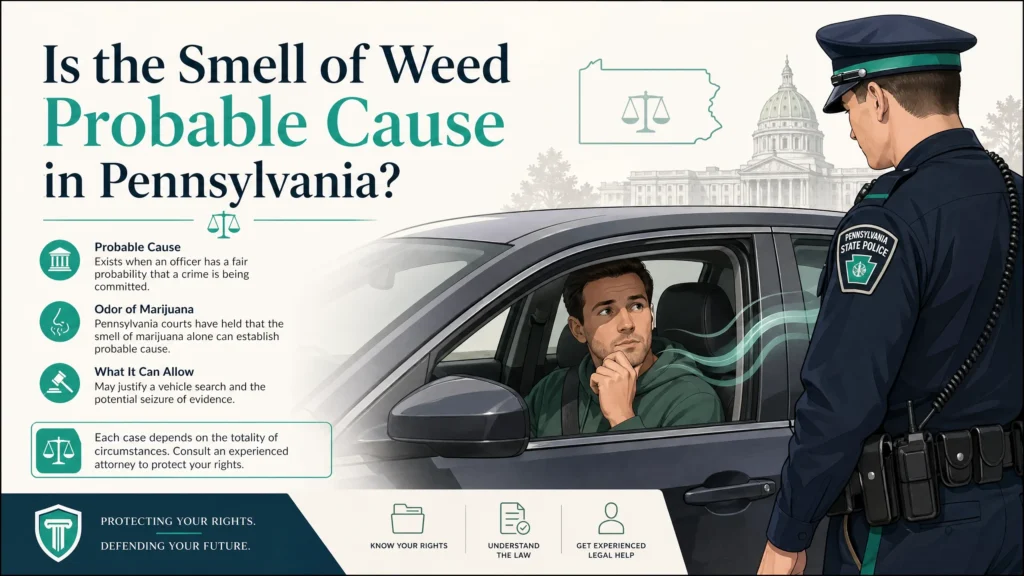
Commonwealth v. Barr (December 2021) established that the smell of marijuana alone is no longer probable cause for a vehicle search in Pennsylvania. This is a meaningful Fourth Amendment protection, but it does not change what happens once a blood test is administered.
If THC is found in your blood above 1 ng/mL, the DUI statute still applies.
A valid PA MMJ card is not a defense. As confirmed by Pennsylvania courts and every DUI attorney in the state: your certification as a registered medical marijuana patient does not create an exception to 75 Pa. C.S. 3802(d).
The Medical Marijuana Act and the DUI statute remain in conflict, and the courts have consistently held that the DUI statute governs for driving purposes.
Commercial Drivers and CDL Holders: A Separate Standard
For commercial vehicle operators, the analysis is even more severe than for regular drivers.

Federal DOT regulations under 49 CFR Part 40 impose a separate zero-tolerance standard for CDL holders operating commercial vehicles. The federal threshold is 0.04% BAC for alcohol, half the civilian standard and zero tolerance for any controlled substance, including marijuana.
A CDL holder with a valid PA MMJ card who tests positive for THC in a DOT drug test faces:
- Immediate removal from safety-sensitive duties
- CDL disqualification for one year on a first offense
- A permanent lifetime CDL ban for certain repeat offenses
- Mandatory entry into the federal Clearinghouse as a violation
- The federal Return-to-Duty process before reinstatement
Pennsylvania’s Medical Marijuana Act explicitly acknowledges that employers can prohibit marijuana use when federal law requires it and the DOT requirement is exactly that circumstance.
CDL drivers in Pennsylvania cannot use medical marijuana regardless of whether they hold a valid PA MMJ card. Under 49 CFR Part 40, the Department of Transportation does not recognize state medical marijuana laws as a valid exception to its drug testing regulations.
This applies to truck drivers, school bus drivers, transit operators, and any other CDL-regulated position in Pennsylvania.
Philadelphia DUI Laws: Does the City Have Its Own Rules?
This is one of the most commonly searched questions about Pennsylvania DUI and the answer is no.

Philadelphia does not have its own DUI law. All DUI enforcement in Philadelphia is governed by the same 75 Pa. C.S. 3802 that applies statewide. The three-tier system, the BAC thresholds, the penalty structure, and the implied consent law are identical in Philadelphia to every other city and county in Pennsylvania.
What does differ in Philadelphia is the prosecution approach and available diversion programs. The Philadelphia District Attorney’s office has its own charging guidelines and diversion priorities that may influence how specific DUI cases are handled.
The ARD program is available in Philadelphia for eligible first-time offenders. But the underlying law is the same state law everywhere.
Philadelphia’s marijuana decriminalization ordinance, which reduces possession of 30 grams or less to a $25 civil fine, has no effect on DUI law. Driving under the influence of marijuana in Philadelphia carries exactly the same Tier 3 DUI exposure as anywhere else in Pennsylvania.
What to Do If You Are Stopped While a PA MMJ Patient
If you are stopped by police while holding a PA MMJ card, these practical steps can protect your legal position.

Do not volunteer your MMJ card status. While you must provide your driver’s license, registration, and insurance on request, you are not required to disclose your medical marijuana patient status unless asked directly. Volunteering this information can trigger a request for chemical testing.
Do not admit to recent cannabis use. You have the right to remain silent. Statements about when you last used cannabis, how much you used, or how you feel are not required and can be used as evidence against you.
Understand your implied consent obligations. Pennsylvania’s implied consent law requires you to submit to a blood, breath, or urine test when lawfully arrested for DUI.
Refusing after arrest triggers an automatic 12-month civil license suspension and typically escalates your charge to Tier 3, even if you were completely sober. In most situations, refusing a chemical test makes your legal position worse, not better.
Contact a Pennsylvania DUI attorney immediately. The specific facts of your traffic stop, probable cause for the stop, grounds for requesting a test, chain of custody of your blood sample, are all legally challengeable.
An experienced Pennsylvania DUI attorney can evaluate whether your stop and test were conducted lawfully and build the best available defense.
Document your MMJ use timing. Knowing when you last used cannabis, in what form, and at what dose is relevant context for any legal defense. Keeping basic records of your usage as an ongoing practice gives your attorney more to work with.
Practical Guidance: How to Protect Yourself
The most important guidance for PA MMJ patients is also the most direct: do not drive on any day you have used cannabis, and exercise significant caution around days when THC metabolites may still be detectable.

This is not a legal limit you can calculate in advance. Unlike alcohol, where standard drinks and waiting time create a rough clearance guide, THC detection depends on your individual metabolism, body fat percentage, frequency of use, and product type.
There is no simple formula.
The safest practical guidance for regular MMJ patients:
- Do not drive on any day you have consumed cannabis
- For occasional users, allow at minimum 24 hours after last use before driving
- For daily or heavy users, metabolites may be detectable for days, exercise significant caution
- If you have any doubt, do not drive
If you have a qualifying condition and are considering getting a PA MMJ card, the DUI exposure is real and worth understanding before certification.
Our PA medical marijuana gun laws guide and employment rights guide cover the other major legal consequences of certification that patients should evaluate.
The legal framework is changing. SB 63 and HB 983 are genuine reform efforts with bipartisan support.
When and if, either becomes law, registered PA MMJ patients will have meaningful protection from being charged with DUI for driving while unimpaired. Until that day, the current statute applies in full.
If you have a qualifying condition and want to explore legal cannabis access in Pennsylvania, Pennsylvania Marijuana Cards offers same-day telehealth certifications with Dr. Johnathon Chance Miller, MD. View the full list of qualifying conditions here.
Frequently Asked Questions
Q: What is the blood alcohol limit in Pennsylvania?
A: Pennsylvania’s legal BAC limit is 0.08%. Driving at or above this level constitutes a per se DUI under Tier 1 of Pennsylvania’s three-tier system (75 Pa. C.S. 3802). The Tier 2 threshold begins at 0.10%, and Tier 3 begins at 0.16% or above. Each tier carries progressively harsher penalties. Commercial drivers face a lower threshold of 0.04% BAC while operating a commercial vehicle. Drivers under 21 face Pennsylvania’s Zero Tolerance Law with a 0.02% threshold. The 0.08% standard applies to civilian adult drivers for standard DUI purposes.
Q: Can I get a DUI in Pennsylvania with a medical marijuana card?
A: Yes. Under current Pennsylvania law (75 Pa. C.S. 3802(d)), a registered PA MMJ patient who drives with detectable THC in their blood above 1 ng/mL can be charged with a Tier 3 DUI, the same penalty level as driving at double the alcohol legal limit. A valid MMJ card is not a legal defense. Proof of actual impairment is not required under the current statute. THC metabolites remain detectable in blood for days to weeks after last use, meaning a patient who used cannabis legally days before can still face charges. Two reform bills, SB 63 and HB 983, would change this by requiring proof of actual impairment for certified patients, but neither has been signed into law as of July 2026.
Q: What are the PA DUI penalties for a first offense?
A: PA DUI penalties depend on which tier applies. At Tier 1 (BAC 0.08 to 0.099%), a first offense carries up to 6 months of probation and a $300 fine with no mandatory jail time or license suspension. At Tier 2 (0.10 to 0.159%), a first offense carries 48 hours to 6 months in jail, fines of $500 to $5,000, and a 12-month license suspension. At Tier 3 (0.16% or above, refusal to test, or any controlled substance including marijuana), a first offense carries 72 hours to 6 months in jail, fines of $1,000 to $5,000, and a 12-month license suspension. Marijuana DUI falls automatically in Tier 3. All tiers require alcohol highway safety school and a CRN evaluation.
Q: What happens if you refuse a breathalyzer or blood test in Pennsylvania?
A: Refusing a chemical test after a DUI arrest in Pennsylvania triggers automatic consequences under the state’s implied consent law. A first refusal results in a 12-month civil license suspension, separate from any criminal case, imposed by PennDOT regardless of whether you are ultimately convicted. The refusal also automatically places your DUI into Tier 3 for penalty purposes, the same level as testing at 0.16% BAC or above. Many people believe refusal helps them avoid a conviction, in Pennsylvania, the opposite is often true. Your attorney can still challenge the validity of your arrest and the circumstances of the refusal, but the automatic suspension is imposed administratively, not criminally.
Q: What are SB 63 and HB 983 and do they protect PA MMJ patients from DUI?
A: SB 63 and HB 983 are Pennsylvania legislative bills that would require proof of actual impairment for certified MMJ patients to be convicted of marijuana DUI but neither has been signed into law as of July 2026. SB 63, sponsored by Senator Camera Bartolotta, passed the Senate Transportation Committee unanimously. HB 983, sponsored by Representative Christopher Rabb, passed the House Transportation Committee 14-10. Both bills would prevent an MMJ card alone from being used as grounds for a DUI chemical test and would require field sobriety tests or drug recognition expert evaluation to establish impairment. Until either bill becomes law, the current per se standard applies in full to all Pennsylvania MMJ patients.
Q: Do commercial truck drivers in Pennsylvania have to follow different DUI rules?
A: Yes, significantly stricter ones. CDL holders operating commercial vehicles face a 0.04% BAC threshold under federal DOT regulations, half the civilian standard and zero tolerance for any controlled substance, including marijuana from a state-licensed dispensary. A positive THC test for a CDL holder results in immediate removal from safety-sensitive duties, a one-year CDL disqualification for a first offense, and mandatory entry into the federal Drug and Alcohol Clearinghouse. Pennsylvania’s Medical Marijuana Act explicitly does not protect CDL holders from these federal requirements. No state-level DUI reform bill, including SB 63 or HB 983, would affect commercial driver testing standards.
Q: Does Philadelphia have its own DUI laws?
A: No. Philadelphia DUI law is identical to the rest of Pennsylvania. All DUI enforcement in Philadelphia is governed by 75 Pa. C.S. 3802, the same statewide statute with the same three tiers, BAC thresholds, and penalty structures. What differs in Philadelphia is prosecution approach and diversion program availability through the District Attorney’s office. Philadelphia’s marijuana decriminalization ordinance reducing possession of 30 grams or less to a $25 civil fine has no effect on DUI law. Driving under the influence of marijuana in Philadelphia carries the same Tier 3 DUI exposure as anywhere else in Pennsylvania.
This blog post is intended for general educational and informational purposes only and does not constitute legal advice. Pennsylvania DUI laws are complex and fact-specific. If you are facing a DUI charge, consult a licensed Pennsylvania criminal defense attorney immediately. Pennsylvania DUI laws and pending legislation are subject to change, always verify current law with official Pennsylvania sources or a licensed attorney. Medically reviewed by Dr. Johnathon Chance Miller, MD (License #MD474783).
Sources
- Pennsylvania General Assembly. “75 Pa. C.S. 3802 — Driving Under Influence of Alcohol or Controlled Substance.“
- Pennsylvania Department of Transportation. “DUI Legislation — Act 24 of 2003.“
- McAndrews Legal. “Pennsylvania DUI Penalties 2026.“
- RGS and G Law. “DUI in Pennsylvania: Laws, Penalties and What to Expect.” June 2026.
- Solomon Berschler Campbell and Thomas. “What Are the 3 DUI Tiers in Pennsylvania and Their Penalties?” April 2026.
- Nevins and McAllister. “Pennsylvania DUI Tiers Explained.” March 2026.
- FindTheLawyers. “Pennsylvania DUI Penalties 2026 Guide.“
- MPL Law. “PA DUI Laws in 2026 — DUI Process Guide.” April 2026.
- NCDD. “Pennsylvania DUI Laws.“
- Law Office of Joseph Lesniak. “Pennsylvania DUI Laws: What Medical Marijuana Patients Need to Know.“
- Law Office of Vincent J. Caputo. “Marijuana DUI in Pennsylvania: What You Need to Know in 2025.” June 2025.
- JustMyDoc. “PA MMJ DUI — Senate Bill 363 Background.” April 2023.
- MMJ Advocate Doc. “Update on Medical Cannabis and DUI Law in PA.“
- Marijuana Moment. “Pennsylvania Lawmakers Approve Bills To Protect Medical Cannabis Patients From DUI Charges.” December 2023.
- Pennsylvania General Assembly. “Senate Bill 63, 2025-2026 Regular Session.“
- Pennsylvania General Assembly. “Senate Co-Sponsorship Memo 43309 — SB 363 Reintroduction.“
- PennsylvaniaStateCannabis.org. “Pennsylvania Marijuana Laws 2026.“
- U.S. Department of Transportation. “49 CFR Part 40 — Drug and Alcohol Testing.“
- Pennsylvania Department of Health. “Medical Marijuana Program.“