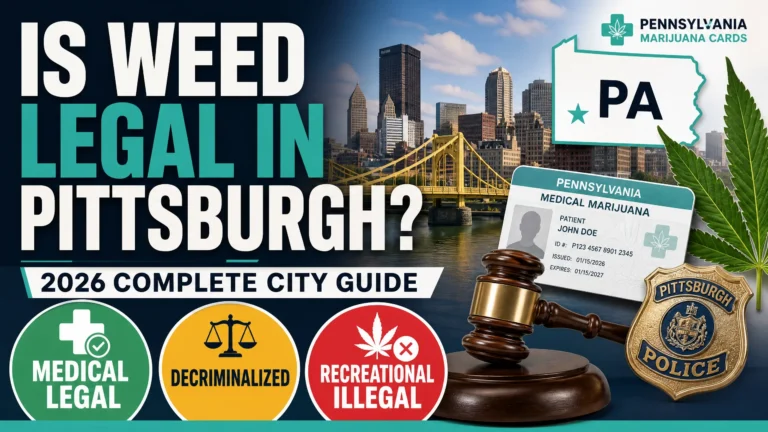

Is weed legal in Pittsburgh? No, recreational marijuana is not legal in Pittsburgh or anywhere in Pennsylvania.
Pittsburgh has decriminalized possession of 30 grams or less since December 2015, which means city law treats small-amount possession as a civil violation rather than a crime. But there is a critical practical distinction most guides miss:
Need a PA Medical Marijuana Card?
Get certified online in 15 minutes. 100% Money-Back Guarantee.
Get Certified Now →Pittsburgh police have discretion under the ordinance, and Pittsburgh criminal defense attorneys report that law enforcement in practice often charges people under state misdemeanor law rather than the local civil ordinance.
Understanding the gap between what the Pittsburgh ordinance says and how it is actually enforced is the most important thing any Pittsburgh resident needs to know about local cannabis laws in 2026.
Key Takeaways
- Pittsburgh decriminalized possession of 30 grams or less in December 2015, making it a $25 civil fine under city law, with a $100 fine or 9 hours community service for public consumption.
- Pittsburgh police have discretion to charge under city ordinance or state law. Defense attorneys report that state misdemeanor charges are more common than the civil fine in practice.
- The ordinance only applies within Pittsburgh city limits. Suburban Allegheny County municipalities, the Pittsburgh International Airport, and surrounding areas operate under state law only.
- Recreational cannabis is not legal in Pittsburgh. Purchasing, selling, growing, and transporting cannabis across state lines remain criminal offenses regardless of the decriminalization ordinance.
- Medical marijuana is fully legal for registered PA MMJ patients at licensed dispensaries in and around Pittsburgh.
- A PA MMJ card gives legal possession rights that decriminalization does not. It removes the possibility of civil or criminal charges for legal cannabis, plus provides employment protections under Act 16.
Pittsburgh Weed Laws 2026: The Two-Layer System
Pittsburgh cannabis law in 2026 operates on two layers that exist simultaneously and can conflict. Understanding both is essential for anyone who uses cannabis in the city.

Layer 1: Pittsburgh City Ordinance (Chapter 627)
Pittsburgh’s marijuana decriminalization ordinance, passed by City Council in December 2015 and signed by then-Mayor Bill Peduto, reclassifies possession of small amounts from a criminal offense to a civil violation handled similarly to a parking ticket.
Do You Qualify for a PA MMJ Card?
Connect with a licensed Pennsylvania state physician online from home.
Under city code, possession of 30 grams or less of marijuana or 8 grams or less of hashish is a civil matter, not a crime.
Layer 2: Pennsylvania State Law
The Pennsylvania Controlled Substance, Drug, Device and Cosmetic Act (35 P.S. § 780-113) classifies possession of 30 grams or less of marijuana as a criminal misdemeanor punishable by up to 30 days in jail and a $500 fine.
This state law has not changed. It applies everywhere in Pennsylvania, including Pittsburgh.
The city ordinance does not override state law. It gives Pittsburgh Police Department officers the option to issue a civil citation rather than make a state misdemeanor arrest. It does not require them to do so.
As Prince Law’s analysis of Pennsylvania decriminalization explains: “Even though cities like Philadelphia and Pittsburgh have reduced penalties for small amounts, stricter state laws still apply.”
What Pittsburgh’s Decriminalization Ordinance Actually Says
Pittsburgh City Code Chapter 627 is the specific ordinance governing marijuana possession within city limits. Its key provisions:

What is covered:
- Possession of 30 grams or less of marijuana
- Possession of 8 grams or less of hashish
The fine structure:
- Simple possession: $25 civil fine
- Public consumption: $100 civil fine or up to 9 hours of community service
An important Pittsburgh-specific detail most guides miss:
Pittsburgh’s ordinance includes a broader definition of “smoking” than many people expect. Chapter 627’s definition explicitly states that “smoking” includes “devices designed to vaporize marijuana or marijuana extracts.”
⚡ Fast & 100% Online PA Medical Cards
Board-Certified Doctors • 100% Money-Back Guarantee
Book Evaluation Now →This means the $100 public consumption fine applies to vaporizing in public spaces, not only to traditional smoking.
If you are using a dry herb vaporizer in a Pittsburgh park, you are within the scope of the public consumption provision.
Who the ordinance covers?
The original intent behind Pittsburgh’s decriminalization was partly about reducing disproportionate enforcement.
As Worgul Law’s Pittsburgh marijuana analysis explains: “According to a report published by the ACLU in 2013, African-American residents of Allegheny County were almost six times more likely to be arrested for marijuana possession than their white counterparts, despite similar rates of use between the two groups.”
The ordinance aimed to reduce these arrest disparities for low-level possession.
What the ordinance does not cover?
Minors caught with marijuana under the ordinance do not face criminal charges, but their parents are notified and are responsible for paying the fine.
Possession above 30 grams, any sale, any cultivation, and interstate transport are fully outside the ordinance and remain subject to state criminal penalties.
The Critical Police Discretion Problem
This is the section that distinguishes an honest guide from a misleading one. Most Pittsburgh cannabis law guides present the decriminalization ordinance as if it functions like a guarantee. It does not.

The Pittsburgh ordinance gives city officers the option to issue a civil citation. It does not require them to do so. Officers retain discretion to charge under state law if they choose.
The Zuckerman Law Firm, a Pittsburgh criminal defense practice that regularly handles marijuana possession cases, states this directly: “In 2015, the City of Pittsburgh passed an ordinance providing for the decriminalization of marijuana.
This provides the City of Pittsburgh Police with the discretion to charge you with a local ordinance instead of the misdemeanor Possession of a Small Amount of Marijuana charge.
Renewing Your PA MMJ Card?
Quick annual recertification online. No paperwork hassle.
Renew Card Online →However, we have found that members of law enforcement typically charge violators with misdemeanor offenses as opposed to the local ordinance violations.”
That is a practicing Pittsburgh defense attorney telling you what actually happens, not what the ordinance technically allows.
Why does this matter practically?
If a Pittsburgh officer exercises discretion to charge you under state law rather than the city ordinance, you are facing a criminal misdemeanor with potential jail time, a $500 fine, and a criminal record entry, not a $25 civil ticket.
The practical outcome depends on which officer you encounter, where you are, what you are doing, and the circumstances of the stop.
Factors that increase the risk of a state charge rather than a city citation:
Possession of amounts close to the 30-gram threshold, where an officer might consider the amount consistent with distribution. Being stopped in circumstances where other criminal suspicion exists.
Prior criminal history. Encountering officers who have not adopted the civil fine approach. Being outside Pittsburgh city limits (covered in Section 5).
Pittsburgh vs Philadelphia: How the Ordinances Compare
Both Pittsburgh and Philadelphia have decriminalized small-amount possession, but with different timelines and some key differences in implementation.

| Feature | Pittsburgh | Philadelphia |
|---|---|---|
| Ordinance passed | December 2015 | October 2014 |
| Covered amount | 30g flower, 8g hashish | 30g flower, 8g hashish |
| Possession fine | $25 | $25 |
| Public consumption fine | $100 or 9 hours community service | $100 or 9 hours community service |
| Vaporization included in “smoking” | Yes, explicitly in ordinance | Not explicitly defined the same way |
| Pre-employment drug test ban | No city-wide ban | Yes, since January 2022 |
| DA non-prosecution policy | No formal equivalent | DA Krasner’s written policy |
| Police enforcement in practice | State charges more common per defense attorneys | More consistent with civil fine approach |
The most significant practical difference between Pittsburgh and Philadelphia is the pre-employment drug testing ban.
Philadelphia’s January 2022 ordinance prohibits most employers from conducting pre-employment marijuana drug tests. Pittsburgh has no equivalent citywide protection.
Pittsburgh workers are subject to standard Pennsylvania state law employment drug testing rules, which allow employer testing policies.
Get Approved by a Licensed PA Doctor
Schedule your appointment in minutes. You only pay if approved.
Start Online Application →For Pittsburgh residents concerned about employment drug testing, a PA MMJ card provides Act 16 protections under Palmiter v. Commonwealth Health Systems for most non-safety-sensitive positions.
That protection exists regardless of whether your employer is in Pittsburgh or anywhere else in Pennsylvania.
Where Pittsburgh Decriminalization Does Not Apply
The Pittsburgh ordinance is city law. It applies only within Pittsburgh city limits. This is a significant practical limitation for people who live, work, or travel in the broader Pittsburgh metro area.
Areas where Pittsburgh decriminalization does NOT apply:

- All suburban Allegheny County municipalities (including neighborhoods that feel like Pittsburgh but are technically separate municipalities)
- Pittsburgh International Airport (federal property, federal law applies)
- The North Shore and South Shore areas that may straddle city/suburb boundaries
- Pennsylvania State Police encounters anywhere in the state (state police enforce state law regardless of local ordinances)
- Monroeville, Penn Hills, Mt. Lebanon, Bethel Park, and all other suburban municipalities
If you are stopped outside Pittsburgh city limits in Allegheny County or anywhere else in Pennsylvania, you are subject to state law only. There is no decriminalization protection.
A first offense for 30 grams or less carries up to 30 days in jail and a $500 fine under state law.
As Worgul Law notes: “This ordinance does not apply to marijuana arrests that occur outside of the city limits. If you are found in Possession of a Small Amount of Marijuana outside of city limits, you should expect to be charged with a misdemeanor offense.”
The geographic limitation matters more than many Pittsburgh residents realize.
If you drive from your Pittsburgh home to a suburb for dinner and a police encounter occurs, you are no longer within the protective scope of Pittsburgh’s ordinance.
What Is Still Illegal in Pittsburgh: The Complete List
Pittsburgh’s decriminalization ordinance narrows the consequences for one specific scenario: simple possession of under 30 grams within city limits.
Ready to Get Your Official PA MMJ Card?
State-certified doctor consultations online. No risk—100% refund if not approved.
Claim Your MMJ Card Online →Everything else remains fully illegal under state law with criminal penalties.
| Activity | Legal Status | Penalty |
|---|---|---|
| Possession under 30g (Pittsburgh city, civil) | Civil violation | $25 fine |
| Possession under 30g (state law, if officer charges) | Criminal misdemeanor | Up to 30 days, $500 fine |
| Possession over 30g (anywhere in PA) | Criminal misdemeanor | Up to 12 months, $5,000 fine |
| Public consumption in Pittsburgh (city) | Civil violation | $100 or 9 hours community service |
| Purchasing without MMJ card | Criminal offense | State misdemeanor penalties |
| Selling any amount | Felony | Up to 2.5 to 5 years |
| Growing any amount | Felony | Up to 5 years, $15,000 fine |
| Interstate transport (including from Ohio) | Federal crime | Federal trafficking charges |
| Driving under the influence | Criminal DUI | PA per se 1 ng/mL blood THC threshold |
Ohio legalized recreational cannabis, making Pittsburgh one of the closest major Pennsylvania cities to a legal recreational border state.

Bringing cannabis purchased legally in Ohio into Pennsylvania is a federal crime, identical to bringing legal New Jersey cannabis across state lines. Ohio legalization does not change Pennsylvania law.
Commonwealth v. Barr and Probable Cause in Pittsburgh
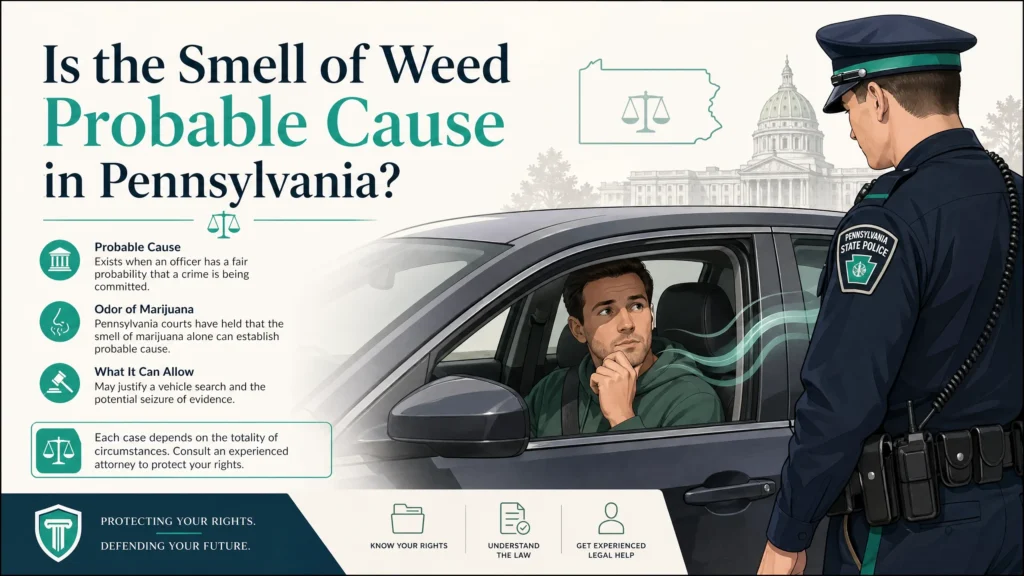
Pittsburgh residents benefit from the Pennsylvania Supreme Court’s December 2021 ruling in Commonwealth v. Barr, 252 A.3d 1086, which ended the plain smell doctrine for marijuana in Pennsylvania.

Before this ruling, the smell of marijuana alone gave police probable cause to conduct a warrantless vehicle or premises search. After the ruling, marijuana odor alone is no longer sufficient probable cause, because the Medical Marijuana Act made cannabis legally possessable for registered patients.
For Pittsburgh residents, this has practical significance during any police encounter.
A Pittsburgh officer or Pennsylvania state trooper smelling marijuana during a traffic stop cannot use that odor alone to justify escalating the search. Additional factors beyond the smell are required to establish probable cause.
This protection is meaningful but has limits. If an officer smells cannabis and also observes other factors such as large amounts of cash, distribution paraphernalia, or cannabis not in original dispensary packaging, those combined circumstances may still support probable cause.
For a full analysis of how this ruling works in practice, see our guide on whether the smell of weed is probable cause in Pennsylvania.
The most protective position during any Pittsburgh police encounter involving cannabis: have a valid PA MMJ card, keep your dispensary-purchased cannabis in its original labeled packaging, and be aware that you do not have to consent to a search.
Medical Marijuana in Pittsburgh: Legal Access for Registered Patients
While recreational cannabis remains decriminalized but not legal in Pittsburgh, registered Pennsylvania medical marijuana patients have full legal cannabis access in the city and surrounding area.
The Pittsburgh metro area has a strong concentration of licensed PA dispensaries. As DocMJ’s Pittsburgh cannabis guide confirms, Pittsburgh dispensaries serve registered patients under the Pennsylvania Medical Marijuana Act with the full range of approved product forms: dry leaf for vaporization, oils, tinctures, capsules, topicals, and concentrates.
As a registered PA patient in the Pittsburgh area, you can:
- Legally purchase cannabis from any licensed PA dispensary in Pittsburgh or statewide
- Legally possess up to a 90-day supply of dispensary-purchased cannabis as determined by your physician
- Access Act 16 employment anti-discrimination protections for most non-safety-sensitive jobs
- Benefit from Commonwealth v. Barr protections during police encounters involving your card-covered cannabis
- Consult with a licensed dispensary pharmacist on products suited to your specific condition
Pittsburgh also has an active cannabis community event scene. The Pittsburgh Cannabis Fest returns annually to Allegheny Commons Park on the North Side as a free, community-focused advocacy event covered in our PA cannabis festival 2026 guide.
Pennsylvania recognizes 24 qualifying conditions for the medical marijuana program, including anxiety disorders (the most common qualifying condition at approximately 60% of all certifications), chronic pain, PTSD, cancer, epilepsy, and many others. The full list is at our qualifying conditions page.
What a PA MMJ Card Gets You Beyond Decriminalization
Pittsburgh’s decriminalization gives you reduced civil penalties for small amounts within city limits, when city police choose to enforce it that way.

A PA MMJ card gives you something fundamentally different: actual legal authorization to possess cannabis, not reduced penalties for illegal possession.
| Situation | Decriminalization Only | With PA MMJ Card |
|---|---|---|
| Caught with under 30g by city police | Possible $25 fine (officer discretion) | Legal possession, no fine, no charge |
| Caught with under 30g by state police | State misdemeanor charges possible | Legal possession, Act 16 protection |
| Outside Pittsburgh city limits | State law only, misdemeanor risk | Legal possession statewide |
| Employer takes adverse action after positive drug test | No state protection | Palmiter v. Commonwealth protection for most jobs |
| Purchasing cannabis | No legal purchase option available | Licensed dispensary access statewide |
| Product quality | Unregulated, unverified | State-mandated COA testing on all products |
| Pharmacist guidance | None available | Licensed pharmacist at every PA dispensary |
The gap is significant. Decriminalization reduces the consequence of something illegal. A PA MMJ card makes it legal.
For Pittsburgh residents managing a qualifying medical condition with cannabis, the card provides protections that decriminalization never can.
If you have a qualifying condition, getting your PA MMJ card is the most meaningful legal protection step you can take. Pennsylvania Marijuana Cards offers same-day telehealth certifications.
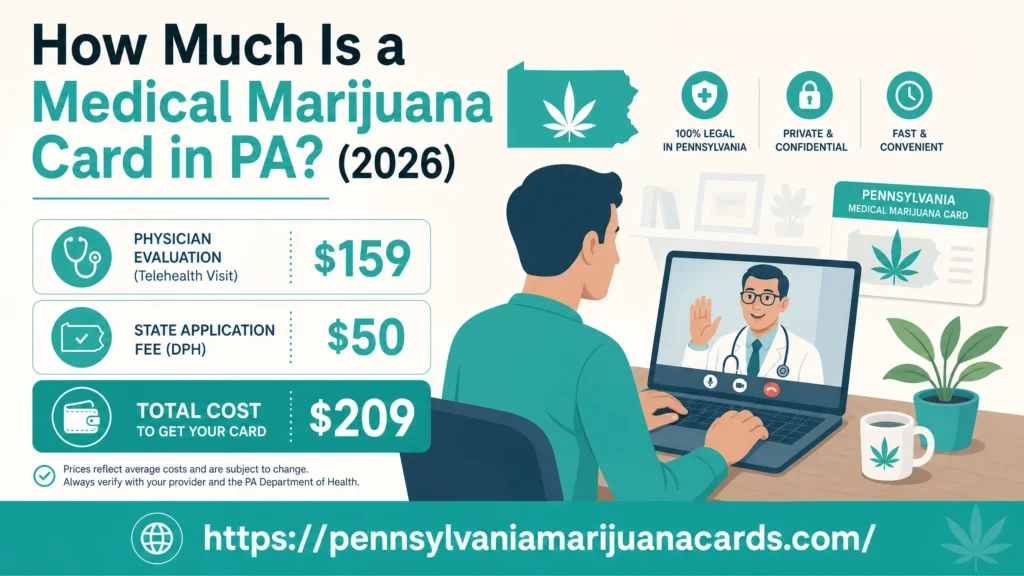
New patients pay $159 physician fee plus the $50 state registration fee, with the state fee waived for Medicaid, SNAP, WIC, CHIP, PACE, or PACENET enrollees through MMAP.
Pennsylvania Recreational Weed: Where Things Stand in 2026
Many Pittsburgh residents want to know when Pennsylvania might legalize recreational cannabis entirely, which would make the decriminalization discussion irrelevant.
As of July 2026, Pennsylvania has not passed recreational legalization.

The most significant recent movement: HB 1200 passed the Pennsylvania House on May 7, 2025 in a 102-101 historic vote, the first time either chamber had ever passed a recreational cannabis bill. The Pennsylvania Senate Law and Justice Committee killed it 7-3 six days later.
SB 120, a bipartisan bill from Senators Dan Laughlin (R-Erie) and Sharif Street (D-Philadelphia) proposing a private retail model rather than state-run stores, was approved by the Senate Law and Justice Committee in October 2025, the furthest any legalization bill has advanced in Pennsylvania history.
As of July 2026, it has not received a full Senate floor vote.
Governor Josh Shapiro has supported legalization in three consecutive budget addresses and estimates Pennsylvania loses $730 million in potential first-year tax revenue to neighboring legal states.
Ohio’s recreational legalization means Pittsburgh now has legal cannabis accessible less than two hours away, and marijuana and the law data confirms that border-state dispensaries report a significant share of customers driving from Pennsylvania.
If SB 120 passes and is signed into law, licensed adult-use sales could begin approximately 12 to 18 months after enactment. A realistic best-case scenario for legal recreational dispensary sales in Pittsburgh would be sometime in 2027 or 2028.
Frequently Asked Questions
Q: Is weed legal in Pittsburgh in 2026?
A: No. Recreational marijuana is not legal in Pittsburgh or anywhere in Pennsylvania. Pittsburgh decriminalized possession of 30 grams or less in December 2015, meaning city police can issue a $25 civil fine rather than making a criminal arrest for small amounts. However, Pittsburgh criminal defense attorneys report that police frequently still charge under state misdemeanor law rather than the civil ordinance. Medical marijuana is fully legal for registered PA MMJ patients.
Q: What are the weed laws in Pittsburgh in 2026?
A: Pittsburgh operates under two overlapping legal frameworks. City ordinance (Chapter 627): possession of 30 grams or less of marijuana or 8 grams or less of hashish is a civil violation with a $25 fine; public consumption (including vaporization) is $100 or 9 hours community service. State law (35 P.S. § 780-113): the same 30 grams or less is a criminal misdemeanor with up to 30 days in jail and a $500 fine. Pittsburgh police have discretion to apply either, and state charges are reportedly common. Outside Pittsburgh city limits, only state law applies.
Q: Does Pittsburgh’s decriminalization actually protect you from arrest?
A: Not reliably. The Pittsburgh ordinance gives police officers the option to issue a civil citation rather than make a criminal arrest. It does not require them to do so. Pittsburgh criminal defense attorneys have stated publicly that law enforcement frequently still charges violators with state misdemeanor offenses rather than city ordinance violations. The ordinance also applies only within Pittsburgh city limits. State police and other non-Pittsburgh law enforcement always apply state law.
Q: How does Pittsburgh compare to Philadelphia for weed laws?
A: Both cities decriminalized possession of 30 grams or less with a $25 civil fine. Both included public consumption penalties of $100 or community service. Key differences: Philadelphia added a pre-employment drug testing ban for most jobs effective January 2022, which Pittsburgh has not matched. Philadelphia’s DA office has a formal written non-prosecution policy for small-amount possession. Pittsburgh has no equivalent formal policy. Pittsburgh’s ordinance was passed in December 2015, one year after Philadelphia’s 2014 ordinance.
Q: Can I buy weed in Ohio and bring it to Pittsburgh?
A: No. Ohio legalized recreational cannabis and is accessible from Pittsburgh. But bringing cannabis from Ohio into Pennsylvania is a federal crime under the Controlled Substances Act regardless of Ohio’s legal status or Pittsburgh’s decriminalization ordinance. Interstate transport of cannabis is a federal offense that local and state decriminalization cannot override.
Q: Where are the dispensaries in Pittsburgh?
A: Pittsburgh and the greater Allegheny County area have multiple licensed PA medical marijuana dispensaries. All require a valid Pennsylvania medical marijuana patient ID card for entry and purchase. The Pennsylvania Department of Health maintains an updated dispensary locator at pa.gov. All dispensary products are state-tested and COA-verified.
Q: Does a PA MMJ card protect you from Pittsburgh marijuana fines?
A: Yes. A valid PA MMJ card gives you legal authorization to possess your physician-determined supply of dispensary-purchased cannabis. Where Pittsburgh decriminalization reduces a potential criminal charge to a possible $25 civil fine (when officers apply the ordinance), a PA MMJ card means no fine and no charge at all for legally obtained cannabis within your authorized supply. The card also provides Act 16 employment protections under Palmiter v. Commonwealth Health Systems for most non-safety-sensitive jobs statewide.
Q: Will recreational weed become legal in Pittsburgh soon?
A: Recreational legalization is a state decision, not a city decision. Pittsburgh cannot legalize recreational cannabis on its own. SB 120, a bipartisan Pennsylvania Senate bill, passed the Senate Law and Justice Committee in October 2025 and is the closest any recreational bill has come to passing. As of July 2026 it has not received a full Senate floor vote. If eventually passed and signed, adult-use dispensary sales could begin approximately 12 to 18 months after enactment, making 2027 or 2028 the earliest realistic timeline.
The Bottom Line
Is weed legal in Pittsburgh?
Not in any full legal sense. Pittsburgh’s 2015 decriminalization ordinance reduced the typical penalty for small-amount possession from a criminal misdemeanor to a civil fine. But defense attorneys practicing in Pittsburgh courts report that officers frequently still apply state misdemeanor charges, and the ordinance applies only within city limits.

What that means for Pittsburgh residents in 2026: the ordinance may help you, or it may not, depending on which officer you encounter and where you are standing. It is a reduction in potential consequences, not legal protection.
The more protective option for anyone managing a qualifying medical condition with cannabis is a PA medical marijuana card.
It makes your cannabis legal to possess, removes the possibility of both state and city charges for your legal supply, and gives you employment protections that no city decriminalization ordinance can provide.
This blog post is intended for general educational and informational purposes only and does not constitute legal advice. Pittsburgh and Pennsylvania cannabis laws are subject to change. This article reflects the legal landscape as of July 2026. If you are facing criminal charges related to marijuana in Pittsburgh or anywhere in Pennsylvania, consult a licensed Pennsylvania criminal defense attorney. Medically reviewed by Dr. Johnathon Chance Miller, MD.
Sources
- Pittsburgh City Code Chapter 627: Marijuana Possession Procedure
- Worgul Law: Marijuana Decriminalization Pittsburgh (March 2026)
- Zuckerman Law: Possession of Small Amount of Marijuana in PA
- NORML: Pennsylvania Local Decriminalization
- NORML: Pennsylvania State Penalties
- Prince Law: Pennsylvania Marijuana Decriminalization Conflict
- Marijuana and the Law: Pennsylvania Marijuana Laws 2026
- Pennsylvania State Cannabis: PA Marijuana Laws
- MPP: Pennsylvania Cannabis Policy
- PA Department of Health: Medical Marijuana Dispensary Locator
- Pennsylvania General Assembly: SB 120 Bill Text
- Commonwealth v. Barr, 252 A.3d 1086 (Pa. 2021)
- Pennsylvania Marijuana Cards: Qualifying Conditions