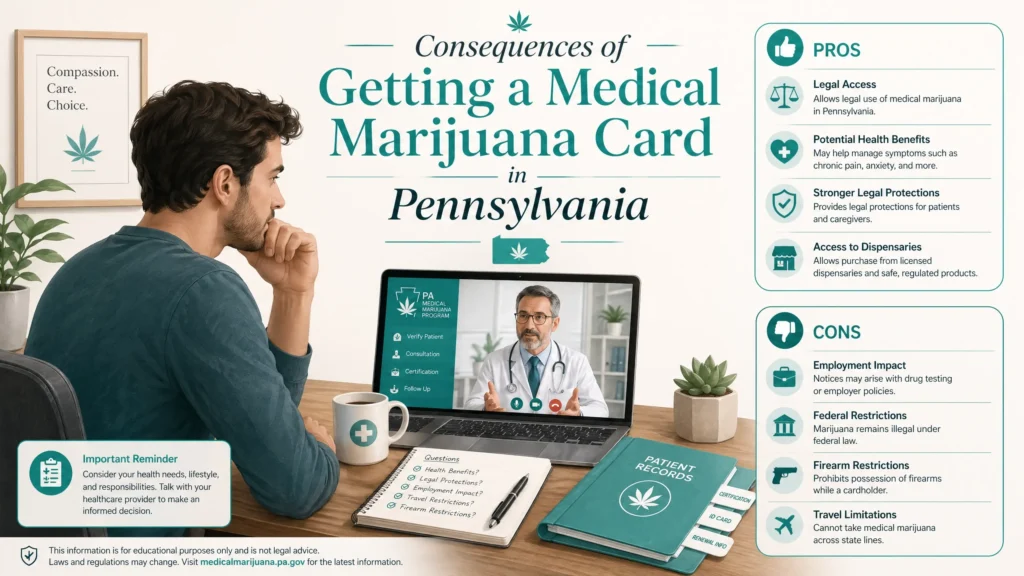
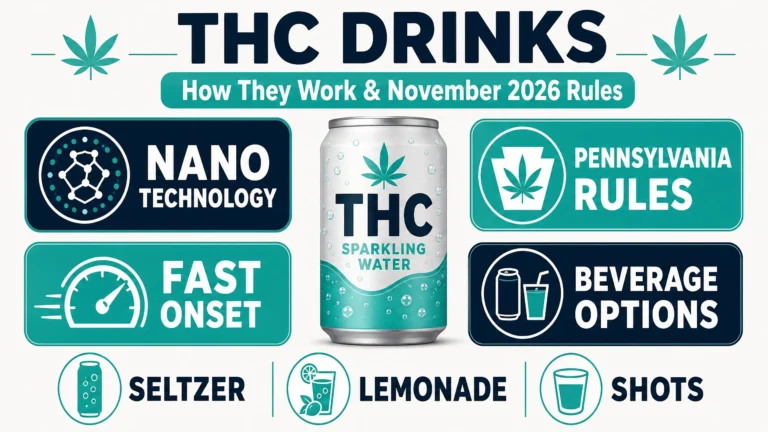

THC drinks have gone from niche novelty to mainstream product in about three years.
You can find them in Pennsylvania smoke shops, gas stations, and online retailers right now: seltzers, shots, sparkling waters, and canned cocktails infused with hemp-derived delta 9 THC, all technically legal under federal law.
Need a PA Medical Marijuana Card?
Get certified online in 15 minutes. 100% Money-Back Guarantee.
Get Certified Now →But not for much longer.
A federal law signed in November 2025 will eliminate most of these products from shelves by November 12, 2026. If you currently use THC drinks for relaxation, sleep, anxiety, or any other reason.
There are four months left before the market changes dramatically.
This guide covers everything you need to know: how THC drinks work, what they actually feel like, whether they’re safe, and what your options are when the deadline arrives.
Key Takeaways
- THC drinks use nanoemulsion technology to deliver effects in 15 to 30 minutes, much faster than traditional edibles, which take 45 to 90 minutes.
- They are legal in Pennsylvania right now under the 2018 Farm Bill, as long as the finished product contains no more than 0.3% delta-9 THC by dry weight.
- A 10mg THC drink is a noticeable dose for most beginners. Start with half a can or a low-dose 2.5mg option if you are new to THC.
- THC drinks will show up on a drug test. The same metabolite detected from any other cannabis product is produced when your body processes THC from a drink.
- Federal law H.R. 5371, effective November 12, 2026, imposes a 0.4mg per-container THC cap that would eliminate more than 95% of current THC drinks from the market.
- Pennsylvania dispensaries do not sell THC drinks. For PA patients who want a similar format after November 2026, sublingual tinctures offer the closest alternative at licensed dispensaries.
What Are THC Drinks?

Do You Qualify for a PA MMJ Card?
Connect with a licensed Pennsylvania state physician online from home.
THC drinks are beverages: seltzers, shots, sparkling waters, lemonades, canned cocktails, infused with hemp-derived delta-9 THC. Most use nanoemulsion technology (explained below) to make the oil-based THC dissolve evenly in water and absorb faster than traditional edibles.
They’re designed to feel like a mild, functional alternative to alcohol. A 5mg THC seltzer is roughly comparable to a glass of wine in terms of effect intensity for most people.
A 10mg drink is closer to two drinks. They hit faster, leave no hangover, and feel cleaner to most users than alcohol at equivalent doses.
The products you’ll find at Pennsylvania smoke shops and online retailers right now include:
- Canned seltzers and sparkling waters (5mg to 10mg per can): the most popular format
- Shots (10mg to 25mg per 2oz bottle): faster to consume, more potent per serving
- Drink mix powders and drops (variable dosing): add to any beverage
- Lemonades and flavored drinks (5mg to 10mg per serving): widely available online
All legitimate products carry a Certificate of Analysis (COA) showing THC content per serving.
That COA is the document that establishes legal compliance under the Farm Bill. Look for it on the packaging or via QR code before purchasing.
How Do THC Drinks Work? The Nanoemulsion Science

This is what makes THC drinks fundamentally different from gummies, capsules, or traditional edibles, and why so many people prefer them.
THC is a fat-soluble compound. It naturally repels water. If you dropped cannabis extract directly into a drink, it would float on top and absorb inconsistently. Nanoemulsion solves this problem.
The process breaks down THC oil into microscopic particles, between 20 and 200 nanometers, using food-grade emulsifiers.
At that size, the particles disperse evenly throughout water-based liquids and, more importantly, absorb through the stomach lining and mucosal tissue much more efficiently than traditional oil-based THC.

⚡ Fast & 100% Online PA Medical Cards
Board-Certified Doctors • 100% Money-Back Guarantee
Book Evaluation Now →The bioavailability difference is significant. Traditional oil-based edibles absorb at roughly 6 to 20% efficiency. Water-soluble nanoemulsified THC achieves 40 to 90% absorption, depending on formulation.
One clinical crossover study published in the Journal of Cannabis Research compared a nanoemulsifying THC/CBD delivery system against standard oil drops in healthy volunteers and found the nanoemulsion formulation produced over double the relative bioavailability and a substantially faster time to peak concentration.
The result you feel: effects in 15 to 30 minutes instead of 45 to 90 minutes, and a more predictable experience because your body is absorbing a consistent percentage of the dose each time.
One important nuance: because nanoemulsion bypasses much of the liver’s first-pass metabolism, the liver converts less delta-9 THC to 11-hydroxy-THC compared to a traditional edible.
11-hydroxy-THC is the compound responsible for the intense, long-lasting experience many people associate with strong edibles.
THC drinks, because of how they’re absorbed, tend to feel lighter and shorter-lasting than the same milligram dose in a gummy. It feels more like inhaled cannabis in character than like a traditional edible.
Do THC Drinks Get You High?
Yes, THC drinks produce psychoactive effects. They contain real delta-9 THC, the same molecule found in cannabis flower and dispensary products.
The effects depend on the dose, your personal tolerance, and whether you’ve eaten recently.
At typical serving sizes:
| Dose | What Most Adults Feel |
|---|---|
| 2.5mg | Very mild relaxation, barely noticeable for most people |
| 5mg | Mild mood elevation, gentle relaxation, comparable to one light drink |
| 10mg | Noticeably psychoactive for most adults, especially beginners |
| 20mg+ | Strong effects, not recommended for new users |
The psychoactive effect from a THC drink tends to feel smoother and less sedating than the equivalent dose from a traditional edible, because less conversion to 11-hydroxy-THC occurs through the nanoemulsion absorption route.
Most users describe the experience as clear-headed and social, with the edge coming off without significant cognitive impairment at lower doses.
Renewing Your PA MMJ Card?
Quick annual recertification online. No paperwork hassle.
Renew Card Online →That said, every person’s endocannabinoid system is different.
Individual responses vary significantly based on body weight, cannabis tolerance, how recently you ate, and your personal sensitivity.
Is 10mg THC Drink Strong?

For someone new to THC, yes. A 10mg drink is a noticeable dose and can feel strong, particularly if you finish the whole can quickly.
Most cannabis physicians in 2026 recommend 2.5mg as the clinical starting point for first-time patients, with 5mg as the second step.
10mg is considered a standard low-to-moderate dose, appropriate for adults with some cannabis experience but not an ideal starting point for a first-time user.
If you’re trying a THC drink for the first time, consider these practical steps:
- Choose a 5mg product rather than 10mg for your first experience
- Drink it slowly over 20 to 30 minutes rather than all at once
- Wait a full 30 minutes before assessing how you feel
- Do not add alcohol. The combination amplifies effects unpredictably
- Don’t drive after consuming any THC product
The nanoemulsion onset means you’ll start feeling something within 15 to 30 minutes. If you’ve drunk the whole can and feel nothing at 15 minutes.
That is normal and expected. Do not open another one. Give it the full 30 to 45 minutes before deciding anything.
How Long Do THC Drinks Take to Kick In?
Nanoemulsified THC drinks have a significantly faster onset than traditional edibles:
- First noticeable effects: 15 to 30 minutes after drinking
- Full effects: 30 to 45 minutes
Compare that to traditional gummies or capsules, which take 45 to 90 minutes to produce noticeable effects and up to 2 hours to reach peak intensity.
The faster onset is the primary reason many people prefer drinks over gummies. You don’t spend an hour wondering if anything is happening.
Get Approved by a Licensed PA Doctor
Schedule your appointment in minutes. You only pay if approved.
Start Online Application →The speed of onset does vary by individual.
People with faster metabolisms and those who drink on an empty stomach tend to feel effects at the faster end of the range. Eating a full meal before drinking can slow absorption slightly.
How Long Do THC Drinks Last?
Because nanoemulsion bypasses much of the liver’s first-pass metabolism, THC drinks tend to have a shorter duration than traditional edibles:
- Typical duration: 2 to 4 hours
- Compared to traditional edibles: 4 to 8 hours
This shorter window is a feature for many users, not a drawback. It means a 5pm THC seltzer doesn’t keep you impaired at 11pm. It also means effects are generally easier to predict and plan around.
Duration extends with higher doses. A 20mg or 25mg serving will last longer than a 5mg one.
Individual metabolism also plays a role. People who process THC slowly may experience effects lasting closer to 5 or 6 hours even at moderate doses.
Are THC Drinks Bad for You?
This is a legitimate question that deserves an honest answer rather than a marketing deflection.
The short answer: At typical serving sizes and moderate use, THC drinks are not known to cause serious harm in healthy adults. But several things are worth knowing.
The liver: Nanoemulsified THC bypasses much of the traditional first-pass liver metabolism, which is actually a net positive. There is less conversion stress on the liver compared to traditional high-dose edibles.
However, any substance processed by your body places some metabolic demand on the liver.
Ready to Get Your Official PA MMJ Card?
State-certified doctor consultations online. No risk—100% refund if not approved.
Claim Your MMJ Card Online →For people with pre-existing liver conditions, or those taking medications that are also metabolized by CYP2C9 or CYP3A4 liver enzymes (including some antidepressants, blood thinners, and anti-epileptics), talking to a physician before regular use is sensible.
Cardiovascular effects: THC can temporarily increase heart rate (tachycardia) at higher doses. This is generally not dangerous for healthy adults but may be a consideration for people with certain heart conditions.
Psychiatric sensitivity: THC can worsen anxiety and trigger paranoia at higher doses in people who are predisposed. If you have a history of anxiety, psychosis, or schizophrenia, discuss cannabis use with a physician before trying THC drinks or any cannabis product.
Daily use and CHS: At moderate doses and reasonable frequency, THC drinks are not known to cause Cannabinoid Hyperemesis Syndrome.
However, heavy, daily use of high-dose THC products over months can lead to CHS in some people, a syndrome where cannabis paradoxically causes severe nausea and vomiting.
If you are using THC drinks daily and notice that your nausea is worsening rather than improving after consumption, stop use and see a physician.
Alcohol and THC: The combination amplifies the effects of both. Many people who switch from alcohol to THC drinks as a harm-reduction tool report positive outcomes. Mixing the two is where risks increase.
How Many THC Drinks Can You Have Per Day?
There is no medically established daily upper limit for THC drinks specifically, but the general clinical guidance from cannabis physicians applies: start with the lowest effective dose, and more is not automatically better.
Most medical cannabis frameworks recommend not exceeding 40 to 50mg of THC per day for chronic users, with much lower daily totals for beginners. At 10mg per drink, that’s a maximum of four drinks per day under that guideline.
Most people find that far more than necessary.
Practically speaking, regular daily use at any meaningful dose builds tolerance, which means you need more product over time to achieve the same effect.
Many medical cannabis specialists recommend taking periodic breaks (one to two days per week without any THC) to prevent tolerance accumulation and avoid the need for escalating doses.
If you’re using THC drinks daily to manage a specific condition such as anxiety, sleep, or pain, that is a meaningful qualifying condition for Pennsylvania’s medical marijuana program, and there is a more stable, tested, and legally protected way to access that relief.
Do THC Drinks Show Up on a Drug Test?

Yes. This is one of the most common misconceptions about hemp THC products, and it needs a clear answer.
Your liver processes delta-9 THC from any source, whether hemp or marijuana, drink or gummy or vape, into the same metabolite: THC-COOH. Standard urine drug tests detect THC-COOH, not THC itself.
The test has no ability to distinguish between hemp-derived THC from a PA smoke shop and marijuana-derived THC from a licensed dispensary. To the test, they are the same substance.
Typical detection windows after drinking a THC beverage:
| Test Type | Occasional Use | Regular Use |
|---|---|---|
| Urine | 3 to 7 days | Up to 30+ days |
| Blood | Up to 48 hours | Up to 72 hours |
| Saliva | Up to 24 hours | Up to 72 hours |
| Hair | Up to 90 days | Up to 90 days |
If your job involves drug testing, this matters regardless of whether your THC drink came from a smoke shop or a licensed dispensary.
Pennsylvania’s employment protections for registered medical marijuana patients (established through Palmiter v. Commonwealth Health Systems) apply only to patients certified under the PA Medical Marijuana Act, not to people using hemp products from smoke shops.
If you are regularly using THC drinks to manage a qualifying medical condition and your job does drug testing, this is another reason to consider formal PA MMJ certification.
How Are THC Drinks Legal in Pennsylvania?

Hemp-derived THC drinks are legal in Pennsylvania under two frameworks: the federal 2018 Farm Bill and Pennsylvania’s Industrial Hemp Act (3 Pa.C.S. §701), which allow hemp-derived products containing no more than 0.3% delta-9 THC by dry weight to be sold legally without a medical marijuana card.
The key mechanism is the dry-weight calculation. A 12oz drink can contain up to roughly 10mg of delta-9 THC and still test at or below 0.3% by the weight of the beverage itself.
That is the loophole that made the entire hemp drinks market possible.
Pennsylvania has no statewide per-serving milligram cap, no age verification mandate under state law (though most retailers card at 21), and no prohibition on hemp THC at retail.
The Pennsylvania LCB has issued a 2023 advisory restricting hemp THC drinks from licensed alcohol premises. You generally won’t find them at bars or licensed restaurants, but smoke shops, convenience stores, and online retailers are all permitted.
Where Can I Buy THC Drinks in PA?
As of July 2026, hemp-derived THC drinks are available at:
- Smoke shops and vape stores throughout Pennsylvania
- Some convenience stores and specialty beverage retailers
- Online retailers that ship to Pennsylvania addresses (most major hemp beverage brands ship to PA)
- Health and wellness stores that carry hemp products
You cannot currently purchase THC drinks at Pennsylvania licensed medical marijuana dispensaries.
PA dispensaries are authorized under the Medical Marijuana Act, which is a separate framework from the Farm Bill and does not currently permit beverage products.
Before purchasing online, verify that the retailer provides a COA for each product.
The COA should show delta-9 THC at or below 0.3% by dry weight of the finished product. Any reputable brand will make this available without you having to ask.
The November 2026 Federal Law Change: What It Means for PA Users
This is the part of the guide that matters most right now, and it is the reason this topic became so urgent in 2026.

On November 12, 2025, President Trump signed H.R. 5371, a government funding bill that contained Section 781, a provision that fundamentally rewrites the federal definition of hemp. The changes take effect exactly one year later: November 12, 2026.
The key change for THC drinks: the new law imposes a 0.4mg per-container total THC cap on hemp-derived products. A standard 12oz THC seltzer on PA shelves today contains 5 to 10mg of THC per can.
That is between 12 and 25 times above the new cap. Under H.R. 5371, these products will no longer qualify as legal hemp. They will be reclassified as Schedule I controlled substances under federal law.
Industry legal analysts estimate that more than 95% of current hemp-derived THC products, including virtually all standard-dose THC drinks, will be eliminated from the market once the November 2026 deadline passes.
What PA SB 49 adds: Pennsylvania’s own Senate Bill 49 (amended March 2026, advanced by committee in May 2026) would align state law with the federal cap, potentially accelerating enforcement at the state level. Floor action is pending as of July 2026.
Are there efforts to reverse this? Yes. The hemp industry is actively lobbying Congress to either delay the November 2026 deadline or replace it with a more permissive regulatory framework in the 2026 Farm Bill.
The Congressional Research Service has published analysis of the legislative pathway. However, as of July 2026, no amendment has passed that would reverse or delay H.R. 5371 Section 781.
PA users should plan around the current November 12, 2026 deadline, not around the possibility of a legislative fix.
What Happens After November 2026: Your Options
If you currently use THC drinks to manage a medical condition, you have four practical paths:

Option 1: PA Medical Marijuana Card + Sublingual Tinctures
This is the most stable long-term option. PA dispensary tinctures offer a similar consumption experience to THC drinks: liquid, measured dose, and relatively fast onset when held sublingually, with full state legal protection, state-mandated COA testing, and dispensary pharmacist guidance. Tinctures are not affected by H.R. 5371 in any way.
If you have a qualifying condition. Anxiety disorders (the most common PA qualifying condition, cited in approximately 60% of all certifications), chronic pain, PTSD, or any of the other 21 recognized conditions.
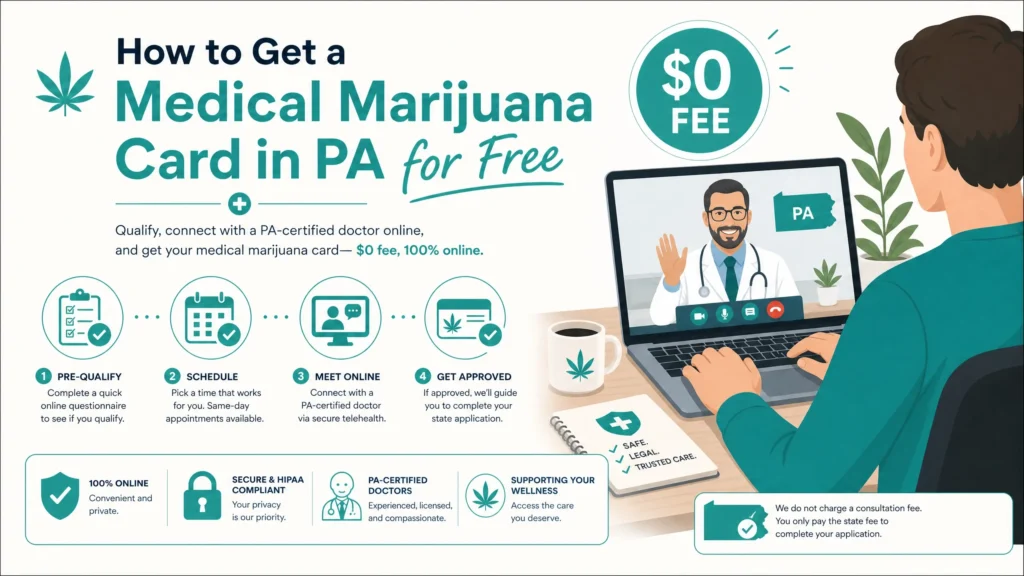
The PA MMJ certification process is completed entirely online via telehealth, typically the same day.
Option 2: Wait and see if the Farm Bill is revised
The 2026 Farm Bill reauthorization may include amendments that create a regulated framework for hemp THC beverages at more permissive potency levels.
This is possible but not guaranteed and involves remaining in legal uncertainty through at least the end of 2026.
Option 3: Very low-dose hemp drinks that comply with the 0.4mg cap
A small number of brands are already developing reformulated products that stay within the 0.4mg per-container threshold.
At that level, effects will be extremely mild, roughly equivalent to trace amounts of THC with minimal psychoactivity for most adults.
These may be worth exploring for those who want a hemp product primarily for relaxation without significant psychoactive effects.
Option 4: Nothing changes for PA dispensary patients
If you are already a registered PA medical marijuana patient, none of this affects you. Your dispensary access, your product options, and your legal protections all remain fully intact on November 12, 2026 and beyond.
| Option | Affected by Nov 2026 Deadline? | Legal Protection | Product Quality |
|---|---|---|---|
| Hemp THC drinks (current) | Yes, most eliminated | None | Unregulated, variable |
| PA MMJ tinctures (dispensary) | No | Full state legal protection | State-mandated COA testing |
| Reformulated 0.4mg drinks | No | Same as hemp market | Minimal psychoactive effect |
| Farm Bill legislative fix | Unknown | Uncertain | TBD |
For PA patients managing a genuine medical condition, the certification process through Pennsylvania Marijuana Cards is completed online the same day with Dr. Johnathon Chance Miller, MD.
| Patient Type | Physician Fee | PA State Fee | Total |
|---|---|---|---|
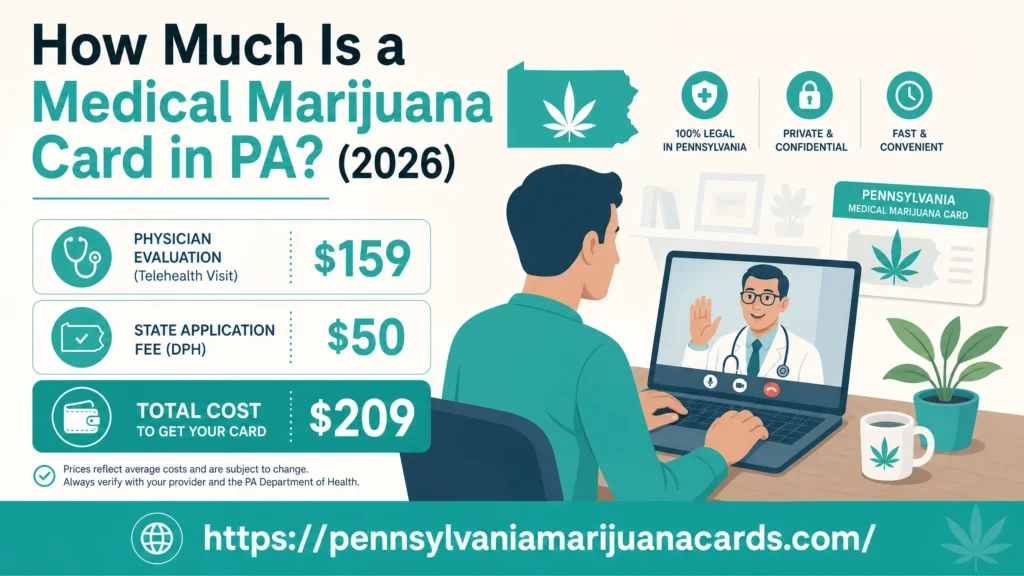
| New Patient | $159 | $50 | $209 |
| Renewal | $149 | $50 | $199 |
| MMAP Qualifying Patients (Medicaid, SNAP, WIC, CHIP, PACE, PACENET) | Physician fee only | $0 (waived) | Physician fee only |
Start your same-day certification here.
Frequently Asked Questions
Q: Do THC drinks get you high?
A: Yes. THC drinks contain real delta-9 THC and produce psychoactive effects. The intensity depends on the dose. A 5mg drink produces mild relaxation comparable to a light alcoholic drink for most people, while a 10mg drink is more noticeably psychoactive. THC drinks use nanoemulsion technology, which produces a faster onset (15 to 30 minutes) and somewhat shorter duration (2 to 4 hours) compared to traditional edibles. The experience tends to feel cleaner and clearer-headed than traditional edibles at the same dose because less conversion to the more potent 11-hydroxy-THC compound occurs through the nanoemulsion absorption pathway.
Q: Are THC drinks bad for you?
A: At typical serving sizes and moderate use, THC drinks are not known to cause serious harm in healthy adults. They use nanoemulsion technology that bypasses much of the liver’s first-pass metabolism, which reduces some processing demands compared to high-dose traditional edibles. However, regular heavy use can lead to tolerance buildup, and daily high-dose use over extended periods carries a risk of Cannabinoid Hyperemesis Syndrome in some users. People with pre-existing liver conditions, cardiovascular issues, anxiety disorders, or those on medications metabolized by CYP2C9/CYP3A4 enzymes should consult a physician before regular use. Mixing THC drinks with alcohol amplifies effects unpredictably.
Q: How long do THC drinks take to kick in?
A: THC drinks using nanoemulsion technology typically produce first noticeable effects in 15 to 30 minutes, with full effects at 30 to 45 minutes. This is significantly faster than traditional edibles like gummies or capsules, which take 45 to 90 minutes. The faster onset occurs because nanoemulsified THC particles (20 to 200 nanometers) absorb through the stomach lining more efficiently than oil-based THC, bypassing much of the slower digestive process.
Q: Do THC drinks show up on a drug test?
A: Yes. Your body processes delta-9 THC from any source, whether hemp-derived or marijuana, into the same metabolite, THC-COOH, which is what standard drug tests detect. The test cannot distinguish between hemp-sourced and marijuana-sourced THC. Detection windows in urine range from 3 to 7 days for occasional use and up to 30+ days for regular heavy use. If your job involves drug testing, hemp THC drinks carry the same risk as any other cannabis product.
Q: How are THC drinks legal in Pennsylvania?
A: Hemp-derived THC drinks are legal in Pennsylvania under the federal 2018 Farm Bill and Pennsylvania’s Industrial Hemp Act (3 Pa.C.S. §701), provided the finished product contains no more than 0.3% delta-9 THC by dry weight. This dry-weight calculation allows a standard 12oz can to contain 5 to 10mg of actual THC while still meeting the legal threshold. No PA state card is required to purchase them. However, federal law H.R. 5371, effective November 12, 2026, will impose a 0.4mg per-container total THC cap that will eliminate most current hemp THC drinks from the market.
Q: Is a 10mg THC drink strong?
A: For a beginner with no prior cannabis experience, yes, a 10mg THC drink is a noticeable and potentially strong experience. Most cannabis physicians in 2026 recommend starting at 2.5mg to 5mg for first-time users. 10mg is considered a standard low-to-moderate dose appropriate for adults with some cannabis experience. If trying a 10mg drink for the first time, consider drinking it slowly over 20 to 30 minutes, waiting a full 30 to 45 minutes before assessing, and not mixing with alcohol.
Q: What is happening to THC drinks in November 2026?
A: Federal law H.R. 5371, signed November 12, 2025 and effective November 12, 2026, imposes a 0.4mg per-container total THC cap on hemp-derived products. Most THC drinks currently sold in Pennsylvania contain 5 to 10mg of THC per can, which is between 12 and 25 times above the new cap. Industry analysts estimate that more than 95% of current hemp-derived THC products, including virtually all standard-dose drinks, will lose their legal hemp classification on that date and be reclassified as Schedule I substances under federal law. Pennsylvania’s own SB 49 may advance state-level enforcement of the same cap. PA licensed medical marijuana dispensary products are completely unaffected.
Q: Where can I buy THC drinks in Pennsylvania?
A: As of July 2026, hemp-derived THC drinks are available at smoke shops, vape stores, some convenience and specialty retailers, and online retailers that ship to Pennsylvania. They are not available at Pennsylvania licensed medical marijuana dispensaries, which operate under the separate Medical Marijuana Act framework. When purchasing, look for products with a Certificate of Analysis (COA) confirming delta-9 THC at or below 0.3% by dry weight. Given the November 2026 federal deadline, availability at retail locations will begin to narrow as brands reformulate or exit the market.
Medical Disclaimer
This blog post is intended for general educational and informational purposes only and does not constitute medical or legal advice. Pennsylvania and federal cannabis and hemp laws are subject to change, including significant changes scheduled for November 12, 2026 under H.R. 5371. Information in this article reflects the legal and regulatory landscape as of July 2026. Do not drive or operate machinery after consuming any THC product. Consult a licensed physician before using any cannabis product if you take prescription medications or have a pre-existing health condition. Medically reviewed by Dr. Johnathon Chance Miller, MD.
Sources
- LoDo Shots: Nowadays THC Drink: A Complete Review and Comparison Guide for 2026 (April 2026)
- 23rd State: Nanoemulsion in Cannabis: Enhanced Absorption Explained (January 2026)
- Mellow Fellow: THC Drink Subscription: Nanoemulsion Science Explained (June 2026)
- Zazzy: Water Soluble THC: Nanoemulsion Technology Guide (December 2025)
- Grand Cannabis: Nanoemulsion in Cannabis Drinks (October 2025)
- CannabisRegulations.AI: Is Hemp-Derived Delta-9 THC Legal in Pennsylvania? 2026 Status and H.R. 5371 (May 2026)
- Cornbread Hemp: Federal Hemp Ban: What It Means and What’s Happening Now (February 2026)
- HempData: What H.R. 5371 Means for Your Hemp Business: A Plain-English Guide (April 2026)
- Regulatory Oversight: Congress Narrows Federal Definition of Hemp, Effectively Banning Most Intoxicating Hemp Products (December 2025)
- Clark Hill PLC: A Billion-Dollar Trade on the Brink: How to Save the Hemp Beverage Industry (April 2026)
- Scarinci Hollenbeck: The Federal Redefinition of Hemp Under H.R. 5371 (December 2025)
- My Pain Center: New Hemp Rule Explained: Understanding the Hemp Ban in H.R. 5371 (November 2025)
- Congress.gov CRS: Changes to the Statutory Definition of Hemp and Issues for Congress (May 2026)
- Congress.gov CRS: Change to Federal Definition of Hemp and Implications for Federal Enforcement