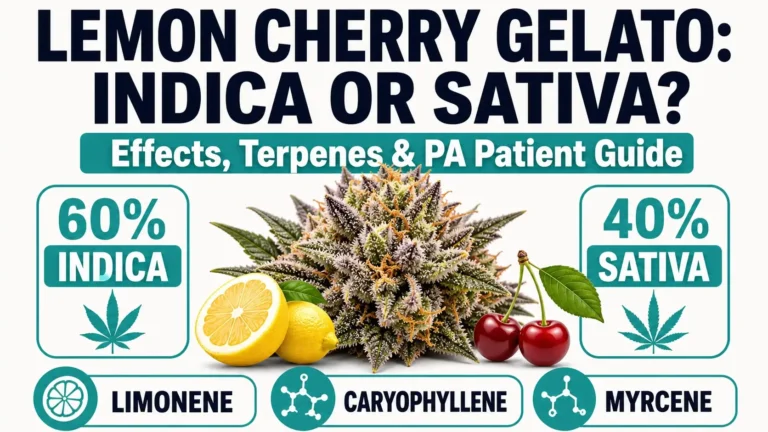

Lemon Cherry Gelato widely known as LCG in Pennsylvania dispensaries, has evolved from a Bay Area cult phenotype into one of the most broadly available premium strains in legal medical markets across the country.
First popularized by Backpackboyz in 2019, this indica-leaning hybrid has earned its reputation through a terpene-rich profile that goes well beyond its celebrated dessert aroma.
Need a PA Medical Marijuana Card?
Get certified online in 15 minutes. 100% Money-Back Guarantee.
Get Certified Now →For Pennsylvania medical marijuana patients managing anxiety, chronic pain, sleep disorders, or PTSD, understanding what the COA actually says about your specific LCG batch is far more important than the label on the shelf.
⚡ Quick Answer
Lemon Cherry Gelato is a slightly indica-dominant hybrid (60% indica / 40% sativa), bred from Sunset Sherbet and Girl Scout Cookies with a third undisclosed parent, testing between 22–33% THC depending on phenotype and cultivator.
For Pennsylvania residents: Lemon Cherry Gelato is one of the more accessible premium strains at PA’s 186+ licensed dispensaries as of July 2026; a valid MMJ card under Act 16 of 2016 is required for legal access.
Key Takeaways
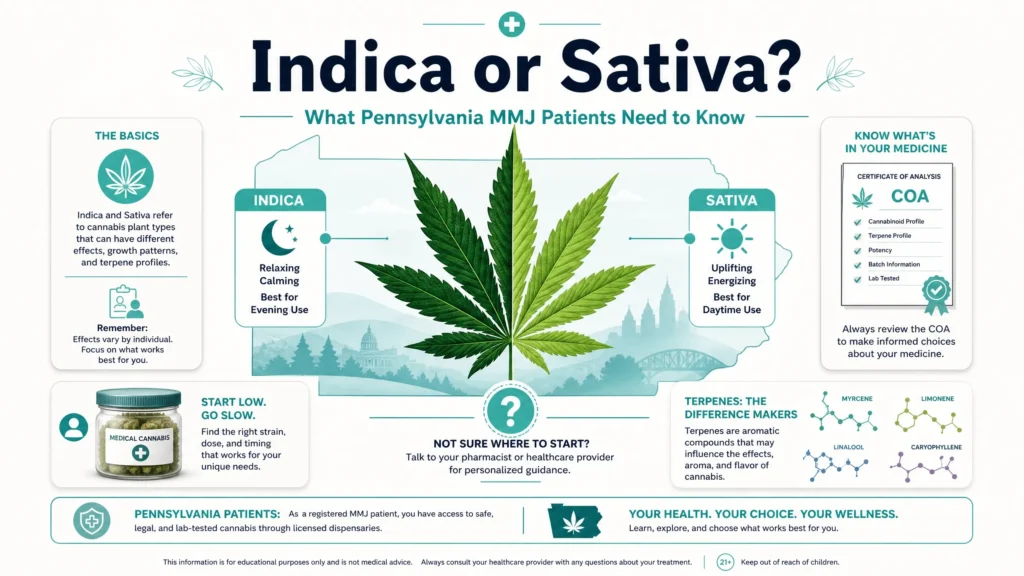
- “Lemon Cherry Gelato” is one of the most label-abused strain names in legal cannabis markets — Leafly noted as early as 2024 that samples labeled LCG can include a broad range of Gelato and Runtz varieties; a batch COA identifying caryophyllene-limonene as dominant terpenes with a Sunset Sherbet × GSC lineage is the only reliable verification.
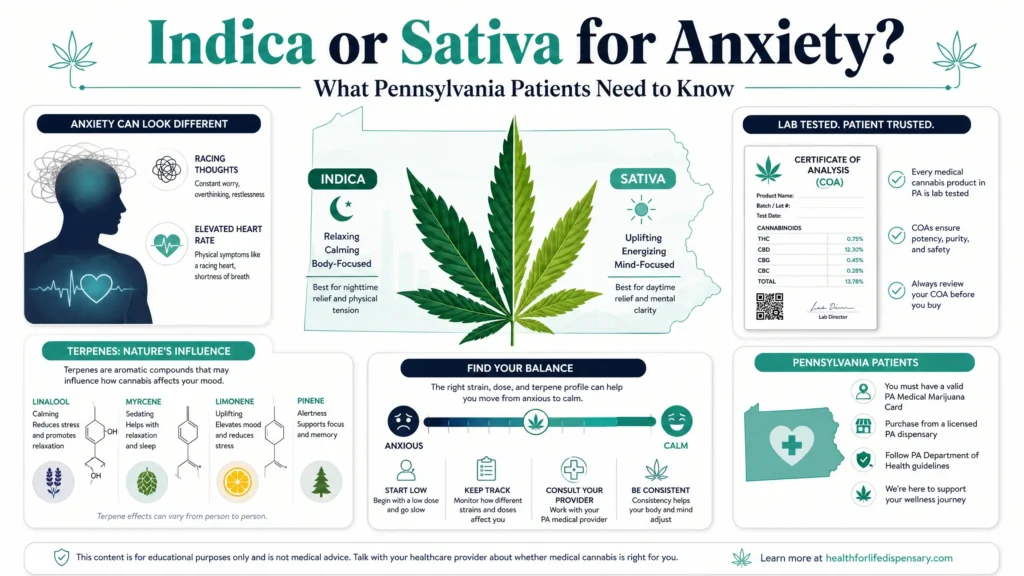
- Caryophyllene is the dominant terpene in most authentic LCG batches, not limonene — this matters clinically because caryophyllene is the only terpene that directly activates CB2 receptors, making it the primary anti-inflammatory and pain-relief driver, while limonene handles the anxiety-moderating and mood effects.
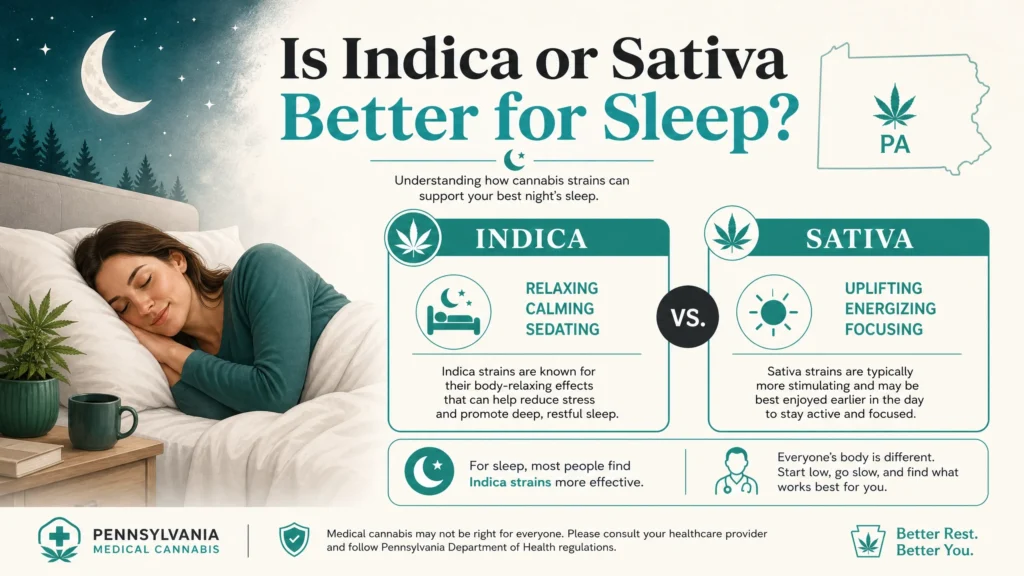
- LCG’s indica-leaning classification reflects its evening-to-nighttime therapeutic window for most patients — the 60/40 indica lean, combined with myrcene’s sedative properties, makes LCG particularly relevant for PA patients managing insomnia, PTSD nightmares, and chronic pain that disrupts sleep.
- A 2025 landmark study in the Journal of Clinical Sleep Medicine found a terpene blend including myrcene, linalool, limonene, and beta-caryophyllene produced measurable increases in restorative sleep — directly relevant to LCG’s terpene profile.
- Pennsylvania’s per se DUI law creates specific risk with LCG’s THC range — at 22–33% THC, metabolite persistence in blood is significant; under 75 Pa.C.S. § 3802(d), any detectable THC in blood is a DUI regardless of card status or perceived sobriety.
Is Lemon Cherry Gelato Indica or Sativa?
Lemon Cherry Gelato is a slightly indica-dominant hybrid 60% indica / 40% sativa, bred from two of California’s most celebrated dessert strains.

Sunset Sherbet (itself a cross of Girl Scout Cookies and Pink Panties, created by Mr. Sherbinski) contributes LCG’s vibrant fruity character and initial cerebral uplift.
Girl Scout Cookies (OG Kush × Durban Poison) adds the euphoric, body-forward foundation and potent cannabinoid density.
A third, undisclosed parent strain contributes dense trichome coverage and may account for the cherry-specific aromatic notes that differentiate LCG from other Gelato-family strains.
Do You Qualify for a PA MMJ Card?
Connect with a licensed Pennsylvania state physician online from home.
Backpackboyz, the Bay Area cannabis collective founded by ex-MMA fighter Juan Quesada, introduced LCG at a Cookies dispensary in Los Angeles in late 2019.
The strain is rumored to be a keeper phenotype from an early Runtz pheno-hunt. From that first drop, LCG spread rapidly across legal markets and is now carried by major brands including STIIIZY, Connected, and Alien Labs.
One critical caveat Pennsylvania patients must understand in 2026: “Lemon Cherry Gelato” has become one of the most broadly applied strain labels in legal cannabis. As Leafly documented, samples sold as LCG now include a wide range of Gelato-family and Runtz-adjacent phenotypes.
Authentic LCG is identifiable by caryophyllene-dominant, limonene-secondary terpene profile combined with Sunset Sherbet × GSC lineage documentation on the COA. The shelf name alone cannot confirm what you are purchasing.

⚠️ COA Callout: At Pennsylvania dispensaries, always request the batch-specific Certificate of Analysis when purchasing any product labeled Lemon Cherry Gelato or LCG. Verify that caryophyllene and limonene are among the leading terpenes.
If a batch shows a dramatically different terpene profile or no terpene data at all, it may not be an authentic LCG expression. Pennsylvania’s 2025 DOH update requires full terpene profiles on all licensed products, giving PA patients a meaningful advantage in verification.

As Dr. Ethan Russo established in his foundational entourage effect research in the British Journal of Pharmacology (2011), the therapeutic profile of any cannabis product is shaped by the complete terpene-cannabinoid interaction, not subspecies classification.
The indica label signals a directional tendency, not a guaranteed outcome.
LCG Cannabinoid Profile

| Cannabinoid | Typical Range | What It Means for PA Patients |
|---|---|---|
| THC | 22–29% (standard); up to 33% (LCG 2.0 phenotypes) | Moderately high to very high; experienced patients only at full doses |
| CBD | <1% | Minimal CBD buffering — terpene profile is the primary modulator |
| THC:CBD Ratio | ~25:1 | Strongly THC-dominant; full psychoactive profile |
| THCA (pre-decarb) | 22–29% | Converts to THC upon vaporization |
Standard LCG batches test between 22–29% THC, placing them in the moderately-high tier that is accessible to patients with some cannabis experience.
LCG 2.0 phenotypes (notably the Barney’s Farm × Backpackboyz collaboration) have been documented at 33% THC, which moves this strain into the high-potency category requiring careful dose management.
The minimal CBD content means there is no natural cannabidiol buffer moderating THC’s psychoactive intensity.
This makes LCG’s terpene profile, specifically the caryophyllene-limonene interaction, the primary pharmacological mechanism shaping the therapeutic experience.
⚡ Fast & 100% Online PA Medical Cards
Board-Certified Doctors • 100% Money-Back Guarantee
Book Evaluation Now →Patients managing anxiety, Pennsylvania’s number one qualifying condition, cited in over 68% of all PA MMJ certifications according to Drake et al. in the Annals of Internal Medicine (July 2025, DOI: 10.7326/ANNALS-25-01037), should start with the lowest available dose regardless of prior cannabis experience, especially when trying a new batch or cultivator’s expression of LCG.
LCG Terpene Profile
Pennsylvania’s 2025 DOH update mandates full terpene disclosure on all licensed dispensary products.
Lemon Cherry Gelato’s three dominant terpenes each carry distinct and clinically meaningful pharmacological data.

Caryophyllene — The Dominant Terpene and the Only One That Activates CB2
Beta-caryophyllene is the lead terpene in authentic LCG batches, contributing the strain’s characteristic spicy-peppery undertone beneath its citrus-cream surface aroma.
It is pharmacologically unique in the cannabis terpene landscape: it is the only known terpene that directly binds CB2 receptors in the endocannabinoid system, functioning simultaneously as a terpene and a dietary cannabinoid.
A 2025 review published in MDPI Pharmaceuticals (July 2025), which analyzed over 200 studies on cannabis terpenes and chronic pain, identified beta-caryophyllene as one of the most clinically supported terpenes for inflammation and neuropathic pain through its CB2 activation.
Research published in the Journal of Psychopharmacology found it also produces anxiolytic effects by modulating the stress response, while a study in Physiology & Behavior documented its anti-anxiety mechanism independently.
- Mechanism: Direct CB2 receptor agonist; anti-inflammatory, analgesic, anxiolytic
- Best for: Chronic pain, neuropathic pain, inflammation, anxiety
- Evidence level: Robust preclinical evidence; emerging human data
Limonene — The Mood-Elevating Anxiety Moderator
Limonene gives LCG its signature bright lemon-citrus aroma and is directly relevant to Pennsylvania’s largest patient population.
A 2024 double-blind, placebo-controlled crossover study from Johns Hopkins University and the University of Colorado found that participants who inhaled THC combined with d-limonene reported significantly reduced anxiety, nervousness, and paranoia compared to THC alone, representing some of the strongest human-level clinical evidence for any cannabis terpene’s anxiety-modifying properties.
Limonene elevates serotonin and dopamine levels in the brain and has documented antidepressant effects in multiple preclinical models.
It’s presence in LCG is the primary reason this indica-leaning strain does not feel as sedating or mood-neutral as many indica-dominant products at comparable THC levels.
- Mechanism: Serotonin and dopamine modulation; neurotransmitter upregulation
- Best for: Anxiety disorder, depression, mood elevation, stress
- Evidence level: Human clinical (double-blind crossover, 2024); multiple preclinical confirmations
Myrcene — The Sleep and Sedation Driver
Renewing Your PA MMJ Card?
Quick annual recertification online. No paperwork hassle.
Renew Card Online →Myrcene is the earthy, musky terpene that underpins LCG’s relaxing body component. It is typically the most abundant terpene in cannabis overall, and its high lipophilicity allows it to cross the blood–brain barrier efficiently.

Preclinical research shows myrcene may reduce inflammation and pain through TRPV1 channel engagement and opioid receptor pathways, with animal models demonstrating sedative and muscle-relaxant effects.
Critically for PA patients managing sleep disorders: a landmark 2025 study in the Journal of Clinical Sleep Medicine tested a terpene blend that included myrcene, linalool, limonene, and beta-caryophyllene in insomnia patients.
Results showed measurable increases in restorative sleep stages, with some participants gaining up to 48 minutes of additional deep sleep nightly.
LCG’s terpene profile closely mirrors this studied combination, making it one of the more evidence-aligned strain choices for patients whose qualifying condition includes significant sleep disruption.
- Mechanism: TRPV1 channel engagement; opioid pathway interaction; sedative CNS effects
- Best for: Insomnia, muscle spasms, pain-related sleep disruption, anxiety
- Evidence level: Robust preclinical; 2025 human clinical sleep study (terpene blend)
Entourage Effect Note: The caryophyllene-limonene-myrcene combination in LCG demonstrates the entourage effect principle established by Russo (2011): caryophyllene targets CB2 receptors for pain and inflammation; limonene moderates THC-induced anxiety and lifts mood; myrcene adds sedative depth and potentiates THC’s analgesic properties.
The three work synergistically, but only if the batch COA confirms all three are present in meaningful concentrations.
Therapeutic Effects for PA Patients
LCG’s therapeutic effect sequence is consistent across patient reviews and predictable from its terpene and cannabinoid profile:
- Onset (5–15 min, vaporized): Cerebral lift — elevated mood, reduced mental tension, talkative and social ease; limonene’s serotonin effects are noticeable early
- Mid-phase (30–60 min): Warm body relaxation building gradually without acute sedation; caryophyllene’s CB2 activation takes hold
- Later phase (60–120 min+): Deepening body calm; at moderate-to-higher doses, myrcene’s sedative properties become more prominent, steering the experience toward evening or nighttime use
The 60/40 indica lean manifests primarily in the later phase. Earlier in the session, LCG presents as more balanced than its classification suggests, a clinical feature that makes it one of the more versatile therapeutic options at Pennsylvania dispensaries for patients who need functional relief during late afternoon before transitioning to rest.
Who Should Use Caution
- Patients with anxiety who have never used high-THC products — LCG’s limonene content helps moderate THC-induced anxiety, but that protection is dose-dependent; high doses can overwhelm it
- Daytime patients who need cognitive clarity — myrcene’s sedative properties make LCG more appropriate for late-afternoon and evening use at moderate doses
- New MMJ patients starting their first cannabis regimen — start at the minimum available dose and wait a full session before reassessing; LCG’s phased effect profile means the full experience takes 60–90 minutes to develop
- All patients who drive — Pennsylvania’s per se DUI law under 75 Pa.C.S. § 3802(d) applies regardless of card status; plan transportation before consuming any cannabis product
What Conditions Is LCG Used For?

Anxiety Disorder
Anxiety is Pennsylvania’s top qualifying condition, cited in over 68% of all PA MMJ certifications (Drake et al., Annals of Internal Medicine, July 2025).
LCG’s limonene-caryophyllene combination is directly relevant: limonene’s 2024 human clinical evidence for reducing THC-induced anxiety and paranoia, combined with caryophyllene’s CB2-mediated stress modulation, creates a pharmacological profile well-suited to anxiety patients at appropriate doses.
The key variable is dose, patients should work upward slowly from a minimal starting point. Learn more about anxiety disorder as a PA qualifying condition.
PTSD and Nightmare Disruption
Patient reviews through April 2026 on AllBud consistently flag PTSD, nightmares, and racing thoughts as conditions where LCG provides meaningful relief.
Get Approved by a Licensed PA Doctor
Schedule your appointment in minutes. You only pay if approved.
Start Online Application →One patient review noted LCG “leaves you very relaxed and free of anxiety as if you’re being wrapped in a weighted blanket” while also providing “motivated” cognitive engagement, a combination that reflects the limonene-myrcene balance unique to this strain’s terpene profile.
Pennsylvania recognizes PTSD as a qualifying condition, and LCG’s evening-oriented therapeutic window aligns with PTSD patients’ typical symptom burden.
Severe Chronic Pain
Caryophyllene’s CB2 receptor activation makes LCG directly pharmacologically relevant to severe chronic and intractable pain.
The 2025 MDPI Pharmaceuticals review identified beta-caryophyllene among the best-supported cannabis terpenes for chronic pain and inflammation.
Myrcene’s TRPV1 channel engagement adds an additional analgesic mechanism. Patient reviews through 2025–2026 repeatedly identify chronic pain and stress as primary use cases.
For patients also qualifying under neuropathies, LCG’s caryophyllene dominance is particularly clinically relevant.
Insomnia and Sleep Disruption
LCG’s myrcene-linalool-caryophyllene terpene profile closely matches the combination studied in the 2025 Journal of Clinical Sleep Medicine landmark study that documented measurable improvements in restorative sleep stages.
Multiple patient reviews through 2025 and 2026 cite sleep improvement as a primary benefit, with patients noting LCG’s effectiveness for insomnia and nightmares.
Pennsylvania patients certifying under anxiety disorder, PTSD, or chronic pain frequently report comorbid insomnia, making LCG’s sleep-relevant terpene profile an additional point of therapeutic alignment.
Lemon Cherry Gelato at Pennsylvania Dispensaries
Lemon Cherry Gelato is one of the more consistently available premium strains across Pennsylvania’s 186+ licensed dispensaries as of July 2026.

Ready to Get Your Official PA MMJ Card?
State-certified doctor consultations online. No risk—100% refund if not approved.
Claim Your MMJ Card Online →It is widely sold under the name LCG on dispensary menus and appears in flower, vape, concentrate, and infused product formats from multiple cultivators.
| Product Format | Typical Onset | Duration | Best Used For |
|---|---|---|---|
| Dry flower (vaporized) | 5–15 min | 2–4 hours | Rapid relief, precise dose control |
| Vape cartridge (live resin) | 5–10 min | 2–3 hours | Preserved terpene profile; portability |
| Oral capsule | 45–90 min | 5–8 hours | Sustained overnight relief; sleep support |
| Tincture (sublingual) | 15–45 min | 3–6 hours | Adjustable dosing; mid-duration relief |
| Infused concentrate (rosin) | 5–15 min (vaporized) | 3–5 hours | Experienced patients; maximum terpene expression |
Dispensary Pharmacist Tip: Because “LCG” covers a wide range of phenotype expressions in the market, do not rely on the shelf name alone. Describe your qualifying condition and ask the pharmacist to identify products with a caryophyllene-dominant, limonene-secondary terpene profile at 2%+ total terpenes.
Request the batch-specific COA and look for Sunset Sherbet × Girl Scout Cookies lineage documentation. A batch with minimal caryophyllene and no documented GSC parentage may not deliver the therapeutic profile you are targeting.

Terpene percentage matters significantly for LCG.
Patient reviews note that a poorly cultivated or improperly cured LCG batch with low total terpenes (~1% or under) produces a noticeably muted experience compared to a well-cultivated batch at 2%+.
The COA terpene data is your best predictor of therapeutic outcome.
Pennsylvania Legal Notes

✅ Valid PA MMJ Card Required Cannabis remains illegal for recreational use in Pennsylvania as of July 2026. Accessing LCG at any Pennsylvania dispensary requires a valid patient card issued under Act 16 of 2016.
🚫 Smoking Is Prohibited Under PA Law Act 16 explicitly prohibits smoking cannabis in Pennsylvania. Legal consumption methods include vaporization of dry flower or concentrates, oral capsules, tinctures, topicals, and edibles. No product format recommendation on this page implies or endorses smoking.
⚠️ Pennsylvania DUI Law: Know Before You Drive Under 75 Pa.C.S. § 3802(d), any detectable level of THC metabolites in your blood constitutes a DUI, regardless of impairment, time since consumption, or MMJ card status. Commonwealth v. Stone (2022) confirmed that a Pennsylvania MMJ card is not a legal DUI defense. LCG’s THC range (22–33%) means metabolite persistence in blood is meaningful. Do not drive after consuming LCG or any cannabis product.
Getting Certified in Pennsylvania
Accessing Lemon Cherry Gelato legally begins with a valid PA MMJ card. Dr. Johnathon Chance Miller, MD (License #MD474783) conducts telehealth certifications for Pennsylvania residents.
| Fee | Amount |
|---|---|
| Physician certification (new patient) | $159 |
| PA state registration fee | $50 |
| Total — new patient | $209 |
| Physician certification (renewal) | $149 |
| PA state registration fee | $50 |
| Total — renewal | $199 |
MMAP Fee Waiver: Patients qualifying for Medicaid, SNAP, WIC, CHIP, PACE, or PACENET may have the $50 state fee waived. Start your telehealth certification here.
How to Choose the Right LCG Product?
Follow these five steps before purchasing any Lemon Cherry Gelato product at a PA dispensary:

- Request the batch-specific COA and verify the terpene profile. Look for caryophyllene and limonene as the leading terpenes. A batch labeled LCG with a myrcene-dominant or uncharacteristic terpene profile may be a misidentified or non-authentic phenotype.
- Check total terpene content — target 2%+ for full therapeutic expression. LCG’s therapeutic value is terpene-driven; a batch with under 1% total terpenes will not deliver the anxiety-moderating, pain-relieving, or sleep-supporting effects its genetics are capable of.
- Match delivery format to your qualifying condition and timing needs. Evening and overnight pain or sleep patients should consider longer-duration oral formats; anxiety patients needing acute relief may prefer the faster onset of vaporized flower.
- Confirm the THC percentage on the COA before dosing. Standard LCG at 22% THC and LCG 2.0 at 33% THC require meaningfully different dosing approaches. Do not assume prior LCG experience automatically transfers to a new batch.
- Start at the lowest available dose and observe the full effect before redosing. LCG’s phased effect profile — cerebral onset followed by progressive body relaxation — takes 60–90 minutes to fully develop. Early redosing before the body component arrives is a common cause of overconsumption.
Pro Tip: If your PA dispensary has live resin cartridge formats of LCG, these preserve the fresh-frozen terpene profile most completely and are among the best ways to experience authentic LCG terpene expression.
Vaporized flower from a well-cured, properly stored batch is the next best option. Both are legal consumption methods under Act 16.
Frequently Asked Questions
Q: Is Lemon Cherry Gelato indica or sativa?
A: Lemon Cherry Gelato is a slightly indica-dominant hybrid 60% indica / 40% sativa, bred from Sunset Sherbet and Girl Scout Cookies, popularized by Backpackboyz in California in 2019. Its indica lean is most apparent in the later phase of its effect profile, where myrcene and caryophyllene contribute progressive body relaxation. The earlier onset is more balanced, with limonene’s mood-elevating properties tempering the indica sedation. Pennsylvania patients should treat the classification as a general directional guide rather than a precise predictor; the batch-specific COA terpene profile is the most reliable therapeutic guide.
Q: What terpenes are in Lemon Cherry Gelato?
A: LCG’s dominant terpenes are caryophyllene, limonene, and myrcene, with linalool present in some phenotypes. Caryophyllene is the lead terpene in authentic batches, contributing peppery spice and direct CB2 receptor activation for anti-inflammatory and pain-relieving effects. Limonene delivers the strain’s citrus character and has the strongest human clinical evidence for reducing THC-induced anxiety. Myrcene provides earthy depth and the sedative-relaxing body component. Pennsylvania’s 2025 DOH update requires full terpene profiles on all licensed products, always compare the COA to these expected dominant terpenes when purchasing LCG.
Q: What is Lemon Cherry Gelato good for medically?
A: Patient data and terpene pharmacology support LCG for anxiety, PTSD, chronic pain, insomnia, and depression. Caryophyllene’s CB2 receptor activation addresses pain and inflammation; limonene’s serotonin modulation targets anxiety and mood; myrcene’s TRPV1 pathway engagement contributes analgesic and sedative effects relevant to sleep and pain management. The 2025 Journal of Clinical Sleep Medicine study found a terpene blend closely matching LCG’s profile produced measurable improvement in restorative sleep stages. Individual response varies by dose, delivery format, and qualifying condition.
Q: How much THC does Lemon Cherry Gelato have?
A: Standard LCG batches test between 22–29% THC; LCG 2.0 phenotypes (Barney’s Farm × Backpackboyz) have been documented up to 33% THC. THC percentage varies significantly by cultivator, phenotype selection, growing conditions, cure quality, and analytical lab methodology. Always verify the exact THC figure on the batch-specific COA at your Pennsylvania dispensary. Do not rely on generic published averages when determining your starting dose.
Q: Is Lemon Cherry Gelato available at Pennsylvania dispensaries?
A: Lemon Cherry Gelato is one of the more consistently available premium strains at Pennsylvania’s 186+ licensed dispensaries as of July 2026. It typically appears as “LCG” on dispensary menus and is available in flower, vape, and concentrate formats from multiple cultivators. Because the LCG label is applied broadly across the market, asking the dispensary pharmacist to confirm caryophyllene-dominant terpene data and Sunset Sherbet × GSC lineage on the COA is the most reliable way to identify an authentic and therapeutically consistent batch.
Q: Can I get a PA medical marijuana card to access Lemon Cherry Gelato?
A: Yes, a valid PA MMJ card under Act 16 of 2016 is required to legally purchase LCG at any Pennsylvania dispensary. Recreational cannabis remains illegal in Pennsylvania as of July 2026. Pennsylvania Marijuana Cards provides telehealth certifications with Dr. Johnathon Chance Miller, MD. New patient total cost is $209 ($159 physician certification + $50 PA state registration fee). Patients enrolled in Medicaid, SNAP, WIC, CHIP, PACE, or PACENET may qualify for the state fee waiver through Pennsylvania’s MMAP program.
Q: Is Lemon Cherry Gelato good for sleep?
A: LCG is one of the better-aligned strain choices for sleep-related qualifying conditions based on its terpene profile. Myrcene’s sedative and muscle-relaxant properties combine with caryophyllene’s CB2-mediated anti-inflammatory effects and linalool (present in select phenotypes) to produce a profile closely matching the terpene combination studied in a 2025 Journal of Clinical Sleep Medicine trial showing measurable improvements in restorative sleep stages. Patient reviews through 2025–2026 consistently confirm LCG’s value for insomnia and nightmare disruption associated with PTSD. Evening timing and oral or vaporized formats at appropriate doses are most suited to sleep-related use.
Medically reviewed by Dr. Johnathon Chance Miller, MD (License #MD474783). This content is for educational purposes only and does not constitute medical advice. Cannabis affects individuals differently. Consult a licensed healthcare provider before using cannabis for any medical condition. Pennsylvania medical marijuana patients must follow all state laws regarding legal methods of consumption. Smoking cannabis is prohibited under PA law. Do not drive after consuming cannabis. THC metabolites remain detectable in blood after psychoactive effects resolve, Pennsylvania’s per se DUI law applies regardless of MMJ card status.
Sources
- Russo, E.B. (2011). Taming THC: potential cannabis synergy and phytocannabinoid-terpenoid entourage effects. British Journal of Pharmacology.
- Drake, C. et al. (July 2025). Pennsylvania MMJ certification trends. Annals of Internal Medicine. DOI: 10.7326/ANNALS-25-01037
- Phytochemical Modulators of Nociception: A Review of Cannabis Terpenes in Chronic Pain Syndromes. MDPI Pharmaceuticals, July 2025.
- Landmark 2025 sleep terpene study — Journal of Clinical Sleep Medicine. Via Terpene Belt Farms formulation guide.
- Johns Hopkins University / University of Colorado 2024 double-blind limonene + THC anxiety study. Via Emerald Bay Extracts.
- 2025 terpene research summary: myrcene, limonene, entourage effect clinical evidence. Burning Bush Labs.
- Beta-caryophyllene anxiolytic and antidepressant evidence. Mamedica UK terpene pharmacology review.
- Pennsylvania Department of Health — Medical Marijuana Program
- Pennsylvania Act 16 of 2016 — Medical Marijuana Act
- 75 Pa.C.S. § 3802(d) — Pennsylvania DUI Statute
- Lemon Cherry Gelato strain data and patient reviews — AllBud.com (reviews through April 2026)
- LCG genetics and brand history — Klutch Cannabis strain profile, March 2026.
- Lemon Cherry Gelato strain overview — Herb.co, March 2026.
- Lemon Cherry Gelato terpene focus report — Lab Effects.