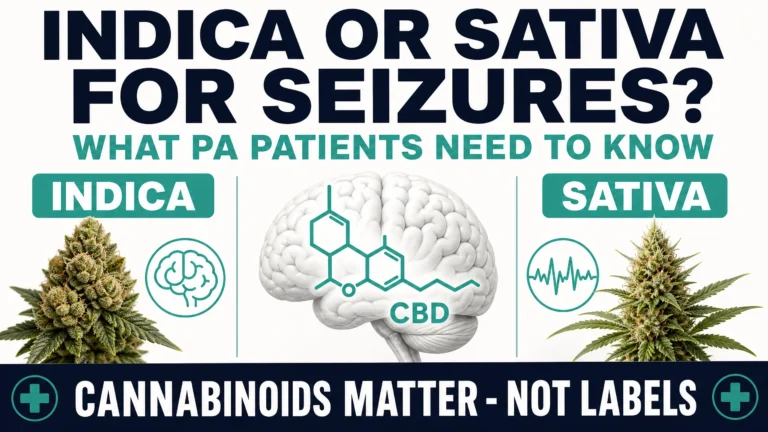

Patients and caregivers searching “indica or sativa for seizures” deserve a direct, medically honest answer and that answer upends what most cannabis websites imply.
The cannabinoid with the strongest peer-reviewed anticonvulsant evidence is CBD, not THC and high-THC products may lower seizure threshold in some patients, producing the opposite of the intended effect.
Need a PA Medical Marijuana Card?
Get certified online in 15 minutes. 100% Money-Back Guarantee.
Get Certified Now →The indica/sativa label predicts neither CBD concentration nor THC content accurately. Pennsylvania’s mandatory COA cannabinoid disclosure gives seizure patients the data that actually matters and this guide explains exactly how to use it.
⚡ Quick Answer
Neither indica nor sativa reliably predicts seizure control, CBD’s anticonvulsant mechanism, not THC or the indica/sativa label, is the most clinically evidenced approach to cannabis-based seizure management.
For Pennsylvania residents: recreational cannabis remains illegal as of July 2026, a valid MMJ card is required to access any of PA’s 186+ licensed dispensaries.
Key Takeaways
- CBD is the anticonvulsant cannabinoid — not THC: The FDA approval of Epidiolex in 2018 established pharmaceutical-grade CBD as a legitimate epilepsy treatment; this is the opposite of what THC-focused recreational cannabis content implies, and it changes how seizure patients should read every dispensary COA
- High-THC products carry a pro-convulsant risk at elevated doses: A clinical warning that is virtually absent from recreational cannabis sites but essential under a physician’s byline and critical for patient safety
- Linalool is the most seizure-relevant terpene: It’s GABA-A receptor modulation parallels the mechanism of benzodiazepine anticonvulsants; a terpene data point no recreational indica/sativa comparison addresses
- Pennsylvania recognizes two separate seizure-related qualifying conditions: Epilepsy and Intractable Seizures qualify independently under Act 16, and patients need to know which category applies to their specific diagnosis and seizure history
- CBD-AED drug interactions require neurologist disclosure: Cannabis CBD significantly elevates clobazam blood levels and interacts with valproate in ways that require medication monitoring; this safety information is absent from all recreational cannabis content and non-negotiable for seizure patients
Why the Indica/Sativa Question Is the Wrong Framework for Seizures
For most cannabis topics, the indica/sativa label is simply unhelpful, a marketing category that tells you nothing about pharmacological content.
For seizure management specifically, following the indica/sativa label rather than the COA cannabinoid panel can lead to product choices that actively worsen seizure frequency.

Seizure threshold, the level of neurological excitation at which a seizure triggers, is modulated by specific cannabinoid and terpene interactions with ion channels, GABA receptors, and glutamate pathways.
These interactions are entirely determined by which cannabinoids and terpenes are present in a product, and at what concentrations. None of this information is captured by whether a cultivar is classified as indica or sativa.
Do You Qualify for a PA MMJ Card?
Connect with a licensed Pennsylvania state physician online from home.
A sativa-labeled product at a Pennsylvania dispensary can be high-CBD with robust anticonvulsant potential. An indica-labeled product from the same dispensary can be high-THC with pro-convulsant risk at elevated doses.
The label tells the seizure patient nothing clinically useful and in this context, acting on label rather than COA data is a genuine safety issue.
As Ethan Russo’s landmark 2011 entourage effect research in the British Journal of Pharmacology established, therapeutic cannabis effect emerges from the full chemical profile, cannabinoids, terpenes, and flavonoids acting together on multiple receptor systems. The indica/sativa binary captures none of this complexity.
What Pennsylvania’s 2025 Labeling Update Provides Seizure Patients
Pennsylvania’s Department of Health updated dispensary product labeling requirements in 2025 to mandate full cannabinoid panels and terpene profiles on every batch-specific COA.
As of July 2026, every product at PA’s 186+ licensed dispensaries must disclose its complete cannabinoid content, including THC, CBD, THCV, CBG, CBC, and all major terpenes, giving seizure patients the exact data needed to make evidence-informed product decisions.
📋 PA Dispensary Rule: For seizure patients, the most critical COA data points are CBD percentage, THC percentage, and linalool concentration, in that order. Always request the batch-specific COA, not the general product menu listing or the indica/sativa label.
CBD’s Anticonvulsant Mechanism — What the Research Actually Shows
The anticonvulsant properties of CBD are the most robustly evidenced therapeutic application of any cannabinoid, culminating in FDA approval and peer-reviewed trials that no recreational cannabis site adequately represents.
CBD reduces seizure frequency and severity through at least three distinct neurological mechanisms, making it a multi-pathway anticonvulsant rather than a single-target drug:

Mechanism 1 — GABA-A Potentiation
GABA (gamma-aminobutyric acid) is the brain’s primary inhibitory neurotransmitter.
Seizures occur when excitatory neuronal activity overwhelms inhibitory GABA signaling. CBD potentiates GABA-A receptor activity, enhancing the brain’s own inhibitory brake on excessive neuronal firing.
This is mechanistically similar to how benzodiazepines (diazepam, lorazepam) and some antiepileptic drugs produce anticonvulsant effect.
Mechanism 2 — Sodium Channel Inhibition
⚡ Fast & 100% Online PA Medical Cards
Board-Certified Doctors • 100% Money-Back Guarantee
Book Evaluation Now →Voltage-gated sodium channels are critical to the initiation and propagation of seizure activity.
CBD inhibits sodium channel function in a manner similar to established antiepileptic drugs including phenytoin and carbamazepine, reducing the rapid neuronal firing that drives tonic-clonic and other seizure types.
Mechanism 3 — GPR55 Antagonism
GPR55 is an orphan G-protein coupled receptor expressed in brain regions associated with seizure activity.
CBD acts as a GPR55 antagonist, blocking a receptor that, when activated, promotes pro-convulsant neuronal excitation.
This mechanism is distinct from both GABA potentiation and sodium channel inhibition, giving CBD a third independent anticonvulsant pathway.
The Epidiolex Clinical Evidence
In 2018, the FDA approved Epidiolex, purified, pharmaceutical-grade CBD, for the treatment of seizures associated with Dravet syndrome and Lennox-Gastaut syndrome in patients aged two years and older.
This approval was based on randomized, double-blind, placebo-controlled trials demonstrating statistically significant seizure frequency reduction, a standard of evidence that no other cannabis-based intervention for any condition has matched.
The Epidiolex approval does not mean all CBD products are equivalent to Epidiolex.
It means CBD’s anticonvulsant mechanism is validated at the highest level of clinical evidence and that seizure patients evaluating dispensary CBD products should understand what the research supports and where the evidence gaps remain.
| CBD Anticonvulsant Evidence | Detail |
|---|---|
| FDA approval | Epidiolex approved 2018 — Dravet syndrome, Lennox-Gastaut syndrome |
| GABA-A potentiation | Enhances inhibitory neurotransmission — reduces excitatory firing |
| Sodium channel inhibition | Reduces seizure initiation and propagation |
| GPR55 antagonism | Blocks pro-convulsant receptor activation |
| Seizure reduction in trials | 39–51% median seizure frequency reduction vs. placebo in Dravet trials |
The THC Pro-Convulsant Warning Seizure Patients Must Know
This is the clinical warning most absent from recreational cannabis content and the most important safety information on this page for seizure patients.

At elevated doses, THC may lower seizure threshold in susceptible individuals, producing pro-convulsant effects that directly counteract CBD’s anticonvulsant activity.
Renewing Your PA MMJ Card?
Quick annual recertification online. No paperwork hassle.
Renew Card Online →Preclinical research has documented dose-dependent biphasic THC effects on seizure threshold: at very low doses, THC may have mild anticonvulsant properties through CB1 modulation; at higher doses, CB1 overstimulation can increase neuronal excitability and reduce seizure threshold.
This is why high-THC, low-CBD products, regardless of their indica or sativa label, are not appropriate first-choice products for seizure patients without specific neurologist guidance.
The clinical evidence supports CBD-dominant or high-CBD formulations for seizure management, not high-THC formulations that may simultaneously reduce CBD’s effectiveness and increase neuronal excitability.
⚠️ Critical Warning for Seizure Patients: High-THC cannabis products, including products labeled “indica” marketed for relaxation, carry pro-convulsant risk at elevated doses. Seizure patients should not select cannabis products based on indica/sativa label or THC percentage alone. CBD concentration and neurologist coordination are the essential factors.
The Biphasic THC Effect on Seizure Threshold
| THC Dose | Seizure Threshold Effect | Clinical Implication |
|---|---|---|
| Very low (microdose) | Possible mild anticonvulsant via CB1 | Limited evidence — not recommended standalone |
| Moderate | Neutral to mild CB1 modulation | May be tolerated alongside high CBD |
| High | Pro-convulsant risk — lowers seizure threshold | Avoid in seizure patients without neurologist guidance |
| Very high (acute) | Documented seizure risk in susceptible individuals | Contraindicated |
Linalool and the Terpene Profile That Matters for Seizures
While CBD is the primary anticonvulsant cannabinoid, terpenes provide a secondary layer of pharmacological relevance for seizure patients and the most important terpene for seizures is one that rarely appears in indica/sativa comparison content.

Linalool — GABA-A Modulation Parallel to Benzodiazepines
Linalool is a floral-scented terpene found in lavender and in many cannabis cultivars.
Linalool potentiates GABA-A receptor activity through a mechanism that parallels benzodiazepine anticonvulsants, enhancing the inhibitory neurotransmission that prevents seizure activity.
This GABA-A mechanism complements CBD’s anticonvulsant pathways, making linalool the single most relevant terpene data point for seizure patients reading a dispensary COA.
A high-CBD product that also shows meaningful linalool concentration on the COA addresses seizure threshold through two GABA-A pathways simultaneously, CBD’s potentiation and linalool’s independent GABA-A modulation.
This terpene-cannabinoid combination is more therapeutically specific for seizures than any indica/sativa label.
Beta-Caryophyllene — Neuroprotection for Seizure-Related Brain Stress
Seizure activity generates significant neuroinflammation and oxidative stress in affected brain tissue.
Beta-caryophyllene’s CB2 receptor activation reduces neuroinflammation, a secondary benefit relevant to seizure patients concerned about cumulative seizure-related neurological damage.
Get Approved by a Licensed PA Doctor
Schedule your appointment in minutes. You only pay if approved.
Start Online Application →BCP does not have direct anticonvulsant evidence comparable to linalool, but its neuroprotective profile makes it a useful secondary COA data point for seizure patients.
| Terpene | Seizure-Relevant Mechanism | Evidence Level | COA Priority for Seizure Patients |
|---|---|---|---|
| Linalool | GABA-A potentiation — directly anticonvulsant | Moderate — preclinical, mechanistic | ⭐ Primary |
| Beta-caryophyllene | CB2 neuroprotection — reduces seizure-related neuroinflammation | Moderate — preclinical | Secondary |
| Myrcene | Indirect GABA-A synergy, sedation | Preliminary | Tertiary |
| Alpha-pinene | Neuroprotective, counters THC cognitive effects | Preliminary | Tertiary |
| Limonene | Serotonin modulation — anxiety reduction | Preliminary | Situational |
Epidiolex vs. PA Dispensary CBD Products — An Honest Comparison
This comparison is entirely absent from recreational cannabis content and seizure patients deserve a clear, honest explanation of the difference.
Epidiolex is pharmaceutical-grade CBD produced under FDA manufacturing standards with rigorously controlled purity, concentration, and batch consistency.

It’s efficacy data comes from controlled clinical trials in specific pediatric epilepsy syndromes. It is prescribed by neurologists and covered by many insurance plans for qualifying diagnoses.
Pennsylvania dispensary CBD products are medical-grade cannabis products regulated by the PA DOH under Act 16, subject to mandatory third-party COA testing for cannabinoid content and terpene profile.
They are not FDA-approved pharmaceutical products, and their efficacy for specific seizure types is not established through the same level of controlled clinical trial evidence that supports Epidiolex.
| Factor | Epidiolex | PA Dispensary CBD Products |
|---|---|---|
| Regulatory standard | FDA pharmaceutical | PA DOH medical cannabis |
| CBD purity | Pharmaceutical grade — >99% pure CBD | Varied — full-spectrum or broad-spectrum |
| Clinical evidence | Phase III RCTs in Dravet, LGS | Observational, case series, anecdotal |
| Other cannabinoids | None — CBD isolate | THC, THCV, CBG, CBC present |
| Terpenes | None | Full terpene profile per COA |
| Insurance coverage | Often covered for qualifying diagnoses | Not covered — out of pocket |
| Neurologist involvement | Required for prescription | Recommended but not required |
| PA availability | Pharmacy prescription | 186+ licensed dispensaries statewide |
The honest clinical position as of July 2026: Seizure patients with Dravet syndrome or Lennox-Gastaut syndrome who have not already discussed Epidiolex with their neurologist should do so before pursuing dispensary CBD products.
For seizure types not covered by Epidiolex’s approved indications, PA dispensary CBD products represent a legally accessible, COA-verified option worth discussing with a neurologist familiar with cannabis pharmacology.
Pennsylvania’s Two Seizure Qualifying Conditions Explained
Pennsylvania Act 16 of 2016 recognizes two distinct seizure-related qualifying conditions and understanding the difference matters for certification.

Epilepsy
Epilepsy qualifies under PA Act 16 as a standalone condition. This category covers patients with a documented epilepsy diagnosis, a neurological disorder characterized by recurrent, unprovoked seizures.
Ready to Get Your Official PA MMJ Card?
State-certified doctor consultations online. No risk—100% refund if not approved.
Claim Your MMJ Card Online →Patients with controlled or partially controlled epilepsy who are seeking cannabis as an adjunct to their current antiepileptic regimen qualify under this category.
Intractable Seizures
Intractable Seizures qualify separately under PA Act 16, covering patients whose seizures have not responded adequately to conventional antiepileptic drug therapy.
This category is particularly relevant for patients with drug-resistant epilepsy who have failed two or more AEDs, which is the clinical definition of intractable or refractory epilepsy.
Patients with drug-resistant epilepsy may qualify under both categories and the Intractable Seizures designation may strengthen a certification case by documenting treatment failure with conventional options.
Patients uncertain about which qualifying condition applies should review Pennsylvania’s full qualifying conditions list and bring complete neurological records, including seizure frequency logs and current AED regimen, to their telehealth certification appointment.
Drug Interactions — Cannabis and Antiepileptic Medications

This section addresses information that is entirely absent from recreational cannabis content and non-negotiable for seizure patients managing complex AED regimens.
Cannabis CBD has clinically significant interactions with several commonly prescribed antiepileptic drugs.
These interactions are not theoretical, they have been documented in the clinical trials that led to Epidiolex’s FDA approval and in subsequent pharmacokinetic research.
Clobazam Interaction — Elevated Blood Levels
CBD inhibits the CYP2C19 enzyme responsible for metabolizing clobazam (Onfi), a benzodiazepine commonly used as an adjunct AED.
When CBD is added to a clobazam regimen, clobazam blood levels can increase by 3–4 fold, producing sedation, cognitive impairment, and other dose-dependent side effects even without changing the clobazam dose.
Patients taking clobazam who begin cannabis CBD therapy require medication monitoring and likely clobazam dose adjustment under neurologist supervision.
Valproate Interaction — Liver Enzyme Monitoring
CBD combined with valproate (Depakote) has been associated with elevated liver enzyme levels in clinical trials, a hepatotoxicity signal that requires monitoring.
Patients taking valproate who begin CBD therapy should have baseline liver function tests and periodic monitoring during CBD use.
General CYP450 Interactions
Both CBD and THC interact with the CYP450 enzyme system responsible for metabolizing many AEDs including carbamazepine, phenytoin, phenobarbital, and lamotrigine.
Any seizure patient beginning cannabis therapy while taking AEDs should disclose their complete medication list to both their neurologist and their certifying physician before the first dispensary purchase.
| AED | Cannabis Interaction | Clinical Action Required |
|---|---|---|
| Clobazam (Onfi) | CBD elevates clobazam levels 3–4x via CYP2C19 | Clobazam dose reduction likely needed |
| Valproate (Depakote) | Combined use associated with liver enzyme elevation | Baseline + periodic liver function monitoring |
| Carbamazepine (Tegretol) | CYP3A4 interaction — mutual metabolism effects | Monitor AED blood levels |
| Phenytoin (Dilantin) | CYP2C9 interaction | Monitor phenytoin blood levels |
| Lamotrigine | Possible clearance effects | Monitor for lamotrigine toxicity signs |
Product Format Guidance for Seizure Patients
Delivery format determines the onset, duration, and consistency of cannabinoid exposure, all of which matter for seizure threshold management.
Consistency is the most important delivery principle for seizure patients.

Erratic cannabinoid blood levels, produced by irregular dosing, highly variable formats, or unpredictable GI absorption, create neurological instability that may increase seizure risk.
Stable, predictable cannabinoid exposure supports stable seizure threshold.
| Format | Onset | Duration | Seizure Management Suitability | Notes |
|---|---|---|---|---|
| Capsule / tablet | 45–90 min | 5–8 hrs | ✅ Best for daily baseline management | Most consistent blood levels |
| Sublingual tincture | 15–45 min | 3–5 hrs | ✅ Good — partial GI bypass | More consistent than edibles |
| Vaporization | 5–15 min | 2–3 hrs | ⚠️ Breakthrough only — not for baseline | Inconsistent for sustained management |
| Edible | 60–120 min | 6–10 hrs | ⚠️ Variable GI absorption | Less predictable — use cautiously |
| Topical | Local only | N/A | ❌ No CNS anticonvulsant effect | Not relevant for seizure management |
💡 Pro Tip: As of July 2026, many PA neurologists treating epilepsy patients are increasingly familiar with cannabis pharmacology and can recommend specific CBD:THC ratios and delivery formats appropriate for their patient’s seizure type.
A neurologist who dismisses cannabis entirely without pharmacological discussion may benefit from seeing the Epidiolex clinical trial literature, a conversation worth initiating at your next appointment.
Pennsylvania Legal Notes Every Patient Must Read
A Valid PA MMJ Card Is Required
Cannabis remains illegal for recreational use in Pennsylvania as of July 2026. Governor Shapiro supports legalization and SB 120 is pending a Senate vote, but as of this writing, recreational cannabis is not law.
Accessing cannabis for seizure management without a valid card under Act 16 of 2016 is a criminal offense regardless of medical need or diagnosis.
Smoking Is Prohibited Under Pennsylvania Law
Act 16 explicitly prohibits smoking cannabis, even for patients with serious neurological conditions. Legal consumption methods include vaporization, oral tinctures, capsules, edibles, and topical application.
For seizure patients, oral capsules and tinctures are the most clinically appropriate formats for consistent cannabinoid delivery.
⚠️ Per Se DUI Law — Critical for Seizure Patients Already Restricted From Driving
Pennsylvania’s per se DUI standard under 75 Pa.C.S. § 3802(d) makes any detectable THC metabolite in blood a DUI offense, regardless of impairment or MMJ card status. Commonwealth v. Stone (2022) confirmed that a PA MMJ card provides no DUI defense.
Many Pennsylvania epilepsy patients are already restricted from driving under PennDOT seizure reporting requirements, PA law requires physicians to report patients with seizure disorders, and PennDOT may suspend driving privileges for patients with uncontrolled seizures.
For these patients, the DUI statute is a secondary concern. However, seizure patients who do drive and use THC-containing products should understand that THC metabolite detection adds DUI risk on top of existing license restrictions.
DUI reform legislation (SB 63 / HB 983) remains pending as of July 2026.
Getting Certified in Pennsylvania
Telehealth certification is available statewide through pennsylvaniamarijuanacards.com.
| Fee | Amount |
|---|---|
| Physician certification (new patient) | $159 |
| PA state registration fee | $50 |
| Total — new patient | $209 |
| Physician certification (renewal) | $149 |
| PA state registration fee | $50 |
| Total — renewal | $199 |
Patients qualifying for Medicaid, SNAP, WIC, CHIP, PACE, or PACENET may have the $50 PA state fee waived through Pennsylvania’s MMAP program.
How to Choose the Right Product for Seizure Management: 5 Steps

- Pull the batch COA and go straight to the cannabinoid panel, ignore the indica/sativa label entirely. For seizure patients, CBD percentage is the primary data point. A high-CBD, low-THC product is the appropriate starting profile for anticonvulsant management. Any product with high THC and low CBD warrants caution and explicit neurologist guidance before use.
- Check the terpene panel for linalool concentration. Linalool’s GABA-A potentiation provides a direct secondary anticonvulsant mechanism that complements CBD’s multi-pathway activity. A high-CBD product with meaningful linalool concentration on the COA targets seizure threshold through more pathways than CBD alone.
- Select capsule or tincture format for daily baseline management. Consistent cannabinoid blood levels are more important for seizure management than for most other MMJ conditions. Capsules provide the most stable absorption profile. Sublingual tinctures offer faster onset with reasonable consistency. Avoid relying on vaporization or edibles as primary seizure management formats due to variable and inconsistent absorption.
- Disclose your full AED medication list to your dispensary pharmacist and certifying physician before your first purchase. The clobazam-CBD interaction alone can produce dangerous sedation without proactive dose monitoring. Every seizure patient on an AED regimen needs a complete drug interaction screen before beginning cannabis therapy and PA dispensary pharmacists are equipped to run this screen.
- Start at the lowest available CBD dose and increase slowly under neurologist monitoring. The Epidiolex clinical trials used weight-based CBD dosing with gradual titration, a protocol that applies broadly to CBD-based seizure management. Begin low, document seizure frequency and severity rigorously, and bring that log to your neurologist for evidence-based dose adjustment.
💡 Pro Tip: Pennsylvania’s 440,000+ registered MMJ patients include a growing number of epilepsy and intractable seizure patients as of July 2026. Dispensary pharmacists at larger PA dispensaries increasingly encounter seizure patients and are developing familiarity with CBD-dominant product recommendations for this population.
Telling your pharmacist “I have drug-resistant epilepsy and I need a high-CBD, low-THC product with linalool” will yield a far more targeted recommendation than asking for “an indica for seizures.”
Frequently Asked Questions
Q: Is indica or sativa better for seizures?
A: Neither indica nor sativa reliably predicts seizure control, because anticonvulsant effect in cannabis is driven by CBD’s multi-pathway neurological mechanisms, not by the indica/sativa label. The most clinically relevant COA data points for seizure patients are CBD percentage, THC percentage, and linalool concentration. High-CBD, low-THC products with meaningful linalool are the evidence-supported starting profile for seizure management, a profile that appears in products across the indica/sativa spectrum. Pennsylvania’s mandatory COA cannabinoid disclosure gives PA patients this data at every dispensary visit.
Q: Does CBD or THC help seizures more?
A: CBD has significantly stronger anticonvulsant evidence than THC. CBD’s anticonvulsant mechanisms, GABA-A potentiation, sodium channel inhibition, and GPR55 antagonism, are documented in peer-reviewed research and validated by the FDA approval of Epidiolex for Dravet syndrome and Lennox-Gastaut syndrome. THC, by contrast, carries pro-convulsant risk at elevated doses, potentially lowering seizure threshold rather than raising it. Seizure patients should prioritize CBD concentration over THC percentage when reading dispensary COA data.
Q: What terpene is best for seizures?
A: Linalool is the most seizure-relevant terpene, due to its GABA-A receptor potentiation, the same inhibitory neurotransmitter pathway targeted by benzodiazepine anticonvulsants. A dispensary product that is high in CBD and also shows meaningful linalool concentration on the COA addresses seizure threshold through two GABA-A pathways simultaneously. Beta-caryophyllene provides secondary neuroprotective benefit relevant to seizure-related neuroinflammation, making it a useful secondary COA data point for seizure patients.
Q: Does Pennsylvania cover epilepsy and seizures under the MMJ program?
A: Yes, Pennsylvania Act 16 of 2016 recognizes both Epilepsy and Intractable Seizures as separate qualifying conditions. Epilepsy covers patients with a documented recurrent seizure disorder. Intractable Seizures covers patients with drug-resistant epilepsy who have not responded adequately to conventional AED therapy. Patients with either diagnosis can pursue telehealth MMJ certification at pennsylvaniamarijuanacards.com. New patients pay $209 total; renewals are $199.
Q: Can cannabis interact with my epilepsy medications?
A: Yes, CBD has clinically significant interactions with several common antiepileptic drugs. CBD inhibits CYP2C19, elevating clobazam blood levels by 3–4 fold and requiring medication monitoring. Combined CBD and valproate use has been associated with elevated liver enzymes requiring hepatic monitoring. Both CBD and THC interact with the broader CYP450 enzyme system affecting carbamazepine, phenytoin, and lamotrigine metabolism. Every seizure patient on an AED regimen must disclose their complete medication list to both their neurologist and certifying physician before beginning cannabis therapy.
Q: Is Epidiolex the same as dispensary CBD products?
A: No, Epidiolex is pharmaceutical-grade CBD produced under FDA manufacturing standards, with efficacy established in controlled clinical trials for specific pediatric epilepsy syndromes. PA dispensary CBD products are medical-grade cannabis products regulated by the PA DOH, subject to mandatory third-party COA testing but not FDA pharmaceutical standards. Dispensary products contain the full cannabis terpene and cannabinoid profile, while Epidiolex is a CBD isolate. Patients with Dravet syndrome or Lennox-Gastaut syndrome should discuss Epidiolex with their neurologist before evaluating dispensary alternatives.
Q: Can I drive if I use cannabis for seizures in Pennsylvania?
A: The driving situation for PA epilepsy patients involves two separate legal frameworks. First, PennDOT requires physician reporting of seizure disorders and may restrict driving privileges for patients with uncontrolled seizures, independent of cannabis use. Second, Pennsylvania’s per se DUI law under 75 Pa.C.S. § 3802(d) makes any detectable THC metabolite in blood a DUI offense regardless of MMJ card status, confirmed in Commonwealth v. Stone (2022). Seizure patients should discuss both frameworks with their neurologist and certifying physician. DUI reform legislation (SB 63 / HB 983) remains pending as of July 2026.
Medically reviewed by Dr. Johnathon Chance Miller, MD (License #MD474783). This content is for educational purposes only and does not constitute medical advice. Cannabis affects individuals differently. Consult a licensed healthcare provider before using cannabis for any medical condition. Pennsylvania medical marijuana patients must follow all state laws regarding legal methods of consumption. Smoking cannabis is prohibited under PA law. Do not drive after consuming cannabis. THC metabolites remain detectable in blood after psychoactive effects resolve, Pennsylvania’s per se DUI law applies regardless of MMJ card status.
Sources
- Russo EB. Taming THC: potential cannabis synergy and phytocannabinoid-terpenoid entourage effects. Br J Pharmacol. 2011
- Devinsky O, et al. Trial of cannabidiol for drug-resistant seizures in Dravet syndrome. N Engl J Med. 2017
- Kaplan EH, et al. CBD and GABA-A receptor potentiation — anticonvulsant mechanism. Epilepsia. 2017
- Patel RR, et al. CBD sodium channel inhibition and seizure reduction. J Neurosci. 2016
- Kaplan JS, et al. GPR55 antagonism as CBD anticonvulsant mechanism. J Neurosci. 2017
- Gaston TE, et al. CBD-clobazam drug interaction — CYP2C19 inhibition. Epilepsia. 2017
- Geffrey AL, et al. CBD-valproate interaction and liver enzyme elevation. Epilepsia. 2015
- Linares IM, et al. Linalool and GABA-A receptor modulation. Frontiers in Neuroscience. 2020
- Gugliandolo A, et al. Beta-caryophyllene neuroprotective mechanisms. Molecules. 2022
- Drake DF, et al. Medical marijuana certifications by qualifying condition — Pennsylvania. Annals of Internal Medicine. July 2025. DOI: 10.7326/ANNALS-25-01037
- Pennsylvania Department of Health — Medical Marijuana Program
- Pennsylvania Act 16 of 2016 — Medical Marijuana Act
- 75 Pa.C.S. § 3802(d) — Pennsylvania per se DUI statute