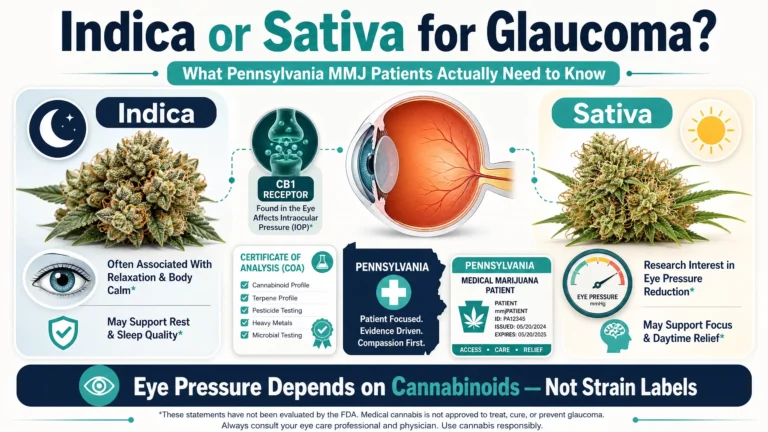

Glaucoma patients searching “indica or sativa for glaucoma” deserve an honest answer and the honest answer has two parts.
First, the indica/sativa label predicts nothing about intraocular pressure reduction.
Need a PA Medical Marijuana Card?
Get certified online in 15 minutes. 100% Money-Back Guarantee.
Get Certified Now →Second, there is a critical cannabinoid fact that most cannabis websites will not tell you: CBD may paradoxically increase intraocular pressure in glaucoma patients, making product selection far more consequential than a simple label choice.
Pennsylvania’s mandatory COA terpene labeling and cannabinoid disclosure gives PA patients the data they need to navigate this correctly.
⚡ Quick Answer
Neither indica nor sativa reliably predicts glaucoma relief, THC’s CB1 receptor activity in ocular tissue is the IOP-reduction mechanism, and CBD may paradoxically increase intraocular pressure in glaucoma patients.
For Pennsylvania residents: Recreational cannabis remains illegal as of July 2026, a valid MMJ card is required to access any of PA’s 186+ licensed dispensaries.
Key Takeaways
- The CBD warning glaucoma patients are not being told, at higher doses, CBD has been shown in peer-reviewed research to increase intraocular pressure rather than reduce it; high-CBD products are not automatically better for glaucoma and may be actively harmful for IOP management
- THC’s IOP-reduction window is only 3–4 hours — to maintain continuous therapeutic pressure reduction, a glaucoma patient would need to dose 6–8 times daily, which raises tolerance, impairment, and legal concerns that most cannabis sites omit entirely
- Neuroprotective terpenes offer a secondary benefit for glaucoma patients — beta-caryophyllene and alpha-pinene have emerging data supporting optic nerve neuroprotection, which addresses glaucoma’s neurodegeneration component beyond IOP reduction alone
- Delivery format determines whether THC reaches ocular tissue at all — cannabis eye drops have poor corneal penetration; vaporized THC achieves meaningful ocular cannabinoid concentrations; this distinction is absent from virtually every recreational cannabis site
- Pennsylvania glaucoma patients need ophthalmologist coordination — cannabis as standalone glaucoma therapy is not supported by current clinical evidence; the strongest patient outcomes involve cannabis as an adjunct to prostaglandin analogs or other first-line IOP medications
Why the Indica/Sativa Question Misses the Real Issue for Glaucoma
The indica/sativa distinction has never been a pharmacological classification, it describes plant morphology and geography, not chemical content or receptor activity.
For most cannabis topics, this means the label is simply unhelpful. For glaucoma specifically, following the indica/sativa label rather than COA cannabinoid data can lead to product choices that actively worsen the condition.

Glaucoma is a progressive optic neuropathy driven primarily by elevated intraocular pressure that damages the optic nerve over time.
Do You Qualify for a PA MMJ Card?
Connect with a licensed Pennsylvania state physician online from home.
The therapeutic question is not “which plant shape reduces eye pressure?”, it is “which cannabinoid profile activates the right receptor mechanism in ocular tissue without counterproductive effects?”
That question is answered by THC percentage and CBD concentration on a product’s Certificate of Analysis, not by whether the label says indica or sativa.
As Ethan Russo’s foundational 2011 entourage effect research established, therapeutic cannabis effect is a product of the full chemical profile acting on multiple receptor systems, a complexity the indica/sativa binary cannot capture.
What Pennsylvania’s 2025 Labeling Update Provides
Pennsylvania’s Department of Health updated dispensary product labeling requirements in 2025 to mandate full terpene profiles and complete cannabinoid panels on every batch-specific COA.
As of July 2026, every product at PA’s 186+ licensed dispensaries must disclose its full cannabinoid content including THC, CBD, THCV, CBG, and CBC, giving glaucoma patients the exact data needed to make clinically informed product decisions.
📋 PA Dispensary Rule: For glaucoma patients, the most important COA data points are THC percentage and CBD percentage, in that order, and for reasons explained in the critical CBD warning section below. Always request the batch-specific COA, not the general product menu listing.
How THC Actually Reduces Intraocular Pressure
The mechanism by which cannabis reduces intraocular pressure has been understood since the 1970s and is well-documented in peer-reviewed literature.

CB1 cannabinoid receptors are expressed in the trabecular meshwork and ciliary body of the eye, the structures responsible for aqueous humor production and drainage that regulate IOP.
THC activates these ocular CB1 receptors, reducing aqueous humor production and increasing uveoscleral outflow, the two mechanisms that collectively lower intraocular pressure.
This is a systemic effect: THC absorbed into the bloodstream reaches ocular tissue through normal circulatory distribution, not through direct ocular contact.
IOP reduction from inhaled or oral THC is clinically meaningful, studies document reductions of 25–30% from baseline in some patients.
⚡ Fast & 100% Online PA Medical Cards
Board-Certified Doctors • 100% Money-Back Guarantee
Book Evaluation Now →This is comparable in magnitude to several pharmaceutical IOP-lowering agents. The clinical limitation is not the magnitude of effect, it is the duration.
Why THC Percentage — Not Indica/Sativa Label — Is the Relevant Variable

Since IOP reduction is a CB1-mediated THC effect, the THC percentage on the COA is the relevant variable for glaucoma patients, not the indica/sativa classification.
A sativa-labeled product with 22% THC and a indica-labeled product with 22% THC will produce equivalent CB1 activation in ocular tissue. The label predicts nothing about the IOP effect.
What varies between products is THC concentration, onset time by delivery format, duration of effect, and CBD content, all of which are documented on the COA and all of which matter clinically for glaucoma management.
The CBD Warning Every Glaucoma Patient Must Read
This is the most important clinical section on this page and the information most likely to be absent from other cannabis websites.
CBD does not reduce intraocular pressure. At higher doses, peer-reviewed research suggests CBD may increase IOP, the opposite of what glaucoma patients need.

A 2018 study published in Investigative Ophthalmology & Visual Science found that CBD administration increased IOP by approximately 18% in animal models and that CBD antagonized the IOP-lowering effects of THC when both were administered together.
As of July 2026, subsequent research has continued to investigate this interaction, and while direct human clinical data remains limited, the signal is consistent and clinically significant enough that the American Academy of Ophthalmology has explicitly cautioned against cannabis use for glaucoma management without ophthalmologist supervision.
⚠️ Critical Warning for Glaucoma Patients: High-CBD cannabis products, including CBD-dominant tinctures, capsules, and edibles marketed for wellness, are not appropriate for glaucoma IOP management and may worsen intraocular pressure.
If you are using cannabis for glaucoma, discuss your full product list with your ophthalmologist and certifying physician before making any product changes.
What This Means for Product Selection
| Product Profile | IOP Effect | Appropriate for Glaucoma? |
|---|---|---|
| High THC, low CBD | IOP reduction via CB1 | ✅ Most appropriate for IOP management |
| Balanced THC:CBD (1:1) | Mixed — CBD may blunt THC IOP effect | ⚠️ Use with ophthalmologist guidance |
| High CBD, low THC | Possible IOP increase | ❌ Not appropriate for IOP management |
| CBD-only (hemp-derived) | Possible IOP increase | ❌ Contraindicated for glaucoma IOP use |
| THCV-containing | Emerging IOP data — preliminary | ⚠️ Discuss with dispensary pharmacist |
This table illustrates precisely why the indica/sativa label is irrelevant for glaucoma and why cannabinoid profile on the COA is the only clinically meaningful product selection tool.
The 3–4 Hour Problem — What Cannabis Can Realistically Do for IOP
This is the honest clinical conversation that most cannabis websites avoid and that a physician’s byline requires addressing directly.

Cannabis reduces intraocular pressure for approximately 3–4 hours per dose. To maintain continuous therapeutic IOP reduction comparable to once-daily prostaglandin analog eye drops, a glaucoma patient would need to dose cannabis 6–8 times daily.
Renewing Your PA MMJ Card?
Quick annual recertification online. No paperwork hassle.
Renew Card Online →At those dosing frequencies, tolerance develops rapidly, impairment accumulates, occupational and driving function are compromised, and the legal implications under Pennsylvania’s per se DUI law become extremely complex.
The American Academy of Ophthalmology’s position on cannabis and glaucoma is clear as of July 2026: cannabis is not recommended as a primary or standalone glaucoma therapy based on this duration limitation alone, independent of the CBD IOP concern.
Where Cannabis Does Offer Genuine Value for Glaucoma Patients
Cannabis is most clinically appropriate for glaucoma patients as an adjunct therapy, used in combination with prescribed IOP medications under ophthalmologist supervision, not as a replacement.
Specific use cases where cannabis may provide genuine benefit include:
- Nocturnal IOP spikes: glaucoma patients who experience elevated IOP during sleep may benefit from an evening cannabis dose that provides 3–4 hours of IOP reduction during the highest-risk pressure window
- Anxiety and sleep comorbidity: glaucoma patients with comorbid anxiety or insomnia (both common in chronic disease populations) may benefit from cannabis addressing those symptoms, with IOP reduction as a secondary effect
- Optic nerve neuroprotection: emerging terpene research suggests neuroprotective benefits independent of IOP reduction, relevant to glaucoma’s progressive optic nerve damage component
Neuroprotective Terpenes and Optic Nerve Preservation
Glaucoma is not purely an IOP condition, it is a progressive optic neuropathy in which elevated pressure drives optic nerve degeneration over time.
Neuroprotection, preserving remaining optic nerve function, is an emerging therapeutic target in glaucoma management as of 2026, and cannabis terpenes with neuroprotective profiles are increasingly relevant to glaucoma patients beyond their IOP effects.

Beta-Caryophyllene — CB2 Neuroprotection
Beta-caryophyllene’s direct CB2 receptor agonism has documented neuroprotective effects in preclinical models.
CB2 activation reduces neuroinflammation and oxidative stress, two mechanisms implicated in retinal ganglion cell death in glaucoma.
While clinical evidence in human glaucoma patients remains preliminary as of July 2026, beta-caryophyllene’s neuroprotective mechanism is the most relevant terpene-level consideration for glaucoma patients beyond IOP.
Alpha-Pinene — Neuroprotective and COX-Inhibitory
Alpha-pinene demonstrates neuroprotective activity in preclinical research through antioxidant and anti-inflammatory pathways.
It’s presence on a COA is a useful secondary data point for glaucoma patients prioritizing optic nerve preservation alongside IOP management.
Get Approved by a Licensed PA Doctor
Schedule your appointment in minutes. You only pay if approved.
Start Online Application →Alpha-pinene also counteracts THC-associated short-term memory impairment through acetylcholinesterase inhibition, practically relevant for glaucoma patients who need to manage IOP while maintaining cognitive function.
| Terpene | Neuroprotective Mechanism | Glaucoma Relevance | Evidence Level |
|---|---|---|---|
| Beta-caryophyllene | CB2 — neuroinflammation reduction | Retinal ganglion cell preservation | Moderate — preclinical |
| Alpha-pinene | Antioxidant, COX inhibition | Optic nerve oxidative stress | Preliminary — preclinical |
| Linalool | GABA-A modulation | IOP-associated anxiety reduction | Preliminary |
| Limonene | Serotonin pathway | Mood, glaucoma-related anxiety | Preliminary |
Delivery Format — What Reaches Ocular Tissue and What Doesn’t
This is a clinically important and almost universally ignored topic in cannabis-glaucoma content.
Not all delivery formats produce meaningful ocular cannabinoid concentrations and for glaucoma patients, understanding this distinction is essential.

Vaporization — Most Effective for Ocular THC Delivery
Inhaled THC achieves peak blood concentrations within minutes and distributes systemically to ocular tissue through the circulatory system.
Vaporized cannabis produces the most rapid and consistent IOP reduction of any legal PA delivery format, with onset within 15–30 minutes and peak IOP reduction at approximately 60–90 minutes post-dose.
Vaporization is also the only legal inhaled method under Pennsylvania Act 16, which explicitly prohibits smoking. For glaucoma patients who need fast-acting IOP reduction, vaporization is the appropriate format choice.
Oral Formats — Delayed but Extended Effect
Capsules, tinctures, and edibles produce systemic THC absorption through GI and hepatic processing.
Onset is slower, 45–120 minutes depending on format and food intake, but duration extends to 4–8 hours, making oral formats more practical for sustained IOP management and nocturnal dosing than vaporization alone.
Sublingual tinctures offer a middle option, partial absorption under the tongue provides faster onset than full GI absorption, with onset of 15–45 minutes and duration of 3–5 hours.
Cannabis Eye Drops — Why They Don’t Work as Marketed
Cannabis-infused eye drops, available from hemp-derived CBD product companies and sometimes discussed in online glaucoma communities, have a fundamental pharmacological problem.
Ready to Get Your Official PA MMJ Card?
State-certified doctor consultations online. No risk—100% refund if not approved.
Claim Your MMJ Card Online →THC and CBD are highly lipophilic molecules that penetrate the corneal aqueous layer very poorly without specialized formulation.
Standard oil-based or aqueous cannabis eye drops produce minimal corneal absorption and negligible intraocular cannabinoid concentrations.
As of July 2026, no FDA-approved or PA-dispensary-available cannabis eye drop formulation has demonstrated clinically meaningful IOP reduction in peer-reviewed human trials.
Glaucoma patients who have been using hemp-derived CBD eye drops believing they are treating their IOP should discuss this with their ophthalmologist.
| Format | Onset | Duration | IOP Efficacy | PA Legal? |
|---|---|---|---|---|
| Vaporization | 15–30 min | 2–3 hrs | ✅ Best for acute IOP reduction | ✅ Yes |
| Sublingual tincture | 15–45 min | 3–5 hrs | ✅ Good for sustained management | ✅ Yes |
| Capsule / tablet | 45–90 min | 5–8 hrs | ✅ Good for nocturnal IOP | ✅ Yes |
| Edible | 60–120 min | 6–10 hrs | ⚠️ Variable absorption | ✅ Yes |
| Eye drops (hemp CBD) | N/A | N/A | ❌ No meaningful IOP effect | ⚠️ Hemp-derived only |
Glaucoma as a PA MMJ Qualifying Condition

Glaucoma is a named qualifying condition under Pennsylvania’s Act 16 of 2016, giving Pennsylvania glaucoma patients direct access to the state’s MMJ program through telehealth certification.
To qualify, patients must have a documented glaucoma diagnosis from a licensed ophthalmologist or optometrist. Pennsylvania does not require patients to have failed specific conventional treatments before qualifying, a diagnosis of glaucoma is sufficient under the current Act 16 framework.
For complete information on the certification process and what documentation to bring to your telehealth appointment, visit the Pennsylvania Glaucoma MMJ qualifying condition page and the full PA qualifying conditions list.
Coordinating Cannabis With Your Ophthalmologist
This is a step that distinguishes responsible glaucoma MMJ use from uninformed self-treatment.
Pennsylvania glaucoma patients using cannabis alongside prescribed IOP medications should inform their ophthalmologist, both because of the CBD-IOP interaction risk and because cannabis may affect IOP measurements taken during routine monitoring appointments.
THC causes vasodilation and can temporarily lower blood pressure, effects that interact with some glaucoma medications including beta-blocker eye drops.
A complete medication and cannabis product disclosure to your ophthalmologist is a clinical safety requirement, not an optional conversation.
Pennsylvania Legal Notes Every Patient Must Read
A Valid PA MMJ Card Is Required
Cannabis remains illegal for recreational use in Pennsylvania as of July 2026. Governor Shapiro has publicly supported legalization and SB 120 is pending a Senate vote, but as of this writing, recreational cannabis is not law.
Accessing cannabis products for glaucoma management without a valid card under Act 16 of 2016 is a criminal offense regardless of diagnosis.
Smoking Is Prohibited Under Pennsylvania Law
Act 16 explicitly prohibits smoking cannabis, even for patients with serious ophthalmic conditions. Legal consumption methods include vaporization, oral tinctures, capsules, edibles, and topical application.
For glaucoma patients, vaporization and oral formats are the most clinically relevant legal options for IOP management.
⚠️ Per Se DUI Law — A Specific Concern for Frequent Glaucoma Dosing
Given that therapeutic IOP management with cannabis requires frequent dosing, potentially 3–4 times daily even as adjunct therapy, glaucoma patients face elevated DUI risk compared to patients using cannabis for conditions requiring less frequent use.
Pennsylvania’s per se DUI standard under 75 Pa.C.S. § 3802(d) makes any detectable THC metabolite in blood a DUI offense, regardless of impairment level or MMJ card status. Commonwealth v. Stone (2022) confirmed that a valid PA MMJ card provides no DUI defense.
For glaucoma patients dosing multiple times daily, THC metabolites will be continuously present in blood, making driving a persistent legal risk that requires explicit discussion with your certifying physician.
DUI reform legislation (SB 63 / HB 983) remains pending as of July 2026 and has not become law.
Getting Certified in Pennsylvania
Telehealth certification is available statewide through pennsylvaniamarijuanacards.com.
| Fee | Amount |
|---|---|
| Physician certification (new patient) | $159 |
| PA state registration fee | $50 |
| Total — new patient | $209 |
| Physician certification (renewal) | $149 |
| PA state registration fee | $50 |
| Total — renewal | $199 |
Patients qualifying for Medicaid, SNAP, WIC, CHIP, PACE, or PACENET may have the $50 PA state fee waived through the MMAP program.
How to Choose the Right Glaucoma Product: 5 Steps

- Pull the batch-specific COA and go straight to the cannabinoid panel. For glaucoma patients, THC percentage and CBD percentage are the two most critical data points, in that order. A high-THC, low-CBD product is the appropriate profile for IOP management. A high-CBD product may worsen IOP. Ignore the indica/sativa label entirely.
- Check the terpene panel for beta-caryophyllene and alpha-pinene. These terpenes offer neuroprotective benefit relevant to glaucoma’s optic nerve degeneration component, independent of IOP effect. A high-THC product that also shows meaningful BCP and pinene concentrations addresses both IOP reduction and neuroprotection simultaneously.
- Select delivery format based on your IOP management pattern. For nocturnal IOP elevation, an evening capsule or edible provides 5–8 hours of sustained coverage during sleep. For daytime breakthrough IOP spikes, a fast-onset vaporizer provides rapid relief within 15–30 minutes. Sublingual tinctures offer a practical middle option for patients who prefer not to vaporize.
- Coordinate with your ophthalmologist before starting or changing products. Disclose your full cannabis product list, including any hemp-derived CBD products, at every ophthalmology appointment. IOP measurements can be affected by recent cannabis use, and your ophthalmologist needs accurate baseline readings to monitor disease progression correctly.
- Start at the lowest effective THC dose. The goal is adequate CB1 activation for IOP reduction, not maximum THC intake. Higher THC doses increase tolerance development, impairment risk, and DUI exposure without proportionally greater IOP benefit. A dispensary pharmacist consultation that includes your glaucoma diagnosis, current medications, and driving needs is an essential step before your first purchase.
💡 Pro Tip: Pennsylvania dispensary pharmacists have access to the same COA data you do and as of July 2026, the most experienced PA dispensary pharmacists are increasingly familiar with the CBD-IOP interaction concern.
Telling your pharmacist “I have glaucoma and I need a high-THC, low-CBD product for IOP management” is the most efficient way to get appropriate product recommendations. Asking for “a good indica for glaucoma” is not.
Frequently Asked Questions
Q: Is indica or sativa better for glaucoma?
A: Neither indica nor sativa reliably predicts glaucoma benefit, because IOP reduction is produced by THC’s activation of CB1 receptors in ocular tissue, a mechanism determined by THC percentage on the COA rather than by the indica/sativa label. Two products with the same THC percentage will produce equivalent CB1-mediated IOP reduction regardless of their label. The more important product selection factor for glaucoma patients is CBD concentration, because at higher doses, CBD has been shown in research to increase rather than decrease intraocular pressure, making high-CBD products potentially harmful for glaucoma IOP management.
Q: Does cannabis actually lower eye pressure in glaucoma?
A: Yes, THC produces clinically meaningful IOP reduction of 25–30% from baseline through CB1 receptor activation in the trabecular meshwork and ciliary body of the eye. This effect is well-documented in peer-reviewed literature dating to the 1970s. The clinical limitation is duration: IOP reduction from a single cannabis dose lasts approximately 3–4 hours, requiring 6–8 daily doses to maintain continuous therapeutic pressure reduction. This frequency creates significant tolerance, impairment, and legal driving concerns that make cannabis impractical as a standalone glaucoma therapy. It is best used as an adjunct to first-line IOP medications under ophthalmologist supervision.
Q: Is CBD good for glaucoma?
A: No, CBD is not appropriate for glaucoma IOP management and may be actively harmful. Research published in Investigative Ophthalmology & Visual Science found that CBD increased intraocular pressure by approximately 18% and antagonized THC’s IOP-lowering effect when administered together. As of July 2026, the American Academy of Ophthalmology has cautioned against unsupervised cannabis use for glaucoma, and the CBD-IOP interaction is a specific concern. Glaucoma patients using hemp-derived CBD products, high-CBD tinctures, or balanced THC:CBD formulations should discuss this with their ophthalmologist immediately.
Q: Does Pennsylvania cover glaucoma as an MMJ qualifying condition?
A: Yes, glaucoma is a named qualifying condition under Pennsylvania’s Act 16 of 2016. Patients with a documented glaucoma diagnosis can pursue telehealth MMJ certification directly. Pennsylvania does not require patients to fail conventional treatments before qualifying, a diagnosis is sufficient. New patient certification costs $209 total ($159 physician fee plus $50 PA state fee). Renewals cost $199. Patients qualifying for Medicaid, SNAP, WIC, CHIP, PACE, or PACENET may have the $50 state fee waived. Details at pennsylvaniamarijuanacards.com.
Q: Can I use cannabis eye drops for glaucoma in Pennsylvania?
A: Cannabis eye drops available from hemp-derived CBD product companies are not effective for IOP reduction. THC and CBD are highly lipophilic molecules that penetrate the corneal aqueous layer very poorly without specialized pharmaceutical formulation. Standard cannabis eye drops produce negligible intraocular cannabinoid concentrations and no meaningful IOP effect in peer-reviewed human trials as of July 2026. PA dispensary products for glaucoma management are inhaled or oral formulations — not eye drops. Glaucoma patients using hemp CBD eye drops should inform their ophthalmologist.
Q: Will a PA MMJ card protect me from DUI if I dose frequently for glaucoma?
A: No, a Pennsylvania MMJ card provides zero DUI protection under the state’s per se DUI law. Under 75 Pa.C.S. § 3802(d), any detectable THC metabolite in blood constitutes a DUI regardless of impairment or card status, confirmed in Commonwealth v. Stone (2022). Glaucoma patients who dose cannabis multiple times daily will have continuously present THC metabolites in blood, making driving a persistent legal risk. DUI reform legislation (SB 63 / HB 983) remains pending as of July 2026. Discuss driving and dosing with your certifying physician explicitly.
Q: Is smoking cannabis legal for glaucoma management in Pennsylvania?
A: No, smoking cannabis is explicitly prohibited under Pennsylvania Act 16 of 2016 regardless of diagnosis or card status. Legal consumption methods for glaucoma management include vaporization, sublingual tinctures, capsules, and edibles. Vaporization provides the fastest IOP-reduction onset among legal PA delivery methods, approximately 15–30 minutes to initial effect, making it the most practical format for acute IOP management. Oral formats provide longer duration appropriate for nocturnal IOP coverage or sustained adjunct therapy.
Medically reviewed by Dr. Johnathon Chance Miller, MD (License #MD474783). This content is for educational purposes only and does not constitute medical advice. Cannabis affects individuals differently. Consult a licensed healthcare provider before using cannabis for any medical condition. Pennsylvania medical marijuana patients must follow all state laws regarding legal methods of consumption. Smoking cannabis is prohibited under PA law. Do not drive after consuming cannabis. THC metabolites remain detectable in blood after psychoactive effects resolve, Pennsylvania’s per se DUI law applies regardless of MMJ card status.
Sources
- Russo EB. Taming THC: potential cannabis synergy and phytocannabinoid-terpenoid entourage effects. Br J Pharmacol. 2011
- Tomida I, et al. Cannabinoids and glaucoma — CB1 receptor and IOP mechanism. Br J Ophthalmol. 2004
- Miller S, et al. Δ9-Tetrahydrocannabinol and cannabidiol differentially regulate intraocular pressure. Invest Ophthalmol Vis Sci. 2018
- Crandall J, et al. Neuroprotection from optic nerve damage — cannabinoid review. Exp Eye Res. 2021
- Gugliandolo A, et al. Beta-caryophyllene neuroprotective mechanisms. Molecules. 2022
- Salehi B, et al. Therapeutic potential of alpha-pinene. Biomolecules. 2019
- Drake DF, et al. Medical marijuana certifications by qualifying condition — Pennsylvania. Annals of Internal Medicine. July 2025. DOI: 10.7326/ANNALS-25-01037
- American Academy of Ophthalmology — Medical Marijuana and Glaucoma position statement
- Pennsylvania Department of Health — Medical Marijuana Program
- Pennsylvania Act 16 of 2016 — Medical Marijuana Act
- 75 Pa.C.S. § 3802(d) — Pennsylvania per se DUI statute