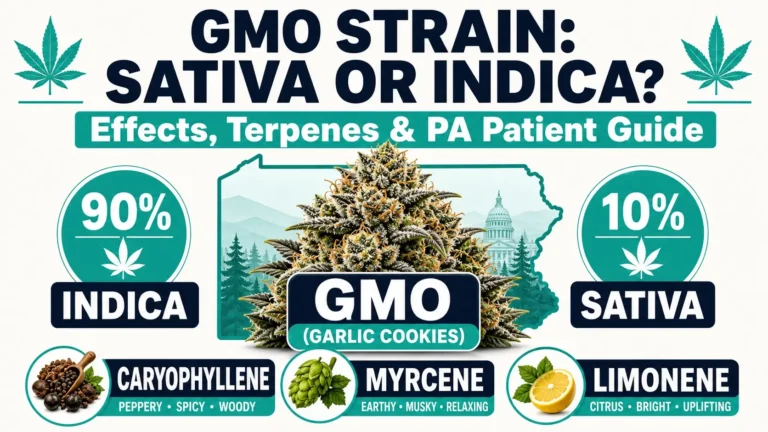

GMO also listed as Garlic Cookies, GMO Cookies, or GMO Garlic Cookies at Pennsylvania dispensaries, is one of the most pharmacologically distinct strains in the legal medical market in 2026.
Born from underground cannabis forums rather than a marketing department, this heavily indica-dominant hybrid carries one of the most clinically relevant terpene profiles for Pennsylvania patients managing chronic pain, insomnia, nausea, and depression.
Need a PA Medical Marijuana Card?
Get certified online in 15 minutes. 100% Money-Back Guarantee.
Get Certified Now →Before you search for it on a dispensary menu, there is one thing every PA patient needs to know: GMO does not stand for “genetically modified organism.”
The name refers to the strain’s unmistakable savory aroma, Garlic, Mushroom, and Onion and has nothing to do with biotechnology.

⚡ Quick Answer
GMO is a heavily indica-dominant hybrid strain (90% indica / 10% sativa), created by crossing Chemdawg D with Girl Scout Cookies (GSC), with THC levels typically testing between 20–33% depending on phenotype and cultivation.
For Pennsylvania residents: GMO appears at select PA dispensaries under multiple names including Garlic Cookies; with 186+ licensed dispensaries statewide as of July 2026, availability varies by region and batch. A valid PA MMJ card under Act 16 of 2016 is required.
Key Takeaways
- GMO is the most indica-dominant widely available strain in PA dispensaries — at 90% indica, it sits in an entirely different therapeutic category than balanced hybrids; patients expecting a “hybrid” experience from this strain will find it far more sedating than anticipated, especially in higher-THC batches.
- Its savory, garlic-forward aroma comes from its Chemdawg lineage and rare sulfurous terpene compounds — these trace compounds are pharmacologically uncommon in other strains and gave rise to an entire “funky strains” subcategory in modern cannabis breeding; they also explain why GMO’s aroma is polarizing for new patients but deeply valued by experienced ones.
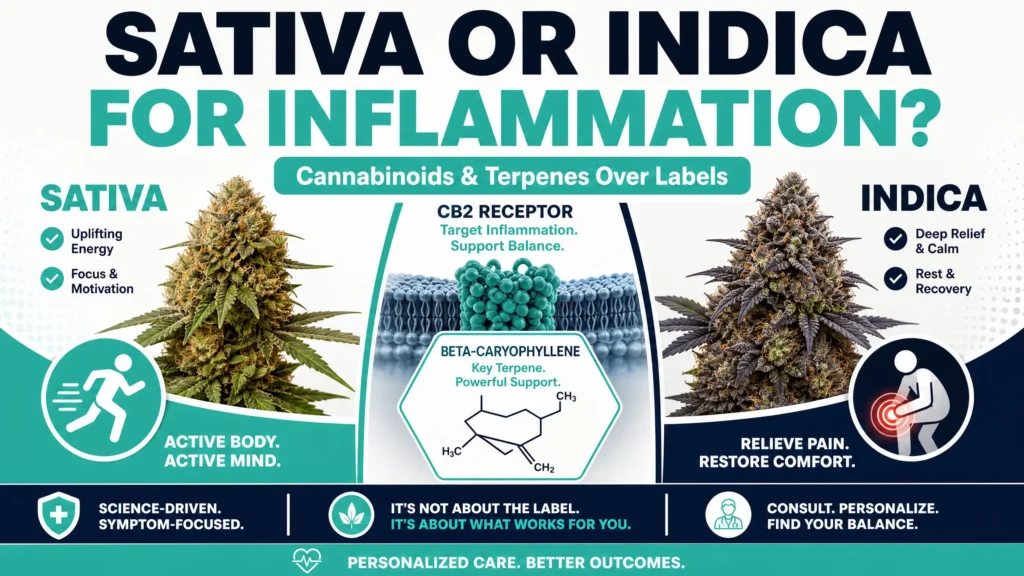
- Caryophyllene dominates GMO’s terpene profile and is the most clinically important terpene for chronic pain patients — as the only known terpene that directly activates CB2 receptors, caryophyllene provides anti-inflammatory and analgesic effects through a mechanism independent of THC’s psychoactive pathways.
- Despite its overwhelming indica classification, GMO’s onset begins with a cerebral, almost sativa-like euphoria — this counterintuitive effect profile is explained by its Chemdawg parent’s balanced hybrid genetics, and is one of the most frequently misunderstood aspects of the strain.
- Pennsylvania DUI law makes GMO’s long-lasting effects a specific planning consideration — patient reviews consistently note effects lasting 3–5 hours or longer; under 75 Pa.C.S. § 3802(d), THC metabolites detectable in blood after effects resolve still constitute a DUI regardless of card status.
Is GMO Sativa or Indica?
GMO is a heavily indica-dominant hybrid 90% indica / 10% sativa, making it one of the most indica-weighted strains commonly stocked at Pennsylvania dispensaries.

For clinical purposes, this classification matters: GMO is not a strain for daytime use, productivity, or patients seeking balanced effects. Its indica dominance produces deep physical sedation, prolonged body relaxation, and pronounced sleep-inducing properties at moderate-to-higher doses.
The genetic story behind GMO begins in the underground. In the early 2010s, Spanish seed bank Mamiko Seeds developed Chem Cookies, a cross of Chemdawg D and the GSC Forum cut.
Do You Qualify for a PA MMJ Card?
Connect with a licensed Pennsylvania state physician online from home.
From that batch, a breeder known as Skunkmasterflex hunted out the phenotype that became famous as GMO. Mamiko Seeds named it simply GMO; early dispensaries, uncomfortable with the name on retail shelves, relabeled it Garlic Cookies, a name that stuck and remains common at Pennsylvania dispensaries today.
Both parent strains carry meaningful indica genetics.
Girl Scout Cookies (OG Kush × Durban Poison) is itself indica-dominant, renowned for euphoric, full-body effects and complex terpene expression. Chemdawg D, while technically a more balanced hybrid, passes on aggressive potency, a fuel-forward aroma, and the rare sulfurous compounds responsible for GMO’s signature garlic-onion character.
The offspring of these two powerhouses pushed strongly toward the indica end of the spectrum, producing the heavy, long-lasting body effects that define GMO’s therapeutic identity.
The 10% sativa genetics, however, have a clinically relevant role. They deliver GMO’s initial cerebral onset, the euphoric, almost social burst that surprises patients expecting immediate sedation.
This effect sequencing is one of GMO’s most documented and misunderstood characteristics, covered in detail in the effects section below.

⚠️ COA Callout: At Pennsylvania dispensaries, GMO may appear as Garlic Cookies, GMO Cookies, or GMO Garlic Cookies. Less commonly, it may appear as Chem Cookies. When verifying authenticity, look for Chemdawg D × GSC Forum cut lineage documentation and a caryophyllene-myrcene dominant terpene profile on the batch COA. Pennsylvania’s 2025 DOH update requires full terpene disclosure on all licensed products, giving PA patients a reliable verification tool.
As Dr. Ethan Russo established in his landmark entourage effect research in the British Journal of Pharmacology (2011), the therapeutic character of any cannabis product is governed by its full terpene-cannabinoid profile, not its subspecies classification.
GMO’s indica label is useful directional guidance but the COA terpene data tells the complete clinical story.
GMO Cannabinoid Profile

| Cannabinoid | Typical Range | What It Means for PA Patients |
|---|---|---|
| THC | 20–24% (standard); 28–33% (premium phenotypes) | High to very high potency; significant dose management required |
| CBD | <1% | Minimal CBD buffering — terpene profile is the primary modulator |
| THC:CBD Ratio | ~25:1 | Strongly THC-dominant; full psychoactive and sedative profile |
| THCA (pre-decarb) | 20–33% | Converts to THC upon vaporization |
GMO’s THC range spans a significant spectrum depending on phenotype. Standard commercial batches test at 20–24% THC — potent but manageable for patients with some cannabis experience.
Premium phenotypes selected for maximum resin production regularly test 28–33%, with some dispensary lab results reaching this upper range.
⚡ Fast & 100% Online PA Medical Cards
Board-Certified Doctors • 100% Money-Back Guarantee
Book Evaluation Now →The spread between 20% and 33% THC represents a dramatically different clinical experience, and the only reliable way to know which tier a specific batch occupies is the COA.
The near-total absence of CBD means patients receive essentially no natural cannabidiol modulation of THC’s psychoactive intensity.
At GMO’s THC levels combined with myrcene’s sedative properties, the combined effect can be profoundly sedating for patients without established tolerance.
Anxiety disorder — Pennsylvania’s leading qualifying condition, cited in over 68% of certifications according to Drake et al. in the Annals of Internal Medicine (July 2025, DOI: 10.7326/ANNALS-25-01037), warrants particular caution here.
High-dose THC can worsen anxiety in sensitive patients regardless of terpene content. GMO is not typically the first-line strain recommendation for anxiety patients, and should be approached with extreme conservatism if used for this purpose.
GMO Terpene Profile
Pennsylvania’s 2025 DOH update mandates full terpene labeling across all licensed products.
GMO’s three dominant terpenes, caryophyllene, myrcene, and limonene, each contribute distinct and well-researched pharmacological properties that directly explain its therapeutic applications.

Caryophyllene — The Lead Terpene and Primary Pain Driver
Beta-caryophyllene is GMO’s dominant terpene and its most clinically significant compound for chronic pain patients. Its spicy, peppery character comes through on the exhale, underlying the garlic-savory top notes.
Pharmacologically, it is the only known terpene that directly activates CB2 receptors, classifying it simultaneously as a terpene and a dietary cannabinoid, capable of producing anti-inflammatory effects through the endocannabinoid system without psychoactivity of its own.
A 2025 review published in MDPI Pharmaceuticals (July 2025), which systematically analyzed over 200 peer-reviewed studies on cannabis terpenes and chronic pain, identified beta-caryophyllene as one of the most mechanistically supported terpenes for pain and inflammation, citing its CB2 activation, TRP channel modulation, and opioid pathway interactions.
A separate study in European Neuropsychopharmacology documented analgesic effects in animal models, while research in Physiology & Behavior found caryophyllene produces anxiolytic effects through stress-response modulation.
- Mechanism: Direct CB2 receptor agonist; anti-inflammatory; analgesic via opioid and TRP pathways
- Best for: Chronic pain, neuropathic pain, inflammation, muscle spasms, anxiety
- Evidence level: Robust preclinical; strong mechanistic support; emerging human data
Myrcene — The Sedation and Deep Body Relaxation Driver
Renewing Your PA MMJ Card?
Quick annual recertification online. No paperwork hassle.
Renew Card Online →Myrcene is the earthy, musky terpene that amplifies and deepens GMO’s signature body sedation. It is the most abundant terpene in cannabis broadly, and its high lipophilicity gives it efficient access to the blood–brain barrier.
Preclinical research shows myrcene reduces joint pain and inflammation through a cannabinoid receptor mechanism, with local application demonstrating measurable reduction in both pain and inflammation markers.
Animal models document sedative and muscle-relaxant properties.
Critically, myrcene amplifies THC’s psychoactive and sedative effects by facilitating THC’s crossing of the blood–brain barrier.
In GMO’s 90% indica context, this myrcene potentiation effect is a central part of why this strain produces such pronounced body sedation.
For PA patients managing pain-disrupted sleep or muscle spasticity, this myrcene-THC synergy is therapeutically meaningful.
- Mechanism: TRPV1 channel engagement; cannabinoid receptor interaction; blood–brain barrier facilitation for THC
- Best for: Insomnia, muscle spasms, spasticity, pain relief, nausea
- Evidence level: Robust preclinical across multiple study models
Limonene — The Counterbalancing Cerebral Terpene
Limonene appears in smaller concentrations in GMO than caryophyllene and myrcene, but its clinical role is disproportionate to its quantity.
Limonene is the terpene most directly responsible for GMO’s counterintuitive cerebral onset, the mood elevation and social euphoria that precedes the deep indica body effect.
A 2024 double-blind, placebo-controlled crossover study from Johns Hopkins University and the University of Colorado found that inhaled d-limonene combined with THC significantly reduced anxiety, nervousness, and paranoia compared to THC alone.
In GMO’s clinical context, limonene acts as the partial anxiety buffer at the onset phase, explaining why many patients report that GMO, despite its extreme indica classification and high THC, does not feel immediately anxiety-provoking in the way that some sativa-heavy high-THC products can.
This limonene cushion is present in authentic GMO batches; it may be diminished or absent in mislabeled or improperly cured products, making COA verification especially important for anxiety-sensitive patients.
- Mechanism: Serotonin and dopamine modulation; anxiety-buffering interaction with THC
- Best for: Mood elevation, anxiety modulation, initial euphoric onset
- Evidence level: Human clinical (double-blind crossover, 2024, Johns Hopkins / U of Colorado)
Entourage Effect Note: GMO’s caryophyllene-myrcene-limonene combination exemplifies the entourage effect described by Russo (2011). Caryophyllene targets CB2 receptors for pain and inflammation; myrcene amplifies THC’s sedative and analgesic reach; limonene modulates anxiety at the onset.
Together, these compounds produce an effect profile more nuanced than its “heavy indica” label alone suggests but only when all three are confirmed present on a batch-specific COA.
Therapeutic Effects for PA Patients
Get Approved by a Licensed PA Doctor
Schedule your appointment in minutes. You only pay if approved.
Start Online Application →GMO’s effect sequence is one of the most distinctive and frequently surprising in medical cannabis and understanding it prevents dosing errors.

- Onset (5–15 min, vaporized): Cerebral euphoria — uplift, social ease, mood elevation; described by multiple reviewers as “almost sativa-like” and “giggly”; limonene’s serotonin effects are active here
- Mid-phase (30–60 min): Transition into full-body warmth and relaxation; physical tension and pain begin to resolve; the indica genetics become the dominant experience
- Later phase (60–180+ min): Deep sedation, muscle relaxation, and in higher doses, full couch-lock; potential for sleep onset; effects documented lasting 3–5 hours or longer in patient reports
This onset-to-sedation progression is GMO’s defining therapeutic characteristic. Patients who take a second dose during the initial cerebral phase, before the body sedation arrives, frequently report overconsumption.
Waiting for the full effect to develop before reassessing dose is not just advisable; for GMO at 28%+ THC, it is essential.
Who Should Use Caution
- Anxiety patients with THC sensitivity — despite limonene’s buffering role, GMO’s high THC at doses above a patient’s tolerance can trigger or worsen anxiety; start at the minimum effective dose and do not escalate during the cerebral onset phase
- Daytime patients who need productivity or cognitive clarity — GMO’s sedative later phase makes it unsuitable for daytime use in most patients; plan for evening or nighttime consumption
- First-time or low-tolerance MMJ patients — GMO at even 20% THC combined with its myrcene content produces pronounced sedation; new MMJ patients should not start with this strain without physician guidance
- All patients who must drive — GMO’s long-lasting effect profile, combined with Pennsylvania’s per se DUI law, requires careful advance transportation planning
What Conditions Is GMO Used For?

Severe Chronic and Intractable Pain
GMO is one of the most consistently cited strains for chronic pain relief across patient review platforms, and its terpene pharmacology supports that reputation.
Caryophyllene’s CB2 activation, myrcene’s cannabinoid-receptor-mediated analgesic pathway, and the combined opioid-sparing potential of these terpenes, documented in a July 2024 University of Arizona Health Sciences study, make GMO’s terpene profile directly relevant to Pennsylvania patients certified under severe chronic and intractable pain.
Patients managing neuropathic pain are also frequently noted in patient reports as benefiting from GMO’s caryophyllene-dominant profile.
Insomnia and Sleep Disruption
Myrcene’s sedative properties, combined with GMO’s 90% indica classification and 20–33% THC, make this strain one of the strongest candidates at Pennsylvania dispensaries for patients whose qualifying conditions include significant sleep disruption.
Patient reviews through March 2026 on AllBud consistently document GMO as a nighttime strain with extended sedative effects.
Multiple PA patients report using GMO specifically for insomnia associated with chronic pain and PTSD, both recognized qualifying conditions in Pennsylvania.
For patients certified under PTSD, GMO’s prolonged body sedation addresses both the hyperarousal and the sleep disruption components of the condition.
Depression and Mood Disorders
Ready to Get Your Official PA MMJ Card?
State-certified doctor consultations online. No risk—100% refund if not approved.
Claim Your MMJ Card Online →Leafly and patient data consistently identify depression as a primary qualifying use for GMO.
The strain’s limonene-driven euphoric onset, described as a “wave of calming euphoria that washes away tension”, provides the mood-elevating component, while the deeper body relaxation addresses the somatic symptoms that frequently accompany depression.
Caryophyllene’s documented antidepressant effects in the Journal of Psychopharmacology, combined with limonene’s serotonin modulation, give GMO meaningful mechanistic support for patients managing depression alongside pain or sleep disorders.
Nausea and Appetite Loss
Leafly’s patient data and dispensary descriptions consistently identify nausea relief and appetite stimulation as documented uses for GMO.
Patient reviews through 2026 note the strain’s munchie-inducing properties as among the most pronounced of any strain they have used, directly relevant to Pennsylvania patients qualifying under conditions that include nausea, appetite loss, or those undergoing treatments that suppress appetite.
Pennsylvania recognizes qualifying conditions including cancer and HIV/AIDS where nausea and appetite management are central therapeutic goals.
Muscle Spasms and Spasticity
Myrcene’s documented muscle-relaxant properties, combined with caryophyllene’s CB2-mediated anti-inflammatory effects, position GMO as clinically relevant for Pennsylvania patients managing spasticity-related conditions.
The MDPI Pharmaceuticals 2025 review specifically identified both terpenes among those with analgesic activity through TRP receptor modulation, a mechanism relevant to muscle spasm disorders.
Pennsylvania recognizes CNS damage and intractable spasticity and multiple sclerosis as qualifying conditions where muscle relaxation is a primary therapeutic goal.
GMO at Pennsylvania Dispensaries
GMO is stocked at select Pennsylvania dispensaries among the state’s 186+ licensed facilities as of July 2026. It appears under multiple names: GMO, Garlic Cookies, GMO Cookies, and GMO Garlic Cookies are all in active use on PA dispensary menus.

Maitri Medicinals in Pennsylvania carries GMO-lineage products including Wookie Burger (a cross of Wookie #15 and GMO Garlic Cookies), and GMO has been listed on PA strain resource sites as among the most recommended strains for pain management.
| Product Format | Typical Onset | Duration | Best Used For |
|---|---|---|---|
| Dry flower (vaporized) | 5–15 min | 3–5 hours | Precise dose control; full terpene delivery |
| Vape cartridge | 5–10 min | 2–4 hours | Portability; consistent dosing |
| Oral capsule | 45–90 min | 6–10 hours | Overnight pain and sleep relief |
| Tincture (sublingual) | 15–45 min | 4–7 hours | Adjustable dosing; sustained relief |
| Concentrated oil (rosin) | 5–15 min (vaporized) | 4–6 hours | Experienced patients; maximum potency |

Dispensary Pharmacist Tip: At Pennsylvania dispensaries, ask for GMO by describing your therapeutic goal rather than the strain name alone. Request products with a caryophyllene-dominant, myrcene-secondary terpene profile and Chemdawg × GSC lineage documentation on the COA.
If your dispensary’s current inventory does not include authentic GMO, a pharmacist familiar with the terpene profile can often identify an equivalent product. Availability rotates frequently and varies significantly by region across PA’s 186+ dispensary network.
Always request the batch-specific COA. The wide THC range in GMO (20–33% across phenotypes) means a generic strain description cannot guide accurate dosing.
The batch COA is the only reliable tool for confirming both THC percentage and terpene profile before purchase.
Pennsylvania Legal Notes

✅ Valid PA MMJ Card Required Cannabis remains illegal for recreational use in Pennsylvania as of July 2026. Accessing GMO or Garlic Cookies at any Pennsylvania dispensary requires a valid patient card under Act 16 of 2016.
🚫 Smoking Is Prohibited Under PA Law Act 16 explicitly prohibits smoking cannabis in Pennsylvania. Legal consumption methods include vaporization of dry flower or concentrates, oral capsules, tinctures, topicals, and edibles. Nothing on this page endorses or implies smoking as a legal consumption method in Pennsylvania.
⚠️ Pennsylvania DUI Law — Especially Relevant for GMO Under 75 Pa.C.S. § 3802(d), any detectable THC metabolites in your blood constitutes a DUI, regardless of impairment, time elapsed, or MMJ card status.
Commonwealth v. Stone (2022) confirmed that a PA MMJ card is not a legal defense to a DUI charge. GMO’s documented 3–5+ hour effect duration, combined with its high THC range, means metabolites remain in blood long after effects resolve. Plan transportation before consuming this strain. Do not drive after use.
Getting Certified in Pennsylvania
Legal access to GMO starts with a valid PA MMJ card. Dr. Johnathon Chance Miller, MD (License #MD474783) conducts telehealth certifications for Pennsylvania residents.
| Fee | Amount |
|---|---|
| Physician certification (new patient) | $159 |
| PA state registration fee | $50 |
| Total — new patient | $209 |
| Physician certification (renewal) | $149 |
| PA state registration fee | $50 |
| Total — renewal | $199 |
MMAP Fee Waiver: Patients qualifying for Medicaid, SNAP, WIC, CHIP, PACE, or PACENET may have the $50 state fee waived. Start your telehealth certification here.
How to Choose the Right GMO Product?
Follow these five steps before purchasing any GMO or Garlic Cookies product at a Pennsylvania dispensary:

- Verify the name on the COA — not just the shelf. Confirm the product lists Chemdawg D × GSC (or Chem D × GSC Forum cut) lineage. GMO’s many aliases mean the shelf name alone is insufficient for verification.
- Check the THC percentage on the batch COA. Decide whether a standard batch (20–24%) or a premium phenotype (28–33%) is appropriate for your tolerance and qualifying condition before selecting a product.
- Confirm caryophyllene and myrcene are present and leading the terpene profile. A batch that shows limonene or other terpenes as the dominant compounds may not be an authentic GMO expression and may not deliver the pain-relieving or sedative properties you are seeking.
- Select the delivery format based on the duration of relief you need. Overnight pain and sleep patients benefit from longer-duration oral capsule formats; patients needing rapid onset for acute pain management may prefer vaporized flower.
- Start at the lowest available dose and wait through the full onset-to-sedation sequence before reassessing. GMO’s cerebral onset phase can last 20–40 minutes before the full body sedation develops; dosing again during this window is the most common cause of overconsumption with this strain.
Pro Tip: GMO is widely considered one of the best strains in legal markets for solventless concentrate (rosin) production, due to its exceptional trichome density and resin yield.
If rosin or live resin concentrate formats are available at your PA dispensary, they represent the fullest expression of GMO’s terpene profile but at significantly elevated THC concentrations (often 70–85%). Concentrate formats are appropriate only for experienced patients with established tolerance.
Frequently Asked Questions
Q: Is GMO sativa or indica?
A: GMO is a heavily indica-dominant hybrid 90% indica / 10% sativa, bred from Chemdawg D and Girl Scout Cookies by Mamiko Seeds. Its 90% indica classification makes it one of the most indica-weighted strains stocked at Pennsylvania dispensaries. It produces deep physical sedation, prolonged body relaxation, and sleep-inducing effects at moderate-to-higher doses. The 10% sativa genetics contribute a distinctive cerebral euphoria at onset that often surprises patients expecting immediate sedation. The strain appears under multiple names in PA dispensaries, including Garlic Cookies, GMO Cookies, and GMO Garlic Cookies.
Q: What does GMO stand for in the cannabis strain?
A: GMO stands for Garlic, Mushroom, and Onion, referring to the strain’s distinctive savory aroma profile, not genetically modified organisms. The name was popularized after the phenotype’s unique garlicky, funky character became its defining identity. Some dispensaries found the “GMO” label commercially awkward and relabeled it Garlic Cookies, which remains in common use at Pennsylvania dispensaries today. The GMO acronym has nothing to do with genetic engineering; this is a naturally bred cannabis cultivar descended from Chemdawg D and Girl Scout Cookies.
Q: What terpenes are in the GMO strain?
A: GMO’s dominant terpenes are beta-caryophyllene, myrcene, and limonene. Caryophyllene is the lead terpene, producing anti-inflammatory and analgesic effects through direct CB2 receptor activation, making it the primary pain-relief driver in this strain’s profile. Myrcene amplifies THC’s sedative properties and contributes muscle-relaxant effects through TRPV1 channel and cannabinoid receptor pathways. Limonene appears in smaller amounts but provides the initial euphoric onset and partially moderates THC-induced anxiety, as documented in a 2024 double-blind human clinical study. Pennsylvania’s 2025 DOH terpene labeling update makes it possible to verify all three on the batch COA.
Q: How much THC does the GMO strain have?
A: GMO typically tests between 20–24% THC in standard commercial batches, and 28–33% in premium phenotypes. The wide range reflects real variation between cultivators, phenotype selections, growing conditions, and post-harvest handling. This spread from 20% to 33%, represents a meaningful clinical difference in dosing and patient experience. Always verify the specific batch THC percentage on the COA from your Pennsylvania dispensary before determining your starting dose.
Q: Is GMO available at Pennsylvania dispensaries?
A: GMO is available at select Pennsylvania dispensaries among the state’s 186+ licensed facilities as of July 2026, often listed as Garlic Cookies, GMO Cookies, or GMO Garlic Cookies. Availability varies by region and batch inventory. Pennsylvania-based strain resources and Maitri Medicinals list GMO and GMO-lineage products in active PA dispensary rotation. When searching for GMO by name, also search “Garlic Cookies” to capture all available products. Ask the dispensary pharmacist to confirm caryophyllene-myrcene dominant terpene profile and Chemdawg × GSC lineage on the COA.
Q: Can I get a PA medical marijuana card to access GMO?
A: Yes, a valid PA MMJ card under Act 16 of 2016 is required to legally purchase GMO or Garlic Cookies at any Pennsylvania dispensary. Recreational cannabis remains illegal in Pennsylvania as of July 2026. Pennsylvania Marijuana Cards offers telehealth certifications with Dr. Johnathon Chance Miller, MD (License #MD474783). New patient certification costs $209 total ($159 physician fee + $50 PA state registration fee). Patients enrolled in Medicaid, SNAP, WIC, CHIP, PACE, or PACENET may qualify for a state fee waiver through Pennsylvania’s MMAP program.
Q: Is GMO good for chronic pain?
A: GMO is one of the most clinically well-supported strains for chronic pain based on its terpene pharmacology. Caryophyllene’s CB2 receptor activation provides anti-inflammatory and analgesic effects through a pathway that operates independently of THC’s psychoactive mechanism. Myrcene adds analgesic depth through cannabinoid receptor and TRPV1 pathway engagement. A 2024 University of Arizona study found that beta-caryophyllene was among the terpenes equally effective as morphine in preclinical neuropathic pain models. Pennsylvania patients certified under severe chronic and intractable pain or neuropathies will find GMO’s terpene profile among the most pharmacologically relevant for their qualifying condition.
Medically reviewed by Dr. Johnathon Chance Miller, MD (License #MD474783). This content is for educational purposes only and does not constitute medical advice. Cannabis affects individuals differently. Consult a licensed healthcare provider before using cannabis for any medical condition. Pennsylvania medical marijuana patients must follow all state laws regarding legal methods of consumption. Smoking cannabis is prohibited under PA law. Do not drive after consuming cannabis. THC metabolites remain detectable in blood after psychoactive effects resolve, Pennsylvania’s per se DUI law applies regardless of MMJ card status.
Sources
- Russo, E.B. (2011). Taming THC: potential cannabis synergy and phytocannabinoid-terpenoid entourage effects. British Journal of Pharmacology.
- Drake, C. et al. (July 2025). Pennsylvania MMJ certification trends. Annals of Internal Medicine. DOI: 10.7326/ANNALS-25-01037
- Phytochemical Modulators of Nociception: Cannabis Terpenes in Chronic Pain Syndromes. MDPI Pharmaceuticals, July 2025.
- University of Arizona Health Sciences (May 2024). Cannabis terpenes for neuropathic pain — beta-caryophyllene opioid-equivalent analgesic effects. Via Emerald Bay Extracts.
- Johns Hopkins University / University of Colorado (2024). Double-blind crossover study: limonene + THC anxiety reduction. Via Emerald Bay Extracts.
- Pennsylvania Department of Health — Medical Marijuana Program
- Pennsylvania Act 16 of 2016 — Medical Marijuana Act
- 75 Pa.C.S. § 3802(d) — Pennsylvania DUI Statute
- Caryophyllene and myrcene anti-inflammatory and pain reduction research. Releaf UK terpene pain review.
- GMO strain data, patient reviews — AllBud.com (reviews through March 2026)
- GMO strain overview — Strainpedia, April 2026.
- GMO strain profile: terpenes to effects — Mood.com, February 2026.
- GMO origin story: from forums to cult. Ripper Seeds, September 2025.
- GMO Cookies strain information — Leafly.
- GMO strain available in PA — Thrive Flower PA Medical Strains 2025.