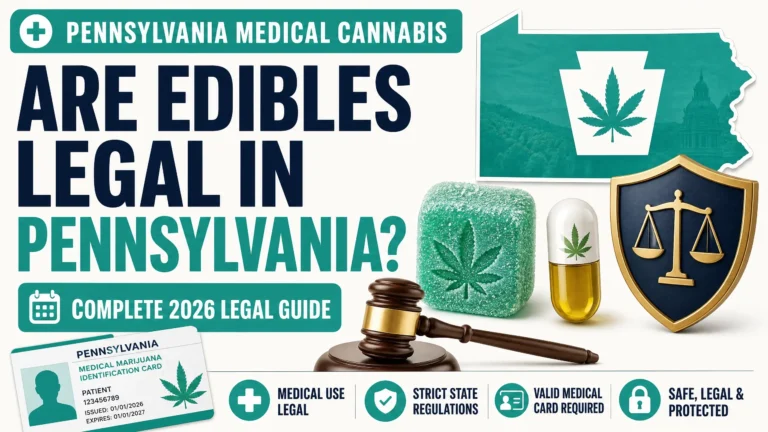

You see delta 9 gummies at a PA smoke shop. Your friend brings edibles from New Jersey. A Pennsylvania dispensary shows you capsules and tinctures but no brownies or candy. You’re wondering which of these is actually legal and which could get you in trouble.
The honest answer is: It depends entirely on what type of edible, where it came from, and how you got it.
Need a PA Medical Marijuana Card?
Get certified online in 15 minutes. 100% Money-Back Guarantee.
Get Certified Now →Pennsylvania has three completely different legal frameworks covering edibles in 2026, and the rules for each are distinct.
This guide breaks down all three clearly, covers what’s changing in November 2026, and explains what PA medical marijuana patients can actually purchase at licensed dispensaries.
Key Takeaways
- Hemp-derived delta 9 edibles from smoke shops are legal now under the 2018 Farm Bill and Pennsylvania’s Industrial Hemp Act (3 Pa.C.S. §701), provided the product contains no more than 0.3% delta-9 THC by dry weight.
- Pennsylvania licensed dispensaries do NOT sell gummies, brownies, or traditional food-based edibles. The PA Medical Marijuana Act (Act 16) explicitly excludes food-form products from approved dispensary formats.
- Marijuana-derived edibles are illegal in Pennsylvania for anyone without an MMJ card, and even MMJ patients cannot buy them at PA dispensaries.
- Bringing edibles from other states into Pennsylvania is illegal, regardless of whether they were purchased legally in that state. Possession is a misdemeanor under 35 P.S. §780-113.
- Federal law H.R. 5371, effective November 12, 2026, imposes a 0.4mg per-container THC cap that will eliminate most hemp delta 9 gummies currently sold in Pennsylvania.
- PA MMJ patients can purchase capsules, oils, and tinctures at licensed dispensaries. These provide oral cannabis consumption in measured doses with state-mandated COA testing.
The Three-Category Breakdown
Before going into detail, here is the complete picture in one table. Every edibles question in Pennsylvania falls into one of these three categories:

| Category | Legal Status | Source | Requires MMJ Card? | Changing in 2026? |
|---|---|---|---|---|
| Hemp-derived delta 9 edibles (smoke shop/online) | Legal NOW under Farm Bill and 3 Pa.C.S. §701 | PA smoke shops, online retailers | No | Yes, Nov 2026 federal ban |
| Marijuana-derived edibles at PA dispensaries | Not sold. PA dispensaries cannot sell food-form products under Act 16 | Licensed PA dispensaries | Card required but product unavailable | No change expected |
| Marijuana-derived edibles (illegal market or out of state) | Illegal. Misdemeanor under 35 P.S. §780-113 | Other states, informal sources | N/A | Still illegal |
Do You Qualify for a PA MMJ Card?
Connect with a licensed Pennsylvania state physician online from home.
Most of the confusion about PA edibles comes from not knowing which category a specific product falls into. The source plant and purchase location determine almost everything.
Category 1: Hemp-Derived Edibles at PA Smoke Shops

What Is Legal Right Now
Hemp-derived delta 9 THC edibles are legal in Pennsylvania today. Pennsylvania’s Industrial Hemp Act (Act 92 of 2016), codified at 3 Pa.C.S. §§701-710, aligns with the federal 2018 Farm Bill to allow hemp-derived products containing no more than 0.3% delta-9 THC by dry weight. The Pennsylvania Department of Agriculture administers this program.
This legal framework is why you can walk into a PA smoke shop today and find:
- Delta 9 gummies labeled 5mg, 10mg, or 25mg THC
- Hemp-infused chocolates and candies
- Delta 9 beverages and seltzers
- Hemp tinctures with meaningful delta 9 content
The molecule in these products is chemically identical to the THC in PA dispensary products. The legal distinction comes entirely from the source plant and the dry-weight test at harvest. A product that tests at or below 0.3% delta-9 by dry weight of the finished product qualifies as hemp and is legal to sell and possess without a medical card.
The Dry-Weight Math
A 5-gram gummy (5,000mg) can legally contain up to 15mg of delta-9 THC and still qualify as hemp under the 0.3% threshold. A 10-gram gummy could contain up to 30mg. This is the mechanism that allows meaningful psychoactive doses in products sold without any prescription or medical card at Pennsylvania retail locations.
Pennsylvania does not currently set a per-serving or per-package milligram cap beyond the 0.3% dry-weight federal standard. No MMJ card is required. No age minimum is mandated by state law for hemp products, though most retailers voluntarily card at 21.
One Critical Caveat
All of this is legal only until November 2026. See the dedicated section below.
Category 2: Marijuana-Derived Edibles at PA Dispensaries
The Surprising Truth Most Patients Don’t Know
Here is where most people get confused: Pennsylvania’s licensed medical marijuana dispensaries do not sell gummies, brownies, chocolates, or any traditional food-based edible products.
This is not a gap in supply or a product category that hasn’t arrived yet. It is an explicit prohibition. The Pennsylvania Medical Marijuana Act (Act 16 of 2016, 35 P.S. §§10231.101 to 10231.2110) approved specific forms of cannabis for dispensary sale. Food-based edibles are not among them.
⚡ Fast & 100% Online PA Medical Cards
Board-Certified Doctors • 100% Money-Back Guarantee
Book Evaluation Now →The approved dispensary product formats under Act 16 are:
- Dry leaf flower (for vaporization only, not smoking)
- Vape cartridges and concentrates
- Tinctures and sublingual preparations
- Capsules and softgels
- Oral oils and liquid concentrates
- Topicals (creams, balms, patches)
No gummies. No chocolates. No infused beverages. No baked goods. A registered PA MMJ patient with a valid card cannot purchase these products at any licensed Pennsylvania dispensary because dispensaries are not permitted to stock them.
Why PA Dispensaries Cannot Sell Gummies
This restriction surprises most people who expect Pennsylvania dispensaries to look like those in New Jersey, Colorado, or Maryland. The explanation comes from how Act 16 was written.

When Pennsylvania lawmakers debated the Medical Marijuana Act in 2015 and 2016, two concerns drove the food-form edibles prohibition:
Child safety
Legislators were concerned about marijuana-infused candies and gummies being mistaken for regular candy by children. Unlike a capsule or tincture, a THC gummy looks identical to a non-infused gummy bear.
The visual indistinguishability created an accidental ingestion risk that the legislature chose to eliminate by prohibiting the format entirely rather than requiring specific packaging.
Dosing accuracy
Cannabis-infused food products are harder to manufacture with consistent, precise dosing than capsules or measured tinctures. A capsule labeled 10mg THC should contain exactly 10mg.
A hand-made cannabis brownie cut into 12 pieces is inherently less precise. The legislature and PA DOH wanted medical cannabis to function more like pharmaceutical products, with verified, consistent dosing rather than approximated food servings.
As Pennsylvania’s Medical Marijuana Act regulations specify, approved forms were chosen deliberately to exclude food-based products. There has been ongoing lobbying to add edibles to the approved list, but as of July 2026, no change to Act 16 has been enacted to permit them.
Category 3: Edibles From Other States or Informal Sources
This category is the clearest legally. Marijuana-derived edibles purchased outside Pennsylvania, whether from a legal dispensary in New Jersey, Maryland, or Ohio, or from an informal source, are illegal to possess in Pennsylvania.

Renewing Your PA MMJ Card?
Quick annual recertification online. No paperwork hassle.
Renew Card Online →Under 35 P.S. §780-113, possession of marijuana in Pennsylvania carries the following penalties:
| Amount | Charge | Maximum Penalty |
|---|---|---|
| 30 grams or less | Misdemeanor | 30 days in jail, $500 fine |
| More than 30 grams | Misdemeanor | 1 year in jail, $5,000 fine |
| Any amount (second offense) | Enhanced penalties | Doubled charges |
Pennsylvania does not recognize out-of-state medical marijuana cards. A valid New Jersey MMJ card or a Colorado recreational purchase provides no legal protection the moment you cross into Pennsylvania. The edibles are illegal once they enter the state.
Marijuana-derived edibles purchased from informal sources (not a licensed dispensary) carry the same criminal exposure.
Field tests cannot reliably distinguish marijuana-derived THC from hemp-derived THC at the product level, but possession of a product that lacks a compliant hemp COA demonstrating the 0.3% threshold creates significant legal exposure.
What PA MMJ Patients Can Buy Instead of Edibles
For Pennsylvania medical marijuana patients who want the oral consumption experience that edibles provide, the dispensary alternatives are practical and well-suited to the same goals.

Capsules
Pre-measured doses of cannabis extract in a swallowable capsule, exactly like any other pill. Available in 5mg, 10mg, and higher doses at most PA dispensaries. Onset is 45 to 90 minutes, duration is 4 to 8 hours. Same metabolic pathway as an edible.
Oral oils and liquid concentrates
Cannabis oil dispensed via an oral syringe with graduated markings. Swallowed directly, producing the same slow-onset, long-duration experience as an edible. More flexible dosing than capsules.
Sublingual tinctures
Cannabis extract in an oil or alcohol base, held under the tongue for 30 to 60 seconds before swallowing. Faster onset than a swallowed capsule (15 to 45 minutes) with a 3 to 5 hour duration. The dropper allows drop-by-drop dose adjustment.
All of these products undergo the same mandatory state-certified third-party laboratory testing as every PA dispensary product.
You get a verified Certificate of Analysis with every purchase confirming potency, terpene profile, pesticides, heavy metals, and microbial contamination. That level of quality assurance is not required for hemp edibles from smoke shops.
For a complete comparison of these formats and which works best for which conditions, see our guide to choosing between flower, oil, tincture, and capsules at a PA dispensary.
The November 2026 Federal Deadline That Changes Everything
Get Approved by a Licensed PA Doctor
Schedule your appointment in minutes. You only pay if approved.
Start Online Application →This is the most time-sensitive information in this guide for anyone currently using hemp-derived edibles from Pennsylvania smoke shops.

On November 12, 2025, President Trump signed H.R. 5371 (the Continuing Appropriations and Extensions Act, 2026). Section 781 of that law fundamentally rewrites the federal definition of hemp, effective exactly one year later on November 12, 2026.
The key change: Hemp-derived consumable products will be subject to a 0.4mg per-container total THC cap. This is not 0.4mg per serving. It is 0.4mg for the entire package.
The impact on current PA hemp edibles:
| Current Product | Typical THC Content | After Nov 12, 2026 |
|---|---|---|
| Standard delta 9 gummy (10mg) | 10mg per gummy | Non-compliant. Federally illegal. |
| Delta 9 gummy pack (5mg x 10) | 50mg total | Non-compliant. |
| Delta 9 seltzer (5mg) | 5mg per can | Non-compliant. |
| Low-dose hemp CBD gummy | Trace THC | Likely compliant if under 0.4mg total |
Industry analysis from CannabisRegulations.ai confirms: “Almost no current hemp delta-9 edible or beverage SKU will comply with that cap.” The vast majority of products currently on PA smoke shop shelves will lose their legal hemp status and face federal reclassification on that date.
The PA medical marijuana program, operating under Act 16, is completely unaffected by this change. Dispensary products are governed by state medical law, not the Farm Bill.
Pennsylvania SB 49: The State-Level Change in Progress
Alongside the federal deadline, Pennsylvania has its own legislation moving through the process.

Senate Bill 49, sponsored by Senator Dan Laughlin, was amended in the Senate Law and Justice Committee on March 16, 2026 to align Pennsylvania state law with the federal hemp ban.
The amended version imposes the same 0.4mg per-container total THC cap at the state level and excludes synthetic and isomerized cannabinoids from hemp protections. The committee advanced the bill 7-4 in May 2026. Floor action is pending as of July 2026.
If SB 49 passes, Pennsylvania would enforce the same cap through state law independent of the federal deadline, potentially accelerating enforcement at the state level.
Ready to Get Your Official PA MMJ Card?
State-certified doctor consultations online. No risk—100% refund if not approved.
Claim Your MMJ Card Online →For Pennsylvania residents who currently rely on hemp edibles to manage a qualifying medical condition, the combination of the federal November 2026 deadline and the advancing SB 49 creates clear urgency. The PA MMJ program is the only access path unaffected by either development.
Do Edibles Show Up on a Drug Test in Pennsylvania?
Yes, regardless of the source.

Delta-9 THC from a hemp gummy metabolizes to the same compound as THC from dispensary products: THC-COOH. Standard urine drug tests detect THC-COOH. The test cannot distinguish between hemp-derived and marijuana-derived THC, and it cannot distinguish between a smoke shop gummy and a dispensary capsule.
Detection windows for oral edibles specifically run longer than inhaled products. Occasional edible users may test positive for 3 to 7 days. Regular edible users may test positive for 30 days or more in urine. Blood tests detect active THC for up to 48 to 72 hours.
Pennsylvania’s per se DUI law (75 Pa. C.S. §3802(d)) makes any detectable level of THC metabolites in blood while driving a potential DUI charge, regardless of whether the source was a legal hemp gummy or a dispensary product.
Senate Bill 363 added actual-impairment protections for registered PA MMJ patients, but this does not apply to hemp gummy users who are not registered in the MMJ program.
Can You Make Edibles at Home as a PA MMJ Patient?
This question sits in a genuine legal gray area that deserves an honest answer.

Some sources note that PA MMJ patients may theoretically make edibles at home using their legally purchased dispensary products (tinctures or oils mixed into food). Act 16 authorizes patients to possess and use medical cannabis in approved forms.
The gray area: Act 16 does not explicitly authorize the preparation of food-based edibles from purchased cannabis products, but it also does not explicitly prohibit it for personal, at-home use by a registered patient.
The legal risk zone: Sharing, distributing, or transporting homemade cannabis-infused food products crosses into distribution territory that creates additional criminal exposure regardless of patient status. Home preparation for personal use by a registered patient is different from sharing those products with anyone else.
If this question is relevant to your situation, the right guidance is to speak with a Pennsylvania cannabis attorney rather than rely on informal interpretations.
Ready for Legal, Tested Oral Cannabis?

If you have a qualifying condition and are currently using hemp edibles from a PA smoke shop to manage it, the PA MMJ program gives you access to capsules, oils, and tinctures that provide the same oral consumption experience with state-mandated testing, pharmacist guidance, and full legal protection through November 2026 and beyond.
Certification at Pennsylvania Marijuana Cards is completed via same-day telehealth with Dr. Johnathon Chance Miller, MD, entirely online.
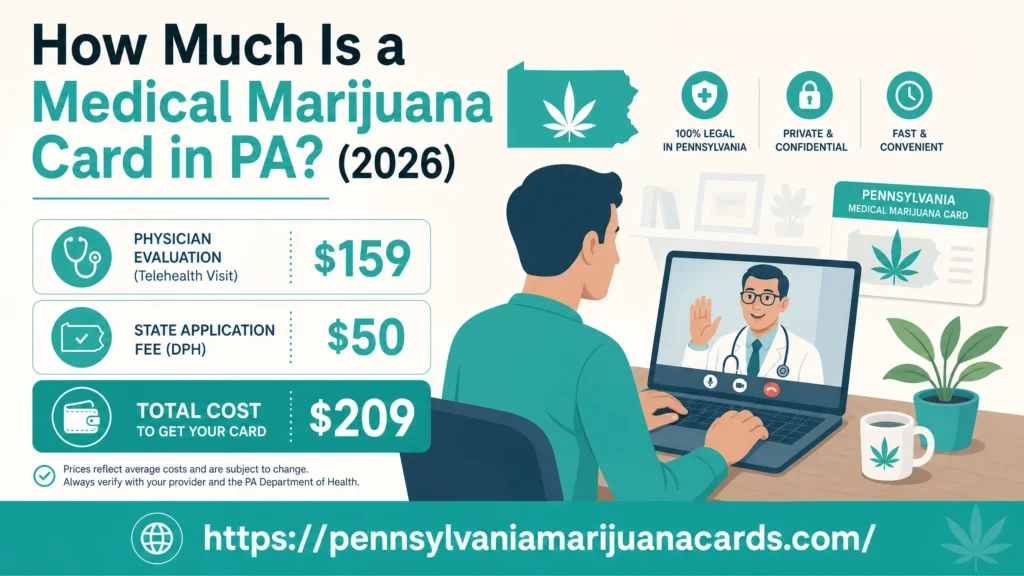
| Physician Fee | PA State Fee | Total | |
|---|---|---|---|
| New Patient | $159 | $50 | $209 |
| Renewal | $149 | $50 | $199 |
| MMAP Qualifying Patients (Medicaid, SNAP, WIC, CHIP, PACE, PACENET) | $0 (waived) | Physician fee only |
Start your same-day certification here.
Frequently Asked Questions
Q: Are edibles legal in Pennsylvania in 2026?
A: It depends on the type and source. Hemp-derived delta 9 edibles (gummies, chocolates) containing no more than 0.3% delta-9 THC by dry weight are legal in Pennsylvania right now under the 2018 Farm Bill and Pennsylvania’s Industrial Hemp Act (3 Pa.C.S. §701). No MMJ card is required. However, Pennsylvania licensed dispensaries do NOT sell gummies or food-based edibles. The PA Medical Marijuana Act (Act 16) explicitly excludes food-form products from approved dispensary formats. Marijuana-derived edibles from other states or informal sources are illegal and subject to misdemeanor charges under 35 P.S. §780-113. Most hemp edibles will also face federal elimination on November 12, 2026 under H.R. 5371.
Q: Can you buy THC gummies at a Pennsylvania dispensary?
A: No. Pennsylvania licensed medical marijuana dispensaries cannot sell gummies, chocolates, brownies, or any traditional food-based edible products. The PA Medical Marijuana Act (Act 16 of 2016) approves specific product formats for dispensary sale: dry leaf flower (for vaporization), vape cartridges, tinctures, capsules, oral oils, concentrates, and topicals. Food-form edibles are explicitly excluded. This restriction was enacted due to child safety concerns (gummies resembling regular candy) and dosing accuracy requirements. PA MMJ patients who want oral consumption can purchase capsules and tinctures at licensed dispensaries instead.
Q: Are edibles from New Jersey legal to bring into Pennsylvania?
A: No. Transporting marijuana-derived edibles from any other state into Pennsylvania is illegal under Pennsylvania law regardless of whether they were purchased legally in that state. Pennsylvania does not recognize out-of-state medical marijuana cards. Possession of marijuana-derived edibles in Pennsylvania without a PA MMJ card is a misdemeanor under 35 P.S. §780-113, carrying up to 30 days in jail and a $500 fine for 30 grams or less. The edibles become illegal to possess the moment they enter Pennsylvania.
Q: What can PA MMJ patients buy instead of edibles at dispensaries?
A: PA MMJ patients have three oral consumption alternatives at licensed dispensaries. Capsules provide pre-measured doses in swallowable form, with 45 to 90 minute onset and 4 to 8 hour duration. Oral oils and liquid concentrates (dispensed via measured oral syringe) provide the same slow-onset, long-duration experience as traditional edibles. Sublingual tinctures held under the tongue for 30 to 60 seconds before swallowing produce faster onset (15 to 45 minutes) and 3 to 5 hour duration. All dispensary products carry state-mandated Certificates of Analysis with verified potency and contaminant testing, unlike unregulated hemp products from smoke shops.
Q: What is happening to hemp edibles in Pennsylvania in November 2026?
A: Federal law H.R. 5371, signed November 12, 2025 and effective November 12, 2026, imposes a 0.4 milligram per-container total THC cap on hemp-derived products. Most hemp delta 9 gummies currently sold in Pennsylvania contain 5mg to 25mg of THC per piece, between 12 and 62 times above the new cap. When this law takes effect, virtually all current hemp edibles will lose their Farm Bill legal status and become federally controlled substances. Pennsylvania’s own SB 49, advanced by the Senate Law and Justice Committee in May 2026, would impose the same 0.4mg cap at the state level. PA licensed dispensary products under Act 16 are completely unaffected by both changes.
Q: Why can’t Pennsylvania dispensaries sell edibles?
A: Pennsylvania’s Medical Marijuana Act (Act 16 of 2016) was written to explicitly exclude food-based edible products from approved dispensary formats. State lawmakers cited two main concerns: child safety (cannabis-infused gummies and candies are visually indistinguishable from regular candy, creating accidental ingestion risk), and dosing accuracy (food products are harder to manufacture with the precise, consistent per-dose potency required for medical use). As of July 2026, no amendment to Act 16 has been enacted to permit food-form edibles at PA dispensaries. The restriction applies to all licensed Pennsylvania dispensaries statewide.
Q: Do hemp edibles show up on a drug test in Pennsylvania?
A: Yes. Hemp-derived delta 9 THC from a gummy metabolizes to the same compound as THC from dispensary products: THC-COOH, which standard urine drug tests detect. The test cannot distinguish between hemp and marijuana sources. Detection in urine typically runs 3 to 7 days for occasional edible users and up to 30 days or more for regular users. Pennsylvania’s per se DUI law (75 Pa. C.S. §3802(d)) also makes any detectable THC metabolite in blood while driving a potential DUI charge, regardless of whether the source was a legal hemp edible or a dispensary product.
Medical Disclaimer
This blog post is intended for general educational and informational purposes only and does not constitute legal advice. Pennsylvania cannabis and hemp laws are subject to significant changes, particularly regarding the federal H.R. 5371 deadline of November 12, 2026 and the pending Pennsylvania SB 49. Always verify current regulations with the Pennsylvania Department of Agriculture (for hemp products) or the Pennsylvania Department of Health (for medical marijuana) before making any purchasing or legal decisions. Anyone facing criminal charges related to cannabis possession should consult a licensed Pennsylvania criminal defense attorney immediately. Medically reviewed by Dr. Johnathon Chance Miller, MD.
Sources
- Pennsylvania Industrial Hemp Act, Act 92 of 2016 (3 Pa.C.S. §§701-710)
- Pennsylvania Medical Marijuana Act, Act 16 of 2016 (35 P.S. §§10231.101-10231.2110)
- Pennsylvania Controlled Substances Act (35 P.S. §780-113) — possession penalties
- David McKenzie Law Firm — Pennsylvania Marijuana Edibles Laws: Legal Status and Criminal Consequences (June 2026)
- YourHealthMagazine.net — Are THC Gummies Legal in Pennsylvania? Laws, Limits, and Where to Buy (2026 Guide, May 2026)
- CannabisRegulations.ai — Is Hemp-Derived Delta-9 THC Legal in Pennsylvania? 2026 Status and H.R. 5371 (May 2026)
- CannabisRegulations.ai — Pennsylvania 2025: Adult-Use Bills Advance While Delta-8 Remains Unregulated (June 2026)
- Gold Naturals Hemp — CBD in Pennsylvania 2026: Legal Status, THC Rules (updated May 2026)
- Regulatory Oversight — Congress Narrows Federal Definition of Hemp, H.R. 5371 (December 2025)
- PennsylvaniaStateCannabis.org — Pennsylvania Marijuana Laws 2026
- Pennsylvania Marijuana Cards — Qualifying Conditions
- Pennsylvania Marijuana Cards — Flower vs Oil vs Tincture vs Capsules: PA Dispensary Guide
- Pennsylvania Marijuana Cards — PA Medical Marijuana Laws