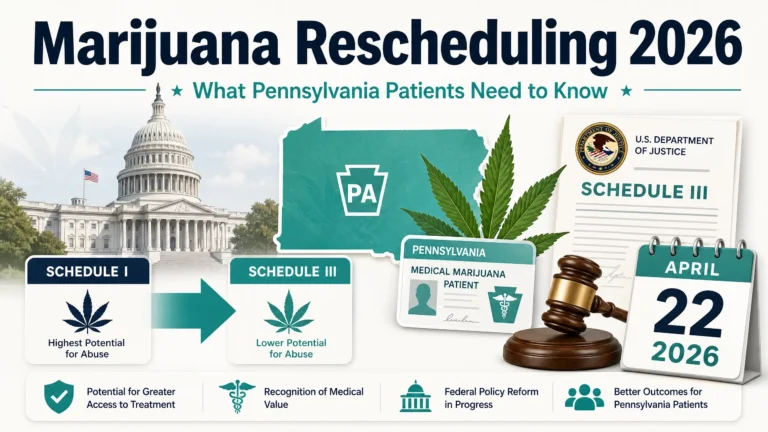

On April 22, 2026, the U.S. Department of Justice made history.
Acting Attorney General Todd Blanche signed a final order immediately moving state-licensed medical marijuana from Schedule I to Schedule III of the Controlled Substances Act.
Need a PA Medical Marijuana Card?
Get certified online in 15 minutes. 100% Money-Back Guarantee.
Get Certified Now →It was the most significant shift in federal cannabis policy since Congress placed marijuana in Schedule I in 1970 — 56 years earlier.
For Pennsylvania medical marijuana patients, this is meaningful. But most of the breathless coverage missed the important nuance: what changed and what did not are two very different lists.
This guide breaks down both clearly, with specific attention to what rescheduling means for your Pennsylvania MMJ card, your dispensary costs, your employment protections, your firearms rights, and what comes next.
Key Takeaways
- The rescheduling happened on April 22, 2026. State-licensed medical marijuana, including all Pennsylvania dispensary products, moved from Schedule I to Schedule III effective April 28, 2026.
- You still need a PA MMJ card. Nothing about rescheduling changes Pennsylvania’s state program. Certification, dispensary access, and annual renewal all work exactly as before.
- Recreational marijuana remains federally illegal. Only state-licensed medical marijuana and FDA-approved products were rescheduled. Adult-use cannabis is still Schedule I pending a separate DEA hearing beginning June 29, 2026.
- Section 280E no longer applies to PA dispensaries as of April 22, 2026. This could lower retail prices for patients over time as Pennsylvania dispensaries gain access to standard business deductions.
- The firearms question shifted significantly. Pennsylvania cannabis attorney Patrick K. Nightingale, Esq. argues that as of April 22, 2026, PA MMJ patients may lawfully possess and acquire a firearm. The ATF Form 4473 draft revision (May 2026) is under public comment. This remains evolving law — consult an attorney before acting.
- Security clearances and DOT drug testing did not change. These are governed by separate legal frameworks independent of the CSA schedule.
What Happened: The April 22, 2026 DOJ Order
President Trump’s December 18, 2025 Executive Order on Increasing Medical Marijuana and Cannabidiol Research directed the Attorney General to complete the rescheduling process as expeditiously as permitted by law.

Do You Qualify for a PA MMJ Card?
Connect with a licensed Pennsylvania state physician online from home.
Acting AG Todd Blanche delivered on that directive four months later.
The April 22, 2026 order placed two categories of marijuana in Schedule III of the Controlled Substances Act, effective April 28, 2026:
- Marijuana contained in an FDA-approved drug product (including dronabinol and CBD-based drugs)
- Marijuana subject to a qualifying state-issued license to manufacture, distribute, or dispense cannabis for medical purposes
Pennsylvania’s Medical Marijuana Act (Act 16 of 2016) is a qualifying state medical marijuana license program. Every product sold at every licensed Pennsylvania dispensary on or after April 28, 2026, falls within the second category.
Every PA MMJ patient purchasing from a licensed dispensary is now accessing a Schedule III controlled substance, not a Schedule I substance.
The legal authority used was Section 811(d)(1) of the Controlled Substances Act, which gives the Attorney General authority to reschedule substances to carry out U.S. obligations under the Single Convention on Narcotic Drugs.
This treaty-based pathway allowed the DOJ to act immediately without completing the traditional notice-and-comment rulemaking process that had stalled for years.
Simultaneously, the order launched a new expedited DEA administrative hearing process to consider whether all marijuana, including recreational, should be moved to Schedule III. That hearing began June 29, 2026.
The Complete What Changed vs What Did Not Table

| Issue | Before April 22, 2026 | After April 22, 2026 |
|---|---|---|
| Federal schedule for PA MMJ products | Schedule I | Schedule III |
| Section 280E tax treatment for PA dispensaries | Applied. No standard deductions. | No longer applies to state-licensed MMJ. |
| Federal criminal exposure for PA MMJ patients | Present under Schedule I classification | Significantly reduced per Manatt and Compassionate Certification Centers analysis |
| Clinical research on cannabis | Restricted under Schedule I | Substantially easier under Schedule III |
| DEA registration for PA dispensaries | Not required/available | New streamlined pathway created |
| Need for PA MMJ card | Required | Still required. No change. |
| Recreational cannabis federal status | Schedule I | Still Schedule I |
| PA state program requirements | Act 16 rules apply | Act 16 rules still apply. No change. |
| Federal firearms prohibition (formal law) | Prohibited for cannabis users | Formally unchanged. Active legal debate. ATF Form 4473 draft revision pending. |
| Security clearance disclosure | Must disclose | Must still disclose. No formal change. |
| DUI law (PA per se) | 1ng/ml per se standard | PA per se standard unchanged. Nightingale argues MMJ DUIs now require actual impairment proof. |
| DOT drug testing | Zero tolerance | Still zero tolerance. No change. |
| Employment protections | PA state protections apply | PA protections strengthened by rescheduling argument |
| Interstate transport | Federal crime | Still a federal crime |
| Home cultivation | Illegal for PA patients | Still illegal |
What Changed for PA Patients: The Real Benefits

Reduced Federal Legal Exposure
Before April 22, 2026, every Pennsylvania patient purchasing cannabis at a licensed dispensary was technically in possession of a Schedule I controlled substance under federal law, the same legal category as heroin. The state-legal protection of Act 16 existed in tension with that federal classification.
After rescheduling, PA MMJ patients purchasing from licensed dispensaries are accessing a Schedule III controlled substance.
As the Compassionate Certification Centers analysis confirmed: “PA cardholders using the program as intended have significantly reduced federal legal exposure under the Controlled Substances Act. Your PA medical marijuana card matters more than ever.”
⚡ Fast & 100% Online PA Medical Cards
Board-Certified Doctors • 100% Money-Back Guarantee
Book Evaluation Now →Manatt, Phelps and Phillips LLP’s legal analysis was equally clear: “state-licensed medical marijuana operators covered by the order are no longer deemed to be trafficking in a Schedule I substance, and criminal exposure that previously flowed solely from Schedule I status is lifted.”
This does not mean cannabis is federally legal for recreational users.
It means that the specific act of a PA MMJ patient purchasing from a licensed Pennsylvania dispensary now has a meaningfully lower federal risk profile than it did on April 22, 2026.
Federal Legitimacy for State Programs
For Pennsylvania’s 440,000+ registered patients, rescheduling delivers something beyond legal technicalities: formal federal acknowledgment that what they are doing has recognized medical value.
The order stated explicitly that rescheduling acknowledges “the medical benefits of marijuana.” After 56 years of federal classification alongside substances deemed to have no accepted medical use, that recognition carries weight.
The 280E Tax Change: What It Means for PA Dispensary Prices
This may be the most concrete financial change for Pennsylvania patients.

Section 280E of the Internal Revenue Code prohibits businesses that traffic in Schedule I or Schedule II controlled substances from deducting ordinary business expenses.
For years, Pennsylvania licensed dispensaries have been unable to deduct rent, payroll, marketing, utilities, and other standard operating costs from their federal taxable income. They paid taxes on gross revenue rather than profit, often resulting in effective tax rates of 70% or more.
Foley Hoag’s legal analysis confirmed: “As of April 22, 2026, medical cannabis subject to a state license is no longer subject to Section 280E of the Internal Revenue Code.” Section 280E only applies to Schedule I and II substances. Schedule III substances are exempt.
What this means for Pennsylvania patients: Over time, as PA dispensaries adjust their tax structures, some portion of the cost savings should translate to lower retail prices. How much and how quickly is uncertain.
The IRS and Treasury announced guidance is forthcoming on the exact implementation.
Renewing Your PA MMJ Card?
Quick annual recertification online. No paperwork hassle.
Renew Card Online →The change does not happen overnight at the retail level. But the structural removal of a major tax burden from PA dispensaries is a genuine price-reduction mechanism that did not exist before April 2026.
For now: Shop with your existing card, ask dispensaries about any pricing changes, and watch for announcements from major PA chains like Trulieve, AYR, and Rise.
Research: The Biggest Long-Term Change
Schedule I status was the single biggest barrier to clinical cannabis research in the United States.

Under Schedule I, researchers needed DEA licenses, special controlled facilities, and could only use federally produced cannabis that was often different in composition from what patients actually used.
Schedule III removes most of those barriers. University researchers can now conduct studies using actual Pennsylvania dispensary products. Clinical trials can proceed without the DEA obstacles that stalled research for decades.
This matters enormously for Pennsylvania patients in the long run.
Better research means better evidence for which qualifying conditions cannabis actually helps, what doses work, what terpene profiles produce which therapeutic effects, and how cannabis interacts with specific medications.
Pennsylvania dispensary pharmacists will eventually have better data to work from.
The DEA also created a new streamlined registration pathway for state-licensed medical marijuana operators. Pennsylvania dispensaries that submitted DEA registration applications within 60 days of the order (by June 29, 2026) can operate under their existing state licenses while applications are processed.
This federal registration is a prerequisite for full lawful operation under Schedule III.
The Firearms Question: A Genuine Shift in PA
This is where the analysis is most nuanced, most consequential, and most actively in motion. Read carefully.

Get Approved by a Licensed PA Doctor
Schedule your appointment in minutes. You only pay if approved.
Start Online Application →Before April 22, 2026, the federal firearms prohibition was clear: under 18 U.S.C. §922(g)(3), anyone who is an “unlawful user of a controlled substance” cannot purchase or possess a firearm.
ATF Form 4473 asked about marijuana use and warned that “use or possession of marijuana remains unlawful under Federal law regardless of whether it has been legalized or decriminalized for medicinal or recreational purposes in the state where you reside.”
After April 22, 2026, Pennsylvania cannabis attorney Patrick K. Nightingale, Esq. offered a consequential legal interpretation: “As of April 22, 2026, state regulated medical cannabis is federally legal to possess as a Schedule III controlled substance. I am of the opinion that a PA MMJ patient may lawfully possess and acquire a firearm and may lawfully obtain a concealed carry permit if otherwise eligible pursuant to Pennsylvania’s Uniform Firearms Code.”
The logic: §922(g)(3) prohibits “unlawful” users of controlled substances. A PA MMJ patient purchasing from a licensed dispensary is now using a federally lawful Schedule III controlled substance. The “unlawful user” language may therefore no longer apply to compliant PA MMJ patients.
The ATF released a draft revision of Form 4473 in May 2026 that reflects this evolving interpretation. The revised form is under public comment through July 2026 and is not yet finalized. The prior warning language about marijuana is under active revision.
What this means practically for PA patients who own or want to own firearms: do not act on this alone. This legal interpretation, however well-reasoned, has not been tested in Pennsylvania courts. Federal case law has not caught up.
Consult a Pennsylvania firearms attorney who is tracking the post-rescheduling landscape before making any decisions. The analysis is moving in a patient-favorable direction, but “moving in a favorable direction” is not the same as “settled law.”
What Did NOT Change for PA Patients
Several things that many patients assumed would change did not.

You Still Need a PA MMJ Card
Rescheduling does not give any Pennsylvania resident the right to purchase cannabis from a PA dispensary without a valid MMJ card.
Act 16 of 2016, the Pennsylvania Medical Marijuana Act, governs dispensary access in Pennsylvania. Rescheduling is a federal action. It does not amend, override, or replace Act 16.
Ready to Get Your Official PA MMJ Card?
State-certified doctor consultations online. No risk—100% refund if not approved.
Claim Your MMJ Card Online →The 24 qualifying conditions, the physician certification requirement, the $50 state fee, and the annual renewal are all unchanged.
Recreational Cannabis Is Still Federally Illegal
The April 22 order applied only to state-licensed medical marijuana and FDA-approved products. Recreational cannabis in adult-use states remains Schedule I.
Anyone purchasing cannabis from a Pennsylvania dispensary without an MMJ card is still accessing a Schedule I substance under federal law. No change.
DOT Drug Testing: Zero Tolerance Remains
The Department of Transportation’s drug testing rules for safety-sensitive employees, commercial drivers, pilots, railroad workers, and transit employees apply zero tolerance for cannabis regardless of state medical marijuana programs.
DOT explicitly confirmed that rescheduling does not change its testing requirements. If you work in a DOT-regulated position, nothing about April 22, 2026 affects your employment drug testing obligations.
Security Clearances: No Change
Federal security clearance applications still require disclosure of all marijuana use, including state-licensed medical marijuana. Rescheduling did not amend the Adjudicative Guidelines that govern clearance decisions.
Arnold and Porter’s security clearance analysis stated plainly in May 2026: “security clearance applicants and holders remain prohibited from using medical marijuana, even where state law permits it” pending any formal revision to the Adjudicative Guidelines.
The DOJ’s solicitor general confirmed in a Supreme Court filing that the rescheduling order does not automatically resolve security clearance issues.
If you hold or are applying for a federal security clearance, do not assume rescheduling changed your disclosure obligations. It did not. Consult a security clearance attorney before making any decisions.
DUI Law: No Change for PA Patients

Pennsylvania’s per se DUI law (75 Pa. C.S. §3802(d)) sets a 1 nanogram per milliliter THC blood threshold for DUI charges regardless of impairment. Senate Bill 363 added actual-impairment protections for registered MMJ patients, but the per se standard still applies in most circumstances.
Patrick Nightingale offered one interesting post-rescheduling interpretation: that because medical cannabis is now federally lawful under Schedule III, all MMJ DUIs may fall under the “prescription medication” section of Pennsylvania’s DUI statute, which requires proof of actual impairment rather than relying solely on blood THC levels.
This interpretation has not been litigated in Pennsylvania courts. It is a legal argument, not settled law. The practical guidance remains unchanged: do not drive after using cannabis on any day you have consumed it.
Employment Protections: Strengthened, Not Transformed
Pennsylvania’s existing employment protections for registered MMJ patients under Palmiter v. Commonwealth Health Systems remain fully in force.
What rescheduling adds is an argument: employer policies stating that cannabis is “illegal under federal law” are now less accurate for medical use from a licensed state program, and some employers may choose to revise their policies.
Compassionate Certification Centers noted: “policy language stating marijuana is ‘illegal under federal law’ is no longer fully accurate for medical use dispensed through a qualifying state program, and employers may choose to revisit such language accordingly.
If you face workplace discrimination related to your medical marijuana use, Pennsylvania’s existing patient protections still apply and the federal rescheduling strengthens your position in any dispute.”
This is meaningful in disputes and litigation. It does not prevent employers from maintaining drug-free workplace policies or testing programs.
The Broader Rescheduling Hearing: June 29, 2026
The April 22 order was not the end of the rescheduling story. It addressed only state-licensed medical marijuana.

The DOJ simultaneously launched a new expedited DEA administrative hearing, beginning June 29, 2026, to consider whether all marijuana, including recreational, should be rescheduled to Schedule III.
This hearing will compile an evidentiary record, receive expert testimony, and evaluate public input. If the hearing process proceeds on schedule, Foley Hoag projected that a final rule on broader rescheduling “could be published as soon as late 2026, though litigation could extend that horizon.”
For Pennsylvania patients, the outcome of this hearing determines whether recreational cannabis in PA (once legalized) would also receive Schedule III status, and whether the full range of federal restrictions associated with cannabis continue to wind down.
Legal Challenges to the Order
The April 22 rescheduling order is facing legal challenges, as expected for any major regulatory action of this significance.
Smart Approaches to Marijuana (SAM), an anti-legalization advocacy group, and the National Drug and Alcohol Screening Association filed suits seeking to overturn the order.
Their primary argument targets the legal authority used: Acting AG Blanche invoked the treaty-based Single Convention pathway rather than completing the standard notice-and-comment rulemaking under the Administrative Procedure Act.
How these challenges resolve will determine the durability of the April 22 order. If courts uphold the order, rescheduling stands.
If courts vacate it on procedural grounds, the broader administrative hearing process (beginning June 29) would become the vehicle for achieving the same result through a more traditional rulemaking process.
For PA patients, this means: The benefits described in this article are real and currently in effect, but the legal landscape is not yet fully settled.
What Comes Next: What Congress Still Needs to Do
Rescheduling through executive order, while historic, does not accomplish everything that full Congressional action would. Several significant issues remain unresolved without legislative action:

The Gun Control Act. The federal firearms prohibition in 18 U.S.C. §922(g)(3) is a statutory provision that only Congress can formally amend. Even with the evolving legal interpretation, a Congressional amendment to the Gun Control Act would provide definitive clarity on firearms rights for MMJ patients.
The SAFER Banking Act. Cannabis businesses, including PA dispensaries, still face banking challenges because the Bank Secrecy Act and anti-money-laundering rules continue to deter most financial institutions.
Rescheduling may make some banks more comfortable, but the SAFER Banking Act would provide a clear legal safe harbor that does not yet exist.
The Farm Bill. The 2026 Farm Bill reauthorization, combined with H.R. 5371’s November 2026 hemp deadline, will shape the legal framework for hemp-derived cannabinoids. Whether the Farm Bill addresses the rescheduling overlap or creates a clearer consumer framework for hemp products remains to be seen.
For Pennsylvania patients, the most actionable near-term step remains keeping your MMJ certification current. An up-to-date PA medical marijuana card is your clearest legal protection under both state and federal law.

Pennsylvania Marijuana Cards offers same-day telehealth certifications with Dr. Johnathon Chance Miller, MD, completed entirely online.
| Physician Fee | PA State Fee | Total | |
|---|---|---|---|
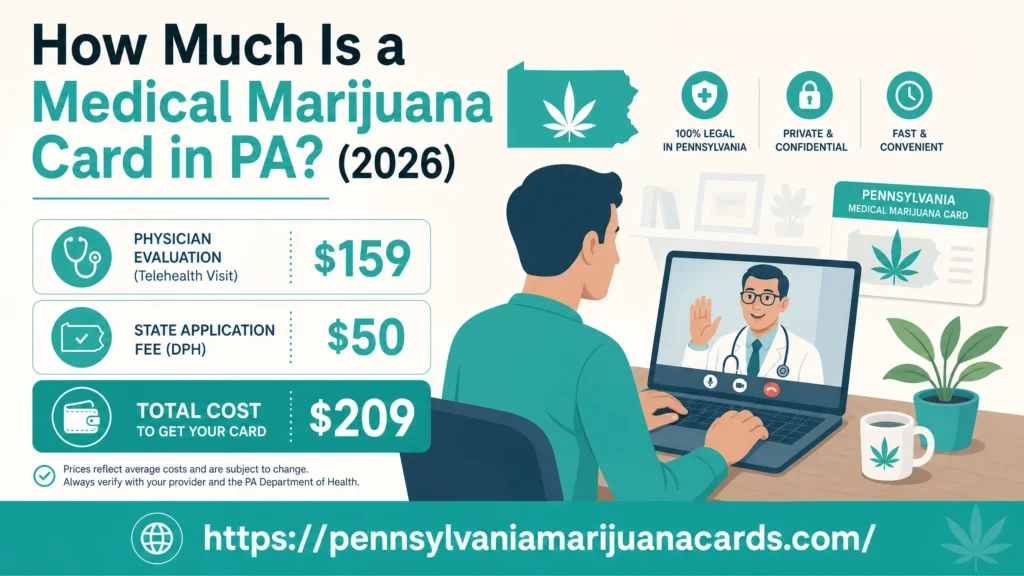
| New Patient | $159 | $50 | $209 |
| Renewal | $149 | $50 | $199 |
| MMAP Qualifying Patients (Medicaid, SNAP, WIC, CHIP, PACE, PACENET) | $0 (waived) | Physician fee only |
Start your same-day certification here.
Frequently Asked Questions
Q: What happened with marijuana rescheduling in 2026?
A: On April 22, 2026, the U.S. Department of Justice issued a final order moving two categories of marijuana from Schedule I to Schedule III of the Controlled Substances Act, effective April 28, 2026. The first category was marijuana contained in FDA-approved drug products. The second, and more consequential, category was marijuana subject to a qualifying state medical marijuana license, which includes all Pennsylvania dispensary products under Act 16 of 2016. This action, directed by President Trump’s December 2025 executive order, was the most significant federal cannabis policy shift since Congress placed marijuana in Schedule I in 1970. The DOJ simultaneously launched a new DEA administrative hearing beginning June 29, 2026, to consider whether all cannabis, including recreational, should be moved to Schedule III.
Q: What does marijuana rescheduling mean for Pennsylvania MMJ patients?
A: For registered Pennsylvania MMJ patients, rescheduling means: significantly reduced federal legal exposure when purchasing from licensed PA dispensaries; potential dispensary price reductions over time as Section 280E no longer applies to state-licensed medical marijuana operators; easier clinical research on cannabis through Pennsylvania universities; and a stronger position in employment discrimination disputes. What it does not change: the requirement for a PA MMJ card, annual recertification, Pennsylvania’s state program rules under Act 16, the need to visit licensed dispensaries, or daily dispensary operations. Recreational cannabis in PA is still illegal. DOT drug testing remains zero-tolerance. Security clearance disclosure requirements were not changed.
Q: Does marijuana rescheduling mean you no longer need a PA MMJ card?
A: No. Rescheduling is a federal action under the Controlled Substances Act. Pennsylvania’s Medical Marijuana Act (Act 16 of 2016) is a state law that governs dispensary access independently of federal scheduling. Rescheduling did not amend Act 16 or change any aspect of Pennsylvania’s state program. PA residents still need a valid physician certification and a registered patient card to purchase any product from a licensed Pennsylvania dispensary. The 24 qualifying conditions, physician certification process, $50 state fee, and annual renewal requirement are all unchanged.
Q: What did Section 280E rescheduling change for Pennsylvania dispensaries?
A: Section 280E of the Internal Revenue Code prohibited businesses trafficking in Schedule I or Schedule II controlled substances from deducting ordinary business expenses. This cost Pennsylvania dispensaries enormously, often resulting in effective tax rates of 70% or more on gross revenue. As of April 22, 2026, state-licensed medical marijuana is no longer subject to Section 280E because it moved to Schedule III. Pennsylvania dispensaries can now deduct standard business expenses including rent, payroll, and marketing from their federal taxable income. Over time, this structural cost reduction is expected to translate to lower retail prices for Pennsylvania MMJ patients, though the timeline and extent depend on individual dispensary pricing decisions and IRS guidance still forthcoming.
Q: Did marijuana rescheduling change gun rights for Pennsylvania MMJ patients?
A: This area of law is actively evolving and no definitive answer exists yet. Pennsylvania cannabis attorney Patrick Nightingale, Esq. argues that because state-licensed medical marijuana is now federally lawful under Schedule III, the “unlawful user of a controlled substance” prohibition in 18 U.S.C. §922(g)(3) may no longer apply to compliant PA MMJ patients. The ATF released a draft revision of Form 4473 in May 2026 that reflects this interpretation and is under public comment through July 2026. The formal law has not been amended by Congress, no court has ruled on this post-rescheduling, and the ATF revision is not yet final. PA MMJ patients who own or want to own firearms should consult a Pennsylvania firearms attorney before making any decisions.
Q: Does marijuana rescheduling affect Pennsylvania DUI laws?
A: Pennsylvania’s per se DUI law (75 Pa. C.S. §3802(d)) setting a 1ng/ml THC blood threshold was not amended by rescheduling. Some Pennsylvania cannabis attorneys argue that because medical cannabis is now federally lawful under Schedule III, MMJ DUI cases should be evaluated under the “prescription medication” section of PA’s DUI statute requiring proof of actual impairment rather than relying solely on blood THC levels. This interpretation has not been tested in Pennsylvania courts. The practical guidance remains unchanged: do not drive on any day you have used cannabis. Senate Bill 363’s actual-impairment protection for registered PA MMJ patients applies regardless of rescheduling.
Q: What is the broader marijuana rescheduling hearing starting June 29, 2026?
A: The April 22, 2026 order only rescheduled state-licensed medical marijuana and FDA-approved products. Recreational cannabis remained Schedule I. The DOJ simultaneously launched a new expedited DEA administrative hearing beginning June 29, 2026, to consider whether all marijuana, including adult-use, should be moved from Schedule I to Schedule III through formal rulemaking. If this broader hearing process completes without successful legal challenges, a final rule on comprehensive marijuana rescheduling could be published as early as late 2026, though litigation may extend that timeline. The outcome would affect whether Pennsylvania recreational marijuana, once legalized, also receives federal Schedule III status.
Medical Disclaimer
This blog post is intended for general educational and informational purposes only and does not constitute legal advice. The legal implications of marijuana rescheduling are complex, rapidly evolving, and have not been fully resolved by courts or regulatory agencies as of July 2026. Information in this article reflects published legal analysis as of July 2026 and is subject to change. Do not make decisions about firearms, security clearances, employment, or dispensary access based solely on this article. Always consult a licensed Pennsylvania attorney for legal guidance specific to your situation. Medically reviewed by Dr. Johnathon Chance Miller, MD.
Sources
- U.S. Department of Justice — Official Press Release: Justice Department Places FDA-Approved Marijuana Products and Products Containing Marijuana Subject to a Qualifying State-issued License in Schedule III (April 22, 2026)
- Compassionate Certification Centers — PA Medical Marijuana Rescheduling Update 2026: What Changed for Patients (June 4, 2026)
- Patrick K. Nightingale, Esq. — What Happens Now That Cannabis Is in Schedule III? (April 30, 2026)
- Patrick K. Nightingale, Esq. — Schedule III Cannabis and Pennsylvania: What Actually Changes (April 28, 2026)
- Foley Hoag LLP — DOJ Immediately Reschedules State-Licensed Medical Cannabis to Schedule III (April 22, 2026)
- Gibson Dunn — DEA Downschedules State Medical Marijuana to Schedule III; Expedited Hearing Set (April 29, 2026)
- Manatt, Phelps and Phillips LLP — DOJ Reclassifies Medical Marijuana, Launches Broader Rescheduling (May 7, 2026)
- Scarinci Hollenbeck — Cannabis Rescheduling Schedule III: DOJ Order Explained (April 22, 2026)
- Frier Levitt — Cannabis Rescheduled to Schedule III: What It Means for Tax, Banking, and Research (April 24, 2026)
- Marijuana Policy Project — DOJ Reschedules State-Legal Medical Cannabis to Schedule III: Questions and Answers (June 2026)
- Arnold and Porter — Any Re-Leaf for Security Clearance Holders? DOJ Reschedules Medical Marijuana (May 2026)
- Pennsylvania Medical Marijuana Act, Act 16 of 2016
- Pennsylvania Marijuana Cards — PA Medical Marijuana Gun Laws
- Pennsylvania Marijuana Cards — Qualifying Conditions