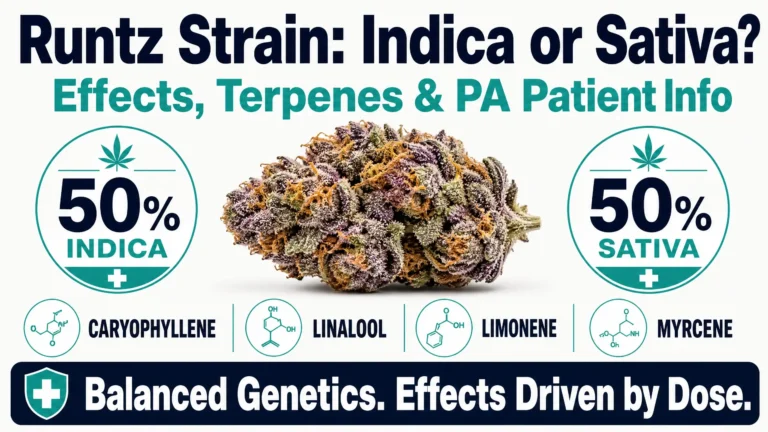

Runtz is a true 50/50 balanced hybrid bred from Zkittlez and Gelato in California’s Bay Area and named Leafly’s Strain of the Year in 2020, making it one of the rare cannabis varieties that sits precisely at the midpoint between indica and sativa characteristics.
That genetic equilibrium is what drives its clinical appeal: PA medical marijuana patients describe a rapid euphoric lift that transitions gradually into deep physical relaxation, with the sedation depth dictated almost entirely by dose rather than genetics.
Need a PA Medical Marijuana Card?
Get certified online in 15 minutes. 100% Money-Back Guarantee.
Get Certified Now →Runtz is widely available across Pennsylvania’s 186+ licensed dispensaries in multiple phenotype expressions, and its four-terpene profile caryophyllene, linalool, limonene, and myrcene, maps directly onto the qualifying conditions most prevalent in the PA MMJ program.
⚡ Quick Answer
Runtz is a true 50/50 balanced hybrid (50% indica / 50% sativa), created by crossing Zkittlez and Gelato, known for rapid euphoric onset followed by graduated physical relaxation whose depth is controlled by dose.
For Pennsylvania residents: Runtz and its phenotypes (White Runtz, Pink Runtz, Black Runtz) appear regularly on PA dispensary menus. Phenotype and batch terpene ratios vary, always request the batch-specific COA, as PA law requires full terpene labeling on all licensed products under the 2025 PA DOH update.
Key Takeaways
- “Runtz” on a PA dispensary menu could be four different clinical products — Original Runtz, White Runtz, Pink Runtz, and Black Runtz have meaningfully different indica/sativa leans and terpene ratios; buying any of them without checking the phenotype and COA is guesswork, not informed patient care
- Runtz’s balanced genetics make dose the primary lever, not genetics — at a modest dose the effect is social and euphoric; at a higher dose the same product shifts toward sedation and sleep; this dose-dependence is clinically significant for PA patients managing both daytime anxiety and nighttime insomnia with a single strain
- A landmark 2025 Journal of Clinical Sleep Medicine study confirmed the specific terpene blend present in Runtz — myrcene, linalool, limonene, and β-caryophyllene together increased restorative sleep in insomnia patients, providing the first robust human-level evidence for what PA patients managing sleep disruption alongside anxiety have been reporting anecdotally
- A July 2024 University of Arizona study found that β-caryophyllene and linalool alone achieved pain reduction comparable to morphine in chronic neuropathic pain models, making Runtz’s terpene profile among the most clinically relevant for PA patients qualifying under the chronic pain category
- PA’s per se DUI statute treats Runtz’s gradual-onset body relaxation no differently than any other cannabis effect — 75 Pa.C.S. § 3802(d) applies from first use; THC metabolites remain detectable in blood long after psychoactive effects resolve, and no PA MMJ card changes this
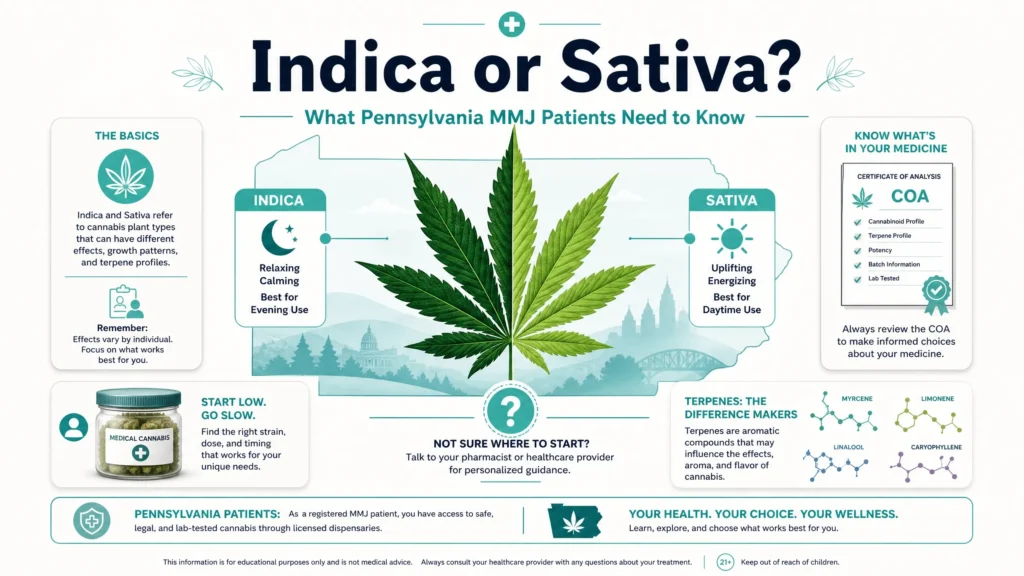
Is Runtz Indica or Sativa?
Runtz is a true 50/50 balanced hybrid one of the few modern cannabis strains where the genetics genuinely sit at the midpoint rather than leaning measurably toward either category.
It’s parentage explains why: Zkittlez (an indica-leaning hybrid from Grape Ape and Grapefruit) and Gelato (an indica-dominant hybrid itself, at approximately 55% indica) contribute complementary but competing characteristics that resolve into a phenotypically balanced expression.
That balance plays out in the effect profile in a clinically important way.

Unlike a sativa-dominant strain that leads with cerebral energy, or an indica-dominant strain that leads with sedation, Runtz produces what patients consistently describe as a two-phase arc: a fast-acting euphoric lift that is social and mood-elevating, followed by a wave of physical relaxation whose depth tracks directly with dose rather than with any fixed genetic outcome.
Do You Qualify for a PA MMJ Card?
Connect with a licensed Pennsylvania state physician online from home.
At a conservative dose, most patients remain mobile and functional. At a higher dose, the same batch tilts toward couch-readiness and sleep onset.
This dose-dependency makes Runtz one of the more clinically versatile strains in the Pennsylvania dispensary market and one of the more important strains to approach carefully for patients managing anxiety, where overconsumption is a meaningful risk.
As Dr. Ethan Russo documented in his foundational 2011 review in the British Journal of Pharmacology, the therapeutic character of any cannabis strain is determined by its terpene and cannabinoid profile far more reliably than by its botanical category. With Runtz’s 50/50 genetics offering minimal predictive value on their own, the batch COA becomes indispensable.

⚠️ COA Required: Pennsylvania law mandates full terpene profile disclosure on all licensed dispensary products under the 2025 PA DOH terpene labeling update. Before purchasing any Runtz product, request the batch-specific Certificate of Analysis, not the generic product sheet to verify the actual terpene ratios, THC percentage, and phenotype expression for that specific harvest.
The Runtz Family: Why White, Pink, and Black Runtz Are Clinically Different
This is the information gap that no recreational cannabis site fills for PA patients.
When a Pennsylvania dispensary menu lists a “Runtz” product, it could be any one of four meaningfully distinct phenotype expressions, each with a different indica/sativa lean, different dominant terpene ratios, and therefore different therapeutic applications.

| Phenotype | Indica / Sativa | THC Range | Dominant Character | Best Clinical Use |
|---|---|---|---|---|
| Original Runtz (OG) | 50% / 50% | 19–29% | Balanced euphoria → relaxation arc | Anxiety, PTSD, chronic pain, mood |
| White Runtz | ~60% indica / 40% sativa | 18–22% | Heavier body effects; more sedating | Evening pain relief, insomnia support |
| Pink Runtz | ~50% / 50% (slight indica lean) | 23–25% | Strong euphoria; longer-lasting | Depression, PTSD, mood disorders |
| Black Runtz | Indica-dominant (~60–65% indica) | 19–24% | Deepest body relaxation; most sedating | Severe pain, insomnia, muscle tension |
Clinical implications for PA patients:
A patient whose dispensary pharmacist recommends Runtz for daytime anxiety management who receives Black Runtz, the most sedating phenotype, may experience sedation that impairs their ability to function at work or manage daily responsibilities.
Conversely, a patient who needs evening pain relief and sleep support and receives Original Runtz at a low dose may find it too activating for sleep onset.
Confirming the phenotype is not a cosmetic preference, it is a clinical decision.
One additional note on Pink Runtz: while it shares Zkittlez × Gelato parentage with the original, some PA dispensary products labeled “Pink Runtz” trace to an alternate lineage of Pink Panties × Rainbow Sherbet, a distinct cross with a different terpene signature.
⚡ Fast & 100% Online PA Medical Cards
Board-Certified Doctors • 100% Money-Back Guarantee
Book Evaluation Now →Ask your dispensary pharmacist to confirm the genetic lineage on the COA, not just the product name.
Cannabinoid Profile: THC, CBD, and Dose-Dependent Effects
| Cannabinoid | Typical Range | PA Patient Relevance |
|---|---|---|
| THC | 19–29% (most PA batches: 20–26%) | Primary driver of psychoactive and therapeutic effects |
| CBD | <1% | Minimal — THC-dominant strain throughout all phenotypes |
| THC:CBD Ratio | ~25:1 or higher | High THC; careful dose titration is essential for new patients |
Runtz is a high-THC, low-CBD strain across all phenotypes.
A 2025 PLOS One study cited by Herb.co noted that retail THC labels frequently overstate measured values, reinforcing the importance of verifying actual THC percentage on the batch-specific COA rather than relying on product marketing.
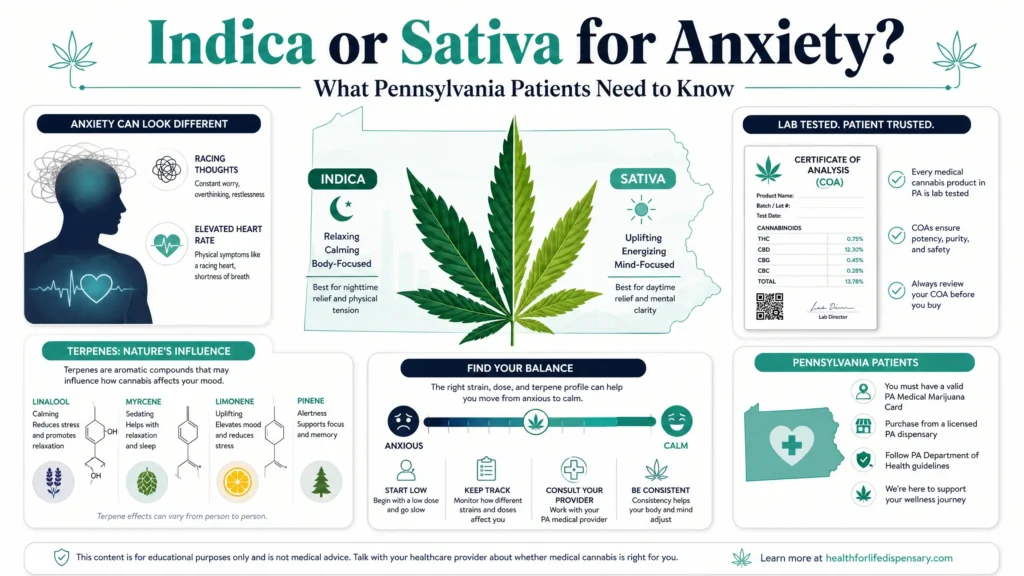
The dose-dependence of Runtz’s effects carries direct clinical implications for PA patients. For anxiety patients, a small initial dose, one or two draws from a vaporizer, then a 20-minute wait is clinically appropriate.
The high-THC profile can produce anxiogenic effects in THC-sensitive patients even when the terpene profile is favorable.
For chronic pain patients, a moderate dose taken in the early evening allows the physical relaxation phase to arrive at its therapeutic window while supporting natural sleep onset.
Patients who are new to medical cannabis should begin at the lower end of this range regardless of prior tolerance to other substances.
Runtz Terpene Profile
Runtz’s four dominant terpenes, β-caryophyllene, linalool, limonene, and myrcene are not only responsible for its signature candy-sweet aroma with peppery undertones.

They represent one of the most clinically well-researched terpene combinations in the PA dispensary market, with 2024 and 2025 human-level studies now directly validating effects that PA patients have been reporting for years.
β-Caryophyllene — The Anti-Inflammatory Backbone
| Property | Detail |
|---|---|
| Aroma | Spicy, peppery, woody — the “pepper” note in Runtz’s finish |
| Mechanism | Directly binds CB2 receptors — the only cannabis terpene to do so |
| Primary therapeutic role | Anti-inflammatory, anxiolytic, analgesic |
| Key 2024 finding | University of Arizona: caryophyllene achieved pain reduction comparable to morphine in neuropathic pain models |
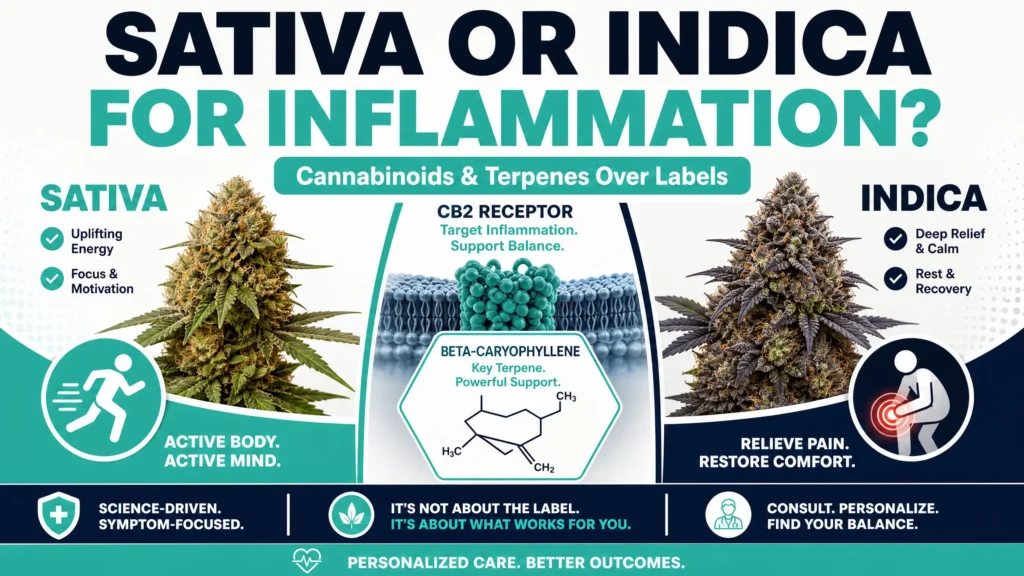
Caryophyllene is Runtz’s dominant terpene and its most pharmacologically distinctive compound. Its direct CB2 receptor activation sets it apart from every other terpene in cannabis, it functions as a dietary cannabinoid, modulating the immune and inflammatory response through the endocannabinoid system without producing psychoactive effects.
A May 2024 University of Arizona Health Sciences study found that β-caryophyllene, alongside several other terpenes present in Runtz, achieved pain reduction comparable to morphine in chronic neuropathic pain animal models, with additive effects when combined with opioid medications.
Renewing Your PA MMJ Card?
Quick annual recertification online. No paperwork hassle.
Renew Card Online →The July 2025 Pharmaceuticals review (PMC) confirmed these findings across multiple chronic pain frameworks, establishing caryophyllene as one of the most evidence-supported terpenes in cannabis for PA patients qualifying under chronic pain categories.
Linalool — The Sleep and Calm Modifier
| Property | Detail |
|---|---|
| Aroma | Floral, lavender, lightly spiced — the soft sweetness beneath Runtz’s fruit |
| Mechanism | Modulates GABA-A receptors; reduces glutamate excitability |
| Primary therapeutic role | Anxiolytic, sedative-adjacent, analgesic for neuropathic conditions |
| Key 2025 finding | Journal of Clinical Sleep Medicine: linalool + myrcene + caryophyllene blend increased restorative sleep by up to 48 minutes in insomnia patients |
Linalool is what makes Runtz therapeutically relevant for PA patients managing insomnia alongside anxiety or pain.
A landmark 2025 study published in the Journal of Clinical Sleep Medicine tested a combination of eight terpenes including linalool, myrcene, limonene, and β-caryophyllene, precisely the terpene grouping found in Runtz and found marginal but meaningful increases in restorative sleep stages, with some participants gaining up to 48 minutes of additional deep sleep nightly.
This represents some of the first human-level clinical evidence for the sleep-promoting properties that PA patients have attributed to this terpene combination anecdotally.
Linalool’s GABA-A modulation is also relevant for anxiety; a PMC review in Frontiers in Psychiatry identified linalool as producing anxiety reduction comparable to paroxetine in lavender oil clinical studies.
Limonene — The Mood Elevator and THC Anxiety Buffer
| Property | Detail |
|---|---|
| Aroma | Citrus, lemon peel, orange — the bright top note in Runtz’s candy profile |
| Mechanism | Elevates serotonin and dopamine activity; modulates GABA and adenosine receptors |
| Primary therapeutic role | Mood elevation, anti-anxiety, stress reduction |
| Key 2024 finding | Johns Hopkins/University of Colorado double-blind study: limonene specifically reduced THC-induced anxiety and paranoia when co-administered |
Limonene’s clinical importance in Runtz is especially relevant given the strain’s high THC content.
A 2024 double-blind crossover study from Johns Hopkins University and the University of Colorado found that inhaled limonene combined with THC significantly reduced self-reported anxiety, nervousness, and paranoia compared to THC alone, without altering other subjective or cognitive effects.
For PA anxiety patients concerned about high-THC products, Runtz’s limonene content provides a documented biochemical buffer.
Patients should still verify limonene percentage on the batch COA; terpene ratios vary between harvests and growers.
Myrcene — The Physical Relaxant
| Property | Detail |
|---|---|
| Aroma | Earthy, musky, herbal — the grounding base beneath Runtz’s sweet profile |
| Mechanism | Activates TRPV1 channels; modulates opioid and adenosine pathways |
| Primary therapeutic role | Muscle relaxation, mild sedation, analgesic support |
| Key 2025 finding | Combined with linalool, myrcene synergistically increased total sleep time in insomnia clinical research |
Myrcene provides the physical ease that defines Runtz’s second-phase effect arc.
As the euphoric lift of limonene and caryophyllene’s upward mood effect settles, myrcene’s TRPV1 channel activation and opioid pathway modulation produce warmth and muscle relaxation across the shoulders, back, and limbs.
Get Approved by a Licensed PA Doctor
Schedule your appointment in minutes. You only pay if approved.
Start Online Application →The 2025 Journal of Clinical Sleep Medicine study specifically noted synergistic effects between myrcene and linalool when combined at a 2:1 ratio, a finding that validates the multi-terpene profile of Runtz batches with high myrcene expression as particularly relevant for sleep-support applications.
🔬 Entourage Effect Note: Runtz’s four-terpene profile produces a combined effect that cannot be predicted from any single compound in isolation. As Dr. Russo’s 2011 British Journal of Pharmacology review established, cannabinoid-terpenoid synergies modulate therapeutic outcomes in ways that significantly exceed what THC alone would deliver.
The caryophyllene-linalool pairing in Runtz addresses pain and anxiety through two independent receptor pathways simultaneously, CB2 receptor activation and GABA-A modulation, a dual-pathway effect that is directly relevant for PA patients managing co-occurring pain and mood symptoms.
Therapeutic Effects: What PA Patients Report
Runtz’s balanced hybrid profile and four-terpene combination produce a clinically consistent effect arc that PA medical marijuana patients describe in terms of two distinct phases.

Phase 1 (onset — approximately 5–20 minutes post-inhalation):
- Rapid euphoric lift with mood elevation and sociability
- Mental clarity and mild focus enhancement at low-to-moderate doses
- Anxiety reduction driven by limonene and caryophyllene’s complementary pathways
- Sensory enhancement — heightened appreciation of taste, music, and surroundings
Phase 2 (20–90+ minutes post-inhalation, dose-dependent):
- Physical relaxation spreading from the shoulders and upper back
- Muscle tension reduction relevant for spasticity, chronic tension, and pain
- Appetite stimulation — relevant for cancer, Crohn’s disease, and IBD patients
- Sleep onset support — in higher doses, myrcene and linalool’s sedative properties become dominant
Who Should Use Caution With Runtz
Runtz’s high-THC, low-CBD profile and dose-dependent sedation arc require particular attention from certain PA patients:
- New MMJ patients — 19–29% THC demands the lowest possible starting dose and a full 20-minute wait before reassessment
- THC-sensitive anxiety patients — despite limonene’s anti-anxiety properties, overconsumption can paradoxically worsen anxiety and trigger paranoia; start low and increase very gradually
- Patients needing consistent daytime function — Runtz’s dose-dependent sedation means a larger-than-expected dose mid-day can unexpectedly impair capacity
- Patients on medications with THC interactions — always disclose MMJ use to your certifying physician and dispensary pharmacist before beginning any new strain
What Conditions Is Runtz Used For?

Anxiety Disorder
Anxiety disorders are Pennsylvania’s leading MMJ qualifying condition, cited in over 68% of all certifications per Drake et al., Annals of Internal Medicine, July 2025 (DOI: 10.7326/ANNALS-25-01037).
Runtz’s caryophyllene-linalool-limonene combination addresses anxiety through three distinct biochemical pathways CB2 modulation, GABA-A receptor activity, and serotonin/dopamine elevation, while the 2024 Johns Hopkins limonene study provides direct human-level evidence for reducing THC-induced anxiety specifically.
For PA anxiety patients, Original Runtz (the most balanced phenotype) consumed at conservative doses offers a therapeutically well-supported option.
Patients with severe anxiety should begin with a single vaporizer draw and wait at least 20 minutes before any additional dose.
Severe Chronic and Intractable Pain
Chronic pain is a qualifying condition under Act 16, and the May 2024 University of Arizona Health Sciences study finding that caryophyllene achieved morphine-comparable pain reduction in neuropathic pain models is directly applicable to Runtz’s dominant terpene.
Ready to Get Your Official PA MMJ Card?
State-certified doctor consultations online. No risk—100% refund if not approved.
Claim Your MMJ Card Online →The July 2025 Pharmaceuticals systematic review (PMC) further validated caryophyllene, myrcene, and linalool’s multi-pathway analgesic mechanisms across chronic pain syndromes.
For PA pain patients who need to remain functional during daytime hours, Original Runtz at moderate dose offers anti-inflammatory and analgesic support without the complete sedation of heavier indica-dominant options.
Black Runtz is more appropriate for patients whose pain management priority is evening and overnight relief.
PTSD
PTSD is a recognized qualifying condition in Pennsylvania’s MMJ program, and Runtz’s balanced euphoria-then-relaxation profile is particularly well-matched for patients experiencing hyperarousal, intrusive thoughts, and sleep disruption.
Phase 1 of Runtz’s effect arc addresses daytime hyperarousal and mood symptoms through limonene and caryophyllene; Phase 2, when dosed appropriately in the evening, supports the sleep onset disruption that characterizes many PTSD presentations.
PA patients with PTSD should discuss phenotype selection with their dispensary pharmacist: Original or Pink Runtz (more balanced) for daytime anxiety management; White or Black Runtz (more indica-dominant) for evening sleep support.
Insomnia Associated With Qualifying Conditions
Insomnia is not a standalone qualifying condition in Pennsylvania, but it is a significant secondary symptom in many recognized conditions, including chronic pain, PTSD, multiple sclerosis, and cancer.
The 2025 Journal of Clinical Sleep Medicine study documenting up to 48 additional minutes of restorative sleep using Runtz’s specific terpene combination (myrcene, linalool, limonene, and β-caryophyllene) provides clinical context for what PA patients have been reporting.
White and Black Runtz phenotypes, with their greater indica lean, are the most appropriate for sleep-support applications consumed in the evening hours via edibles or capsules for extended-duration onset.
Neuropathies
Neuropathic conditions are a qualifying condition under Act 16, and caryophyllene’s CB2 receptor activation is directly relevant to neuroinflammatory pain pathways.
The 2024 University of Arizona finding that caryophyllene achieved comparable pain reduction to morphine in chemotherapy-induced neuropathic pain models is particularly noteworthy for PA patients managing peripheral neuropathy.
Linalool has also demonstrated neuropathic pain relevance in the Frontiers in Psychiatry PMC review, with the reviewers identifying it as a candidate for inflammatory and neuropathic pain management with a favorable safety profile compared to existing medications.
Runtz at Pennsylvania Dispensaries
Runtz and its phenotype family are among the most consistently available strain groups across Pennsylvania’s 186+ licensed medical marijuana dispensaries as of July 2026.

The strain’s broad therapeutic profile and versatile dose-dependence have made it a staple recommendation at the dispensary pharmacist counter for patients managing anxiety, pain, PTSD, and insomnia-associated conditions.
All four major phenotypes, Original, White, Pink, and Black Runtz, appear on PA dispensary menus, though availability varies by location, grower, and batch cycle.
Common Product Formats at PA Dispensaries
| Format | Onset Time | Duration | Best Phenotype | Best For |
|---|---|---|---|---|
| Dry leaf (vaporization only) | 5–15 minutes | 2–3 hours | Original or Pink Runtz | Dose titration; daytime anxiety; fast relief |
| Vape cartridge | 5–10 minutes | 1–2 hours | Original or Pink Runtz | Convenience; consistent per-draw dosing |
| Live resin / concentrate | 5–10 minutes | 2–4 hours | Original Runtz | Maximum terpene expression; experienced patients |
| Tincture | 15–45 minutes | 3–5 hours | White or Black Runtz | Inhalation-free; precise measured dosing |
| Capsule / tablet | 45–90 minutes | 4–8 hours | White or Black Runtz | Extended overnight pain or sleep support |
| Edible (gummies) | 45–120 minutes | 4–8 hours | White or Black Runtz | Long-duration sleep support; evening use |
💡 Pro Tip: Runtz’s fruit-forward terpenes, especially limonene, degrade faster than heavier terpenes like caryophyllene when exposed to heat, light, or air. Live resin and whole-flower vaporization products preserve these volatile terpenes far better than distillate-based cartridges.
If you purchased a Runtz vape cartridge and the characteristic candy-citrus aroma seems faint, you may be receiving a distillate product with added terpenes rather than a full-spectrum extract, ask your dispensary pharmacist to clarify the extraction method before purchasing.
Always describe your symptoms to your dispensary pharmacist, not the phenotype name.
If you explain that you manage daytime anxiety and evening sleep disruption, the pharmacist can identify which current Runtz batch and phenotype best matches your dual-symptom presentation, or recommend a different strain entirely if the current inventory is not well-matched.
This is the most underused resource in Pennsylvania’s MMJ program.
Pennsylvania Legal Notes for MMJ Patients
✅ Valid PA MMJ Card Required
Cannabis remains illegal for recreational use in Pennsylvania as of July 2026.
To legally purchase and use Runtz or any cannabis product, you must hold a valid PA medical marijuana card under Act 16 of 2016. Cards are valid for one year from issuance.
🚫 Smoking Is Prohibited Under PA Law
Act 16 explicitly prohibits smoking cannabis. Legal consumption methods for PA MMJ patients include:
- Vaporization of dry leaf or concentrate
- Tinctures and oils
- Capsules and tablets
- Edibles including gummies
- Topicals
- Sublingual products
⚠️ Pennsylvania’s Per Se DUI Law — Critical for Runtz Patients
Runtz’s gradual-onset physical relaxation and dose-dependent sedation create a specific DUI risk that PA patients must understand clearly.
75 Pa.C.S. § 3802(d) makes any detectable THC metabolites in blood a per se DUI offense, regardless of whether you hold a valid PA MMJ card, whether you feel impaired, or whether the effect you experienced was primarily “relaxing” rather than acutely intoxicating.
As established in Commonwealth v. Stone (2022), a PA medical marijuana card is not a legal defense.

The two-phase effect arc of Runtz means that Phase 1 (euphoric lift) may feel manageable while Phase 2 (deep body relaxation) has already impaired driving-relevant functions.
Do not drive after using Runtz or any cannabis product. THC metabolites remain detectable in blood for hours to days after all subjective effects have resolved.
💊 Getting Certified in Pennsylvania
PA MMJ certifications are available via telehealth through Dr. Johnathon Chance Miller, MD at pennsylvaniamarijuanacards.com:
| Fee | Amount |
|---|---|
| Physician certification (new patient) | $159 |
| PA state registration fee | $50 |
| Total — new patient | $209 |
| Physician certification (renewal) | $149 |
| PA state registration fee | $50 |
| Total — renewal | $199 |
ℹ️ MMAP Fee Waiver
Patients qualifying for Medicaid, SNAP, WIC, CHIP, PACE, or PACENET may have the $50 state registration fee waived through Pennsylvania’s Medical Marijuana Program Fee Waiver.
How to Choose the Right Runtz Product?

- Identify the phenotype first — confirm whether the dispensary product is Original, White, Pink, or Black Runtz, and verify the indica/sativa lean on the batch COA before committing to a format. Different phenotypes serve different therapeutic purposes.
- Request the batch-specific COA — verify that caryophyllene, linalool, limonene, and myrcene appear in the terpene panel. Note which terpene is highest: a batch with dominant linalool is more sedating and sleep-supportive; one with dominant limonene skews more toward daytime mood and anxiety management.
- Match delivery format to timing and symptom — vaporized dry leaf or cartridge for daytime anxiety or fast-onset pain relief; edibles, capsules, or tinctures for extended overnight relief or sleep support using White or Black Runtz.
- Start with the minimum effective dose — without exception — Runtz’s 19–29% THC range and dose-dependent sedation arc mean that an exploratory first session should involve the smallest possible dose with a full 20-minute wait before any additional use.
- Describe your full symptom picture to the dispensary pharmacist — tell them whether your goals are daytime anxiety relief, evening pain management, sleep support, or a combination, so they can recommend the specific Runtz phenotype and format best matched to your PA qualifying condition.
💡 Pro Tip: If you are a PA patient managing both anxiety and sleep disruption, one of the most common co-occurring symptom pairs in the program, consider discussing a split-phenotype approach with your pharmacist: Original or Pink Runtz via vaporization for daytime anxiety at low dose, and White or Black Runtz in edible or capsule form for evening sleep support.
The 2025 Journal of Clinical Sleep Medicine evidence for the Runtz terpene blend’s sleep-promoting properties is most relevant when the product is consumed 60–90 minutes before the target sleep window.
Frequently Asked Questions
Q: Is Runtz indica or sativa?
A: Runtz is a true 50/50 balanced hybrid, not indica-dominant or sativa-dominant in its original expression, bred from Zkittlez (indica-leaning) and Gelato (indica-dominant hybrid). Its genetic balance produces a two-phase effect: a rapid euphoric lift driven by limonene and caryophyllene, followed by graduated physical relaxation whose sedation depth is determined by dose rather than genetics. However, phenotype matters significantly: White Runtz and Black Runtz lean more indica-dominant (approximately 60/40), while Pink Runtz maintains the balanced 50/50 split. Always confirm the specific phenotype and batch COA at your PA dispensary.
Q: What terpenes are in Runtz?
A: Runtz’s dominant terpenes are β-caryophyllene, linalool, limonene, and myrcene. Caryophyllene is the primary terpene and the only one in cannabis that directly activates CB2 receptors, relevant for anti-inflammatory and analgesic effects. Linalool modulates GABA-A receptors with anxiolytic and sleep-supportive properties documented in a 2025 clinical study. Limonene elevates serotonin and dopamine and was shown in a 2024 Johns Hopkins study to specifically reduce THC-induced anxiety. Myrcene contributes physical relaxation and analgesic support through TRPV1 and opioid pathways. These four terpenes work synergistically rather than independently, and their ratios vary by batch, COA verification is essential.
Q: What is Runtz good for medically?
A: Runtz is used by PA medical marijuana patients primarily for anxiety, chronic pain, PTSD, insomnia associated with qualifying conditions, and depression. Its balanced hybrid profile and four-terpene combination address both mood and physical symptoms through multiple receptor pathways simultaneously. The 2024 University of Arizona study confirming caryophyllene’s morphine-comparable pain relief, the 2025 Journal of Clinical Sleep Medicine study confirming the Runtz terpene blend’s sleep-promoting properties, and the 2024 Johns Hopkins limonene/THC study together represent among the strongest clinical evidence available for any strain’s terpene combination in the PA dispensary market.
Q: How much THC does Runtz have?
A: Most Runtz batches at Pennsylvania dispensaries test between 20–26% THC, though the full phenotype range runs 19–29% with Black Runtz and some Original Runtz batches at the higher end. CBD content is consistently below 1% across all phenotypes. A 2025 PLOS One study found that retail THC labels frequently overstate measured values; always verify actual THC percentage on the batch-specific COA rather than relying on product marketing. This is especially important with Runtz given the dose-dependence of its sedation arc.
Q: Is Runtz available at Pennsylvania dispensaries?
A: Yes, Runtz and its phenotypes (White, Pink, Black) are consistently available across Pennsylvania’s 186+ licensed medical marijuana dispensaries as of July 2026. All four major phenotypes appear on PA dispensary menus, though specific phenotype availability varies by location, grower, and batch cycle. Calling ahead or checking your dispensary’s online menu is the most reliable way to confirm current stock and phenotype. Product formats typically include dry leaf for vaporization, vape cartridges, live resin concentrates, tinctures, and edibles.
Q: Can I get a PA medical marijuana card to access Runtz?
A: Yes, a valid PA MMJ card is the only legal way to purchase Runtz or any cannabis product in Pennsylvania. To qualify, you must have one of the 24 recognized qualifying conditions under Act 16 of 2016, including anxiety disorder, PTSD, chronic pain, neuropathies, multiple sclerosis, and many others. Telehealth certifications are available at a total cost of $209 for new patients including the $50 state fee. Patients qualifying for Medicaid, SNAP, WIC, CHIP, PACE, or PACENET may have the state fee waived through the MMAP program.
Q: Is Runtz good for anxiety?
A: Runtz is clinically well-supported for anxiety management in PA patients, provided phenotype selection and dose titration are handled carefully. The caryophyllene, limonene, and linalool terpene combination addresses anxiety through three independent pathways, CB2 receptor modulation, serotonin/dopamine elevation, and GABA-A receptor activity. The 2024 Johns Hopkins double-blind study confirming that limonene reduces THC-induced anxiety specifically is particularly relevant given Runtz’s high-THC profile. However, THC-sensitive anxiety patients can experience paradoxical worsening of anxiety symptoms with overconsumption. PA patients with anxiety disorder as their qualifying condition should start with Original Runtz (most balanced phenotype), begin with a single vaporizer draw, and confirm high limonene content on the COA before purchasing.
PA-Specific Elements Checklist ✓
- PA dispensary availability context (186+ statewide; all four Runtz phenotypes on PA menus)
- PA legal consumption reminder — no smoking, all legal methods listed
- COA guidance — batch-specific COA, phenotype confirmation, linalool vs. limonene ratio reading
- Qualifying condition bridges with internal links (anxiety, chronic pain, PTSD, neuropathies)
- PA DUI law awareness — 75 Pa.C.S. § 3802(d) cited + Commonwealth v. Stone (2022); Runtz-specific two-phase arc DUI risk explained
- Dispensary pharmacist guidance — describe symptoms + phenotype + format together
- Soft MMJ certification CTA — pricing table + telehealth link to homepage
Medically reviewed by Dr. Johnathon Chance Miller, MD (License #MD474783). This content is for educational purposes only and does not constitute medical advice. Cannabis affects individuals differently. Consult a licensed healthcare provider before using cannabis for any medical condition. Pennsylvania medical marijuana patients must follow all state laws regarding legal methods of consumption. Smoking cannabis is prohibited under PA law. Do not drive after consuming cannabis. THC metabolites remain detectable in blood after psychoactive effects resolve, Pennsylvania’s per se DUI law applies regardless of MMJ card status.
Sources
- Russo, E.B. — Taming THC: Potential cannabis synergy and phytocannabinoid-terpenoid entourage effects. British Journal of Pharmacology, 163(7), 1344–1364 (2011)
- Drake et al. — Anxiety disorder certifications in Pennsylvania MMJ program. Annals of Internal Medicine, July 2025. DOI: 10.7326/ANNALS-25-01037
- Phytochemical Modulators of Nociception: Cannabis Terpenes in Chronic Pain Syndromes. Pharmaceuticals / PMC, July 2025
- Sex Differences in Anxiolytic Properties of Linalool and β-Myrcene. PMC / MDPI, December 2024
- Review: Pinene and Linalool as Terpene-Based Medicines for Brain Health. Frontiers in Psychiatry / PMC, 2021
- University of Arizona Health Sciences 2024: Cannabis terpenes including caryophyllene achieve morphine-comparable pain relief in neuropathic models. Emerald Bay Extracts summary, 2025
- 2025 Journal of Clinical Sleep Medicine: CBD + terpene formulation (including linalool, myrcene, caryophyllene, limonene) increased restorative sleep in insomnia patients. Terpene Belt Farms, November 2025
- Johns Hopkins/University of Colorado 2024: Limonene reduces THC-induced anxiety in double-blind crossover study. Emerald Bay Extracts, February 2026
- Pennsylvania Medical Marijuana Act — Act 16 of 2016, PA General Assembly
- 75 Pa.C.S. § 3802(d) — Pennsylvania per se DUI statute
- Pennsylvania Department of Health — Medical Marijuana Program