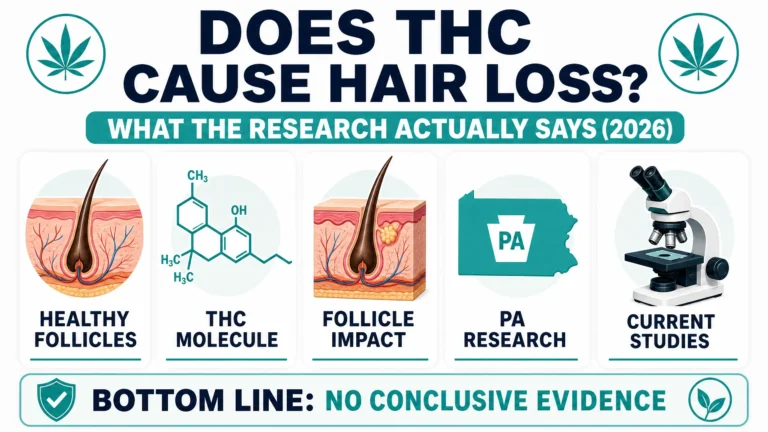

Does THC cause hair loss?
This is a common concern among patients who start noticing more shedding after beginning a medical cannabis regimen, and it deserves an honest, research-based answer rather than a reassuring non-answer.
Need a PA Medical Marijuana Card?
Get certified online in 15 minutes. 100% Money-Back Guarantee.
Get Certified Now →The short version: Laboratory research shows THC can interact with hair follicle receptors in ways that may disrupt the hair growth cycle. But no large-scale human clinical studies have established a direct causal link between cannabis use and meaningful hair loss.
For most adult patients, especially those managing a chronic medical condition, other factors are far more likely to explain changes in hair or skin than THC itself.
This guide walks through what the science actually shows, what is still unknown, and how to think about these concerns if you are a Pennsylvania medical marijuana patient.
Key Takeaways
- Laboratory research confirms CB1 receptors in hair follicles, but no large-scale human study has established a causal link between cannabis use and clinically significant hair loss.
- UK-licensed cannabis medicines including Sativex and Epidyolex do not list alopecia as a recognized adverse effect, which is meaningful reassurance from the highest-quality clinical data available.
- Chronic illness, stress, nutritional changes, and other medications are far more established causes of hair loss than THC for the typical PA MMJ patient managing a qualifying condition.
- PA patients vaporize, not smoke. Many hair and skin concerns in cannabis research reference smoking specifically. Vaporization eliminates combustion-related oxidative stress, making several proposed mechanisms less relevant.
- THC may contribute to acne in predisposed individuals through testosterone and sebum effects, but CBD in balanced products may partially offset this.
- For the “does THC stunt growth” question: no solid evidence connects THC to reduced height in adults. The concern is real but specific to heavy adolescent use during active development.
How Hair Growth Actually Works: The Basics
Before examining what THC may or may not do to hair, understanding the normal hair growth cycle gives important context.

Do You Qualify for a PA MMJ Card?
Connect with a licensed Pennsylvania state physician online from home.
Hair follicles cycle through three phases. The anagen phase is active growth, lasting two to seven years per follicle. The catagen phase is a short transitional period of two to three weeks. The telogen phase is a resting period of three to four months, after which the hair sheds and a new anagen cycle begins.
At any given time, approximately 85 to 90 percent of your hair is in the anagen phase. Hair loss becomes noticeable when a larger-than-normal percentage of follicles shift into telogen simultaneously, a condition called telogen effluvium, or when follicles miniaturize over time due to hormonal influences, which is androgenetic alopecia (pattern hair loss).
The distinction between these two types matters a lot for interpreting cannabis-related hair concerns. Telogen effluvium is typically triggered by physiological stressors such as illness, surgery, significant dietary changes, emotional stress, or medication changes.
It causes a temporary shed that usually resolves once the trigger is removed. Androgenetic alopecia is a long-term, genetically driven process primarily influenced by dihydrotestosterone (DHT).
Understanding which type might be occurring helps clarify whether cannabis is a plausible cause.
Does THC Cause Hair Loss? What the Research Shows
The honest answer is that the available research is limited, methodologically imperfect, and points in conflicting directions.

What the laboratory research shows?
As Bolt Pharmacy’s 2026 clinical review summarizes, hair follicles contain both CB1 and CB2 receptors, meaning they are directly responsive to cannabinoid signaling.
In ex vivo tissue models (studies on isolated human hair follicle tissue, not in living people), THC exposure has been associated with inhibited hair shaft elongation, suppressed proliferation of hair follicle keratinocytes, and premature entry into the catagen phase.
Research cited by Shear Pointe Hair Restoration indicates that the University of Debrecen conducted research highlighting THC’s role in inhibiting human hair follicle growth in these isolated tissue models.
What the clinical evidence shows?
This is where the picture changes significantly. As Bolt Pharmacy’s review states plainly: “No large-scale, peer-reviewed studies have conclusively established a causal link between cannabis use and alopecia or accelerated hair shedding.”
⚡ Fast & 100% Online PA Medical Cards
Board-Certified Doctors • 100% Money-Back Guarantee
Book Evaluation Now →The most informative real-world clinical data comes from pharmaceutical cannabis. UK-licensed cannabis-based medicines, specifically Sativex and Epidyolex, both of which contain significant THC and CBD, do not list alopecia as a recognized adverse effect in their Summaries of Product Characteristics.
These products have been prescribed to thousands of patients in controlled medical settings with rigorous adverse event monitoring. If THC routinely caused meaningful hair loss, it would appear in these reports.
The gap between lab and clinic
Laboratory tissue models are useful for understanding biological mechanisms, but they do not replicate the complex environment of a living human using cannabis.
Dosing, route of administration, systemic versus topical exposure, individual genetics, and interactions with other physiological factors all modify outcomes in ways that isolated tissue studies cannot capture.
The CB1 Receptor Connection: Lab Evidence vs. Clinical Reality

The presence of CB1 receptors in hair follicles is real, and it is the starting point for understanding why THC-hair loss concerns have scientific credibility even if clinical proof is lacking.
The endocannabinoid system regulates a wide range of physiological processes, and hair follicle cycling appears to be one of them.
Research in the FASEB Journal has found that endocannabinoids (the body’s naturally produced cannabinoids) help regulate hair follicle cycling. This makes it biologically plausible that introducing external cannabinoids like THC could influence that process.
The proposed mechanism goes like this
THC activates CB1 receptors in hair follicles. This activation may reduce the expression of proteins needed to maintain the anagen (growth) phase. Follicles shift prematurely into the catagen (transition) phase. This shortens individual hair growth cycles and could, over time, lead to increased shedding.
This mechanism is plausible and supported by in vitro data. What is missing is the translation to clinically meaningful hair loss in real patients using cannabis at typical doses over realistic timeframes.
The dose-dependence is also unknown: the concentrations used in laboratory tissue models may exceed what hair follicles are exposed to systemically during normal cannabis use.
As the Good Health by Hims team summarizes
“THC can bind to CB1 receptors in your hair follicles, possibly interrupting the hair growth cycle and causing early shedding. But the science isn’t fully clear on this yet.”
Renewing Your PA MMJ Card?
Quick annual recertification online. No paperwork hassle.
Renew Card Online →That “not fully clear yet” is the most accurate framing available with current evidence.
The Confounding Variable Problem: What Is Actually Causing the Hair Loss?
This is the most practically important section for PA MMJ patients who have noticed more hair shedding since beginning cannabis use.

The confounding variable problem in cannabis-hair loss research is significant. People who use cannabis are often doing so because they have a medical condition. Those conditions, and the treatments for them, carry their own hair loss risks. Separating the cannabis effect from everything else is difficult.
Established, well-documented causes of hair loss that commonly apply to PA MMJ patients:
| Cause | How It Relates to PA MMJ Patients |
|---|---|
| Chronic illness and physiological stress | Cancer, Crohn’s, chronic pain, and other qualifying conditions are established triggers of telogen effluvium |
| Medications | Chemotherapy, immunosuppressants, anticoagulants, and antidepressants all list alopecia as a known side effect |
| Psychological stress | Managing a serious chronic condition elevates cortisol, which drives telogen effluvium |
| Nutritional changes | Cannabis-induced appetite changes, especially in patients with nausea, can affect protein and iron intake |
| Hormonal conditions | Thyroid disorders, PCOS, and hormonal medication changes are more common in chronically ill populations |
| Androgenetic alopecia | Genetic pattern hair loss often becomes apparent in the same life stage when chronic conditions develop |
Regular cannabis use can elevate cortisol levels in some users. As Shear Pointe Hair Restoration notes, increased cortisol can trigger telogen effluvium by causing premature entry of hair follicles into the resting phase.
However, this cortisol-cannabis link works both ways: cannabis is often used precisely because it reduces psychological stress and cortisol in patients with anxiety or chronic pain. The net effect on hair depends on whether the cannabis is reducing more stress than it may be introducing.
Bolt Pharmacy’s 2026 review puts this clearly: “Individuals who use cannabis may also smoke tobacco, experience poor nutrition, or have elevated psychological stress. All of these are independent, well-established contributors to hair loss.”
The takeaway for PA patients: before concluding that THC is the cause of new hair shedding, review everything else that changed around the same time. A new medication, a worsening of the underlying condition, a dietary change, or a period of heightened stress is more likely the explanation for most patients.
Does THC Cause Acne? The Sebum and Hormone Story
Acne concerns follow a similar pattern to hair loss concerns: a biologically plausible mechanism, some supporting evidence, significant confounders, and no definitive causal proof in humans.
The proposed pathway connecting THC to acne has two main components.

The testosterone pathway
As Honeydew’s June 2026 skin health analysis explains, research published in the Journal of Clinical Pharmacology found that THC can temporarily increase testosterone levels in some users. Testosterone and other androgens stimulate sebaceous glands to produce more sebum (skin oil).
Get Approved by a Licensed PA Doctor
Schedule your appointment in minutes. You only pay if approved.
Start Online Application →Excess sebum mixes with dead skin cells, clogs pores, and creates conditions for acne-causing bacteria to thrive. If you are already prone to hormonal acne, a temporary testosterone spike could worsen breakouts.
The direct sebaceous gland pathway
The endocannabinoid system has been shown to play a role in regulating sebocyte (oil-producing cell) function. CB2 receptors are found in sebaceous glands. THC binding to these receptors may influence oil production, though research shows mixed results.
A 2014 study in the Journal of Clinical Investigation specifically examined cannabinoids and sebocyte function and found that different cannabinoids could either stimulate or suppress oil production depending on concentration and compound.
Important nuances
The smoking-specific concern does not apply to PA patients. Combustion byproducts from smoking introduce free radicals and hydrocarbons that damage skin cells directly, slow healing, and worsen inflammation.
Pennsylvania medical marijuana patients are required to vaporize, not smoke. Several of the mechanisms linking cannabis to acne specifically involve smoke exposure and are not relevant to vaporization users.
The cannabis-induced munchies and acne connection is indirect but worth noting. High-glycemic diets (chips, candy, fast food) are strongly linked to acne severity. If cannabis consistently drives food choices toward high-glycemic options, skin health can suffer through that pathway rather than through direct cannabinoid action.
CBD’s Role: Does It Counteract THC’s Skin Effects?
Pennsylvania dispensary products, particularly flower and balanced tinctures, contain both THC and CBD. This matters because CBD and THC appear to have partially opposing effects on skin and hair.

On hair follicles
CBD does not bind CB1 receptors in the same way as THC. It has a more complex, modulatory effect on the endocannabinoid system. Where THC may activate CB1 in ways that push follicles toward catagen, CBD may partially offset that signaling. The net effect of combined THC and CBD exposure on hair follicles is not well characterized.
On acne and skin
A 2014 study published in the Journal of Clinical Investigation found that CBD exerts sebostatic and anti-inflammatory effects on human sebocytes, essentially reducing oil production and calming inflammation. This finding has been widely cited as a basis for CBD-based skincare products.
If THC tends to increase sebum and CBD tends to reduce it, the net effect of a balanced product depends on the ratio and the individual’s receptor sensitivity.
Practical implication for PA patients
Ready to Get Your Official PA MMJ Card?
State-certified doctor consultations online. No risk—100% refund if not approved.
Claim Your MMJ Card Online →If you use dispensary products with significant CBD content, such as balanced tinctures (1:1 THC to CBD ratios) or full-spectrum capsules, the skin and hair concerns associated with THC alone may be moderated by the CBD component. High-THC, low-CBD products would carry a higher theoretical risk based on the available evidence.
Does THC Stunt Your Growth? Two Different Questions
“Does THC stunt your growth” is actually two separate questions that often get conflated, and the answers are meaningfully different.

Question 1: Does THC reduce physical height?
There is no solid evidence that cannabis use reduces height in adults. Height is determined by genetic programming and growth plate closure. Once growth plates close in late adolescence, no substance or lifestyle factor can make a person shorter. For adults, the height question is settled: no.
For adolescents, the picture is more cautious. A study published in the Journal of Clinical Endocrinology and Metabolism found an association between heavy adolescent cannabis use and slight height reductions in males and females.
However, the studies use self-reported data, and nutritional and other confounding factors complicate interpretation. No research has established a direct causal mechanism by which THC specifically prevents bone elongation.
Question 2: Does THC stunt cognitive and brain development in adolescents?
This question has a much clearer and more concerning answer. A landmark April 2026 study from UC San Diego, published in Neuropsychopharmacology and analyzing data from more than 11,000 participants in the Adolescent Brain Cognitive Development (ABCD) Study, found that teenagers who began using cannabis showed slower gains in thinking and memory skills compared to non-using peers. As lead researcher
Dr. Natasha Wade stated: “Adolescence is a critical time for brain development, and what we’re seeing is that teens who start using cannabis aren’t improving at the same rate as their peers.”
This cognitive development concern is separate from physical height but represents a well-evidenced and meaningful risk for adolescent use.
For adult PA MMJ patients
Pennsylvania’s medical marijuana program serves adults, and the growth-stunting question rarely applies to them directly. The physical height concern does not apply to anyone past adolescence.
The cognitive concern is primarily relevant during active brain development, which continues into the mid-twenties, meaning young adult patients (ages 18 to 25) should be aware of this research even if they are legally eligible for the program.
The PA Patient Perspective: What Is Different for You
Several features of Pennsylvania’s medical marijuana program make some of these concerns less applicable to registered PA patients than to general cannabis users.

Vaporization, not smoking
Pennsylvania law prohibits smoking cannabis. All PA medical patients who use flower products do so through dry herb vaporizers.
This eliminates combustion-related oxidative stress, the smoke-specific mechanisms for skin damage, and the direct toxin exposure from combustion byproducts. Many of the peer-reviewed studies linking cannabis to hair and skin concerns reference smoking specifically. Those particular pathways are not relevant to PA patients.
Product quality and COA testing
All Pennsylvania dispensary products are tested by two independent, state-approved laboratories before sale. As covered in our How to Read a Pennsylvania Dispensary COA guide, every product comes with verified potency, terpene, and contaminant data. This quality assurance is absent in the unregulated hemp market.
Pharmacist consultation
Licensed pharmacists are required to be on-site at all licensed PA dispensaries. If you have concerns about specific products and potential side effects, a dispensary pharmacist can review your full medication list and qualifying condition and provide informed guidance. This is a meaningful patient safety resource that general cannabis users do not have access to.
Qualifying conditions context
PA MMJ patients have serious medical conditions. Cancer patients may be losing hair from chemotherapy. Crohn’s patients may have nutritional deficiencies affecting skin. Chronic pain patients may have elevated cortisol from persistent pain. For these patients, cannabis is far down the list of probable causes for hair or skin changes.
When to Talk to a Doctor About Hair or Skin Changes?
This guide is educational, not diagnostic. Hair loss and skin changes can have many causes, and some require medical evaluation. Here is a practical framework for deciding when to consult a physician.

See a doctor if:
- Hair loss is sudden and significant, losing more than 100 to 150 hairs per day consistently
- Hair loss is occurring in patches rather than diffuse shedding
- Hair loss is accompanied by other symptoms such as fatigue, unexplained weight changes, skin changes, or joint pain
- Acne is severe, cystic, or leaving scarring
- You have started a new medication within the past three to six months alongside cannabis
- Hair or skin changes began within weeks of starting or significantly increasing cannabis use and no other explanation exists
It is likely not urgent if:
- You are experiencing mild, diffuse shedding that has stabilized
- You recently experienced a significant stressor, illness, or dietary change
- Hair changes began around the same time as a new medication known to affect hair
- Skin changes are mild and fluctuate with diet, stress, and sleep
Your dispensary pharmacist is also a good first resource if you suspect a specific product may be involved. They can note your concern, review your product choices, and suggest alternatives with different cannabinoid ratios or consumption methods.
If you do not yet have a PA medical marijuana card and want access to dispensary pharmacist guidance and state-tested products, explore whether your condition qualifies or get certified today.
Frequently Asked Questions
Q: Does THC cause hair loss?
A: Laboratory research shows THC interacts with CB1 receptors in hair follicles and may disrupt the hair growth cycle in isolated tissue models. However, no large-scale human clinical studies have established a direct causal link between cannabis use and significant hair loss. UK-licensed cannabis medicines containing THC, specifically Sativex and Epidyolex, do not list alopecia as a recognized adverse effect, which is the strongest available reassurance from clinical settings. For most patients, chronic illness, stress, medications, or nutritional factors are more likely explanations for hair changes than THC.
Q: Does THC cause acne?
A: THC may contribute to acne in predisposed individuals through two proposed pathways: temporary testosterone elevation stimulating sebum production, and direct CB2 receptor activation in sebaceous glands. However, research is limited and results are mixed. Smoking cannabis introduces combustion byproducts that directly damage skin, but this is not relevant to Pennsylvania patients who are required to vaporize. CBD, present in most dispensary products, has documented sebostatic (oil-reducing) and anti-inflammatory effects that may partially counteract THC’s sebum-stimulating effects.
Q: Does THC stunt your growth?
A: This question covers two different concerns. Physical height: no solid evidence shows THC reduces height in adults. Once growth plates close, height is set. Heavy adolescent use has been associated with slight height differences in some studies, but direct causation has not been established. Cognitive development: a major April 2026 UC San Diego study of more than 11,000 participants found that teens who began using cannabis showed slower cognitive development compared to peers. This brain development concern is real and specific to adolescent and young adult use.
Q: Why am I losing more hair since starting cannabis?
A: The most likely explanations for hair loss that coincides with starting cannabis are: a new medication started around the same time, the chronic condition being treated causing physiological stress, nutritional or dietary changes, elevated cortisol from managing illness, or pattern hair loss (androgenetic alopecia) that was already developing. THC cannot be completely ruled out, but it is lower on the probability list than these established causes for most patients. If the shedding is significant, see a physician or dermatologist for evaluation.
Q: Is hair loss from THC permanent?
A: If THC does contribute to hair shedding through a telogen effluvium-type mechanism, telogen effluvium is typically reversible once the triggering factor is removed or resolved. Hair that sheds in this pattern usually regrows within three to six months. Androgenetic alopecia, which is genetically driven and DHT-related, is a separate, longer-term process that would not be reversed by stopping cannabis.
Q: Are PA dispensary products different from street cannabis for skin and hair concerns?
A: Yes, in meaningful ways. PA dispensary products are state-tested for cannabinoid content, contaminants, and pesticides. They are consumed via vaporization rather than smoking, eliminating combustion-related skin effects. They are available in a range of THC:CBD ratios, and balanced products with significant CBD may have different skin effects than high-THC-only products. Licensed dispensary pharmacists can also discuss specific concerns with you, something unavailable with unregulated products.
Q: Should I stop using cannabis if I am concerned about hair or skin?
A: This is a decision to make with your certifying physician, not based on a blog. For most PA patients managing a serious medical condition, the therapeutic benefit of cannabis is significant and well-documented for their qualifying condition. Minor, unconfirmed cosmetic concerns would not typically outweigh those benefits without a clearer causal link. If hair loss is significant, rapid, or causing distress, see a dermatologist for evaluation while continuing to discuss your cannabis regimen with your physician.
The Bottom Line
Does THC cause hair loss?
The research shows it is biologically plausible but not clinically proven. For adult Pennsylvania MMJ patients managing chronic conditions, the factors most likely to cause changes in hair and skin are the conditions themselves, the medications that treat them, the stress of being ill, and the nutritional changes that often accompany serious health challenges.
The honest reassurance: if you are a registered PA patient vaporizing state-tested dispensary products with significant CBD content, you are using cannabis in the format least likely to cause the side effects described in many cannabis-and-hair studies, most of which reference smoking, street cannabis, or isolated THC compounds in laboratory conditions.
If you have specific concerns about a product affecting your hair or skin, your dispensary pharmacist is the right first point of contact. They understand the product range, your options, and how to recommend alternatives.
This blog post is intended for general educational and informational purposes only and does not constitute medical advice. Hair loss and skin changes can have many causes and may require professional medical evaluation. If you are experiencing significant or rapid hair loss, consult a dermatologist or your physician rather than making changes to your medical cannabis regimen without professional guidance. Medically reviewed by Dr. Johnathon Chance Miller, MD.
Sources:
- Bolt Pharmacy: Can Weed Cause Hair Loss? Evidence, Causes and UK Treatments (June 2026)
- Shear Pointe Hair Restoration: Marijuana and Hair Loss (October 2025)
- Scandinavian Biolabs: Can Weed Cause Hair Loss? Scientific Research (March 2025)
- Good Health by Hims: Can Weed Cause Hair Loss?
- Transitions Hair: Cannabis and Hair Loss (September 2025)
- Honeydew: Does Weed Cause Acne? (June 2026)
- Dr. Good Deed: Does Smoking Weed Cause Acne? (June 2026)
- Meet Ludist: Does Weed Cause Acne? (February 2026)
- University of California San Diego: Largest US Study Finds Teen Cannabis Use Linked to Slower Cognitive Development (April 2026)
- The Cannigma: Does Weed Actually Stunt Growth? (February 2026)
- Leafwell: Can Using Cannabis Stunt a Child’s Growth? (October 2025)
- Oláh A et al. 2014: Cannabidiol exerts sebostatic and anti-inflammatory effects on human sebocytes, Journal of Clinical Investigation
- PA Department of Health: Medical Marijuana Program