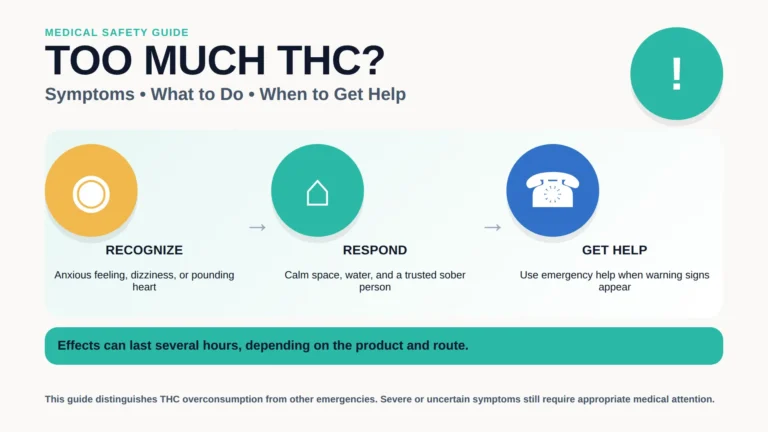
Too much THC does not cause a fatal overdose. No confirmed human deaths from THC alone have been recorded, and the DEA confirms no reported fatalities from marijuana overdose.
But consuming more THC than your body can comfortably process causes a deeply unpleasant experience lasting hours. Anxiety, paranoia, rapid heart rate, nausea, and disorientation can feel truly frightening while they are happening. For Pennsylvania medical marijuana patients, this scenario is more common than most guides acknowledge.
Need a PA Medical Marijuana Card?
Get certified online in 15 minutes. 100% Money-Back Guarantee.
Get Certified Now →High-potency dispensary products, the delayed onset of troches and tinctures, and the tendency to take more when nothing is felt yet are a reliable combination for overconsumption.
Understanding what is happening, what to do, and when to call for help is practical knowledge every PA patient should have before it is ever needed.
Key Takeaways
- THC overconsumption is not a fatal overdose in the traditional sense. No confirmed deaths from THC alone have been recorded. What happens is an intensely uncomfortable experience that will pass.
- Symptoms include anxiety, paranoia, rapid heart rate, nausea, dizziness, and time distortion. For oral products (troches, tinctures, capsules) these can last 6 to 12 hours. For vaporized flower they typically resolve in 2 to 4 hours.
- The most common cause in PA patients is the edible double-dose trap, taking more because effects have not appeared yet, then both doses hitting simultaneously.
- CBD taken sublingually can help reduce THC effects. Do NOT take CBD as an edible, research shows edible CBD extends and intensifies THC effects rather than reducing them.
- Call 911 or Poison Control (1-800-222-1222) if someone loses consciousness, cannot breathe normally, has a seizure, or a child has ingested a cannabis product. These are genuine emergencies.
- Do not drive. Pennsylvania’s per se DUI law sets a threshold of 1 ng/mL active THC in blood. If you have consumed too much THC, driving is both dangerous and illegal regardless of how you feel.
Can You Overdose on THC? The Honest Medical Answer
The word “overdose” is used differently in cannabis context than in most drug contexts, and the distinction matters.
With opioids or alcohol, overdose means a dose high enough to suppress breathing or cause organ failure, potentially leading to death.
Do You Qualify for a PA MMJ Card?
Connect with a licensed Pennsylvania state physician online from home.
THC does not work through these mechanisms. Unlike opioids, THC primarily affects coordination, memory, and perception. Cannabinoid receptors (CB1 and CB2) are not present in the brainstem regions that control breathing at the level required for fatal respiratory depression.
As research published through the National Institute of Health confirms, there are no recorded instances of fatal overdoses from THC alone in humans. A 2014 research paper does describe two deaths where men had used marijuana, but the authors explicitly note they cannot establish a direct causal relationship between cannabis use and the cause of death.
What “too much THC” does cause is an acute intoxication state that can be intensely distressing. The medical term is cannabis intoxication or THC overconsumption.
It is not the same pharmacological event as a heroin overdose or alcohol poisoning. But it is not trivial either.
For someone experiencing severe THC overconsumption, particularly a first-time patient or someone who has accidentally consumed far more than intended, the physical and psychological symptoms are real, frightening, and can sometimes lead to dangerous secondary situations.
The modern cannabis landscape makes overconsumption more common than in previous generations.
Research confirms modern cannabis contains multiple times the THC concentration compared to strains from the 1990s. PA dispensary concentrate products like live rosin and vape cartridges can reach 65 to 85% total cannabinoids, levels that were essentially unavailable a decade ago.
Who is at highest risk of THC overconsumption:
| Patient Profile | Why Risk Is Higher |
|---|---|
| First-time or new cannabis users | No established tolerance; no personal reference point for what effects feel like |
| Patients switching from flower to concentrates | Dosing intuition from flower does not transfer to 65-85% THC concentrates |
| Patients using oral products (troches, capsules) | Delayed onset leads to double-dosing before first dose appears |
| Anxiety disorder patients | Lower threshold for THC-induced anxiety escalation; anxiety is PA’s most common qualifying condition |
| Patients who have taken a tolerance break | Previous tolerance has reset; former doses now too high |
| Anyone mixing THC with alcohol | Alcohol significantly amplifies and prolongs THC intoxication |
Symptoms of Too Much THC: What to Expect
THC overconsumption produces both physical and psychological symptoms. Understanding the full spectrum helps patients recognize what is happening and respond calmly rather than escalating fear.
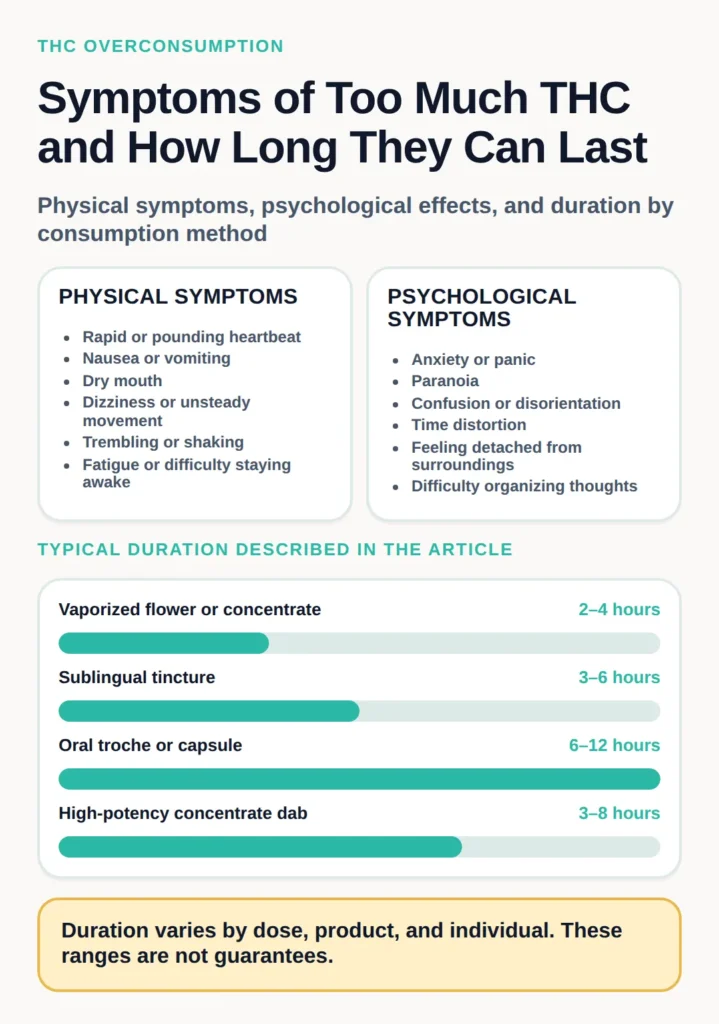
Physical symptoms:
- Rapid or pounding heartbeat (tachycardia), one of the most alarming physical sensations, but not typically dangerous in healthy adults
- Nausea and sometimes vomiting
- Dry mouth intensified beyond normal
- Pale skin or flushing
- Unsteady movement or coordination problems
- Trembling or shaking
- Chest tightness or shortness of breath (usually anxiety-driven rather than cardiac)
- Extreme fatigue or difficulty staying awake
⚡ Fast & 100% Online PA Medical Cards
Board-Certified Doctors • 100% Money-Back Guarantee
Book Evaluation Now →Psychological symptoms:
- Intense anxiety, the most commonly reported symptom
- Paranoia, feeling watched, threatened, or that something terrible is about to happen
- Confusion and disorientation
- Time distortion, minutes feeling like hours
- Derealization, feeling detached from your body or surroundings
- Difficulty forming coherent thoughts or sentences
- Heightened sensitivity to sounds, lights, and sensations
- Intrusive or looping thoughts
Duration by consumption method:
| Consumption Method | Typical Duration of Overconsumption Symptoms |
|---|---|
| Vaporized flower or concentrate | 2 to 4 hours, occasionally longer |
| Tincture (sublingual absorption) | 3 to 6 hours |
| Troche or capsule (oral/digestive) | 6 to 12 hours |
| High-potency concentrate dab | 3 to 8 hours depending on amount |
The duration difference between vaporized and oral products is one of the most practically important things for PA patients to understand.
When something feels overwhelming from a troche taken at 7pm, that experience may not fully resolve until 5 or 6am.
Knowing this in advance, rather than discovering it during the experience, significantly reduces the panic that comes from not knowing when it will end.
THC Overconsumption vs Panic Attack vs Cannabis Hyperemesis: How to Tell the Difference
Three different scenarios involve cannabis and distressing physical or psychological symptoms. Knowing which one is occurring determines the appropriate response.
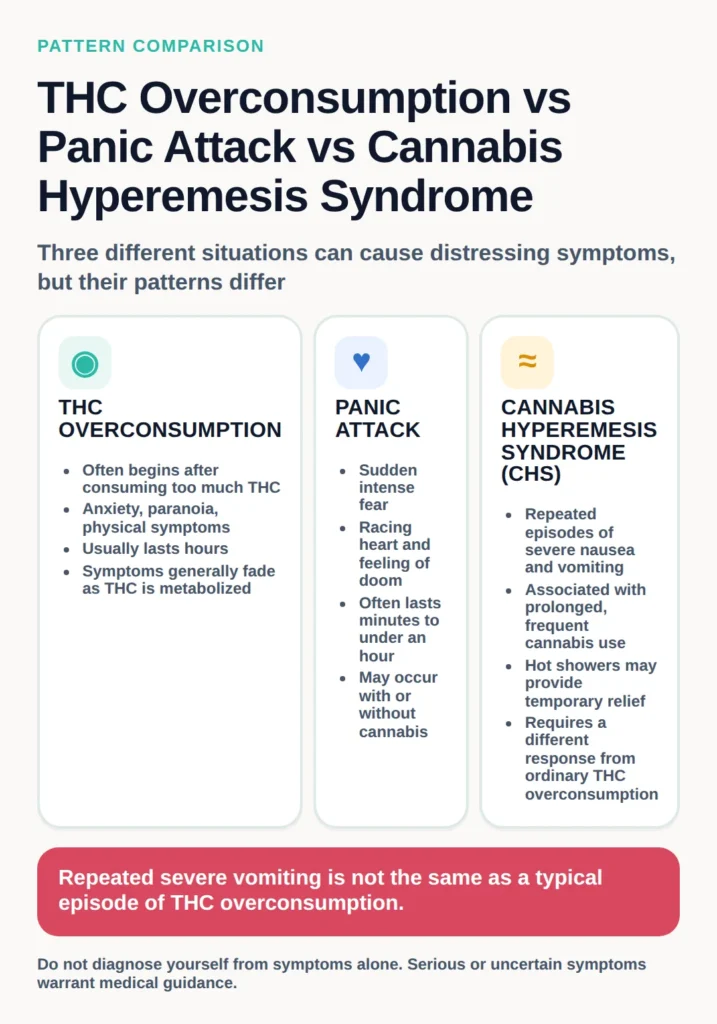
| Feature | THC Overconsumption | Panic Attack | Cannabis Hyperemesis Syndrome (CHS) |
|---|---|---|---|
| Onset | 15 min to 2 hours after consumption | Sudden, often without clear trigger | Cyclical over days or weeks |
| Primary symptom | Combination of anxiety, paranoia, physical symptoms | Intense fear, racing heart, feeling of doom | Severe, repeated nausea and vomiting |
| Duration | Hours (2 to 12 depending on method) | Minutes to under an hour | Hours to days per episode |
| Relationship to cannabis | Directly caused by consuming too much | May be triggered or worsened by THC | Worsens WITH more cannabis, briefly relieved by hot showers |
| Hot shower relief | No specific relief | No specific relief | Yes, temporary relief from hot water is a hallmark sign |
| Trigger | Too much THC, too fast | Stress, anxiety, sometimes THC | Daily or near-daily high-dose use over long period |
| Resolution | Resolves as THC clears system | Resolves with calming techniques | Only fully resolves with cannabis cessation |
| Emergency risk | Low unless secondary complications | Low | Moderate, dehydration and electrolyte loss |
If you or someone around you regularly uses cannabis and is experiencing episodes of severe, repeated vomiting temporarily relieved by hot showers, that is not simple THC overconsumption.
That is a pattern consistent with Cannabis Hyperemesis Syndrome, which requires a different response entirely.
For the vast majority of people asking “did I take too much THC”, the answer involves acute onset of anxiety and physical symptoms shortly after consuming a cannabis product. That is standard THC overconsumption, and what this guide addresses.
The Edible Double-Dose Trap: Why This Happens at PA Dispensaries
This is the single most common mechanism behind THC overconsumption for Pennsylvania dispensary patients, and it is entirely preventable with the right information.
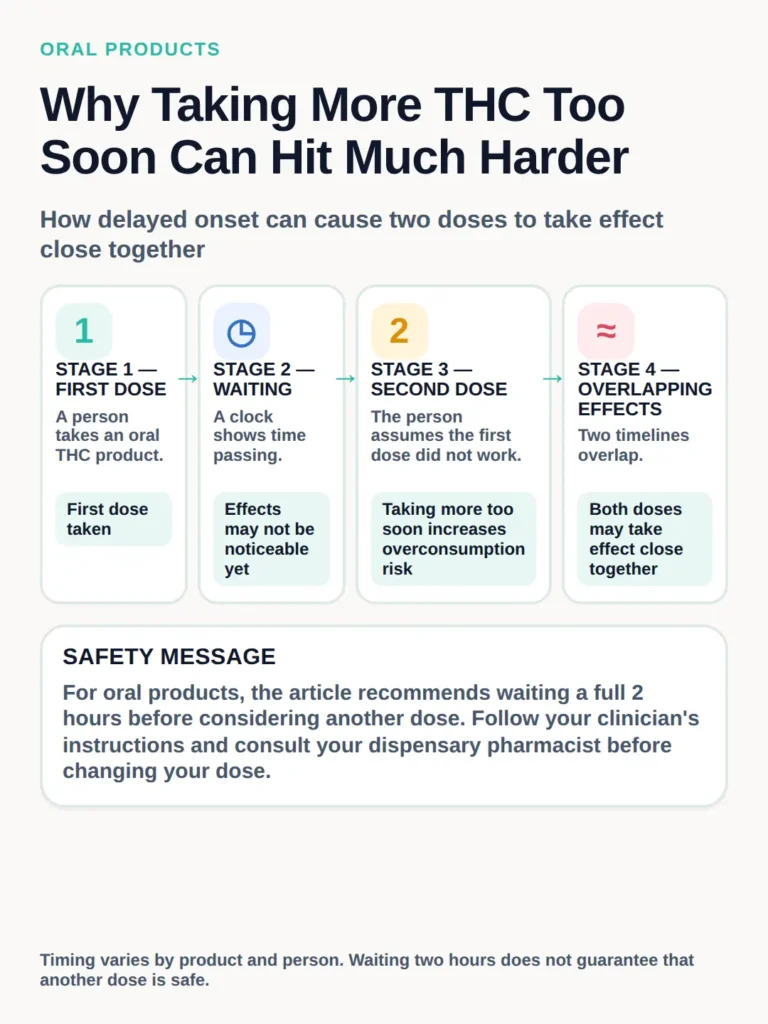
Here is the sequence:
Renewing Your PA MMJ Card?
Quick annual recertification online. No paperwork hassle.
Renew Card Online →A patient takes a troche or tincture at a dose they believe is appropriate, say, 10mg from a new product. Forty-five minutes pass. They feel nothing. They assume the dose was too small, or the product did not work, or their tolerance is higher than expected. They take another 10mg.
Twenty minutes later, the first dose begins to take effect. The second dose arrives shortly after. Instead of experiencing 10mg, they experience 20mg arriving in rapid succession, often at the peak of the first dose. For a new patient or someone whose tolerance is lower than they assumed, this produces the full overconsumption experience.
The timing of oral THC products through Pennsylvania’s dispensary system is highly variable.
Troches and tinctures held sublingually absorb in 15 to 45 minutes. Swallowed capsules and troches take 45 minutes to 2 hours to produce first effects. Peak effects can arrive up to 3 hours later depending on what was eaten, metabolism, and the specific formulation.
The rule that prevents this situation: After taking any oral cannabis product, wait a full 2 hours before considering any additional dose.
Set a timer. Write down when you took it. If 2 hours have passed and you feel nothing, consult your dispensary pharmacist before increasing.
The pharmacist is on-site at every licensed PA dispensary specifically to help with dosing questions like this.
For more detail on what specific milligram amounts feel like at different tolerance levels, see our guides on is 5mg of THC a lot and is 100mg of THC a lot.
High-Potency PA Dispensary Products: The Context Patients Need
Pennsylvania’s licensed dispensary system carries products that represent a dramatically wider potency range than most patients realize when they first receive their MMJ card.
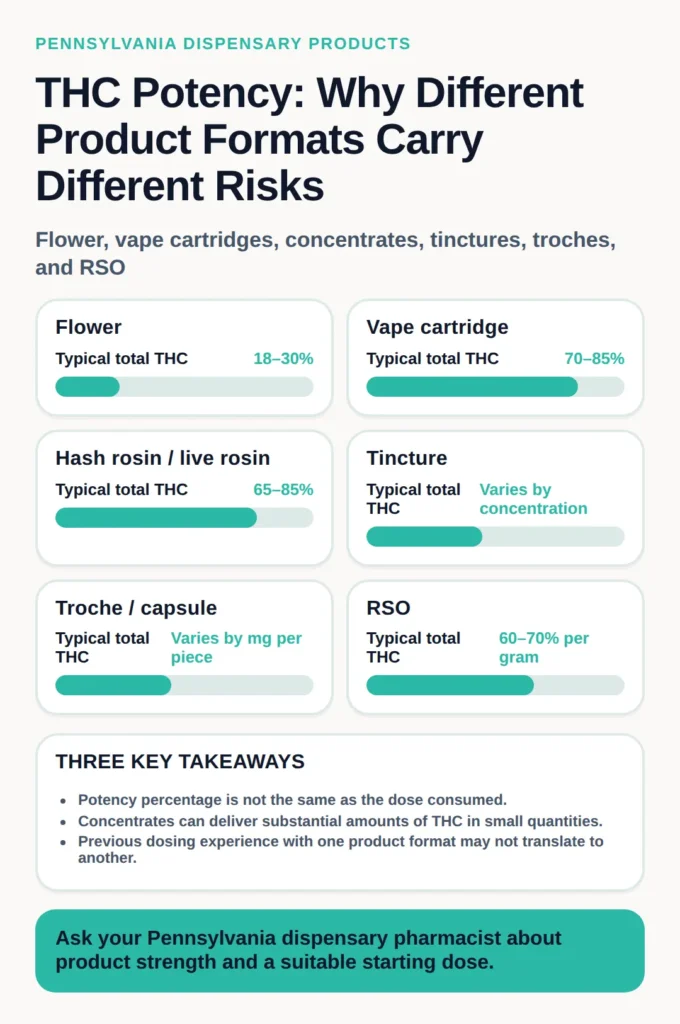
PA dispensary flower products typically show 18 to 30% total THC after applying the decarboxylation formula covered in our how to read a PA dispensary COA guide. That is already two to three times higher than typical street cannabis from ten years ago.
Concentrate products including live rosin, hash rosin, vape cartridges, and RSO represent an entirely different potency category.
Get Approved by a Licensed PA Doctor
Schedule your appointment in minutes. You only pay if approved.
Start Online Application →As covered in our hash rosin vs live rosin guide, premium concentrates routinely test at 65 to 85% total cannabinoids.
A rice-grain amount of live rosin (approximately 0.05g) delivers the equivalent potency of multiple full draws from a flower vaporizer.
For patients transitioning from flower to concentrates, or trying concentrates for the first time, the standard dosing intuition developed from flower use does not transfer. A dab that looks small by flower standards can deliver 3 to 5 times the THC of a typical flower session.
PA dispensary product potency ranges:
| Product Format | Typical Total THC Range | Relative Overconsumption Risk |
|---|---|---|
| Flower (vaporized) | 18% to 30% | Moderate, fast onset helps self-titration |
| Vape cartridge | 70% to 85% | High, easy to take multiple puffs quickly |
| Hash rosin / live rosin | 65% to 85% | High, small amounts deliver large doses |
| Tincture (sublingual) | Varies by concentration | Moderate, onset delay creates redose risk |
| Troche / capsule (oral) | Varies by mg per piece | High, longest delay before effects appear |
| RSO | 60% to 70% per gram | Very high, extremely concentrated format |
The same principle applies to high-potency tinctures. A 1,000mg CBD/THC tincture in a 30ml bottle delivers approximately 33mg per full dropper, a significant dose for most patients, not a starting dose.
The practical guidance: when trying any new product format or brand from a PA dispensary, ask the on-site pharmacist specifically about starting dose for your tolerance level. Do not assume your previous dose from a different product format applies.
What To Do Right Now If You Have Taken Too Much THC
If you are reading this because you or someone nearby has consumed too much THC, follow these steps in order:
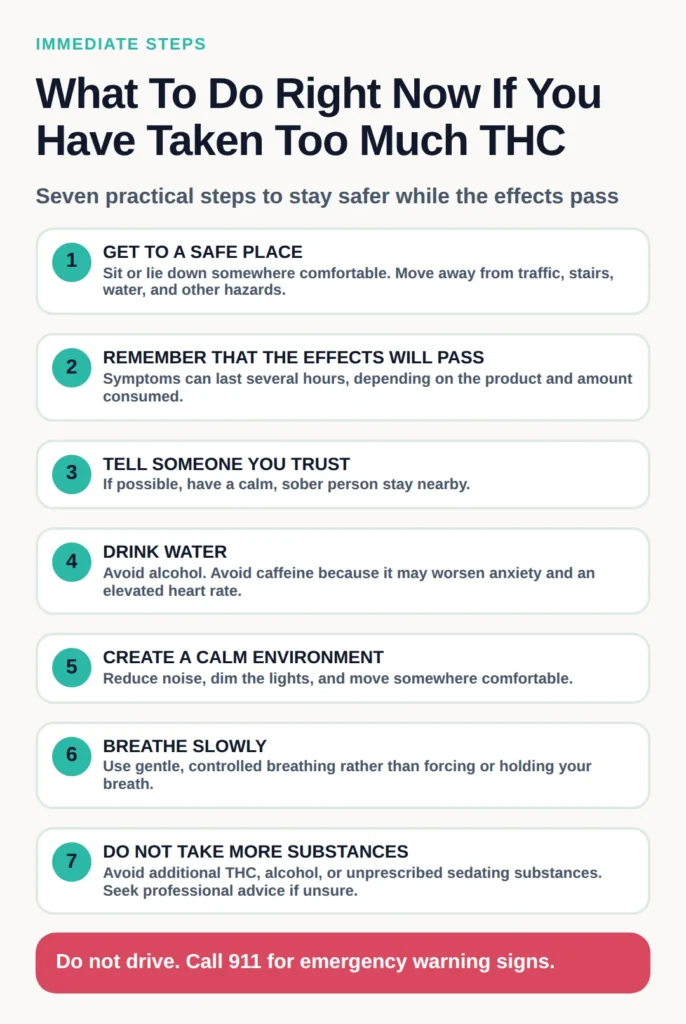
Step 1: Confirm you are physically safe
Sit or lie down somewhere comfortable and safe. If you are in a vehicle, get out of it. You cannot drive. If you are near traffic, stairs, water, or other physical hazards, move away from them. Physical safety is the first priority.
Step 2: Remind yourself it will end
The most distressing aspect of THC overconsumption is the subjective experience that the feeling will never stop. It will stop. Depending on how you consumed it and how much, this may take 2 to 12 hours, but it will resolve as your body clears the THC. Repeat this to yourself if needed: “This is temporary. My body is processing THC. I am physically safe.”
Step 3: Tell someone you trust
If you are with another person, tell them what happened. You do not need emergency services in most cases, but having a calm, sober person nearby who knows what is happening significantly reduces the psychological distress.
Step 4: Hydrate
Ready to Get Your Official PA MMJ Card?
State-certified doctor consultations online. No risk—100% refund if not approved.
Claim Your MMJ Card Online →Drink water steadily. Not alcohol (it significantly worsens and prolongs the experience), not caffeinated beverages (caffeine can worsen anxiety and heart rate elevation). Water.
Step 5: Create a calm environment
Dim the lights if possible. Reduce noise. Lie down. A cool or slightly cold environment can help with the physical discomfort. If you are outside, go indoors.
Step 6: Use controlled breathing
Slow, deliberate breathing directly counteracts the panic response. Breathe in for 4 counts, hold for 4, exhale for 6. Repeat. This activates the parasympathetic nervous system and reduces the anxiety spiral that often amplifies THC overconsumption symptoms.
Step 7: Do not take more of anything
This includes more cannabis, alcohol, sleep medications, or anything else. The only exception is sublingual CBD if available, covered in the next section.
Quick reference summary:
| Step | Action | What Not To Do |
|---|---|---|
| 1 | Get to a safe physical location | Do not drive |
| 2 | Remind yourself it is temporary | Do not catastrophize or google symptoms |
| 3 | Tell someone you trust | Do not be alone if avoidable |
| 4 | Drink water | Do not drink alcohol or caffeine |
| 5 | Create a calm, quiet environment | Do not go to noisy or stimulating places |
| 6 | Use controlled breathing (4-4-6) | Do not hold your breath or hyperventilate |
| 7 | Take sublingual CBD if available | Do not take edible CBD or more THC |
The CBD Rescue Technique: Does It Work?
The advice to “take CBD if you have too much THC” is widely repeated online. The evidence base is genuine but the delivery method is critical, and most guides get this wrong.
Sublingual CBD: may help
CBD taken sublingually (held under the tongue for 60 seconds before swallowing) can reduce THC’s psychoactive intensity through partial CB1 receptor modulation.
Taking 25 to 50mg of CBD sublingually when feeling overwhelmed by THC is a reasonable first-response technique that many patients find helpful.
CBD edibles: do not use
This is the critical error most guides fail to flag. Research indicates that edible CBD taken while already high from THC can extend and intensify the psychoactive effects rather than reducing them.
The liver metabolism pathway that converts oral THC to 11-hydroxy-THC (the potent metabolite behind intense edible experiences) is affected by oral CBD in ways that prolong rather than shorten the experience.
If your only CBD option is an edible form, gummy, capsule, or chewed troche, it is better to skip it entirely than risk extending the experience.
Black pepper: Anecdotal but safe
Sniffing or lightly chewing a few black peppercorns is widely reported to reduce THC-induced anxiety. The proposed mechanism involves beta-caryophyllene (the same terpene that gives pepper its aroma) binding to CB2 receptors. Rigorous clinical evidence is limited, but it is completely safe and some patients find meaningful relief. Worth trying if available.
If you are a PA dispensary patient, having a high-CBD sublingual tincture at home alongside your THC products is practical preparation. PA dispensaries carry CBD-dominant tinctures that serve exactly this purpose. For more on tincture options, see our CBD tinctures guide for Pennsylvania patients.
When To Call for Help: Clear Criteria for PA Patients
Most cases of THC overconsumption resolve on their own without medical intervention. But some situations do warrant calling for help. Here are the specific criteria:
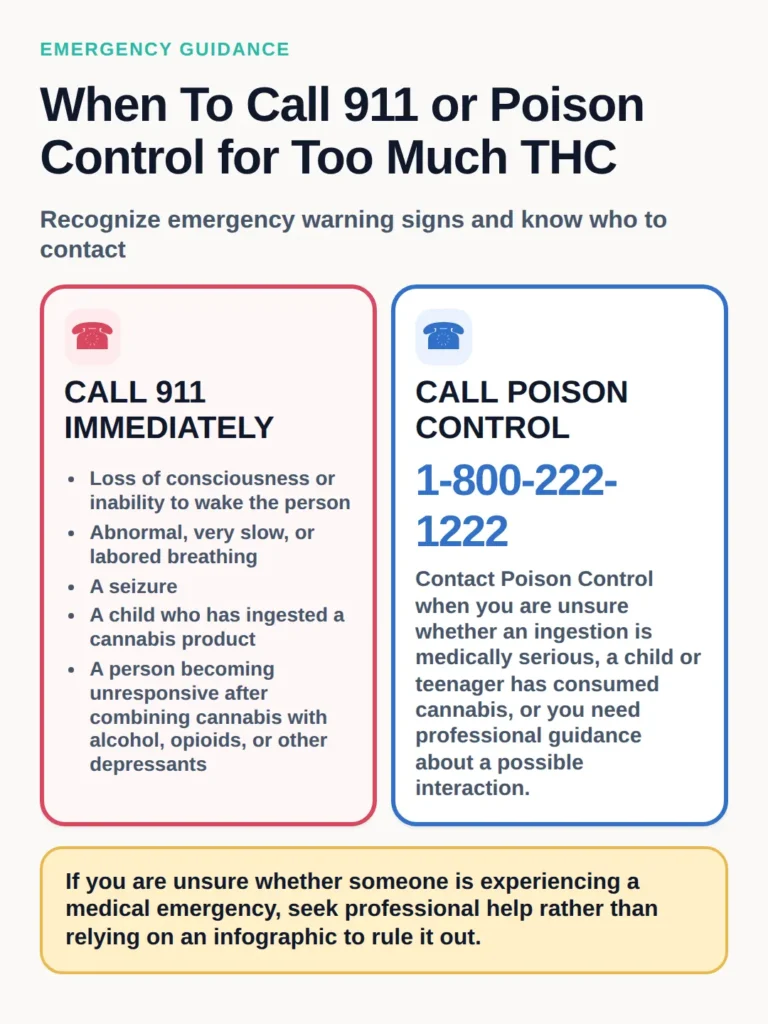
Call 911 immediately if:
- The person has lost or is losing consciousness and cannot be roused
- Breathing is irregular, very slow, or seems labored
- A seizure has occurred
- A child has ingested a cannabis product of any amount
- Cannabis was combined with alcohol, opioids, or other depressants and the person is becoming unresponsive
- A child has accessed a tincture bottle or high-potency product
Call Poison Control (1-800-222-1222) if:
- You are unsure whether the amount consumed is medically serious
- A child or teenager has consumed any cannabis product
- Cannabis was combined with another substance and you are uncertain of the interaction
- Symptoms are severe and you want professional guidance without calling 911
Call the PA MMJ Helpdesk (888-733-5595, 7AM to 9PM ET daily) if:
- You have questions about a dispensary product’s potency or formulation that contributed to the situation
- You want to report a product concern
- You have general questions about your PA MMJ program access
You likely do not need emergency services if:
- The person is conscious and responding to you
- Breathing is normal
- Symptoms are anxiety, paranoia, and nausea without loss of consciousness
- No other substances were combined with cannabis
- No children are involved
Unnecessary ER visits for cannabis overconsumption are extremely common and place a burden on emergency departments. Unless one of the clear criteria above applies, the appropriate response is supportive care at home.
Synthetic Cannabis vs Natural THC: A Critical Distinction
This distinction belongs in every THC overconsumption guide, and very few include it clearly enough.
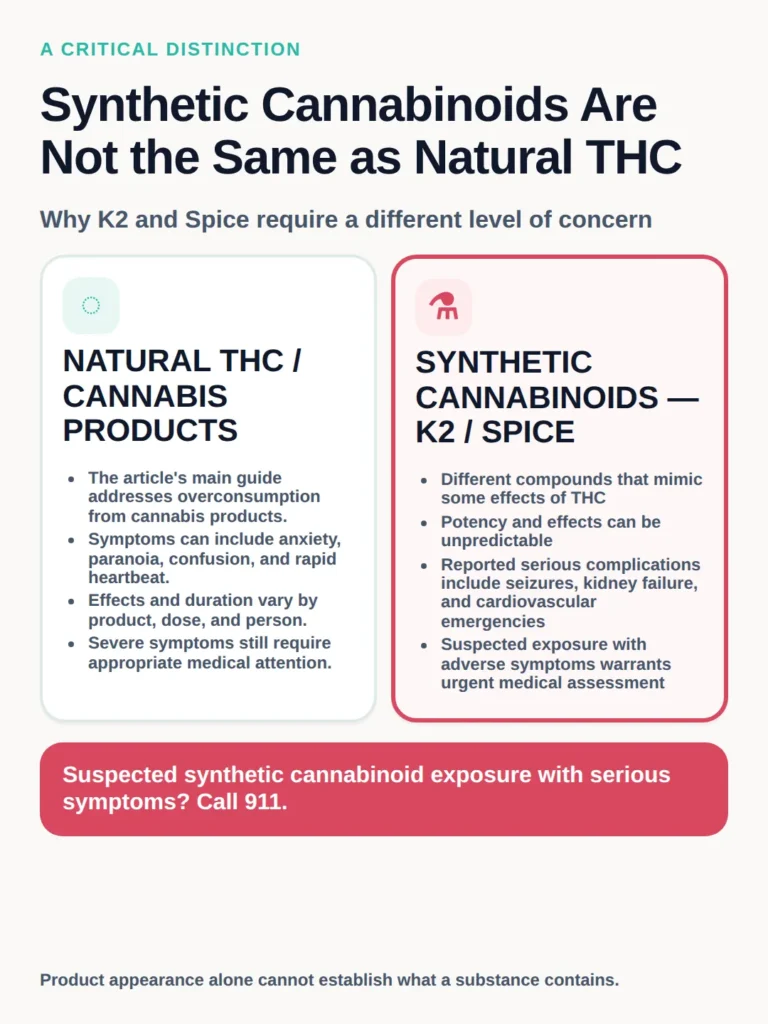
Natural cannabis (dispensary products, hemp products): The overconsumption scenarios described throughout this guide apply. Uncomfortable but not typically life-threatening on their own.
Synthetic cannabinoids (K2, Spice, “synthetic marijuana”): These are entirely different compounds that merely mimic some effects of THC but with dramatically higher potency and completely unpredictable effects.
They are NOT cannabis. They are not available at PA licensed dispensaries.
Synthetic cannabinoid intoxication can cause seizures, kidney failure, heart attacks, and death. It is a genuine medical emergency requiring immediate 911 response.
If someone has used a product labeled as “herbal incense,” “K2,” “Spice,” or any similar product that is not from a licensed PA dispensary or reputable hemp retailer, treat any adverse symptoms as a potential emergency and call 911.
Pennsylvania licensed dispensary products are completely free of synthetic cannabinoids, every product is tested by two independent DOH-approved laboratories before sale. This is one of the clearest practical benefits of the regulated dispensary system over unregulated sources.
Pediatric and Accidental Ingestion: A Separate Emergency
PA dispensary products, particularly troches, tinctures, and oil formulations, can look like ordinary candy or food to a child. The colorful packaging required for labeling, the sweet taste of some troches, and the candy-like appearance of certain products create an accidental ingestion risk.
For children, the guidance is different from adults: Children’s smaller body mass means a dose that would be uncomfortable but manageable for an adult can cause serious intoxication requiring medical evaluation. The CDC specifically calls out cannabis edibles as a leading cause of pediatric poisoning calls in states with legal cannabis programs.
If a child has ingested any cannabis product:
Call Poison Control immediately: 1-800-222-1222. Provide the product name, potency (in mg THC per piece), how much the child appears to have consumed, and the child’s approximate weight and age.
Do not wait for symptoms to appear before calling. Children can deteriorate quickly and the Poison Control team will guide you on whether ER evaluation is needed.
Store all PA dispensary products in the original child-resistant packaging, in a locked location, out of reach and out of sight of any children in the home. This is not only common sense. Pennsylvania law requires that registered patients store medical marijuana in its original dispensary packaging.
The PA-Specific DUI Risk During Overconsumption
Pennsylvania patients who have taken too much THC face a specific legal risk that most guides from other states do not address: the temptation to drive to a safer location, to a pharmacy, or to seek help.
Pennsylvania’s per se DUI law (75 Pa.C.S. § 3802) sets a threshold of 1 ng/mL of active THC in blood.
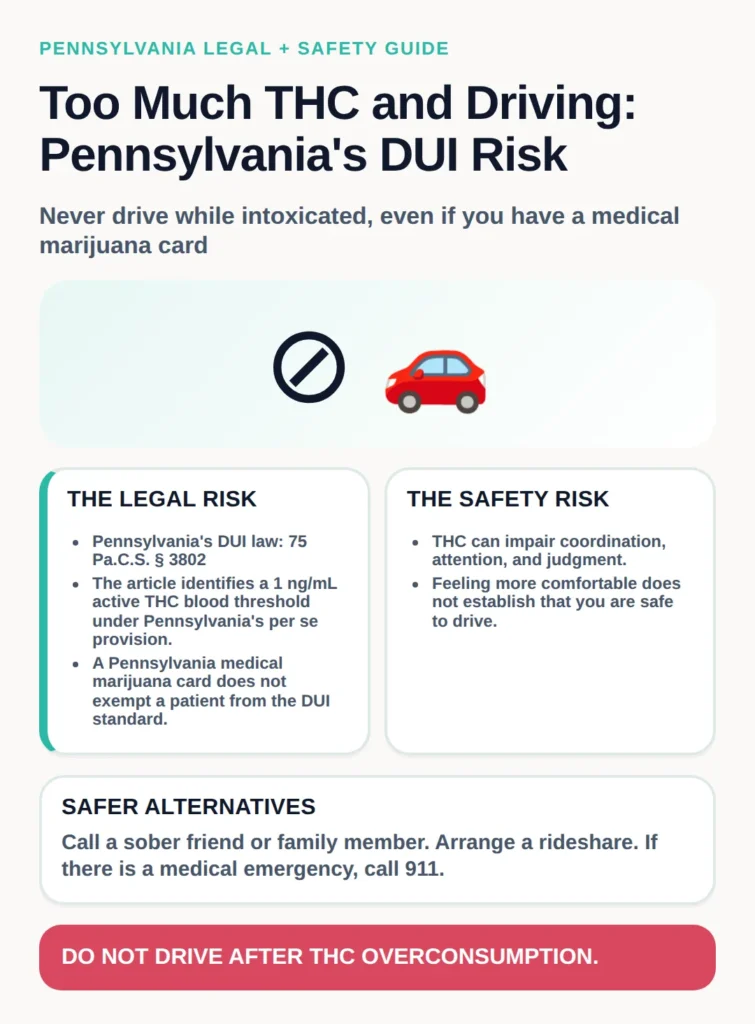
If you are experiencing significant THC overconsumption, your blood THC is almost certainly well above that threshold. Driving is both dangerous and constitutes a criminal DUI offense.
Unlike many states, Pennsylvania’s threshold applies to both MMJ patients and non-patients equally. Your card provides no exemption.
Your PA MMJ card does not exempt you from this DUI standard. As covered in more detail in our how long does delta 9 stay in your system guide, active THC in blood peaks rapidly after consumption and remains at detectable levels for hours.
The practical guidance: If you or someone with you needs to move locations, call a rideshare, call a sober friend, or call a family member. If there is a genuine medical emergency, call 911 and explain what happened, emergency services exist exactly for these situations and honesty helps them respond appropriately.
Under no circumstances should a person who is significantly intoxicated from THC drive a vehicle, regardless of how necessary it seems in the moment.
How to Prevent Overconsumption at PA Dispensaries
The best guide to too much THC is the one you read before it ever happens. For Pennsylvania registered patients, these are the specific practices that prevent overconsumption:
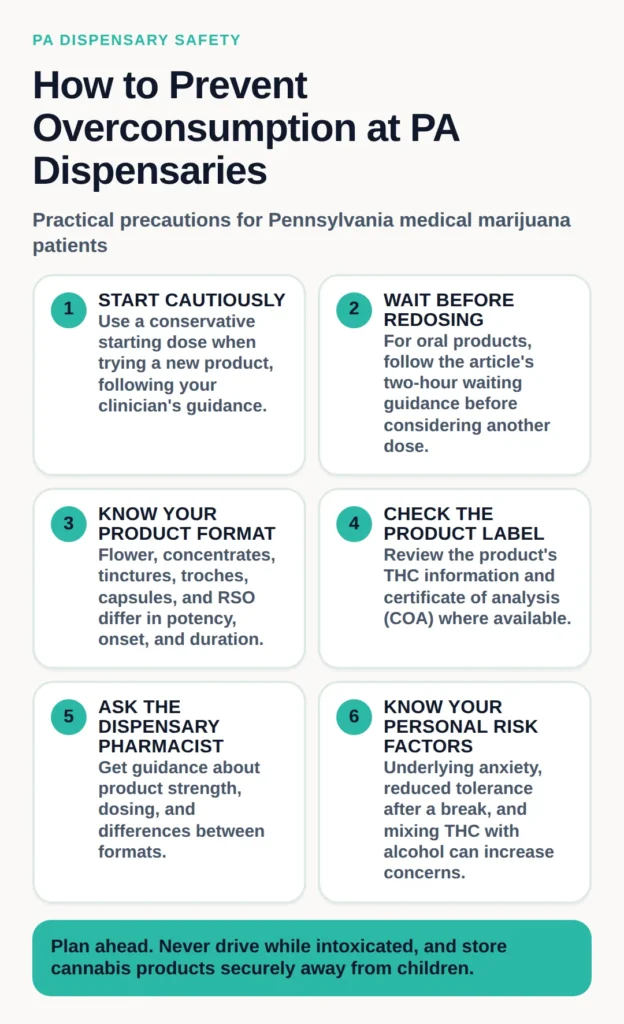
Start every new product with a smaller dose than you think you need.
A new batch of the same strain, a new product format, or a product from a different grower can behave differently. PA dispensary products vary by batch, which is why reading the COA for total THC and total terpenes on every new purchase matters.
Set a 2-hour timer before any redose with oral products. Without a timer, subjective time distortion from even a modest dose makes the wait feel much longer than it is, increasing the temptation to take more.
Know your format. The difference between vaporizing 0.2g of 22% flower and eating a 25mg troche is not just the amount, it is the conversion pathway, the bioavailability, and the duration. Formats are not interchangeable in terms of dose equivalency.
Ask your dispensary pharmacist. Every licensed PA dispensary has a pharmacist on-site. For new patients, for new product formats, and for any patient who has experienced overconsumption before, a 5-minute pharmacist consultation before purchasing can prevent hours of discomfort.
Understand your personal risk factors.
Anxiety disorders are the most common qualifying condition for Pennsylvania’s medical marijuana program at approximately 60% of all certifications.
Patients with underlying anxiety disorders have a lower threshold for THC-induced anxiety escalation. Lower starting doses, CBD-dominant or ratio tinctures, and gradual titration are especially important for this group.
For condition-specific guidance on cannabis and anxiety, see our anxiety disorder and medical marijuana in Pennsylvania guide.
Frequently Asked Questions
Q: Can you overdose on THC?
A: Not in the fatal sense that applies to opioids or alcohol. No confirmed human deaths from THC alone have been recorded, per the DEA and National Institute of Health research. What THC overconsumption does cause is acute cannabis intoxication: intense anxiety, paranoia, rapid heartbeat, nausea, confusion, and time distortion lasting 2 to 12 hours depending on how it was consumed. Uncomfortable and frightening, but not typically life-threatening in healthy adults when no other substances are involved.
Q: How long does too much THC last?
A: Duration depends primarily on how you consumed it. Vaporized flower or concentrate: 2 to 4 hours. Sublingual tinctures: 3 to 6 hours. Oral troches, capsules, or swallowed edibles: 6 to 12 hours. High-potency concentrate dabs can extend to 4 to 8 hours depending on the amount. The experience gradually fades as your body metabolizes the THC, it does not cut off suddenly.
Q: What does too much THC feel like?
A: Most patients describe a combination of intense anxiety or panic, paranoia, rapid or pounding heartbeat, nausea, dizziness, confusion, time distortion, and a feeling of being very “stuck” in the experience. First-time patients often describe not knowing whether they are having a panic attack or a medical emergency. The experience is self-limiting, it resolves as THC clears your system, but can be deeply distressing while it is occurring.
Q: What is the fastest way to sober up from too much THC?
A: There is no way to force THC out of your system quickly. The most effective approaches: move to a calm, quiet environment; drink water; use slow controlled breathing; and if sublingual CBD is available, take 25 to 50mg under your tongue (not edible CBD). Time is the primary factor. Symptoms from vaporized products resolve faster than from oral products. Avoid alcohol, caffeine, and any additional cannabis.
Q: Should I go to the emergency room if I took too much THC?
A: For most cases of THC overconsumption in healthy adults with no other substances involved, the ER is not necessary. Call 911 immediately if: the person loses consciousness, breathing is irregular, a seizure occurs, a child has ingested cannabis, or cannabis was combined with alcohol or opioids and the person is becoming unresponsive. Call Poison Control (1-800-222-1222) if you are unsure or if a child is involved.
Q: Why did the second dose hit so hard even though I waited?
A: This is the edible double-dose trap. PA dispensary troches and tinctures can take 45 minutes to 2 hours to produce first effects, with peak effects sometimes arriving even later. If a second dose is taken before the first has fully appeared, both arrive at nearly the same time. The result is far more intense than either dose alone would have produced. The prevention rule: always wait a full 2 hours before any oral cannabis redose.
Q: Is too much THC dangerous for people with heart conditions?
A: THC reliably increases heart rate (tachycardia) and can temporarily increase blood pressure. For healthy adults this is uncomfortable but not dangerous. For patients with pre-existing cardiac conditions including arrhythmias, coronary artery disease, or heart failure, significant THC overconsumption represents a higher-risk situation. If you have a cardiac condition and experience significant tachycardia or chest pain alongside THC overconsumption, seek medical evaluation rather than waiting it out at home.
Q: Is there a Pennsylvania poison control number for cannabis?
A: The national Poison Control line covers Pennsylvania: 1-800-222-1222, available 24 hours a day, 7 days a week. For general questions about your PA MMJ program including product concerns, the PA MMJ helpdesk is 888-733-5595, available 7AM to 9PM ET daily. For life-threatening situations, call 911.
The Bottom Line
Too much THC produces a deeply uncomfortable experience. Sometimes frightening. But it is not the same medical emergency as an opioid or alcohol overdose.
Understanding that it will end, knowing what to do while it is happening, and being clear on when to call for help makes all the difference between a manageable situation and a panic-driven escalation.
For Pennsylvania medical marijuana patients specifically, the most important preventive step is the one you take before the experience ever happens: start low with new products, wait the full 2 hours before any oral redose, ask your dispensary pharmacist when in doubt, and have sublingual CBD available at home.
If you are not yet a registered PA MMJ patient and want access to pharmacist guidance, COA-verified products, and the full PA dispensary system, check whether your condition qualifies or get certified at Pennsylvania Marijuana Cards.
This blog post is intended for general educational and informational purposes only and does not constitute medical advice. If you believe you or someone nearby is experiencing a medical emergency, call 911 immediately. Poison Control: 1-800-222-1222. PA MMJ Helpdesk: 888-733-5595. Medically reviewed by Dr. Johnathon Chance Miller, MD.
Sources
- Recovered.org: Cannabis Overdose. Symptoms, Risks, and When to Seek Help (June 2026)
- CannaMD: Too Much THC? Symptoms, What to Do and When to Get Help (August 2026)
- Epiphany Wellness: Cannabis Overdose and Marijuana Risks (March 2026)
- Cornbread Hemp: Can You Overdose on THC? (July 2026)
- Radix Recovery: What Does a Marijuana Overdose Feel Like? (June 2026)
- California Detox: Can You Overdose on Marijuana? (April 2026)
- NIH PMC: Tetrahydrocannabinol Intoxication from Food at a Restaurant. Wisconsin 2024
- Recovery.com: Edibles and THC Overdose (April 2026)
- DEA: Marijuana Fact Sheet
- CDC: Cannabis and Poisoning (2024)
- PA Department of Health: Medical Marijuana Program