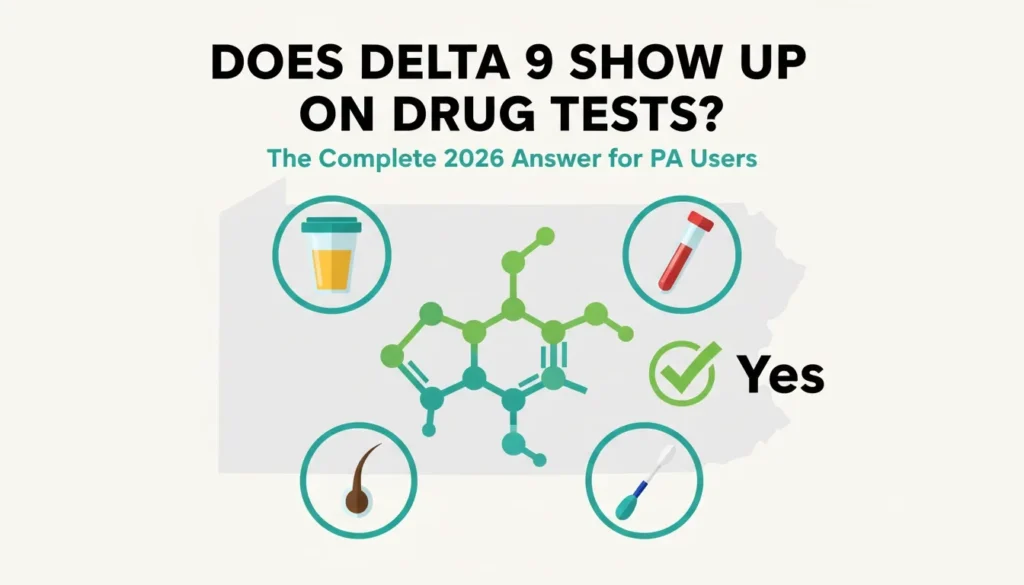

Blood tests for delta 9 THC are not the same as urine tests. They detect different compounds, operate on completely different timelines, and carry different legal consequences — particularly in Pennsylvania.
If you are asking how long delta 9 stays in your blood, you are probably facing a situation with real stakes: a DUI investigation, a post-accident workplace test, a court-ordered blood panel, or simply trying to understand your legal position as a Pennsylvania cannabis user or medical marijuana patient.
Need a PA Medical Marijuana Card?
Get certified online in 15 minutes. 100% Money-Back Guarantee.
Get Certified Now →This guide gives you the full, accurate picture — the pharmacokinetics of delta 9 in blood, the specific detection windows for different usage patterns and consumption methods, and the Pennsylvania-specific legal context that makes this question uniquely important for PA residents in 2026.
Blood Tests vs. Urine Tests: A Critical Distinction

Most people researching drug detection timelines focus on urine — the most common format for workplace pre-employment and random drug screens. Blood testing operates differently in almost every meaningful way.
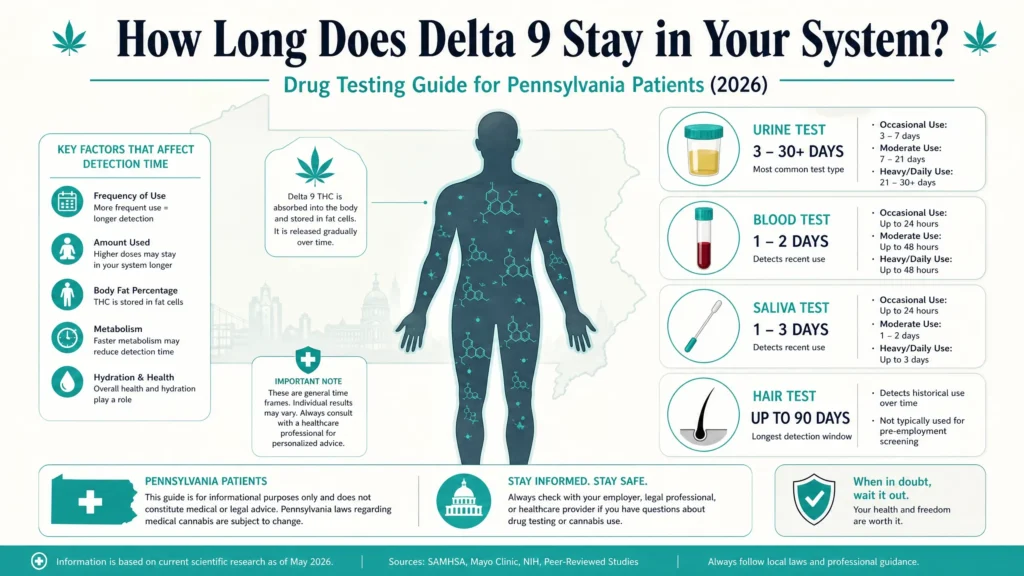
Urine tests detect THC-COOH — the primary metabolite produced when your liver breaks down delta 9 THC. This metabolite is stored in fat tissue and released slowly over days to weeks. Urine tests measure past use, not current intoxication. A person who used cannabis weeks ago and feels completely normal can test positive on a urine screen.
Blood tests are primarily used in law enforcement DUI investigations, post-accident workplace testing, medical contexts, and probation monitoring. They can detect both active delta 9 THC in the bloodstream and its metabolites. Blood testing is more invasive, requires trained personnel, and has a significantly shorter detection window for active THC — but in Pennsylvania, the legal consequences of a positive blood test can be severe in ways that a urine test typically is not.
Do You Qualify for a PA MMJ Card?
Connect with a licensed Pennsylvania state physician online from home.
Understanding which compound a blood test is detecting — and what that means for your specific situation — is the foundation for everything else in this guide.
The Two Compounds Blood Tests Detect — and Why Both Matter
A critical distinction that most articles on this topic blur or ignore entirely: a blood test for cannabis can detect two entirely different compounds with very different detection windows and very different legal implications.
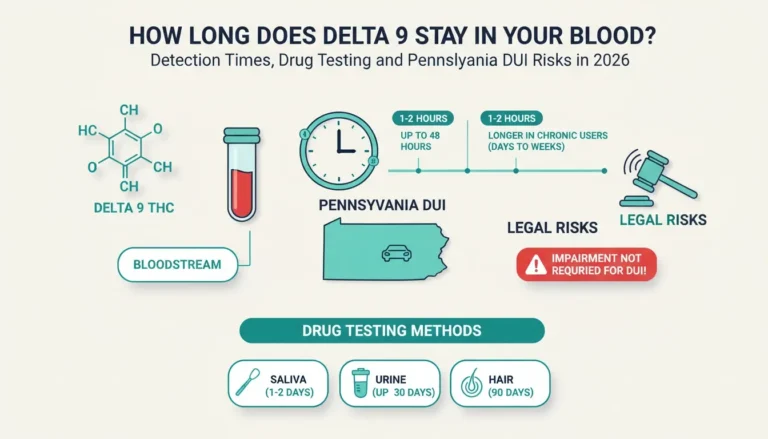
Active Delta 9 THC — the parent psychoactive molecule itself, circulating in the bloodstream. This is what is present during the period of actual intoxication. According to pharmacokinetics research on cannabis published in PMC, after inhalation, active delta 9 THC peaks in blood within minutes and begins declining rapidly as it is absorbed into fat tissue and metabolized by the liver. For most users, active THC blood concentrations drop significantly within 3 to 4 hours of inhalation — aligning roughly with the period of actual impairment.
THC-COOH (11-nor-9-carboxy-THC) — the primary inactive metabolite produced when the liver processes delta 9 THC via CYP450 enzymes. This compound has no psychoactive properties — it does not produce intoxication. However, it is fat-soluble, accumulates in adipose tissue, and is slowly re-released into the bloodstream over days to weeks. As McCormick & Vilushis legal analysis of PA DUI testing explains: while active THC metabolites might be near zero several hours after using, the inactive metabolites will still be present in blood at much higher levels — high enough to support a DUI charge.
Why both matter for Pennsylvania users: Pennsylvania’s per se DUI law applies to both active THC and its metabolites in blood. This means that even when active delta 9 has completely cleared — when you feel no effects whatsoever and are genuinely unimpaired — THC-COOH metabolites detectable in your blood can still support a criminal DUI charge under current PA law. This is the central and most controversial aspect of Pennsylvania’s approach to cannabis DUI enforcement.
How Long Does Delta 9 Stay in Your Blood? Detection Windows by Usage Pattern
Blood detection windows for delta 9 THC are significantly shorter than urine detection windows — but the two-compound distinction means the answer varies depending on which compound is being measured.

Active Delta 9 THC in Blood
| Usage Pattern | Active THC Detection Window |
|---|---|
| Single / occasional use | 3 to 6 hours post-inhalation; up to 12 hours post-ingestion |
| Moderate use (several times per week) | Up to 8 to 12 hours |
| Daily use | Up to 12 to 24 hours |
| Heavy chronic use | Potentially 24 to 48 hours in some cases |
These windows reflect the period during which actual intoxication is most likely concurrent with blood detectability. As Refine Recovery’s pharmacokinetics guide confirms, blood tests detect active THC in the bloodstream rather than metabolites, making them effective for determining recent use — with THC concentrations peaking within minutes after smoking and declining rapidly.
THC-COOH Metabolites in Blood
| Usage Pattern | Metabolite Detection Window |
|---|---|
| Single / occasional use | 12 hours to 3 days |
| Moderate use | 3 to 7 days |
| Daily use | 7 to 14 days |
| Heavy chronic use | 14 to 30+ days |
As Drink Delta’s cannabinoid detection research notes: for infrequent users, active THC can be found in blood for 3 to 4 hours and its metabolite 9-carboxy-THC for 2 to 3 days. Frequent users can have active THC detected for 4 to 8 hours, while 9-carboxy-THC may remain detectable for up to two weeks.
The Pennsylvania Threshold
Pennsylvania law specifies a threshold of 1 nanogram per milliliter (ng/mL) of THC or its metabolites in blood as sufficient to support a per se DUI charge — one of the lowest thresholds in the country. As Tibbott Richardson’s PA DUI defense analysis explains: Pennsylvania prohibits driving with any amount over 1 ng/mL of THC or its metabolites in blood. This is called the per se law for DUI of marijuana, meaning prosecutors do not have to show that your driving was actually impaired.
This 1 ng/mL threshold has profound implications for PA users: even trace concentrations of metabolites — well below any level associated with actual impairment — satisfy the legal standard for a DUI charge.
How Consumption Method Affects Blood Detection Time
⚡ Fast & 100% Online PA Medical Cards
Board-Certified Doctors • 100% Money-Back Guarantee
Book Evaluation Now →The route of administration significantly affects both the speed at which delta 9 enters the bloodstream and how long it remains detectable. This is a distinction almost no competitor addresses specifically for blood testing.
Inhalation (Vaporization — the Legal PA Method)
When delta 9 is inhaled via vaporization — the only legal inhaled delivery method for Pennsylvania medical marijuana patients — absorption is near-instantaneous. THC crosses the alveolar membrane in the lungs and reaches peak blood concentrations within minutes. The rapid peak is followed by an equally rapid decline as THC distributes into fat tissue and the liver begins metabolization.
Blood peak: Within 3 to 10 minutes of inhalation Active THC detectable: Approximately 3 to 6 hours for occasional users Metabolites detectable: 12 hours to several days depending on frequency
Oral Ingestion (Edibles, Tinctures, Capsules)
When delta 9 is consumed orally, absorption occurs through the gastrointestinal tract and the compound undergoes first-pass metabolism in the liver before reaching systemic circulation. This process converts a significant portion of delta 9 into 11-hydroxy-THC — a metabolite with higher CB1 binding affinity than delta 9 itself and greater fat solubility.
The implications for blood detection: edible consumption produces a delayed peak (45 to 90 minutes), a longer duration of active compound in blood, and a potentially longer metabolite detection window compared to equivalent doses inhaled. As Cornbread Hemp’s pharmacokinetics research explains, 11-hydroxy-THC is stored in fat tissue rather than being eliminated right away — contributing to an extended detection period.
Blood peak: 1 to 2 hours after ingestion Active compounds detectable: Up to 12 to 24 hours for occasional users Metabolites detectable: Potentially longer than inhalation due to 11-OH-THC fat storage
For Pennsylvania MMJ patients managing timing around driving, the edible vs. vaporization distinction is practically significant: edible consumption produces a longer window of both impairment and blood detectability than the same dose inhaled.
Factors That Influence Your Individual Blood Detection Window

No two people clear delta 9 from their blood at the same rate. The following variables determine where your personal timeline falls within the general ranges above.
Body fat percentage. Delta 9 THC is lipophilic — it binds to fat. People with higher body fat percentages have a larger tissue reservoir from which THC and metabolites are slowly re-released into the bloodstream. A person with 30% body fat who uses cannabis daily will typically have a longer metabolite detection window in blood than a leaner person with identical usage.
Usage frequency and recency. Occasional users who last used cannabis two weeks ago have minimal circulating metabolites. Daily users who used yesterday have much higher concentrations being continuously released from fat stores.
Individual liver enzyme activity. Delta 9 THC is metabolized primarily by CYP2C9 and CYP3A4 enzymes in the liver. Genetic variation in these enzymes, as well as interactions with medications that inhibit or induce them, affects how quickly your body converts THC to its metabolites and how quickly those metabolites are eliminated.
Renewing Your PA MMJ Card?
Quick annual recertification online. No paperwork hassle.
Renew Card Online →Product potency and dose. Higher-potency products — concentrates, high-THC vaporizer cartridges — deliver more THC per use, creating a larger fat storage burden and longer metabolite release.
Hydration and kidney function. While blood clearance is primarily driven by liver metabolism and fat redistribution rather than kidney excretion, overall physiological health including renal function affects metabolic rate.
Pennsylvania’s DUI Law and Blood THC: What Every PA User Must Understand

This section is the most critical part of this guide for Pennsylvania readers — and it contains information that most cannabis content completely fails to address.
Pennsylvania operates under a per se DUI law for THC.
Under 75 Pa.C.S. § 3802(d), any detectable amount of THC or its metabolites above 1 ng/mL in a driver’s blood constitutes a DUI offense — regardless of actual impairment, regardless of whether the driver shows any signs of intoxication, and regardless of whether the driver holds a valid Pennsylvania medical marijuana card.
This is fundamentally different from alcohol DUI law. For alcohol, Pennsylvania’s per se threshold is 0.08% BAC — a level with an established scientific correlation to driving impairment. For THC, there is no established correlation between blood concentration and driving impairment, yet Pennsylvania treats any detectable presence above 1 ng/mL as legally equivalent to drunk driving.
As Pennsylvania DUI attorney analysis from Pennsylvania-DUI-Lawyer.com states directly: more than 700,000 Pennsylvanians hold medical marijuana cards — and under current law, none are protected from DUI prosecution based solely on blood test results. THC metabolites can remain detectable in the body for weeks. Blood testing does not measure impairment — it only detects presence.
The “sober but positive” scenario.
This is not a theoretical concern — it is a documented pattern affecting PA MMJ patients statewide. Consider a realistic scenario: a certified patient uses their legally prescribed cannabis on a Friday evening to manage chronic pain or anxiety. By Saturday morning, they feel completely normal — no impairment, no residual effects. They drive to work. A minor traffic stop for a turn signal violation leads to an officer noticing their PA MMJ card, which — prior to recent legislative changes — could itself serve as grounds for requesting a chemical test. The blood test returns positive for THC-COOH. The result is a DUI charge carrying mandatory minimum penalties.
As one Pennsylvania DUI attorney quoted in McAndrews Legal’s DUI reform analysis described it: every single medical marijuana patient is technically DUI 24/7, 365 days a year under the current law, regardless of whether they are actually impaired.
DUI penalties in Pennsylvania are severe.
Get Approved by a Licensed PA Doctor
Schedule your appointment in minutes. You only pay if approved.
Start Online Application →THC-related DUI in Pennsylvania is charged at the highest tier of Pennsylvania’s three-tier DUI system — the same tier as alcohol DUI with a BAC of 0.16% or above. First offense consequences include mandatory minimum 72 hours in jail, 12-month license suspension, fines of $1,000 to $5,000, and dramatically increased insurance rates. Subsequent offenses carry escalating mandatory minimums.
Blood test refusal creates a separate problem.
Pennsylvania’s implied consent law means that refusing a blood test when lawfully requested carries automatic PennDOT license suspension — separate from any criminal charges. As Gambone Law’s PA DUI analysis notes: you should never refuse a chemical test because the refusal in and of itself will result in a license suspension regardless of the outcome of the criminal case. Your attorney can still challenge the admissibility of blood evidence, but refusing the test does not eliminate the legal consequences.
Commercial drivers face zero tolerance regardless of any state law changes.
Federal regulations governing commercial driver’s license (CDL) holders impose zero tolerance for any THC in the system while operating a commercial vehicle. This applies to truck drivers, bus drivers, and school bus operators in Pennsylvania — and no state DUI reform legislation changes this federal standard.
The Landmark Court Case Every PA MMJ Patient Should Know About

In 2022, the Pennsylvania Superior Court issued a ruling that directly defines the legal risk every PA MMJ patient faces on the road.
In Commonwealth v. Stone, the court addressed whether a registered medical marijuana patient could be convicted of DUI based solely on the presence of THC in their blood without evidence of actual impairment. The court’s ruling was unambiguous:
- Marijuana remains a Schedule I drug under Pennsylvania law — even for registered medical users
- The Medical Marijuana Act allows legal possession and use, but does not create an exception to DUI laws
- The Commonwealth does not need to prove that the THC in a defendant’s blood came from non-medical marijuana to convict under Pennsylvania’s DUI statute
- § 3802(d)(1) creates strict liability — a violation occurs when a driver has any Schedule I substance in their blood while driving, regardless of impairment level
The court explicitly stated that it is up to the legislature — not the courts — to change marijuana’s classification or update DUI laws. This ruling remains in effect as of May 2026 and sets the precedent that governs every THC-related DUI case in Pennsylvania.
Pennsylvania’s DUI Reform Bills: What Is Changing in 2026
This is the most important — and most underreported — development for Pennsylvania cannabis users as of May 2026.
Two pieces of legislation are actively moving through the Pennsylvania General Assembly with the specific goal of protecting MMJ patients from the “sober but positive” DUI scenario:
Ready to Get Your Official PA MMJ Card?
State-certified doctor consultations online. No risk—100% refund if not approved.
Claim Your MMJ Card Online →Senate Bill 63 — sponsored by Sen. Camera Bartolotta (R) with bipartisan support, SB 63 cleared the Pennsylvania Senate Transportation Committee in a unanimous vote. The bill would require proof of actual impairment for medical marijuana patients to be charged with DUI. Key provisions include:
- Proof of actual impairment required — THC presence in blood alone is insufficient for conviction
- A PA MMJ card cannot be used as probable cause for a DUI stop or chemical test
- Law enforcement must rely on standardized field sobriety tests and drug recognition experts to establish impairment
- Federal regulations for commercial drivers remain unchanged — CDL holders still face zero tolerance
House Bill 983 — sponsored by Rep. Christopher Rabb (D), HB 983 passed the Pennsylvania House Transportation Committee 14-10. It achieves the same goal through slightly different legislative language but mirrors SB 63’s core protection: requiring proof of actual impairment rather than mere blood metabolite presence for MMJ patient DUI convictions.
As Marijuana Moment reported on the legislative advancement, Sen. Bartolotta stated the measure is designed to close a “loophole” in Pennsylvania’s medical cannabis law that currently permits law enforcement to arrest and prosecute patients for driving under the influence of marijuana without demonstrating that they are actively impaired.
What this means for PA MMJ patients right now:
As of May 2026, these reforms have not yet been signed into law. The per se DUI standard — any detectable THC in blood = potential DUI — remains in effect. The legislative momentum is encouraging, but until either bill passes both chambers and is signed by the Governor, every Pennsylvania MMJ patient who drives remains legally exposed under current law.
The practical guidance has not changed: do not drive within a timeframe where active THC may still be present in your blood. Understand that metabolites may be detectable for days to weeks after last use. If stopped, remain calm, consult an attorney, and do not make statements that could be self-incriminating.
If You Are Stopped While a PA MMJ Patient: Practical Guidance
This is not legal advice — if you face a DUI investigation, consult a licensed Pennsylvania criminal defense attorney immediately. What follows is general information about your rights and the process.
Know the current law. As of May 2026, a positive blood test for THC metabolites above 1 ng/mL can support a per se DUI charge regardless of your MMJ card. Your card demonstrates legal access to cannabis — it does not prevent prosecution.
Your MMJ card cannot currently be used as sole probable cause. Even under current law, as The Law Offices of Joseph Lesniak’s PA DUI guidance explains, the law clarifies that a medical marijuana patient’s ID card cannot, on its own, justify a request for a chemical test. Officers must have reasonable grounds based on behavior or other evidence.
Do not refuse a blood test. As noted above, refusal triggers automatic license suspension independent of any criminal outcome. Your attorney can challenge the admissibility and handling of blood evidence after the fact.
Document everything. Time of last use, product, dose, and route of administration are all relevant to any legal defense. If you are a regular MMJ patient, keeping basic notes about your usage patterns may help your attorney contextualize blood test results.
Contact a Pennsylvania DUI attorney immediately. THC DUI defense strategies include challenging the legality of the traffic stop, questioning blood test chain of custody and laboratory procedures, and presenting evidence of lack of actual impairment through dashcam footage, field sobriety test performance, and witness testimony.
Pennsylvania-Specific Context: Legal Access and Your Rights

If you are currently using cannabis in Pennsylvania without a medical marijuana card — whether for anxiety, chronic pain, sleep, or another health reason — the DUI risk covered in this guide applies to you in full without any of the legal context or potential protections that certification provides.
A Pennsylvania medical marijuana card does not eliminate DUI risk under current law. But it does provide:
- Legal access to tested, accurately labeled products at licensed PA dispensaries
- A physician relationship that documents your condition and treatment
- Access to dispensary pharmacist guidance on product selection and dosing
- The potential benefit of SB 63 / HB 983 protections when those reforms pass — which will apply only to registered medical patients, not unregistered recreational users
Pennsylvania recognizes 24 qualifying conditions. The most common by far is anxiety disorder, cited in approximately 60% of all PA MMJ certifications according to research published in the Annals of Internal Medicine in July 2025, analyzing over 1.7 million certification records. Chronic pain, PTSD, and numerous other conditions also qualify.
You can view the complete list of Pennsylvania’s qualifying conditions here, or learn specifically about anxiety disorder and PA MMJ certification here.
The certification process is done entirely online through telehealth — no clinic visit required. A licensed Pennsylvania physician reviews your condition and, if you qualify, submits your certification to the state. You can start the process at Pennsylvania Marijuana Cards.
Cost breakdown:
| Fee | Amount |
|---|---|
| Physician certification fee (new patient) | $159 |
| PA state registration fee | $50 |
| Total (new patient) | $209 |
| Physician certification fee (renewal) | $149 |
| PA state registration fee | $50 |
| Total (renewal) | $199 |
Pennsylvania residents qualifying for Medicaid, SNAP, WIC, CHIP, PACE, or PACENET may have the $50 state fee waived through Pennsylvania’s MMAP program.
Frequently Asked Questions
Q: How long does delta 9 THC stay in your blood?
A: There are two different answers depending on which compound is being measured. Active delta 9 THC — the parent psychoactive molecule — clears from blood relatively quickly. For occasional users after inhalation, active THC is typically detectable for 3 to 6 hours. For daily users, up to 12 to 24 hours. Edibles produce a longer active compound window — up to 12 to 24 hours for occasional users due to 11-hydroxy-THC production. However, blood tests also detect inactive THC-COOH metabolites, which persist much longer: 12 hours to 3 days for occasional users, and up to 14 to 30 days for heavy chronic users. Pennsylvania’s per se DUI law applies to both active THC and metabolites in blood — meaning a driver can test positive for a blood DUI days after their last use while feeling completely unimpaired.
Q: Will delta 9 show up on a blood test the next day?
A: Active delta 9 THC will generally not be detectable in blood the day after occasional use — it clears within hours for most non-chronic users. However, the inactive metabolite THC-COOH is very likely still detectable in blood the next day for most users regardless of frequency, because it accumulates in fat tissue and is slowly re-released. For Pennsylvania drivers, this is critically important: under current PA law, detectable THC metabolites above 1 ng/mL the day after use — or days after — can support a DUI charge despite zero impairment. Regular users may have detectable metabolites in blood for a week or more after last use.
Q: How is a blood test for THC different from a urine test?
A: Blood tests and urine tests measure different compounds and serve different purposes. Urine tests detect THC-COOH metabolites and are primarily used for workplace and pre-employment screening — they reflect past use over days to weeks and are not designed to measure current impairment. Blood tests can detect both active delta 9 THC and metabolites and are primarily used in law enforcement DUI investigations, post-accident testing, and probation monitoring. Blood testing has a significantly shorter detection window for active THC, making it more relevant to recent use. However, metabolite detection in blood can persist for days to weeks in regular users — long past the period of actual impairment. In Pennsylvania, it is blood testing that drives DUI prosecutions, not urine testing.
Q: Can you get a DUI in Pennsylvania for delta 9 even with a medical marijuana card?
A: Yes — under current Pennsylvania law as of May 2026. Pennsylvania’s per se DUI statute (75 Pa.C.S. § 3802(d)) treats any detectable amount of THC or its metabolites above 1 ng/mL in blood as sufficient for a DUI charge, regardless of whether the driver holds a valid PA MMJ card and regardless of whether they are actually impaired. The 2022 Pennsylvania Superior Court ruling in Commonwealth v. Stone confirmed that a medical marijuana card is not a defense to DUI prosecution based on blood THC presence. However, two reform bills — SB 63 and HB 983 — have advanced through committee with bipartisan support and, if passed, would require proof of actual impairment for MMJ patient DUI charges rather than allowing blood metabolite presence alone to be sufficient. As of May 2026, those bills have not yet been signed into law.
Q: How long after using cannabis should a Pennsylvania MMJ patient wait before driving?
A: There is no legally safe specific number of hours under current Pennsylvania law — because inactive metabolites can remain detectable in blood for days to weeks, and the per se threshold of 1 ng/mL applies to metabolites, not just active THC. The safest practical guidance based on the pharmacokinetics: for inhalation, most occasional users’ active THC blood concentrations drop significantly within 3 to 6 hours. For edibles, wait at least 6 to 8 hours or longer due to the extended active compound window. However, even after active effects resolve, metabolite levels may still exceed PA’s threshold, particularly for daily or regular users. The only reliable way to know your personal blood metabolite level is laboratory testing — which is not practically accessible before routine driving decisions. If facing a DUI charge, consult a Pennsylvania criminal defense attorney immediately.
Q: What are SB 63 and HB 983 and how do they affect PA MMJ patients?
A: SB 63 and HB 983 are Pennsylvania legislative bills actively advancing through the General Assembly as of May 2026 that would reform the state’s DUI law for medical marijuana patients. Currently, any detectable THC metabolites in a driver’s blood above 1 ng/mL can result in a DUI conviction even without evidence of actual impairment. SB 63 — which passed the Senate Transportation Committee unanimously — would require proof of actual impairment for MMJ patients to be convicted of DUI, prevent police from using a patient’s MMJ card alone as probable cause for a chemical test, and require law enforcement to rely on field sobriety tests and drug recognition experts to establish impairment. HB 983 passed the House Transportation Committee 14-10 with similar protections. Neither bill has been signed into law as of May 2026 — meaning the current per se standard still applies. These reforms would not affect commercial drivers, who remain subject to federal zero-tolerance rules regardless of any state law changes.
Q: Does the type of delta 9 product affect how long it stays in your blood?
A: Yes — in two important ways. First, consumption method matters: inhaled delta 9 via vaporization peaks in blood within minutes and active THC clears relatively quickly (3 to 6 hours for occasional users), while oral consumption via edibles or tinctures takes longer to peak (1 to 2 hours) and produces 11-hydroxy-THC — a metabolite with higher fat solubility that may extend both the active compound window and metabolite detection period. Second, product potency matters: higher-THC products deliver more delta 9 per use, creating a larger fat-stored metabolite burden that takes longer to clear. A high-potency concentrate used daily will produce a much longer blood metabolite detection window than a low-dose edible used occasionally. For Pennsylvania MMJ patients, vaporization is the only legal inhaled delivery method — smoking cannabis is prohibited under Pennsylvania’s Medical Marijuana Act.
Medically reviewed by Dr. Johnathon Chance Miller, MD. This content is for educational purposes only and does not constitute legal or medical advice. Pennsylvania DUI laws and medical marijuana regulations are subject to change — always verify current law with official Pennsylvania sources. If you are facing a THC-related DUI charge in Pennsylvania, consult a licensed Pennsylvania criminal defense attorney immediately. Do not drive while impaired by any substance.
Sources:
- Chayasirisobhon S. “Mechanisms of Action and Pharmacokinetics of Cannabis.” Permanente Journal / PMC, 2020.
- Refine Recovery. “How Long Does Delta-9 Stay in Your System?” March 2026.
- Cornbread Hemp. “How Long Does Delta 9 Stay in Your System?” March 2026.
- Drink Delta. “How Long Can You Detect Cannabis, THC, Delta 9, and Delta 8?”
- Viia Hemp. “How Long Does Delta 9 THC Stay in Your System?” October 2024.
- McCormick & Vilushis LLC. “Pennsylvania DUI: Can a Blood Test Detect Marijuana?” September 2025.
- Pennsylvania General Assembly. 75 Pa.C.S. § 3802(d) — DUI Controlled Substances.
- Pennsylvania-DUI-Lawyer.com. “Penalties for Marijuana DUI in Pennsylvania Explained.” January 2026.
- Tibbott Richardson LLC. “Sewickley, PA Marijuana DUI Defense.” November 2025.
- McAndrews Legal. “PA Medical Marijuana DUI: Proposed Law to Help Patients.” December 2025.
- My State College Lawyer. “PA Court Rules Medical Marijuana Use Can Result in DUI Charges.” June 2025.
- Marijuana Moment. “Pennsylvania Lawmakers Approve Bills To Protect Medical Cannabis Patients From DUI Charges.” December 2023
- MMJ Advocate Doc. “January 2025 PA Legislative Update — SB 63 DUI Reform.” March 2025.
- The Law Offices of Joseph Lesniak, LLC. “Pennsylvania DUI Laws: What Medical Marijuana Patients Need to Know.”
- Gambone Law. “Medical Marijuana, DUI, and Your Pennsylvania Driver’s License.” October 2025.
- The Holistic Center / TCH Evaluation. “PA Medical Marijuana Law Updates: 2025 Program Changes.” January 2026.
- Pennsylvania General Assembly. Senate Bill 63 — 2025 Regular Session.
- Drake C, et al. “Medical Cannabis Certifications After Pennsylvania Added Anxiety Disorders as a Qualifying Condition.” Annals of Internal Medicine, July 2025.
- Pennsylvania Department of Health. Medical Marijuana Program.