
Blue Dream is one of the most searched cannabis strain names in the United States and among the most commonly stocked at Pennsylvania’s 186+ licensed medical marijuana dispensaries.
Patients asking is Blue Dream indica or sativa are usually looking for a simple answer to a more complex question: will it sedate me or energize me, and will it help my specific condition?
Need a PA Medical Marijuana Card?
Get certified online in 15 minutes. 100% Money-Back Guarantee.
Get Certified Now →The botanical label gives a partial answer. The terpene profile on a batch-specific Certificate of Analysis gives the complete one.
This guide covers both along with everything Pennsylvania MMJ patients need to know before selecting a Blue Dream product at a PA dispensary.
⚡ Quick Answer
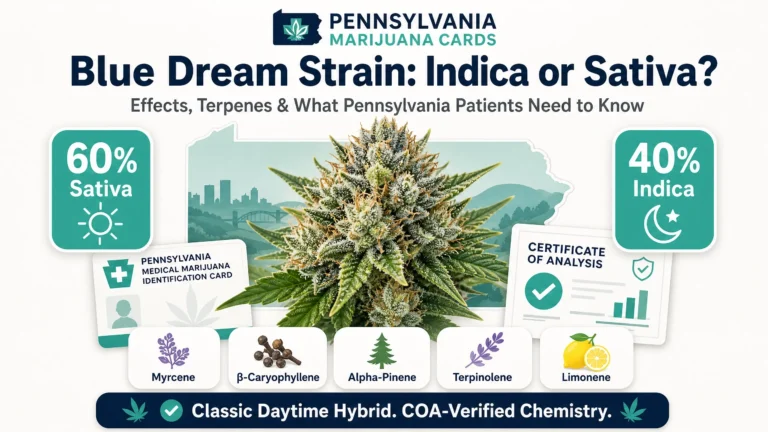
Blue Dream is a sativa-dominant hybrid, typically classified as approximately 60% sativa and 40% indica, with THC ranging from 17–24% and CBD from 0.1–2%.
- Genetic lineage: Blueberry (indica) × Haze (sativa) cross
- Dominant terpenes: myrcene, beta-caryophyllene, alpha-pinene, terpinolene, limonene
- Primary therapeutic applications: anxiety, PTSD, chronic pain, daytime mood support
- THC range: 17–24% (batch-specific — always verify via dispensary COA)
- Widely available at PA dispensaries statewide; format and terpene profile vary by batch
- A valid PA MMJ card under Act 16 of 2016 is required to purchase at any licensed dispensary
For Pennsylvania residents: smoking is prohibited under PA law regardless of MMJ card status, vaporization is the only legal inhaled delivery method.
Key Takeaways
- “Sativa-dominant hybrid” is more accurate than either “sativa” or “indica”: Blue Dream’s Blueberry indica genetics contribute meaningful body relaxation that the “sativa” label entirely misrepresents, making two patients with the same strain name have very different experiences depending on the batch.
- Terpinolene is the terpene that sets Blue Dream apart from other sativa-dominant strains: It drives the strain’s energizing, creativity-associated character, yet it is absent from most product front labels and only visible on the COA.
- Blue Dream’s CBD range (0.1–2%) varies enough between batches to meaningfully change the anxiety profile: A batch with 2% CBD and 17% THC behaves pharmacologically differently from one with 24% THC and 0.1% CBD, even under the same strain name.
- Pennsylvania’s per se DUI law applies to Blue Dream users: 75 Pa.C.S. § 3802(d) means any detectable THC metabolite in blood is a DUI offense regardless of card status, a critical consideration for patients who use Blue Dream during the workday for anxiety.
- Describing your symptoms — not the strain name — to your PA dispensary pharmacist is the most reliable way to get a Blue Dream batch whose COA terpene profile actually matches your therapeutic need.
Is Blue Dream Indica or Sativa?
Blue Dream is a sativa-dominant hybrid, typically classified as approximately 60% sativa and 40% indica.

It’s genetic parents are Blueberry, a deeply relaxing indica developed by DJ Short in the 1970s, and Haze, a classic sativa landrace known for producing energizing, cerebral effects.
That cross is precisely why Blue Dream is neither a clean sativa nor a clean indica experience: the Blueberry genetics contribute measurable body relaxation and mild sedation, while the Haze genetics drive the uplifting, mentally stimulating character the strain is known for.
Do You Qualify for a PA MMJ Card?
Connect with a licensed Pennsylvania state physician online from home.
In practical terms, asking is Blue Dream sativa or indica at a Pennsylvania dispensary is asking the right question in the wrong direction.
A more clinically useful question is: what does this specific batch’s terpene profile look like on the COA?

PA Dispensary Reality Check: “Blue Dream” is one of the most brand-diluted strain names in the industry. PA dispensaries stock multiple Blue Dream phenotypes, crosses, and branded variants, each with a distinct terpene expression.
A terpinolene-dominant Blue Dream batch will feel meaningfully more energizing than a myrcene-dominant one, even at identical THC percentages.
The COA terpene panel is the only reliable guide. Pennsylvania’s 2025 DOH update requires full terpene profile disclosure on all licensed dispensary product COAs, this data is always available; patients need only ask.
Why “Is Blue Dream Sativa or Indica” Is the Wrong First Question
As Ethan Russo established in his landmark 2011 paper in the British Journal of Pharmacology, the entourage effect, the synergistic interaction between cannabinoids and terpenes, determines the therapeutic character of a cannabis product far more reliably than its botanical classification.

The indica/sativa taxonomy was developed for horticultural purposes, not pharmacological ones.
Two Blue Dream products labeled identically can express entirely different terpene profiles depending on cultivation environment, phenotype selection, and post-harvest handling.
For Pennsylvania patients making therapeutic decisions under a physician’s oversight, COA data is the clinical input. The strain label is the starting-point conversation.
Blue Dream Cannabinoid Profile

Cannabinoid Data Table
| Cannabinoid | Typical Range | Clinical Relevance for PA Patients |
|---|---|---|
| THC | 17–24% | Primary psychoactive and analgesic effect; anxiety risk at higher doses |
| CBD | 0.1–2% | Variable buffer — higher-CBD batches reduce anxiety risk; lower-CBD batches increase it |
| CBG | Trace (<0.5%) | Emerging anti-inflammatory and neuroprotective data; trace levels limit contribution |
| THC:CBD Ratio | ~10:1 to 20:1 | Moderate-to-high THC dominance; wide batch variation makes COA review critical |
Blue Dream’s cannabinoid profile introduces an important nuance for PA patients: the CBD percentage matters more here than in most high-THC strains because it sits in a range where the difference between 0.1% and 2% CBD is pharmacologically meaningful.
A Blue Dream batch at 24% THC and 0.1% CBD is a different therapeutic tool than one at 17% THC and 2% CBD, the latter provides a partial CBD buffer that reduces the risk of THC-driven anxiety without meaningfully blunting analgesic or anxiolytic effect.
This is the single most important number to check on the Blue Dream COA after the terpene panel. Anxiety-disorder patients in particular should prioritize batches with higher CBD percentages within the available range.
Blue Dream Terpene Profile
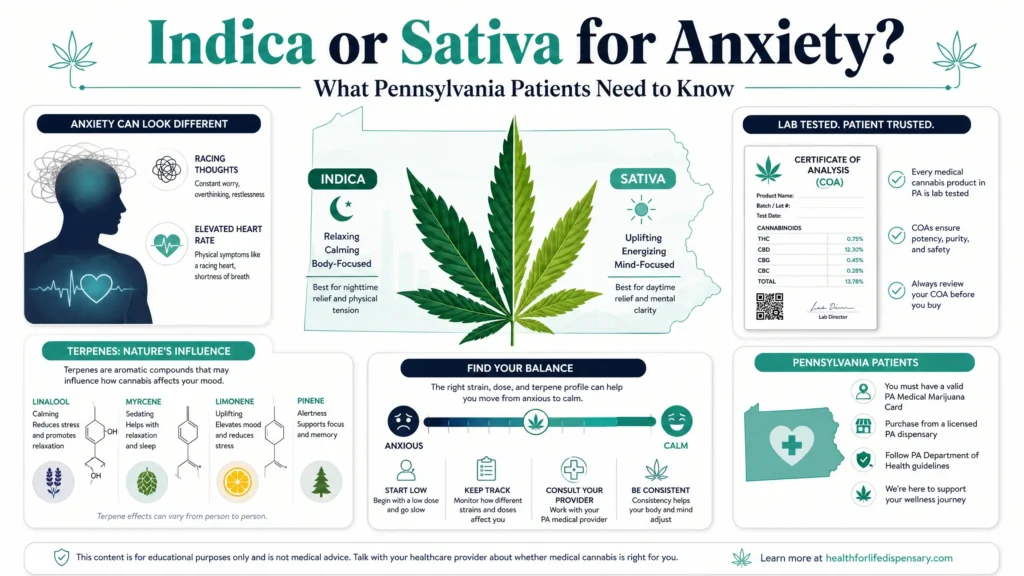
Blue Dream’s therapeutic identity is built on a terpene profile that is more complex than most sativa-dominant strains.
⚡ Fast & 100% Online PA Medical Cards
Board-Certified Doctors • 100% Money-Back Guarantee
Book Evaluation Now →The five dominant terpenes work through distinct and partially complementary mechanisms, understanding each helps PA patients use COA data intelligently.

Myrcene
Myrcene is typically the most abundant terpene in Blue Dream, which surprises many patients who associate myrcene with sedating indica products.
In Blue Dream’s hybrid context, myrcene contributes body relaxation and mild analgesic effect without dominating the experience the way it does in a high-myrcene indica.
Preclinical research has documented myrcene’s analgesic and anti-inflammatory properties, and its role in enhancing cannabinoid permeability across the blood-brain barrier is relevant for dose calibration, myrcene-rich batches may require lower THC doses to achieve equivalent therapeutic effect.
PA patient relevance: Batches with very high myrcene (above 0.8%) will lean more sedating and body-focused, less “classic Blue Dream” in character. Best for evening pain management and stress relief rather than daytime use.
Evidence level: Moderate (preclinical analgesic data; human cannabis cohort observational data)
Beta-Caryophyllene
Beta-caryophyllene (BCP) is the only terpene that functions as a dietary cannabinoid, it binds selectively to CB2 receptors, producing anti-inflammatory effects without psychoactivity.
Published research has established BCP’s mechanism as a functional CB2 agonist. In Blue Dream, BCP’s anti-inflammatory activity is particularly relevant for patients managing anxiety-comorbid pain, or for PTSD patients where neuroinflammatory processes may contribute to symptom burden.
PA patient relevance: BCP complements THC’s CB1 activity without adding to psychoactivity, relevant for daytime use where cognitive function needs to be preserved.
Evidence level: Moderate (established CB2 binding mechanism; human clinical data ongoing)
Alpha-Pinene
Alpha-pinene is one of Blue Dream’s defining terpenes and contributes the sharp, fresh pine note in its aroma.
Renewing Your PA MMJ Card?
Quick annual recertification online. No paperwork hassle.
Renew Card Online →Pinene’s documented acetylcholinesterase-inhibiting properties may partially counteract THC-induced short-term memory impairment, a meaningful benefit for PA patients using Blue Dream during the workday.
Pinene also has bronchodilatory properties relevant to patients using vaporized formats.
PA patient relevance: Alpha-pinene content supports functional, mentally clear daytime use, one of Blue Dream’s most clinically distinct features relative to indica-dominant alternatives.
Evidence level: Preliminary (preclinical mechanism established; human cannabis-specific data limited)
Terpinolene
Terpinolene is the terpene most responsible for Blue Dream’s distinctive character among sativa-dominant strains. It drives the uplifting, slightly sweet-floral energy that separates Blue Dream from other high-myrcene hybrids.

Preclinical research has identified terpinolene’s antioxidant and mild sedative properties at higher concentrations, but at the levels present in Blue Dream, its primary experiential contribution is alertness and mild mood elevation.
Terpinolene is notably absent from most indica-leaning strains, it’s presence in Blue Dream is a key COA marker for the “classic” Blue Dream effect profile.
PA patient relevance: If a Blue Dream batch is low in terpinolene, it will not express the energizing, creative character the strain is known for, it will be a generic hybrid. Terpinolene percentage on the COA is the primary authenticity check for patients seeking the classic Blue Dream experience.
Evidence level: Preliminary (antioxidant data established; behavioral data limited to preclinical models)
Limonene
Limonene in Blue Dream reinforces the anxiolytic profile established by terpinolene and contributes the faint citrus note detectable in some phenotypes.
A 2019 human trial documented significant anxiety score reductions following limonene inhalation, supporting the clinical relevance of limonene content for Pennsylvania’s largest patient population, those certified for anxiety disorders.
Get Approved by a Licensed PA Doctor
Schedule your appointment in minutes. You only pay if approved.
Start Online Application →Over 68% of all PA MMJ certifications cite anxiety as a qualifying condition, per Drake et al. in the Annals of Internal Medicine (July 2025, DOI: 10.7326/ANNALS-25-01037).
PA patient relevance: Limonene co-expression with terpinolene amplifies the anxiolytic and mood-elevating profile, the most clinically relevant combination for anxiety-disorder patients using Blue Dream.
Evidence level: Moderate (human inhalation trial; cannabis-specific human data ongoing)
Blue Dream Terpene Profile Table
| Terpene | Aroma Character | Primary Effect | PA Patient Relevance | Evidence Level |
|---|---|---|---|---|
| Myrcene | Earthy, musky, herbal | Analgesic, mild sedation, BBB permeability | Evening pain/stress; potentiates THC | Moderate |
| Beta-caryophyllene | Spicy, pepper, woody | CB2 anti-inflammatory, no psychoactivity | Daytime pain, neuroinflammation | Moderate |
| Alpha-pinene | Pine, fresh | Alertness, partial memory support | Daytime cognitive function | Preliminary |
| Terpinolene | Sweet, floral, slightly piney | Uplifting, mild mood elevation | Classic Blue Dream character; anxiety/PTSD | Preliminary |
| Limonene | Citrus, bright | Anxiolytic, serotonin modulation | Anxiety, stress-triggered conditions | Moderate |
Entourage Effect Note: Blue Dream’s sativa-dominant hybrid character emerges from the interaction of all five terpenes with THC, not from any single compound. A batch high in terpinolene and limonene will feel meaningfully more energizing and anxiety-relieving than one where myrcene dominates.
This is why the COA terpene panel, not the strain name, is the pharmacologically relevant guide for PA patients.
Therapeutic Effects for PA Medical Patients
Blue Dream’s therapeutic effects, framed for PA MMJ patients:

Commonly reported therapeutic effects:
- Reduction in anxiety symptoms and intrusive thought patterns
- Mood elevation and emotional stabilization relevant to PTSD and anxiety comorbidities
- Mild-to-moderate analgesia for chronic musculoskeletal and neuropathic pain
- Preservation of daytime cognitive function — more than most THC-dominant strains at equivalent potency
- Appetite stimulation and mild anti-nausea effect
- Fatigue reduction relevant to patients managing chronic pain or depression comorbidities
Who Should Use Caution with Blue Dream
- THC-naive patients — 17–24% THC is in the moderate-to-high range; new patients should begin with a lower-THC product and titrate toward Blue Dream
- Anxiety patients sensitive to THC — even with its anxiolytic terpene profile, Blue Dream’s THC content can trigger anxiety at doses above an individual patient’s threshold; begin low
- Patients using Blue Dream for sleep — the terpinolene and pinene content makes some Blue Dream batches activating rather than sedating; myrcene-dominant batches are better suited to sleep onset
- Patients on CYP450-metabolized medications — CBD at meaningful percentages (closer to 2%) inhibits CYP450 enzymes; patients on topiramate, SSRIs, or antiepileptics should discuss cannabis use with their prescribing physician
- Anyone who must drive — Pennsylvania’s per se DUI law applies regardless of how functional the patient feels after use
What Conditions Is Blue Dream Used For?

Anxiety Disorder
Anxiety Disorder is Pennsylvania’s most frequently certified qualifying condition, cited in over 68% of all PA MMJ certifications.
Blue Dream is among the most commonly recommended strain profiles for anxiety patients at PA dispensaries, specifically because its terpinolene-limonene-pinene combination delivers anxiolytic and mood-elevating effects while preserving functional daytime capacity better than most high-THC alternatives.
For anxiety patients, limonene and terpinolene content on the COA are the key selection criteria, not the THC percentage alone.
PTSD
PTSD patients frequently report benefit from Blue Dream’s combined anxiety-reducing and mood-stabilizing profile.
The strain’s sativa-dominant character means it does not typically produce the dissociative, overly sedating effects that some high-myrcene products cause in PTSD patients, a meaningful clinical distinction for patients who need daytime symptom management without impaired function.
Ready to Get Your Official PA MMJ Card?
State-certified doctor consultations online. No risk—100% refund if not approved.
Claim Your MMJ Card Online →Dispensary pharmacists in Pennsylvania typically recommend terpinolene-forward Blue Dream batches for PTSD patients managing daytime anxiety and hypervigilance.
Severe Chronic or Intractable Pain
Severe Chronic or Intractable Pain patients who need daytime pain management without significant sedation frequently find Blue Dream’s hybrid profile appropriate.
It’s myrcene-driven analgesic component addresses pain perception while the terpinolene and pinene content preserve functional wakefulness. For patients with pain-anxiety comorbidity, a clinically common presentation, Blue Dream’s dual mechanism is among the more pharmacologically coherent strain profiles available at PA dispensaries.
Neuropathies
Neuropathies patients managing peripheral neuropathic pain alongside functional impairment may find Blue Dream’s cognitive-preserving profile more appropriate than higher-myrcene, more sedating alternatives.
BCP’s CB2 anti-inflammatory activity is specifically relevant to the neuroinflammatory component of peripheral neuropathy.
Daytime vaporized use with a terpinolene-forward batch is the typical dispensary pharmacist recommendation for neuropathy patients who need to remain functional during work hours.
Blue Dream at Pennsylvania Dispensaries
Blue Dream is one of the most consistently stocked strain profiles across Pennsylvania’s 186+ licensed medical marijuana dispensaries as of July 2026.
Patients will find it in multiple formats, though batch availability and terpene profiles vary by dispensary and by production cycle.

Blue Dream Product Formats at PA Dispensaries
| Product Format | Onset | Duration | Best For | PA Legal? |
|---|---|---|---|---|
| Vaporized flower | 2–10 min | 1–3 hrs | Acute anxiety, acute pain | ✅ Yes |
| Vaporizer cartridge | 2–5 min | 1–3 hrs | Portable, dose-controlled daytime use | ✅ Yes |
| Sublingual tincture | 15–45 min | 4–6 hrs | Titration, moderate onset, daytime | ✅ Yes |
| Oral capsule | 45–120 min | 6–8 hrs | Chronic pain, overnight relief | ✅ Yes |
| Concentrate (wax/live resin) | 2–5 min | 2–4 hrs | Terpene-rich; preserves profile better | ✅ Yes |
| Topical | Minimal systemic | Ongoing | Localized musculoskeletal pain | ✅ Yes |
| Smoked flower | — | — | Any | ❌ Illegal in PA |
Critical note on batch variation: Because Blue Dream is tested and labeled per batch, terpene profile and THC/CBD percentages differ between production runs.
A Blue Dream vaporizer cartridge from one PA dispensary may be terpinolene-dominant and highly energizing; the same brand’s flower from a different batch may be myrcene-dominant and more sedating.
Always request the batch-specific COA, not the generic product information sheet.
COA Guidance for PA Blue Dream Patients
When reviewing a Blue Dream COA at a PA dispensary:

- Check the dominant terpene first — terpinolene at or near the top signals the classic Blue Dream energizing/anxiolytic profile; myrcene dominance signals a more sedating, body-forward experience
- Verify CBD percentage — higher-CBD batches (closer to 2%) provide a partial anxiety buffer; lower-CBD batches (0.1%) require more careful dose calibration for anxiety patients
- Confirm THC% against your tolerance — the 17–24% range is wide; a 17% batch and a 24% batch require meaningfully different dosing strategies
- Check the batch date — terpene content degrades over time; prioritize batches tested within the last three to four months
💡 Dispensary Pharmacist Tip: Rather than asking for “Blue Dream,” describe your therapeutic goal: “I have anxiety and chronic back pain and need something I can use during the day without losing focus.”
The pharmacist can then cross-reference that profile with current COA data across all available products, which may include Blue Dream batches, or a different strain that better fits your symptom pattern on that day’s inventory.
Pennsylvania Legal Notes
Valid PA MMJ Card Required
Recreational cannabis remains illegal in Pennsylvania as of July 2026. All purchases at Pennsylvania’s licensed dispensaries require a valid patient card issued under Act 16 of 2016.
Blue Dream is available legally only to registered PA MMJ patients with a current, valid card.
Smoking Is Prohibited Under PA Law
Pennsylvania Act 16 of 2016 explicitly prohibits smoking cannabis regardless of MMJ card status. Vaporization is the only legal inhaled delivery method available to PA patients.
Patients who smoke Blue Dream flower, even with a valid card are in violation of state law. All other legal formats, oral capsules, edibles, sublingual tinctures, topicals, and vaporizer cartridges are permitted.
⚠️ Per Se DUI Law — Critical for Blue Dream Patients
75 Pa.C.S. § 3802(d) establishes Pennsylvania’s per se DUI standard: any detectable level of THC or THC metabolites in blood constitutes DUI, regardless of actual impairment and regardless of MMJ card status.

The Pennsylvania Superior Court confirmed in Commonwealth v. Stone (2022) that a valid MMJ card is not a defense to a per se DUI charge.
This is especially relevant for Blue Dream patients, who may use the strain during daytime hours for anxiety or pain and underestimate residual THC detection.
Do not drive after using Blue Dream. Pending legislation SB 63 and HB 983 propose DUI reforms for MMJ patients but are not yet law as of July 2026.
Certification Fees
| Fee | Amount |
|---|---|
| Physician certification (new patient) | $159 |
| PA state registration fee | $50 |
| Total — new patient | $209 |
| Physician certification (renewal) | $149 |
| PA state registration fee | $50 |
| Total — renewal | $199 |
MMAP Fee Waiver: Patients who qualify for Medicaid, SNAP, WIC, CHIP, PACE, or PACENET may have the $50 state registration fee waived through Pennsylvania’s Medical Marijuana Access Program.
Certification is completed by telehealth, no in-person visit required. Get certified at PennsylvaniaMarijuanaCards.com.
How to Choose the Right Blue Dream Product?

- Request the batch-specific COA before selecting. Identify the dominant terpene — terpinolene-forward for energizing/anxiolytic effect, myrcene-forward for sedating/analgesic effect. Confirm both the THC% and CBD% against your tolerance and therapeutic goal.
- Match the terpene profile to your primary condition. Anxiety and PTSD patients should prioritize terpinolene and limonene content. Chronic pain patients with daytime needs should look for BCP and pinene alongside terpinolene. Patients using Blue Dream for evening pain or insomnia should seek myrcene-dominant batches.
- Choose the delivery format based on timing. Acute daytime symptom management calls for vaporized flower or a cartridge (2–10 minute onset). Sustained daytime coverage calls for a sublingual tincture (15–45 minute onset, 4–6 hour duration). Overnight or prophylactic use calls for a capsule (45–120 minute onset, 6–8 hours).
- Begin at the lowest available dose. Blue Dream’s 17–24% THC range means the margin between therapeutic and anxiety-triggering is patient-specific and must be established through careful titration. For vaporization: one measured pull, then a 15-minute wait before reassessing. For capsules: the lowest available dose in the first session.
- Account for the daytime DUI risk. Blue Dream’s sativa-dominant profile is frequently chosen for daytime use — but PA’s per se DUI law applies regardless of how functional a patient feels. Plan transportation and work schedules accordingly before using any cannabis product during the day.
⚠️ Pro Tip: If your primary concern is daytime anxiety with preserved cognitive function, live resin or fresh-frozen concentrate formats often preserve terpinolene content better than dried flower or standard oil cartridges, terpinolene is particularly volatile and degrades faster than myrcene or BCP during processing.
Ask your dispensary pharmacist which formats in their current Blue Dream inventory have the highest terpinolene retention.
Frequently Asked Questions
Q: Is Blue Dream indica or sativa?
A: Blue Dream is a sativa-dominant hybrid, typically classified as approximately 60% sativa and 40% indica. Its parent strains are Blueberry (a classic indica) and Haze (a sativa landrace), producing a strain that combines cerebral, uplifting sativa effects with measurable indica-derived body relaxation. The sativa-dominant label gives a general orientation, patients seeking precise therapeutic guidance should use the COA terpene panel, where terpinolene dominance confirms the energizing, anxiety-relieving character most patients associate with Blue Dream.
Q: Is Blue Dream sativa or indica — does the label affect what I should buy?
A: The sativa/indica label on a Blue Dream product tells you less than the COA does. Two Blue Dream products at two Pennsylvania dispensaries can have meaningfully different terpene profiles, one terpinolene-dominant and energizing, one myrcene-dominant and more sedating, while both carry the same “Blue Dream sativa-dominant hybrid” label. For PA medical patients, the COA terpene panel is always more informative than the strain classification for predicting the therapeutic experience of a specific batch.
Q: What terpenes are in Blue Dream?
A: Blue Dream’s dominant terpenes are myrcene, beta-caryophyllene, alpha-pinene, terpinolene, and limonene. Myrcene provides mild analgesic and body-relaxing effect; beta-caryophyllene delivers CB2 anti-inflammatory activity; alpha-pinene supports daytime alertness and may partially offset THC-induced memory effects; terpinolene drives Blue Dream’s characteristic uplifting energy and distinguishes it from other hybrid strains; limonene reinforces the anxiolytic profile. Terpinolene percentage on the COA is the key marker for patients seeking the classic Blue Dream daytime experience, batches low in terpinolene will not express that character regardless of strain labeling.
Q: What is Blue Dream good for medically?
A: Blue Dream is most commonly used in Pennsylvania dispensary settings for anxiety, PTSD, and chronic pain patients who need daytime relief without significant sedation. Its terpinolene and limonene content produces a documented anxiolytic and mood-elevating profile relevant to PA’s largest patient population, those certified under the Anxiety Disorder qualifying condition. Its hybrid analgesic profile (myrcene + BCP + THC) addresses pain without the full sedation of an indica-dominant product. PTSD patients frequently use Blue Dream for daytime hypervigilance and intrusive thought reduction. It is less well-suited as a primary sleep aid due to its activating terpene profile in most batches.
Q: How much THC does Blue Dream have?
A: Blue Dream typically tests at 17–24% THC across PA dispensary batches, with CBD ranging from 0.1–2%. The CBD percentage is notably variable, unlike most high-THC strains where CBD is consistently below 0.5%, Blue Dream batches at 1–2% CBD provide a partial anxiety buffer that is pharmacologically meaningful for sensitive patients. Always verify both THC% and CBD% on the batch-specific COA before purchasing, as these figures vary significantly between production runs even from the same brand.
Q: Is Blue Dream available at Pennsylvania dispensaries?
A: Yes, Blue Dream is one of the most consistently stocked strain profiles across Pennsylvania’s 186+ licensed dispensaries as of July 2026. It is available in vaporized flower, vaporizer cartridges, sublingual tinctures, oral capsules, and live resin concentrate formats at most locations, though specific product availability varies by dispensary and current batch inventory. Because Blue Dream’s terpene profile varies between batches, requesting the COA before purchase is recommended regardless of which PA dispensary you visit.
Q: Can I get a PA medical marijuana card to access Blue Dream?
A: Yes, most patients seeking Blue Dream for anxiety, PTSD, or chronic pain meet Pennsylvania’s qualifying condition criteria. Anxiety Disorder and PTSD are among Pennsylvania’s most commonly certified qualifying conditions, and Severe Chronic or Intractable Pain and Neuropathies cover pain-primary patients. A telehealth evaluation with a certifying physician determines which qualifying condition applies based on your documented medical history. The total out-of-pocket cost for a new PA patient is $209 ($159 physician certification + $50 state registration fee). Patients on Medicaid, SNAP, WIC, CHIP, PACE, or PACENET may have the $50 state fee waived. The card is valid for one year.
Medically reviewed by Dr. Johnathon Chance Miller, MD (License #MD474783). This content is for educational purposes only and does not constitute medical advice. Cannabis affects individuals differently. Consult a licensed healthcare provider before using cannabis for any medical condition. Pennsylvania medical marijuana patients must follow all state laws regarding legal methods of consumption. Smoking cannabis is prohibited under PA law. Do not drive after consuming cannabis. THC metabolites remain detectable in blood after psychoactive effects resolve, Pennsylvania’s per se DUI law applies regardless of MMJ card status.